Category Archives: On the Road

Ajanta and Ellora Caves

Go back in time about 2,200 years.

That’s what I did with a few friends for Thanksgiving. After an early morning flight to Aurangabad and a quick breakfast at our hotel, we were on the road to the Ajanta Caves by 9 a.m. with our guide, Rahman.

So, if you go back in time to around the 2nd century BC … you might pause while fishing in the Waghora River to gaze up at the horseshoe-shaped cliff that hugged your nook of the Deccan Plateau. Maybe you would take a deep breath and feel grateful for the towering volcanic basalt walls enclosing your idyllic spot in west-central India. Then, maybe someone would tap you on the shoulder and said, “Hey, you know how Buddhism is really popular right now? Well, the king wants us to carve some caves into those cliffs for the Buddhist monks to chillax and study during monsoon season. So, I’m thinking you hold the chisel in place, and I’ll whack it with a sledgehammer.”

And so it began. (maybe…)

Ajanta Caves
Between 200 BC and 150 AD (thereabouts), workers dug into the hillsides to create caves where the monks could live, study and worship. Some were simple caves with small living quarters and rock beds. Some caves featured stupas, symbolic mound-like structures that were carved out of the solid rock as the space was excavated. Buddhists of that era revered the stupa, which was topped by a shelf for Buddhist relics (an eyelash here, a fingernail there). Cave construction took a hiatus for awhile, but resumed in the 5th century. By then, Buddhism had entered a new phase that included worshipping images of Buddha himself at all stages of his life and in all sorts of symbolic postures. However, soon Hinduism gripped the region, and the caves lost their appeal to everyone but local goatherds. Forgotten by the outside world for more than 1,000 years, they were lucky to escape the medieval Muslim invaders, who decimated many of the region’s other sacred sites.

Why were the caves carved HERE? According to Lonely Planet:

Located close enough to the major trans-Deccan trade routes to ensure a steady supply of alms, yet far enough from civilization to preserve the peace and tranquility necessary for meditation and prayer, Ajanta was an ideal location for the region’s itinerant Buddhist monks to found their first permanent monasteries. … In its heyday, Ajanta sheltered more than 200 monks, as well as a sizable community of painters, sculptors and labourers employed in excavating and decorating the cells and santuaries.

Untitled

Eventually, a British soldier on a hunting expedition spotted one of the caves from a hilltop. He started the unfortunate tradition of scratching his name and date into the ancient cave paintings – John Smith, 1819. Tourists now throng to these caves, which are slowly deteriorating. While security guards and tour guides can help deter graffiti artists, there’s no stopping Mother Nature and her annual monsoon assault. Rainwater seeps through the porous rock, collecting in buckets as it drips from finely painted ceilings.

viewpoint

The UNESCO World Heritage site features 29 caves lining a modern-day sidewalk. Their very existence would be fascinating enough, but the cave walls host surprisingly preserved paintings revealing influences from China, Greece, Egypt, Persia and other parts of the world. Murals tell stories from Buddhist (and later, Hindu) mythology, battles, local history and everyday life.

Rahman led us to the oldest caves first. He pointed out windows and arches sculpted in the shape of a peepal tree leaf. Buddha found enlightenment under the peepal tree, also known as a bodhi tree, so its distinctive leaf is both lovely and symbolic. Here’s a peepal leaf-shaped lintel over the door to a monk’s simple bedroom.
Untitled

Cave 9 dates from the 1st century BC but has some paintings that were added 600 years later. Its vaulted ceiling was originally braced with superfluous wooden beams and rafters.
Untitled

In Cave 10, we saw John Smith’s scrawl (which was hard to photograph in the dim light)…
P1030136

… as well as some stunning paintings.
Untitled

Marina, Kathryn, Lloyd, me and Nancy striking some of Buddha’s famous postures.
Untitled

After introducing us to a few caves, Rahman set us free for awhile.

This elderly lady opted for a ride with the “dhooli-wallahs” (sedan-chair porters).
Untitled

For the most part, we didn’t have to battle for space with other tourists. There were busloads of visitors, but the site was spread out enough to give everyone plenty of space. And people seemed to follow the rules outlined on this sign. The only shouting we heard was from a big group of school kids who discovered a classmate-sized langur monkey in their midst.
Untitled

I have to admit I did tease my friends a bit and even snapped a few unauthorized photos … like this one. Rahman said many Buddhist monks from around the world make a pilgrimage to see the caves.
Untitled

Cave 26 featured a larger-than-life reclining Buddha on his deathbed, blissfully drifting off to nirvana and into the arms of flying angels and musicians.
Untitled

On the opposite wall, seven evil sisters fail in their attempt to seduce Buddha while their satanic father Mara watches from his perch on an elephant.
Untitled

Very little of this cave went uncarved!
Untitled

Cave 19 is considered the finest “chaitya hall,” or shrine, at Ajanta. The sign outside the cave says a feudatory prince was the generous donor for the cave in the 5th century AD.
Untitled

Lonely Planet: “Notice the development from the stumpier stupas enshrined within the early chaityas to this more elongated version. Its umbrellas, supported by angels and a vase of divine nectar, reach right up to the vaulted roof.”
Untitled

Eventually, we walked back to the beginning of the horseshoe to meet up with Rahman and visit Caves 1 and 2.
Untitled

Hanging out with Buddha in Cave 1. Something that always strikes me at historical sites in Asia: We’re not only allowed to enter these caves and get close up and personal with the ancient art. We can actually plop down right ON the ancient art to mug for a photo. It’s both fantastic and tragic.
Untitled

Check out the ceiling in Cave 2. This has survived since around year 500-ish. Insane.
Untitled

Untitled

Lonely Planet explains the painting techniques:

First, the rough-stone surfaces were primed with a 6- to 7-centimeter coating of paste made from clay, cow dung and animal hair, strengthened with vegetable fiber. Next, a finer layer of smooth white lime was applied. Before this was dry, the artists quickly sketched the outlines of their pictures using red cinnabar. The pigments, all derived from natural water-soluble substances (kaolin chalk for white, lamp soot for black, glauconite for green, ochre for yellow and imported lapis lazuli for blue), were thickened with glue and added only after the undercoat was completely dry. Finally, after they had been left to dry, the murals were painstakingly polished with a smooth stone to bring out their natural sheen. The artists’ only sources of light were oil-lamps and sunshine reflected into the caves by metal mirrors and pools of water (the external courtyards were flooded expressly for this purpose). Ironically, many of them were not even Buddhists but Hindus employed by the royal courts of the day. Nevertheless, their extraordinary mastery of line, perspective and shading, which endows Ajanta’s paintings with their characteristic other-worldly light, resulted in one of the great technical landmarks in Indian Buddhist art history.

1401809_10151757879961006_1734632896_o

When we arrived at Ajanta, touts harassed us to buy their wares. As we were leaving the site, the same touts descended.
One said to me, “I am Raj. Remember me from this morning? I have shop with postcards.”
“Hi, Raj,” I said. “I’m sorry, but I already bought some postcards.”
He looked so disappointed and whined, “But I TOLD you this morning, I have POSTCARDS.” Poor Raj.

Ellora Caves
Day 2 of our visit to Aurangabad brought us to Ellora, another series of caves about 100 kilometers southwest of Ajanta. Here, 34 Buddhist, Hindu and Jain caves line a two-kilometer path along a volcanic ridge. This spot was located between two prosperous cities on a caravan route. Right about the time Ajanta was abandoned, a 500-year excavation of Buddhist caves kicked off at Ellora. That was followed by about 300 years of work on Hindu caves, and finally a group of caves from the 9th-11th centuries reveal the local rulers’ adoption of the Jain faith. We traipsed through in reverse chronological order, following the sunlight.

Cave 32 blew our minds. So unassuming from outside the gate …
Untitled

… but chock full of decorative carving inside.
Untitled

The two-story Jain temple was packed with sculpture, including Gomatesvara (one of the 24 religious leaders), who meditated in the forest so deeply that vines crept up his legs while animals and snakes crawled around his feet.
Untitled

The upstairs shrine was dedicated to Mahavira, who taught a philosophy of non-violence and kindness to every living being. Check out the size of these pillars! The whole shrine was carved out of solid rock.
Untitled

This website – The Ellora Caves – includes floor plans and heaps of photos that show what we saw in this cave (as well as all the other caves at Ellora).

From the Jain temple, we took a short ride to see the Hindu group of caves, starting with the most spectacular of all – Cave 16, the Kailash Temple.
Untitled

Not really a cave at all, the temple was carved straight down 107 feet from the hillside. Krishna I initiated its excavation in the late 700s, but the whole project took 100 years to complete. Workers hauled away more than 200,000 tons of rock to reveal a replica of Mount Kailash, the Himalayan dwelling place of Shiva and Parvati. The temple’s snow-like lime plaster coating has mostly chipped away. Rahman pointed out that the temple took the shape of a massive chariot. Lonely Planet explains: “The transepts protruding from the side of the main hall are its wheels, the Nandi shrine its yoke, and the two life-sized, trunkless elephants in the front of the courtyard (disfigured by Muslim raiders) are the beasts of burden.”

The scale of this temple left us all breathless. From the ground looking up, and from the hillside looking down, we couldn’t fathom how such a perfectly proportioned and ornately decorated structure could emerge from the rock. I couldn’t believe I had never learned about the Kailash Temple in school. Its impressiveness ranks up there with Angkor Wat in Cambodia and the temples along the Nile River in Egypt, and yet I would never had known it existed if I hadn’t moved to India. It definitely inspired awe and gratitude on this Thanksgiving weekend.

Here are some details from Wikipedia:

Within the courtyard are three structures. As is traditional in Shiva temples, the first is a large image of the sacred bull Nandi in front of the central temple. The central temple – Nandi Mantapa or Mandapa – houses the Lingam. The Nandi Mandapa stands on 16 pillars and is 29.3 meters high. The base of the Nandi Mandapa has been carved to suggest that life-sized elephants are holding the structure aloft. A rock bridge connects the Nandi Mandapa to the Shiva temple behind it. The temple itself is a tall pyramidal structure reminiscent of a South Indian Dravidian temple. The shrine – complete with pillars, windows, inner and outer rooms, gathering halls, and an enormous lingam at its heart, is carved with niches, pilasters, windows as well as images of deities, mithunas (erotic male and female figures) and other figures. Most of the deities at the left of the entrance are Shaivaite (followers of Shiva) while on the right hand side the deities are Vaishnavaites (followers of Vishnu). There are two Dhvajastambhas (pillars with the flagstaff) in the courtyard. The grand sculpture of Ravana attempting to lift Mount Kailasa, the abode of Lord Shiva, with his full might is a landmark in Indian art.

For much, much more information, check out the Archaeological Survey of India’s website about the Brahmanical Group of Caves.

Untitled

Untitled

Untitled

Untitled

The story of the Ramayana.
Untitled

Big bad-ass Shiva.
Untitled

Inside the shrine.
Untitled

The sacred lingam. Is it sacrilegious that it makes me feel icky?
Untitled

After poking around the temple, we climbed up the hillside to see it from above. That’s Nancy, Lloyd, Kathryn and Katy. Yikes, it was a long way down.
Untitled

Untitled

Untitled

Untitled

Our guide, Rahman (top), sits with his friend, who was the tour guide for another bunch of AES teachers.
Untitled

Well, nothing could compete with the Kailash Temple, but we did pop into one Buddhist cave before leaving Ellora. On the way, we saw these little cuties on a school trip eating lunch in the shade of a tree.
Untitled

Cave 10 is known as Sutar Jhopadi, or “Carpenter’s Workshop,” because of the stone rafters carved in the ceiling. A caretaker opened the second-story balcony for us.
Untitled

Untitled

As we were leaving, a huge group of Indian tourists spotted Katy and accosted her for a photo, but Nancy grabbed her hand and pulled her away. I snapped this shot as I ran for safety.
Untitled

Daulatabad
On the way back to the hotel, we stopped at Dalautabad. I remembered reading in William Dalrymple’s amazing book City of Djinns that the brutal Mughal ruler Tughluq relocated his empire’s capital from Delhi to Dalautabad in 1327, and he forced all of Delhi’s residents to WALK there – an 1,100-kilometer (683-mile) journey. And here we were, at the base of his hilltop fort! (Actually, occupation of the site changed hands many times since it was first used as a capital for Hindu tribes in the 9th century.)

Untitled

Rahman had us pause just inside the gate. He introduced us to the Jama Masjid, a mosque built by Delhi sultans in 1318, and the stone-lined “elephant tank,” which provided water to the fort and irrigated its gardens. We posed with these Muslim school girls on a class trip and shook their popsicle-sticky hands.
Untitled

Untitled

All day, I had been looking forward to climbing this hill, but Rahman said we didn’t have time.
Untitled

Crestfallen, I asked how long it would take to walk to the top. “Two hours minimum,” he said. And how much time did we have to explore the site? “One hour,” he replied. Challenge accepted!

I bolted up the path, taking the steps two at a time. I paused to snap a few shots whenever I thought I was about to hyperventilate. The walkway twisted up and down stairs, through a series of fortifications, over a moat, into pitch-black tunnels reverberating with chirping bats and forking into dead ends before ultimately climbing to a 12-pillared pavilion. Breathless, I checked my time. 28 minutes! I took a quick shot of the pavilion and texted it to my friends with the message, “I made it! I’m about to throw up.”

I dashed into the structure and quickly admired the views.

Untitled

Untitled

Untitled

Untitled

As I prepared to head back down, I spotted one more look-out post perched right on the summit. Doh! Tempting, but I had to skip it.

Untitled

Home Away From Home
Our group stayed at the Vivanta Hotel in Aurangabad. Despite a late afternoon chill in the air, I felt compelled to get in the pool both days. I didn’t mind the cold in my bones when I knew our room had a shower with hot water that lasted long enough to wash my hair AND body, unlike our shower at home. Such a treat!
Untitled

Other notes of local interest …
For some reason, these ubiquitous langur monkeys don’t distress me the way Delhi’s macaque monkeys do. In fact, I kind of love them.
Untitled

Aurangabad’s cattle featured painted horns. Rahman said everyone decorates their animals for a local festival each year in the fall. This guy has an Indian flag theme going on.
Untitled

This was an after-lunch breath freshener at the Ajanta Caves restaurant. Fennel seed and sugar.
Untitled

5 weekends, 5 countries

Yowza.

Maldives
Thailand
Oman
Nepal
India

In the last five weeks, I spent only one weekend in New Delhi. Finally, a few moments to process. So much has happened in such a short amount of time, personally and professionally. Here’s the scoop in chronological order:

Maldives – Nothing soothes my soul like a little time by the sea. Tony and I escaped for a week in Paradise for Spring Break. See my post about our relaxing vacation – Maldives Diary.

Thailand – As an EAL (English as an Additional Language) specialist, I co-teach in grade-level classrooms, usually during the literacy block. The workshop model at our school draws heavily on resources from the Teachers College Reading and Writing Project at Columbia University. For years, I’ve heard teachers rave about the Teachers College summer institutes, but I’ve never had an opportunity to go. Unable to get to the mountain, I brought the mountain to me! Well, the Near East South Asia Council of Overseas Schools brought the “mountain” to its Spring Educators Conference, and I was lucky to land a coveted spot in The Writing Project’s Foundation Course. I can see the eyerolls and exaggerated snoring sounds, but seriously, I was like a kid in a candy store. Top-notch instruction with immediate take-aways. That’s the kind of stuff teachers drool over. Another perk was networking and sharing ideas with educators from other international schools.
After 12 years overseas, it would be impossible to attend an international teachers conference and not see friends from my past – thank goodness! This conference was no different; I ran into people from our days in Istanbul, Shanghai and Vientiane.

Oman – As arguably the least-sporty coach at our school, I gave a pathetically weepy speech at the Season 3 Awards Ceremony last week. For some reason, the Forensics Team (debate, public speaking and drama) gets recognized alongside softball, baseball, badminton and track-and-field athletes. Maybe the “real” coaches found me a bit overdramatic, but that’s what we forensics geeks love. As one of four coaches who traveled with the team to Muscat, Oman, in mid-April, I felt overwhelmed with pride for their accomplishments at the tournament. See details at O, Man! Forensics and Fun in Muscat.

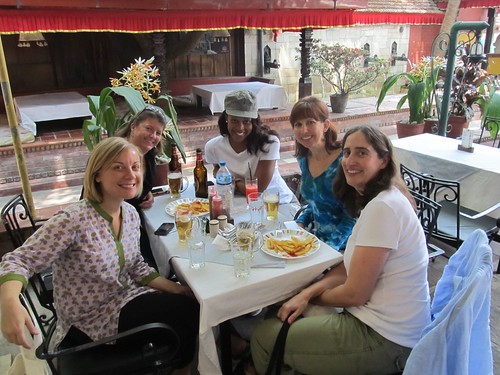
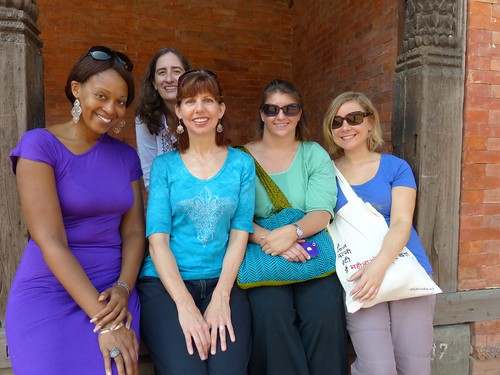
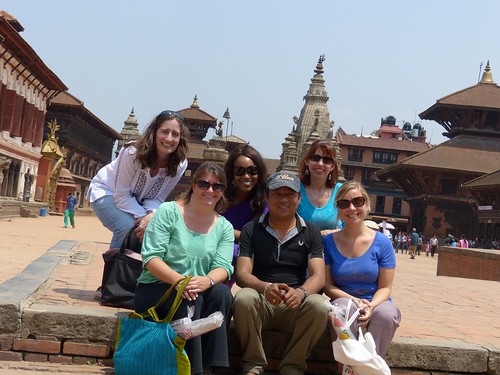
Nepal – With the end of the school year in sight, I joined four other ladies for a weekend get-away to Kathmandu to recharge our batteries and enjoy some quality time with two friends moving back to the States. Check out that post at Kathmandu – Ladies Weekend.

India – This is such a busy and emotional time in the life of a teacher abroad. Report cards, placement decisions for next year, language testing, farewell parties for friends moving on, big changes.

Looking back to May 2012, I can say our first year in India was hard, possibly the hardest first year we’ve had anywhere. As Bob Hetzel, our departing school director, is fond of saying, “Whatever is true about India, the opposite is also true.” That makes it particularly difficult to learn the ropes and settle in to this city that defies all western logic. By the end of our first year, we were feeling marginally better about our decision to move here but still overwhelmingly frustrated. Then a departing teacher, who spent five years in New Delhi, shared this snippet of wisdom: “Your second year will be exponentially better. And your third year will be exponentially better than your second year. And so on. You won’t believe it!” He was right.
Year two really WAS exponentially better than year one. Not perfect, but much much better. Despite the daily head-slapping confusion of living in a developing country, we also experience daily revelations. I cautiously look forward to an exponentially better year three. As we add two new members to our household, New Delhi is finally starting to feel like home.
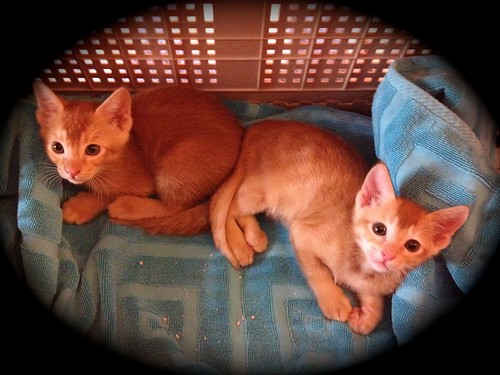
Introducing Ella and Khushi.
Untitled

Kathmandu – Ladies weekend!

As the school year winds down, international teachers say a lot of farewells. Many of our friends and colleagues will depart for new adventures, and it’s hard to say good-bye. So we procrastinate. We drag it out. We have parties and dinners and weekend get-aways to stall the inevitable. In that spirit, a group of us took off for Kathmandu, Nepal, the last weekend in April to celebrate two ladies who will leave Delhi at the end of the school year – Katrina and Shannon.

In case you didn’t know, Nepal is the only country with a flag that is NOT a rectangle:
nepal-flag

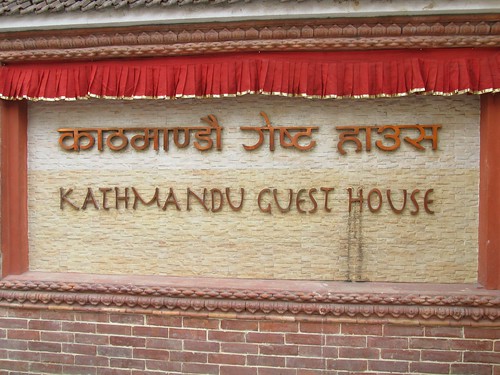
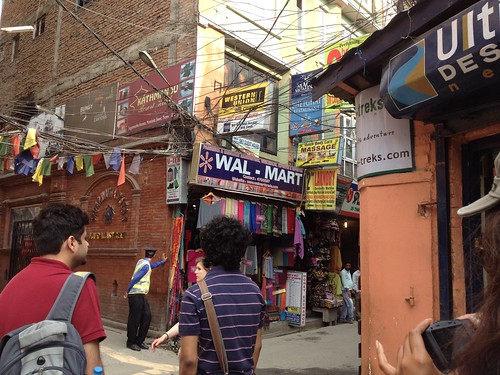
An early morning flight on Friday got us to the Kathmandu Guest House before lunch. I’ve actually outgrown guest houses, but this one came recommended, looked good online and, hey, it was good enough for the Beatles in 1968. As we settled in among the throngs of backpackers and trekkers, we realized the website may have exaggerated a bit. I awoke early each day to sip coffee and read my book in the guesthouse’s peaceful courtyard cafe, which was full of flowers and fountains. Outside the gate, however, the narrow streets clogged with tourists and traffic.

Inside the Kathmandu Guesthouse gate
(Photo by Katrina)
Untitled

Untitled

Untitled

Untitled

There were several of these statues with monkeys clinging to their wieners. I’m sure there must be a reason for it, but my research has yielded nada.
Untitled

Outside the Kathmandu Guest House gate
(photo by Tammy)
Untitled

(3 photos by Katrina)
Untitled

Untitled

Untitled

Bhaktapur – UNESCO World Heritage Site
(Everything that sounds factual in this section comes from the book Discovering Bhaktapur – A Guide to the Historic Newar City, which I found in pdf form online. So interesting! Now that I’ve read up on this place, I need to return and see everything I missed.)

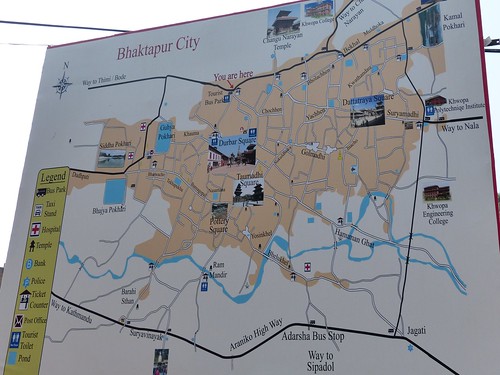
Saturday morning, we took a car about 20 kilometers to the ancient town of Bhaktapur, which was one of three independent kingdoms in the Kathmandu Valley about 300 years ago. The city declined after unification in the late 1700s, and a massive earthquake in 1934 damaged or destroyed most homes and temples. Germany was instrumental in helping rebuild and revitalize Bhaktapur through a major project that tackled restoration of historic and religious monuments, the water and sewer infrastructure, health education, land development and housing, schools and more through the late 1980s. The rise in tourism has also renewed interest in conserving its unique culture, architecture and handicrafts.

At the entrance to Bhaktapur, we bought a ticket and hired a guide, Shyam.
Untitled

Pausing so Shyam can tell us about Durbar Square.
Untitled

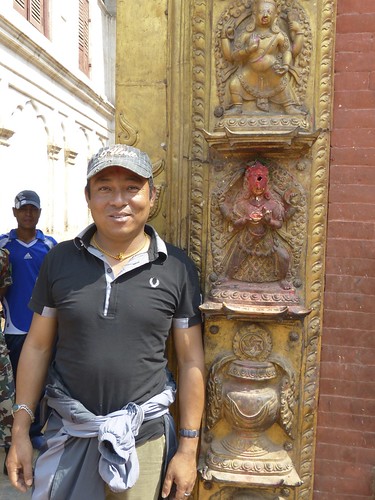
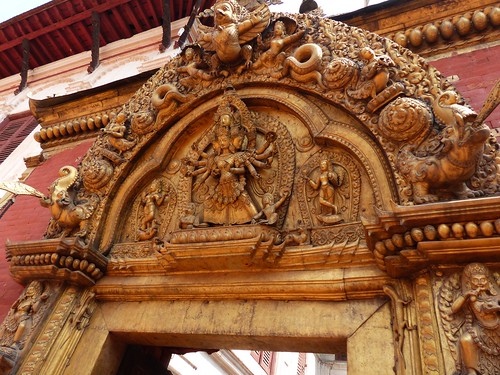
Shyam stands at the Golden Gate, the entrance to the religious areas of the royal palace.
Untitled

Untitled

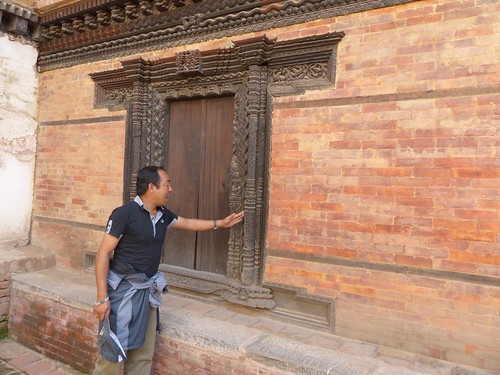
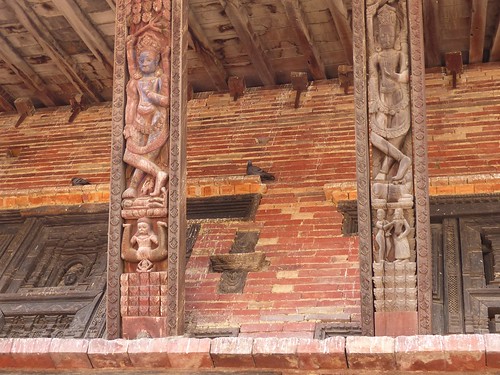
He explains that some of the wood carvings are original and others were created during the restoration.
Untitled

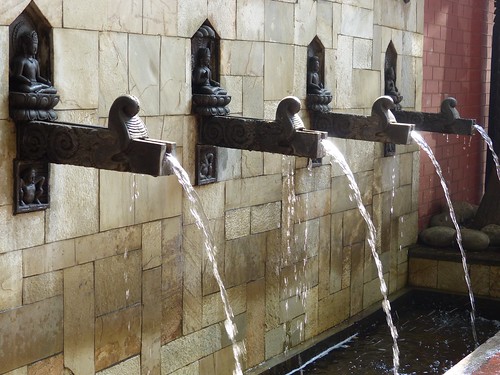
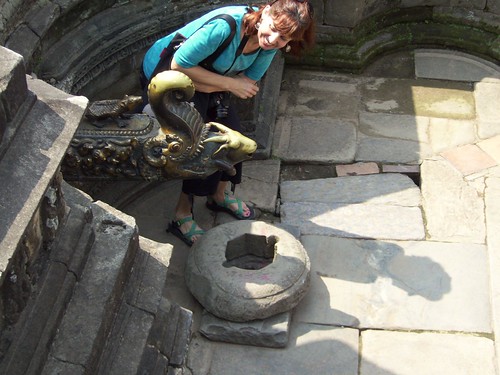
Only Hindus were allowed into Mul Chowk, home of the most holy temple of Taleju, the goddess worshipped by the royal family. We could, however, visit Naga Pokhari, a royal bath guarded by the gilded snake god Vasuki. I climbed down to check out the strange water spout. According to my book, such taps are typical of the era.

The spout itself is usually in the form of a makara, a mythical water creature that seems like a cross between a crocodile and an elephant. It is the vehicle of the water god Varuna. It often has a fish emerging from its mouth.

This one had a goat emerging from its mouth and a web-footed rat-like thing on its back.
Untitled

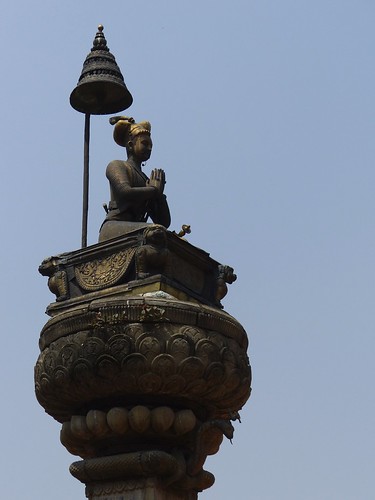
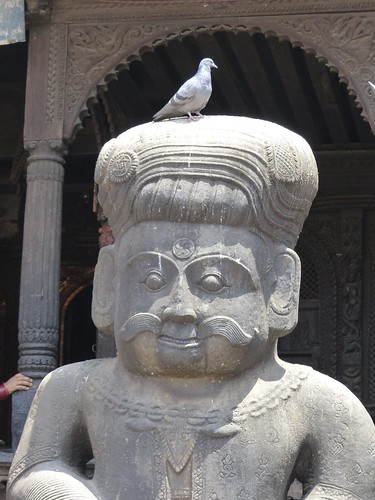
Facing the Golden Gate is the king who built it, Bhupatindra Malla (1696-1722), sitting atop a tall pillar. The statue was constructed in 1753 by his son, the last king of Bhaktapur.
Untitled

The Yaksheswar Mahadev Temple, dedicated to Shiva and dating back to the 1450s, features many erotic woodcarvings. Shyam said they represent the 24 sexual positions guaranteed to produce a son. “I know in Europe they have more than 24 positions, but here we have only 24,” he said with a laugh. My handy book says the carvings are actually associated with religious tantric cults of that time.
Untitled

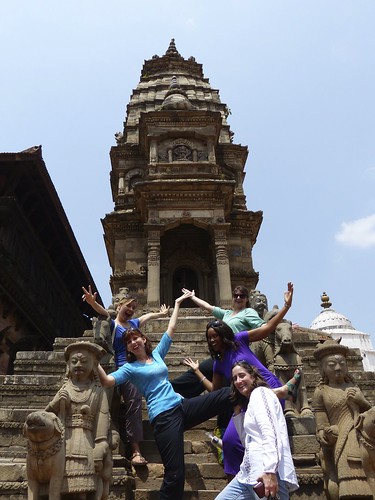
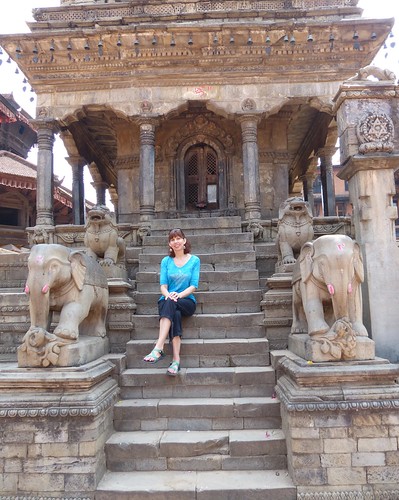
This whimsical little temple is dedicated to Siddhilaxmi, the goddess of success. My book says,

It has a delightful series of figures guarding its steps: a couple of chained rhinos (suggesting that the Mallas perhaps kept a menagerie), a pair of camels and what appears to be two naughty boys refusing to accompany their mothers.

Untitled

Another little temple.
Untitled

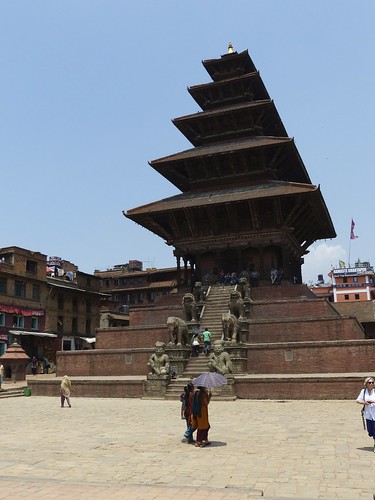
The Nyatapola Temple is the 30 meter-high pagoda in Taumadi Square. More from my book:

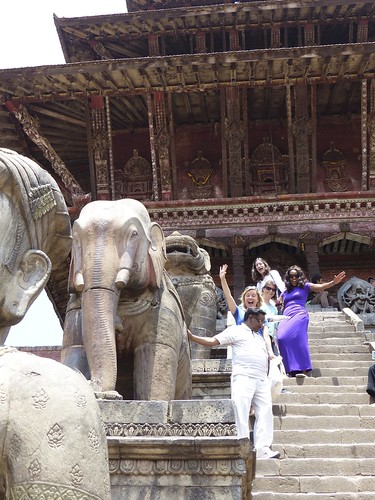
It’s thought to be dedicated to the beautiful goddess Siddhilaxmi and only special Taleju priests are allowed secret access to the inner sanctum. Nobody else worships there. It was built on the orders of Bhupatindra Malla in 1702. It is said that he set a fine example by carrying the first three bricks on his shoulder. This so inspired the population that all the remaining materials were brought up in the following five days. … Guarding the temple are ten mighty figures. At the bottom are two local wrestling champions called Jayamala and Patta. Next up, ten times stronger, are a pair of elephants. Then two lions, two griffins (sarduls) and two deities, Singhini and Byanghini. Each is ten times stronger than the pair below.

Untitled

Untitled

View from the top.
Untitled

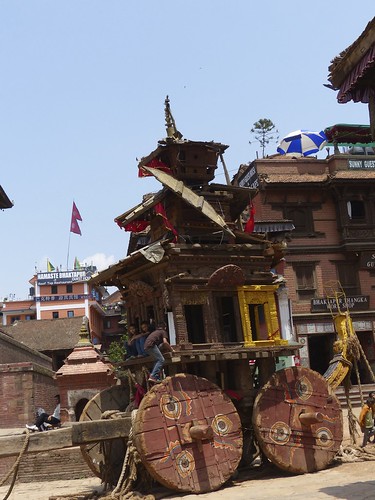
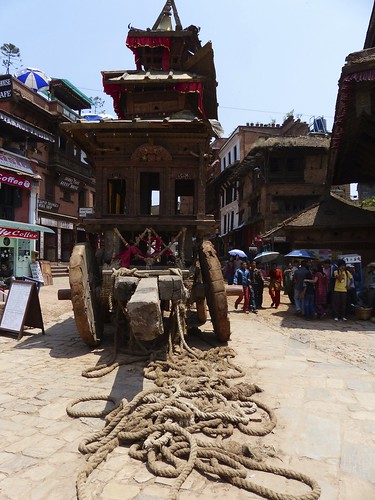
According to Shyam, this “vehicle” plays an exciting part in a big religious festival, sort of a tug-of-war thing to carry an image of the god Bhairav to meet up with the goddess Bhadrakali for a fertility ritual.
Untitled

My book says those rickety wheels inevitably crush raucous festival-goers.
Untitled

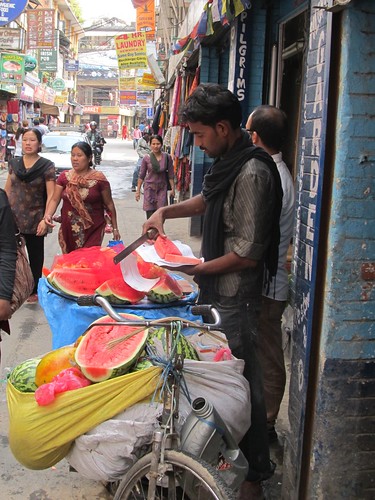
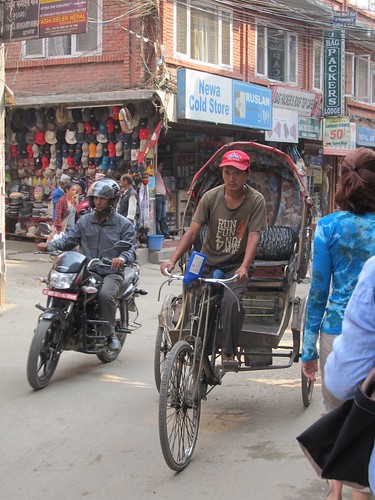
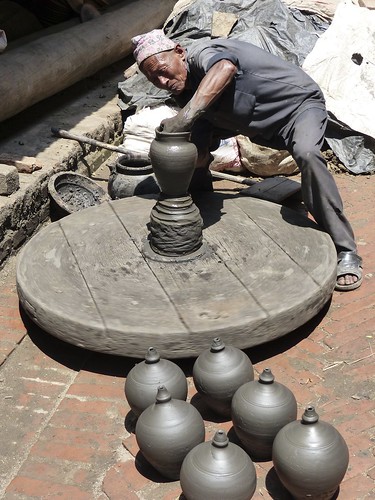
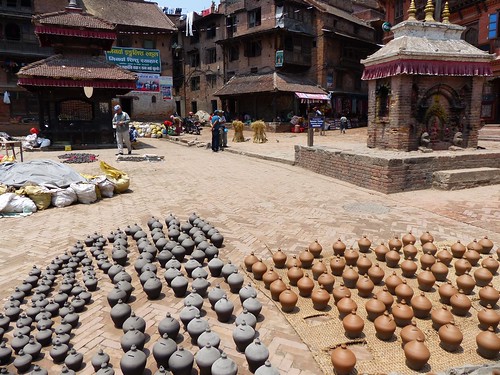
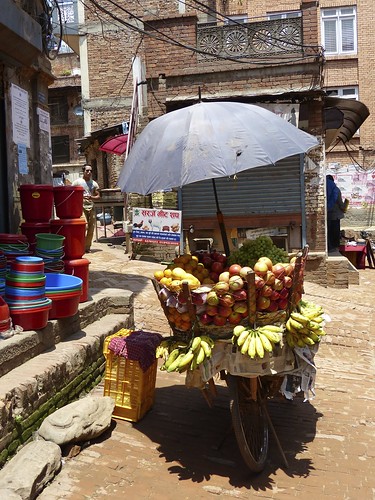
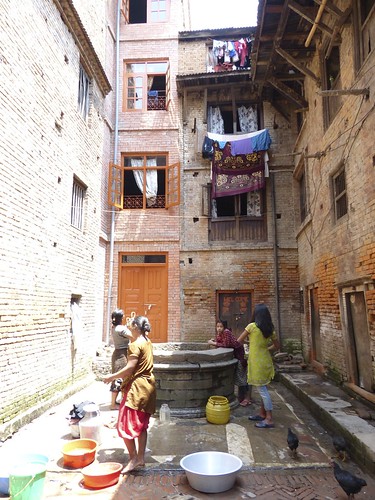
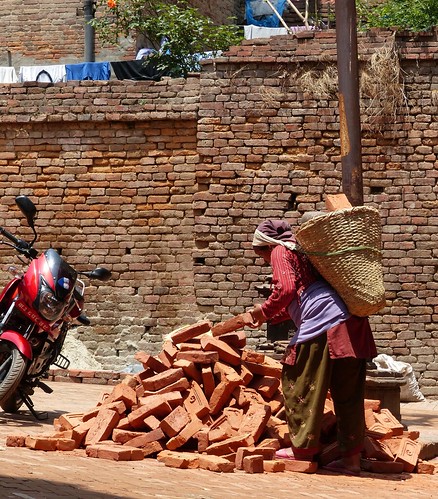
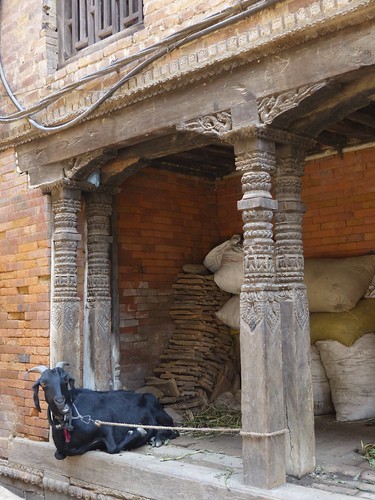
Shyam led us through a rabbit warren of alleys, where we witnessed the daily rituals of life: ladies drawing water from the wells, grannies minding toddlers and goats, workers hauling loads of timber and bricks, craftsmen carving wood and throwing pots, old men bent over a card table, children kicking around a ball or rolling a tire, vendors selling a little bit of everything. Here’s an interesting tidbit from my book:

The ancient route from Delhi and Kathmandu to Lhasa and Beijing went through Bhaktapur. A steady trade was maintained in salt, wool, gold dust, copper, medicinal herbs, spices and yak tails (used as royal fly whisks). Probably not much silk though. This trade peaked in the early 18th century and then declined after the national unification in 1767. A community of Newari traders has remained in Lhasa to import Nepali goods up to the present time.

Untitled

Untitled

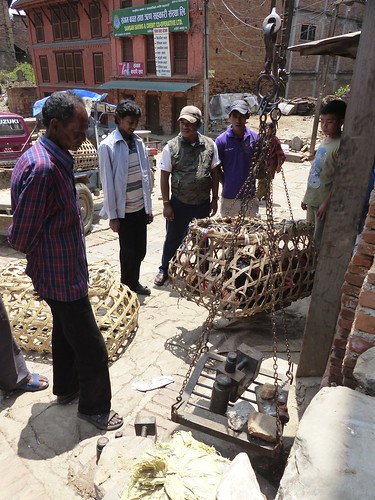
“Weighing” chickens for sale.
Untitled

Untitled

Untitled

Untitled

Untitled

Untitled

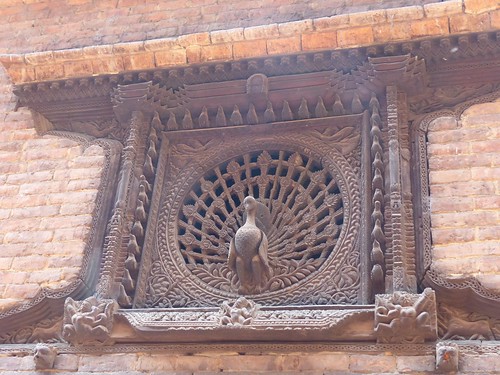
The famous Peacock Window.
Untitled

Untitled

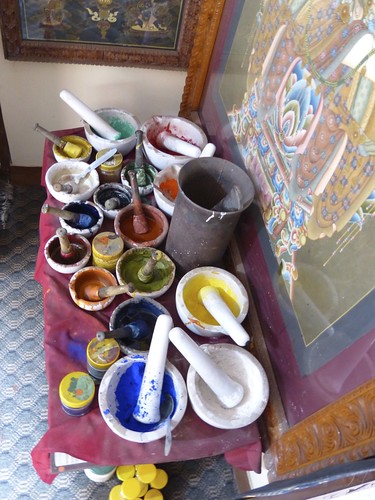
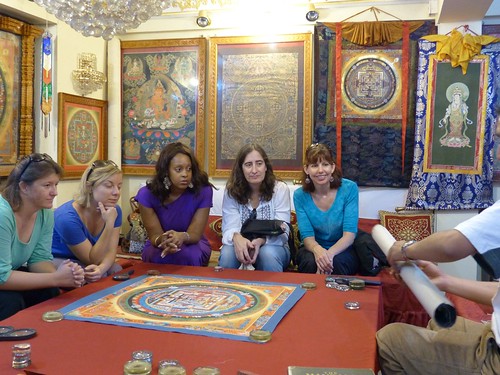
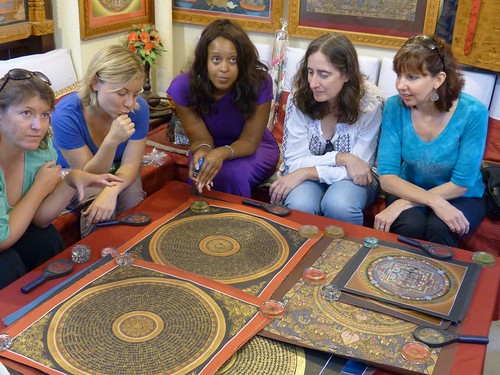
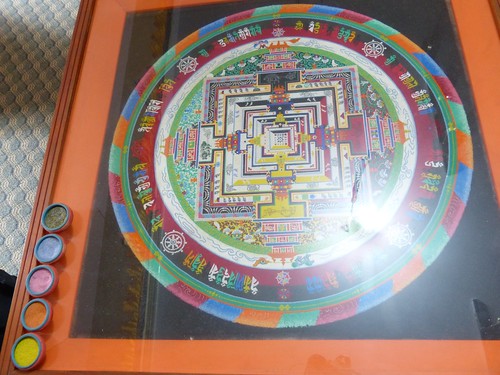
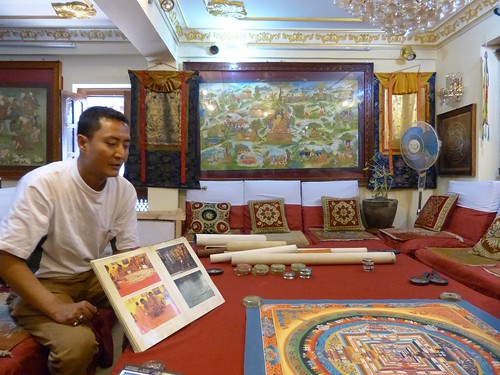
During our tour of Bhaktapur, Shyam took us to the Lama Thanka Painting School. We learned about the Dalai Lama’s sand mandala design.
Untitled

According to the Namgyal Monastery Institute of Buddhist Studies,

Sand mandalas are one of the most magnificent types of mandala construction and are associated with the most profound and elaborate Buddhist ceremonies in Tibet. Every color, dot, and line in the mandala represents an essential part of the deity and Buddhist philosophy. Each component must be placed in exactly the same place every time the mandala is constructed.
Although sand mandalas are made on a flat surface they are, to the devout, a three dimensional palace, representing the mind of the Buddha. The person contemplating the mandala enters into it, as they would a building or an enclosure.
The mandala construction itself is the result of long and disciplined effort, but it is nonetheless a temporary work. When the monks are finished, there is a dissolution ceremony where the deity is released by the dismantling of the mandala. The sand is cast into a body of water to emphasize and highlight the impermanence of all things and the importance of nonattachment. When the sand enters the water, the kindness and compassion of the deity are disseminated into the world to benefit all beings.

Untitled

Untitled

Then, of course, we started looking at paintings by students and masters, and then, of course, we couldn’t resist buying some. They really are stunning. Mine features a favorite mantra of compassion – om mani padme hum – painted in gold gajillions of times in concentric circles.

Untitled

Untitled

We had a fascinating day with Shyam.
Untitled

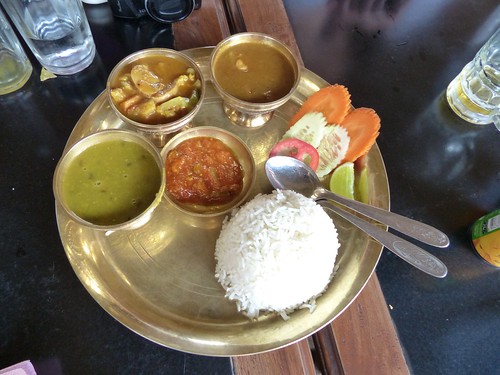
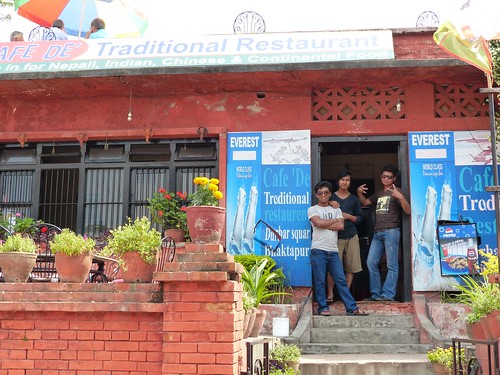
Before leaving Bhaktapur, we ate lunch at the redundantly named Cafe de Traditional Restaurant. I’m not sure what we ate, but I assure you it was delicious!
Untitled

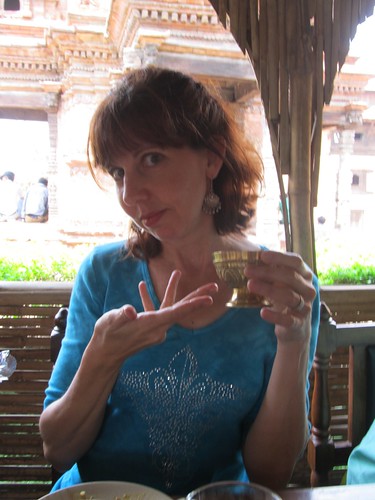
The best part was dessert: King’s Curd, a sweet scrumptious yogurty treat. Katrina took this shot of me loving my King’s Curd.
Untitled

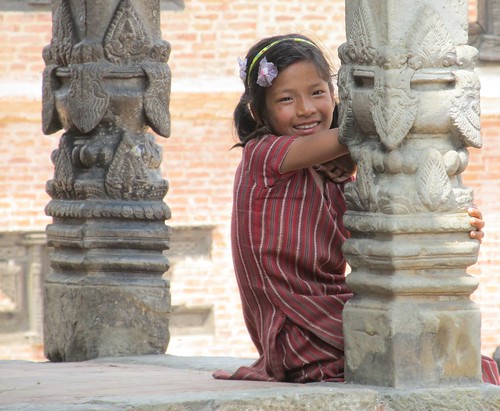
This little girl watched us eat. Katrina’s pic.
Untitled

These guys were our waiters.
Untitled

Back in Thamel, the backpacker part of Kathmandu, we popped into a Mexican restaurant for margaritas. I hung my camera, purse and bag of bananas on the back of my chair. (That detail will become important later.) We enjoyed a little siesta and then took off for a spectacular French dinner at Chez Caroline. Yes, before we left Kathmandu, we had devoured Italian, Mexican, French and Nepalese cuisine, including more than our fair share of momos.

In the morning, I wandered down to the courtyard for coffee but felt like something was amiss, you know, that feeling you get just after shutting the front door and realizing you don’t have your keys? I read my book for awhile, uneasy but unable to figure out why. Finally, I realized I hadn’t seen my camera that morning. I knew I had taken it to the Mexican restaurant, but I couldn’t remember having it after that. I wandered over to the restaurant and shook the metal grate over the door until a cleaning lady popped her head out the window. She came downstairs and let me in to search. No luck. One of the waiters shook his head. There were really only two possibilities: Another diner stole it or a staff member found it.

The camera had been an expensive Christmas present to myself (although Tony technically made the amazon.com purchase and put it under the tree). I was already mourning the loss, but even more, I was kicking myself for losing all the photos from this trip. Back at the guesthouse, Katrina wasn’t feeling well, so she stayed in bed while the rest of us headed out on another excursion.

Bouddhanath Stupa
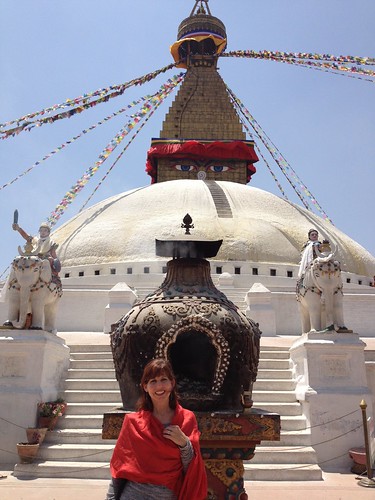
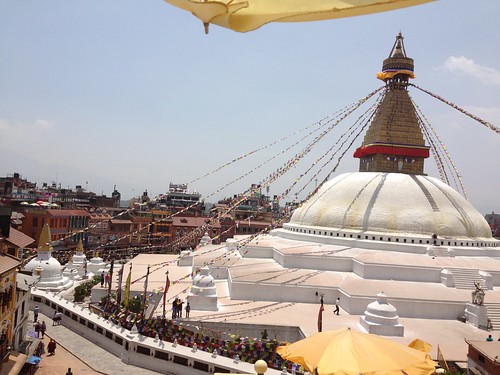
The Bouddhanath Stupa, first built in the 14th century, is one of the holiest Buddhist sites in Nepal and one of the largest stupas in the world. It was declared a UNESCO World Heritage site in 1979. As usual, one of my favorite travel websites – Sacred Destinations – has an excellent write-up about the stupa.

From above, Bodnath Stupa looks like a giant mandala, or diagram of the Buddhist cosmos. And as in all Tibetan mandalas, four of the Dhyani Buddhas mark the cardinal points, with the fifth, Vairocana, enshrined in the center (in the white hemisphere of the stupa). The five Buddhas also personify the five elements (earth, water, fire, air and ether), which are represented in the stupa’s architecture.
There are other symbolic numbers here as well: the nine levels of Boudhanath Stupa represent the mythical Mt. Meru, center of the cosmos; and the 13 rings from the base to the pinnacle symbolize the path to enlightenment, or “Bodhi” — hence the stupa’s name.
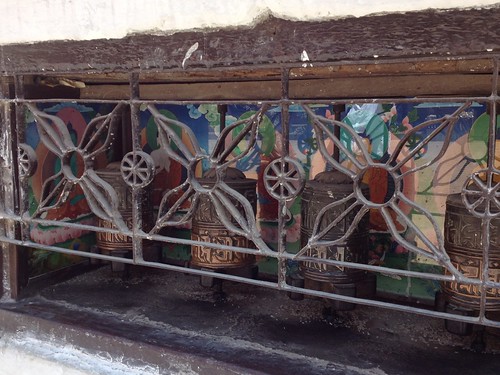
At the bottom, the stupa is surrounded by an irregular 16-sided wall, with frescoes in the niches. In addition to the Five Dhyani Buddhas, Boudhanath Stupa is closely associated with the Bodhisattva Avalokiteshvara (Padmapani), whose 108 forms are depicted in sculptures around the base. The mantra of Avalokiteshvara – Om Mani Padme Hum – is carved on the prayer wheels beside the images of Avalokiteshvara around the base of the stupa.
The base of the stupa consists of three large platforms, decreasing in size. These platforms symbolize Earth, and here you can look out at the mountains while listening to the chants of the devout doing kora, walking around the stupa praying.
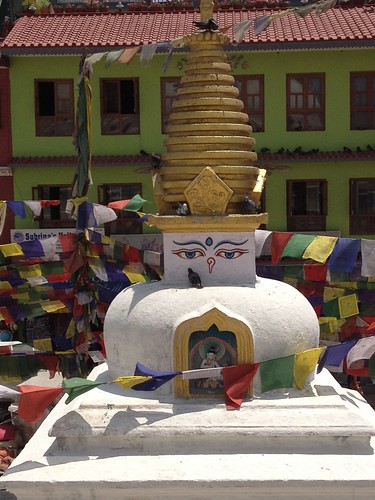
Next come two circular plinths supporting the hemisphere of the stupa, symbolizing water. As at Swayabunath, Bodnath is topped with a square tower bearing the omnipresent Buddha eyes on all four sides.
Instead of a nose is a question-mark-type symbol that is actually the Nepali character for the number 1, symbolizing unity and the one way to reach enlightenment—through the Buddha’s teachings. Above this is the third eye, symbolizing the wisdom of the Buddha.
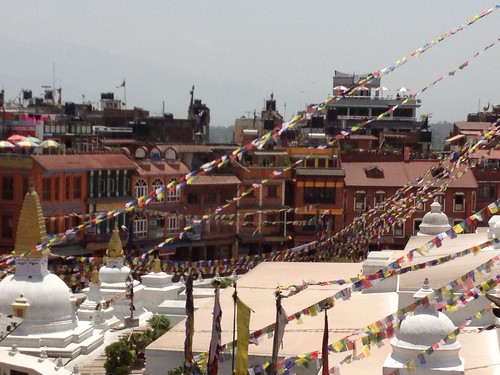
The square tower is topped by a pyramid with 13 steps, representing the ladder to enlightenment. The triangular shape is the abstract form for the element of fire. At the top of the tower is a gilded canopy, the embodiment of air, with above it a gilded spire, symbolic of ether and the Buddha Vairocana. Prayer flags tied to the stupa flutter in the wind, carrying mantras and prayers heavenward.
The main entrance to the upper platform of Bodnath Stupa is on the north side. Here Amoghasiddhi, progenitor of the future Buddha, presides. Below Amoghasiddhi is the Buddha Maitreya, the future Buddha.
Surrounding Boudhanath Stupa are streets and narrow alleys lined with colorful homes, Tibetan Buddhist monasteries, and street vendors.

Buddhism is my go-to religion in times of strife. I like the mantras, the rituals, the karma. So I decided to follow the pilgrims on the circumambulatory path, turning every one of the prayer wheels while chanting the mantra adorning each one: om mani padme hum.
Untitled

Untitled

Untitled

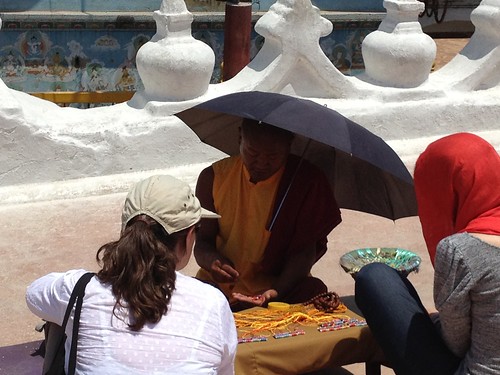
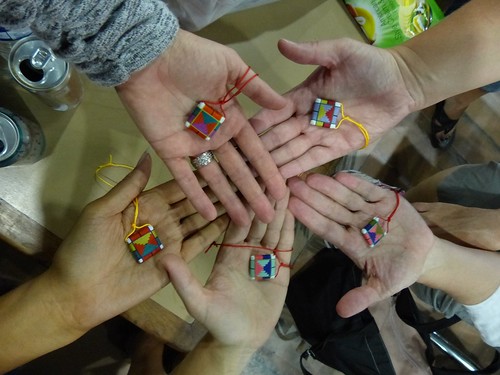
All of us gave a donation to a monk at the stupa in exchange for a blessing. The monk wrote the mantra on paper, folded it, wrapped it in colored thread and then blessed it.
(Photo by Tammy)
Untitled

Untitled

We climbed up to a rooftop cafe for a quiet break (and a good view of what seemed to be the filming of a cheesy music video) before heading back to our guesthouse.
(Photo by Tammy)
Untitled

Untitled

Well, I don’t know if it was the prayer wheels, the monk’s mantra necklace, Katrina’s rise from her sickbed to give the stink-eye to the workers at the Mexican restaurant or just dumb luck, but when we got back to Thamel, I ran up the stairs to the restaurant and the bartender said, “We found your camera! We already returned it to your guesthouse!” All’s well that ends well.

And that’s the end. We packed a LOT into a short girls get-away. Ladies, I’m gonna miss you!

O, Man! Forensics and fun in Muscat

Forensics – Not just for dead people.
That’s the slogan on the back of our team T-shirts.
As one of the MESAC Forensics Team coaches, I heard a lot of surprised exclamations such as, “Wow! You guys do forensics? I didn’t know you were trained in that!” Sigh … It’s not “forensic science” à la CSI. It’s forensics à la Socrates. In other words, the students compete in debate, public speaking and dramatic interpretation of monologues or duet scenes.

According to the American Forensic Association,

“Forensics” is a word rooted in the Western world’s classical experience. The Greeks organized contests for speakers that developed and recognized the abilities their society felt central to democracy. These exercises acquired the title “forensics,” derived from the Latin term “forensis” and closely related to forum. Because the training in this skill of public advocacy, including the development of evidence, found one of its important venues in the law courts, the term “forensic” has also become associated with the art and science of legal evidence and argument.

Our school is a member of MESAC (Middle East South Asia Conference), which also includes schools from Oman, the United Arab Emirates and Qatar. As one of four American Embassy School coaches (a fifth stayed behind in India), I traveled with 20 amazing high-schoolers to represent AES at the 2013 MESAC Forensics Tournament, April 17-21 in Muscat, Oman.

The American-British Academy (ABA) played host.
Untitled

Our fledgling forensics program fielded a debate team for the first time, and this was only the second year we participated in acting and speaking events. Nevertheless:
* Two of the debaters beat last year’s winners to earn a bronze medal.
* We sent 12 students to the finals.
* Seven kids came home with medals.
* AES placed second overall.

This is what we liked to see! Lots of “AES” on the results posters.
Untitled

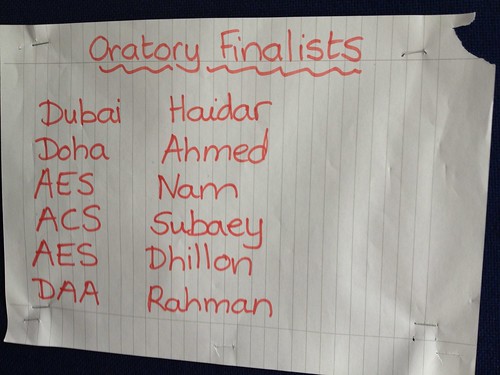
We adults felt excited for the medalists, but our greatest fulfillment came from watching the growth that occurred over the course of our season. This is a unique team in that students have an opportunity to express themselves in ways that take them far out of their comfort zone. For the oratory event, they wrote, memorized and presented powerful speeches calling for action. Our students addressed mental health in children, women’s rights in India, care of HIV/AIDS patients, Asian stereotypes and parental pressure for perfection. They spoke from the heart, revealing their deepest fears and biggest aspirations.

We may have seen the greatest transformation in our students competing in oral interpretation. They chose challenging pieces of literature to read, and some of the English learners required line-by-line explanations of the meaning before they could start interpreting. They worked so hard, begging for extra coaching time, meeting on weekends, shedding their inhibitions. When one of our 10th-graders took the stage to read “The Orange” by Joyce Carol Oates, she gave it everything she had, leaving the audience disarmed but in awe. Our only senior had brilliantly edited down a scene from “‘Night, Mother” and read the lines for both characters. Her subtle sophisticated performance tricked my mind into thinking there really were two people on stage and her last line forced a catch in my throat as I fought back tears.

There were so many success stories … not a slacker in the bunch. In addition to their work, our kids were kind, friendly and outgoing. They bonded with students from other schools and demonstrated admirable sportsmanship. So proud of them all! I feel incredibly fortunate to work at a school with this caliber of young people.

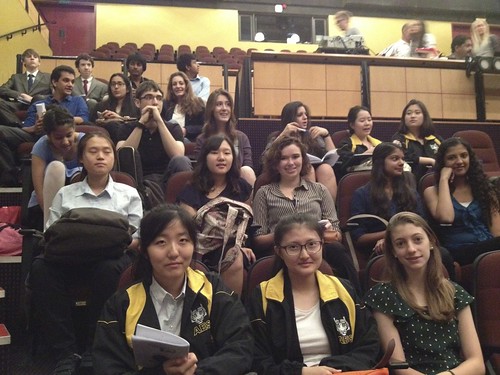
First day of the tournament at ABA … waiting in the auditorium.
Untitled

My good friend Jacqueline, who taught with us in Turkey, now works at The American International School of Muscat. I was hoping to meet up with her during our visit, but the tournament schedule was grueling. Imagine my excitement when she showed up at the ABA coaches lounge! She hung out with us at the school a few times and then surprised me with a ticket to see “Madame Butterfly” at the Royal Opera House. I almost declined, exhausted from a lingering cold and the intensity of the tournament, but I couldn’t resist the lure of a cultural event paired with some Jacq time. The two-year-old Opera House was stunning inside and out. In fact, I may have appreciated the venue even more than the show!
Untitled

So much elegance.
Untitled

I NEED one of these lamps.
Untitled

Jacqueline and me. (I’m the one who looks less like a posh opera-goer and more like a worn-out teacher at the end of a long day.)
Untitled

Here’s a cool promotional video from the Royal Opera House website:

Our only other foray into Muscat was a traffic-y bus ride with all the kids and coaches to a souk, a fun market with Omani souvenirs and crafts. We spent about 30 minutes poking around before heading back to our hotel. Students stayed with ABA families, so coaches enjoyed a little downtime. In fact, one of the other coaches had issued a challenge: Which coach could find the best souvenir for one riyal (about $3)? Back at the hotel, the coaches met to compare souvenirs. The AES coaches nailed it. We had purchased a bizarre plastic pull-string toy featuring a Barbie-ish doll riding a sort of bicycle rickshaw with a green alien-ish baby and a rotating umbrella. We turned it into a trophy and gave it temporarily to our MVP. (I’ll post a photo when we get it back.)

Spring Break – Maldives Diary

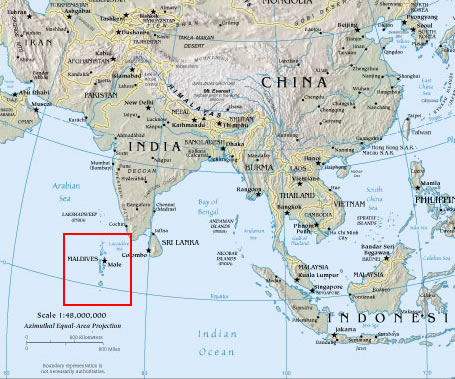
Spring Break! Off to the Maldives – a garland of islands in the Indian Ocean off the southern tip of India. Woo hoo!

According to Visit Maldives:

The Maldives lies in two rows of atolls in the Indian Ocean, just across the equator. The country is made up of 1,190 coral islands formed around 26 natural ring-like atolls, spread over 90,000 square kilometers. These atolls structures are formed upon a sharp ridge rising from the ocean, making way for their secluded uniqueness.

206jh_asia_map

Sunday, March 24
Air India recently cancelled our short flight to the Maldives via Colombo, Sri Lanka. We felt lucky the savvy travel experts of Sun Tours had our backs and rebooked us on another flight. It’s probably a good thing I was too busy to process the new schedule. On paper, it seemed OK: Delhi to Kochin (southern India). Kochin to Male (capital of the Maldives). Seaplane to our resort in the Lhaviyani Atoll.

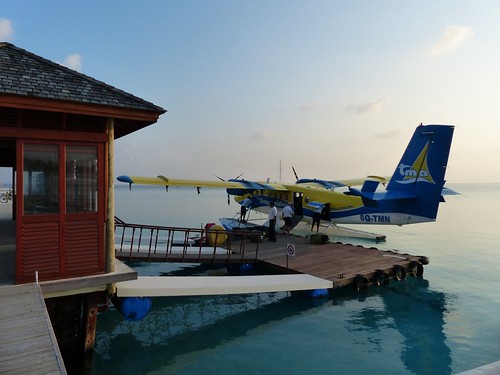
Here’s how it really played out: We left for the airport at 4:30 a.m. About half way into our “direct flight” to Kochin, the flight attendants made the stow-everything-and-get-ready-to-land announcement. After panicking momentarily that we had boarded the wrong plane, we soon realized we had been duped by the “fake direct flight” ploy. Grrr… uncool, Spice Jet. We dropped off about half the passengers in Hyderbad, stayed on board while the crew cleaned the plane, and then waited for the new group to board. Eventually, we reached Kochin and caught our connection to Male, where we traveled by seaplane to the Kuredu Resort (after a quick stop at another resort). We finally reached paradise after 13 hours and FIVE separate flights.

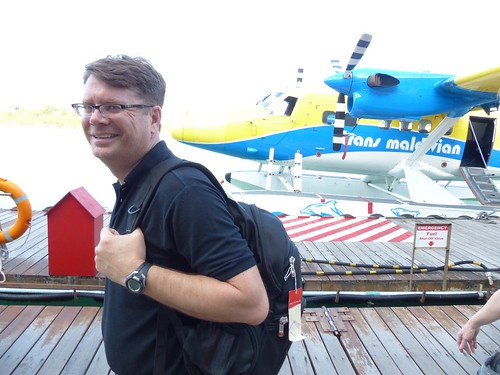
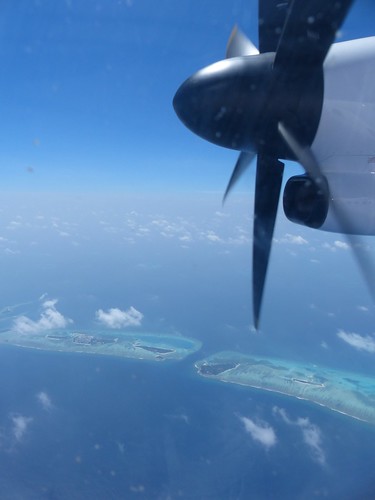
Our first seaplane ride ever!
Untitled

View from the seaplane.
Untitled

Unloading at our island.
Untitled

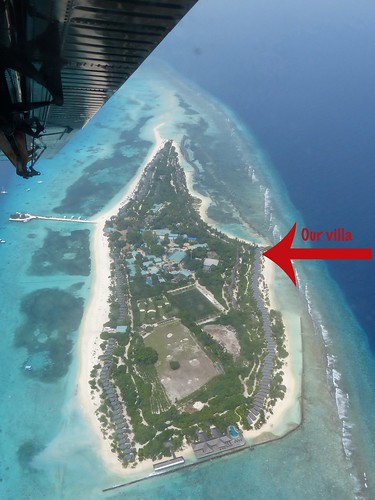
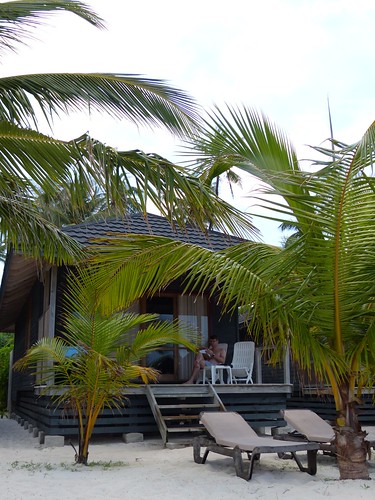
And now I’ll stop whining and start gushing … this place was fabulous! We came here at the recommendation of my brother and his wife, who vacationed on this island last year. Kuredu Resort has the whole island to itself. For six glorious days, Tony and I were living large in a beachfront villa overlooking the Indian Ocean. See?
ourvilla

Untitled

By the time we arrived and checked in, we barely had time for dinner before crashing for the night.

Monday, March 25
A compulsory informational meeting gobbled up much of our morning. We bought a power adaptor, signed up for a few excursions, and did a little exploring around the island.

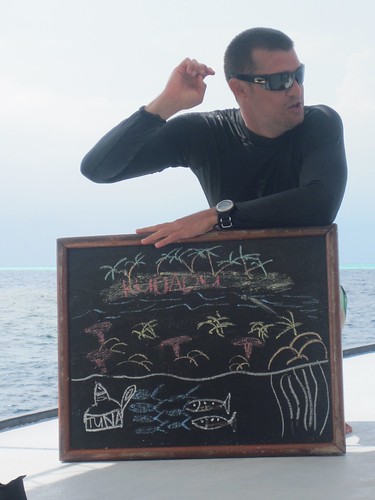
At 2:30, we joined about 12 others for a snorkeling boat trip. Our guide, Greg, was from South Africa, but we and he were the only native English speakers. His onboard presentation about the snorkeling site was quite funny as he tried to make himself understood. Surely the Europeans spoke enough English to get the gist, but he kept miming ridiculous concepts like “brain coral.” Our favorite line was when he asked, “How do you say snorkel in German?” The Germans replied in unison: “Schnorkel.” Ha! Now Tony and I cannot stop saying, “Do you vant to schnorkel?”

Untitled

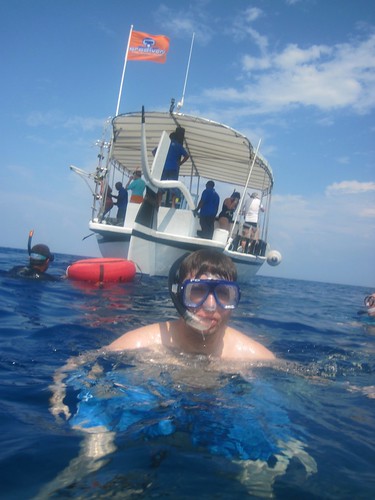
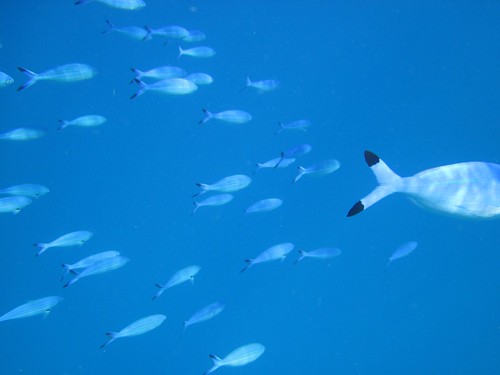
Oh, snorkeling was super fun. We swam around two different sites teeming with fish and took a few mostly lame photos with a borrowed underwater camera.

Untitled

Untitled

Untitled

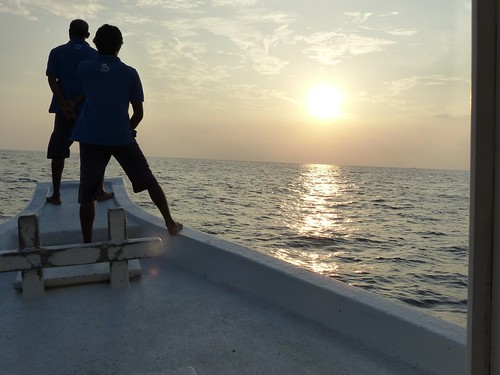
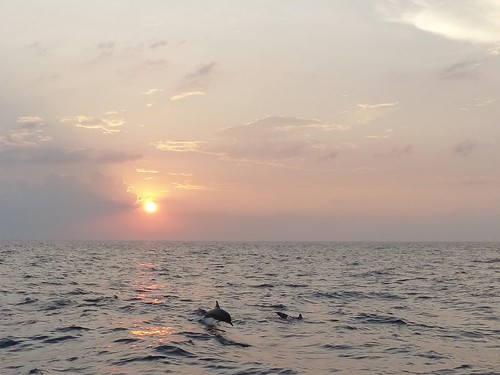
That evening, we were back on a boat for the complimentary sunset cruise. About 30 people sat stiffly on the benches of a dive boat, and I was beginning to wonder whether this was really worth our time. After motoring around for half an hour, the crew began shouting and clapping. Dolphins! They seemed to respond to the cheers, swimming right alongside our boat and leaping into the air. One baby dolphin repeatedly jumped out of the water and spun around like a corkscrew. Their playful demonstration had us all laughing and cheering. One of the crewmen pulled me to the front of the boat, so I sat on the deck with one foot in the water, getting soaked by the waves but loving every moment.

Untitled

The boat crew looks for dolphins.
Untitled

Jackpot!
Untitled

Untitled

Tuesday, March 26
My favorite way to start the day here was sitting on this porch bed with a strong cup of coffee (Nespresso machine in our villa!), cherishing the salty air, rolling surf, gentle breezes clicking the palm fronds together, and the sea’s gradual transition from clear cerulean at the shore to turquoise to jade and ultimately nearly black as it drops off the horizon.
Untitled

But enough with the poetic ruminations… there was no time to sit around trying to name the exact color of the water. I decided I wanted to walk the perimeter of the island today, so that’s what we did. Kuredu is part of the Lhaviyani Atoll, created gajillions of years ago when a volcano erupted. The volcano’s crater now forms the center of the atoll – a relatively shallow and calm lagoon with sloping reefs – ringed by small islands. That means one side of Kuredu faces the atoll’s interior, while the other side faces the open sea. Our walk revealed interesting differences on the two sides of the island – coarser sand, broken coral, crashing waves, and refreshing winds on the Indian Ocean-facing side (where our villa was located) and babypowder sand with gently lapping waves and no breeze on the interior-facing side. At one point, we peeled off our cover-ups and left them inside my sunhat on the sand while we walked, waded and eventually swam from a long skinny sandbar cutting through perfectly clear water. The strong current seemed to deter most fish, but we did see a small black-tipped reef shark. It felt like a Disney moment. You know that blue water in the Splash Mountain log ride? This water was THAT blue. How is that possible?

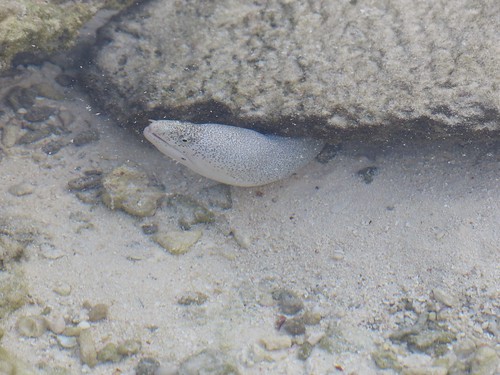
By the time we fully circumnavigated the island, we were exhausted. After a nap, a dip in the pool, a quick snorkel outside our villa, lunch, a visit to one of the wifi hotspots (which was not so “hot” of a spot as it lost power after a few minutes), we decided to go for another swim in the pool created by concrete pylons a short distance offshore in front of our villa. However, the low tide left little water for swimming. Instead, we donned a scuba mask, sat on the sandy bottom and bent over the rocks and dead coral to observe the tidepool ecosystem. Tiny technicolor fish, hermit crabs, eels and sea slugs seemed unconcerned about the receding tide. I guess they knew it would be back again soon.

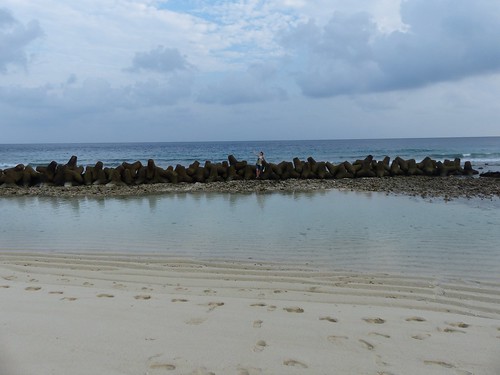
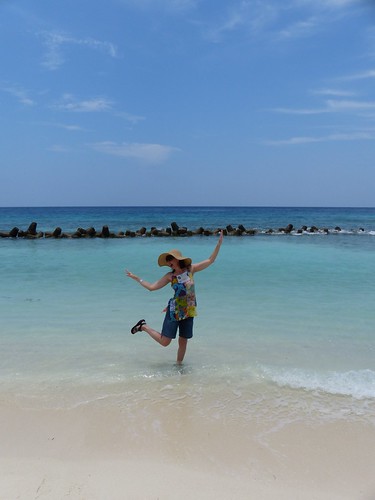
Low tide. That’s me standing out by the concrete pylons.
Untitled

Untitled

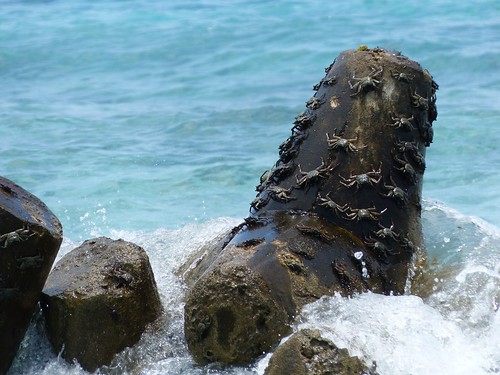
High tide. Hundreds of crabs crawl onto the pylons and hang on for dear life.
Untitled

Untitled

With set meal times at one of the three restaurants, we built our day around food, and then – like the street cows of New Delhi – we paraded en masse to the next feeding. Breakfast and lunch featured standard buffet fare, but the dinners raised the bar with culinary themes. Tonight’s “Arabian” seafood kebabs ranked among my favorite meals in recent memory.

The “O Resort” restaurant.
Untitled

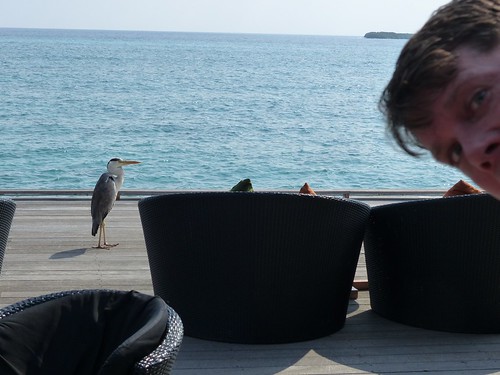
Tony photobombing my pic of this cool bird.
Untitled

Wednesday, March 27
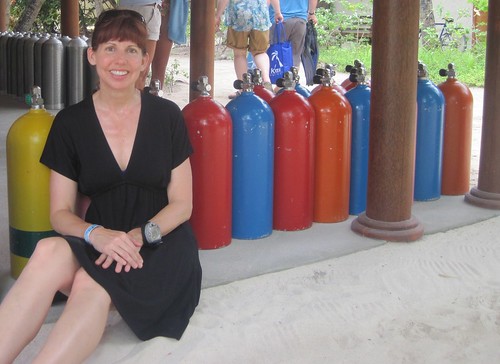
Because we hadn’t gone scuba diving in two years, we decided to refresh our skills with a scuba orientation class. Our instructor, Sebastjan, introduced us to the Prodivers dive center and the island’s “house reef,” a vibrant coral reef literally a short jump off the end of the jetty. It was our first time diving in water warm enough to ditch the wetsuit. (around 30C; 86F. Perfect!) We carried all our gear to the end of the pier (except for the tanks which arrived via wheelbarrow). I had a little trouble with a hissing inflator on my vest, so Sebastjan had to run back to the dive shop and switch it out for a new one. Once in the water, we went over a few basic skills: flooding and clearing your mask (I am an EXPERT at this because my upside-down-lightbulb-shaped face makes every mask leak…), losing your regulator (the oxygen source), and running out of air and using your dive buddy’s “octopus” (the extra regulator everyone carries).

Getting ready to dive. A man cut in front of me to steal the pink tank, but I got a funky orange one. Why does that matter? I don’t know, but it does.

Untitled

After ensuring we knew the basics, Sebastjan led us on an hourlong dive. We cruised along next to a nice coral reef and visited a boat wreck. Highlights: a sea turtle, puffer fish, a school of about 20 huge translucent orange-and-white angel fish, tons of geeky looking pointy-nosed unicorn fish, and zillions of colors darting in and out of the coral. One of the most amazing experiences on earth has to be floating silently into a huge crowd of ambivalent rainbow fish who make space but otherwise ignore your presence.

We loved this dive so much that we signed up for an afternoon boat ride to another dive site: Tinga Giri. It took just 10 minutes to get there, and it was such a treat not to wrestle into a wetsuit on a rocking boat. We just attached our BCDs to our tanks, slipped on our fins and masks and jumped in. This was another gorgeous coral reef with brilliant diversity. At one point, a huge tuna swam by. I thought it was a dolphin at first and I nearly hyperventilated with joy.

I had borrowed a mask from the dive shop to testdrive it before buying, and it worked beautifully! Sucked right on to my mutant face and didn’t leak a bit. It fogged up repeatedly, though, so good thing I’m a pro at taking off and cleaning my mask underwater. Later, we got some great tips from the divemasters: coat your mask with toothpaste overnight and don’t wear any sunscreen on your face. What?! I didn’t try the toothpaste, but the sunscreen advice made a huge difference. Who knew creams caused mask fog? Geez.

Thursday, March 28
Lazy breakfast.
Eventually, we headed to the dive shop to rent snorkel gear, and I turned in my borrowed mask and bought a new one. We walked out to the pier and hopped in the water for a snorkel on the house reef. My new mask leaked like crazy! So frustrating. It was the same exact model as the one that worked so well yesterday. I tried adjusting the straps a million times. If I let it fill about half way, I could still sort of see. Aaarrgghhh!

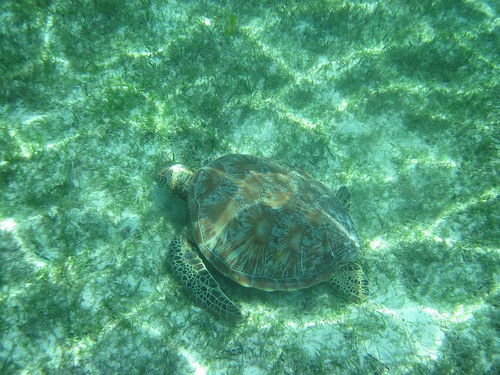
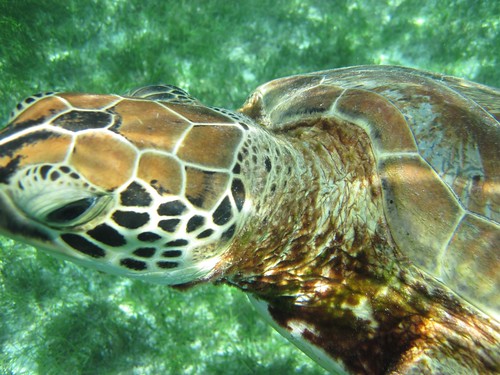
We did spot a turtle munching grass on the sea floor. She swam right at my face when she came up for air; I actually had to move out of her way.

Untitled

Untitled

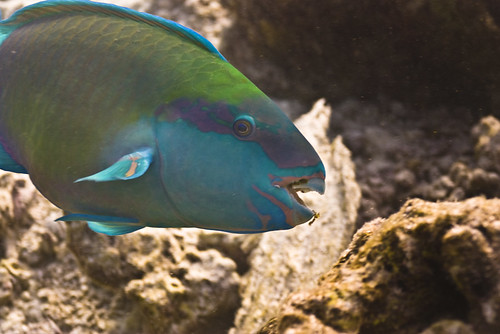
Back in the room, we rinsed the mask and discovered it had a piece of plastic missing, which caused the leak. After lunch, we took the leaky mask back to the shop, and they exchanged it for a new one. We repeated our morning snorkel with much more success in the mask department. Overall today we saw three sea turtles (although Tony thinks the one I spotted was the same one we had seen earlier). Several massive buck-toothed parrotfish chewing on the coral kind of freaked me out, but like all the other intimidating sealife, they left us well enough alone. (Photo from cruisemaldives.travel.)

parrotfish

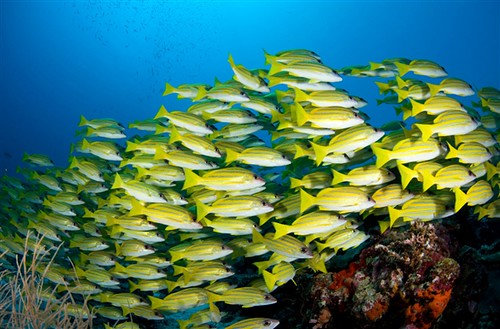
Another ubiquitous underwater attraction is the schooling of hundreds of fish into a blob that appears, from a distance, to be one enormous sea creature. I was fooled more than once, and believe me your stomach flips over when that happens.
We saw schools like this one many times. (Photo from US News Travel.)

yellow_school_of_fish

Friday, March 29
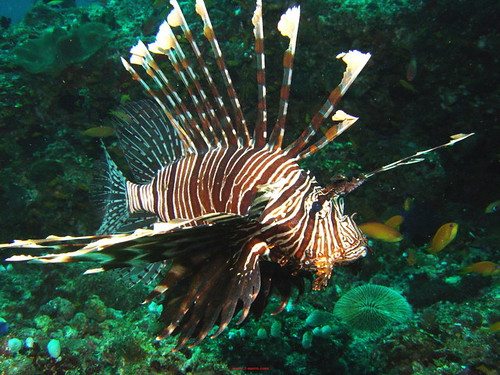
We snorkeled the house reef again and saw a huge turtle! Tony chased a ginormous black fish – a grouper, maybe? – which kept just out of reach with a quick flick of its tail. We also found three lionfishes like this one in a little coral cave. (Photo from Travel For Passion website.) Pretty, but venomous, so we didn’t linger.

LionFish (1)

While I’m a strictly stick-to-the-surface snorkeler, Tony bravely held his breath and dove to explore the depths, including the tip of the boat wreck.
Untitled

Later, we walked out to the barely visible sandbar at high tide. It was obvious how the sandbar was formed; waves crashed onto it from both sides. We struggled to stay upright, unstable on the soft sand with the surf pounding our shins, but we looked rather Biblical, as if we were walking on water. After trudging quite a ways out into the sea, we wondered whether the sandbar ever disappeared completely when the tide got very high. Just in case, we quickly paddle-sprinted back to shore.

For our last dinner at Kuredu, our waiter, Shareef, had set a fancy table for us with flowers and sand stencils of a turtle, dolphin and letters spelling out “See you soon.”
Bittersweet.
Untitled

Windy evening.
Untitled

Every night after dinner, we sat outside at the seaside bar, sipping drinks and staring at the underwater floodlights for passing sharks and big fish. Night after night, we watched between one and four large fish circle one of the lights repeatedly, hypnotically, breaking stride only when a reef shark or another unwelcome visitor approached.

Saturday, March 30
We were sad to say good-bye to our utopian island, but it was time for the long journey home. Even though Spice Jet tricked us with its pretend “direct flight,” we have to give them kudos for being on time or early each leg of the trip. We left Kuredu around 11 a.m. and got home shortly after midnight.

Have I piqued your interest in the Maldives? Check out the Visit Maldives website for more facts, photos and awesomeness.

Amster…DAM, we loved it!

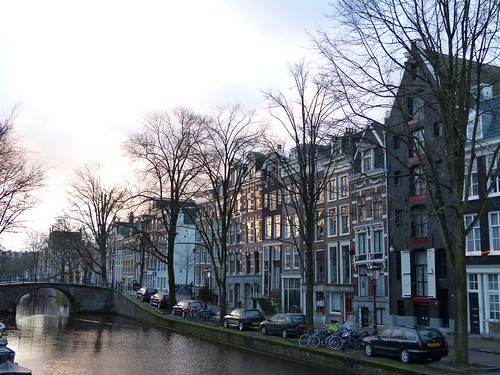
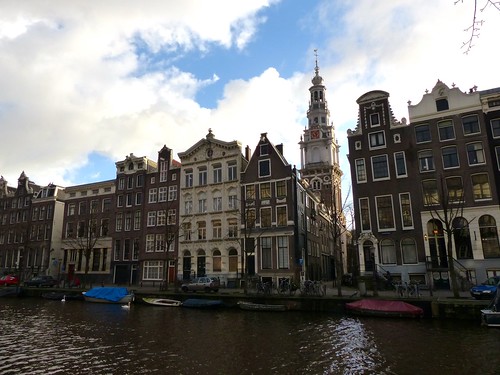
Before returning to New Delhi after our Michigan Christmas, Tony and I spent a week playing in Amsterdam. Our hotel room wasn’t ready at our pre-dawn arrival, so we took the first of many walks around the city’s gorgeous neighborhoods, groggily watching the sunrise reflected in canal house windows.
Untitled

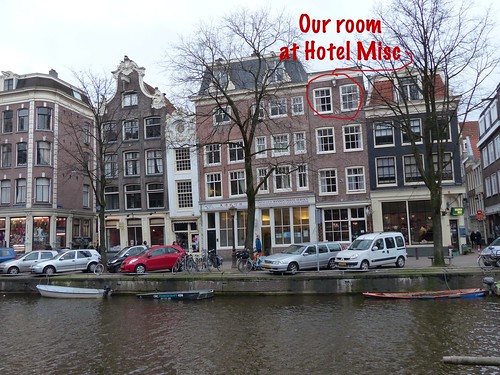
At Hotel Misc, our room overlooked the canal leading to Neiumarkt and Dam Square on the left and the Amstel River on the right.
hotelmisc

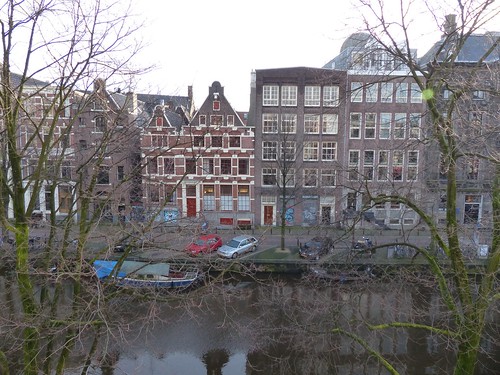
View from our window.
Untitled

After long meandering walks, this church steeple told us we were almost back to the hotel.
Untitled

The Red Light District was right around the corner, but so were many other attractions. We covered a ridiculous amount of Amsterdam on foot, stopping at various cafes to warm up with mint tea, thick soup and crusty bread. According to amsterdam.info,

The old centre was formed by rings of canals with unique mostly 17th century residences of wealthy merchants, financiers, craftsmen, doctors, lawyers, politicians and artists. Because of lack of space, these houses were mostly narrow, not more than 30ft wide (9 meters). They are are characterized by big narrow windows, decorative gable tops, very narrow stairs inside and pulley outside to transport larger objects to upper floors. Very often the residences served also as businesses. Merchants’ houses had their storage in attics and cellars. Sometimes the lift was installed in the middle of the house plan, to transport the goods between floors. The office of the merchant was usually on the ground floor. Like in Venice the canals were the main way of transporting the goods.

Nighttime walks included a chilly stroll along the Amstel River, where we marveled at some installments for the Amsterdam Light Festival. My favorite looked like an illuminated fishnet dangling over the canal, but after visiting the festival’s website, I now know it is a reference to the 2010 earthquake in Chile.

Amsterdam On Foot (and Briefly By Boat)

We invested in the Museumkaart, a pass good for one year and entrance to 400 museums in the Netherlands, including more than 30 in Amsterdam. We definitely got our money’s worth – saving both money and time (you can skip to the head of the line at many locations).

I started to post photos of each place, but all museums have excellent websites with much better pictures than mine. Just click on the links! Here’s where we went:

The Rembrandt House Museum – This was one of my favorite attractions of the whole week. Rembrandt was living and working in this building when he went bankrupt in 1656. Creditors carefully inventoried and then auctioned off all his possessions. The meticulous inventory, along with the artist’s own notes, enabled the museum to recreate the interior as it likely looked during his time – right down to the angle of his easel near the window.

Anne Frank House – The museum does a beautiful job of preserving the young author’s legacy, as well as the story of the others who hid here during the Holocaust.
(If you’re planning to visit Amsterdam, book your Anne Frank House tickets before you go. We’re so glad we did; the lines were around the block!)

Rijksmuseum – A massive renovation project kept many masterpieces behind closed doors, but we greatly enjoyed our visit nonetheless. Like many Amsterdam attractions, they provided an excellent audio tour with fascinating stories behind the frames. Rembrandt’s enormous painting “The Night Watch” was certainly a highlight, especially because a finished puzzle of that artwork hangs in Tony’s sister’s living room. Tony and I both loved “The Milkmaid” by Vermeer. Could’ve stared at that all day.

Hermitage Amsterdam – Another renovation project has closed the Van Gogh Museum, but a collection of 75 major works was on display here. The exhibit reflected seven themes in Van Gogh’s life, which were yet again explained in a wonderful audio tour. There’s something magical about seeing iconic art in person. One display showed a box filled with skeins of yarn in various shades of yellow, brown and ocher. Van Gogh was known to combine complementary strands and roll them into a ball, experimenting with combinations before choosing paint colors. The box on display featured yarn in colors that perfectly matched the adjacent painting, “Quinces, Lemons, Pears and Grapes.” So many favorites at this museum … I can’t pick just one!

The Old Church – The oldest monument in Amsterdam dates back to 1250. It sits smack dab in the middle of the Red Light District with prostitutes posing in windows overlooking the church. In warmer weather, you can climb up the tower.

The New Church – We entered to see the church but instead found an exhibit on the American Indian had taken over every square inch, top to bottom and side to side. It was surreal standing under the 17th-century organ and watching the old black-and-white Popeye cartoon with the Indian chief singing, “Me, Big Chief Ugh-Amugh-Ugh, Gotta have a squaw!” playing in a loop as part of a display on stereotypes.

Museum Our Lord in the Attic – Protestant Amsterdam of the 17th century prohibited Catholics from openly practicing their religion, so Jan Hartman converted the attics of three skinny canal houses into a secret church. It served as the parish church for city centre Catholics for more than 200 years

Museum Willet-Holthuysen – Walking by the lovely but narrow facades of Amsterdam’s canal houses, we were filled with curiosity about what lay beyond the front door. This home of 19th-century socialites gave us a glimpse, including the basement kitchen, the front room (where Louisa Holthuysen received guests between 3:30 and 5 p.m. back in the 1800s), the airy conservatory overlooking a symmetrical garden, and the ostentatious stairwell with statues of Greek gods.

Royal Palace Amsterdam – Originally the town hall of Amsterdam, grandiose statuary provide clues to each room’s function. For example, Lady Justice guards the magistrate’s court flanked by a creepy skeletal Death and Punishment (carrying a knee crusher). We were entranced by the grandeur, including the earth’s two hemispheres inlaid into the floor and Atlas towering overhead with the heavens balanced on his shoulders.

Well, now that you know a bit about where we went, I suppose I’ll share some of my own photos.

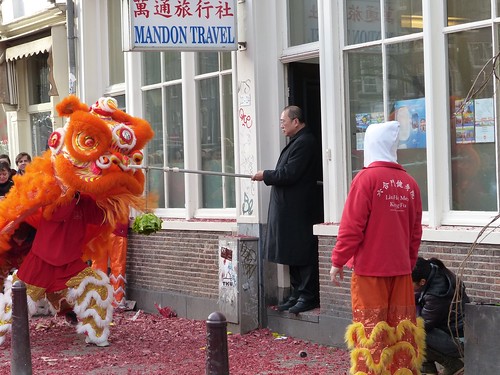
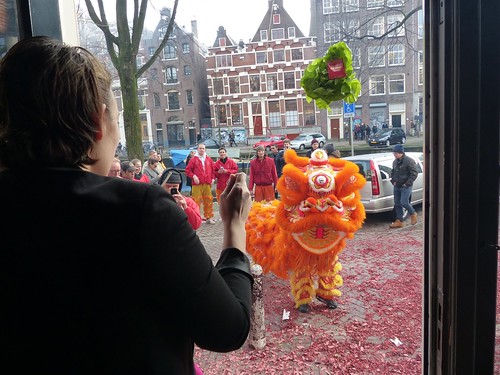
We rang in the New Year twice: once on Dec. 31 (see my post called New Year’s Eve in Amsterdam) and once on Jan. 2, when a local Chinese Lion Dance troupe visited the hotel in honor of Chinese New Year, celebrated a bit early to take advantage of the city’s temporary lenience on fireworks. Flashback to our days in Shanghai for sure!
They visited the travel agency next door first, collecting the auspicious lettuce and financial donation.
Untitled

At Hotel Misc, proprietor Rachel taunted the lion with lettuce dangling from the building’s hoist hook.
Untitled

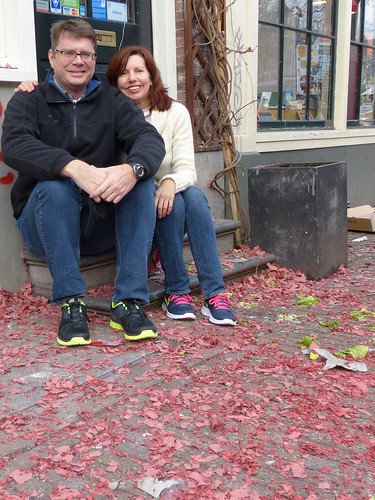
After the lion caught the lettuce, the troupe frightened away evil spirits with a deafening display of firecrackers … and left a big mess.
Untitled

Christmas War 2012

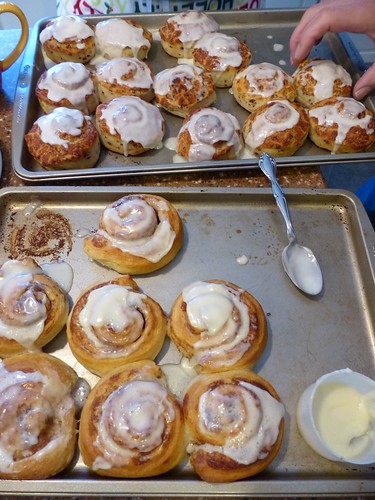
In the olden days, Santa left Nerf weapons under the tree or next to our stockings in plain sight. After opening our presents, playing with our new toys, loading our PEZ dispensers, and eating cinnamon rolls, we would break out the Nerf guns for a family battle in the wrapping paper wreckage of our living room. We never questioned the idea of a Christmas morning war.

Over the years, this tradition morphed a bit as adult children reunited for the holidays. Sometimes we delayed the war till later in the day or played a more mellow version, such as lining up cans for targets or aiming our sticky darts to fly through an upstairs window.

We often laugh about the year my parents hosted a Sri Lankan college student, Iranga, for the holiday. (When my parents lived in Saudi Arabia, where women aren’t allowed to drive, Iranga’s father was my mother’s driver.) Tony and I were living in Kansas at the time, but we traveled to Michigan for a Dickinson family gathering. On Christmas morning, my sisters and I were surprised to find no armaments under the tree. Did Santa think we had outgrown this annual event? Presents were distributed, and as per another family tradition, the youngest child opened all of hers first. Finally, it was my mother’s turn. As she unwrapped her last gift, we began to chatter about plans for the rest of the day. “Oh wait,” my father said. “There’s one more box hiding back here behind the tree.” He passed it to my mom, who gingerly peeled off the paper from a large cardboard box. She opened the flaps, peeked in and then quickly whipped out a huge Nerf blaster and passed a second one to my dad. They both pelted us with ping-pong balls as we dove behind furniture, crying with laughter and howling over the unfairness of being unarmed. Poor Iranga didn’t know what to think.

Although Tony and I moved abroad and skipped 11 years of family Christmases, we kept a photo on our fridge of my sisters in the heat of battle, Kate ducking behind an overstuffed chair and Meg peeking out from under a pile of wrapping paper. Returning to Michigan for Christmas 2012, we weren’t sure what to expect, but we invested in a couple Nerf guns, disguised them with tissue paper and stashed them in a gift bag, just in case.

My sister Kate and her family live a short distance away, but they spent the night Christmas Eve so we could all enjoy seeing Nico and Paul wake up to Christmas. Adults rose first and made coffee, warning the boys to stay in their room until we had set up with our cameras. As expected, the neighbor had left a Christmas cake on the front step. Our fridge and freezer were stuffed to capacity, so we had to leave it out there. Finally, we called the boys and got the morning under way. Everything was normal … for awhile.

Untitled

I love this shot of their sweet faces!
Untitled

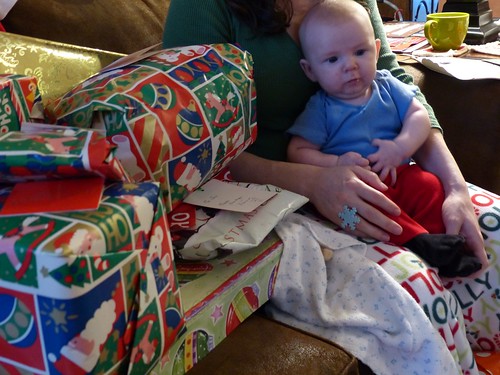
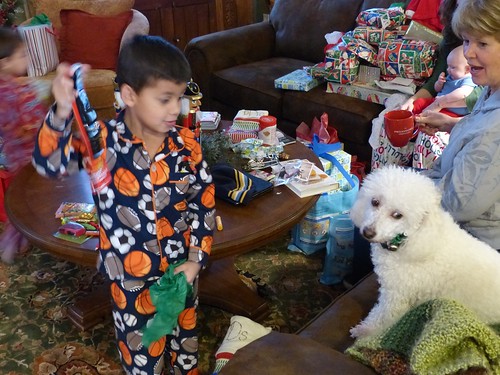
William with his loot. The youngest kid gets to open his presents first.
Untitled

“Look, Buddy, you got a new belt!” said Nico. Or, a new collar, maybe.
Untitled

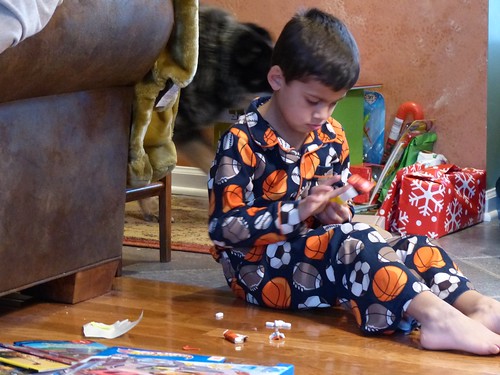
Nico loading his PEZ dispenser.
Untitled

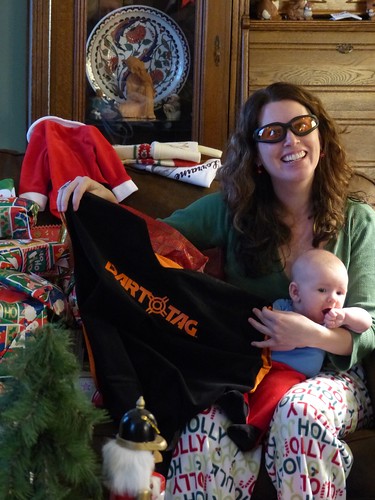
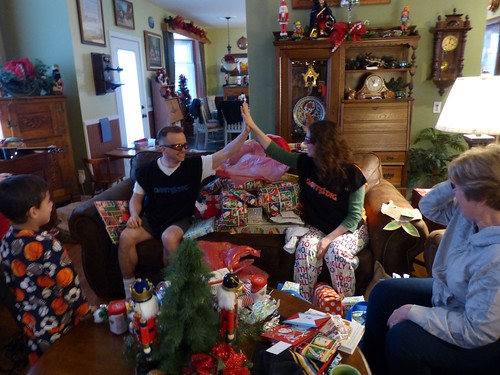
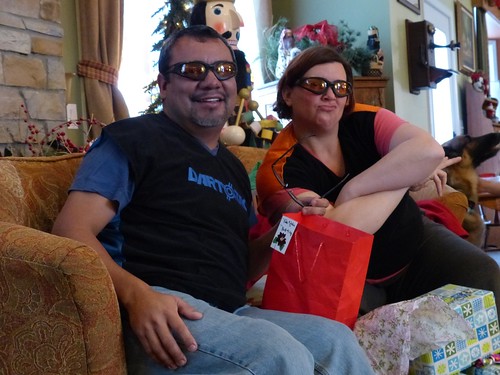
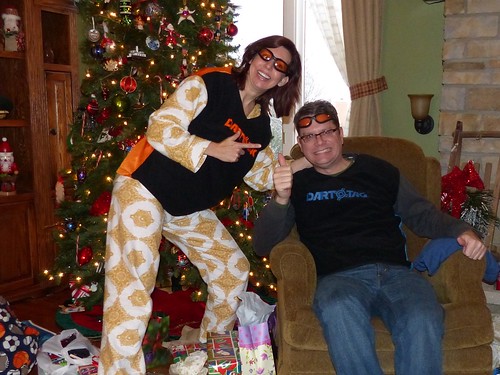
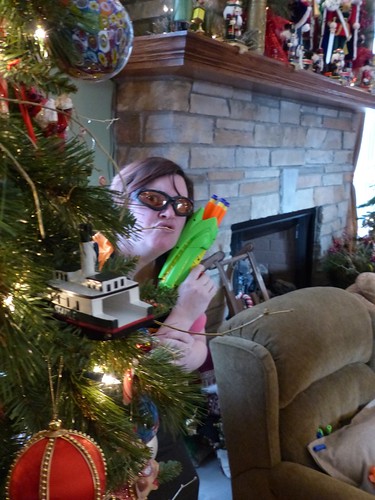
Megan and Britt had given each couple, including themselves, a “family present.” They opened theirs first: Dart Tag vests with orange safety glasses. They high-fived, and we knew the game was on.
Untitled

Untitled

Suspense built as each couple opened the gift and donned their gear.

John and Kate
Untitled

Me and Tony – I was trying for gangsta, but my jammies killed the look.
Untitled

My brother Mike was oddly oblivious. We kept telling him, “Open your gift from Meg and Britt!” but he sweetly and innocently insisted on waiting to open joint presents until Summer arrived on the 28th. We all knew that would be too late …
Untitled

After everyone unwrapped their presents, my dad brought the Christmas cake inside and asked if anyone wanted any.
Untitled
However, he still had a couple gifts to open, so I stood up and moved the cake box from his lap to an end table. It felt suspiciously light, and I had a feeling all hell was about to break loose. I quickly set my camera to video, placed it strategically on a bookshelf and stepped away. Sure enough, Dad called Nico over to help him uncover the “cake.” Inside the box, were two Nerf guns. And this is how it unfolded:

Favorite moments from the initial attack:
* Everyone trying to be covert, reaching for their stashed weapons as Nico lifts the “cake box” lid.
* My mom protecting her face with the gift I brought her from India, a papier-mâché mask I found at a handicrafts fair in Delhi.
* My clueless brother shouting, “Hey, where’d you get the guns?” while holding the baby.
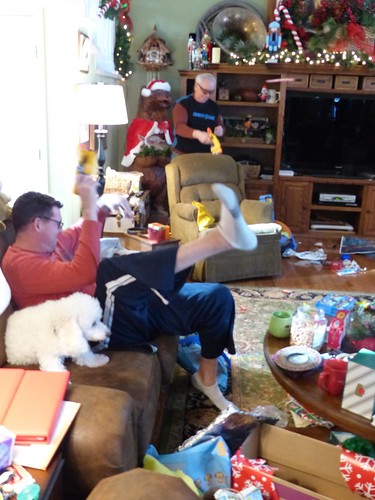
* Sidney, the Jimenez family dog, laying still through all the chaos, looking annoyed and a bit worried.
* Britt taking cover behind the sofa with his arsenal of Dart Tag guns. (He and Meg bought five Dart Tag sets, gave the vests and glasses as gifts and then kept all the weapons!)
* My pregnant sister, Kate, shouting, “I think I peed my pants!” followed by, “Watch the ninnies!”

Yeah, we’re all class.

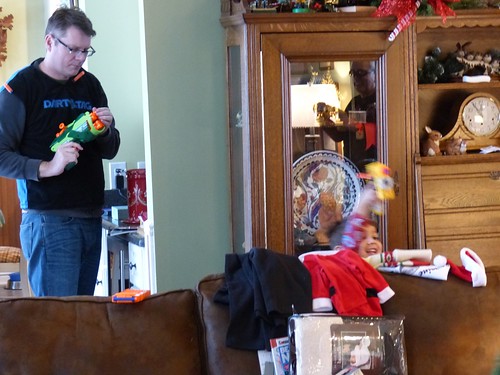
Eventually, the action moved beyond the living room with teams spread out upstairs and downstairs. I claimed to be an embedded journalist, but that didn’t stop them from blasting me with their velcro darts, which stuck to my vest like little badges of courage.

Nice cover, Kate.
Untitled

Tony reloads while Paul has his back.
Untitled

Mike, finally armed, and trusty guard dog, Buddy.
Untitled

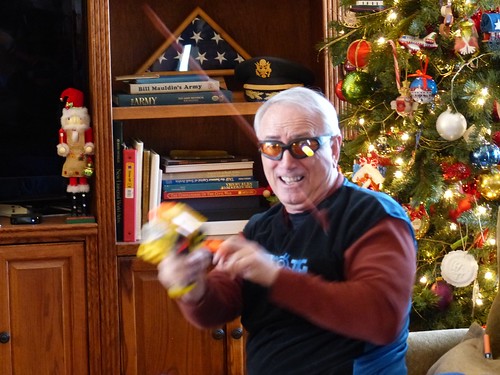
Thank goodness for safety glasses, eh Dad?
Untitled

Eventually, someone called a truce and everyone regrouped in the kitchen to enjoy another Dickinson Christmas tradition: cinnamon rolls. And then there was peace.
Untitled

Home for the Holidays

I have to admit I was feeling a tinge of resentment about heading to the States for Christmas. (So many destinations on my bucket list and so little time.) However, as our departure date approached, I started to get excited. In Michigan, we could stay at our little lake house, go to the movies, visit the amazing Detroit Institute for the Arts, take the nephews to kid-friendly attractions, enjoy the wonderful nature trails, eat at fantastic restaurants, drink quality wine at reasonable prices, hang out in fun pubs/coffee shops/cafes/etc., hit the sales, and otherwise sample aspects of American life we miss in India.

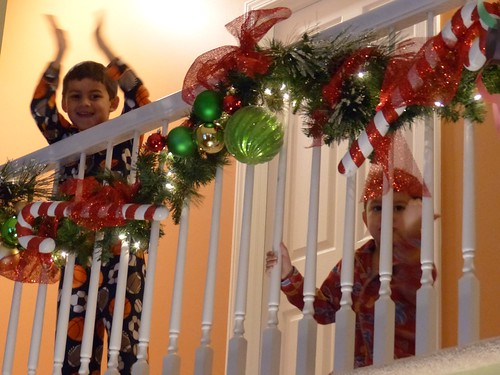
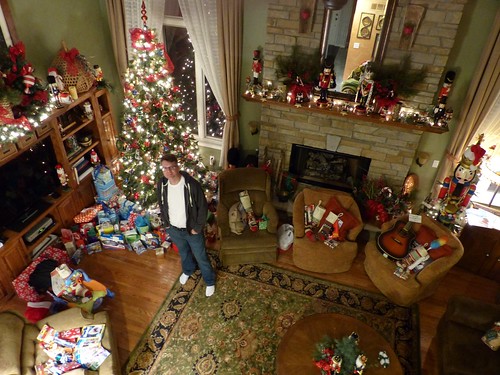
In reality, I rarely left my parents’ house. The place was so Christmas-y inside and out with over-the-top decorations – miles of twinkly lights, THREE Christmas trees, garland, ribbons, glittery snowflakes, life-sized quilted snowmen and wooden nutcrackers, wreaths, personalized stockings and myriad displays. It was like Santa’s Workshop exploded. Add that to a jam-packed fridge, bottomless pots of coffee and a kitchen table ringed with the people I love most – what more could I want? Somehow the hours slipped away, and we’d realize we had done nothing but sit around and chat, transitioning from coffee to wine as the day wore on. My mom prepared a bunch of family favorites for our dinners, so we didn’t even eat out much. Here are a few shots to set the mood.
(I made this little movie in iPhoto; not sure if I like the format. Does it make you dizzy?)

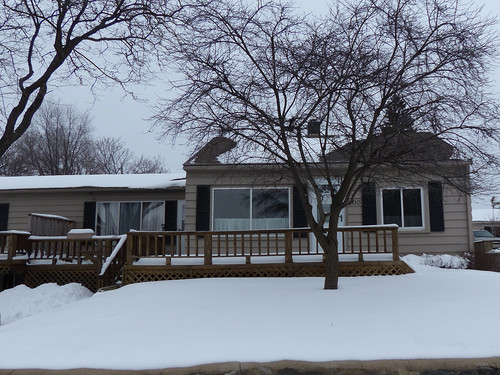
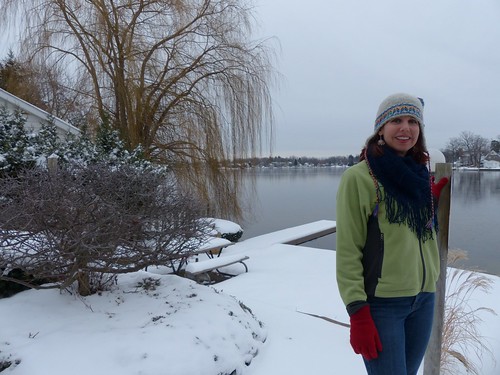
Tony spent one night at our lakehouse, and I drove out with him to see the lake in its snowy glory, but I couldn’t bear to spend a whole night away from the rest of the gang.
P1000581

Untitled

Of course, I was all about the nephews and wanted to spend nearly every waking moment with them.

Christmas morning started off like any normal Christmas. But at the Dickinson Resort, nothing stays normal for long. Stay tuned…

New Year’s Eve in Amsterdam

I never thought I’d have anything good to say about jetlag, but it sure helped us stay up late on New Year’s Eve! Midnight arrived in Amsterdam at 6 p.m. Michigan time, so we were wide awake and hungry. Our hotel hosts, Rachel and Pepijn, prepared traditional Dutch treats-mostly fried balls of assorted tasty concoctions-and treated us to a small bottle of champagne. Perfect! Situated a few steps from the festivities at Neuimarkt Square, our tiny lobby provided a safe and entertaining vantage point. Tony and I braved the rain for the countdown, shared a toast and a smooch, and then popped back inside. Locals said the fireworks were tame compared to past years, but they still worried about their tinder-box canal houses while impaired revelers launched heavy artillery “probably purchased in Belgium” (a country with loose laws regarding such things, we were told). We hung out with the hotel crowd until nearly 2 a.m. – surely a record for us! (The bad side of jetlag? I was still reading in bed when the church bells rang at 4 a.m.)

Twelve Years of Christmas

I just dug through 701 email messages and pages of old blog posts, as well as photo albums uploaded willy-nilly on shutterfly, picasa and flickr to reconstruct my memory of the last 12 Christmases. I knew for sure that we hadn’t spent a single Christmas in the States, but I couldn’t remember exactly where we HAD spent them. Now I know. And I’m documenting the details here so I’ll be able to find it easily next time. If you traveled with us and/or think I got some of this wrong, please let me know!

When we lived in Turkey, we didn’t actually get a break for Christmas, so we attended and hosted parties (and even flew to Germany for the weekend once) to rouse some holiday spirit. Here’s the run-down on our post-Christmas semester breaks:
2001-02 – Cappedocia and Ephesus, Turkey, with Koc School colleagues Marcos, Renee, Steph and Sarah.
2002-03 – Koh Samui, Bangkok, and Chiang Mai, Thailand, with Marcos and Amber.
2003-04 – Cairo and a Nile cruise in Egypt with Lisa.
2004-05 – Miami and Carnival Cruise with Lisa, followed by the job fair at the University of Northern Iowa.

After moving to China, our two-week semester breaks coincided with Christmas.
2005-06 – Phuket, Thailand.
2006-07 – Malaysian Borneo with Scott and Amy.
2007-08 – Dickinson family reunion in Ramstein, Germany.
2008-09 – Yangshuo, China, followed by the job fair in Bangkok.

During our two years in Laos, we got a whole month off for the semester break!
2009-10 – Krabi, Thailand, followed by a visit from my sister Megan, who traveled with me to Cambodia and Luang Prabang, Laos.
2010-11 – played host in Vientiane to house guests Scott, Amy and Blake, and then headed to the Bangkok job fair.

So far in India, our semester break has been 3 weeks.
2011-12 – Garmish, Germany, with my parents, brother and sis-in-law.

And that brings me to NOW. After all that, I can confidently say we spent Christmas 2012 in the United States for the first time since moving abroad. Why would we do that?

Here’s the short answer:
P1000238

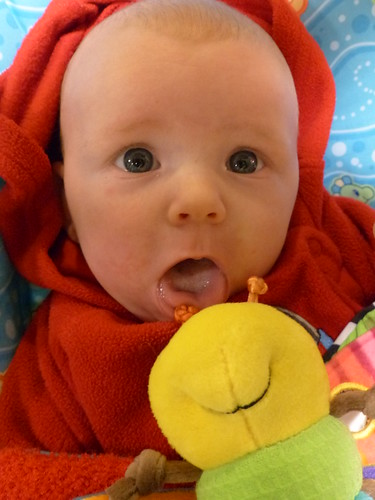
His name is William Augustus Warren, and he is the latest addition to my nephew collection. Will, aka Guster, aka Love Bucket, was born Sept. 29 to my sister Megan and her hubby, Britt. The devastating loss of their first son, Benjamin, made William’s arrival all the more poignant and powerful. I simply couldn’t wait till summer to meet this little guy. A bit shy at first, he quickly warmed up to all the Dickinson chaos. I cuddled the stuffing out of him, and my eyes more often than not teared up with love. Tony enjoyed bouncing him while singing inappropriate lullabies (such as “Two Beavers are Better Than One” from the TV show, “How I Met Your Mother”). By the end of our two-week visit, William had changed so much! He gained more control over his wobbly head, and he began to kick and wave with gusto. His wide blue eyes started tracking to whoever cooed the loudest … or to whichever ceiling fan caught his fancy. Best of all, he started smiling! Big, gummy, perfect smiles!

Here are a few more shots of that sweet doll baby.

Of course, I cherished every minute with my other two nephews, Nico and Paul, too. Hilarious, curious, talented and cute as can be, those two little guys rock my world. Stay tuned … I have heaps more Christmas coverage to come …