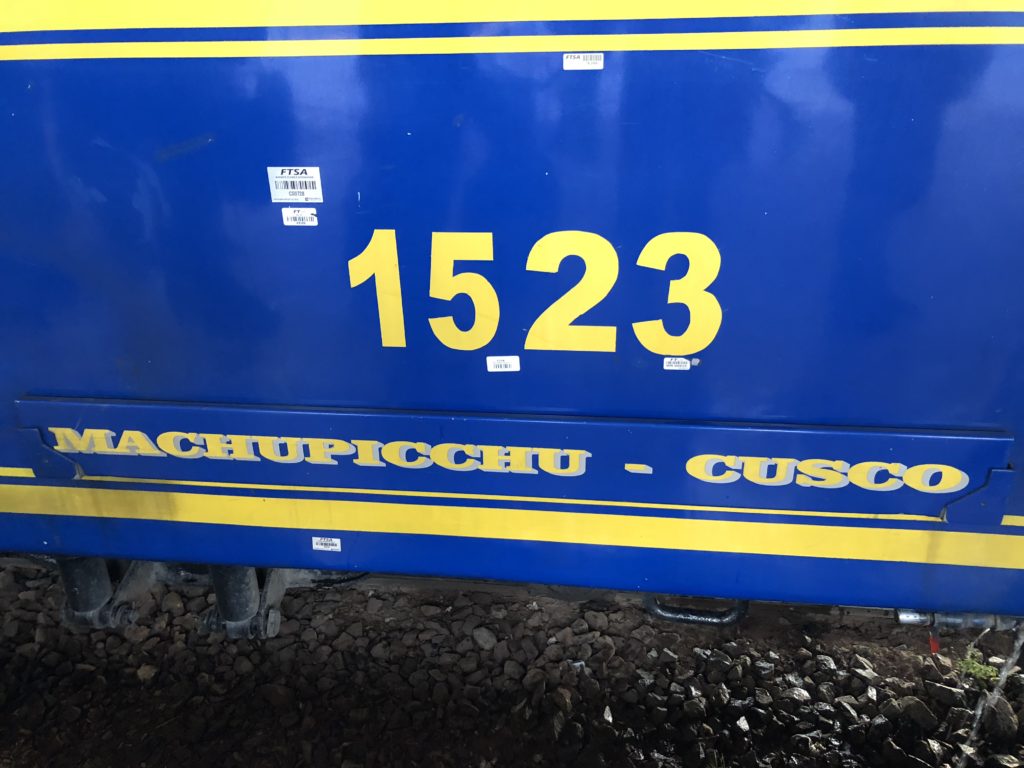
Tuesday morning, we rose with the roosters, collected our packed breakfasts (sandwiches and fruit), checked out of the hotel, and piled in a van to the train station.
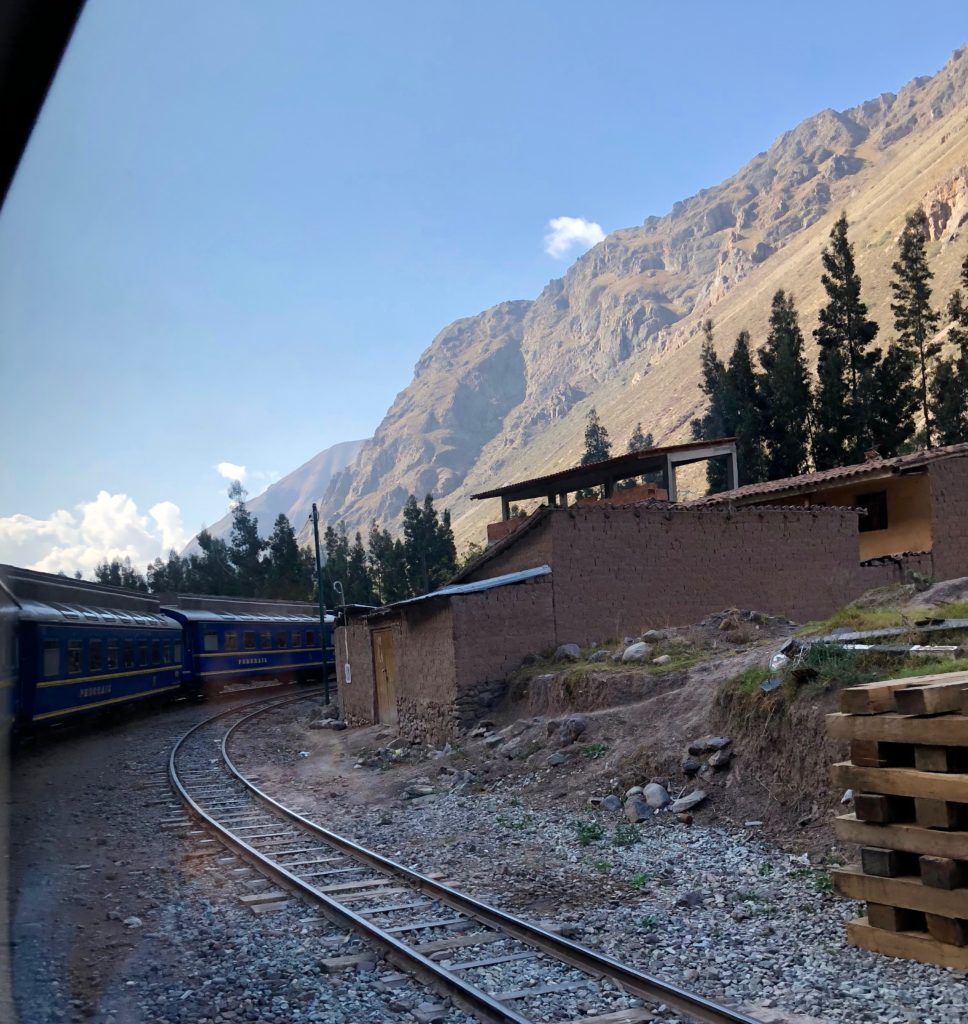
The Peru Rail train was packed with travelers heading to Aguascaliente, which is the jumping off point for visiting Machu Picchu. Tony and I sat at a small table facing a couple who had somewhat lower hygiene standards than ours. Between naps, I marveled at the landscapes zipping by.
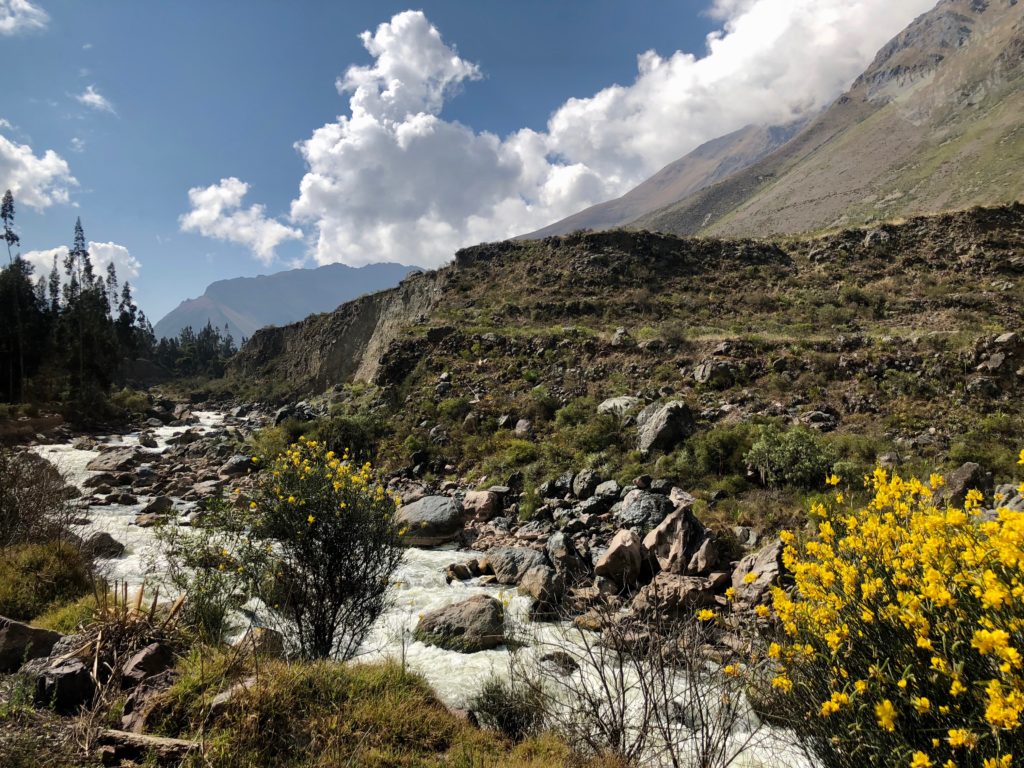
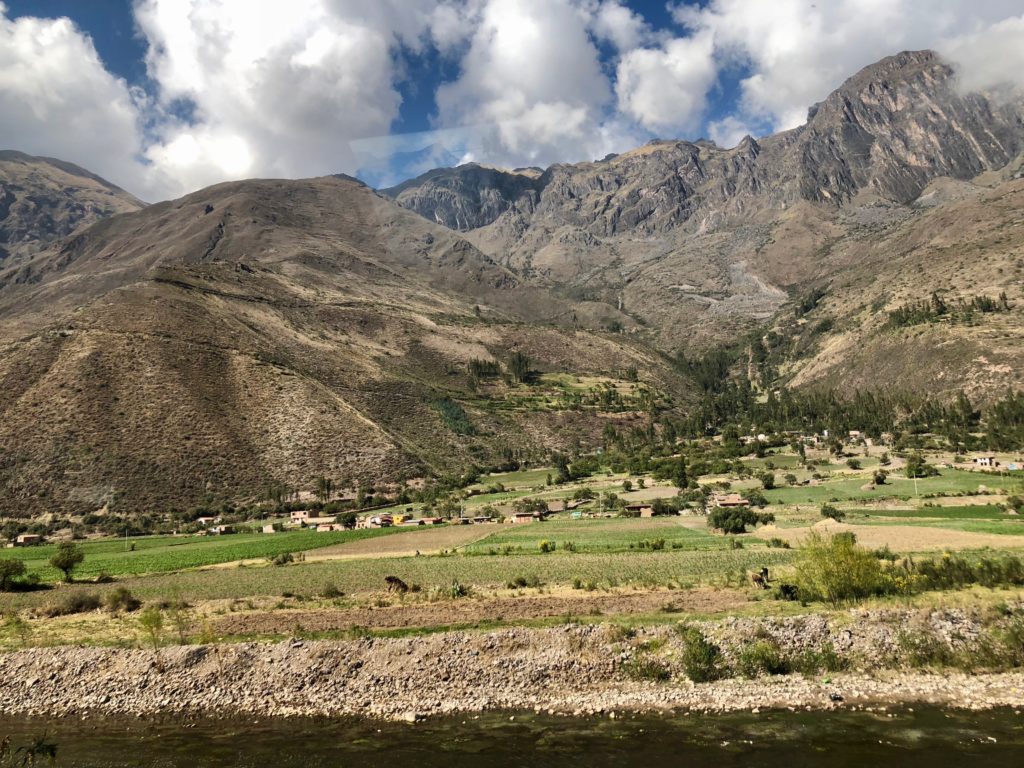
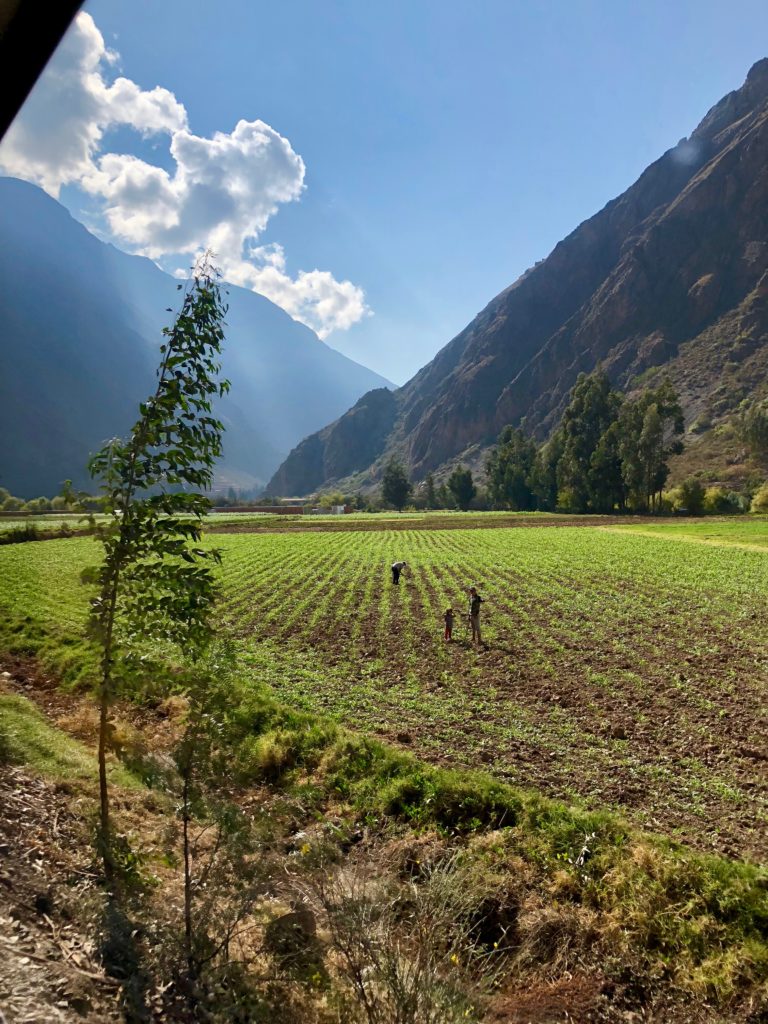
Tony said the train ride was a highlight of this trip. “I’ve been lucky enough to see the Great Wall of China, the Roman ruins of Ephesus, the pyramids of Egypt, the hidden city of Petra” he said. “To be honest, the Inca ruins were cool, but the mountains made me really happy.”
Shots out the train window:
I had arranged for someone from our Aguascaliente hotel to meet us at the train station. After some initial confusion, we found him and then looked around for his car. That’s when we realized there were no cars. He led us up a steep hill, over a bridge, up another steep hill, over a ramp, up some steps, up another steep hill, to the tippy top section of town, and then up a flight of stairs at the hostal, Samananchis Machupicchu. Keep in mind that we were not only dragging our luggage but also dragging our altitude-affected bodies, hearts racing and breath coming in raspy gasps.
After checking in, we wandered out for lunch and landed at Mapacho for Peruvian cuisine and craft beer. Actually, their sign said “CRATF beer,” but it was still pretty tasty.
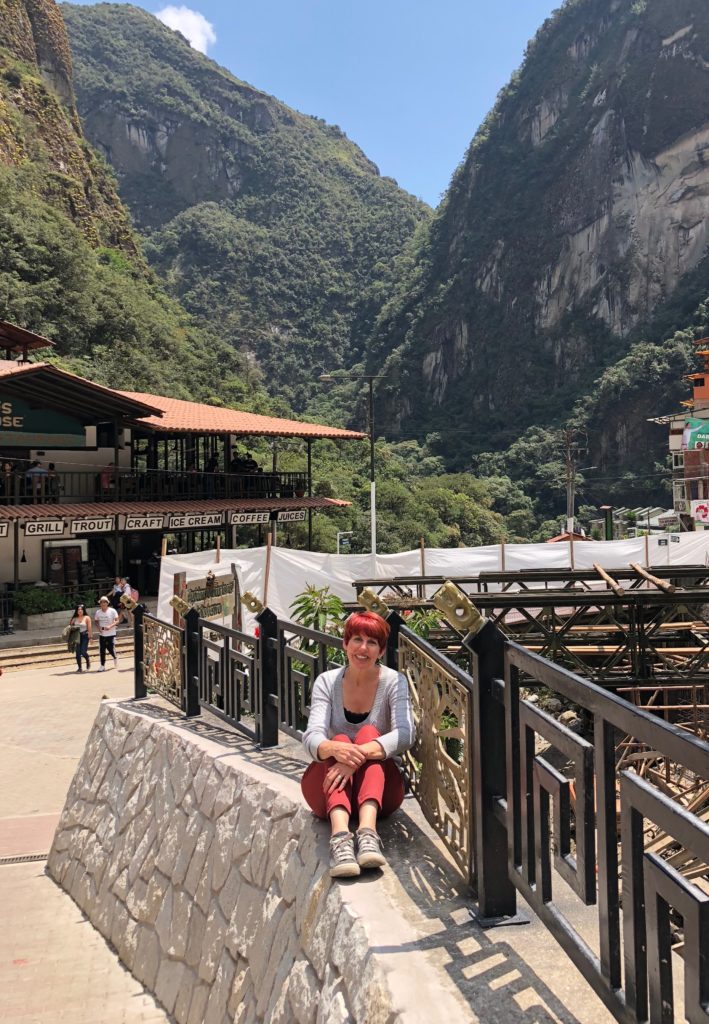
Hordes of sweaty tourists mob Aguascaliente each day. They eat, drink, and maybe sleep here before lining up for blocks to catch a bus up the mountain. The town exists solely to meet the needs of these travelers jonesing for a glimpse of Machu Picchu. People had warned us that it was the kind of place where you want to get in and get out ASAP. To my surprise, the town was touristy but quaint with lots of outdoor sculptures, a colorful artisan market, decent restaurants, friendly people, and even a French bakery (where I had a buttery pain au chocolat and great coffee), not to mention 360-degree views of the Andes.
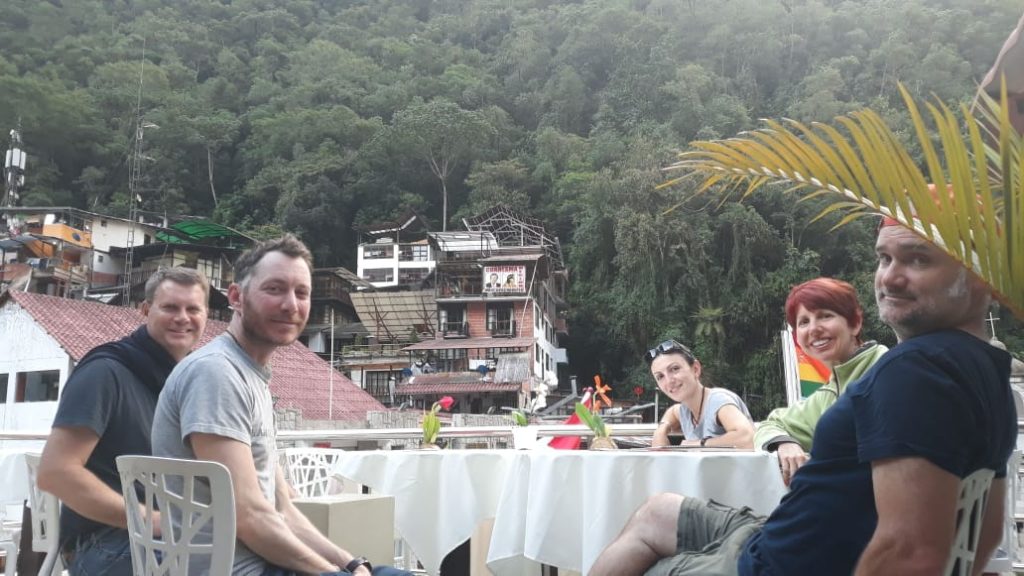
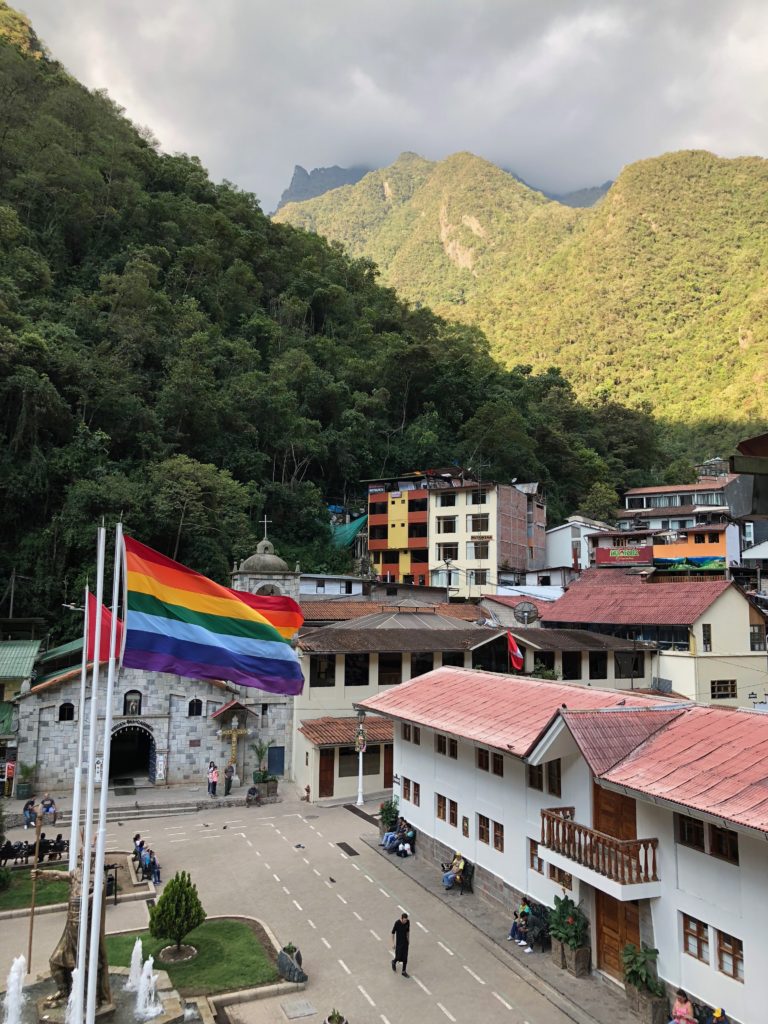
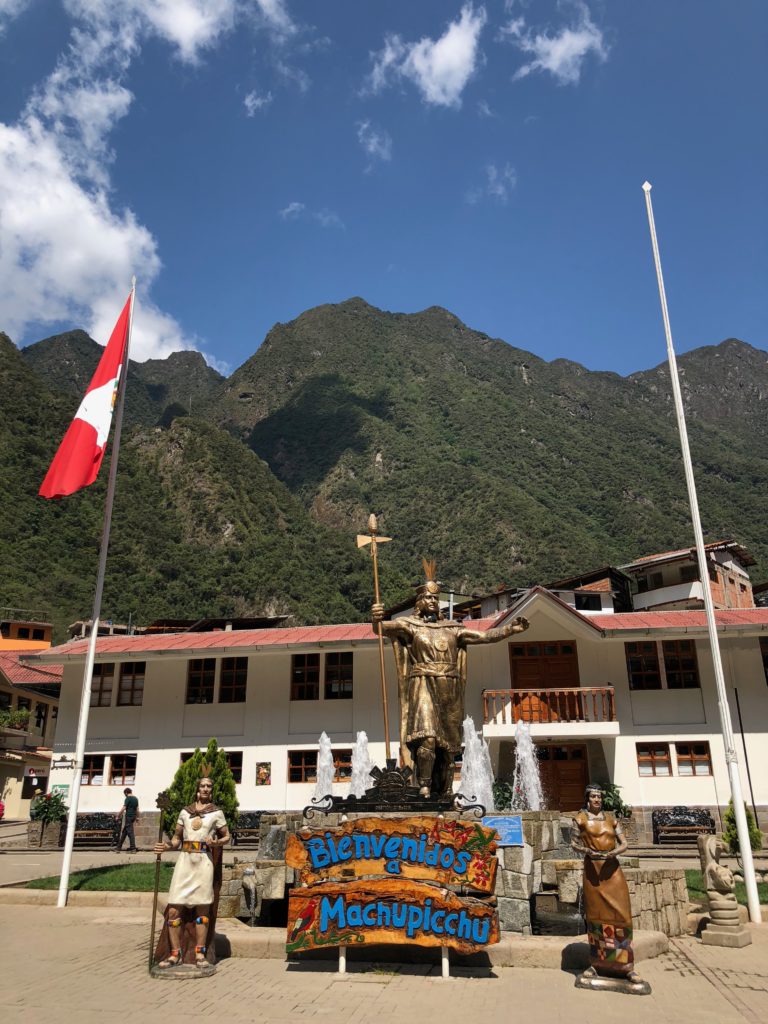
Quite a few friends were traveling in Peru during this break. We met up with Paul, Traci, and their two kids, for drinks overlooking this courtyard. Although we liked to believe the town was flying a gay pride flag, it turns out it is actually the flag of the Inca empire. I guess that makes more sense.
We spent much of this holiday waking up early to travel and then waiting in lots of lines. Monday morning was no different. We headed to the airport at the crack of dawn for our 9:44 flight to Cusco.
Our ultimate goal for this trip was to visit Machu Picchu, but there’s no easy way to get there. You have to fly to Cusco, catch a train to Aguascaliente, and then ride a bus up the mountain to the site.
The Lima airport defies logic. Most airports offer few entertainment options until after you get through security. In Lima, however, you can poke around in a variety of shops, wet your whistle in any number of bars, or fill up at the expansive food court before getting in line for the security check. Wise seasoned travelers such as ourselves know that you should get through security as soon as possible, so we did. Unfortunately, the other side of security was like Siberia. Not a single restaurant. One snack bar. One souvenir shop. And our flight was delayed for more than three hours.
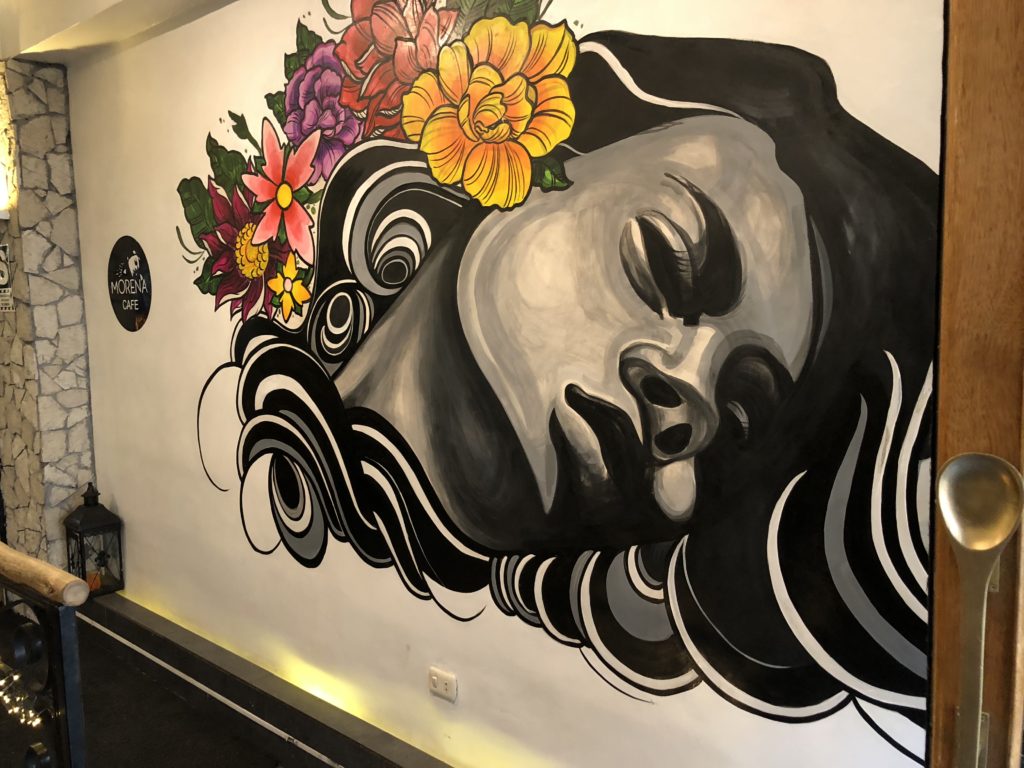
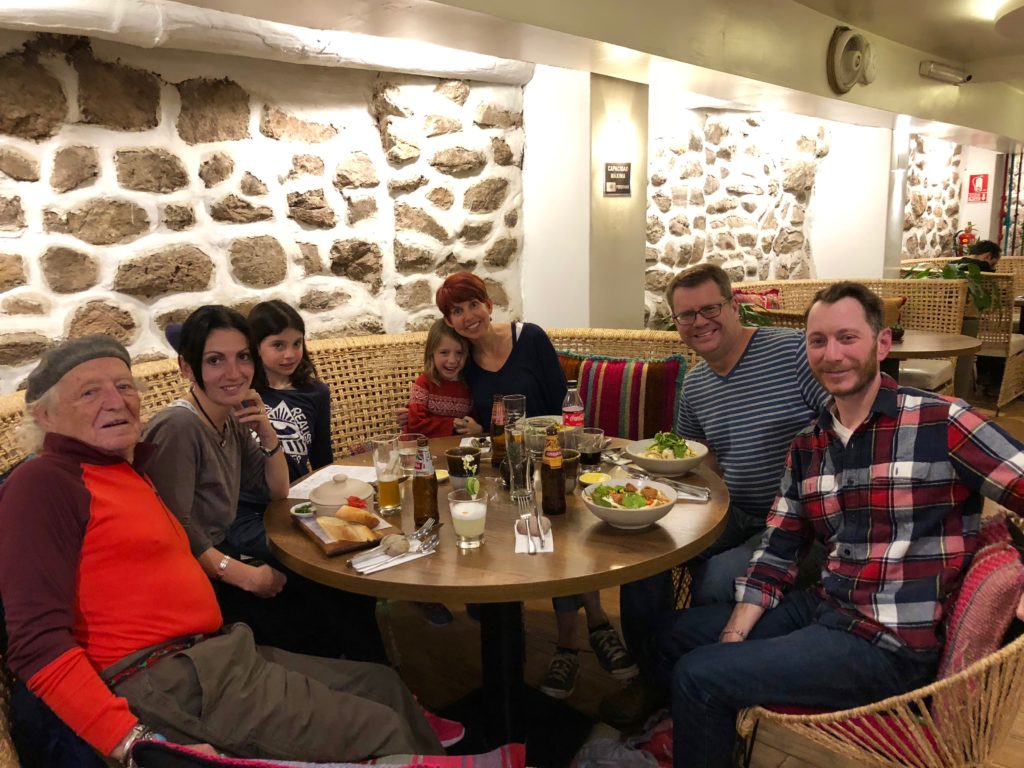
By the time we reached Cusco and checked in to our cute little hotel, we were all famished. We met up with Ian’s father, Peter, who had flown from the States, and we all walked down the hill in search of food. We arbitrarily chose the restaurant, Morena. Reviews were mixed, but I loved my meal, and I was starting to see how easy it was to be vegetarian in Peru. In fact, the Incas in this region cultivated quinoa, which continues to be a Peruvian staple. I ate a LOT of quinoa on this trip and never tired of it.
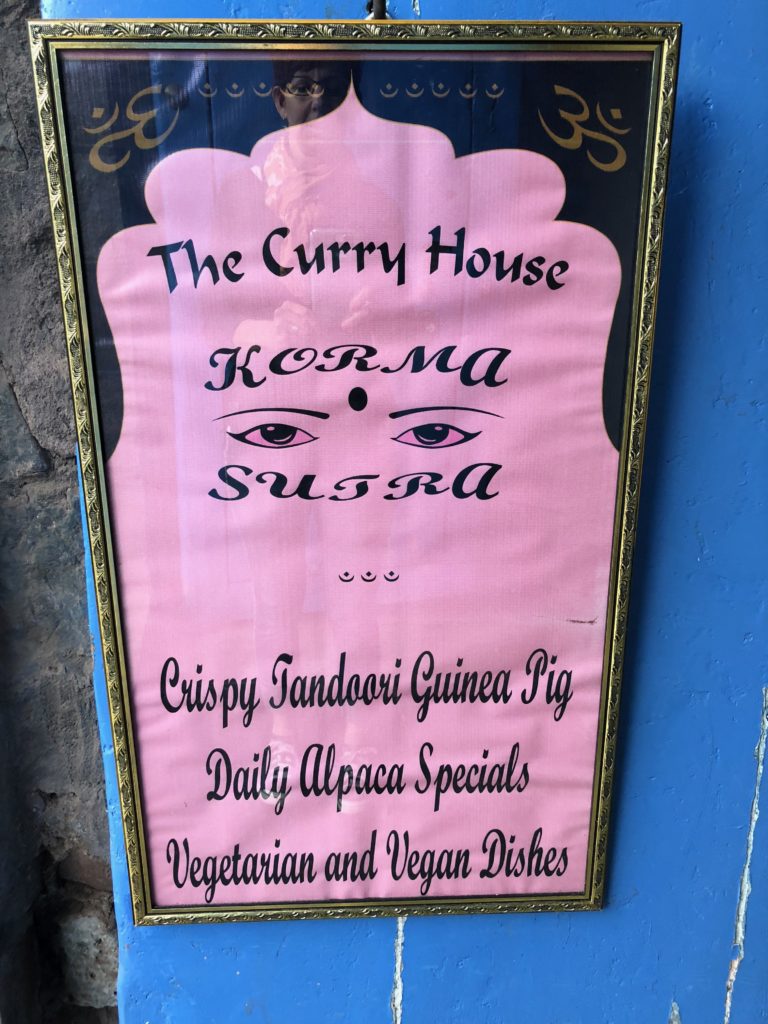
Guinea pig is another staple here. Crispy tandoori guinea pig? No thank you!
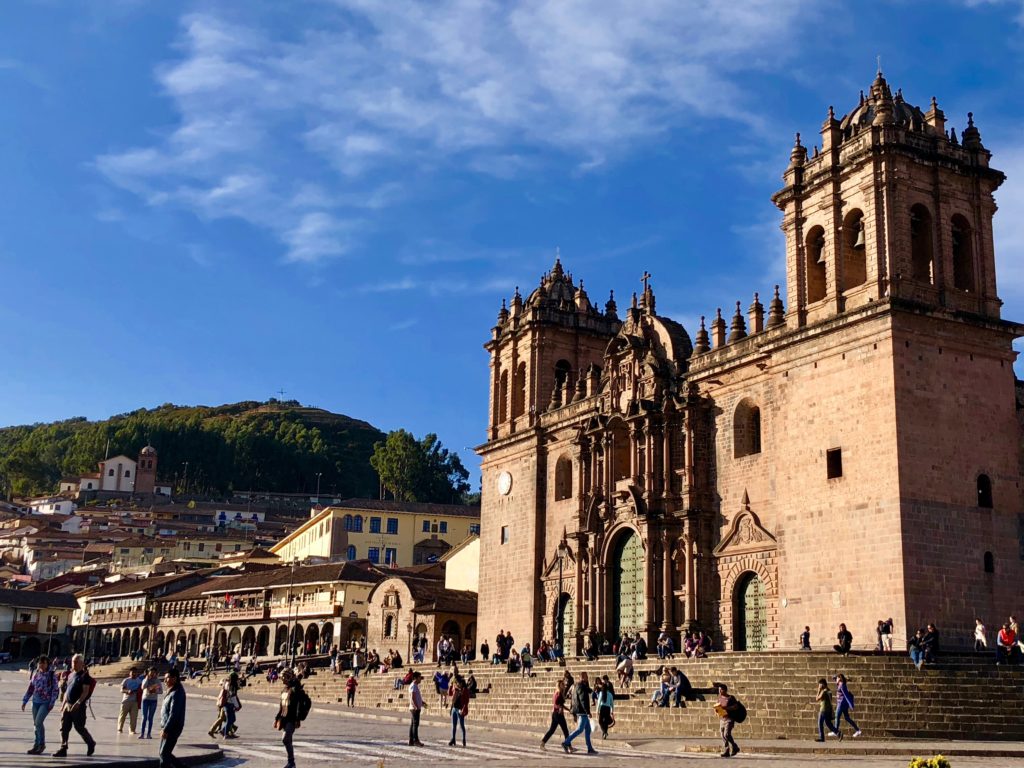
Cusco was gorgeous. I was looking forward to spending more time here on our last day in Peru. For now, it was just a stopover.
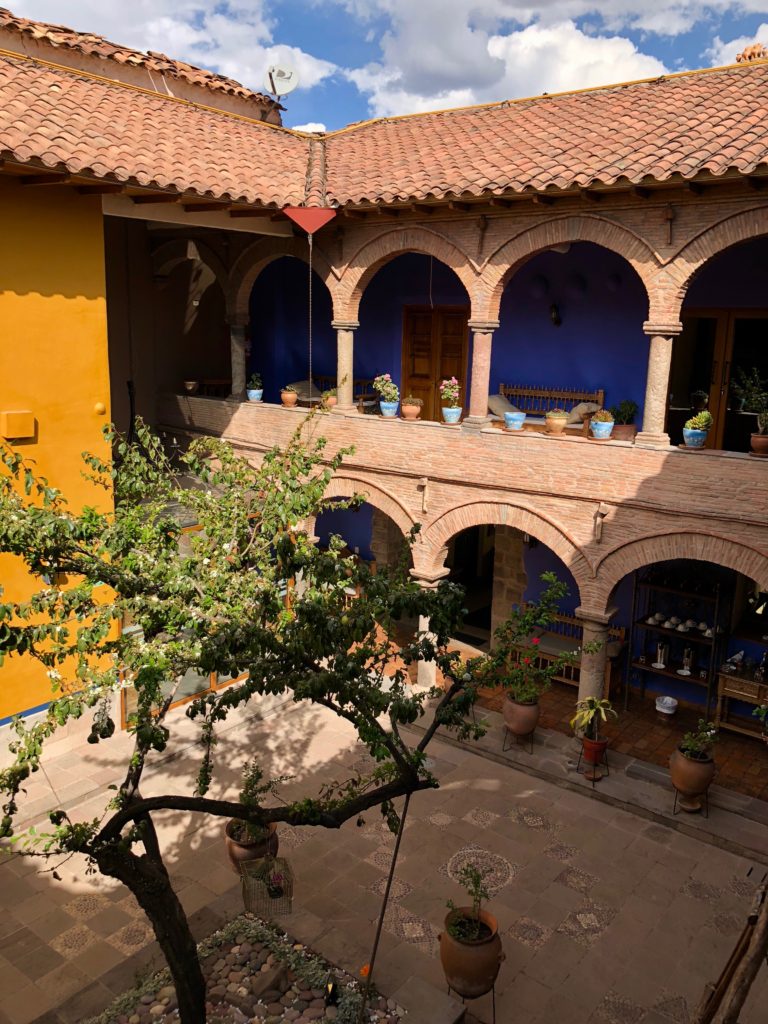
Our hotel, Tambo del Arriero Hotel Boutique, featured a central courtyard, bold colors, and quirky decor. We were too tired and full from our late lunch to venture out again for dinner, so we met up for drinks and crashed early. We knew we had another dawn departure planned.
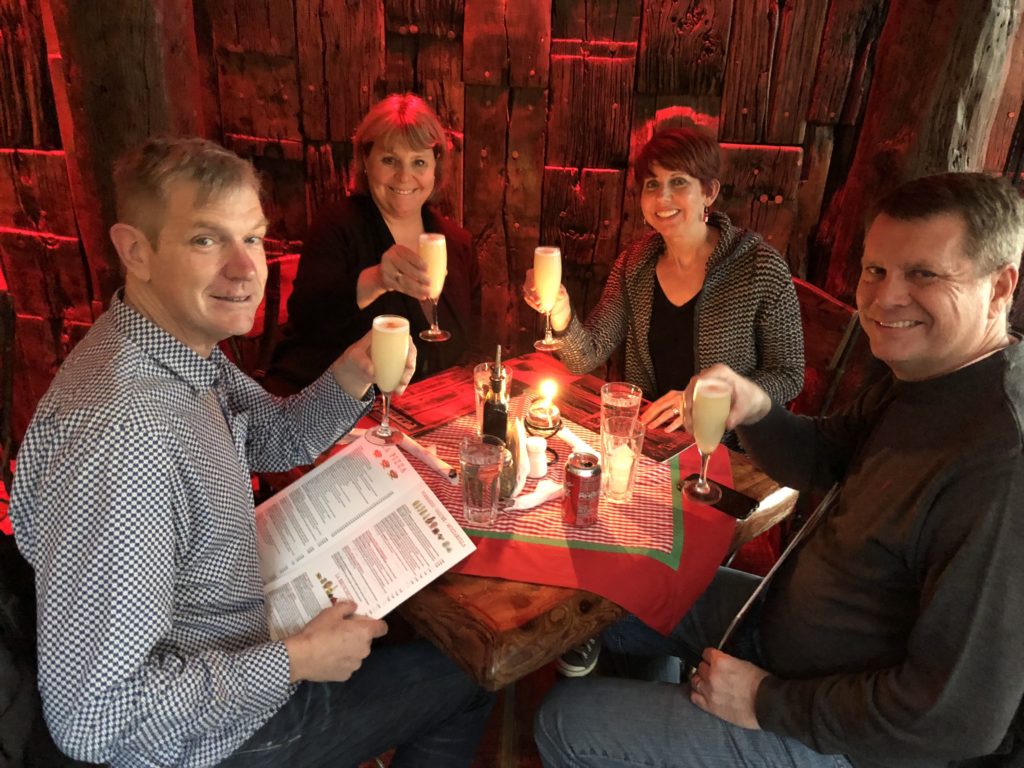
As Chile celebrated Dieciocho, Tony and I skipped town for a week in Peru with our friends, Ian and Stella, and their two girls. But first things first, we had to welcome our latest house sitters, Kathy and Leigh, with our customary pisco sour toast at our favorite restaurant, Tiramisu.
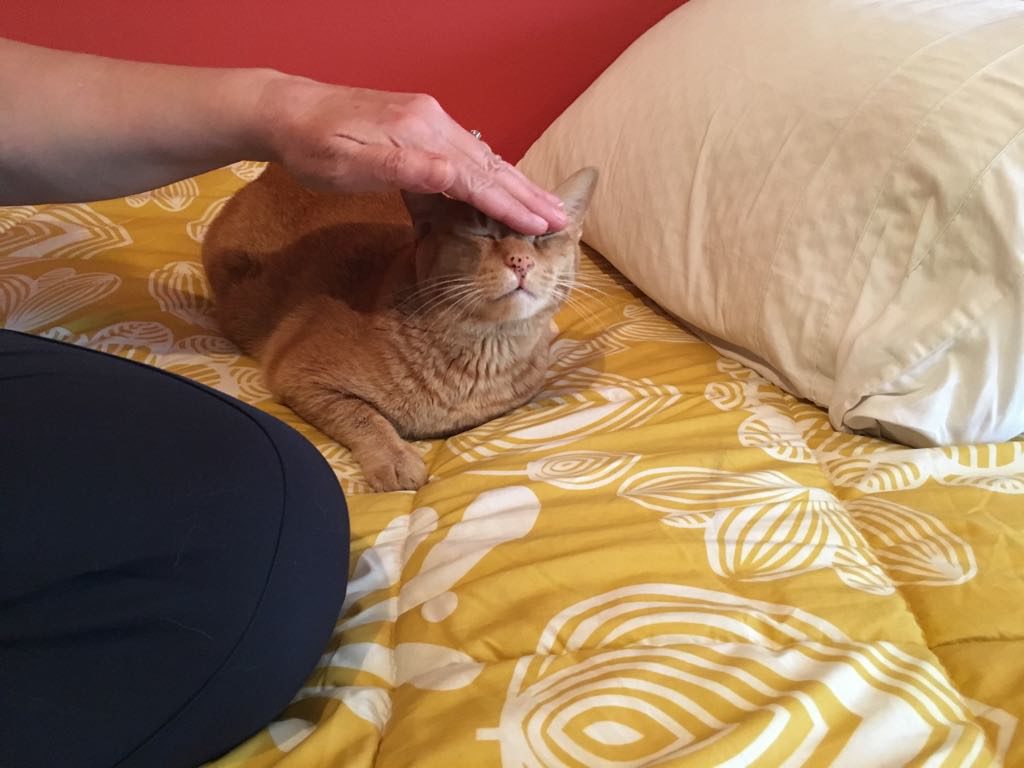
During our trip, these lovely Aussies sent several updates with photos of Ella, who clearly didn’t lack for attention.
For our first stop in Peru, we landed in Lima and stayed at a nice little Airbnb in the Miraflores district. A friend from our New Delhi days, Alicia, recently moved here to work at the The American School of Lima, so we basically spent 24 hours eating with Alicia and seeing nothing else of the city. For our first meal, we enjoyed delicious traditional Peruvian fare at Panchita.
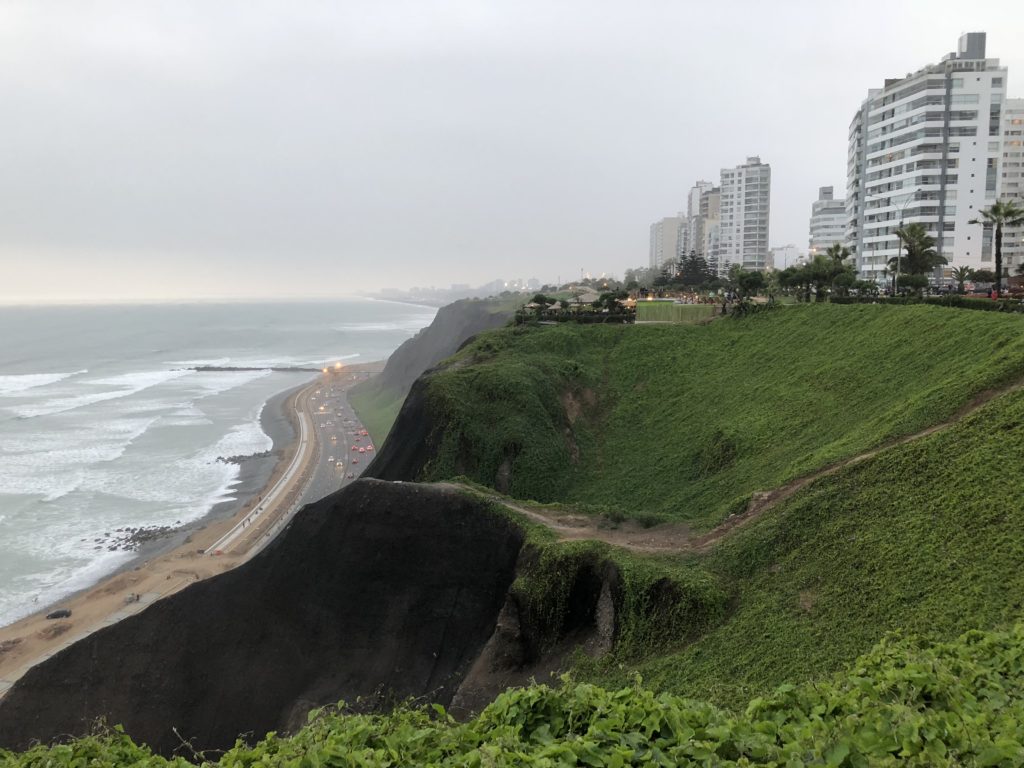
The next morning, Tony and I found a local café for a light breakfast and then walked to Alicia’s incredible apartment. The vibrant Miraflores neighborhood sits on a cliff that overlooks the Pacific Ocean, so the walk featured stunning scenery. The district’s quaint streets were lined with restaurants, cafés, pubs, and shops. We paused to join spectators at a small skateboard/dirt bike park for a few minutes, and then strolled along the cliffside promenade.
At Alicia’s 10th-floor apartment, I couldn’t get over the view! Alas, we had to leave. Gluttony awaited at one of the world’s top-ranked restaurants, Astrid & Gaston.
Our story began in 1994. Upon finishing their culinary studies in Paris, Gastón Acurio and Astrid Gutsche founded their eponymous restaurant in a small house in the district of Miraflores. At first, the restaurant was quite French, as it was dictated by the global trend. Over time, it became decidedly Peruvian. We embraced our culture and flavors, experimenting with local ingredients and recipes with one goal in mind, to promote our cuisine around the world.
In 2014, on our 20th anniversary, we left Cantuarias Street to start a new project: to settle in Casa Moreyra, the 17th century San Isidro estate. Today, Gastón and Astrid, together with a young team of chefs, are in constant search of new flavors and ideas to offer.
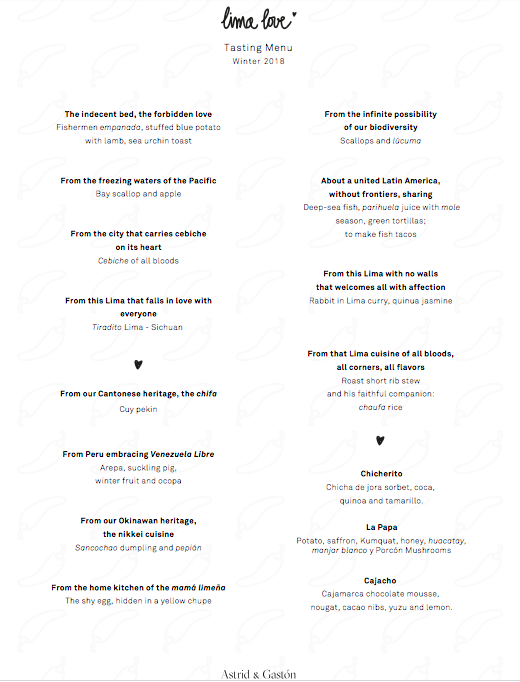
We opted for the 15-course tasting menu, and Alicia and I added the wine pairings. This was the menu. Eeek!
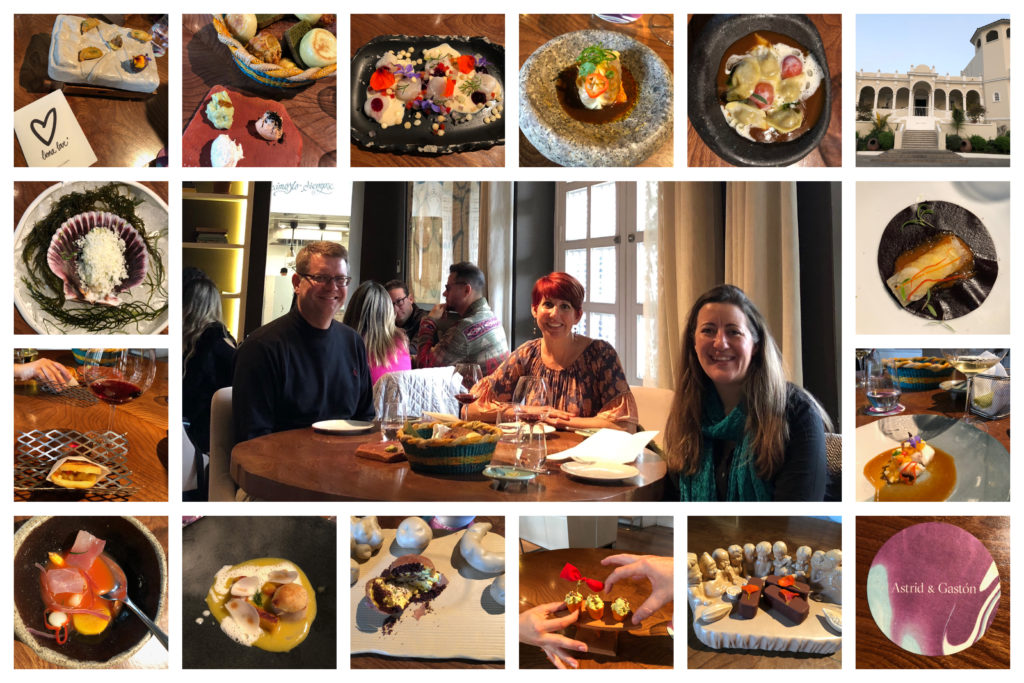
With my recent (and unfortunately timed) adoption of vegetarianism, Alicia’s aversion to seafood and other slimy things, and Tony’s disdain for vegetables, we created some challenges for the chef. Somehow, it all worked. The servings were small but packed with deliciousness. Some of the presentations were a bit cheesy, like the first one, “an indecent bed,” which came on a sculptural plate shaped like a bed, but I had no complaints. Almost five hours later, we were comfortably full, a bit tipsy, and feeling giddy.
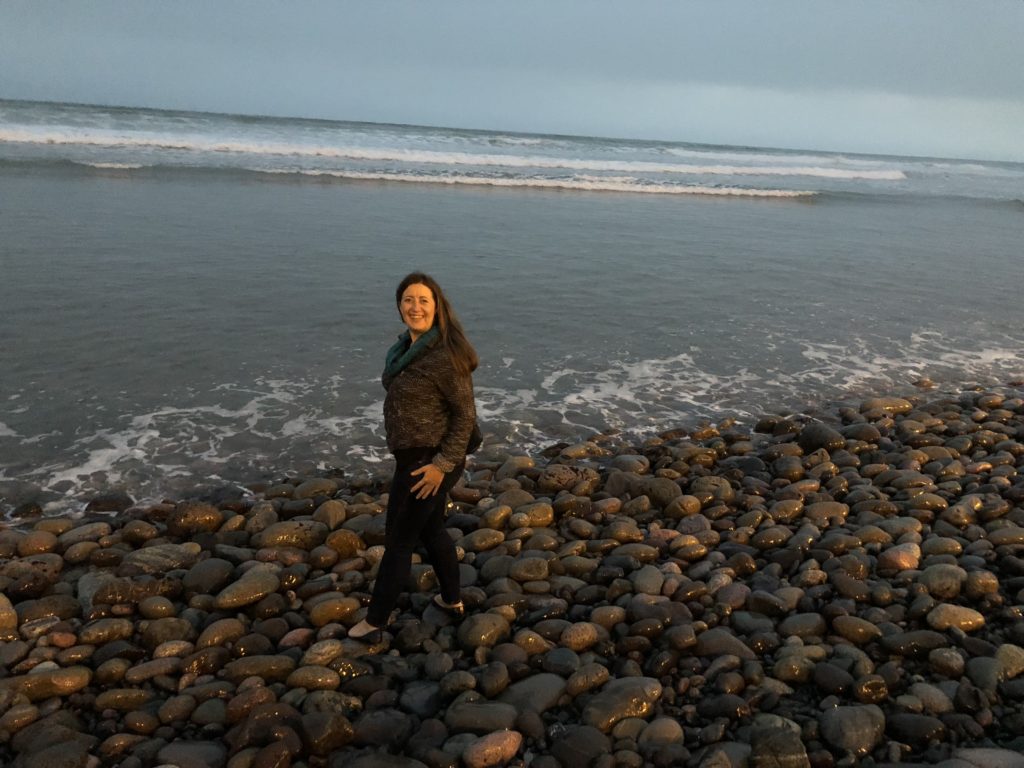
Back in Alicia’s neighborhood, we walked along the promenade. She hadn’t yet ventured down to the water since moving to Lima, and I certainly couldn’t NOT touch the ocean. We walked down a lot of steps and crossed the road on a pedestrian bridge to reach the rocky beach.
One perk of international teaching for so long is we know people practically everywhere, and reunions are always special. Thanks for hanging out with us, Alicia!
Tony and I just got home from Peru, and I was sitting down to write about our trip when I realized I never finished writing about our last trip. Such a blog slacker.
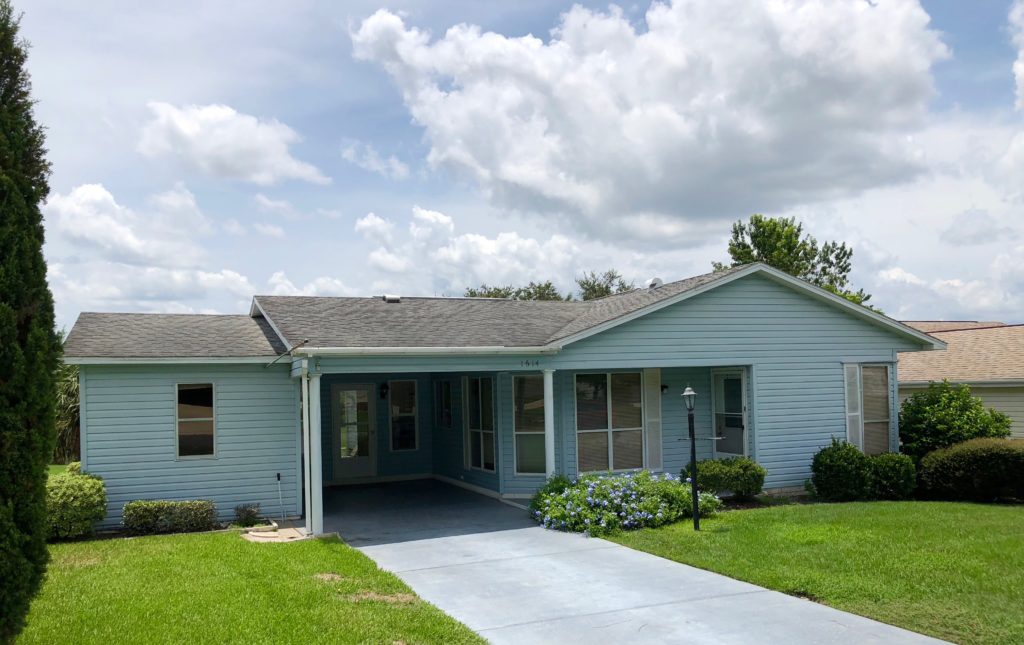
After our visit to Costa Rica, I ditched Tony and popped up to Florida to sign the paperwork on our new house and hang out with my family. We found a cute furnished home on the golf course, just a block from my parents, and we’re hoping it will be a hit with snowbirds seeking a seasonal rental. It was in pretty good shape, but the previous owners had rented it out for a long time without much TLC.
I did a cursory inventory of the house and hauled a lot of bedding, dishes, and random objects to a local thrift shop and the garbage. The sellers seemed to have dumped all their unwanted junk at this house before signing it over to us.
I have mixed feelings about owning a home in a 55+ neighborhood, even if it bills itself as a “fun and affordable active adult community where everything you could possibly want, need, or dream of doing in your retirement years is just a golf car ride away.” The town makes a few exceptions for buyers who are (just barely) too young for the ‘hood. When I got my Villages ID, the community center workers made me feel like a teenager. “You’re so youuuuuung!” they crooned.
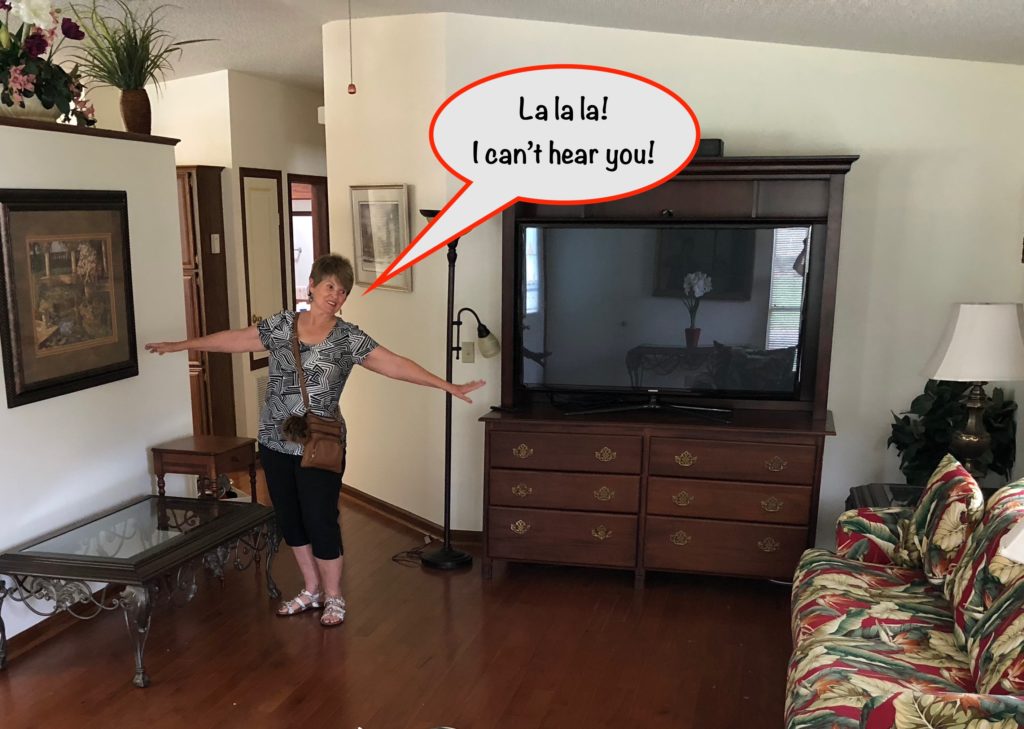
We decided to task my mom with the job of getting the place rent-worthy. She found many ridiculous former “fixes,” such as shutters hung upside down and kitchen drawers reinforced with a paint stirrer and a broken yardstick. She swore she could make the repairs and decorate by the end of September. The only stipulation: “I have a vision, and you don’t get to say anything about it.” Hmmm… I don’t know many contractors that include a clause like that. But hey, she’s doing it for free and she has a knack for this. We call her “business” La La La Decorating. (You know, like when you hold your hands over your ears and say, “La la la, I can’t hear you!”)
Lucky for me, my whole family decided to spend spring break in The Villages. My sister, Kate, and her gang drove down from Michigan, and my brother, Mike, and his clan popped by Florida en route from Korea to their new home in Abu Dhabi. My other sister, Megan, and her family recently moved to Florida, so they drove about five hours to join the fun.
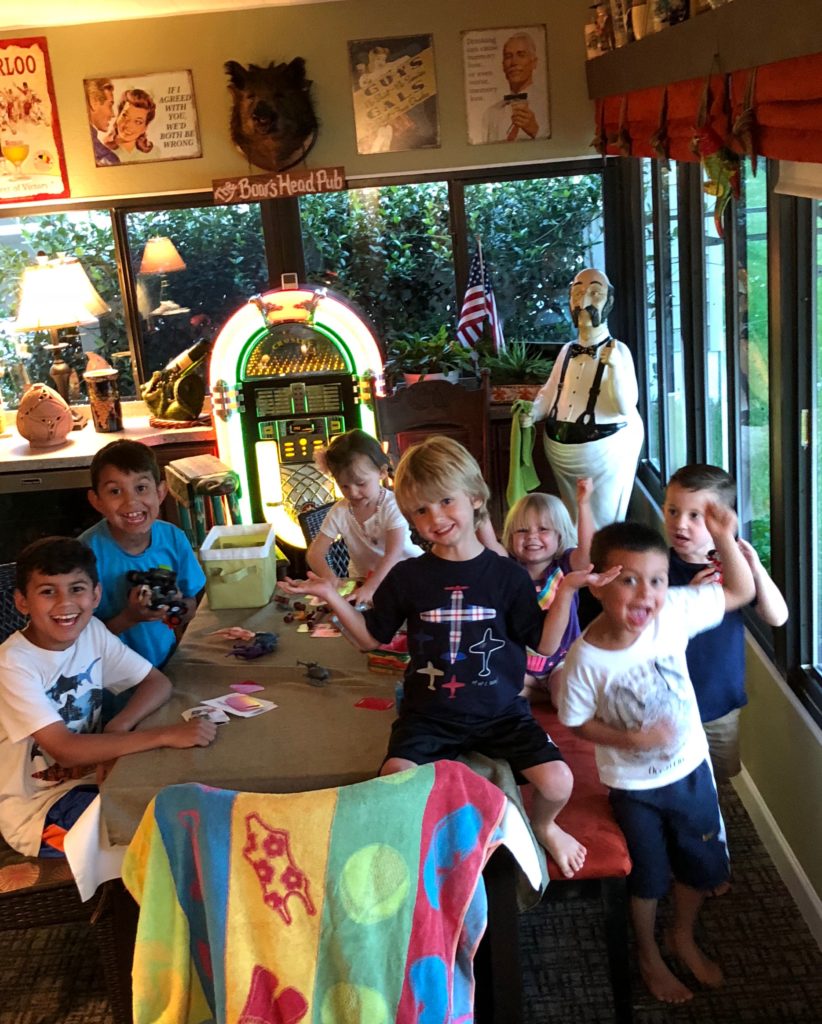
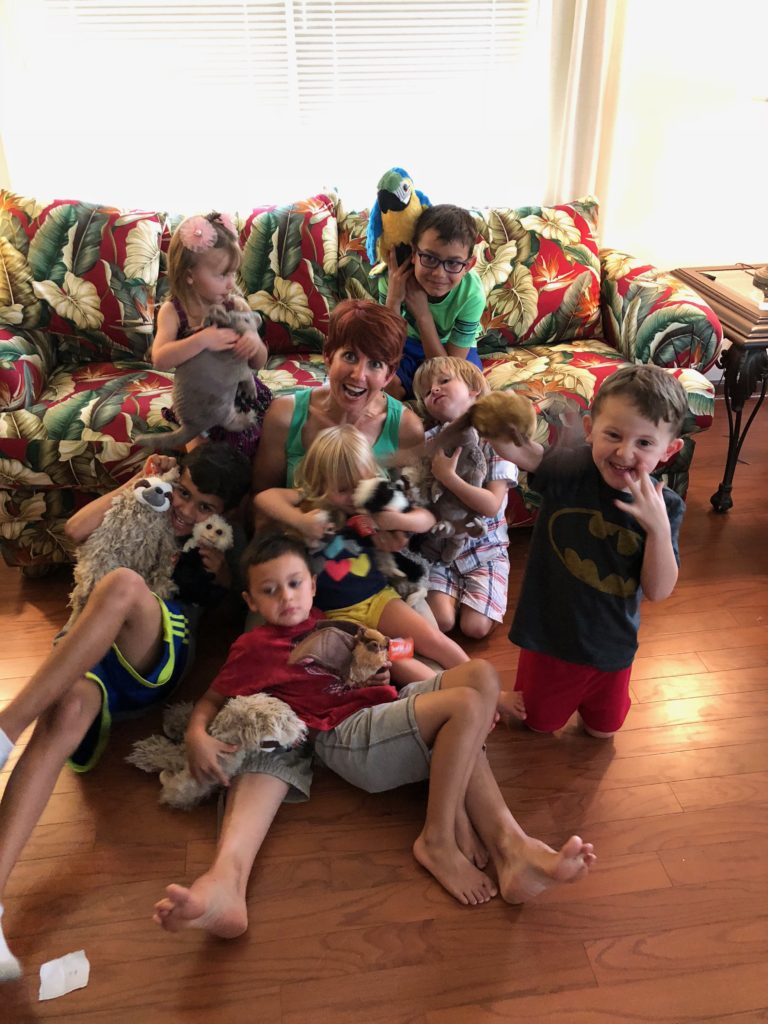
That was a whole lot of chaos at my parents’ house, so I hauled all seven nieces and nephews up the street to my vacant house. They played with legos and army men, made slime, wrestled, and colored. We had an epic pillow fight with the many trash-bound pillows left by the previous owners.
For my Super Auntie moment, I had planned a special presentation about Costa Rica. The little cuties all sat at my feet like they were in circle time at school while I shared fun facts about the different places we visited and showed pictures on my phone of the animals we spotted on our trip. At the end, I leaned down and whispered, “Guess what? I brought some of the animals back for you.”
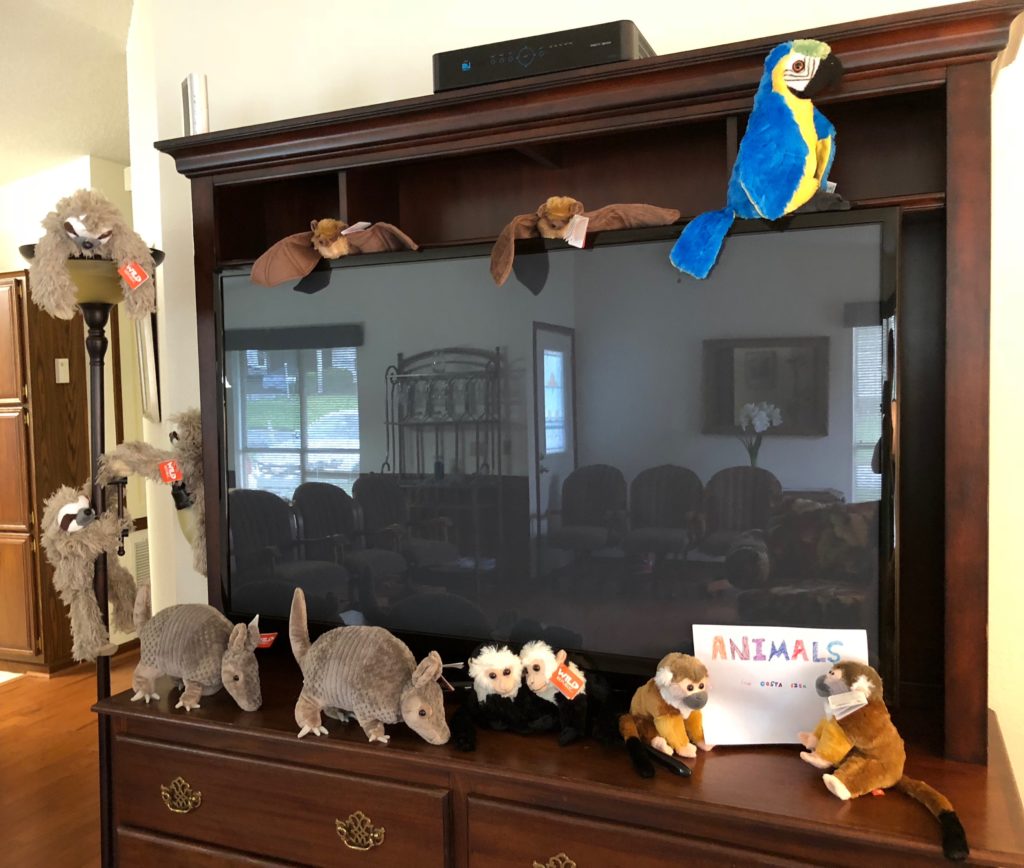
They paraded to the living room, where my oldest nephew, Nico, had helped me set up an exhibit of stuffed animals. He made a sign and positioned the sloths, bats, squirrel monkeys, white-faced monkeys, armadillos, and a macaw on the TV cabinet. He and I had come up with a system for each kid to draw a number, and then they would go in that order to choose their animal to keep. I worried that they would fight over a specific animal or get upset if they didn’t get the one they wanted, but it all went smoothly. Their cherubic smiles swelled my heart and eased my distress at spending a cubic ton of cash on amazon to get those toys.
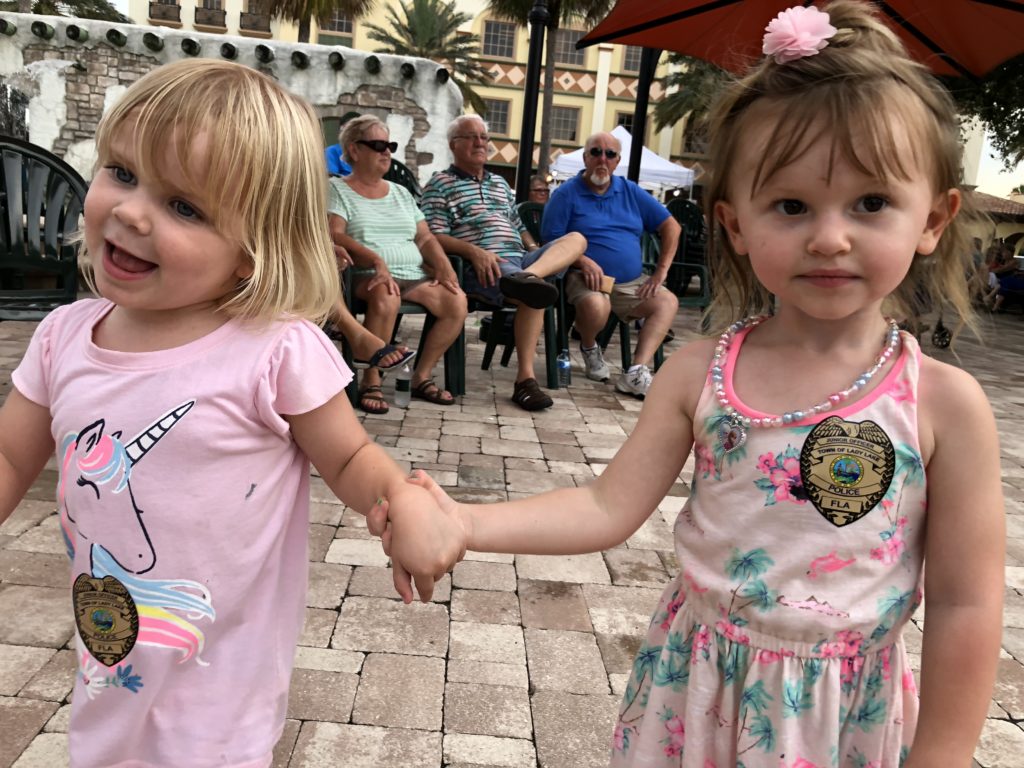
Of course, there was the requisite dancing in the Spanish Springs town square (accessible by golf cart from my parents’ – and, gulp, now our neighborhood).
We also went bowling one afternoon and got a lot of attention. “You guys sure have fun,” one bowling alley senior commented.
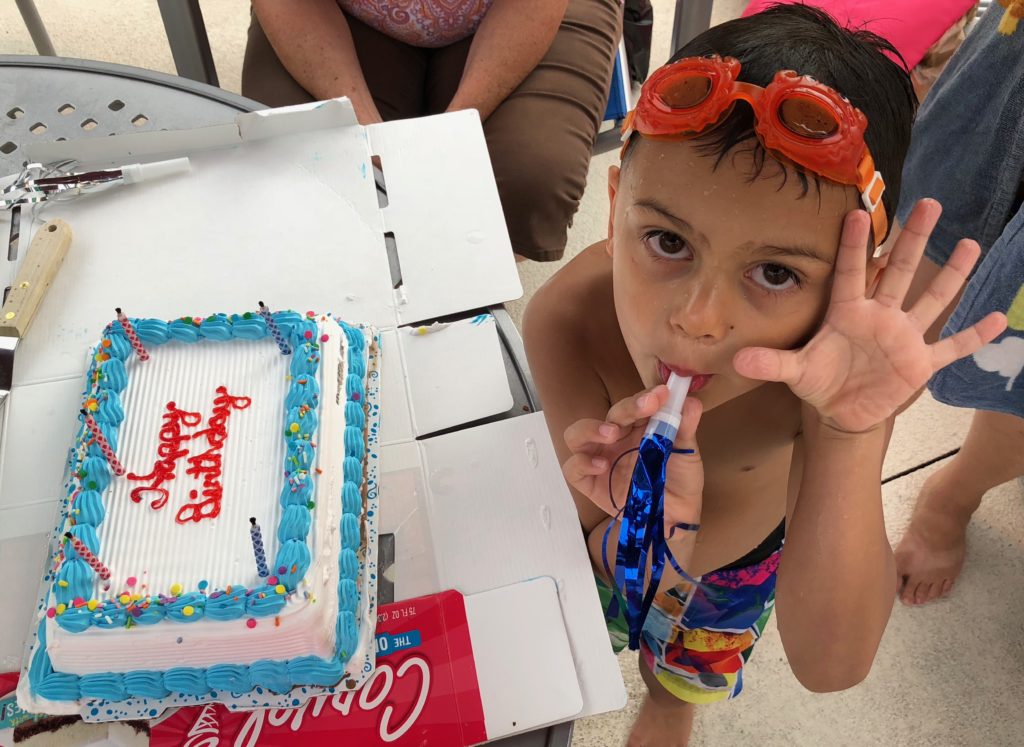
And Jack celebrated his 5th birthday poolside.
We crammed a lot of love into less than a week’s visit. Adios till Christmas!
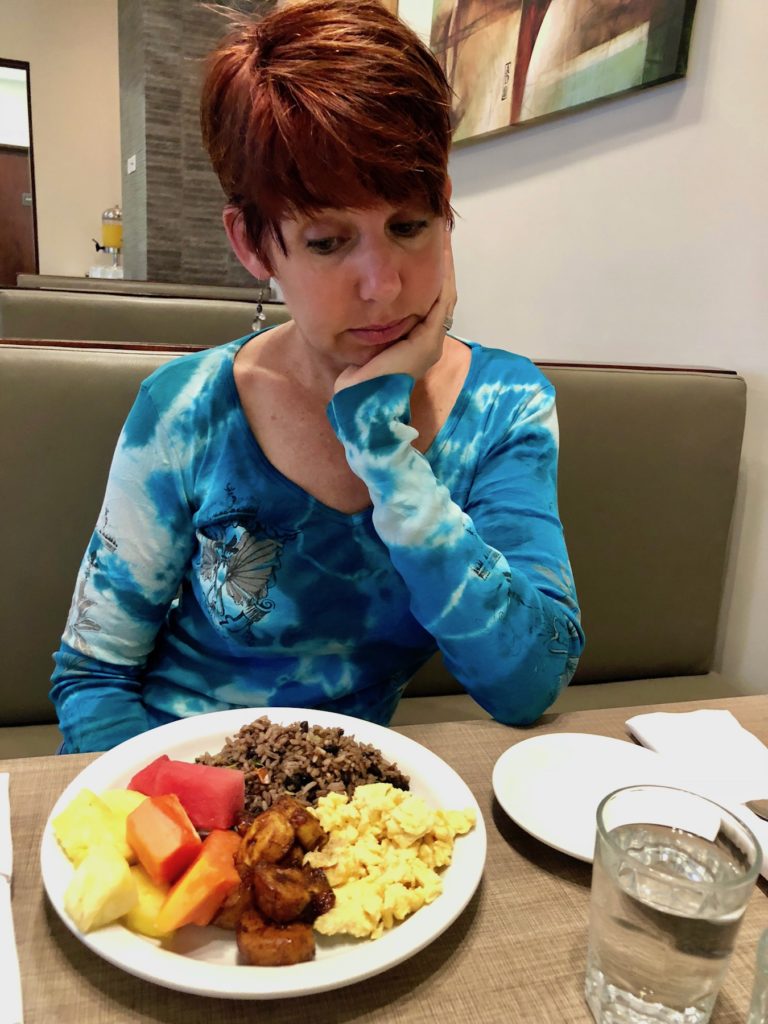
I have eaten some variety of rice, beans, and fried plantains for breakfast, lunch, and dinner almost every day for three weeks. You would think I’d be sick of it, but you know what? I looked forward to every meal. And I was feeling a bit glum this morning, knowing it was my last gallo pinto, the traditional Costa Rican breakfast.
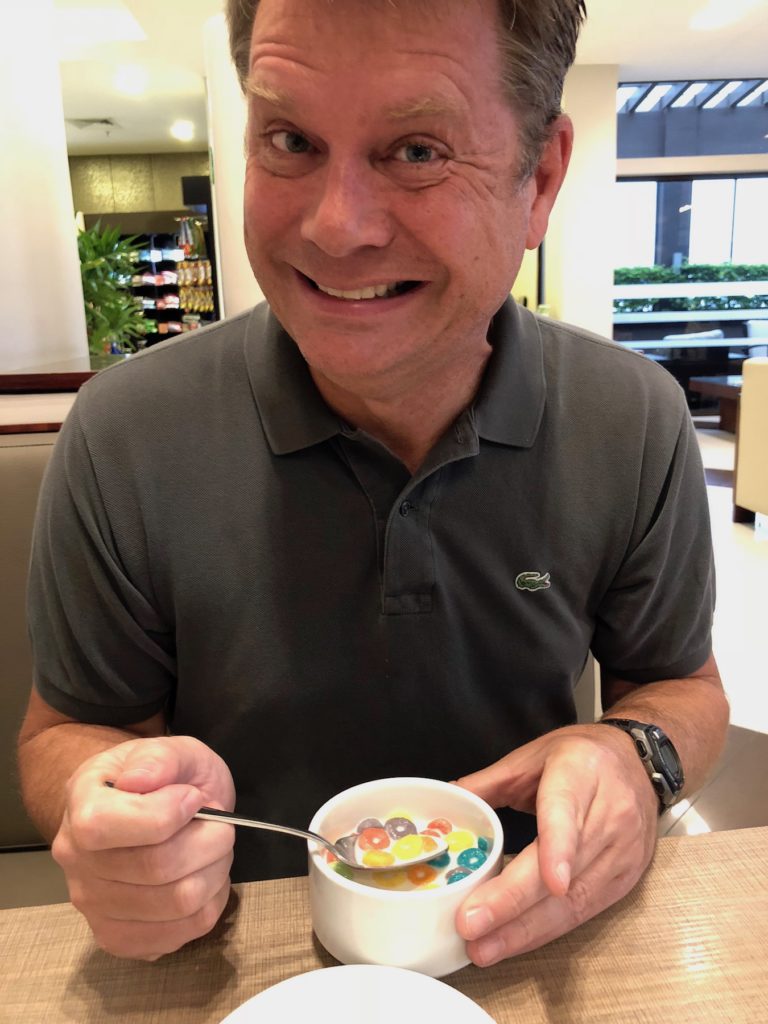
Tony, on the other hand, was totally psyched to find Froot Loops at the hotel breakfast buffet. “I feel like I have to eat this since I saw three different kinds of toucans on this trip,” he said.
I’m writing this at the San Jose airport (Costa Rica, although google maps kept defaulting to California), waiting for my flight to Orlando. Tony and I have been living abroad and traveling the world for 18 years, and this was one of our best trips ever. I feel pretty certain we’ll be back!
With one more week till school resumes, Tony is heading home to Santiago, and I am on my way to see my family. All three siblings will be there with their spouses and kids, and I’ll crash on my parents’ sofa. There will be no peaceful morning coffee with toucans, but my mom has parakeets, and my nephews are actually not that different from the squirrel monkeys we saw playing in the rainforest canopy.
In preparation for this trip, Tony and I read Monkeys are Made of Chocolate, a wonderful collection of essays by an American who came to Costa Rica as a cattleman and became a naturalist. The author, Jack Ewing, shares fascinating and enlightening anecdotes about his encounters with wildlife on his property, which he gradually transformed from pastureland to a lush nature reserve called Hacienda Barú National Wildlife Refuge. The reserve encompasses 830 acres of protected area with a variety of habitats, including tropical rainforest, swamp forest, mangrove estuary, pastures, river banks, and beach front.
When we awoke to another overcast morning yesterday, we decided to ditch our beach plans and instead visit the place we knew so well from Ewing’s book. We reached Hacienda Barú in about half an hour and bought our day pass to the trails. Timidly, I asked if Ewing was available and was told he generally arrived at about 8:30 a.m. I seriously got giddy at the thought of meeting him.
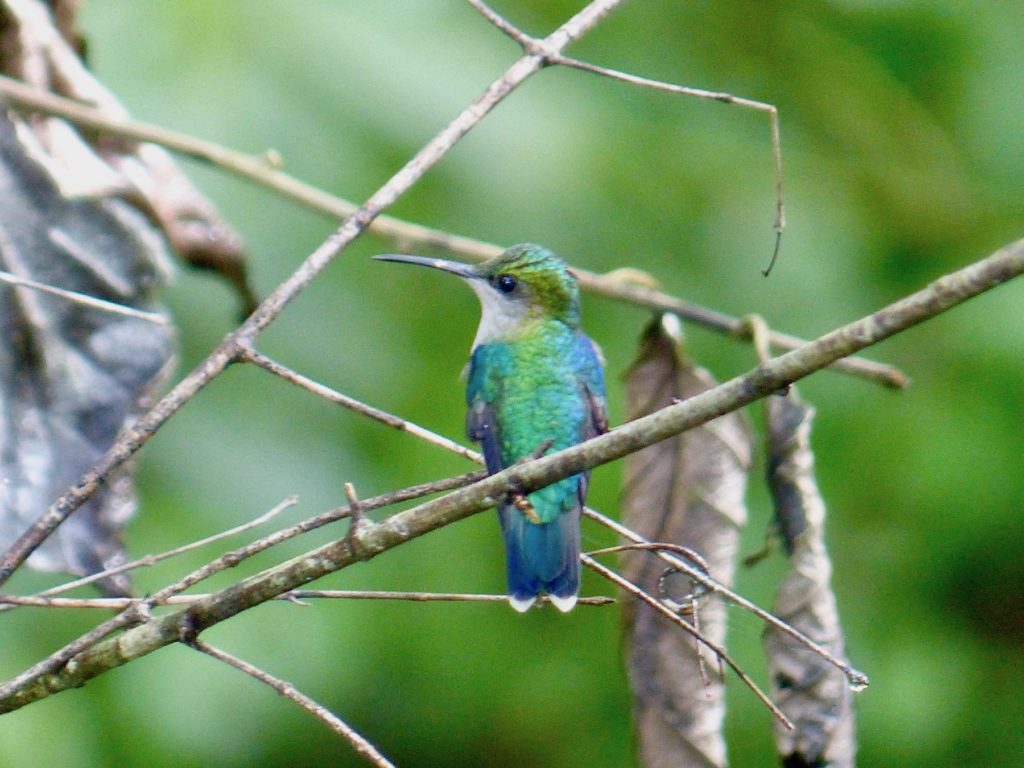
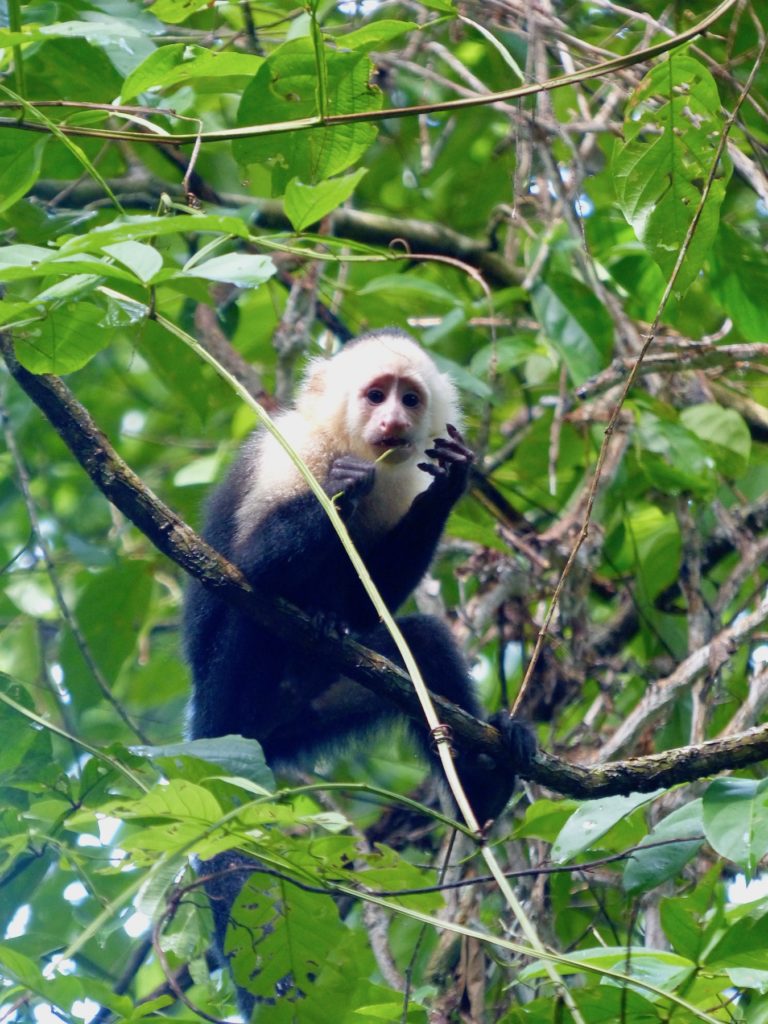
We hit the first trail, which was wide and flat. Right off the bat, we found a hummingbird, a small agouti (the oversized rodent), and some capuchin monkeys.
The easy path branched off and crossed the main road to lead up a hill to the Lookout Trail. No longer wide and flat, this trail was steep and muddy but amazing.
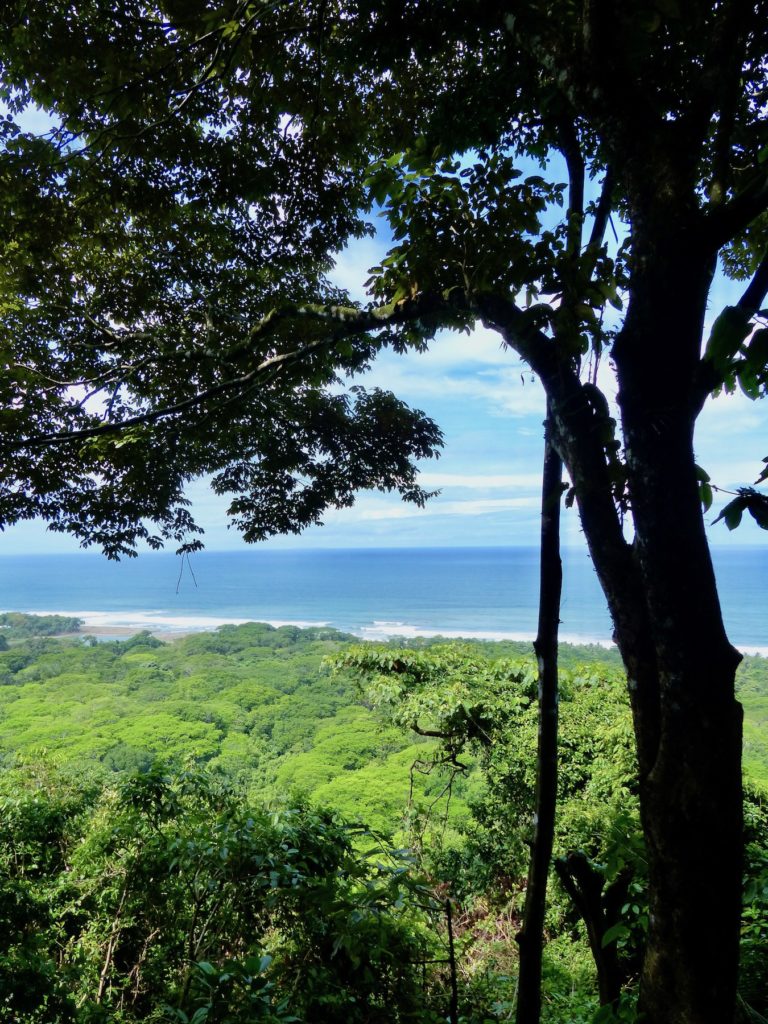
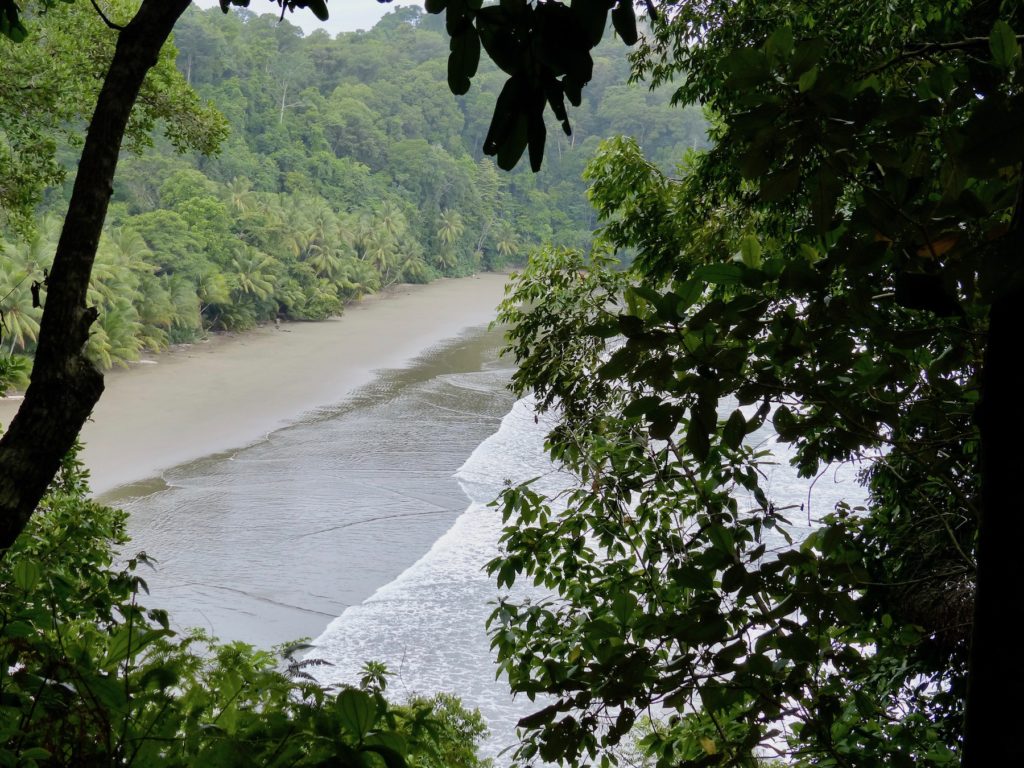
When we finally reached the top, we were drenched with sweat and panting to catch our breath. But this was the view, so …
A sign at the top explained that the Lookout Trail passed through a section of Hacienda Barú that was the first to be restored back to its natural state after several decades of deforestation for crops and cattle pasture. A photo shows the barren hillside from 1979, when workers stopped chopping weeds on the hillside. Another picture, from 2015, illustrates the forest’s resilience with dense, mature vegetation, the way it looked for us on this day.
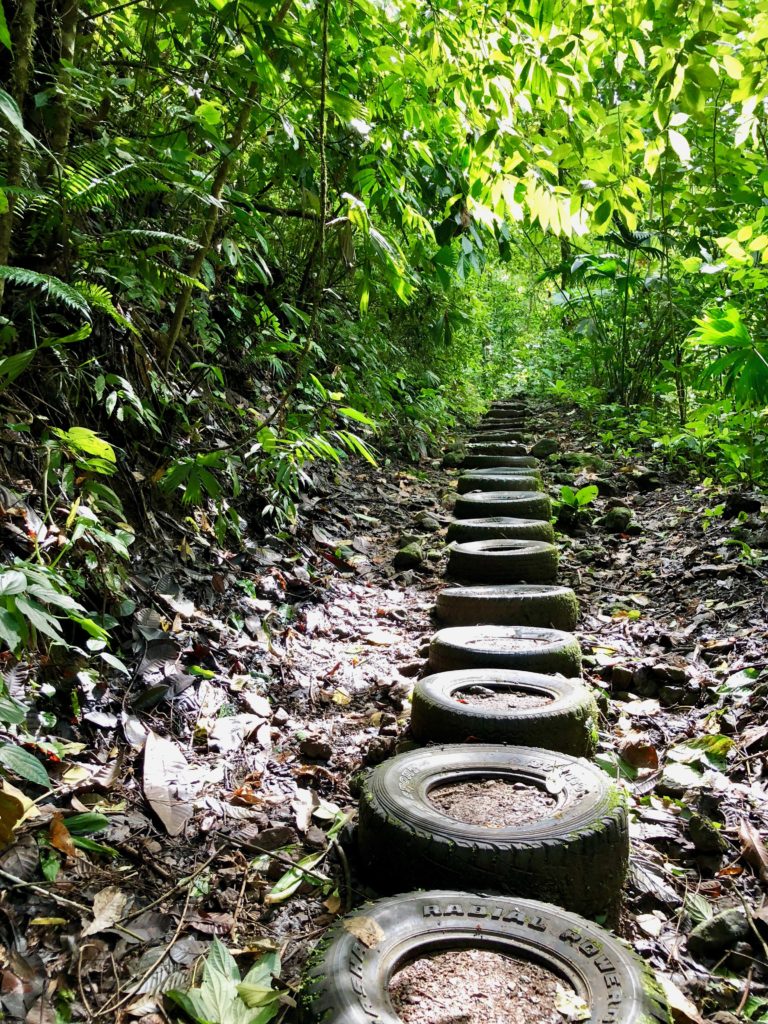
The challenging trail continued for about another half hour’s walk around the top of the hill, and then we headed back down. At the bottom, we met an old man who was chopping wood. He told us he’d been working on this hill for 25 years, helping to keep the trail accessible by cutting steps into the earth and reinforcing them with his wooden shingles and stakes. Although his work seemed tedious and hot, he wore a big smile and seemed genuinely happy to receive our appreciation.
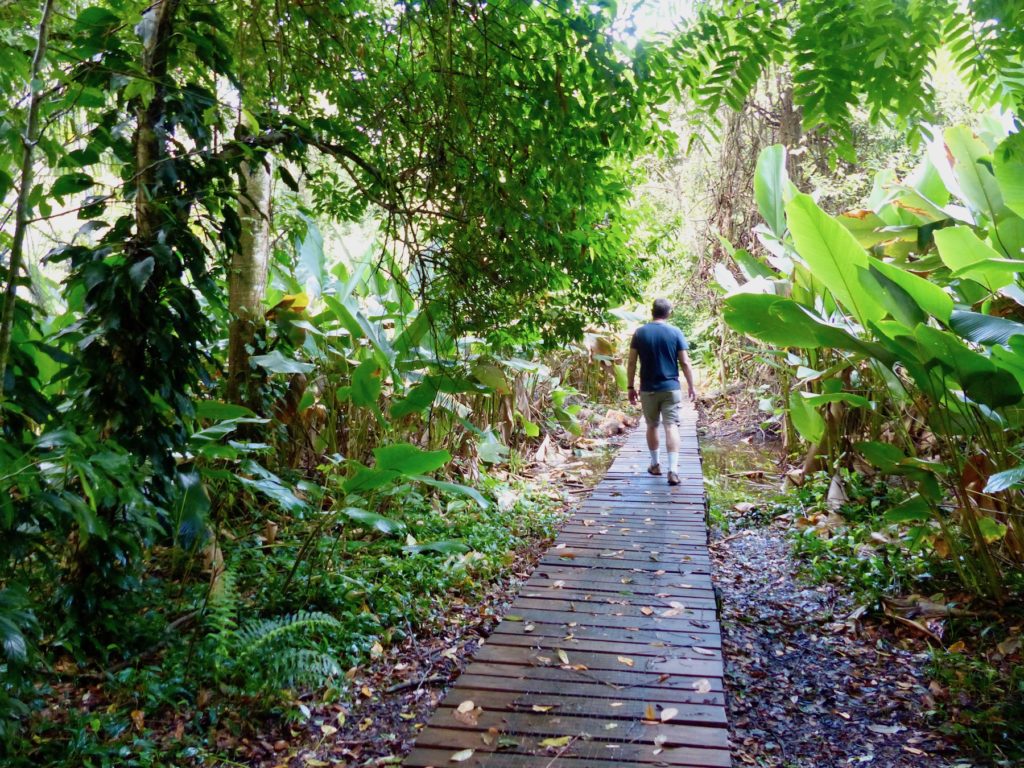
All of the trails we hiked featured informative signs about the flora and fauna, and some had nice little touches like sunken tree stumps or wooden sidewalks to help us pass the particularly wet or muddy sections.
Possibly the most enthralling creature we encountered on this day (and frankly, on our whole trip) might be the smallest: the leafcutter ant. I mentioned it in a previous post, but at Hacienda Barú, we saw some mind-blowing ant trails. One sign said Ewing had followed a trail for more than half a kilometer between its source and its nest. Can you imagine the equivalent distance for an animal of our size? According to the BBC, a leafcutter ant can carry a piece of foliage 50 times its weight. That would be like me walking half a kilometer carrying a cow!
Check out this video. It’s insane!
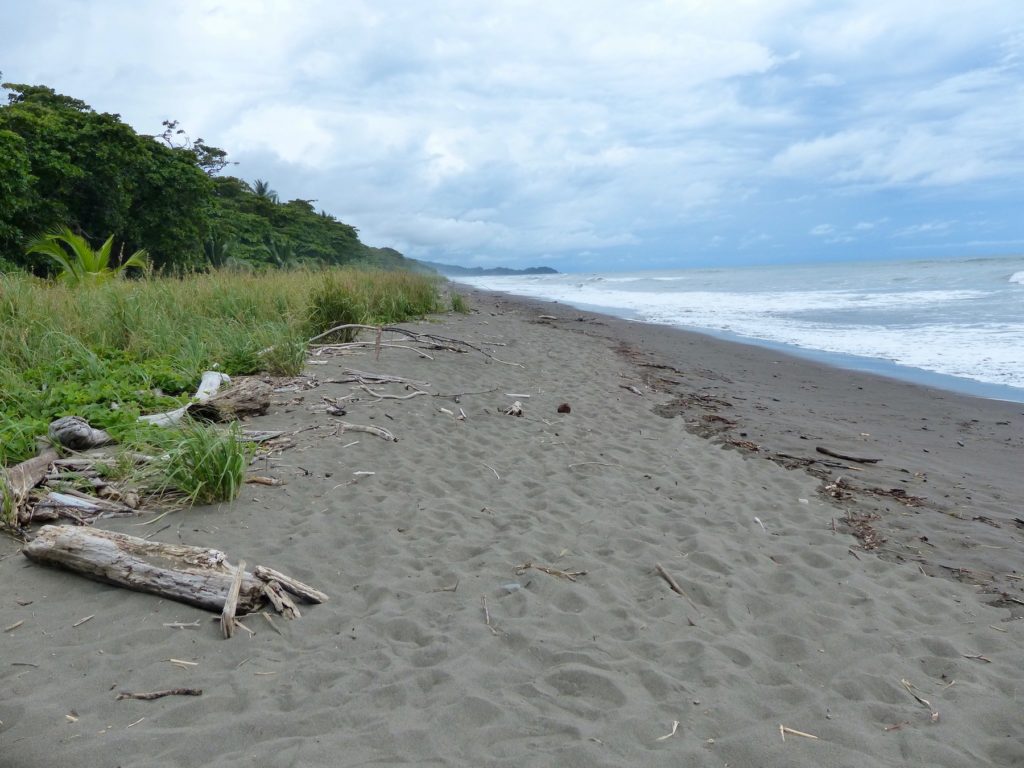
At the end of the trail, we followed the road down to the beach. Ewing writes about the importance of this coastal property on his website. It is one of a few areas along the coast with long stretches of Indian almond trees, which provide food for scarlet macaws, squirrels, capuchin monkeys, parrots and parakeets, he said.
The scarlet macaw disappeared from this area in the late 1960’s as a result of overhunting, deforestation of old growth forests that provide nesting sites and a marked decrease of the Indian almond tree from the beaches. Wherever people move to the seashore one of the first things they seem to do is destroy the almond trees and plant coconut palms. On shorelines where there is a thick natural stand of almonds with a healthy volunteer nursery of young trees underneath, the beach always remains intact. The thick tangle of roots holds the sand in place forming a natural barrier to the heavy wave action during stormy periods. There is a minimum of erosion of the line between beach and land. In contrast, where coconut palms have been planted the waves wash away the sand between trees and underneath the ball of palm roots causing them to fall over.
I couldn’t stop thinking about Jack Ewing’s legacy. By creating this nature reserve and launching his education, conservation, and research projects, he is helping to ensure future generations understand the importance of protecting this fragile ecosystem. His writing reflects a voice of compassionate intelligence with a little folksy self-deprecation, which made me worship him a bit.
When we wrapped up our hike, we popped in to the office to see if Ewing was there. He kindly came out to the reception desk to greet us, and I acted like a prepubescent girl meeting Justin Bieber (or whoever is cultishly cool now with that crowd). I gushed about how much I admired him, and I thanked him profusely for creating such a special experience for visitors. I blathered on about what a powerful impact he has made in the region. And, well, shoot, I don’t know what else I said, but I’m sure it was embarrassing. Anyway, we shook hands, and I skittered out of there without taking a photo, dang it!
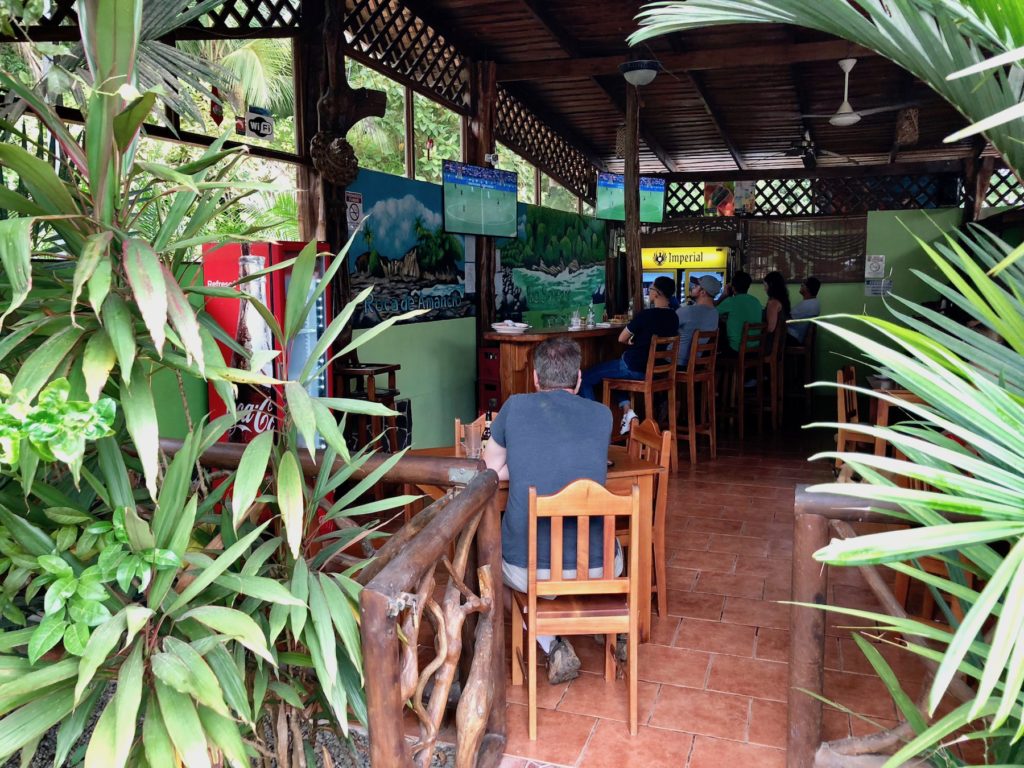
On our way back to the hotel, we stopped at a roadside restaurant where we had eaten delicious comidas typicas the other day. The place was packed with locals watching the World Cup match between England and Croatia, so we stuck around to see Croatia win in overtime.
This was one of my favorite days of the whole trip.
I had a vision of wrapping up our Costa Rica adventure with a few lazy days at the beach. We would read our books, banter about our favorite moments of the trip, and take turns cooling off in the waves while alternately guarding our bags from thieving monkeys. Alas, the one drawback of traveling to the rainforest during rainy season is, well, rain.
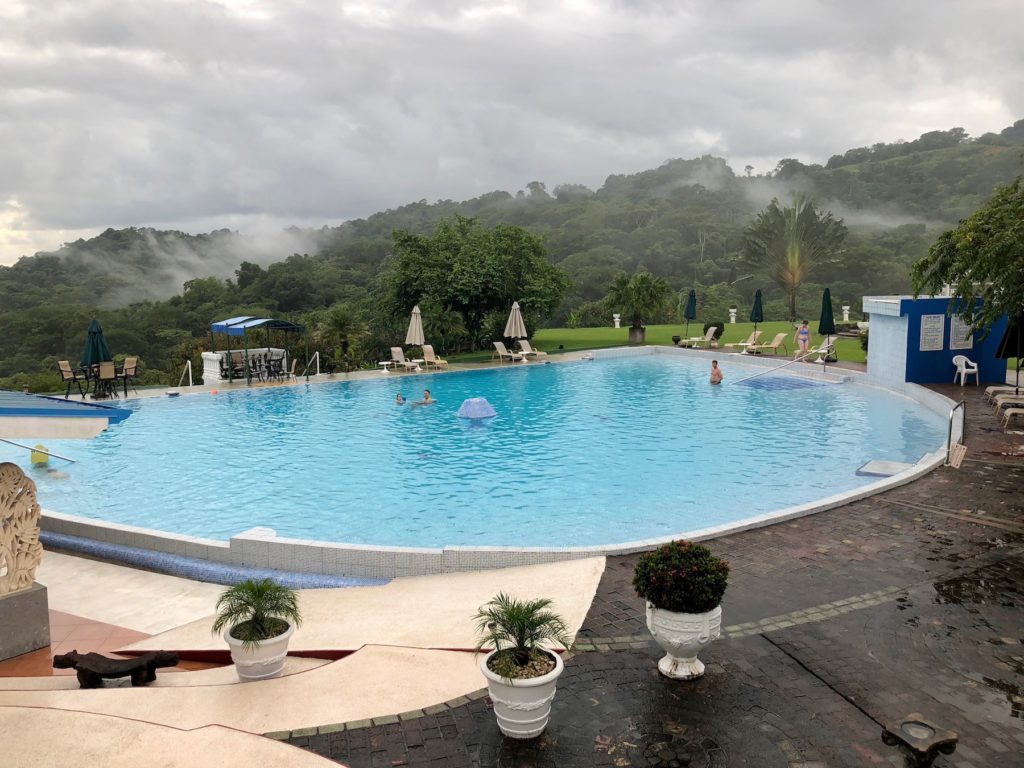
We’ve been pretty lucky, really. We like to get our days started early, and fortunately for us, the rain tends to hold off till after lunch. Nevertheless, we’re not having the “beach weather” I envisioned. Instead of lounging at the beach, we’re lounging at the pool, in our room, and on our terrace here at Cristal Ballena Boutique Hotel & Spa.
When I booked this place, I didn’t realize it was named one of nine “Costa Rica Birding Hotspots.” The hotel has recorded 200 bird species on site, and I am surprisingly obsessed by this.
Do you know the collective noun for a group of toucans? It’s a “durante.”
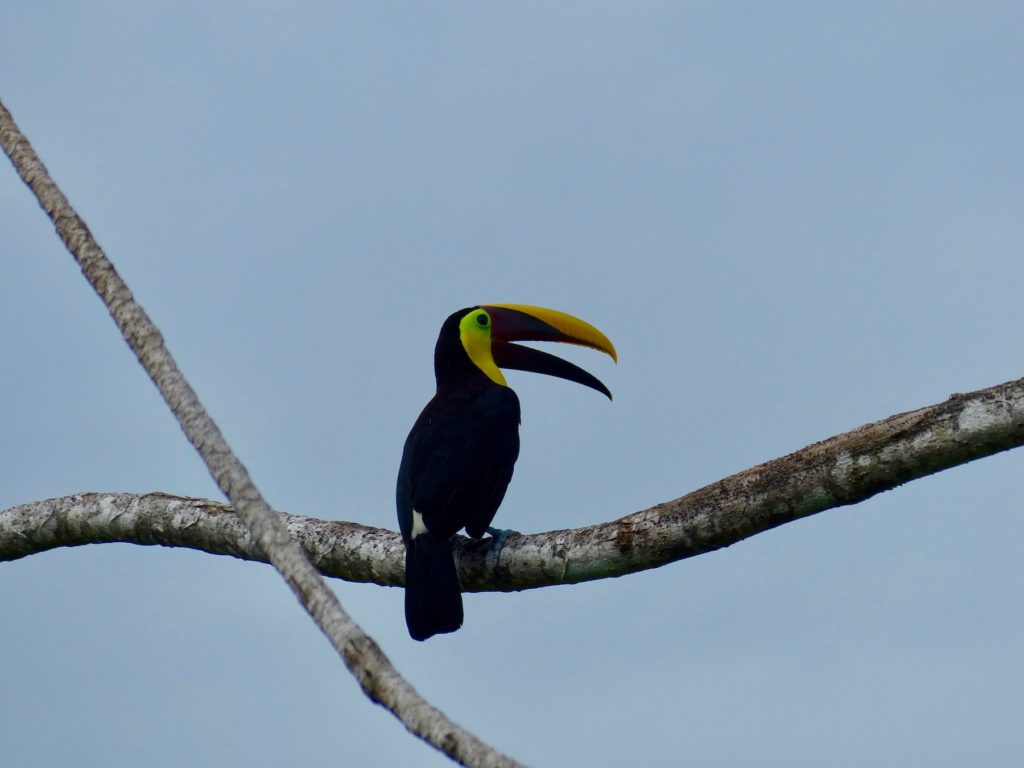
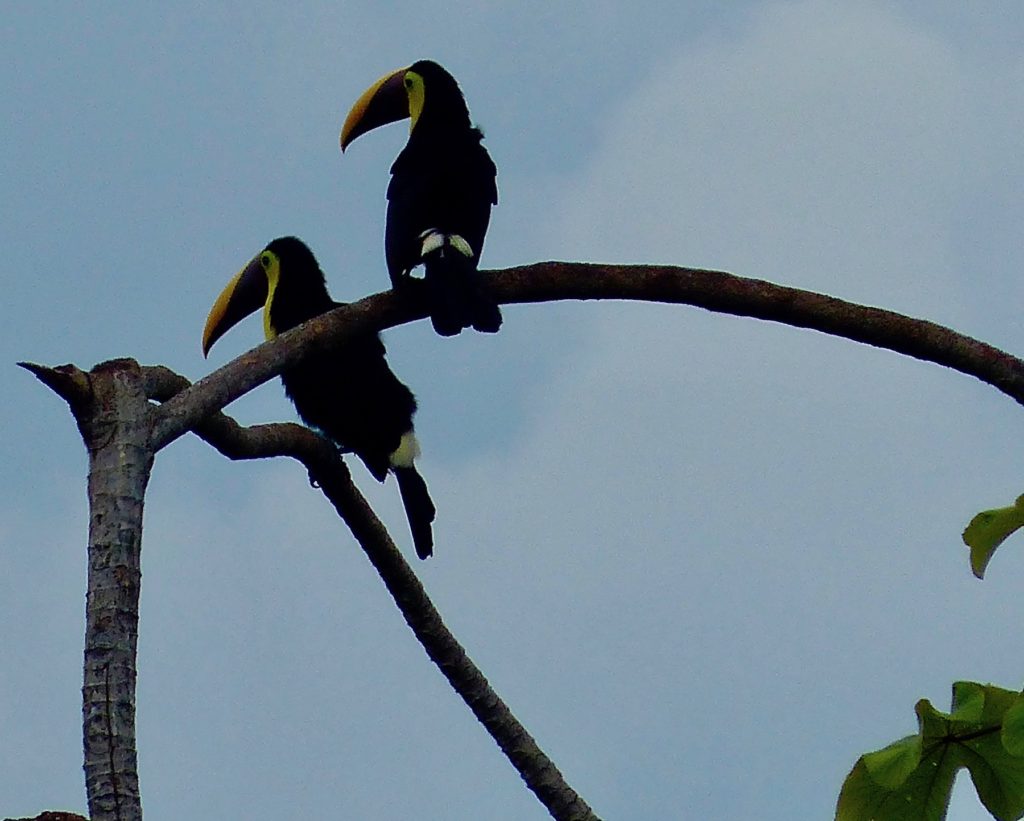
Do you know why I know that? Because a durante of yellow-throated toucans hung out in the tree next to me at breakfast on Tuesday! I counted seven. They were fascinating to watch with their top-heavy bodies. They hop like a wind-up toy up the tree branches and then soar to other trees. Two smacked beaks together repeatedly; not sure if that was aggressive behavior or if they were just playing.
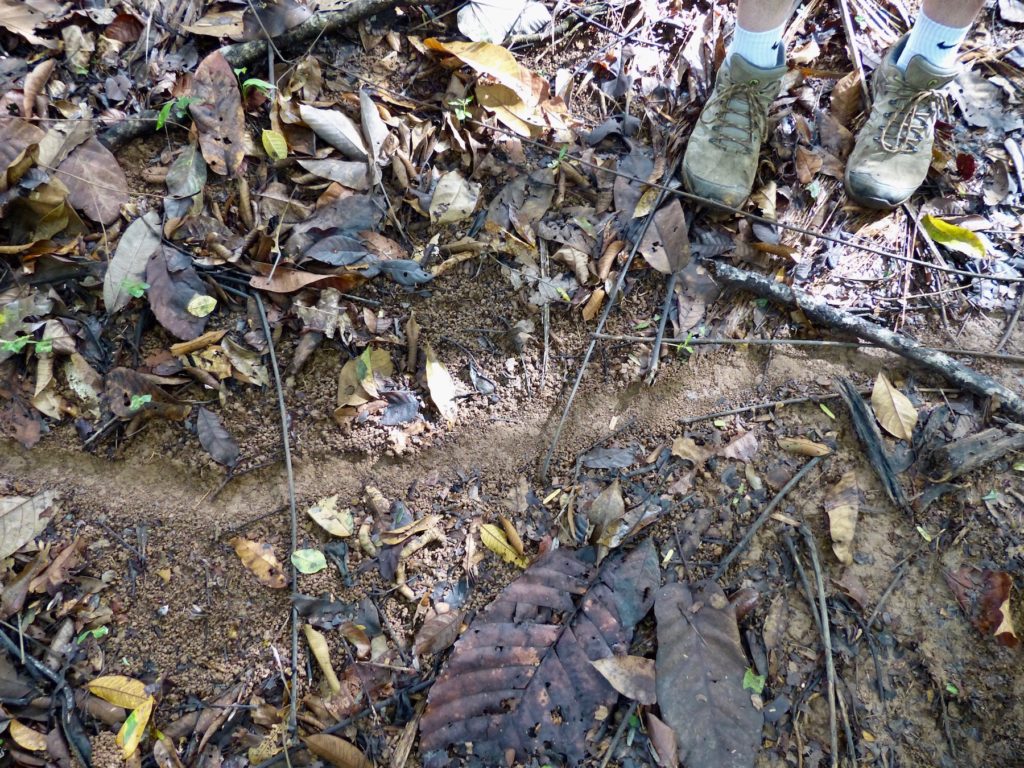
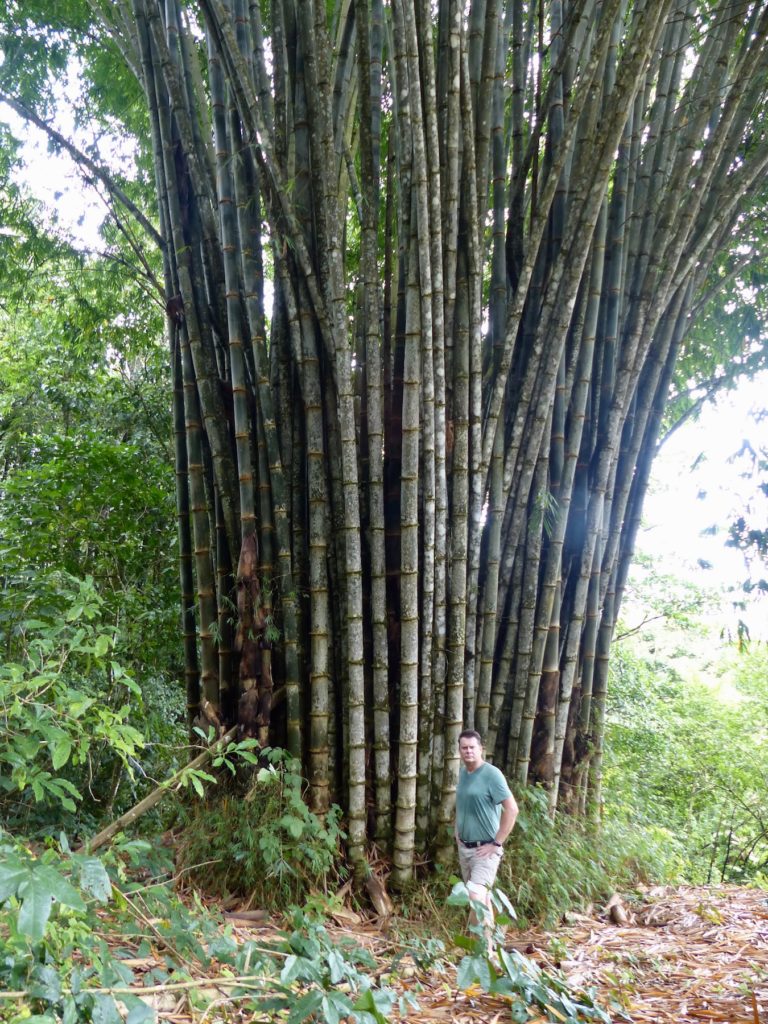
We tackled the hotel’s rainforest trail, which was a mess of slippery mud after all the recent rainfall. The only real excitement was finding this track. We figured it could only have been a snake, so we tentatively poked around the area in hopes of finding a boa, but no luck. The trail ended at this huge stand of bamboo. When you see how tall it grows, it’s hard to believe it’s not indigenous.
After reading on the terrace and napping, we decided to check out Uvita Beach for lunch. We thought google maps was messing with our heads or that we just never really found the right place, but later I read that the beach essentially disappears at high tide, and there were no beachfront shops or restaurants because there was literally no beachfront.
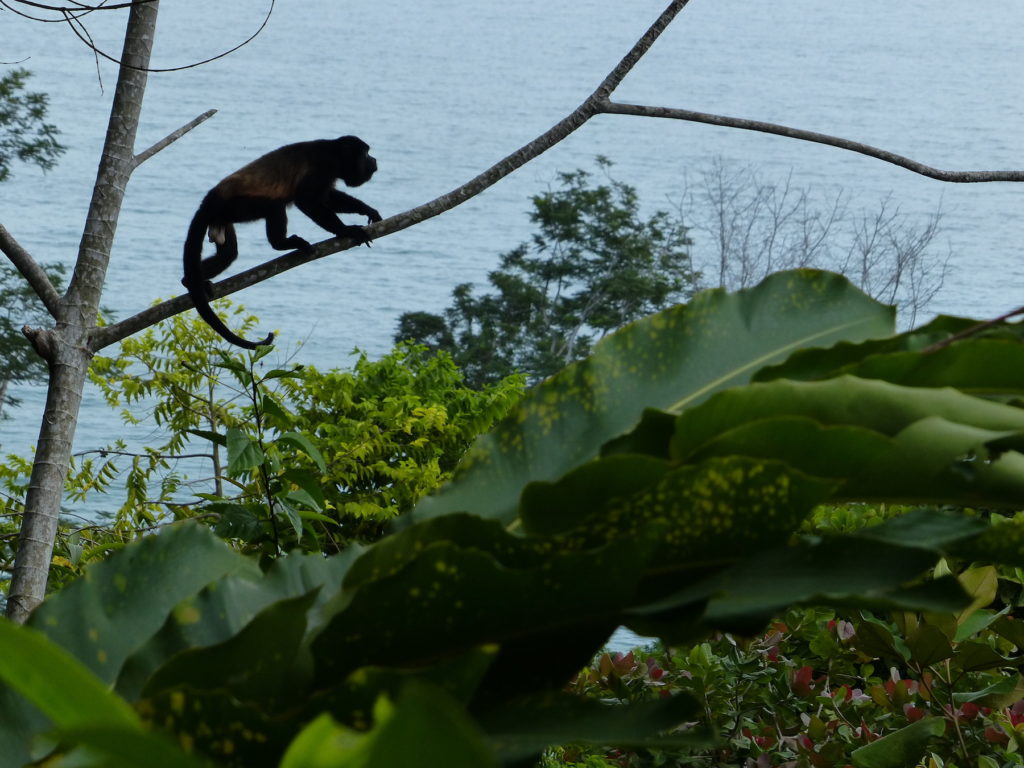
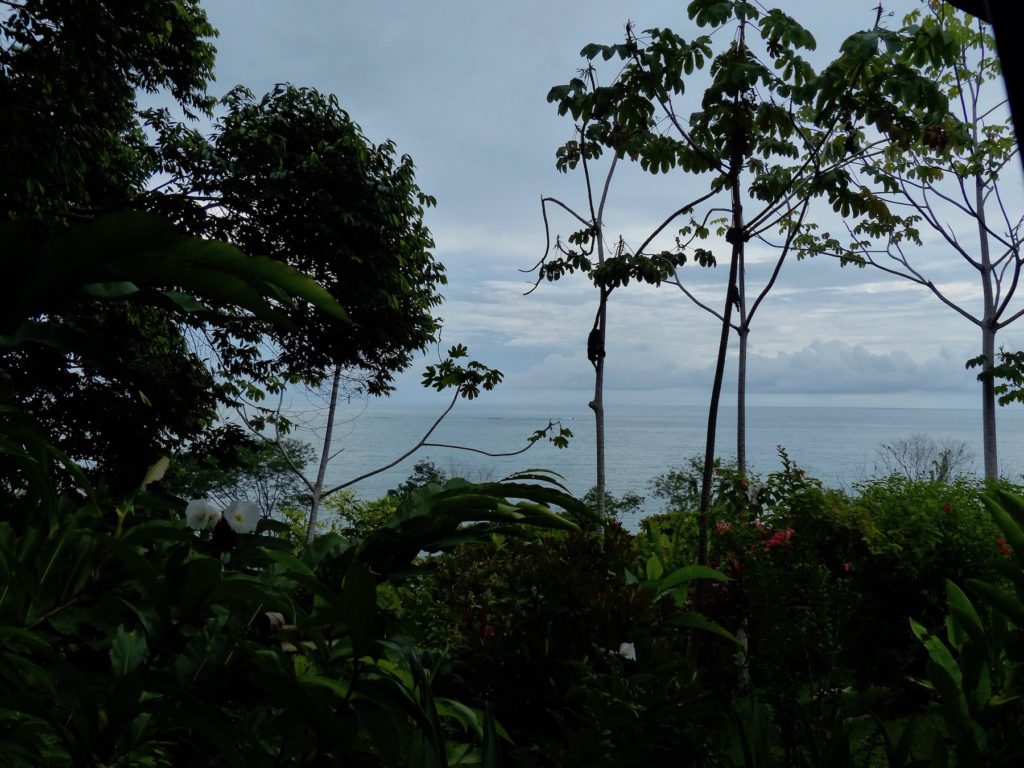
I had heard of the restaurant at La Cusinga Lodge, so we decided to check it out. Holy moly, what an incredible place! We were greeted at the parking area and led to the Aracari Restaurant, high on the hill looking out over the jungle and the ocean. That would have been fabulous enough, but then a howler monkey put on a little show for us. He climbed from tree to tree, plucking off flowers and shoving them in his mouth. His prehensile tail wrapped around a branch while he dangled to grab a snack or reached precariously far to grab the next limb in his path. Finally, he found a good spot in the canopy to curl up for a snooze. A couple other howler monkeys came along and woke him up, and they all wandered off after a while.
This was our view, and our monkey friend is right smack in the middle, climbing down the tree.
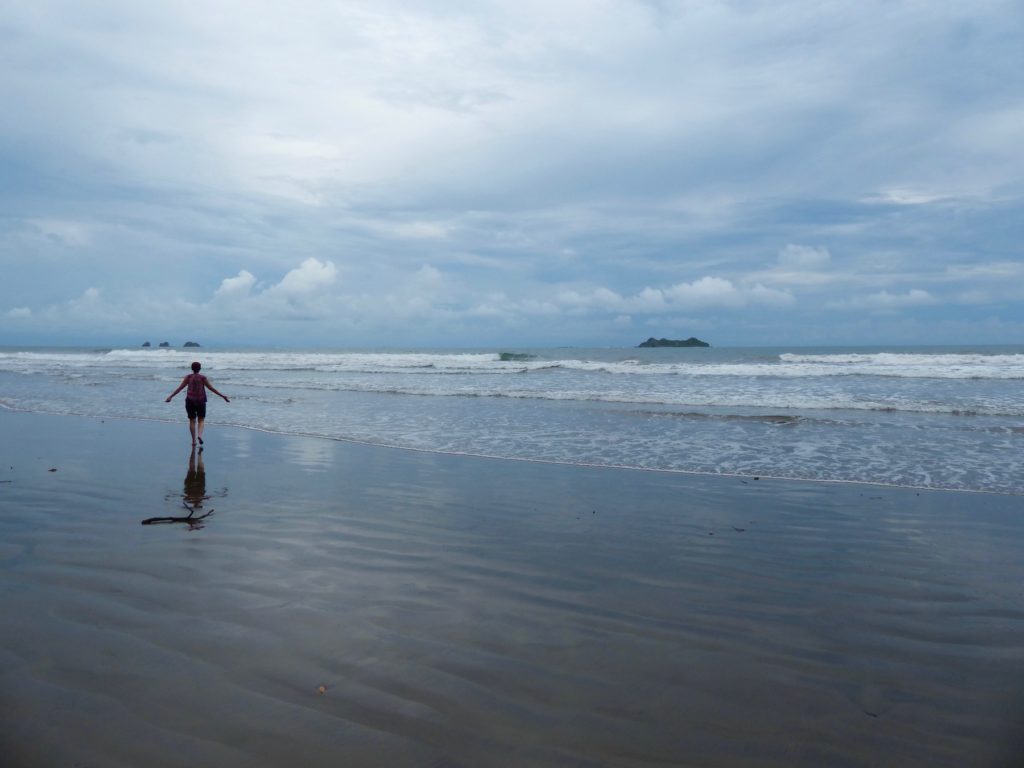
As we prepared to leave, we noticed a delivery truck blocking our car. At the same time, I saw a sign pointing to the beach. “Let’s check out the beach while we wait for that guy to move,” I said. We took off down the path. It turned out to be a long, steep, muddy path. But it was SO worth it! We finally emerged from the jungle at this little pristine stretch of sand. Not another soul in sight. I was elated. Of course, I immediately kicked off my shoes and waded into the warm water. Rain or no rain, I will be returning to this beach for a proper swim.
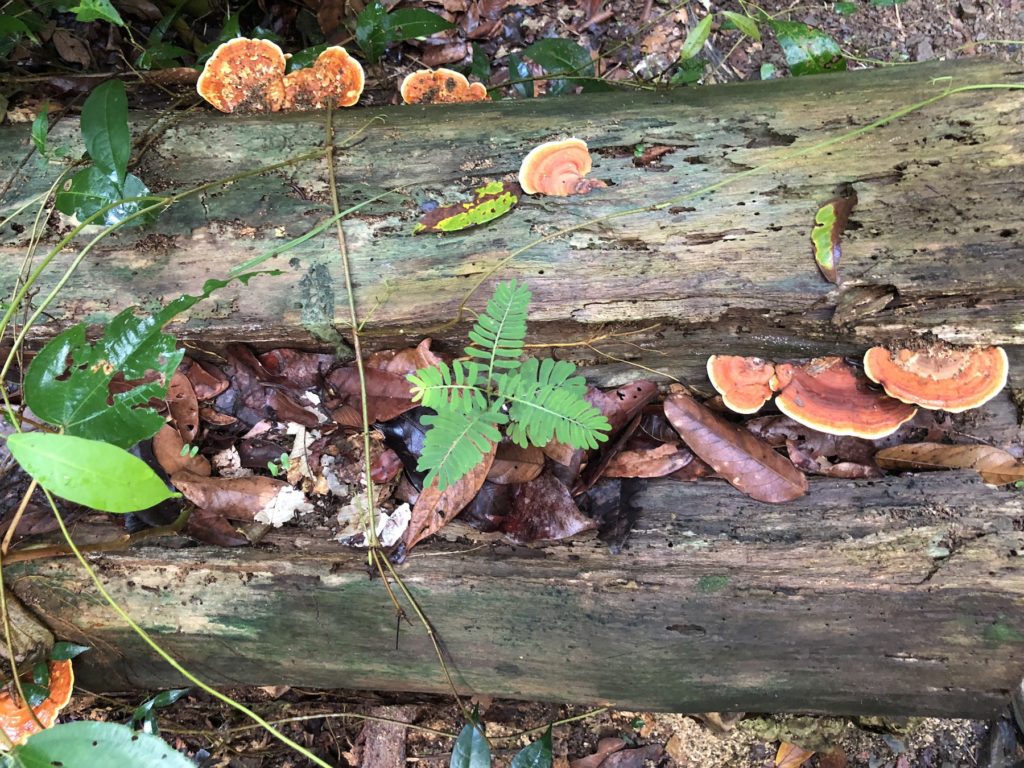
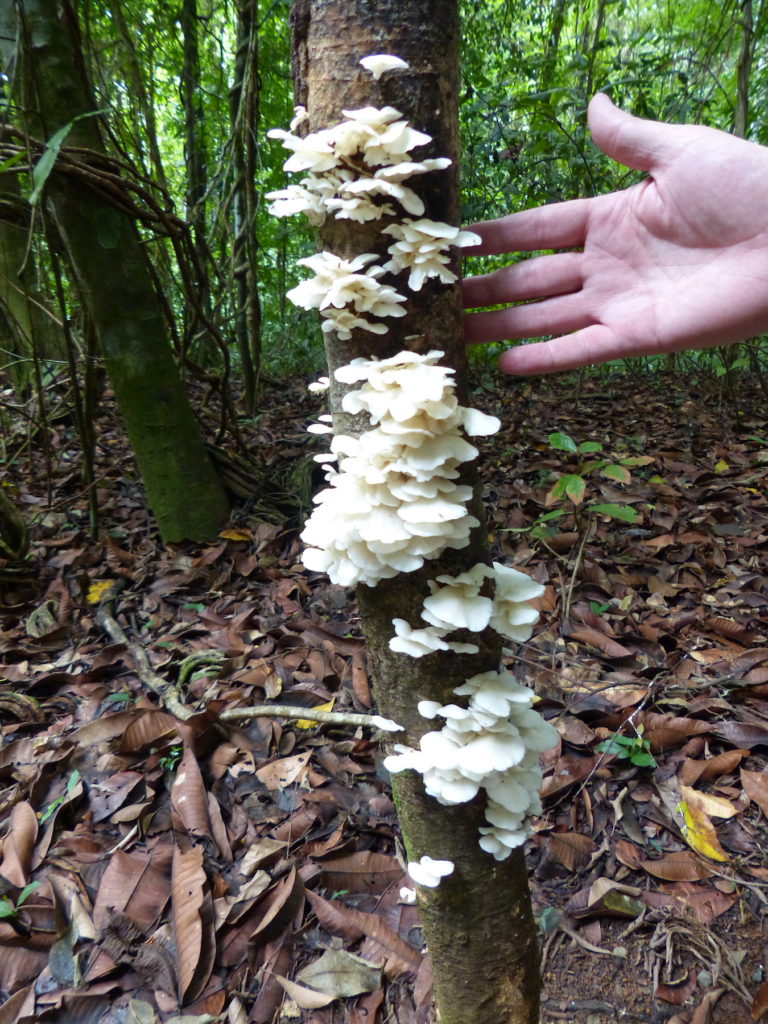
Decomposers, important components in the food chain (as we learned in third grade last year).
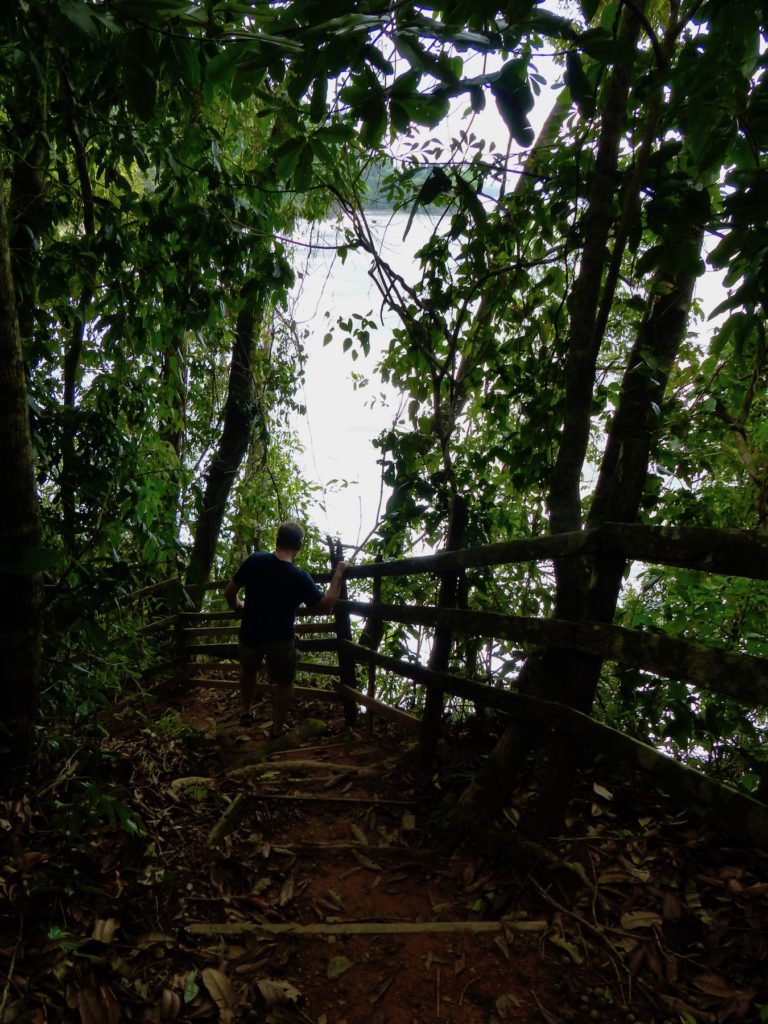
We did not expect this to be so hard.
Almost there!
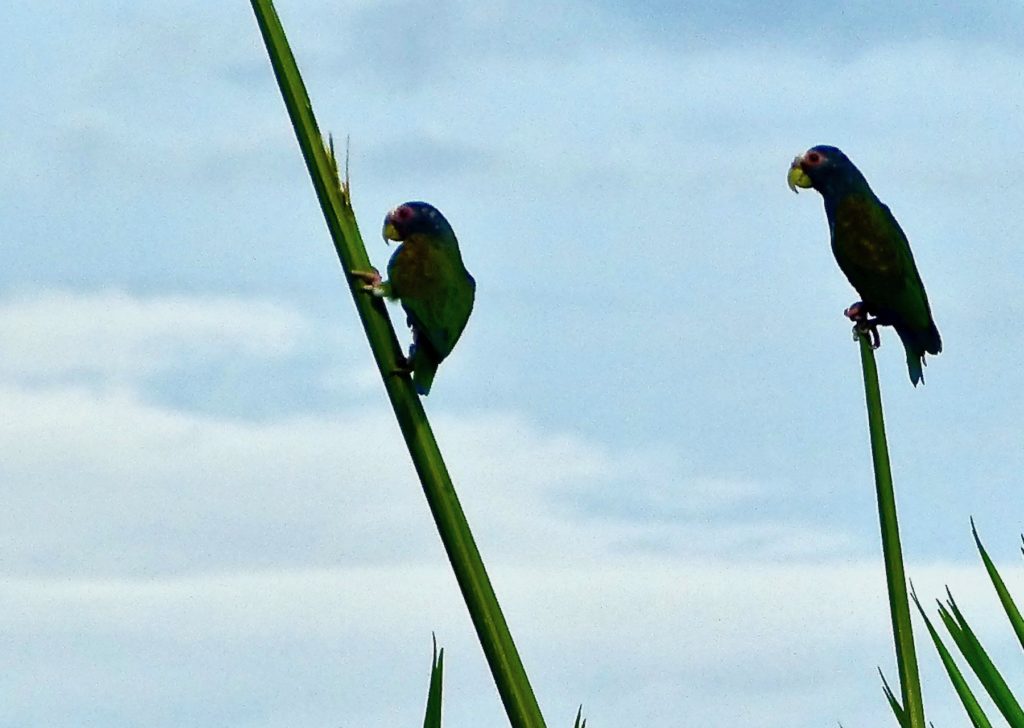
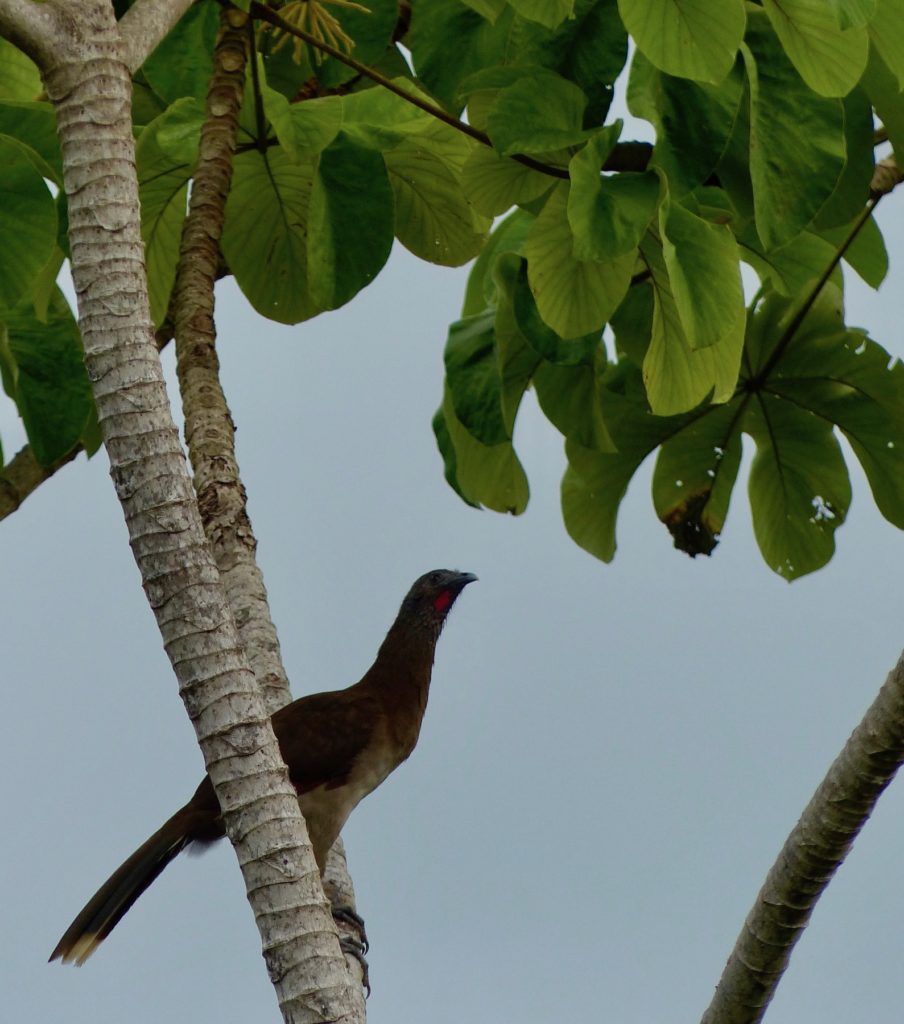
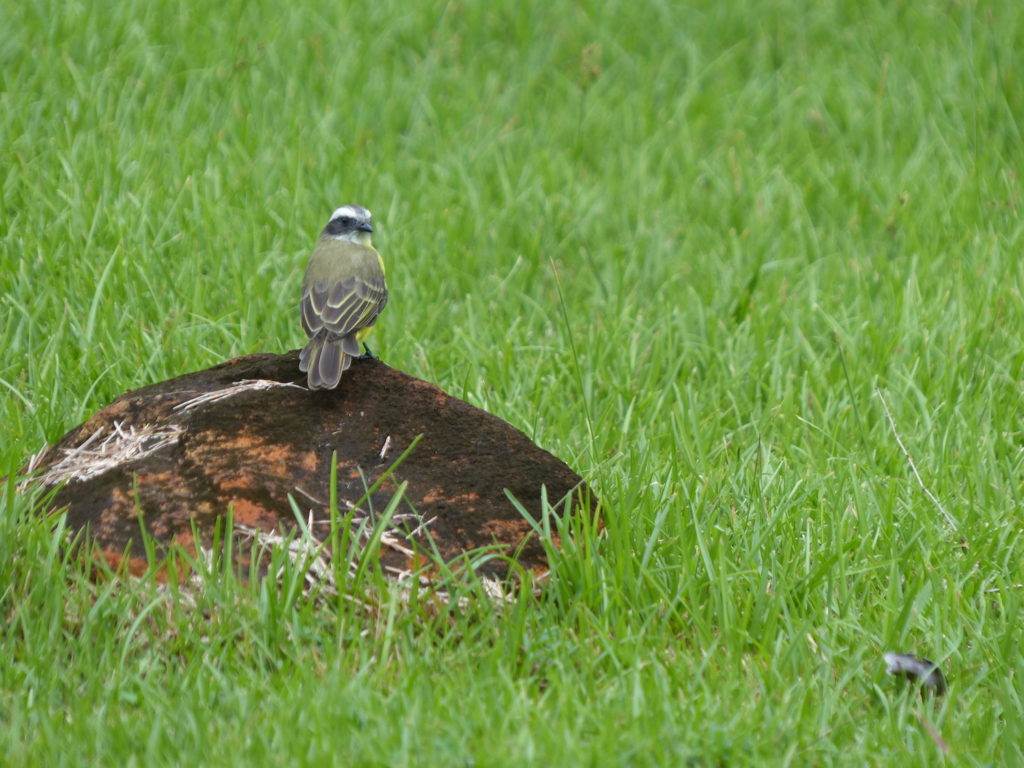
The rest of the day was filled with birdwatching from our terrace: more toucans, some white-crowned parrots, tropical kingbirds (little brown songbirds with yellow tummies), and big brown birds with the coolest name ever, gray-headed chacalacas. Not the best photos, but I blame the birds who refused to stand still.
Over cocktails last night, Tony and I were trying to decide what to do for our last day in Manuel Antonio. Actually, Tony wasn’t even paying attention as I processed out loud: We could go to the beach. We could do another hike. We could hang around our B&B, walking in the forest and watching the wildlife from our terrace.
Tony stared blankly at me as I counted off all the cool creatures we’d seen on this trip: sloths, howler monkeys, snakes, birds I didn’t even know existed, freaky insects, giant rodents. “You know what I haven’t seen up close? Scarlet macaws,” I said. “I’ve seen a bunch fly by our B&B, but they never stop to give me a good look.”
As Tony sipped his happy hour drink, I googled “best place to see scarlet macaws in Manuel Antonio.” The answer? The mangrove forest. So, I impulsively searched Trip Advisor for a tour in the mangrove forest, got on my phone, and booked a boat trip for the morning with William of William Mangrove Tours.
Spoiler alert: No sense waiting till the end to tell you we didn’t see any dang scarlet macaws. As I write this on our B&B balcony, about 10 of those big red jerks have squawked and flown past, mostly hidden by branches, taunting me. But I digress…
William picked us up at 8 a.m. and took us to his home in Damas, a short distance north of Quepos. We met his wife, Mary, who prepared a delicious lunch for us after the tour, and his niece, Laura, who guided our boat ride. We joined about 10 other people for a journey through the estuaries of the mangrove forest.
I may not have seen a scarlet macaw, but I did become completely fascinated by mangroves and spent much of the afternoon reading about them. (Sometimes I can’t believe how much I don’t know. How did I get to be 51 without ever learning about mangroves?)
I love this opening line of an article called “Costa Rica’s Mysterious Mangroves – A Treasured and Exotic Habitat” by Richard Garrigues, a naturalist from the States who has lived in Costa Rica since 1981.
In the nebulous zone between high and low tide, where freshwater meets saltwater and the ground is neither liquid nor solid, grow the mangroves.
Mangroves grow in brackish water, that is, water from the ocean that merges with river water at high tide. They use filtration systems to tolerate the salty sea water, and their tangled, intertwined roots create protection against strong tidal currents.
And we’re off.
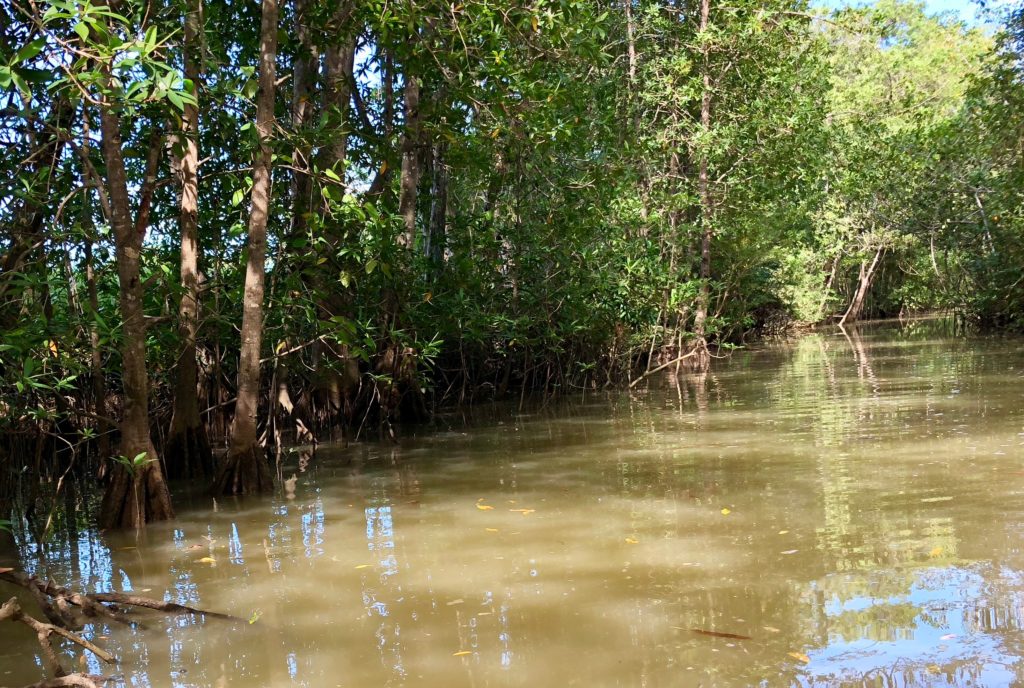
On our boat tour, we saw three different mangrove species:
* The pineapple mangrove is the least tolerant to salt water and thrives upriver, where the salinity is lower. It sits on pyramid-shaped roots.
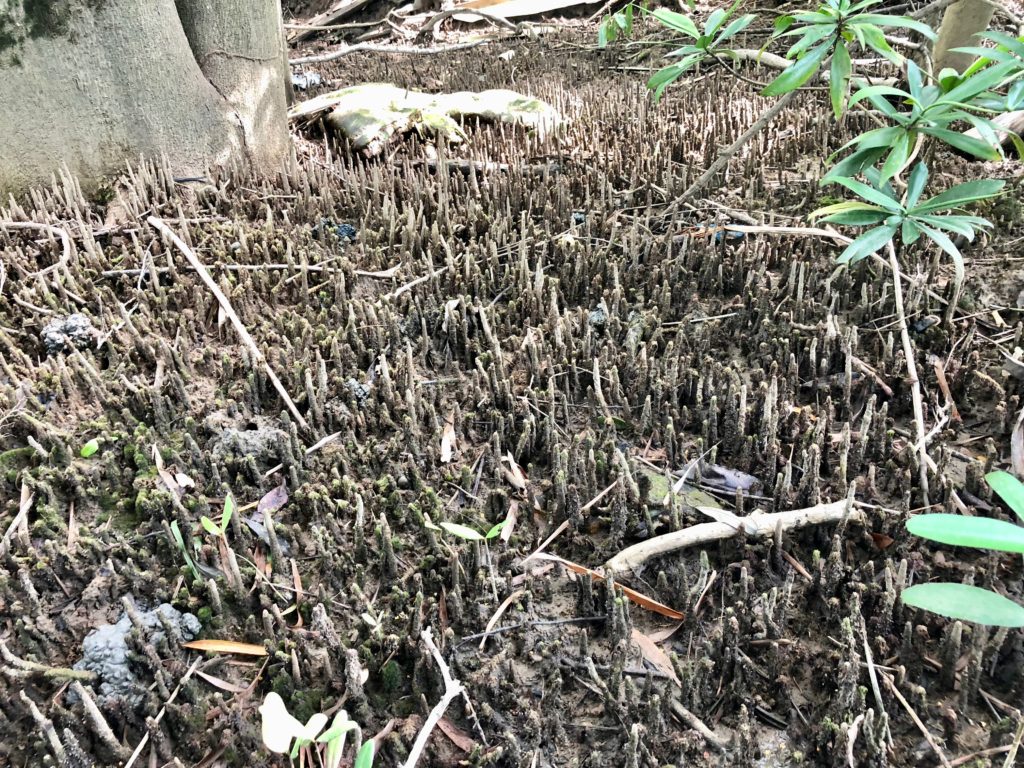
* The black mangrove is found a little closer to the mouth of the river, where the proportion of sea water is higher. This species has aerial roots that look like little straws sticking up out of the water. These pneumatophores allow the tree to breathe oxygen from the air instead of the salty soil, which is largely devoid of oxygen.
Pneumatophores look like sprouting plants, but they’re air filters!
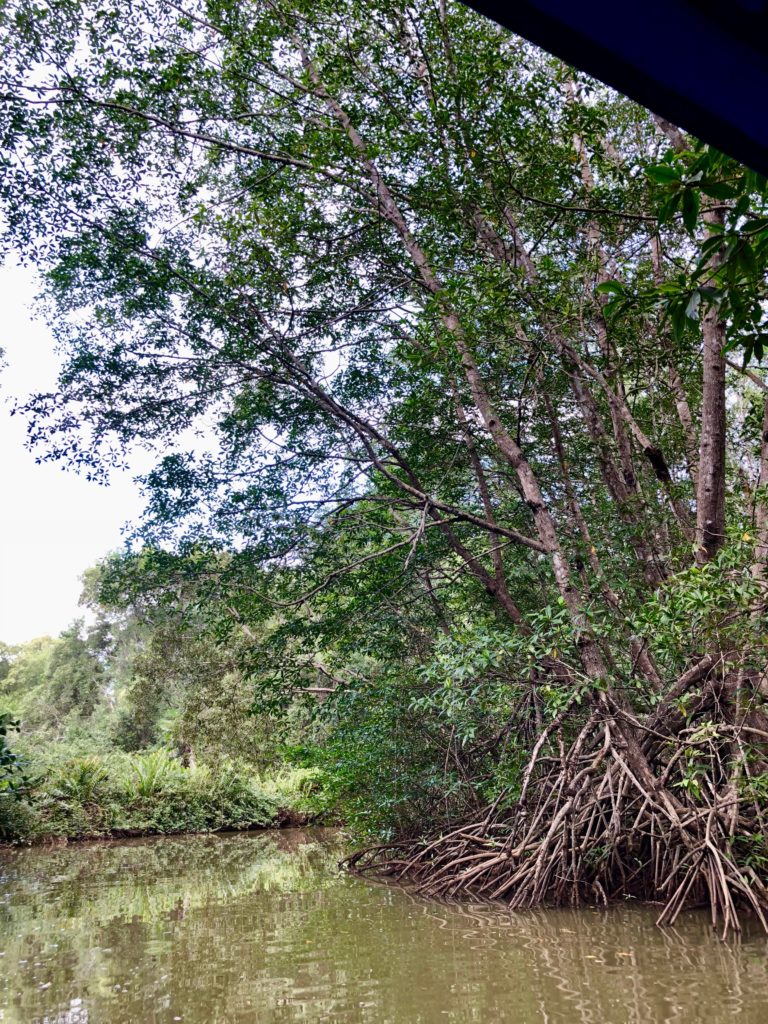
* The red mangrove is the most tolerant of salt water and grows right up to the point where the ocean meets the river. It has prop roots, which branch off in various directions, arch above the water, and interlace with neighboring tree roots before anchoring in the salty mud. The red mango’s reproduction system is pretty wacky. Its seeds, called propagules, germinate and grow into new plants before they fall from the tree.
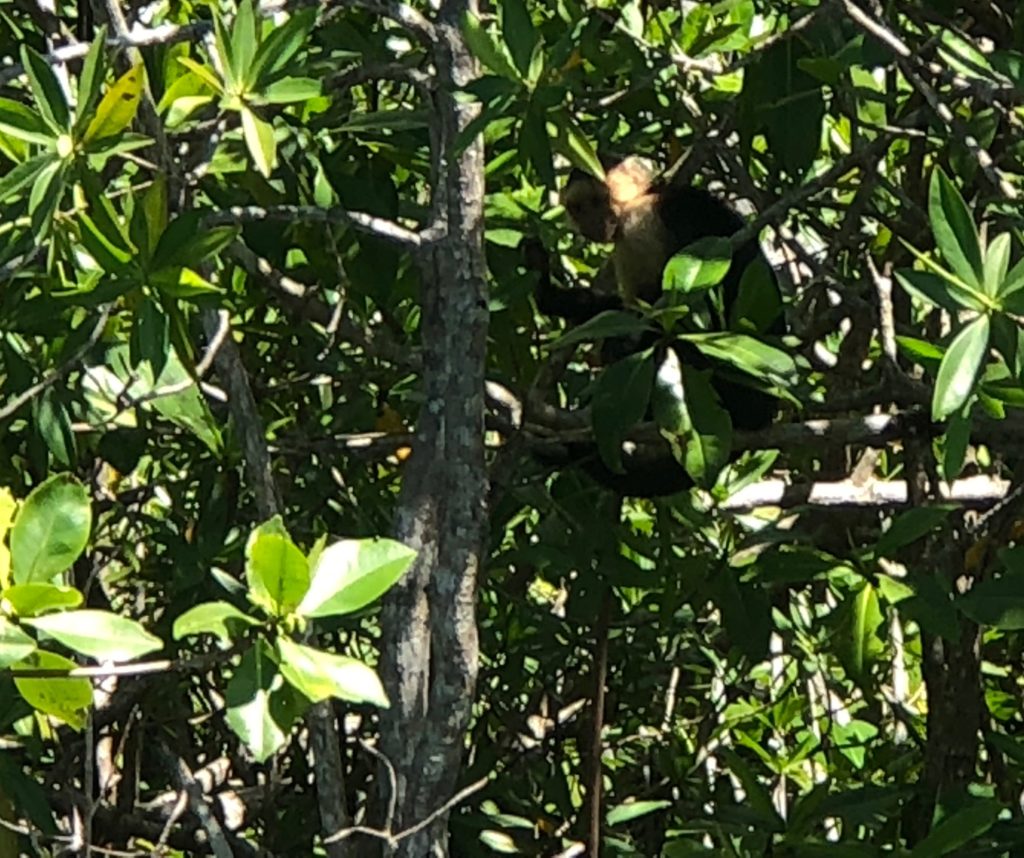
Capuchin monkey in a red mangrove tree.
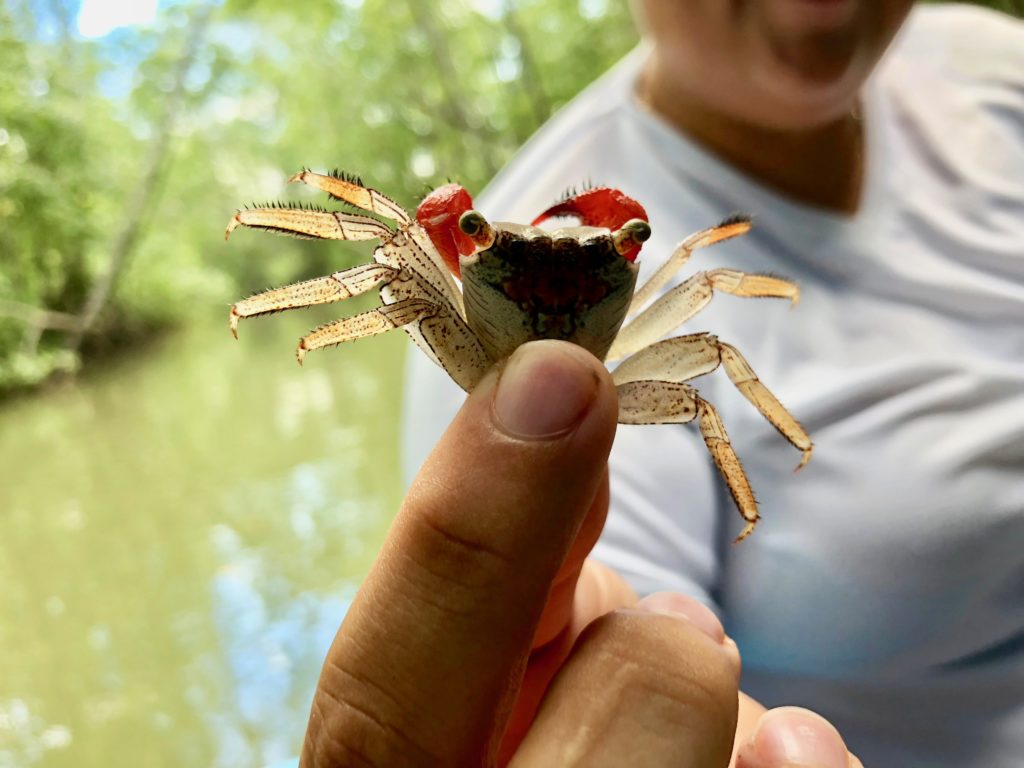
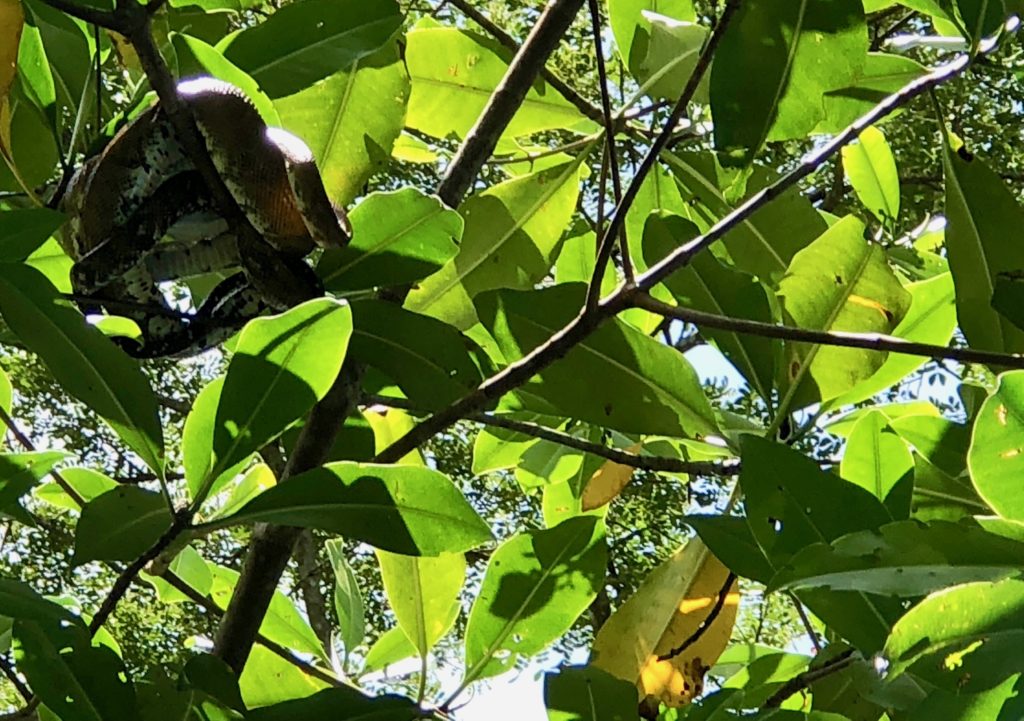
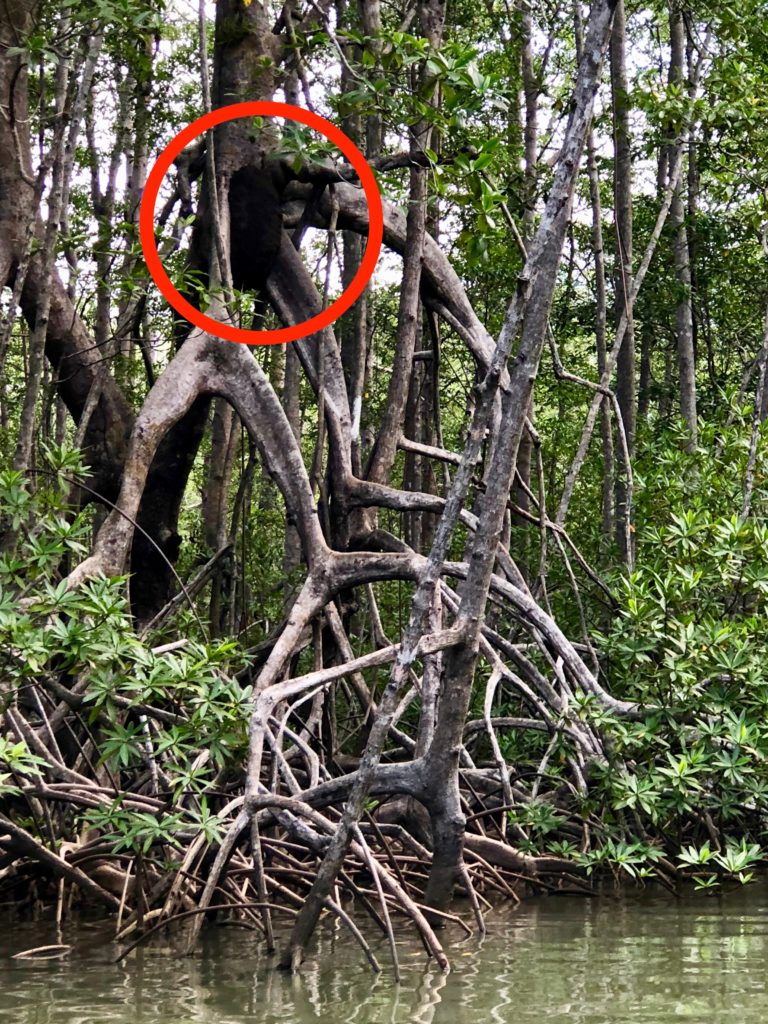
Although the mangrove forest is home to many animals, they were mostly hidden during our visit. We saw two capuchin monkeys, a rainbow boa constrictor, a few white ibis, heaps of iguanas and other lizards, a little blue heron, a tiger heron, a gajillion little crabs, and many huge termite nests that look like big black blobs on the tree trunks. Laura told us that 90% of animals in the mangrove forest eat termites.
Tiger-faced crab.
Sleeping rainbow boa.
A massive termite nest.
Sure, I would have like to see a scarlet macaw. But, hey, it’s hard to feel disappointed when you spend the day looking at views like this.
Maybe some people think, “Seen one rainforest, seen em’ all.”
Not me.
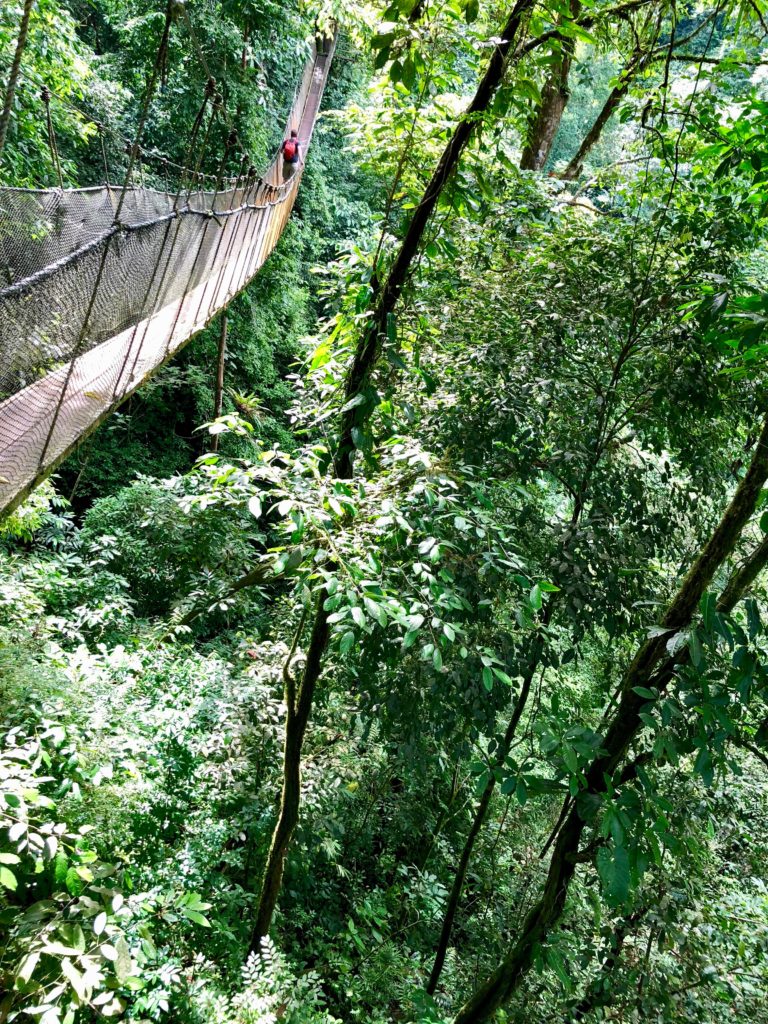
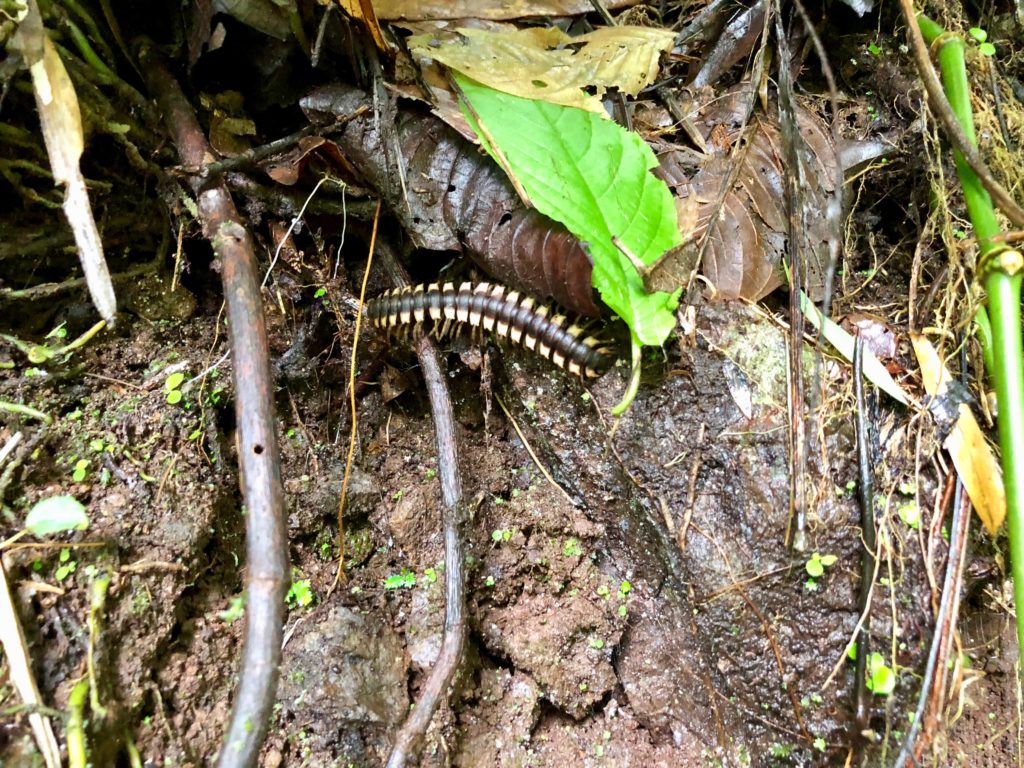
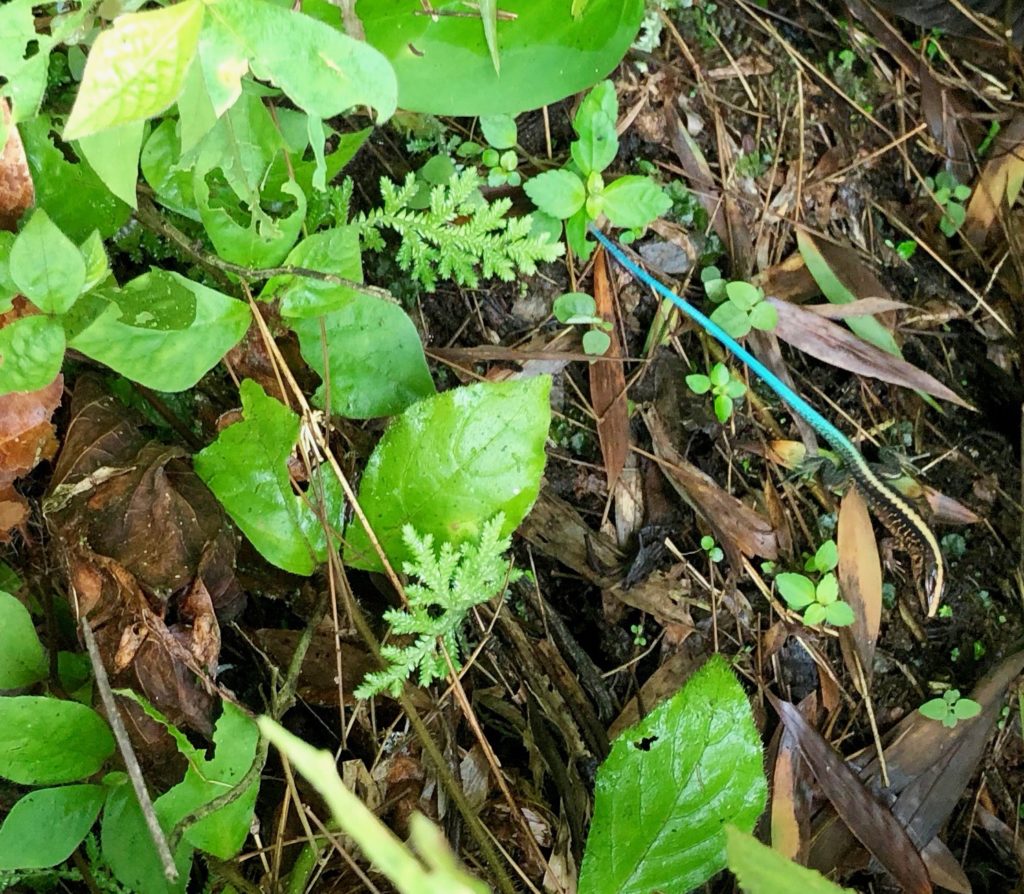
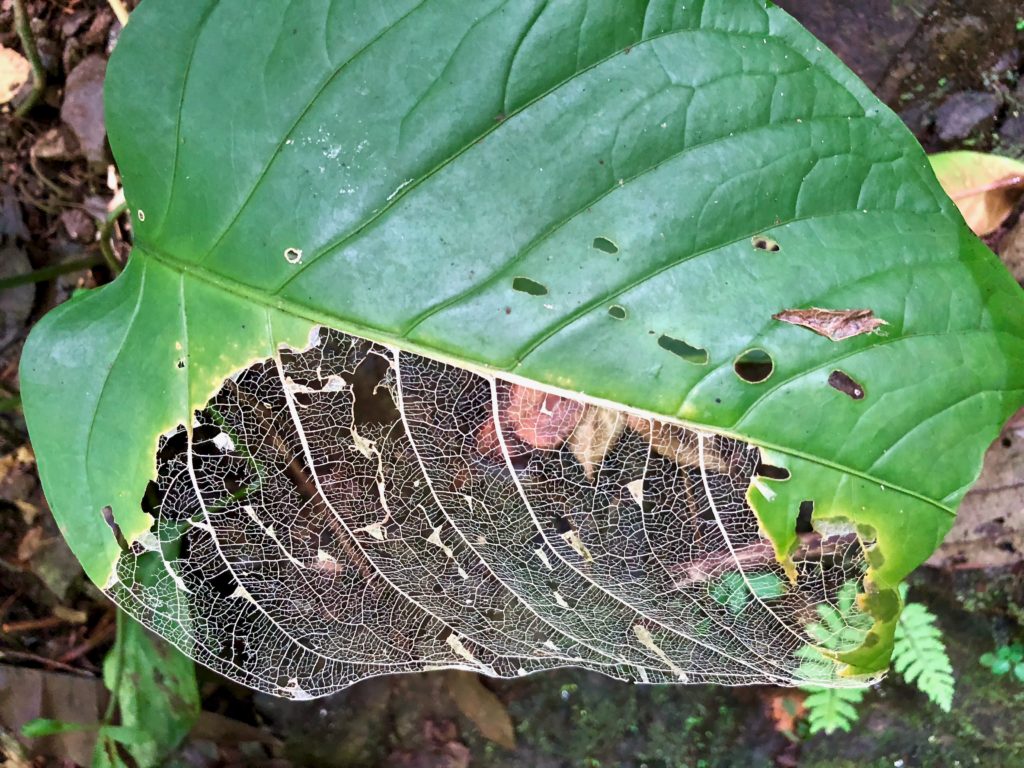
Even after traipsing around the forests of Costa Rica for the last two weeks, I continue to marvel at every unfurling fern, each denuded leaf and tell-tale trail of leafcutter ants, all the tenacious vines twisting and looping to reach the coveted sunlight, and any living creature, from millipedes to sloths. Today was no different. Tony and I drove to Rainmaker, a conservation park not far from Manuel Antonio. The trails and signage were less polished than the national park we toured yesterday, but we had the place almost to ourselves. We only saw one other couple while we were hiking.
The park has an interesting history, told succinctly on the travel blog Two Weeks in Costa Rica:
Sometime around 1990, a farmer named Don Victor Fallas needed some cash so was looking to sell a portion of his land near Parrita. A Costa Rican named Mauricio Gutierrez entered the picture and agreed to purchase 200 hectares (500 acres) on behalf of the company the Body Shop, which wanted the farmland to grow products for use in their cosmetics. Don Victor also owned a large amount of primary rainforest on a nearby mountain. Though he needed to sell it because of his debt, he wanted to find someone who would keep it preserved. Mauricio shared a similar vision and agreed to buy 2,000 hectares (5,000 acres) of the forest in his own name, thinking the pristine land could be valuable in a future tourism business.
Just as the paperwork was being finalized, Mauricio died tragically in an accident when he fell into a waterfall on the property while trying to save a child. With no buyer, the deal was about to fall through when Mauricio’s wife, Ann Gutierrez from the US, stepped in. She didn’t have the cash upfront but somehow got Don Victor to agree to a five-year mortgage. The only problem was that Don Victor wanted $100,000 as a down payment—and he wanted it in a week. The story then goes back to the Body Shop. Ann contacted Gordon Roddick, co-founder of the cosmetics giant, who agreed to lend her $100,000 for the down payment, and the deal went through.
Today the land is completely paid off and preserved. If it hadn’t been for Ann and her children Alessandra and Mick stepping in, the land probably would have been turned into a lumberyard. Apparently the bank that owned the property was in talks with a Japanese wood company that was set to buy the land if Don Victor defaulted on his loan. After visiting the property and seeing for ourselves how special it is, we can really appreciate Ann, Alessandra, and Mick’s efforts to keep Mauricio’s vision of conservation alive.
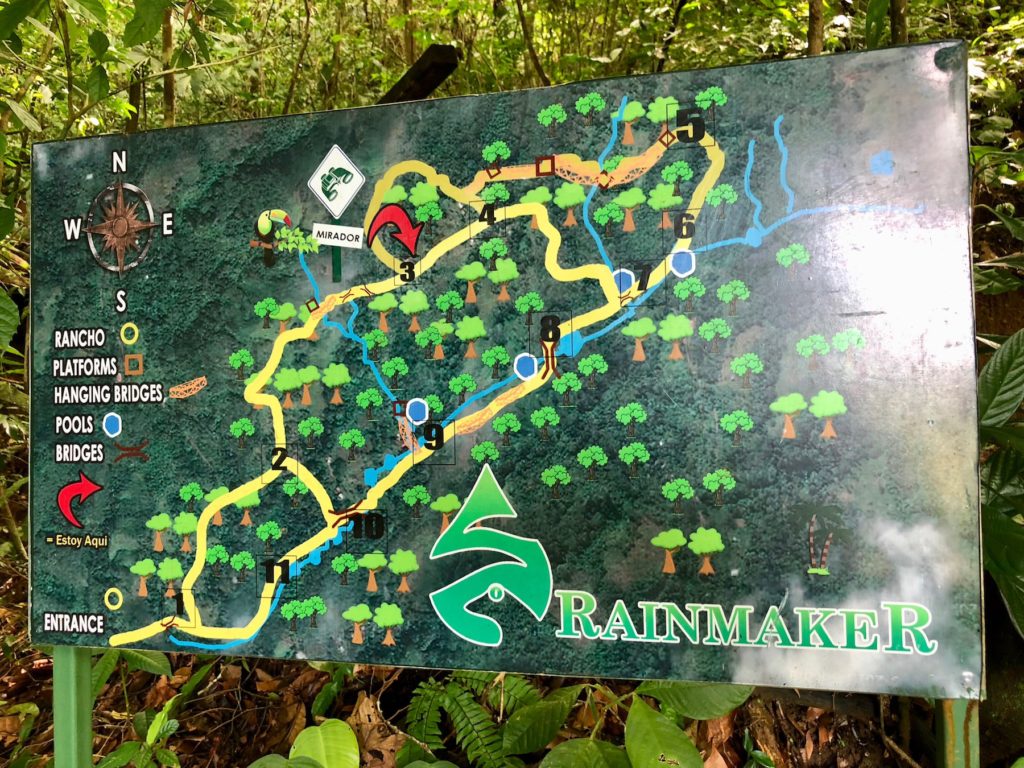
The ironically named Rio Seco (Dry River) rushes through the park, forming gorgeous pools and waterfalls. At the entrance, we were told the water level was dangerously high for swimming except at one spot: Pool 7. Fortunately, maps were posted throughout the park, so we knew when we got to the right place.
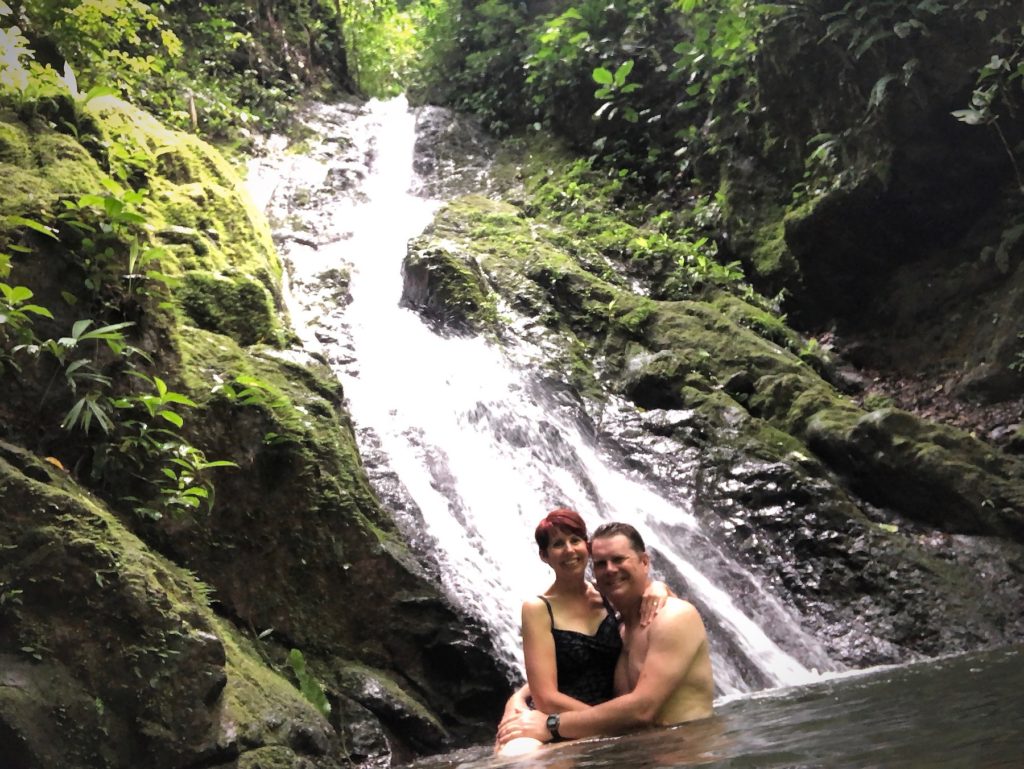
A lovely little waterfall fed the pool, which was set back a bit from the main path. We changed into swimsuits and stepped into cool, fresh water up to my neck at the deepest point. A little yellow bird sang as she built a nest in an overhanging tree. Butterflies swooped overhead. Beauty surrounded us.
I set my phone on timer and crossed my fingers that it wouldn’t fall into the pool!
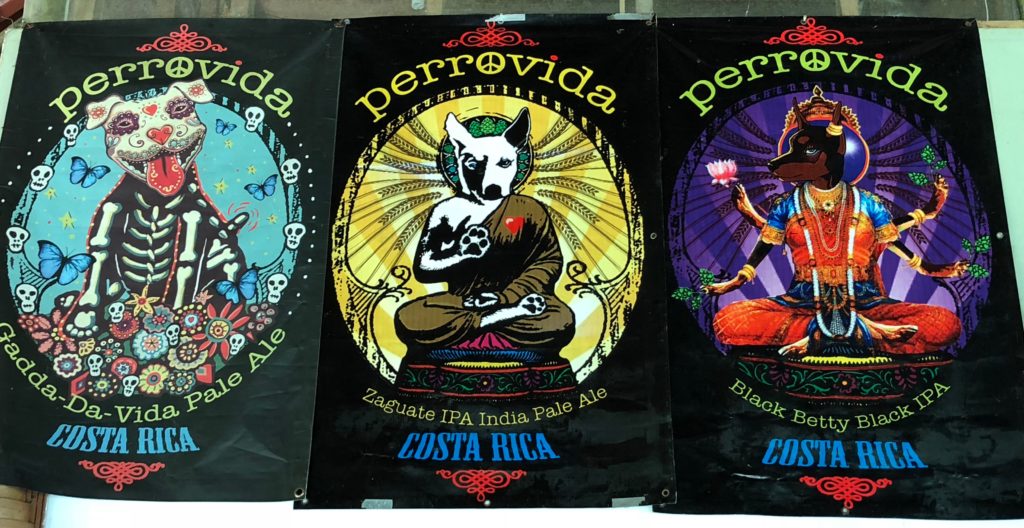
When we emerged from the forest, we enjoyed a casado lunch and a craft beer called Perrovida (Dog’s life), which is brewed down the road. I loved their promotional poster. I tried the beer in the middle.
Back in Quepos, we strolled along the waterfront and got some ice cream before heading to our B&B for the afternoon. I sat on our balcony writing for awhile, but my attention was quickly diverted by a party of squirrel monkeys. Unfortunately, they were moving so quickly through the canopy that I couldn’t get a clear photo or video. They were so funny to watch as they leapt from branch to branch, swinging their long tails, and grabbing on for dear life. Twice, I saw monkeys lie on their bellies on a branch with all four legs dangling, as if they were just plain tuckered out.
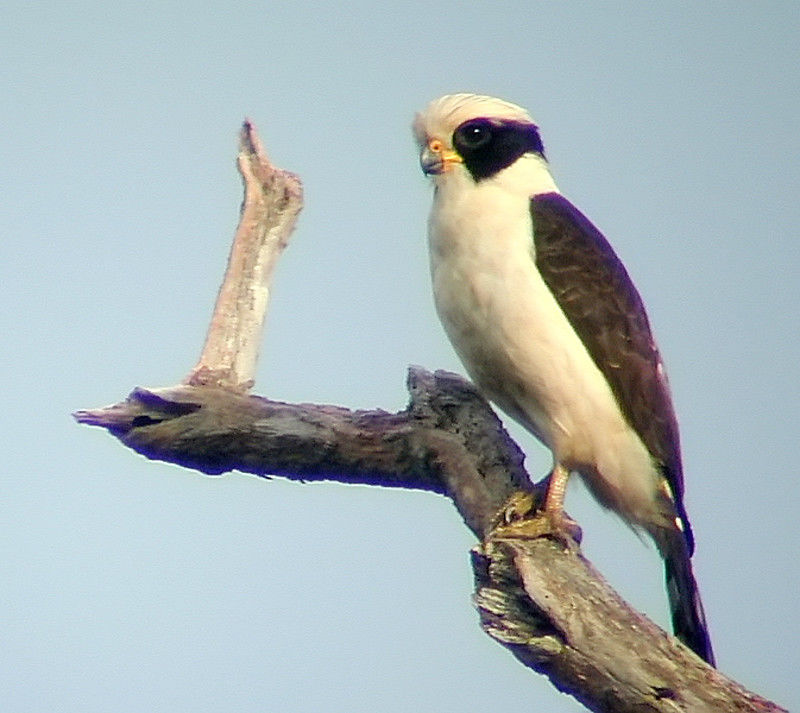
While focusing on the monkeys, I noticed something in the distance that looked like a huge bird sitting on a limb. Tony and I tried for probably 30 minutes to figure out what it was. We zoomed in with our phones, used our lame little binoculars, and googled like mad. I ran down to ask Carlos for better binoculars, but all he had was a telescope, which was too big for me to haul up all the steps. I thought it might be an owl, but it had a striped tail, and we couldn’t find any Costa Rican owls online with striped tails. Finally, somehow, Tony nailed it: a laughing falcon, known in Costa Rica as a “guaco” because it makes the sound “wah-coh!”
It was too far away for a clear shot, but here’s a photo of a laughing falcon from the Carnivora website. Pretty cool. We read that they often stay in the same spot for hours, eyes peeled for small reptiles. Macagua rieur. Famille des Falconidés. Ordre : Falconiformes
We wandered up the hill to Barba Roja for happy hour and a nice sunset view before dinner.
Today, we woke up to the sound of lashing rain. We had planned to be the first ones at Manuel Antonio National Park when it opened at 7 a.m., but the rain was a bit of a deterrent.
Finally, we agreed: It’s just rain! We won’t melt! And off we went. The only change we made in our plans was to leave our swimsuits behind. The park includes several private beaches where we had hoped to frolic for awhile, but we decided to make this a hiking day instead.
Following Carlos’s advice, we parked in a lot near the entrance to the park and ignored all the touts trying to lure us with more expensive parking options, tours, and crap for sale. We may not have been THE first in the park, but we were darn close. As Carlos predicted, the rain ceased within minutes.
Most trails were paved, and hills generally had easy-to-maneuver stairs or ramps. Bathrooms popped up periodically. As jungle hikes go, it was a fairly chill place to visit. We saw one sloth, a couple agoutis (those giant hamsters), a few cool birds and colorful crabs, and the blue morpho butterflies, which freak you out with their flashes of iridescence. I appreciated both the high-level coastline and rainforest views, as well as the ground-level access to the beaches and forest floor. As we were leaving around noon, mobs of people were going in. Tony and I smugly high-fived over having the park mostly to ourselves.
We tackled every trail and even paused at each beach to enjoy the scenery, only slightly bummed that we hadn’t brought our swimsuits.
Tony, wearing his Tevas, ventured into the surf a bit more than I did, laced as I was into my hiking shoes. At one point, he wandered up the beach while I rested on this fallen tree, soaking up the sounds and smells of the ocean. I sat here for more than five minutes before I realized my seat mate was a ginormous iguana. How did I miss him?
FYI, the combination of 100 percent humidity, gravity, and the action of moving our bodies to trek up and down hills actually results in clothes stretching several sizes, and my awesome hiking pants were easily three inches longer by the end of this day. Our clothes were drenched with sweat, and my fingers shriveled like raisins from the weird combination of dehydration and perspiration.
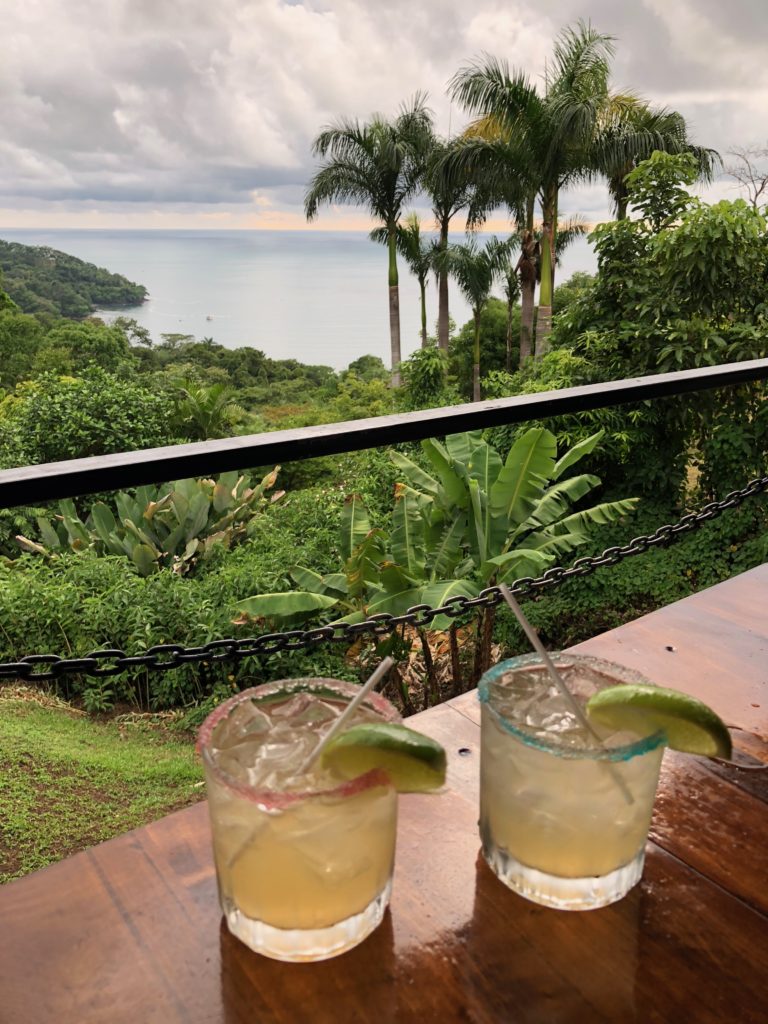
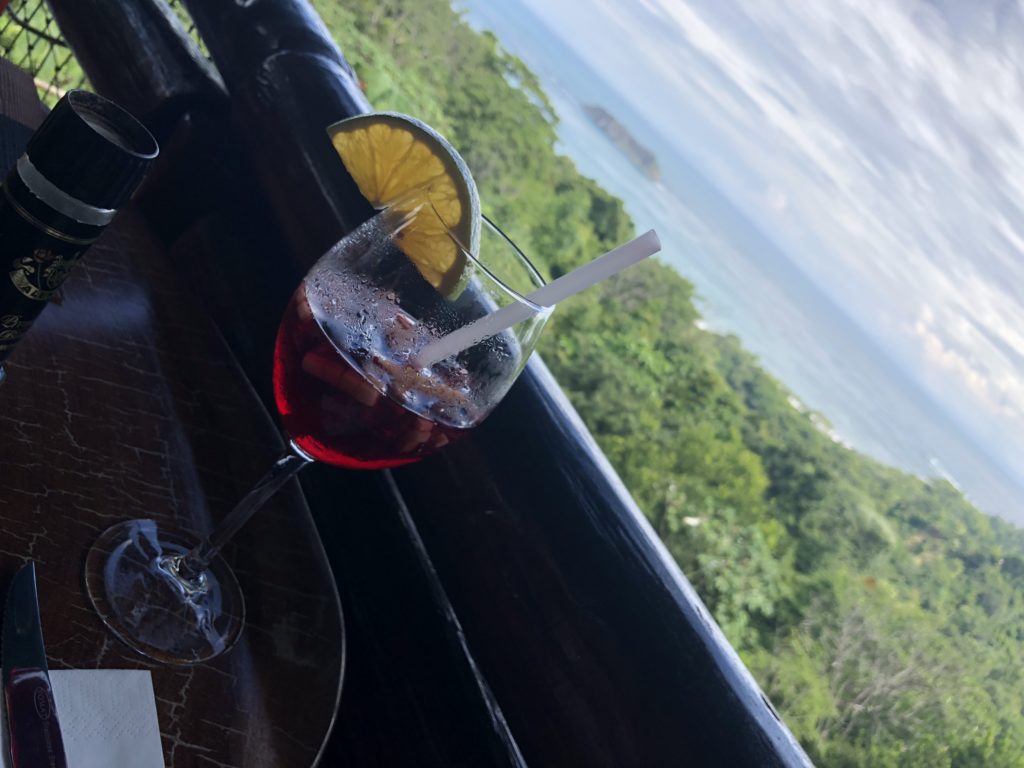
After almost five hours, we headed back to our room for a shower. We were ridiculously smelly and dirty. Once clean, we went to El Avion for lunch. We went for the cheesy airplane, but the food, sangria, and view were nothing to sneeze at.
This kitschy restaurant boasts a plane leftover from the Iran-Contra scandal of the 1980s. Here’s the info from the El Avion website:
Our Fairchild C-123 was a part of one of the biggest scandals in the 1980’s. The Reagan Administration set up a bizarre network of arms sales to Iran designed to win release of US hostages held in Lebanon and raise money to fund the Nicaraguan, counter-revolutionary guerilla fighters, commonly referred to as the “Contras”. By artificially inflating the prices of arms, “National Security Council” NSC official Oliver North, was able to reap profits that could be diverted to fund the counter-revolutionaries of the Cuban allied Sandinista government.
Of the $16 million raised, only $3.8 million actually funded the Contras. With the CIA’s help, they purchased several items, including two C-123 cargo planes, two C-7 planes, a Maule aircraft, spare parts, and munitions. They also built a secret airstrip on an American-owned, 30,000 acre ranch in northwest Costa Rica.
On October 5,1986, a US cargo plane, the twin sister, of El Avion’s own Fairchild C-123, was shot down over Nicaragua. A crew member Eugene Hasenfus, pilot hired by a private company to fly airlift and resupply missions. parachuted to safety and was captured by the Sandinista army.
Led out of the jungle at gun point, Hasenfus’s existence set in motion an incredible chain of cover-ups and lies that would mushroom into one of the biggest scandals in American political history known as the Iran-Contra Affair. As a result of this successful Sandinista strike on our Fairchild’s sister plane, the cargo operation was suspended and one of the C-123s was abandoned at the International Airport in San José.
In August 2000, we purchased the abandoned Fairchild and shipped the pieces of the Iran-Contra relic to Quepos. The fuselage was shipped via ocean ferry because it was 10 inches too wide for the antiquated Chiquita Banana railroad bridges! After hauling seven sections up the Manuel Antonio hill, the C-123 finally found its current cliff-side resting-place.
Now, our C-123 has been retired to less risqué endeavors as a restaurant, bar and an enduring Cold War relic. Join us for food under its wings, drinks in the fuselage pub or climb into the cockpit!
The restaurant was crowded, but nobody was in the plane bar when we were there at lunch. I climbed up into the cockpit and played pilot for a minute.
Later, I practiced a little yoga at a small covered space next to our treehouse while rain pounded the metal roof.
And then we braved the downpour to eat some comidas typicas at this fun place. I just can’t get enough of the casado. Black beans, rice, a green salad, some fried plantains, a piece of fish. So simple, but so delicious. Yum!