Glamour Shots – Delhi Style

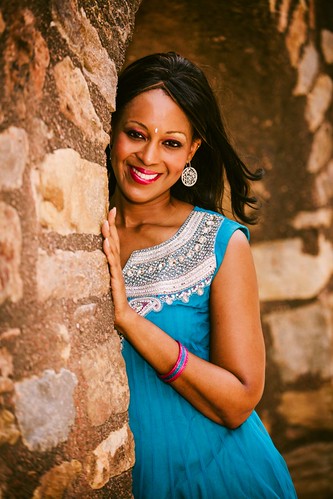
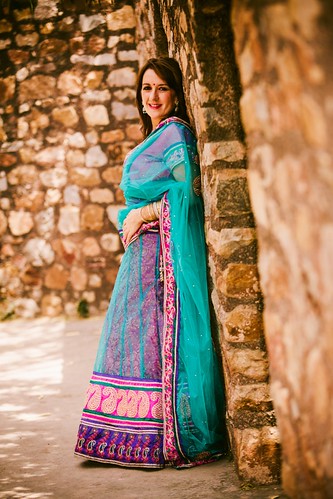
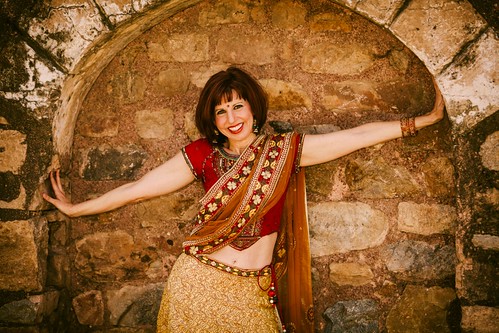
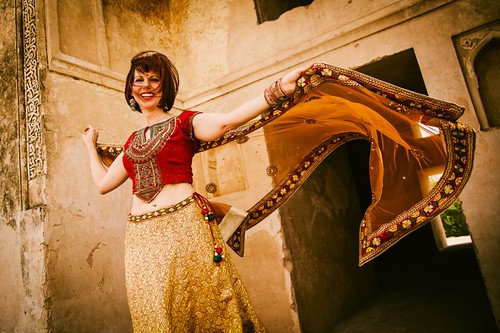
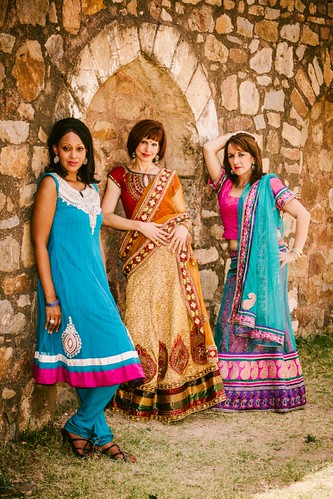
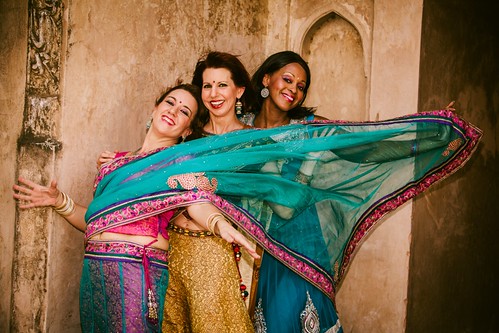
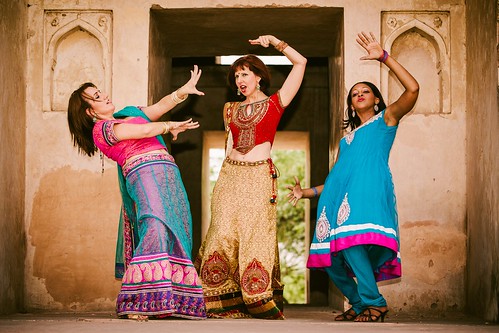
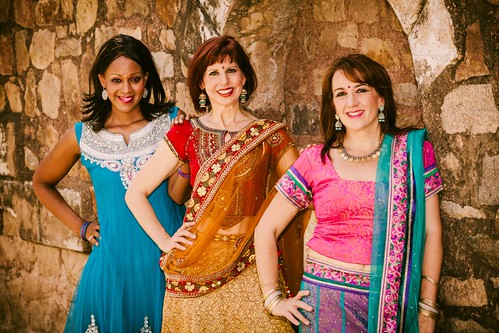
Browsing through the shops in Delhi’s backpacker district, Pahar Ganj, I laughed with my friends Katrina and Nancy at the spangly belly dancing costumes for sale. “We should totally do a photo shoot wearing those outfits at some historical site!” we joked. Somehow that throw-away comment turned into a brilliant plan, which came to fruition last weekend.

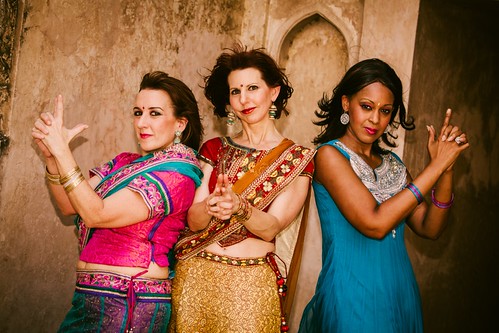
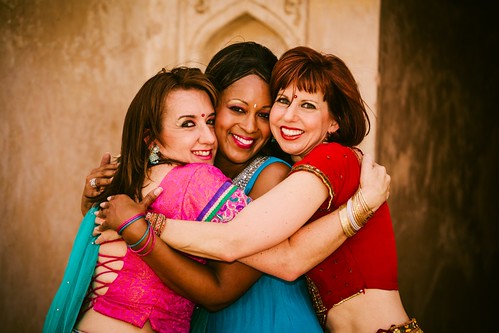
The three of us became fast friends as “newbies” at the American Embassy School, and we’re now struggling with the knowledge that Katrina won’t be here after summer break; she’s heading back to the States. There couldn’t be a better going-away gift for this beautiful, elegant lady than Glamour Shots – Delhi Style. In addition, over the last two years, we three felt compelled to stage the clichéd Charlie’s Angels guns-drawn pose every time we spotted a camera. While those shots were all spontaneous, we couldn’t resist actually planning a special culminating picture.

As the day of the photo shoot approached, I tried on my costume. It was completely see-through and not at all flattering.

Untitled

“Maybe we should wear our pretty Indian clothes instead,” I suggested. We each have saris, anarkalis or lehengas, which pop with color and better camouflage our flaws. We agreed to pose in our fancy outfits first, and then we’d change into our belly dancing costumes.

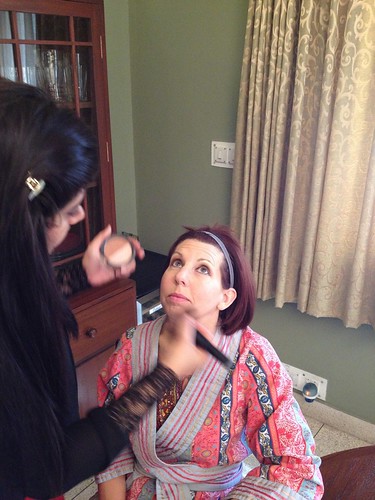
Around 7 a.m. Sunday, our make-up artist arrived (late) and went to work on me.

Untitled

Yogita had no sense of humor about this experience, or maybe she just wasn’t a morning person. I told her I could do my own mascara, and she commanded me to make my lashes thick. “I’ll try,” I said, “but I only have about four lashes on each eye.” Katrina and Nancy laughed, but Yogita only responded drily, “I know. I saw.”
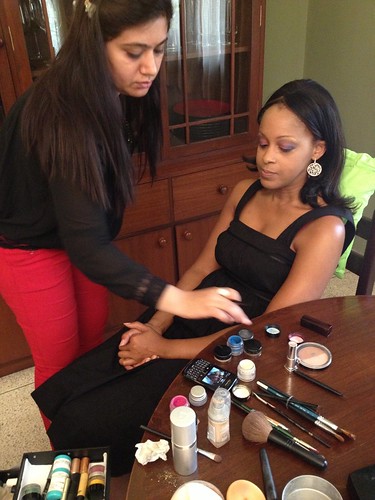
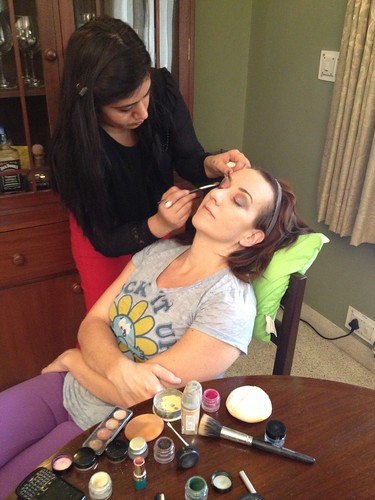
Katrina was next, then Nancy.

Untitled

Untitled

Finally we were ready to meet up with our photographer, Tim Steadman, who was patiently waiting at the Qutub Minar parking lot. Yogita clumsily banged her make-up suitcase down the stairs until it burst open and spilled her supplies everywhere. Already more than 30 minutes late, we rudely tiptoed over the scattered plastic boxes and brushes to dash out to my car.

Worried my long full skirt would get bunched under the car pedals, I opted to drive in capris. At the Qutub Minar parking lot, I pulled on my skirt and whipped off my pants before we phoned Tim to say we’d arrived. By the time we climbed into his car, it was about 9:45 a.m. and already 108ºF. He drove a short distance and pulled into a quiet road leading to the Mehrauli Archaeological Park, where we ladies had once visited on a walking tour. Check out MEHRAULI ARCHAEOLOGICAL PARK – AN URBAN OASIS. If you don’t feel like reading my old blog post, here’s a paragraph about the spot Tim chose for the day:

Sir Thomas Metcalfe, who was the East India Company’s resident at the Mughal Court, constructed his 19th-century country house right over the 17th-century mausoleum of Muhammad Quli Khan (an attendant to the Mughal emperor Akbar and stepson of Akbar’s wet nurse). Metcalfe’s dining room was apparently directly over Khan’s tomb, and he further embellished the area with pavilions, a dovecote and a waterway to bring visitors to the estate by boat.

Unfortunately, getting there required a bit of walking and climbing of steep steps. This trek was much easier on the aforementioned walking tour in appropriate footwear and sensible clothes. I tottered in my strappy sandals over the lawn and up the broken stone steps, clutching my wadded-up tulle dupata in one sweaty hand and layers of heavy polyester skirt fabric in the other. We took refuge in the shade but couldn’t avoid the scorching breeze that evaporated all the moisture from our eyes and lips.

Katrina’s a natural.
ksn05

Lovely Nancy.
ksn10

Me “working it.”
ksn25

ksn64

I think we were going for sultry here, but we mostly just look pissed.
ksn20

One of my favorites.
ksn43

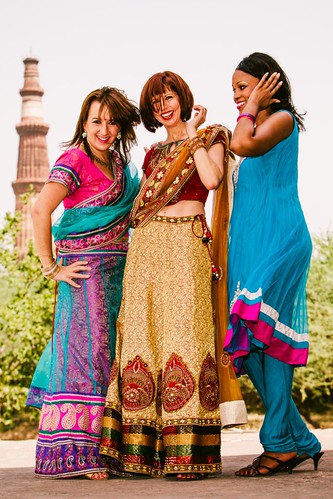
That’s the 12th-century Qutub Minar in the background. Standing on the grounds of Delhi’s “first city” dressed in fancy Indian garb felt kinda magical.
ksn50

Unlike Yogita, Tim had a wonderful sense of humor. “Just put one hand on your hip like this,” he would say, striking the pose. “And then stick out your other hip and look off in the distance.” It’s a good thing he knew how to pose us because only Katrina seemed to have a natural flair for modeling. I couldn’t help acting ridiculous, quoting Zoolander and Austin Powers. “Now you’re a lemur!”

We eventually got around to our Charlie’s Angels pose, accentuated with a nice windblown hair effect.

ksn45

Not yet ready to wrap it up, we threw in a little Matrix action, too.
ksn77

By the time we trudged back to Tim’s car, sweaty and dehydrated, we had lost the motivation to peel off our dresses and stage a redux in the belly dancing costumes. Whew!

Looking at Tim’s photos, we can’t help but notice our saggy baggy flabby bits, but it’s also easy to see the beauty – inside and out. This was a joyous, silly, beauty-filled day, and I felt especially grateful to have such amazing ladies in my life.

ksn21

ksn75

Here’s a video with some of my favorite shots.

Want more? Check out my flickr album, Charlie’s Angels – Delhi Style, with all 160 photos (80 shots in both color and B&W).

5 weekends, 5 countries

Yowza.

Maldives
Thailand
Oman
Nepal
India

In the last five weeks, I spent only one weekend in New Delhi. Finally, a few moments to process. So much has happened in such a short amount of time, personally and professionally. Here’s the scoop in chronological order:

Maldives – Nothing soothes my soul like a little time by the sea. Tony and I escaped for a week in Paradise for Spring Break. See my post about our relaxing vacation – Maldives Diary.

Thailand – As an EAL (English as an Additional Language) specialist, I co-teach in grade-level classrooms, usually during the literacy block. The workshop model at our school draws heavily on resources from the Teachers College Reading and Writing Project at Columbia University. For years, I’ve heard teachers rave about the Teachers College summer institutes, but I’ve never had an opportunity to go. Unable to get to the mountain, I brought the mountain to me! Well, the Near East South Asia Council of Overseas Schools brought the “mountain” to its Spring Educators Conference, and I was lucky to land a coveted spot in The Writing Project’s Foundation Course. I can see the eyerolls and exaggerated snoring sounds, but seriously, I was like a kid in a candy store. Top-notch instruction with immediate take-aways. That’s the kind of stuff teachers drool over. Another perk was networking and sharing ideas with educators from other international schools.
After 12 years overseas, it would be impossible to attend an international teachers conference and not see friends from my past – thank goodness! This conference was no different; I ran into people from our days in Istanbul, Shanghai and Vientiane.

Oman – As arguably the least-sporty coach at our school, I gave a pathetically weepy speech at the Season 3 Awards Ceremony last week. For some reason, the Forensics Team (debate, public speaking and drama) gets recognized alongside softball, baseball, badminton and track-and-field athletes. Maybe the “real” coaches found me a bit overdramatic, but that’s what we forensics geeks love. As one of four coaches who traveled with the team to Muscat, Oman, in mid-April, I felt overwhelmed with pride for their accomplishments at the tournament. See details at O, Man! Forensics and Fun in Muscat.

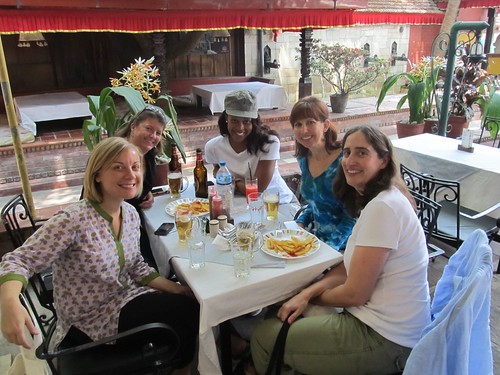
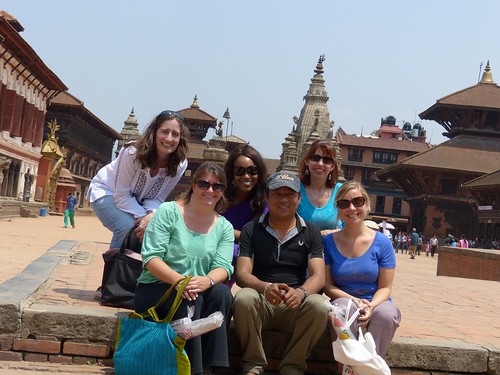
Nepal – With the end of the school year in sight, I joined four other ladies for a weekend get-away to Kathmandu to recharge our batteries and enjoy some quality time with two friends moving back to the States. Check out that post at Kathmandu – Ladies Weekend.

India – This is such a busy and emotional time in the life of a teacher abroad. Report cards, placement decisions for next year, language testing, farewell parties for friends moving on, big changes.

Looking back to May 2012, I can say our first year in India was hard, possibly the hardest first year we’ve had anywhere. As Bob Hetzel, our departing school director, is fond of saying, “Whatever is true about India, the opposite is also true.” That makes it particularly difficult to learn the ropes and settle in to this city that defies all western logic. By the end of our first year, we were feeling marginally better about our decision to move here but still overwhelmingly frustrated. Then a departing teacher, who spent five years in New Delhi, shared this snippet of wisdom: “Your second year will be exponentially better. And your third year will be exponentially better than your second year. And so on. You won’t believe it!” He was right.

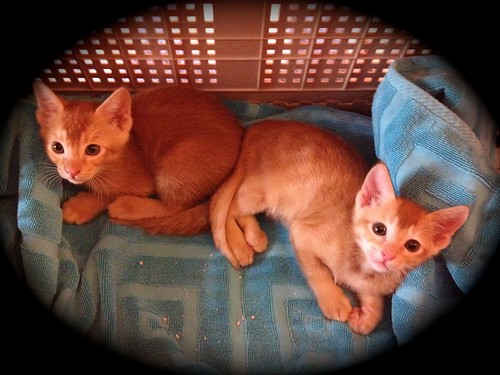
Year two really WAS exponentially better than year one. Not perfect, but much much better. Despite the daily head-slapping confusion of living in a developing country, we also experience daily revelations. I cautiously look forward to an exponentially better year three. As we add two new members to our household, New Delhi is finally starting to feel like home.
Introducing Ella and Khushi.
Untitled

Kathmandu – Ladies weekend!

As the school year winds down, international teachers say a lot of farewells. Many of our friends and colleagues will depart for new adventures, and it’s hard to say good-bye. So we procrastinate. We drag it out. We have parties and dinners and weekend get-aways to stall the inevitable. In that spirit, a group of us took off for Kathmandu, Nepal, the last weekend in April to celebrate two ladies who will leave Delhi at the end of the school year – Katrina and Shannon.

In case you didn’t know, Nepal is the only country with a flag that is NOT a rectangle:

nepal-flag

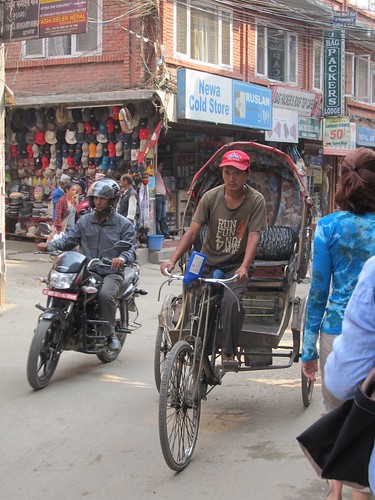
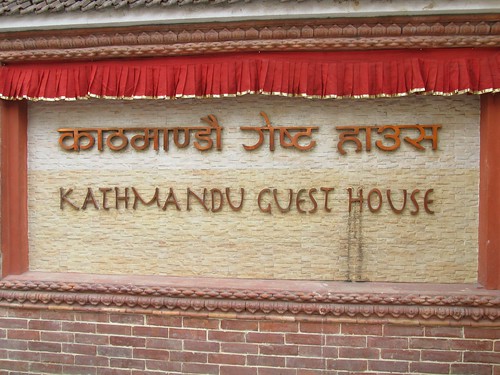
An early morning flight on Friday got us to the Kathmandu Guest House before lunch. I’ve actually outgrown guest houses, but this one came recommended, looked good online and, hey, it was good enough for the Beatles in 1968. As we settled in among the throngs of backpackers and trekkers, we realized the website may have exaggerated a bit. I awoke early each day to sip coffee and read my book in the guesthouse’s peaceful courtyard cafe, which was full of flowers and fountains. Outside the gate, however, the narrow streets clogged with tourists and traffic.

Inside the Kathmandu Guesthouse gate
(Photo by Katrina)
Untitled

Untitled

Untitled

Untitled

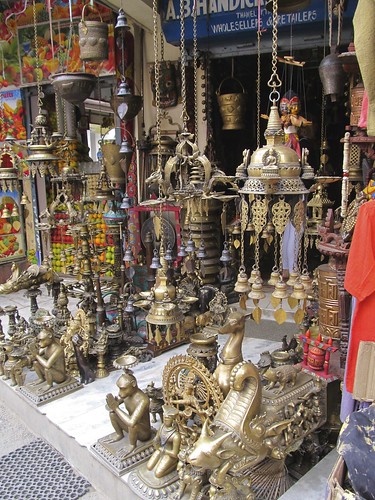
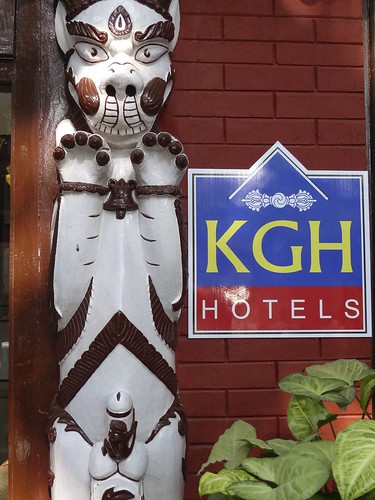
There were several of these statues with monkeys clinging to their wieners. I’m sure there must be a reason for it, but my research has yielded nada.
Untitled

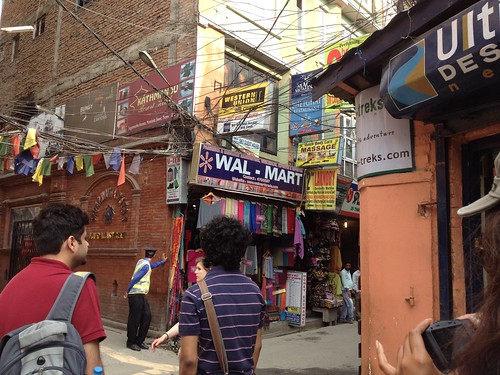
Outside the Kathmandu Guest House gate
(photo by Tammy)
Untitled

(3 photos by Katrina)
Untitled

Untitled

Untitled

Bhaktapur – UNESCO World Heritage Site
(Everything that sounds factual in this section comes from the book Discovering Bhaktapur – A Guide to the Historic Newar City, which I found in pdf form online. So interesting! Now that I’ve read up on this place, I need to return and see everything I missed.)

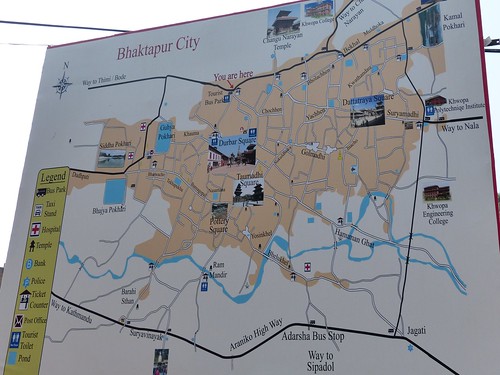
Saturday morning, we took a car about 20 kilometers to the ancient town of Bhaktapur, which was one of three independent kingdoms in the Kathmandu Valley about 300 years ago. The city declined after unification in the late 1700s, and a massive earthquake in 1934 damaged or destroyed most homes and temples. Germany was instrumental in helping rebuild and revitalize Bhaktapur through a major project that tackled restoration of historic and religious monuments, the water and sewer infrastructure, health education, land development and housing, schools and more through the late 1980s. The rise in tourism has also renewed interest in conserving its unique culture, architecture and handicrafts.

At the entrance to Bhaktapur, we bought a ticket and hired a guide, Shyam.
Untitled

Pausing so Shyam can tell us about Durbar Square.
Untitled

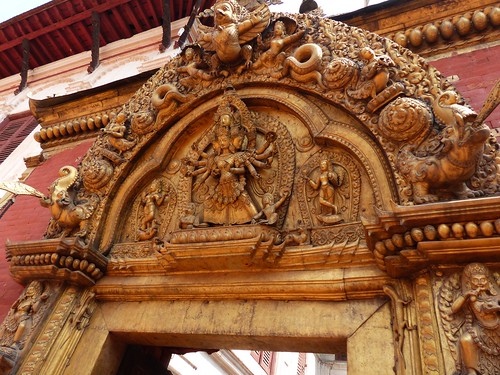
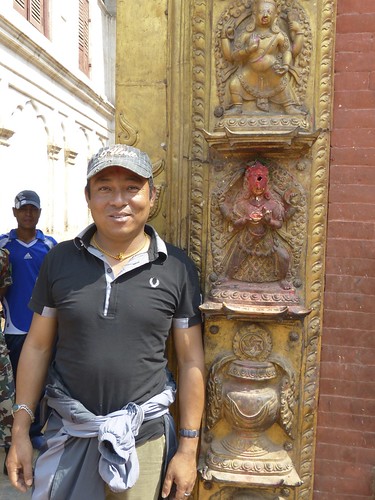
Shyam stands at the Golden Gate, the entrance to the religious areas of the royal palace.
Untitled

Untitled

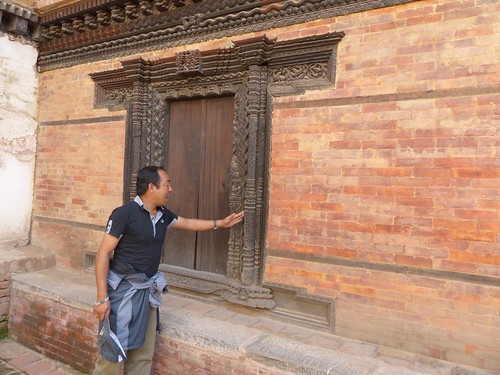
He explains that some of the wood carvings are original and others were created during the restoration.
Untitled

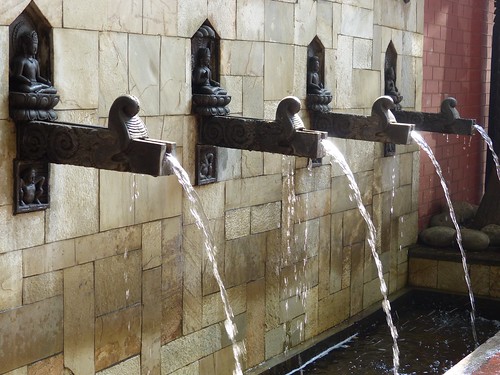
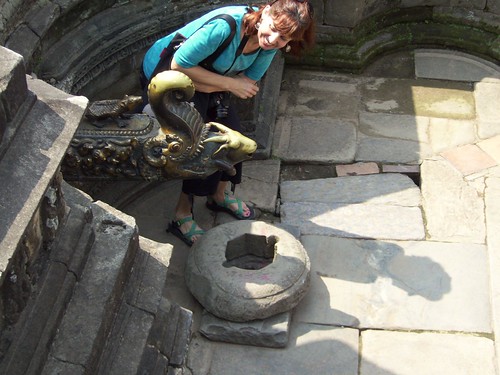
Only Hindus were allowed into Mul Chowk, home of the most holy temple of Taleju, the goddess worshipped by the royal family. We could, however, visit Naga Pokhari, a royal bath guarded by the gilded snake god Vasuki. I climbed down to check out the strange water spout. According to my book, such taps are typical of the era.

The spout itself is usually in the form of a makara, a mythical water creature that seems like a cross between a crocodile and an elephant. It is the vehicle of the water god Varuna. It often has a fish emerging from its mouth.

This one had a goat emerging from its mouth and a web-footed rat-like thing on its back.
Untitled

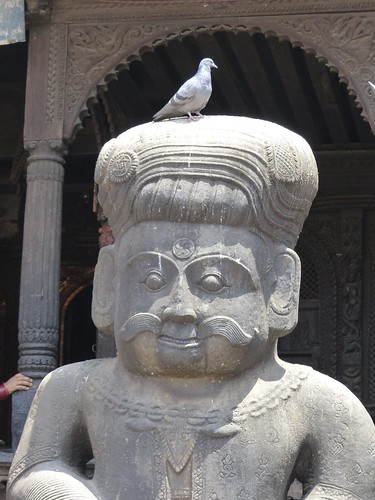
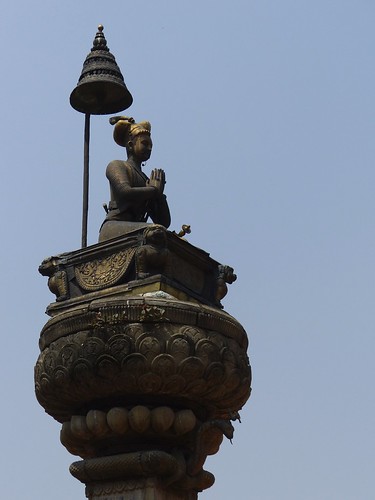
Facing the Golden Gate is the king who built it, Bhupatindra Malla (1696-1722), sitting atop a tall pillar. The statue was constructed in 1753 by his son, the last king of Bhaktapur.
Untitled

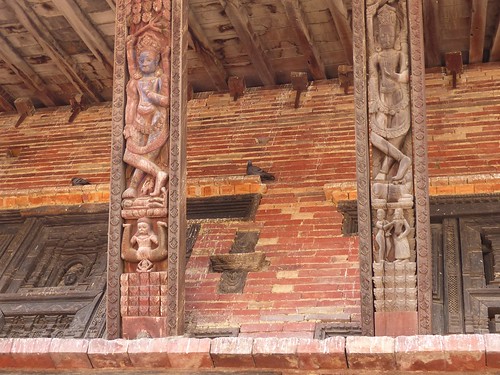
The Yaksheswar Mahadev Temple, dedicated to Shiva and dating back to the 1450s, features many erotic woodcarvings. Shyam said they represent the 24 sexual positions guaranteed to produce a son. “I know in Europe they have more than 24 positions, but here we have only 24,” he said with a laugh. My handy book says the carvings are actually associated with religious tantric cults of that time.
Untitled

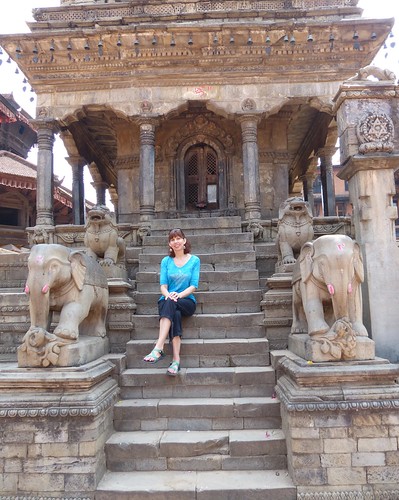
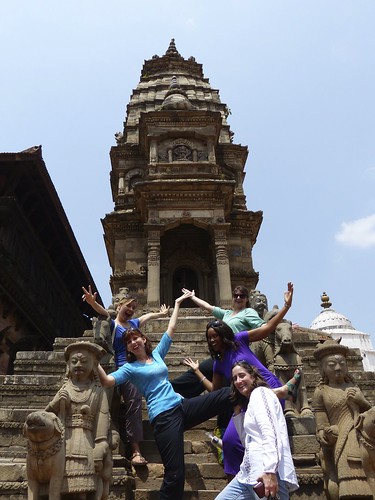
This whimsical little temple is dedicated to Siddhilaxmi, the goddess of success. My book says,

It has a delightful series of figures guarding its steps: a couple of chained rhinos (suggesting that the Mallas perhaps kept a menagerie), a pair of camels and what appears to be two naughty boys refusing to accompany their mothers.
Untitled

Another little temple.
Untitled

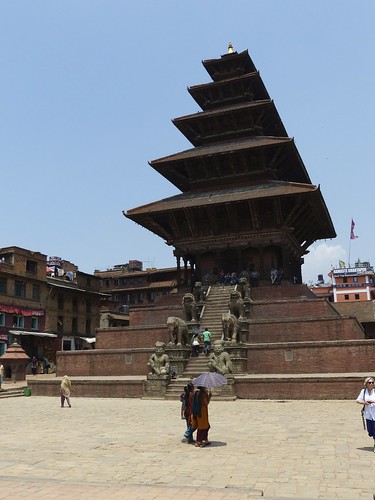
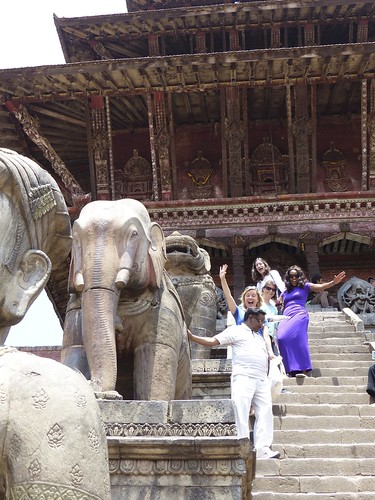
The Nyatapola Temple is the 30 meter-high pagoda in Taumadi Square. More from my book:

It’s thought to be dedicated to the beautiful goddess Siddhilaxmi and only special Taleju priests are allowed secret access to the inner sanctum. Nobody else worships there. It was built on the orders of Bhupatindra Malla in 1702. It is said that he set a fine example by carrying the first three bricks on his shoulder. This so inspired the population that all the remaining materials were brought up in the following five days. … Guarding the temple are ten mighty figures. At the bottom are two local wrestling champions called Jayamala and Patta. Next up, ten times stronger, are a pair of elephants. Then two lions, two griffins (sarduls) and two deities, Singhini and Byanghini. Each is ten times stronger than the pair below.
Untitled

Untitled

View from the top.
Untitled

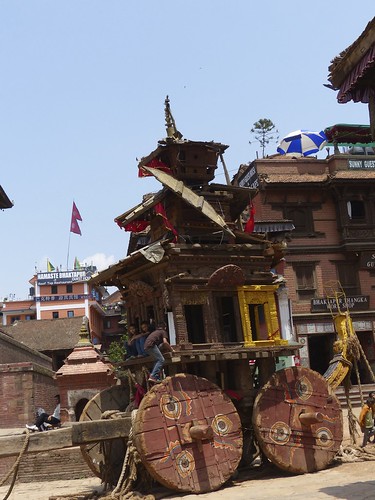
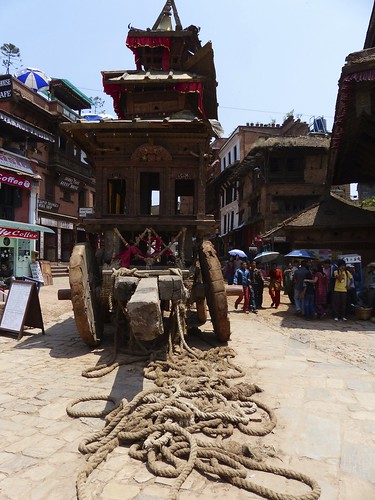
According to Shyam, this “vehicle” plays an exciting part in a big religious festival, sort of a tug-of-war thing to carry an image of the god Bhairav to meet up with the goddess Bhadrakali for a fertility ritual.
Untitled

My book says those rickety wheels inevitably crush raucous festival-goers.
Untitled

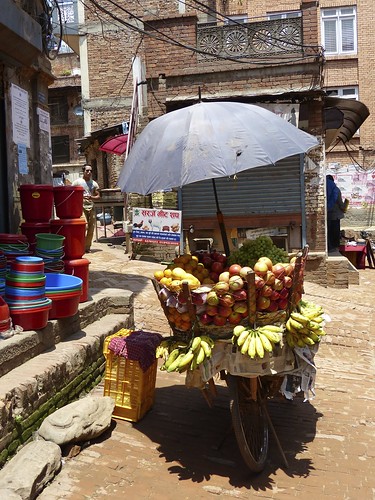
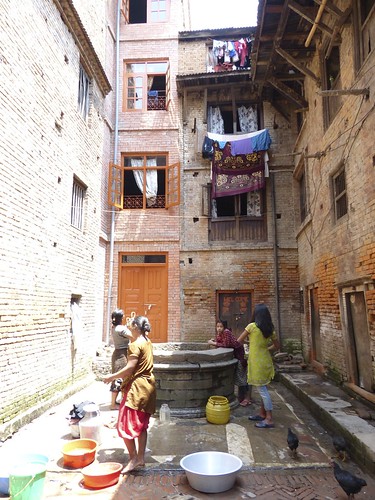
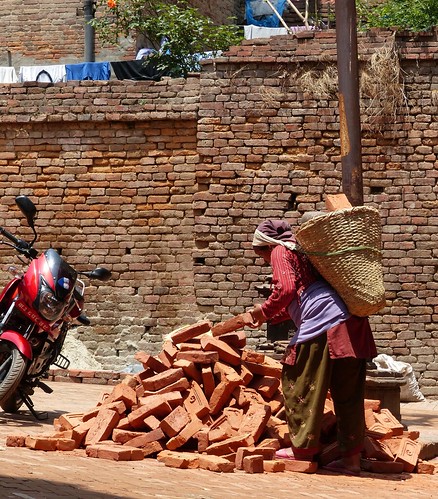
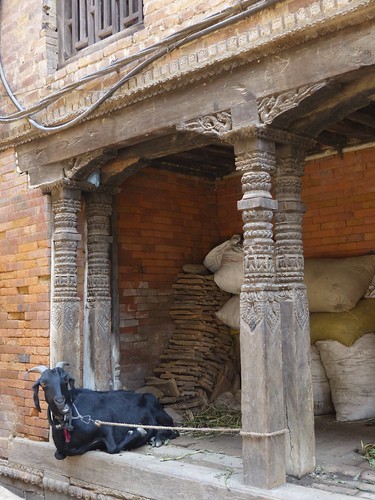
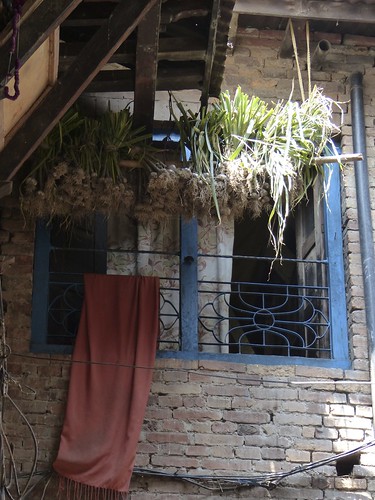
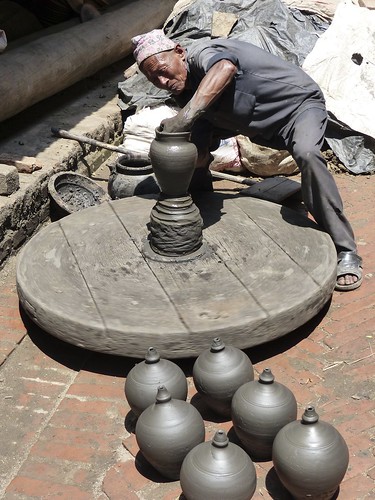
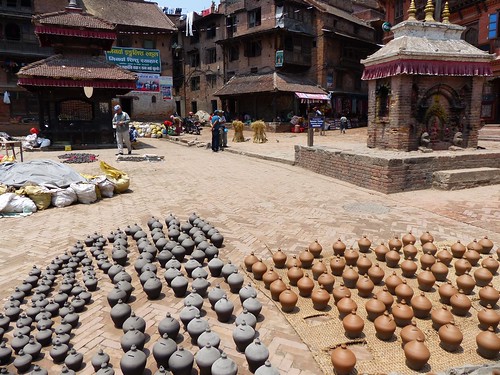
Shyam led us through a rabbit warren of alleys, where we witnessed the daily rituals of life: ladies drawing water from the wells, grannies minding toddlers and goats, workers hauling loads of timber and bricks, craftsmen carving wood and throwing pots, old men bent over a card table, children kicking around a ball or rolling a tire, vendors selling a little bit of everything. Here’s an interesting tidbit from my book:

The ancient route from Delhi and Kathmandu to Lhasa and Beijing went through Bhaktapur. A steady trade was maintained in salt, wool, gold dust, copper, medicinal herbs, spices and yak tails (used as royal fly whisks). Probably not much silk though. This trade peaked in the early 18th century and then declined after the national unification in 1767. A community of Newari traders has remained in Lhasa to import Nepali goods up to the present time.
Untitled

Untitled

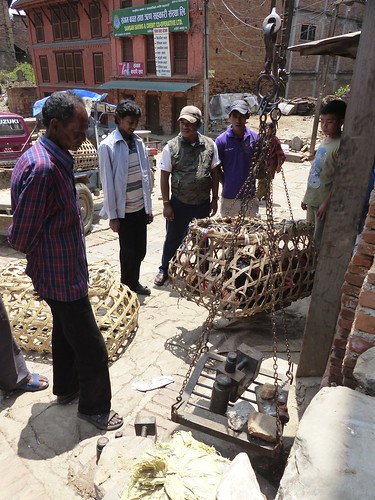
“Weighing” chickens for sale.
Untitled

Untitled

Untitled

Untitled

Untitled

Untitled

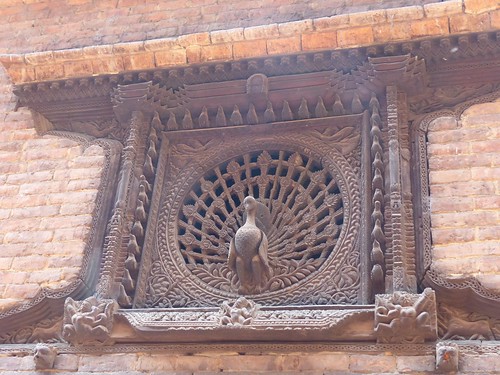
The famous Peacock Window.
Untitled

Untitled

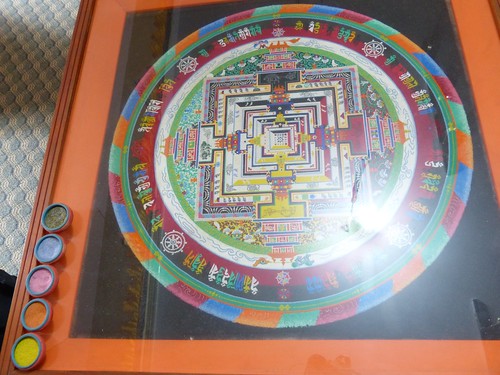
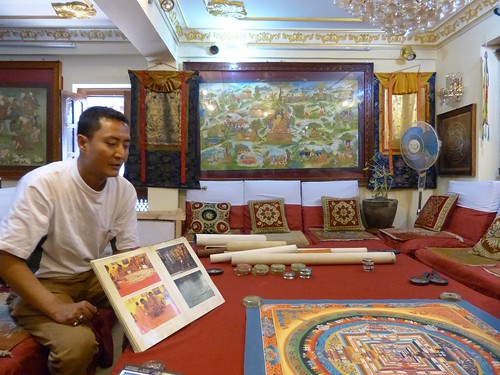
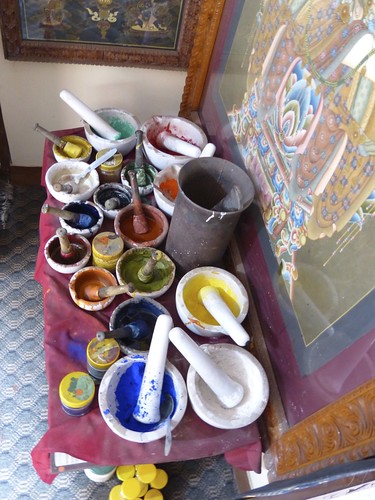
During our tour of Bhaktapur, Shyam took us to the Lama Thanka Painting School. We learned about the Dalai Lama’s sand mandala design.
Untitled

According to the Namgyal Monastery Institute of Buddhist Studies,

Sand mandalas are one of the most magnificent types of mandala construction and are associated with the most profound and elaborate Buddhist ceremonies in Tibet. Every color, dot, and line in the mandala represents an essential part of the deity and Buddhist philosophy. Each component must be placed in exactly the same place every time the mandala is constructed.
Although sand mandalas are made on a flat surface they are, to the devout, a three dimensional palace, representing the mind of the Buddha. The person contemplating the mandala enters into it, as they would a building or an enclosure.
The mandala construction itself is the result of long and disciplined effort, but it is nonetheless a temporary work. When the monks are finished, there is a dissolution ceremony where the deity is released by the dismantling of the mandala. The sand is cast into a body of water to emphasize and highlight the impermanence of all things and the importance of nonattachment. When the sand enters the water, the kindness and compassion of the deity are disseminated into the world to benefit all beings.
Untitled

Untitled

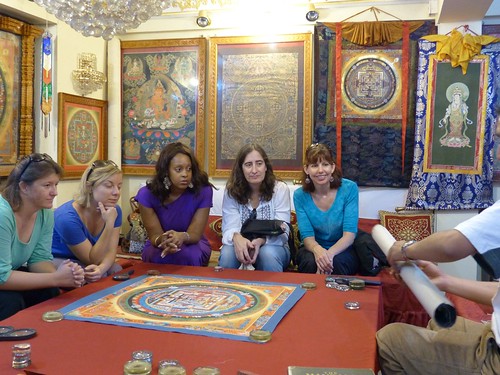
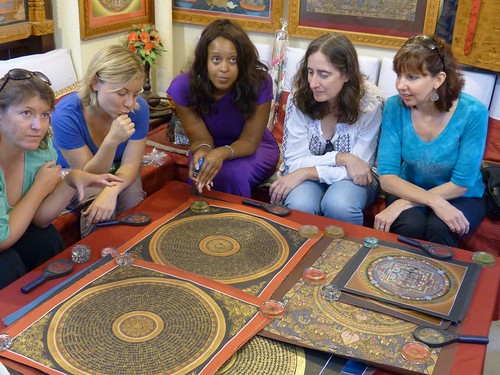
Then, of course, we started looking at paintings by students and masters, and then, of course, we couldn’t resist buying some. They really are stunning. Mine features a favorite mantra of compassion – om mani padme hum – painted in gold gajillions of times in concentric circles.
Untitled

Untitled

We had a fascinating day with Shyam.
Untitled

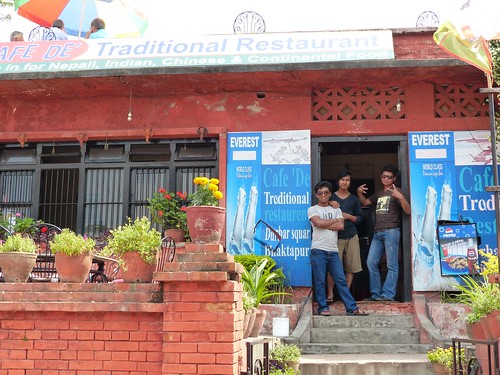
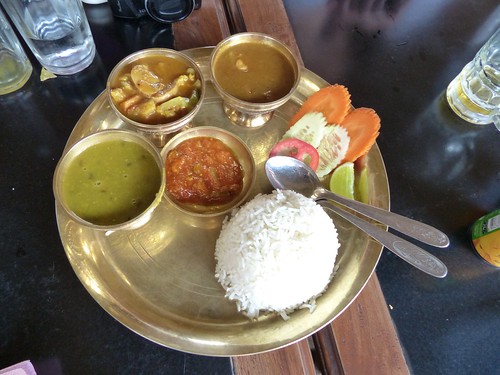
Before leaving Bhaktapur, we ate lunch at the redundantly named Cafe de Traditional Restaurant. I’m not sure what we ate, but I assure you it was delicious!
Untitled

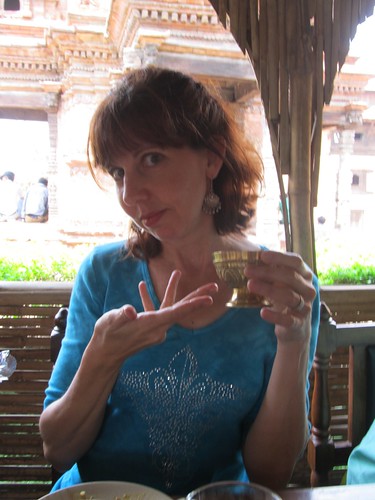
The best part was dessert: King’s Curd, a sweet scrumptious yogurty treat. Katrina took this shot of me loving my King’s Curd.
Untitled

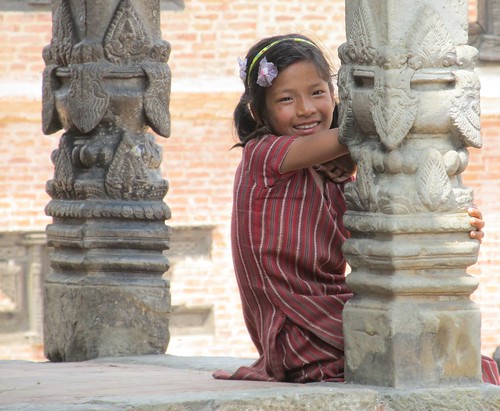
This little girl watched us eat. Katrina’s pic.
Untitled

These guys were our waiters.
Untitled

Back in Thamel, the backpacker part of Kathmandu, we popped into a Mexican restaurant for margaritas. I hung my camera, purse and bag of bananas on the back of my chair. (That detail will become important later.) We enjoyed a little siesta and then took off for a spectacular French dinner at Chez Caroline. Yes, before we left Kathmandu, we had devoured Italian, Mexican, French and Nepalese cuisine, including more than our fair share of momos.

In the morning, I wandered down to the courtyard for coffee but felt like something was amiss, you know, that feeling you get just after shutting the front door and realizing you don’t have your keys? I read my book for awhile, uneasy but unable to figure out why. Finally, I realized I hadn’t seen my camera that morning. I knew I had taken it to the Mexican restaurant, but I couldn’t remember having it after that. I wandered over to the restaurant and shook the metal grate over the door until a cleaning lady popped her head out the window. She came downstairs and let me in to search. No luck. One of the waiters shook his head. There were really only two possibilities: Another diner stole it or a staff member found it.

The camera had been an expensive Christmas present to myself (although Tony technically made the amazon.com purchase and put it under the tree). I was already mourning the loss, but even more, I was kicking myself for losing all the photos from this trip. Back at the guesthouse, Katrina wasn’t feeling well, so she stayed in bed while the rest of us headed out on another excursion.

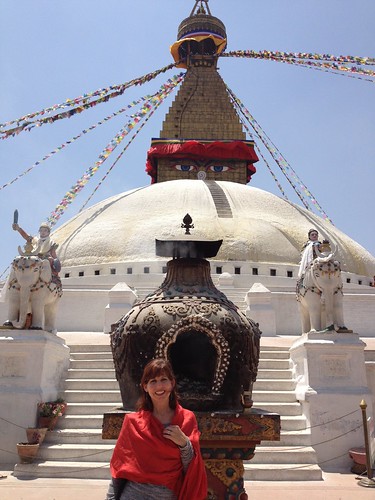
Bouddhanath Stupa
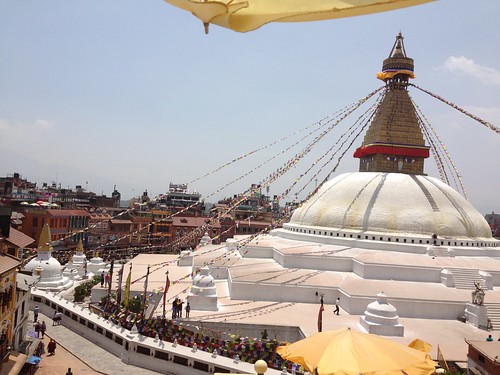
The Bouddhanath Stupa, first built in the 14th century, is one of the holiest Buddhist sites in Nepal and one of the largest stupas in the world. It was declared a UNESCO World Heritage site in 1979. As usual, one of my favorite travel websites – Sacred Destinations – has an excellent write-up about the stupa.

From above, Bodnath Stupa looks like a giant mandala, or diagram of the Buddhist cosmos. And as in all Tibetan mandalas, four of the Dhyani Buddhas mark the cardinal points, with the fifth, Vairocana, enshrined in the center (in the white hemisphere of the stupa). The five Buddhas also personify the five elements (earth, water, fire, air and ether), which are represented in the stupa’s architecture.
There are other symbolic numbers here as well: the nine levels of Boudhanath Stupa represent the mythical Mt. Meru, center of the cosmos; and the 13 rings from the base to the pinnacle symbolize the path to enlightenment, or “Bodhi” — hence the stupa’s name.
At the bottom, the stupa is surrounded by an irregular 16-sided wall, with frescoes in the niches. In addition to the Five Dhyani Buddhas, Boudhanath Stupa is closely associated with the Bodhisattva Avalokiteshvara (Padmapani), whose 108 forms are depicted in sculptures around the base. The mantra of Avalokiteshvara – Om Mani Padme Hum – is carved on the prayer wheels beside the images of Avalokiteshvara around the base of the stupa.
The base of the stupa consists of three large platforms, decreasing in size. These platforms symbolize Earth, and here you can look out at the mountains while listening to the chants of the devout doing kora, walking around the stupa praying.
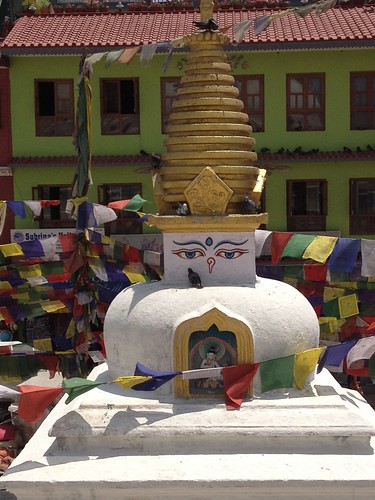
Next come two circular plinths supporting the hemisphere of the stupa, symbolizing water. As at Swayabunath, Bodnath is topped with a square tower bearing the omnipresent Buddha eyes on all four sides.
Instead of a nose is a question-mark-type symbol that is actually the Nepali character for the number 1, symbolizing unity and the one way to reach enlightenment—through the Buddha’s teachings. Above this is the third eye, symbolizing the wisdom of the Buddha.
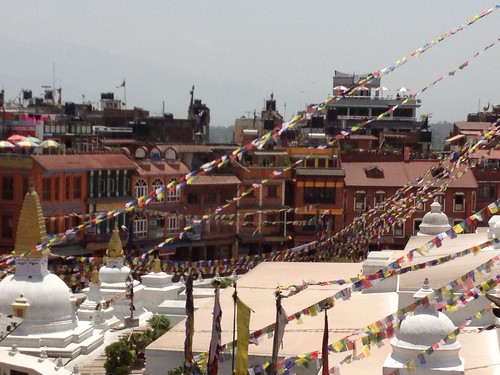
The square tower is topped by a pyramid with 13 steps, representing the ladder to enlightenment. The triangular shape is the abstract form for the element of fire. At the top of the tower is a gilded canopy, the embodiment of air, with above it a gilded spire, symbolic of ether and the Buddha Vairocana. Prayer flags tied to the stupa flutter in the wind, carrying mantras and prayers heavenward.
The main entrance to the upper platform of Bodnath Stupa is on the north side. Here Amoghasiddhi, progenitor of the future Buddha, presides. Below Amoghasiddhi is the Buddha Maitreya, the future Buddha.
Surrounding Boudhanath Stupa are streets and narrow alleys lined with colorful homes, Tibetan Buddhist monasteries, and street vendors.

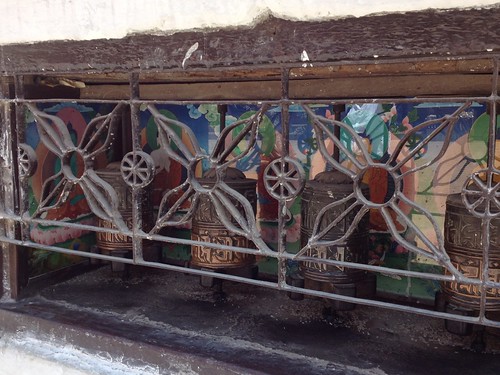
Buddhism is my go-to religion in times of strife. I like the mantras, the rituals, the karma. So I decided to follow the pilgrims on the circumambulatory path, turning every one of the prayer wheels while chanting the mantra adorning each one: om mani padme hum.
Untitled

Untitled

Untitled

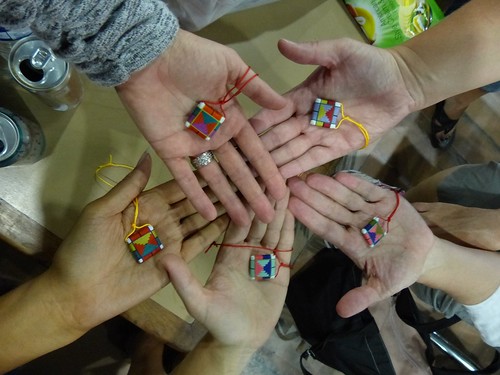
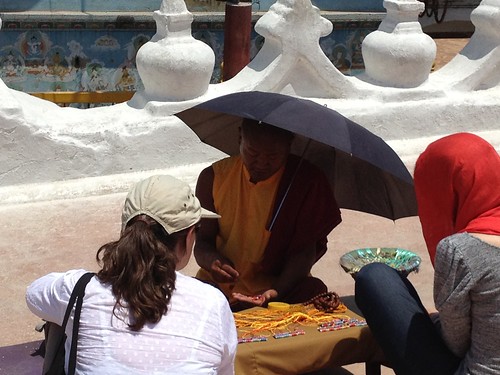
All of us gave a donation to a monk at the stupa in exchange for a blessing. The monk wrote the mantra on paper, folded it, wrapped it in colored thread and then blessed it.
(Photo by Tammy)
Untitled

Untitled

We climbed up to a rooftop cafe for a quiet break (and a good view of what seemed to be the filming of a cheesy music video) before heading back to our guesthouse.
(Photo by Tammy)
Untitled

Untitled

Well, I don’t know if it was the prayer wheels, the monk’s mantra necklace, Katrina’s rise from her sickbed to give the stink-eye to the workers at the Mexican restaurant or just dumb luck, but when we got back to Thamel, I ran up the stairs to the restaurant and the bartender said, “We found your camera! We already returned it to your guesthouse!” All’s well that ends well.

And that’s the end. We packed a LOT into a short girls get-away. Ladies, I’m gonna miss you!

O, Man! Forensics and fun in Muscat

Forensics – Not just for dead people.
That’s the slogan on the back of our team T-shirts.
As one of the MESAC Forensics Team coaches, I heard a lot of surprised exclamations such as, “Wow! You guys do forensics? I didn’t know you were trained in that!” Sigh … It’s not “forensic science” à la CSI. It’s forensics à la Socrates. In other words, the students compete in debate, public speaking and dramatic interpretation of monologues or duet scenes.

According to the American Forensic Association,

“Forensics” is a word rooted in the Western world’s classical experience. The Greeks organized contests for speakers that developed and recognized the abilities their society felt central to democracy. These exercises acquired the title “forensics,” derived from the Latin term “forensis” and closely related to forum. Because the training in this skill of public advocacy, including the development of evidence, found one of its important venues in the law courts, the term “forensic” has also become associated with the art and science of legal evidence and argument.

Our school is a member of MESAC (Middle East South Asia Conference), which also includes schools from Oman, the United Arab Emirates and Qatar. As one of four American Embassy School coaches (a fifth stayed behind in India), I traveled with 20 amazing high-schoolers to represent AES at the 2013 MESAC Forensics Tournament, April 17-21 in Muscat, Oman.

The American-British Academy (ABA) played host.
Untitled

Our fledgling forensics program fielded a debate team for the first time, and this was only the second year we participated in acting and speaking events. Nevertheless:
* Two of the debaters beat last year’s winners to earn a bronze medal.
* We sent 12 students to the finals.
* Seven kids came home with medals.
* AES placed second overall.

This is what we liked to see! Lots of “AES” on the results posters.
Untitled

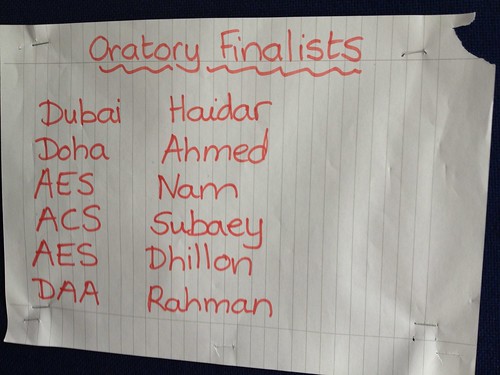
We adults felt excited for the medalists, but our greatest fulfillment came from watching the growth that occurred over the course of our season. This is a unique team in that students have an opportunity to express themselves in ways that take them far out of their comfort zone. For the oratory event, they wrote, memorized and presented powerful speeches calling for action. Our students addressed mental health in children, women’s rights in India, care of HIV/AIDS patients, Asian stereotypes and parental pressure for perfection. They spoke from the heart, revealing their deepest fears and biggest aspirations.

We may have seen the greatest transformation in our students competing in oral interpretation. They chose challenging pieces of literature to read, and some of the English learners required line-by-line explanations of the meaning before they could start interpreting. They worked so hard, begging for extra coaching time, meeting on weekends, shedding their inhibitions. When one of our 10th-graders took the stage to read “The Orange” by Joyce Carol Oates, she gave it everything she had, leaving the audience disarmed but in awe. Our only senior had brilliantly edited down a scene from “‘Night, Mother” and read the lines for both characters. Her subtle sophisticated performance tricked my mind into thinking there really were two people on stage and her last line forced a catch in my throat as I fought back tears.

There were so many success stories … not a slacker in the bunch. In addition to their work, our kids were kind, friendly and outgoing. They bonded with students from other schools and demonstrated admirable sportsmanship. So proud of them all! I feel incredibly fortunate to work at a school with this caliber of young people.

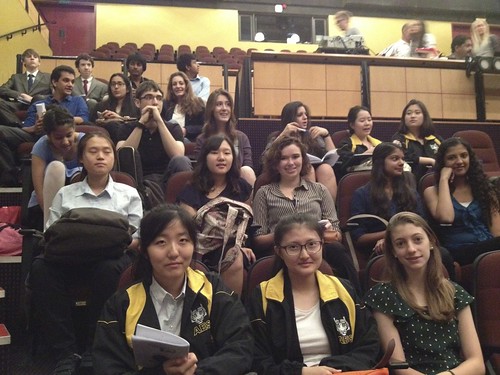
First day of the tournament at ABA … waiting in the auditorium.
Untitled

My good friend Jacqueline, who taught with us in Turkey, now works at The American International School of Muscat. I was hoping to meet up with her during our visit, but the tournament schedule was grueling. Imagine my excitement when she showed up at the ABA coaches lounge! She hung out with us at the school a few times and then surprised me with a ticket to see “Madame Butterfly” at the Royal Opera House. I almost declined, exhausted from a lingering cold and the intensity of the tournament, but I couldn’t resist the lure of a cultural event paired with some Jacq time. The two-year-old Opera House was stunning inside and out. In fact, I may have appreciated the venue even more than the show!
Untitled

So much elegance.
Untitled

I NEED one of these lamps.
Untitled

Jacqueline and me. (I’m the one who looks less like a posh opera-goer and more like a worn-out teacher at the end of a long day.)
Untitled

Here’s a cool promotional video from the Royal Opera House website:

Our only other foray into Muscat was a traffic-y bus ride with all the kids and coaches to a souk, a fun market with Omani souvenirs and crafts. We spent about 30 minutes poking around before heading back to our hotel. Students stayed with ABA families, so coaches enjoyed a little downtime. In fact, one of the other coaches had issued a challenge: Which coach could find the best souvenir for one riyal (about $3)? Back at the hotel, the coaches met to compare souvenirs. The AES coaches nailed it. We had purchased a bizarre plastic pull-string toy featuring a Barbie-ish doll riding a sort of bicycle rickshaw with a green alien-ish baby and a rotating umbrella. We turned it into a trophy and gave it temporarily to our MVP. (I’ll post a photo when we get it back.)

Gimme a break

I thought this would be the weekend I could slow down and take a breath. I have a month’s worth of backlogged blogs in my mind.
Then I remembered we coaches were taking our high school forensics team out to dinner Friday night.
Then I remembered I had compulsory CPR training Saturday morning, an awards ceremony for spring teams Saturday afternoon and a farewell party for some departing teachers Saturday night.
I’m finally getting my hair colored Sunday morning (after cancelling twice because of other commitments; my grey roots are staging a mutiny), but report cards are due next week, so there goes the rest of my day.
So, maybe I’ll slow down, take a breath and blog next weekend.
TTYL.