Although a 5000-year-old Indian scripture refers to a city located in modern-day Delhi, archaeologists will have to keep digging to find proof. Sites unearthed so far have found signs of Delhi’s urban dwellers in seven successive ancient cities dating to around 1060. New Delhi, as we know it, is considered the eighth. Yesterday, we visited the ruins of Delhi’s first ancient city – Qila Rai Pithora, which extended the citadel of Lal Kot, constructing a walled city with 13 gates.
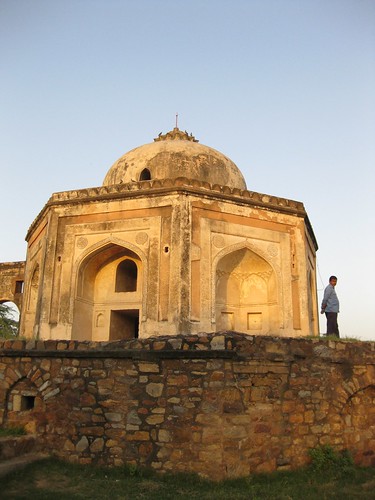
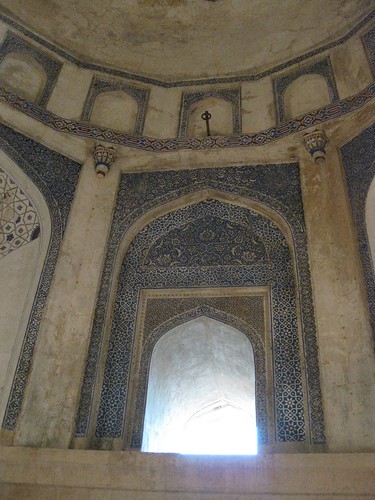
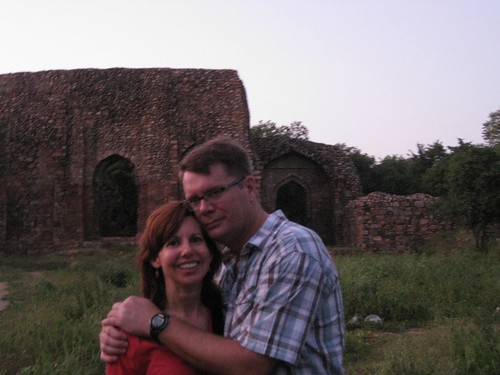
I had heard the name “Surekha” from several sources, so I got in touch with the founder of Delhi Metro Walks and signed up a group of 11 teachers to join her Saturday tour. We all met at a busy street corner and walked to the Mehrauli Archaeological Park with a brief stop at a square domed tomb, which recently underwent renovation. We veered off the sidewalk onto a dirt path that wound up a hill. No wonder British soldiers used to picnic at this spot; even today the view is lovely. Back then, the forest and hunting lodge must have been a welcome refuge from city life. Inside the mausoleum, intricate finials and traditional patterns decorated the walls. According to an article in The Hindu(India’s national newspaper), the resident of the tomb is up for debate. The tomb’s caretakers migrated to Karachi after Partition forced Pakistani nationals to leave India (and vice versa). “No one remains to help unravel the mystery of the mausoleum,” the article says.
Climbing up to the tomb.
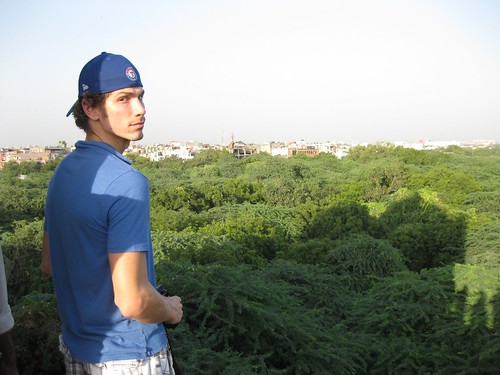
Isaac checks out the view.
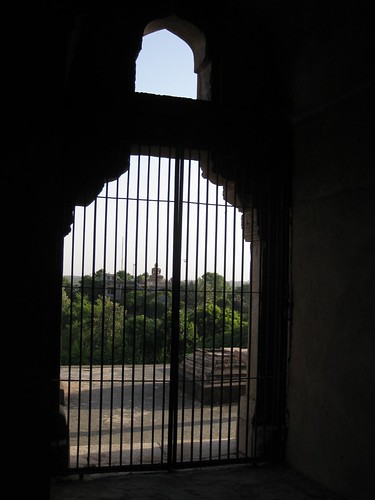
Inside the mausoleum.
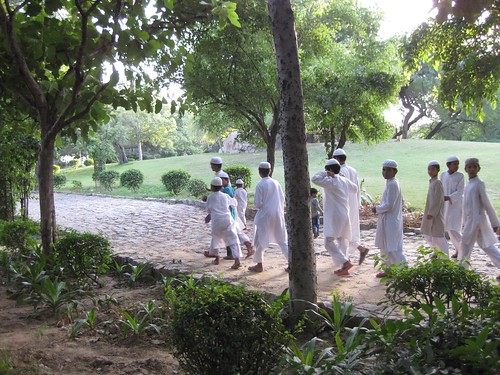
After back-tracking to the sidewalk, crossing a busy street, and cutting through the debris of a recently relocated flower market, we entered the Mehrauli Archaeological Park. Suddenly the honking and shouting faded, and we found ourselves amidst sun-dappled trees, rolling lawns and a newly planted rose garden. We exchanged curious looks with this little group.
Starting in 1997, the Indian National Trust for Art and Cultural Heritage (INTACH), with funding from the Delhi Tourism Development Corporation (DTDC), has been identifying, excavating, renovating and conserving 42 of the buildings (which represent nearly every era in Delhi’s history) in this 100-acre park. In addition, According to the INTACH website:
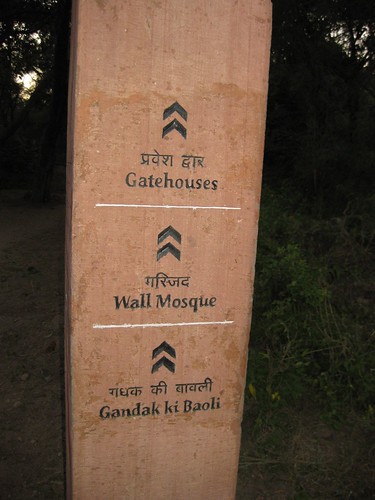
50 trail markers, 40 monument description boards, 150 benches and project description boards, together with 2 km of heritage trails were laid down. Both signage and pathways have been built of natural materials such as sandstone and the local quartzite stone employing traditional workmanship thereby contributing to the unique natural and historic character of the area.
Here are some highlights of our tour.
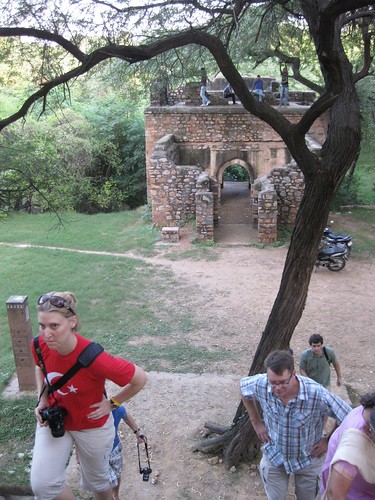
Sir Thomas Metcalfe, who was the East India Company’s resident at the Mughal Court, constructed his 19th-century country house right over the 17th-century mausoleum of Muhammad Quli Khan (an attendant to the Mughal emperor Akbar and stepson of Akbar’s wet nurse). Metcalfe’s dining room was apparently directly over Khan’s tomb, and he further embellished the area with pavilions, a dovecote and a waterway to bring visitors to the estate by boat.
The motorbikes are parked in what would have been the canal. The building was a boathouse, and we walked up the steep steps to the site of the former tomb/country estate.
Work is underway to restore the building to its original state – as a mausoleum, not as a weekend get-away.
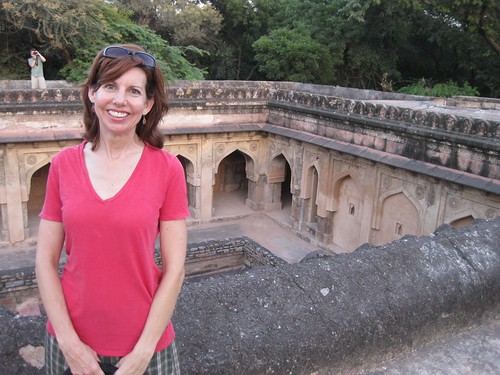
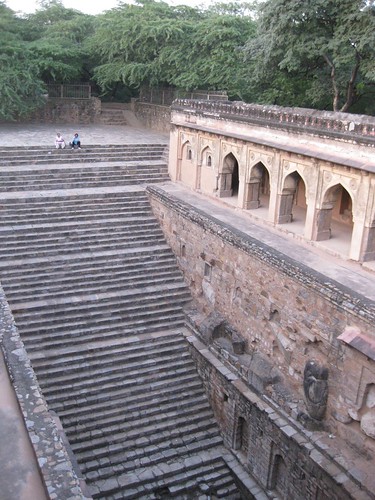
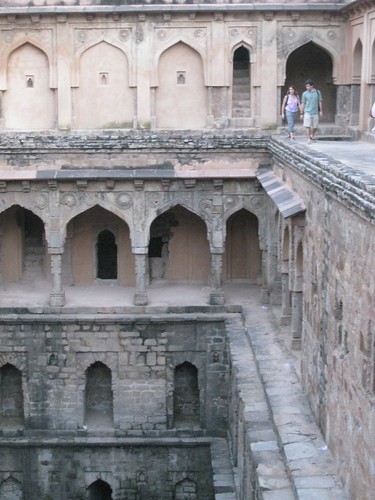
The Rajon Ki Baoli is a three-storey stepwell built in 1516.
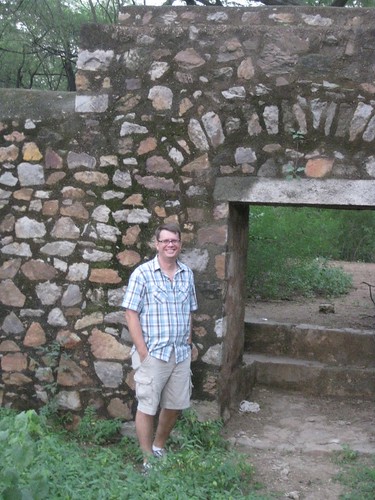
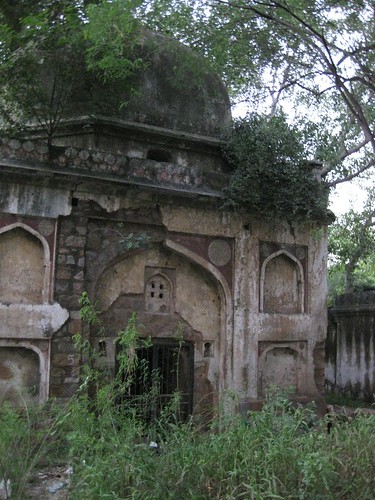
Many walls, gates, foundations and buildings remain unidentified and overgrown with weeds and trees. The sign marking this one just said “wall” or something like that.
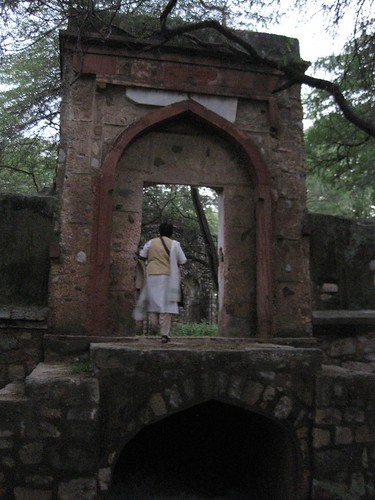
Surekha walks through an archway.
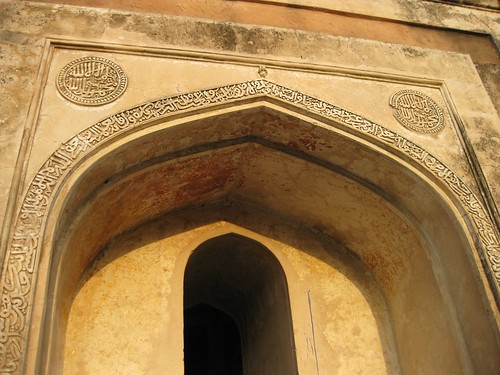
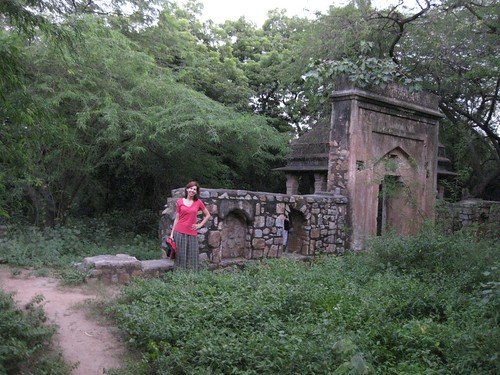
Near the entrance of another tomb.
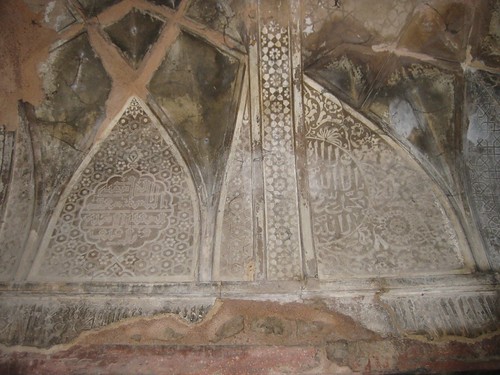
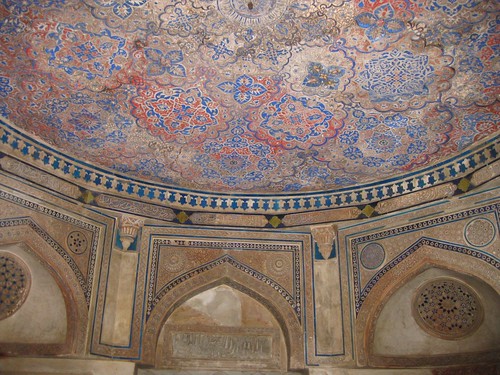
Inside the mausoleum of Shahid Kahn (son of Sultan Balban, see below), Surekha pointed out the “scrafitti” on the ceiling. I had never heard that word before!
The sun was setting as we approached the tomb of Ghiyas-ud-din Balban, who reigned from 1265-87. Surekha explained that this building is believed to be the first in India constructed with “true” arches. The Speaking Arch is an interesting article that clarifies architectural significance of that arch.
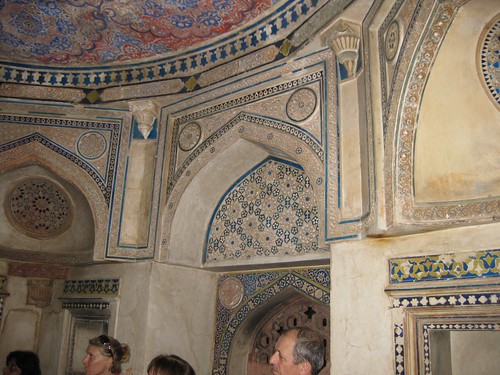
Surekha saved the best for last, but it was pitch black by the time a caretaker unlocked the gate to the Jamali-Kamali mausoleum. Inside the tiny building, we used the flashes on our cameras to light up the colorful, ornate space.
It was so dark, I couldn’t see what I was shooting. When I opened up the pictures on my computer, I decided not to crop out the heads in the interest of perspective.
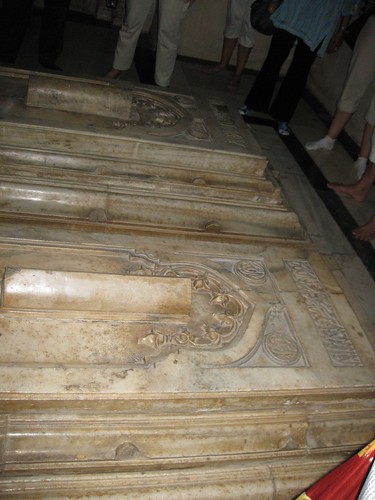
The tomb of Dervish Shaikh Jamali, a Sufi saint who died in 1536, lies next to that of Kamali, who is assumed to be an associate of the saint’s family.
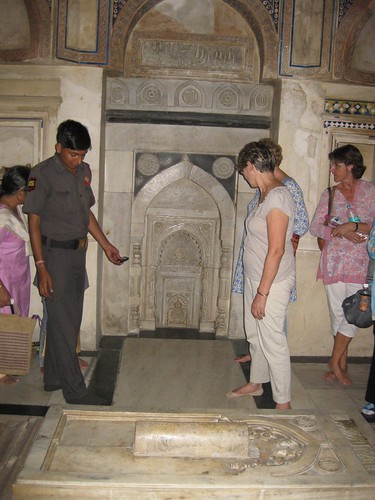
The mihrab is a nook that indicates the direction of Mecca.
After leaving the Jamali-Kamali tomb, we walked in darkness back to the starting point and – with some help from Surekha – rounded up some tuktuks for a short ride to dinner. We invited our wonderful tour guide to join us, but she had another busy day planned for Sunday and needed to rest.
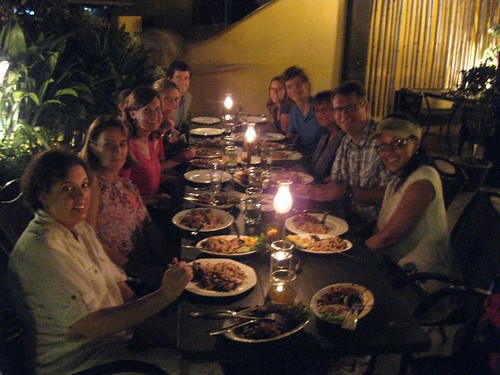
Our group met up at Thai High restaurant and enjoyed a delicious dinner on the rooftop terrace.
Delhi is the symbol of old India and new … even the stones here whisper to our ears of the ages of long ago and the air we breathe is full of the dust and fragrances of the past, as also of the fresh and piercing winds of the present.
– Jawaharial Nehru, India’s first prime minister (1947-64)
I echo Nehru’s poetic take on this fascinating city, but unfortunately I have to admit the allure of ancient ruins, modern art galleries, teeming bazaars and cultural shows hasn’t been enough to break my weekly school-home-school-home cycle that leaves me too exhausted for weekend revelry. Then I found out about Restaurant Week and suddenly mustered the energy to venture beyond my usual route.
During Restaurant Week, 13 upscale eateries offered 3-course meals at a fixed price – 1,000 Rupees or about $20. I would have gone every night except the available dinner seatings were at 8:30 p.m. at the earliest! I’m usually in bed by then on school nights. So I booked two reservations: Friday dinner and Saturday lunch.
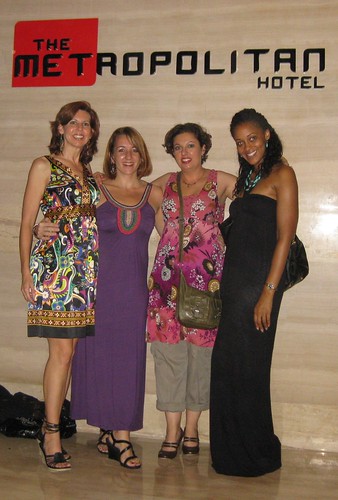
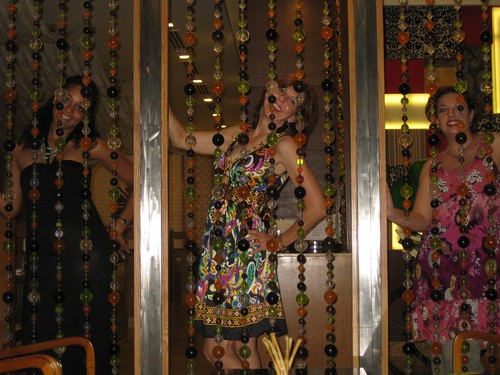
For Friday’s outing, I invited three other teachers – Nancy, Andi and Katrina – for a little Ladies’ Night at Chutney Restaurant, located in the Metropolitan Hotel. Rather than worry about transportation, we hired Kapoor, the taxi driver who takes Tony and me to school each day. Having no feel for the layout of this city or the time needed to get from any point A to any point B, I planned for an hour’s drive. In fact, it took 20 minutes. So we settled in at the hotel bar and enjoyed cocktails and some fun with the beaded curtain.
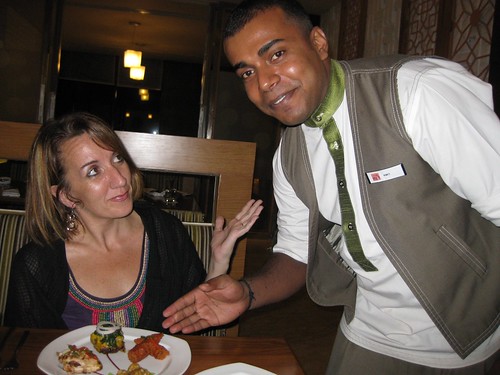
We finally got seated for dinner around 8:45 p.m., by which time we had nearly eaten the sofa cushions. Our waiter, Amit, graciously explained that two menus were on offer: vegetarian and non-vegetarian. Un-versed in Indian cuisine, we made him repeat and describe the courses several times and ultimately confused him in return by mixing and matching the options to create our own combo-veg-non-veg menu.
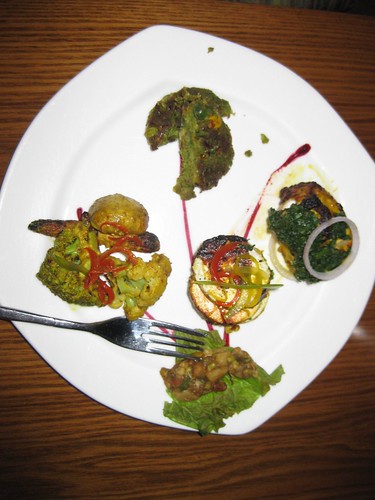
I opted for the veg appetizers, as pictured here.
Hmmm.. I wish I could tell you what I ate. All I can say is it was delish.
We all chose shorba tamatar, aka spicy tomato soup, for the second course and started pouring the wine in earnest to douse the fire in our mouths. For the third course, I went non-veg with two scrumptious curries – fish and chicken, served with rice, black-lentil dal and nan bread. Dessert featured a fried something (called tukda) and a dense Indian-style fruity ice-cream.
By the time we swallowed the last drop of wine, our cheeks ached from laughing. As much as I relish a fine meal, I know it’s much better paired with fun company. We were having such a great time that we forgot to watch the clock, so when we stumbled outside at 11:30, Kapoor was nowhere to be found. I pulled out my phone to ring him only to find the battery had died. One of my new friends called Tony to get Kapoor’s number, and our sleep-deprived driver eventually pulled up to the restaurant in an understandably cranky mood. My bad.
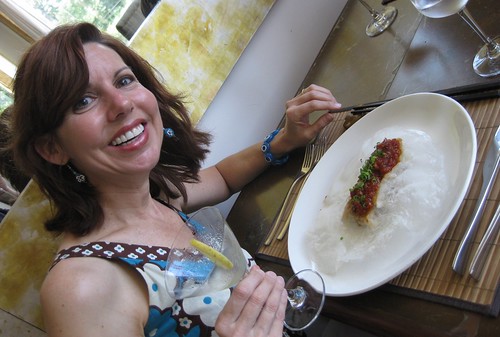
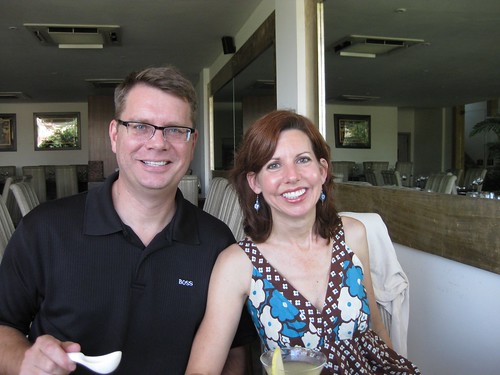
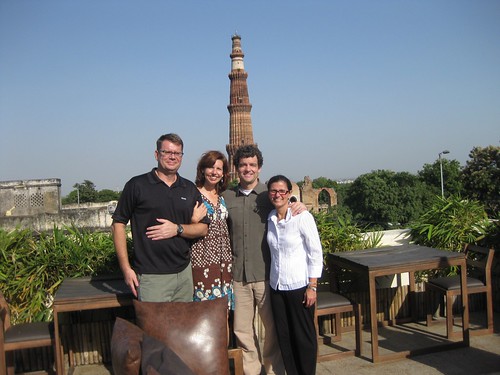
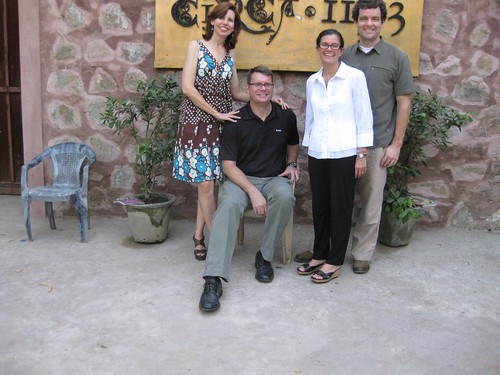
Still a bit full from the Friday night dinner, I climbed into a taxi Saturday with Tony and another new teaching couple – Dan and Sandra – for my second Restaurant Week outing. In the shadow of the historic Qutub Minar, the restaurant Circa 1193 served up a beautiful view and tasty Asian fusion dishes. The menu included a few choices for each course. My line-up: vegetarian miso soup, pork gyoza with a spicy tomato relish, crunchy and carmelized basa (an Indonesian fish), and yuzu and mint cheesecake (at which time I learned that yuzu is a small citrus fruit). I figured the optional cocktail pairings would help alleviate my hangover, so I also enjoyed a Garden Frost Martini (green apple and cucumber) with my dumplings, a glass of Opera Chardonnay with my fish, and a passion fruit spritzer with my dessert.
On the deck, overlooking the ruins.
The taxi driver took this shot. He was a good sport.
So, that wasn’t so hard. Breaking out of my routine actually felt good. I’m inspired to check out a little more of this city, bit by bit, dish by dish.
As a high-schooler in Germany, I felt pretty special to dance the night away (in my red lace gloves) at prom in the Heidelberg Castle and walk down the aisle in my purple cap and gown for graduation at the historic Worms Cathedral. Hard to beat that, I thought.
Well, not really.
Tony and I just got home from a staff retreat at a 15th-century fortress in Rajasthan, India. Quoting from “30 Rock,” Tony called it “the retreat to move forward,” but there were no cheesy team-building games or activities with awkward compulsory sharing. Just a lot of chillin’ and “Princess Bride” jokes (Have fun storming the castle!).
More than 50 teachers (plus a few non-teacher spouses and kids) traveled to the Neemrana Fort-Palace, which sits on a plateau at 1,640 feet, about three hours’ drive from New Delhi. The 2-billion-year-old Aravalli Mountains serve as a backdrop.
Built as a fortified palace starting in 1464 AD, Neemrana served as home to descendants of northern India’s last independent Hindu king, Prithviraj Chauhan III. Chauhan was defeated in battle and executed by Mohammad Ghori in 1192 AD, ushering in an era of Muslim rule. When India attained independence in 1947, royal privileges were ultimately abolished, leaving Maharaja Rajendra Singh strapped for cash and unable to maintain the crumbling fort. Thirty years later, entrepreneurs with a vision purchased the ransacked, dilapidated ruins and renovated the fort into an upscale heritage hotel.
I loved climbing up and down the zig-zagging wedding cake stairs of this ancient funhouse to discover interesting nooks at every level. However, just getting from our room to the restaurant involved a serious quad workout and a copious amount of sweat, so you can imagine our disappointment when we saw the algae coating on the surface of the pool. Some teachers and their kids crossed their fingers and dove in (after consulting with the hotel and checking Ph levels), but I’ve already done a round of antibiotics in India and didn’t feel the need to contract anything new at this juncture.
The green pool was disheartening for several reasons. Tony had fantasized about escaping Delhi’s oppressive heat with a refreshing dip, and I was looking forward to socializing poolside with our new colleagues. The crowd did gather around the steamy pool area, but I shunned the bonding opportunity in favor of the cool spa.
Our room – the Gujarat Mahal – was whitewashed and decorated with interesting art and period furniture. Small arched windows inside bigger arched niches overlooked the grassy valley, and the marble bathroom was reminiscent of a Turkish hamam.
Our room
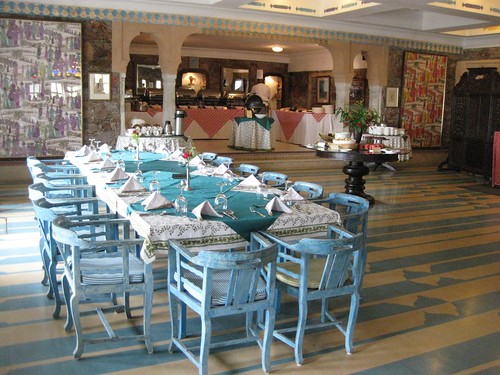
The restaurant
Shots from around the fort. (The one of Tony and Mr. Singh is for you, Mom!)
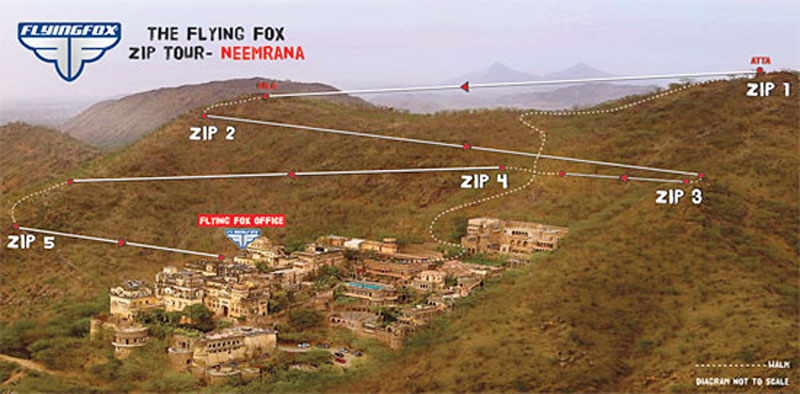
After a sweatfest exploration of the multi-tiered fort and stumbling upon gardens, pools, sculptures, carvings and dreamy views of the valley, we took to the sky with Flying Fox, a zip tour operator.
Here’s the course map.
So much fun! Wild peacocks created our soundtrack, and the views of the fort were splendid!
On our first day at Neemrana, Tony went for a hike while I enjoyed a foot massage at the spa. He was soon joined by a jewelry vendor, who journeyed with him to the nearby stepwell, known locally as the “baoli.”
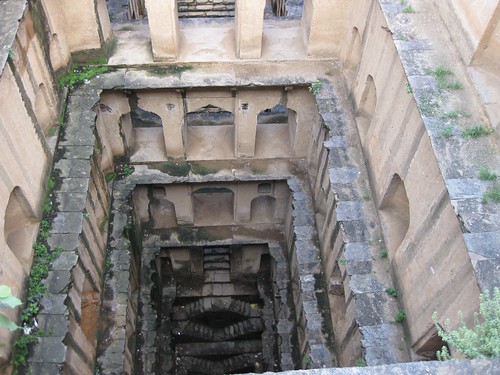
The next morning, we rose early so Tony could show me his impressive find. I expected to see a very deep yawn-inspiring water source, not unlike those I encountered as the ag reporter for a small Kansas newspaper years ago. Turns out, this baoli is older than America and way way way cooler than any Kansas farmer’s well.
I spent a lot of time trying to find accurate historical information online, but I mostly encountered the musings of other travelers, and the “facts” often contradicted each other. This blurb is from the website of Mosaic Architecture and Restoration, which posted in 2005 that it was restoring the stepwell. I cleaned it up a bit and added some English parentheticals.
Built in the 1760s it is a 9-storey underground structure of majestic scale. It was built by the Rajas of Neemrana for famine relief. Traditionally baolis in Rajasthan have acted as sarai (rest stops) for the travelers. The baoli has been neglected for decades. Now under the Rural Tourism project of the Union Government, this structure is being converted into a Crafts Haat (bazaar). The project involves restoring many roofs, re-doing the brackets, flooring, plastering and ensuring security through metal gates and katheras (stone parapets). The steps – about 200 in number – will also be re-laid.
We were there on a Sunday, so if there is, in fact, a restoration project or a craft bazaar, the workers and/or vendors must have taken the day off.
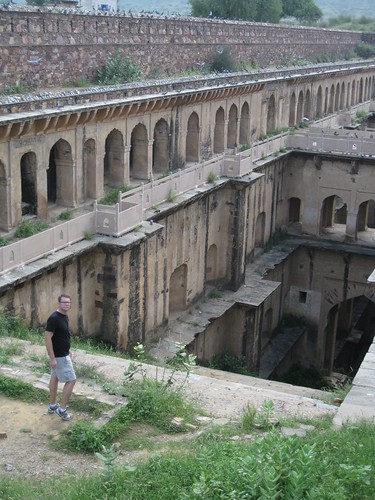
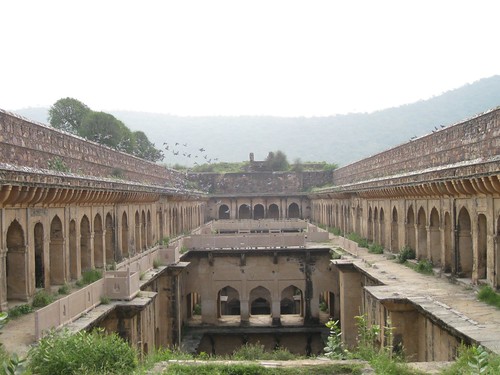
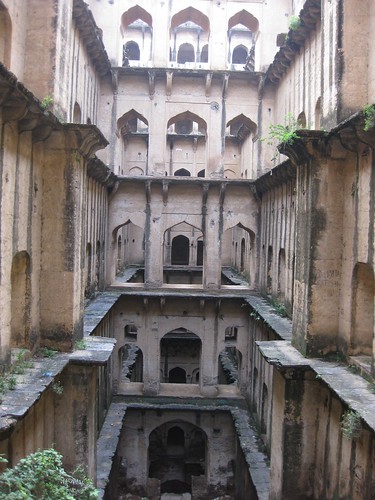
This is a WELL. Can you imagine? It’s like an upside-down apartment building.
This area would have been where the Spice Road travelers tied up their animals, found some shade, traded goods, and caught a few z’s.
I reached over the railing to try to get a shot all the way down, but I was too chicken to make a serious effort.
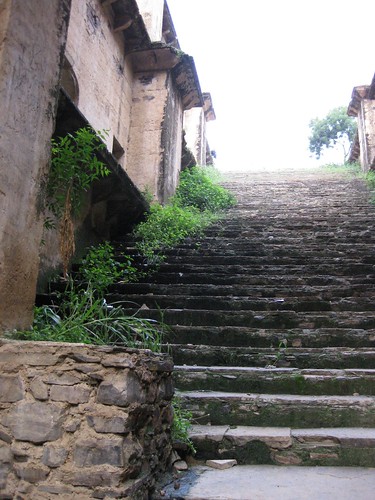
The steps going down into the well were worn and treacherous.
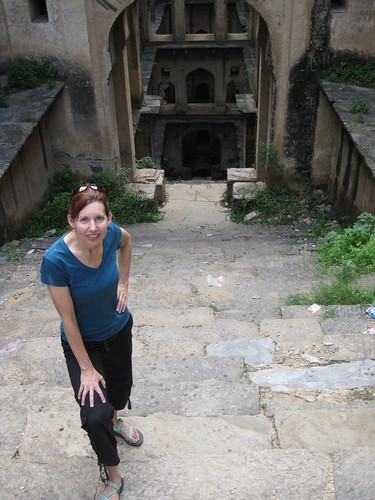
Tony waited at the top while I traipsed down a few storeys.
A view from inside.
The baoli echoed with the droning coo of pigeons and squawks of Alexandrine parakeets. Here, Tony spooks some of them.
Our hike to and from the baoli was an adventure in itself. Located just one kilometer from the fort, as the crow flies, the baoli wasn’t as easy to find as you would think. When Tony visited it with the jeweler, they walked from the fort to the main road and on to the well. But we decided to take the scenic route on a dirt road that wound through farmland and the nearby village.
As we left the fort, these donkeys joined us.
We followed the donkeys on a trail, nodding at brightly clad ladies coming down from the mountain with firewood piled on their heads and backs, passing a murky pond where a wild boar and her piglets scurried about, making way for men in traditional white kurtas leading hump-backed cows, gawking at the women and young girls collecting water and balancing the massive urns on their heads, and trying not to stare into the courtyards of small homes, where families were waking up and going through their morning rituals.
Although we received some curious stares (and we think at least one rude comment from a group of bored young men), the villagers mostly smiled and called out “hello” or returned our “namaste.” One man came out from his courtyard and shook our hands. “Welcome to my India,” he said and then struggled in frustration for his next phrase. “Nice to meet you,” I said, and his face brightened with recognition. “Yes! Nice to meet you,” he parroted.
We passed one muddy courtyard, where small children were using buckets to wash several enormous water buffalo. When they saw us, they jumped up and down, waving and shouting, “Hello!” Other youngsters passed us in the alleys with big grins and cheerful greetings. Nobody asked us for money or otherwise hassled us. The village’s welcome wagon seemed genuine and heartfelt.
For my first three-day weekend in India, I joined eight other teachers for a roadtrip to see the Taj Mahal. In an uncharacteristic move, I relinquished all power and let a new friend, Sandra, organize the whole thing. I hopped in the van Saturday morning without knowing (a) exactly where we were going, (b) what kind of hotel she booked, (c) whether we would have a guide, and (d) what was on the itinerary. How liberating!
Tony took too long to commit to the trip, so Sandra filled all the seats in the van. He was fine with that. In my absence, he bought a TV and a toaster, so it worked out well for everyone.
See my previous post, Getting to Agra, for details on the chaotic colorful cacophany we experienced on the journey.
After seven hours of watching India roll by the van windows like some unscripted Bollywood movie, we pulled in to a parking lot and met Tanveer, who would be our tourguide in Agra. He explained that we were going to visit Akbar’s Tomb first. This was a pleasant surprise as I hadn’t realized we’d be seeing anything other than the Taj Mahal.
I will describe our sightseeing as though I knew what I was seeing at the time, but really I returned to New Delhi and researched everything before starting this blog post. Just play along.
So who the heck is Akbar, and why were we visiting his tomb?
The Mughal Empire controlled much of the South Asia from 1526 to 1858, and Jalāl ud-Dīn Muhammad Akbar (eventually known as – or self-dubbed – Akbar the Great) became the third Mughal emperor in 1556 at the age of 13. During his 49-year reign, he modeled religious tolerance and a passion for art, literature and culture. He was also a follower of Salim Chishti, a holy man who lived in the region of Sikri. Remember that fact; it will be important later.
At the time, it was customary to design and construct your tomb while you were still around to see it. Akbar planned it and picked the site but died of dysentery before it was finished, so his son Jahangir oversaw its completion. The red sandstone contrasts dramatically with the white marble and black slate, and the Persian calligraphy is gorgeous. Tanveer pointed out a flaw: White marble slabs with inlaid black calligraphy reach up on both sides of the main gate’s arch, but then peter out. The calligrapher didn’t space his work properly to the fill the whole canvas. Plus, thanks to the laws of physics, the inscriptions up high look teeny compared to the elegantly huge writing at eye level. Tanveer said the calligrapher, Amanat Khan, learned his lesson. (That’s another little bit of foreshadowing.)
In this slideshow, you see a tomb, but that’s only a cenotaph – a word I just learned that means an empty tomb used to honor the deceased. Akbar is actually buried on a lower floor inaccessible to tourists. You’ll also see a blurry shot of a precious little girl. Stupid shaky hands! We saw a jillion beautiful people on this trip, and I wanted to take pictures of all of them. This family happily complied and then posed with me for some pics of their own.
Leaving Akbar’s Tomb, wild green parakeets swooped overhead and landing in the trees. Tanveer announced our next stop: Agra Fort.
Now we’re going to be bouncing around through time as I detail our Agra trip, so bear with me. Fortunately, all the main characters are related, so it shouldn’t get too complicated.
The imposing red sandstone walls of Agra Fort popped against the bluest sky I’ve seen in ages. The fort’s 1.5 miles of enclosure walls surround the imperial city of the Mughal rulers, starting with our buddy Akbar in 1565.
Only 10 percent of the fortress was open for visitors, thanks god. That 10 percent was exhausting! In one tower with a beautiful white marble balcony, Tanveer told us this was where Akbar’s grandson Shah Jahan lived out the last eight years of his life in exile after his son Aurangzeb staged a violent overthrow. Shah Jahan spent many hours each day staring out over the Yamuna River at his beloved wife’s mausoleum, the Taj Mahal. Stay tuned for details on that world wonder!
Tanveer rattled off one fascinating anecdote after another as he rushed us through the various buildings, courtyards and gardens. He was appropriately bossy and exasperated when we didn’t pay attention, so I felt nervous straying away to take photos. Hence, these shots aren’t very creative. That’s Tanveer by the fort map, and that’s the Taj Mahal in the background shot of me. Very cool.
Turns out Agra Fort was one of three UNESCO World Heritage sites we would visit this weekend. For more details on Agra Fort, check out the UNESCO website.
The brilliant blue sky had turned gray and angry by the time we finished seeing the fort, and we returned to our hotel in a downpour. We stayed at the Raj Mahal, which bills itself as “world-class luxury.” Not so much. But it was perfectly clean, comfortable and quiet. After a long day of sight-seeing in the hot sun, all I wanted in the whole world was a cold beer. Alas, Agra is a predominantly Muslim city, and most people were observing Ramadan, so we were lucky to get snacks and water in the hotel restaurant.
Our gang rose early to visit the Taj Mahal at sunrise. Tanveer said only the “lovers” – people who want to take their time and treasure the experience – visit the Taj this early. It seems he was right; the crowd didn’t start to swell until we were on our way out. Perfect.
So back to the Mughals. Remember poor Shah Jahan who was exiled at Agra Fort? Before his son got all crazy on him, he was the fifth Mughal emperor from 1627 to 1658. Obsessed with art, architecture and opulence, he was a prolific builder and supported some of the era’s most renowned craftsmen.
The relationship of Shah Jahan and his young queen Mumtaz Mahal is legendary. Although he had two other wives, historians agree Mumtaz Mahal was his one true passion. When she died giving birth to their 14th child, Shah Jahan vowed not to take any more wives and to build the most beautiful mausoleum in the world.
Tanveer brilliantly built suspense, walking us slowly up to the massive red sandstone gate that opened to the Taj Mahal garden while sharing the history and facts about the site. When the gleaming white marble building came into view, it honestly made me gasp. Built on a hill above the Yamuna River, it appears to float in the sky, a fitting tribute in a dreamy love story.
We strolled along the garden paths, pausing frequently to admire the Taj from different angles. Tanveer pointed out the mosque on the left-hand side and a matching building on the right-hand side built in a quest for perfect symmetry. The extra building couldn’t be used as a mosque (because it pointed away from Mecca), so it became a rest house where Taj Mahal visitors would hang out after praying at the mosque and paying their respects at the mausoleum. Considering the rest house was merely a symmetrical prop, its design and intricate carvings were quite impressive. (See the photos of the red sandstone building in the Taj Mahal slideshow.)
The Taj Mahal itself was both smaller and more awe-inspiring that I expected. I knew it had been built by an emperor for his beloved queen, but I guess I missed the fact about it being a mausoleum. I was expecting a meandering palace attached to her burial site. In fact, you could walk around the whole thing in just a few minutes.
But you wouldn’t want to; you have to take is slowly to absorb all the incredible detail that 22,000 workers spent 22 years crafting. Delicate carvings, white marble inlaid with semi-precious stones, minarets that lean slightly away from the mausoleum in case of an earthquake, the 33-foot-high brass finial at the top of the dome, magically designed arches that appear and then disappear a few steps later, towering columns of inlaid Persian calligraphy, the effect of the rising sun on the marble’s hue, the tiny windows of mica, and the view over the river to the Agra Fort, where Shah Jahan mourned his dead wife.
Remember the poorly planned calligraphy at Akbar’s tomb? By the time Shah Jahan hired that same calligrapher to decorate the Taj Mahal, the artist had worked out some fairly advanced math. According to a website on Taj Mahal calligraphy,
The calligrapher’s signature bears witness to his status and renown at the court, since many of his peers remained anonymous. He was so talented that he used an optical trick to inlay the verses at the Taj. The letters seem to be of equal size but they are not. As they move upwards to the peak of the arches, they gradually get bigger. It is a fact that things that are far away look smaller, hence by varying the size of the letters, the inscriptions look perfectly proportioned, no matter where you view it from. Such is the perfection of the Taj!
Photography was prohibited inside, unfortunately. Just like Akbar’s Tomb, there were cenotaphs to represent the caskets of Shah Jahal and Mumtaz Mahal surrounded by a lacy screen carved from marble; the real tombs were downstairs. Shah Jahal’s cenotaph is the only asymmetrical element in the whole complex. He hadn’t planned on being buried here, but his own mausoleum was never built.
UNESCO World Heritage Site number two? Check.
We returned to the hotel for breakfast and then checked out, loaded our bags into the van and headed to Sikri for our last sight-seeing stop in Agra.
Remember when I mentioned that ol’ Akbar the Great was a follower of the Salim Chishti? Akbar visited the Sufi saint when his wife had failed to conceive. Salim Chishti blessed the emperor, and soon the first of three sons was born. Akbar was smitten, so he did what anyone would do: build a whole new city and move the capital of his empire there just to be near his favorite holy man.
The UNESCO World Heritage site says, “it offers a unique example of architectural ensembles of very high quality constructed between 1571 and 1585.” Sikri was the capital of the Mughal Empire for only about 10 years, and then it was all but abandoned until archaeologists “re-discovered” it in 1892.
I love roaming around places like this, trying to imagine life as a 16th-century royal. It wasn’t easy for those ladies – stone beds, no air-con, competing wives and murderous sons, etc. Imagine being one of the slave girls who served as a living pawn in the life-sized chess-like courtyard game!
In this slideshow, you see the countryside as we approach Sikri. That was quite a change from the roadside scenery in Agra. The rest of the shots are inside the ancient city. One pic shows some remaining frescoes, although most of the city is unpainted with fine stone carving miraculously intact. The shot with Tanveer was an attempt to capture the purple comb in his back pocket, but also to show the stone pattern for the courtyard game played with live girls.
UNESCO World Heritage site number three? Check!
Here are some random shots of Agra from the bus window: a modern Indian family on a scooter, water buffaloes cooling off in a city pond, and people going about their business.
We were so lucky to have beautiful weather at all our stops, especially considering it’s monsoon season. Shortly after leaving Sikri for our ride back to Delhi, the deluge began again.
We got home lickety-split – only five hours, compared with the seven hours we spent getting to Agra. Next time, I’ll take the express train. Although my body feels like it got run over by an overloaded tuktuk, I feel incredibly fortunate to live here with so many opportunities to explore historical and contemporary India. I am now an Indian-culture addict. Where will I get my next fix?
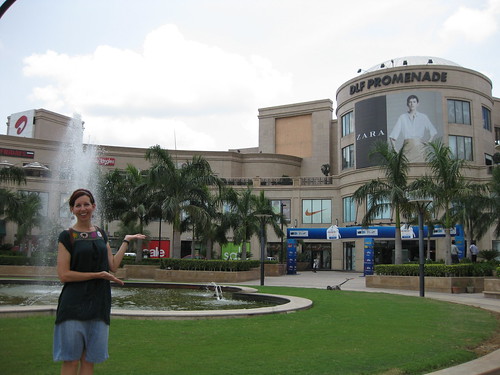
Tony and I recently took a tuktuk to the DLF Promenade mall just 10 minutes from our apartment.
It features many western shops such as Zara, Mango and Marks & Spencer and a few appealing restaurants, but more enticingly it also boasts store after store of colorful, glittery, girly, swirly Indian fashions, not to mention stunning wares for the house. And it turned out there wasn’t just ONE mall; it’s a mall complex. Nice to have options.
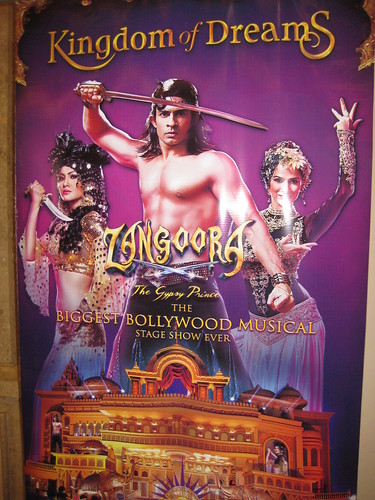
Funny how it takes so little to remind us that we’re not in America anymore. Once we entered the mall, we couldn’t hear ourselves think amidst a promotional performance for this show:
Here’s a sample. Maybe we’ll go see the real thing.
Saturday was Rahki, an Indian festival that celebrates the relationship between brothers and sisters. Sisters tie a sacred thread (often embellished with fake jewels or sparkly flowers) on the wrists of their brothers or male cousins as a symbol of love and good wishes. In return, brothers offer money, gifts or sweets to their sisters with a vow to provide lifelong protection. To celebrate this popular festival, families headed out of New Delhi early Saturday morning to reunite sisters and brothers.
Unfortunately, we also headed out early Saturday morning to visit Agra, about 200 kilometers south. We were told the drive would take about three hours. It took seven.
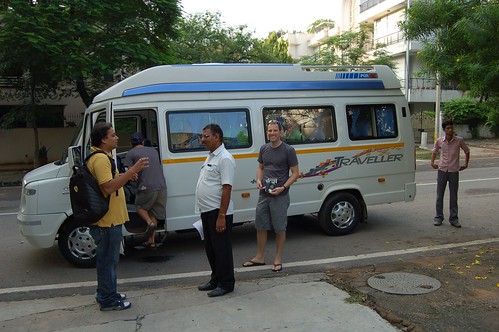
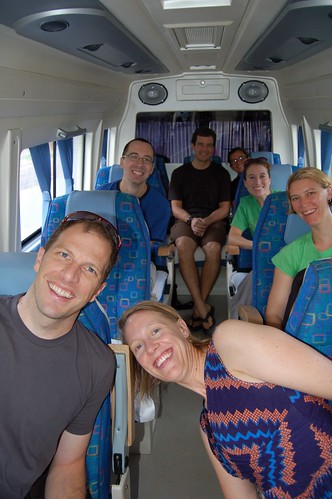
The van picked us up at 6:45 so we could beat the traffic! Woo hoo!
The gang’s all here.
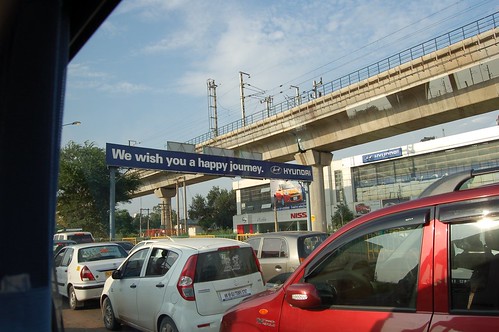
Off on our “happy journey.”
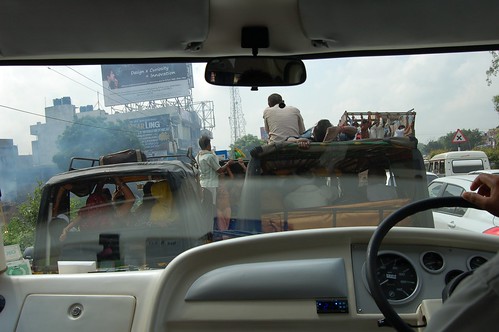
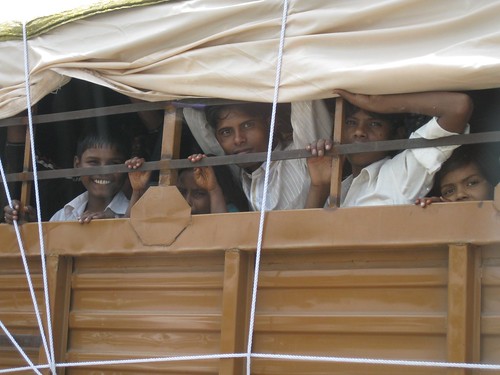
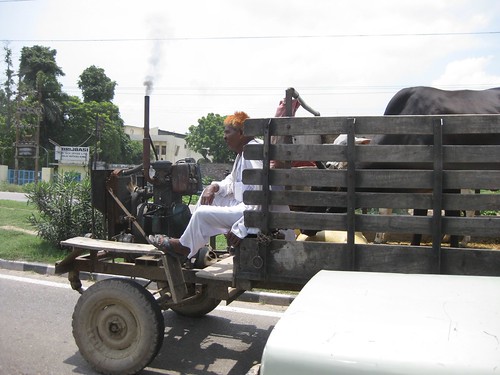
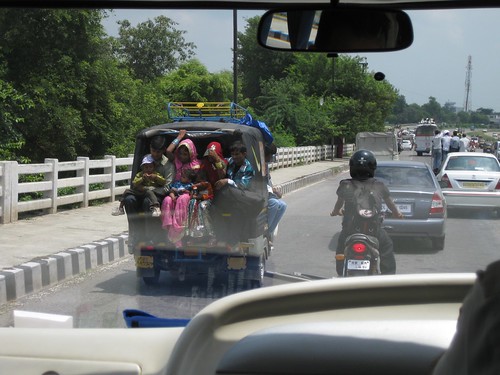
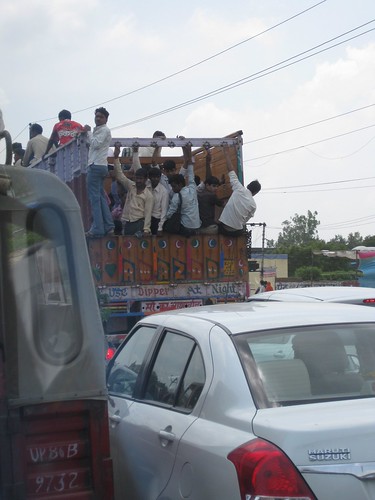
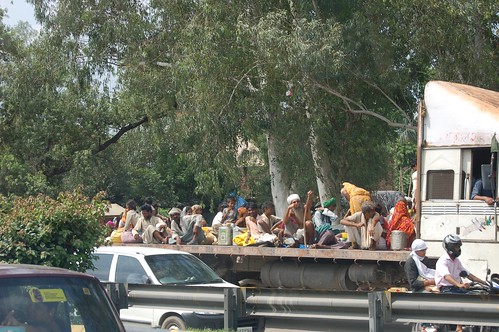
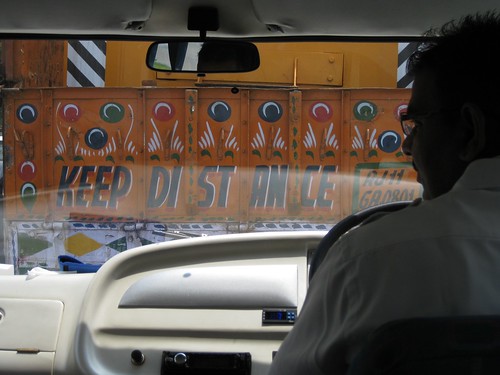
It seemed the whole city was trying to get somewhere else. These photos were all shot through the van window.
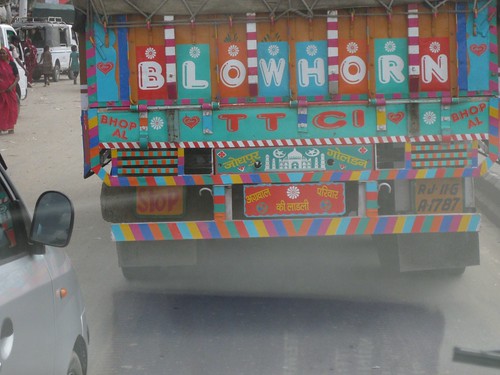
Trucks all encouraged other drivers to blow their horns, and boy did they ever! Most trucks also had the painted instruction, “Use dipper at night.” We learned that using your dipper means flicking your lights.
Our sweet driver Raju is not heeding the warning on the truck, eh?
I have lived and traveled in places with horrific traffic, but I have never seen anything like this! Bumper to bumper with nearly every imaginable vehicle. I expected to get on the highway here in New Delhi and then exit in Agra. No such luck. We spent much of our time crawling through village markets, weaving around back alleys, dodging cows, dogs and pedestrians, and rocking gently over potholes and speed bumps. Here’s a little video for a glimse into our day. Note the guy getting a shave in the midst of the chaos.
The sights and sounds outside our van were so compelling that I couldn’t be bothered to read or listen to music. At one point, we were stuck at an intersection where every driver pulled in to the middle so nobody could move until a sweaty young policeman stepped in and somehow restored a fleeting sense of order. Our hero for the day!
If someone had told me the ride to Agra would be seven hours, there is NO WAY I would have done it. But I’m so glad I did! I hope to go again some time, although I’ll be sure to avoid holiday weekends.
Today we wrapped up our first week at the American Embassy School in New Delhi, India. Although we’re inundated with information about our new school, students, apartment, neighborhood, city and country, we also feel an overwhelming sense of belonging.
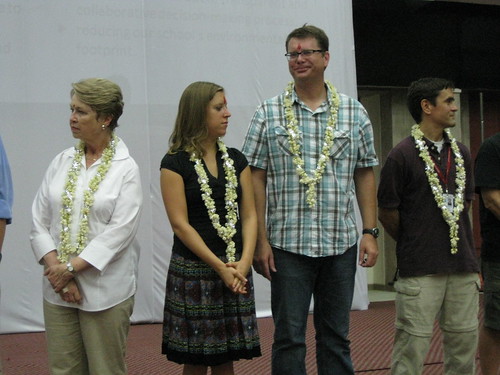
On August 1, the new and returning teachers finally met each other for the first time. We were introduced at an all-faculty presentation in the gym, where administrators read a short biography for each new teacher, and we received a garland of fragrant flowers and a red smear of paint between the eyebrows to symbolize the third eye. That’s Tony with Jan (who we knew in China) and new friend Becky.
Our new teacher cohort – the “newbies” – received a warm welcome yesterday at a party thrown by the “two-bies,” teachers who were new to AES last year. They sympathized with our newness and offered reassurances that we would soon feel settled and confident. We have attended several other functions designed to merge AES old-timers with the new group of teachers, and it’s amazing how seamlessly it happens.
In addition to the outpouring of kindness, the administration has modeled a spirit of balance and caring that permeates the whole school. When Director Bob Hetzel met with new teachers to discuss the school’s mission statement, he shared anecdotes about the power of collaboration and shared values, saying, “We have a commitment to making the world a better place.”
We have yet to hear a negative word or bitter comment from anyone about the school’s leadership. In fact, teachers repeatedly note how the director and principals somehow motivate everyone to raise the bar and cultivate creativity without undue pressure or stress.
That doesn’t mean we don’t create our own stress. My department, English as a Second Language, is undergoing major changes, so I can’t count on returning teachers to show me the ropes. We’re all learning as we go, which can be unsettling. I hope next year at this time (when I will be a “two-bie”), I will tell the “newbies” how brilliantly we developed a new immersion program at AES with the insights and shared wisdom of all elementary teachers.