Geck-o-rama

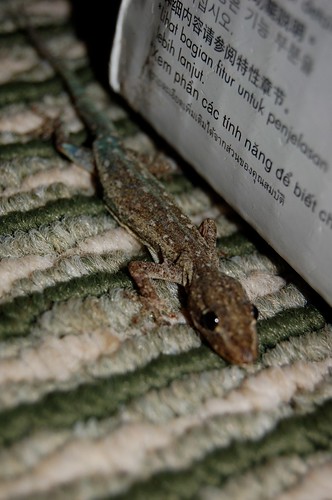
Yeah, they leave tell-tale signs of their visit all over the walls, but I just love the geckos here! We usually have one or two keeping us company in the kitchen or living room each evening. They stick to the wall with their plump little toes and freeze for hours at a time before scurrying off in search of a snack. I strongly encourage them to eat mosquitoes. As pets, they are no worse than my belated cat, Ketta, who begrudgingly allowed me to pet her just long enough to lure me into a false sense of security, at which time she’d whip her calico head around and sink her fangs into my hand. I fell for that trick again and again. Geckos are equally unaffectionate, but at least it’s not painful.
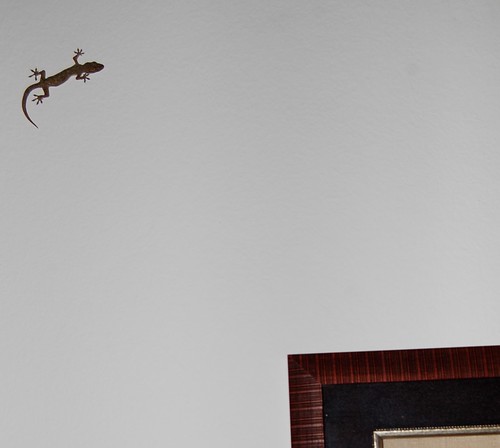
This poor little guy was hanging out in the kitchen when I got home from school. I set my camera on “macro” and got right down in his tiny face. He must have been blinded by the flash or paralyzed by fear because he was still in that position when I was heading upstairs to bed.

DSC_0146

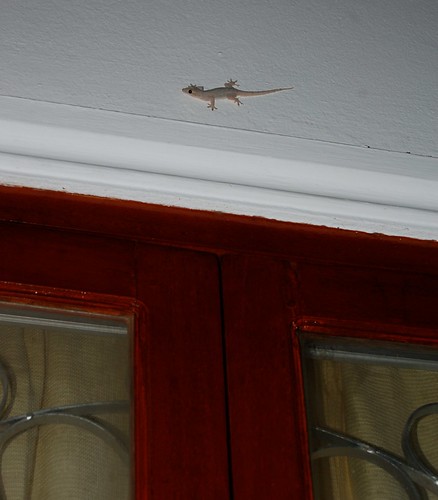
This may be the same one as the kitchen gecko. Dunno. But he was chillin’ in the living room this afternoon.

DSC_0147

This is our carport, where the geckos get together for late night dining. About 10 of them scattered when I approached with my camera, but this one didn’t get away in time.

DSC_0152

Bless Our House

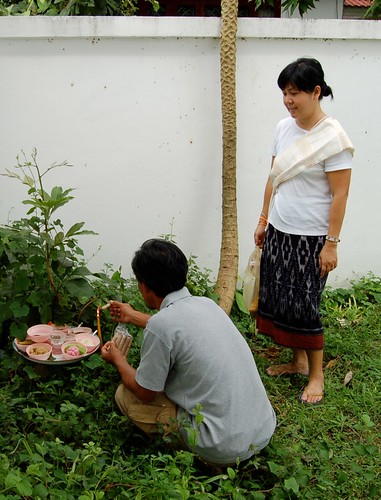
Our landlady, Mrs. Villay, and her handyman, Mr. Pye, stopped by the house on Saturday with a couple trays full of little snacks and drinks. When I opened the gate, I said, “Oh, wow, thank you!” and Mrs. Villay said, “It’s not for you. It’s for the spirits.” So she put one tray on the front steps and the other in the backyard, burned some incense, said a little prayer, and then popped inside for a minute to chat. Most Lao people are Buddhist, and they usually have a little spirit house in their yard, where they leave all kinds of treats: bananas, sticky rice, noodles, beer, Coke, cigarettes, fake money, etc. We don’t have a spirit house, unfortunately, but I guess the next best thing is to make an offering in an auspicious corner of the property. Hope it worked.

DSC_0138

Vientiane Shopping Excursion

My fantastic EAL coordinator, Carine, invited me on a shopping excursion last Saturday with our new school counselor, Leslie, and our new special ed teacher, Barbara. We went to Home Ideal, a smallish version of a Chinese K-Mart; a rattan shop, where I bought a shoe shelf; the “Morning Market,” a crazy collection of Laos handicrafts and Chinese crap; a pharmacy; and then a lovely Mekong Riverside restaurant. So civilized!

Lovely Light Fixture

We had been living in this house for more than a week before I really noticed our living room light fixture. Its awesome-ness simply can’t be captured with a camera. The center looks a big like a bunch of grayish grapes. Five large beige scallop shells surround the grapes, but the extra long fluorescent lightbulbs stick out the ends of the shells. The most truly fabulous part of all is the rope lights with colored Christmas-y twinkle lights inside. Pink, green, yellow, orange. You really cannot imagine how truly hideous it is. But it makes me happy every time I look at it … which is a lot. I just keep picturing our landlady at Home Depot, thinking, “Ah ha! That is exactly the most perfect fabulous light fixture I ever saw! I must have it for my house!”
Lovely light fixture

First Impressions – The House

A driver took us to our new home straight from the Vientiane airport on Aug. 1. When Mr. Lamon pulled open the huge metal gate, the wildly overgrown yard distracted us momentarily from the two-storey French Colonial home. He unlocked the side door and beckoned us inside, where we found a layer of dust blanketing the vinyl furniture and hardwood floors. Gecko poo dotted the white walls, and the kitchen counters and cabinets showed signs of rodent infestation. Ant trails criss-crossed nearly every surface. Upstairs, dirt filled all the nooks and crannies of the rattan beds and night stands. The built-in closets and drawers of the four bedrooms were desperately in need of a good scrubbing.

As our spirits sank, our new superintendent Steve Alexander popped in and cursed a bit. The landlady had promised to clean up the house and yard, he said. He placed a few calls, and before long a cleaning crew showed up. Their efforts made the house habitable in the short run, but we knew a lot more elbow grease was needed before our shipment arrived. Luckily for me, Tony suffered terrible insomnia for the first week, so he whiled away the hours mop in hand while I enjoyed Ambien-induced slumber.

After just three days, the movers delivered our shipment – 124 boxes! We happily replaced the landlady’s furniture and began setting up our home. Slowly, it’s coming together. Tony fixed a stopped up shower drain, assembled several shelves and took down two hideous light fixtures. The permanent shower rod was installed too high, so water splashed under the shower curtain and all over the bathroom, but I solved that problem by purchasing a spring rod and installing it a bit lower. I also came up with the brilliant plan of covering the front door with a Turkish kilim (and using the kitchen door exclusively) to open up the living room space. Every day, we get the house a little more organized, a little more decorated. Today, I woke up and went downstairs for breakfast without having to move anything out of my path. Progress!

Any idea how to make the captions show up? If you’re interested, click on the photos to go to flickr.com.

Moving On

It’s always hard to say good-bye to family, friends and the familiarity of the States at the end of our summer vacations. However, Tony and I usually look forward to getting “home,” wherever that may be. Two weeks ago, we took off for a new home in Vientiane, Laos.

In those last two weeks, we finalized the purchase of a summer house in Michigan, traveled for 31 hours to Laos, moved in to our new house in Vientiane, hired a maid named Daeng and a night guard named Ae, received our shipment from China, unpacked everything and found a place for most of it, started new teaching jobs at Vientiane International School, bought a motorbike, found pants that fit Tony (no small feat in Southeast Asia!), got the internet and new printers set up at home, and began exploring our new city.

We still haven’t figured out how to work our stove.

Wow, no wonder we’re tired.

Farewell China Tour (Day 10)

Last Day of Our Adventure!
As we sipped our coffee at breakfast, the lace curtains fluttered in the morning breeze. Cath and I looked out at the mountains and sadly reminded ourselves that this was the last day of our fabulous adventure. We walked the Barkhor around Jokhang Temple a final time and popped in to a few shops. I bought a gorgeous yak bell that I had been eyeing all week at a quaint little store owned by a Tibetan family. I had to haggle quite a bit over the price, but I promised to tell all my friends about them (which I will do as soon as I unearth their business card…).

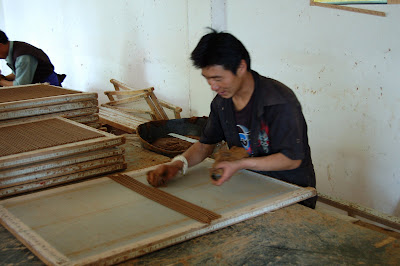
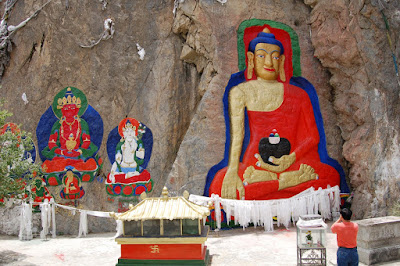
On our way to the airport, Chum Zhun took us to a supermarket to shop for dried yak meat. After sampling several varieties, I delegated yak tasting to Cath and bought the kind she recommended as a special gift for my dad. (Hmmm … I wonder if it’s still in his fridge?) We toured an incense factory that was overrun with Chinese tourists, quickly stopped to see an ancient Buddha painting on the side of a mountain, and then drove to the airport for our flight back home.

From Incense Factory
From Rock Painting

For the first time during our visit to Lhasa, we saw a major Chinese military presence. They clumped together in menacing groups, donned in full riot gear and holding protective plastic shields. We felt terribly intimidated. There was no obvious reason for the throngs of soldiers. In fact, the Tibetans went about their business as usual – buying breakfast noodles from street vendors, making the sacred trek around the temple, staffing the market stalls, chatting with friends, etc. After three glorious days full of meaningful encounters with the Tibetans, Cath and I had formed an idealistic image of the region and its peace-loving people. This morning, our unrealistic perception was shattered by the tangible reminder that Tibet was truly under Chinese occupation. We spent much of the morning in stunned silence, saddened by the nonsensical presence of troops at a place of worship and even more impressed with the beautiful Tibetan people, who regularly risk their livelihoods or even their lives to maintain their traditional ways.

Returning to Shanghai was bittersweet. Cath and I had shared an unforgettable journey, but it was time to face reality. She was moving back to Canada, and Tony and I were moving to Laos. It was time to say good-bye to China, and we agreed that our trip had been the perfect send-off. Zai jian! And Gale Zhu!

Farewell China Tour (Day 9)

Samye Monastery
In order for a monastery to be a monastery, it must have three things: holy statues, scriptures and monks. The Samye Monastery, founded in 775, was the first in Tibet to have all three. Located across the Brahmaputra River from the city, the monastery was a little tricky to find. We checked out of our hotel early, hoping to catch the first ferry. What Chum Zhun didn’t tell us was that the “ferry” was really just a rickety boat that didn’t run on a regular schedule at all. Rather, it left when full of passengers.

We drove the short distance to the dock around 9 a.m. As we sat on the concrete steps by the water, a group of monks in ruby red robes arrived, chatted with the boat pilot for a few minutes and then left. Around 9:30, some Chinese tourists showed up, took a few pictures and took off again. At 10, Chum Zhun inquired about the delay. We were waiting for the monks, they said, who were enjoying a bowl of noodles for breakfast, so we would leave when they returned. Dejected, we returned to our posts on the concrete steps and watched another ferry approaching the dock. It struck a sandbar, and everyone climbed out of the boat and into the knee-deep water, straining to push the boat clear. We couldn’t help but worry that our boat would meet the same fate.

Finally, the monks appeared, ready for the journey with full bellies. They joined an eclectic collection of passengers and cargo: a motorcycle, several large stuffed bags (maybe grain?), lots of local Tibetans, a group of Chinese tourists (including one portly guy decked out head to toe in Beijing Olympics gear), an iron I-beam the length of the whole boat, and us (the only foreigners). As our boat pulled away from the dock, another Chinese family came running from the parking area. I thought for sure they’d just catch the next boat, but NO! We actually turned back to get them.

The pilot used a long pole to push us out of shallow water, deftly avoiding the sandbar, and then turned on the motor for our slow peaceful trip across the river. Cath and I introduced ourselves to a shy Tibetan girl named Minma, who had been staring at us and smiling. Although children are required to learn Mandarin in school, she didn’t understand me (obviously her poor country school hadn’t taught her enough Mandarin; I’m sure I spoke it perfectly!). One of the monks translated but then quietly turned away with his pink umbrella blocking the sun. Otherwise, our river cruise was uneventful.

If the slideshow doesn’t work, just refresh your page!

Once we reached land, we all piled in to the covered bed of a pick-up truck and sat on wobbly benches for the bone-jarring ride to the monastery. We toured the three main floors, each with a different style of architecture: Tibetan, Chinese and Indian. The Indian level should have come with a parent advisory, such as: “This floor is rated R for sexual content.” However, the sex was purely of a religious nature as depicted by a king getting it on with one of his two consorts in his attempt to reach enlightenment.

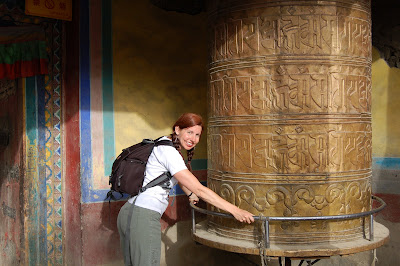
Cath and I decided to turn the prayer wheels that lined the monastery’s perimeter. We had just started when a monk came sprinting over to remind us that we were going the wrong way. He laughed and gestured, reminding us that Tibetans always walk clockwise at holy places. Everyone we encountered smiled, put their hands together in prayer and greeted us with an ebullient “tashi dele!” Deeply proud of this historic place, they seemed honored that we went to so much trouble to see it.

I didn’t want to ruin the spirit of hospitality by snapping too many photos, so instead I just tried to remember all the meaningful moments. One highlight that nearly brought tears to my eyes: We saw two adorable Tibetan toddlers giggling and chasing each other near some holy statues. Chum Zhun said Tibetan mothers routinely take their babies to temples and monasteries to teach them Buddhist rituals early on. One little guy waddled over to me with a crumpled jiao note (about a penny) in his tiny hand. He held up his money, cocked his head, looked at me imploringly with beautiful big brown eyes, and squeaked something that sounded like “Blah blah blah Buddha.” I just smiled at him, shrugged my shoulders to indicate I didn’t understand, and looked at Chum Zhun for help. She translated, “He wants you to give his money to Buddha.” By then the boy had skipped off to find a smarter adult tall enough to toss his money over the railing at the Buddha statue.

Cath, Chum Zhun and I dined on yak meat and potatoes at a humble little restaurant on the monastery grounds. A jovial group of monks ate at a nearby table.

If this slideshow doesn’t work, just refresh your page!

The pick-up truck/bus driver had told us to meet at 2:30 for the ride back to the boat. Punctual as always, that’s what we did. Within the next 30 minutes, we were joined by a group of Tibetan teen-aged girls, the Chinese tourists (including the Beijing Olympics fan), and some of the Tibetan villagers who were on the morning boat. And we waited … and waited … and waited.

Chum Zhun got off the bus to investigate and was gone a long time. Around 3:30, she returned, flustered. The bus driver told her that, once again, the monks were the cause of the delay, so she stomped off to the restaurant where they were eating lunch and sternly reminded them of the departure schedule. Although frustrated with the seemingly inconsiderate monks, she also felt guilty for being so rude to them. She noted the obvious: It’s really bad karma to scold a monk. She decided she could make up for it by offering her seat to one of the monks, but first she let him stand for about 10 minutes of the bumpy ride as punishment for his tardiness.

When the bus reached the boat dock, the three of us quickly boarded the boat. We were the only ones who did. Some people gleefully waded in the river; some stood in the shadow of the bus to light up their cigarettes; some made the ubiquitous peace-sign as they posed for snapshots; and some dipped their umbrellas in the water and opened them up in the quest for cool shade in the blazing heat. Chum Zhun sighed and said she had annoyed enough people today, so she asked me to say something to the boat pilot. “Zou ba!” I shouted in Mandarin. “Let’s go!” The pilot nicely explained that we were waiting for another group. “Five minutes,” he said. Finally, a bus pulled up with the same tourists who had arrived at the monastery for their tour when we were waiting to leave. In the time we waited, they toured the whole monastery and drove back to the boat dock.

The boat ride back was much livelier than our morning cruise. A Swiss tourist struck up a conversation with one of the monks, who was very friendly and eager to share information about the region. The Tibetan teens chatted with us in Mandarin. They had just finished their university entrance exams and had gone to the monastery to pray for good marks. They were gorgeous and giggly and took photos with a film camera.

We drove a few hours back to Lhasa and attended a dinner show with both traditional and modern Tibetan dancing. The buffet included sheep lung, sausage made from sheep intestines, several yak meat dishes, barley cakes, butter tea and barley beer. The only thing that made me gag a little was a yak-cheese cake that tasted like the smell of a cow barn.

If this slideshow doesn’t work, just refresh your page!

Farewell China Tour (Day 8)

Yamdrok Yutso Lake
Whew! What a relief to wake up feeling relatively normal. We still couldn’t believe the dramatic effect of the altitude on our bodies.

Chum Zhun picked us up after breakfast, and Feng Shifu drove us out of town. Puffy white clouds floated in a sapphire sky, bluer than I’d ever seen in China. Our van climbed twisty roads in the barren brown mountains. Yaks and sheep wandered the vast hillsides, searching for clumps of vegetation. Farmers in brightly colored dress worked in the fields. Villages zipped by. Homes were made of mud brick and stone with many pots of blooming flowers and ornately painted woodwork around the doorframes and windows, contrasting with the drab backdrop.

The Tibetan word for yak translates to “treasure” reflecting the animal’s value to farmers and nomads. Yaks help with all the manual labor in the fields, and Tibetans use every part of the yak after it’s slaughtered. They get wool and leather from the skins, make traditional medicine out of the hooves, and eat everything else. Chum Zhun told us that her mother lives in a small village, where she owns a yak. One year, wolves killed the family’s yak, and they were forced to depend on neighbors to help with the farming until they could save enough to buy another one. A single yak can cost more than $500, a fortune to tribal farmers.

Our van pulled in to a parking area overlooking Yamdrok Yutso Lake. Cath and I climbed up a path in our quest to reach 5,000 meters, but Chum Zhun chased after us to say we had wandered on to a military road. Not a good idea in this region of unrest.

Nestled in the monochrome mountains, the turquoise lake appeared luminous. Low-lying fluffy clouds drifted by, revealing snow-capped mountains in the distance. Prayer flags fluttered from every structure as people sought the highest possible point to release their prayers. The flags, pre-printed with Tibetan prayers, come on a string in five auspicious colors: blue, white, red, green and yellow. Chum Zhun tied up a string of flags to pray for her niece, who was taking the elementary school final exams today.

We drove a little further to a more isolated spot overlooking the lake and enjoyed a picnic lunch on the steps of a Tibetan home. Unable to eat everything the tour company had packed, Cath and I gave our extra food to the family’s little boy, who ran in to the house, calling to his mother and referring to us with the Tibetan word for “older sister.” Two massive mastiff dogs, wearing collars of shaggy sheep’s wool dyed red, stood guard and watched us eat. They happily gulped down our chicken bones.

A yakherd stood nearby with his yak decked out in colorful gear, so we gave him a little money to pose with us for a photo. We both got a bit more than we bargained for when he copped a feel. Tibetans don’t have much junk in their trunk, so you can’t blame a guy for checking out a couple of western booties when he gets the chance.

If this slideshow doesn’t work, just refresh your page!

Yumbulagang Palace
Following our intimate encounter with the yakherd, we drove a few more hours to the town of Tsetang, checked in to a hotel, and took off to visit Yumbulagang, the first palace in Tibetan history. The palace is located in Lhoka Province, which is considered the cradle of Tibetan civilization. During our brief stay in this province, we saw Tibet’s first palace, first temple and first monastery.

We had the option to ride a horse, yak or camel (?!) to the mountaintop palace, but we opted to walk. We purchased prayer flags from a villager at the base of the hill. Cath had performed a rain dance a few times, which Chum Zhun found hilarious, so we were not surprised when rain began to fall during our ascent. The thirsty crops glistened in the sunshine that filtered through the rainclouds.

After visiting the palace (first constructed in the second century BC), we bought strings that had been blessed by the palace monks. Chum Zhun told us to wear the strings around our necks for three days to get the full benefit of the blessings. As Cath was digging in her bag for a donation, she held our prayer flags between her legs. The monk laughed and said something to our guide, who gently reminded Cath that the flags were holy and maybe that wasn’t a very dignified place to put them. The monk smiled at our apologetic self-conscious giggles.

At a stone fire pit, an old lady showed Cath how to make an offering: toss a bundle of herbs (sage, I think) onto the fire, then throw in a handful of barley, and finally sprinkle a little water on top. We turned the big metal prayer wheels and climbed higher up the mountain in the blustery rain to hang our prayer flags. Chum Zhun, Cath and I tied all our flags together to make one long string of 15 flags. As Cath secured one end at the top of the hill, Chum Zhun told us to take a moment to say our prayers (and she urged us not to limit our prayers to just one wish). Unlike birthday wishes, it’s customary to share your prayers with each other, so we all did just that. I had said prayers for more rain to end the drought, Tibetan independence, and safe and happy transitions for all my friends who are moving this year.

(I felt a lot of pressure! In retrospect, I would have liked to spend more time up there to cover all my bases. However, the wind was getting pretty scary.)

Then Chum Zhun took the other end of our string, climbed down the hill and up the other side to pull the flags across the chasm. As soon as she tied the flags, a strong gust of wind lifted them up high, and we couldn’t help but feel our prayers being released into the heavens. It was a powerful experience.

As we walked back down the hill, we greeted people in Tibetan: Tashi dele! They loved it, often stopping to smile, putting their hands together in a prayer and bowing to us. Many laughed in surprise to hear us experimenting with their language, but they always replied with a joyful “tashi dele” of their own.

If this slideshow doesn’t work, just refresh your page!

Tradruk Temple
Our next stop was nearby – the first temple in Tibetan history. The wife of Tibet’s 33rd king apparently told him that the country was shaped like a female monster, and he needed to build temples all over the land to “pin down” the ogress. Among the 12 temples he built, Jokhang Temple (back in Lhasa) was constructed on the monster’s heart, and this one in Tsetang was built on its left arm.

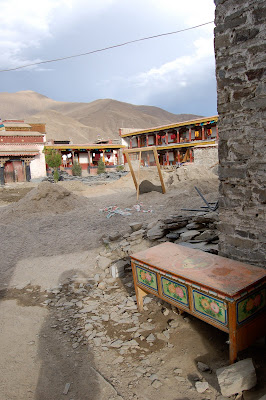
The temple was under renovation during our visit, so several sections were torn up or covered with scaffolding. As we arrived, the workers were leaving, so they all filed by with friendly waves and smiles, yelling out, “hello!” or “tashi dele!” Beautifully painted Tibetan furniture – the kind we paid lots of money for in Shanghai – sat in the courtyard, exposed to the elements. A big attraction at this temple is the Compassion Buddha thangka made out of about 30,000 pearls, so we filed up some stairs to see it. Very impressive.

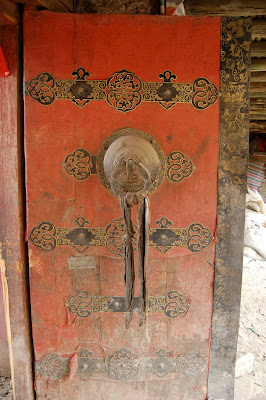
From Tradruk Temple
From Tradruk Temple

Tibetan Funerary Customs
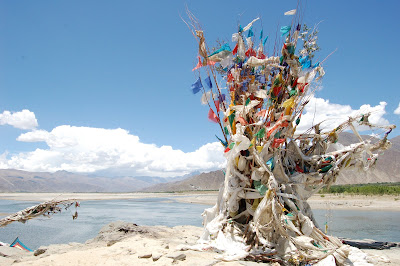
On our way to Tsedang, we pulled over to the side of the road to take photos of prayer flags hung on a tree beside the Brahmaputra River. As we stood at the peaceful spot, we had a confusing conversation with Chum Zhun. Although she spoke excellent English, we sometimes had to decipher her accent or unusual word choice. We thought we were encountering the language barrier when she looked around and pointed to the remains of a campfire. “There was a body here,” she said.
Me, assuming she meant someone had just left: “You mean, somebody was here?”
Chum Zhun: “No, there was a body here.”
Cath, thinking she must have heard wrong: “There was a party here?”
Chum Zhun: “No, a body. There was a water funeral here.”

Whoa, Nelly! A body? A water funeral? And thus began our gruesome (by Western standards) introduction to Tibetan customs regarding the disposal of a dead person. If Patricia Cornwell novels or episodes of CSI make you nauseous, you may want to skip the rest of this post.

Chum Zhun detailed the five most common methods for disposing of the dead. This used to be based on the status of the deceased, but now Tibetans do whatever is the most convenient or desired, she said.
(1) Stupa – These above-ground fancy-schmancy tombs are reserved for kings or dalai lamas.
(2) Cremation
(3) Burial
And here’s where it gets interesting. The last two options start with the same procedure. This information is quoted from the a website that confirmed what Chum Zhun told us:

A complete set of funeral procedures should start while the person’s life still lingers. The family members would feed the dying person with a tablet made of rare Tibetan herbs mixed with burnt ashes of the drapery, hair and nails of Living Buddhas, which is said to be able to help the dying person cut off some intrinsic qi, i.e. the human appetites, and let the soul leave peacefully. Meanwhile Lamas would be commissioned to chant scripture, so as to help the dying person to get rid of anguish and fear at the last moments. Notably the ladies and children generally are not allowed to approach the dying person, because it is said that will disturb his mood and influence his smooth transmigration.
As soon as the person dies, a piece of white cloth will be used to cover his face, and nobody is allowed to touch or move the dead body from then on. At the same time, Lamas will be commissioned to hold a ceremony called Paowa, that is said to help the soul’s exodus from the skull and rise to heaven, instead of expelling it from the asshole and falling to hell.
During the funeral preparation period, a pottery jar will be hung on the doorway of the dead person’s home as a sign of mourning. Meanwhile some cypress branches will be burned in the jar, adding in some tsamba, cattle or sheep’s blood, meat and fat, as well as the milk, cheese and butterfat, a way of serving meals to the dead. Throughout this period, all friends, relatives and neighbors shall not sing, dance or make any fun. Cats, dogs, and other livestock are to be strictly kept away from the dead body.
Wizards are also commissioned to divine and select appropriate time of the funeral, which is usually at 4 or 5 o’clock in the early morning on the fourth or fifth day after the time of death. The body is bent into a shape like a fetus in pregnancy, with his arms and legs being bound together. The body, covered with a white tweed, will be carried on back of a family member, and moved towards the funeral yard for a certain distance, and then be handed over to a professional body carrier, but by no means will it be placed on the earth on the way, or else the soul of the dead will wander about there.

After all that takes place, a professional body carrier takes the body to the riverside for a Water Funeral or a mountaintop for a Sky Funeral.

(4) Water Funeral – The body is carried to the banks of the river, where it is ritually chopped into pieces and tossed in the water. “I am looking at the current, and it seems that body parts would wash ashore,” Cath said. But Chum Zhun assured us that men are hired to stand along the water’s edge with long poles to push any wayward chunks back out into the river. When we expressed concern about swimmers potentially encountering a finger or face, Chum Zhun pointed out that fish rapidly consume the body parts.
(5) Sky (or Celestial) Funeral – The body is carried high up the mountain to a sacred platform near a temple (only a few locations have been sanctioned for sky funerals). An appointed sky funeral wizard removes the body’s organs and cuts all the flesh from the bones. Then he crushes the bones into a powder and mixes it with barley to make balls. Vultures then enjoy a feast of bone-and-barley balls, followed by flesh, and lastly, the organs. Any bits that escape the vultures must be burned.

Tibetans carefully screen their funeral officials because a sloppy funeral could prevent the spirit from moving on, Chum Zhun said. The procedures – especially for the complicated water and sky funerals – must be followed meticulously.

She said Tibetans grieve privately because public tears rain on the path of the deceased’s soul. They believe that a person’s soul is released from the body when you die, so the shell that remains is nothing special and should be used to make a final religious offering. By feeding a loved one to the fish or the vultures, you complete the circle of life and honor Buddha.

From Water Funeral

Prayer Wheels
We saw lots of prayer wheels during our stay in Tibet – from tiny ones on a keychain to gargantuan ones that took all our strength to turn. Check out this website to learn more about them.

From prayer wheels