Samye Monastery
In order for a monastery to be a monastery, it must have three things: holy statues, scriptures and monks. The Samye Monastery, founded in 775, was the first in Tibet to have all three. Located across the Brahmaputra River from the city, the monastery was a little tricky to find. We checked out of our hotel early, hoping to catch the first ferry. What Chum Zhun didn’t tell us was that the “ferry” was really just a rickety boat that didn’t run on a regular schedule at all. Rather, it left when full of passengers.
We drove the short distance to the dock around 9 a.m. As we sat on the concrete steps by the water, a group of monks in ruby red robes arrived, chatted with the boat pilot for a few minutes and then left. Around 9:30, some Chinese tourists showed up, took a few pictures and took off again. At 10, Chum Zhun inquired about the delay. We were waiting for the monks, they said, who were enjoying a bowl of noodles for breakfast, so we would leave when they returned. Dejected, we returned to our posts on the concrete steps and watched another ferry approaching the dock. It struck a sandbar, and everyone climbed out of the boat and into the knee-deep water, straining to push the boat clear. We couldn’t help but worry that our boat would meet the same fate.
Finally, the monks appeared, ready for the journey with full bellies. They joined an eclectic collection of passengers and cargo: a motorcycle, several large stuffed bags (maybe grain?), lots of local Tibetans, a group of Chinese tourists (including one portly guy decked out head to toe in Beijing Olympics gear), an iron I-beam the length of the whole boat, and us (the only foreigners). As our boat pulled away from the dock, another Chinese family came running from the parking area. I thought for sure they’d just catch the next boat, but NO! We actually turned back to get them.
The pilot used a long pole to push us out of shallow water, deftly avoiding the sandbar, and then turned on the motor for our slow peaceful trip across the river. Cath and I introduced ourselves to a shy Tibetan girl named Minma, who had been staring at us and smiling. Although children are required to learn Mandarin in school, she didn’t understand me (obviously her poor country school hadn’t taught her enough Mandarin; I’m sure I spoke it perfectly!). One of the monks translated but then quietly turned away with his pink umbrella blocking the sun. Otherwise, our river cruise was uneventful.
If the slideshow doesn’t work, just refresh your page!
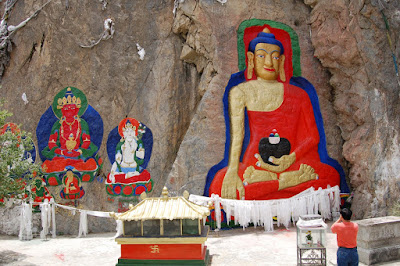
Once we reached land, we all piled in to the covered bed of a pick-up truck and sat on wobbly benches for the bone-jarring ride to the monastery. We toured the three main floors, each with a different style of architecture: Tibetan, Chinese and Indian. The Indian level should have come with a parent advisory, such as: “This floor is rated R for sexual content.” However, the sex was purely of a religious nature as depicted by a king getting it on with one of his two consorts in his attempt to reach enlightenment.
Cath and I decided to turn the prayer wheels that lined the monastery’s perimeter. We had just started when a monk came sprinting over to remind us that we were going the wrong way. He laughed and gestured, reminding us that Tibetans always walk clockwise at holy places. Everyone we encountered smiled, put their hands together in prayer and greeted us with an ebullient “tashi dele!” Deeply proud of this historic place, they seemed honored that we went to so much trouble to see it.
I didn’t want to ruin the spirit of hospitality by snapping too many photos, so instead I just tried to remember all the meaningful moments. One highlight that nearly brought tears to my eyes: We saw two adorable Tibetan toddlers giggling and chasing each other near some holy statues. Chum Zhun said Tibetan mothers routinely take their babies to temples and monasteries to teach them Buddhist rituals early on. One little guy waddled over to me with a crumpled jiao note (about a penny) in his tiny hand. He held up his money, cocked his head, looked at me imploringly with beautiful big brown eyes, and squeaked something that sounded like “Blah blah blah Buddha.” I just smiled at him, shrugged my shoulders to indicate I didn’t understand, and looked at Chum Zhun for help. She translated, “He wants you to give his money to Buddha.” By then the boy had skipped off to find a smarter adult tall enough to toss his money over the railing at the Buddha statue.
Cath, Chum Zhun and I dined on yak meat and potatoes at a humble little restaurant on the monastery grounds. A jovial group of monks ate at a nearby table.
If this slideshow doesn’t work, just refresh your page!
The pick-up truck/bus driver had told us to meet at 2:30 for the ride back to the boat. Punctual as always, that’s what we did. Within the next 30 minutes, we were joined by a group of Tibetan teen-aged girls, the Chinese tourists (including the Beijing Olympics fan), and some of the Tibetan villagers who were on the morning boat. And we waited … and waited … and waited.
Chum Zhun got off the bus to investigate and was gone a long time. Around 3:30, she returned, flustered. The bus driver told her that, once again, the monks were the cause of the delay, so she stomped off to the restaurant where they were eating lunch and sternly reminded them of the departure schedule. Although frustrated with the seemingly inconsiderate monks, she also felt guilty for being so rude to them. She noted the obvious: It’s really bad karma to scold a monk. She decided she could make up for it by offering her seat to one of the monks, but first she let him stand for about 10 minutes of the bumpy ride as punishment for his tardiness.
When the bus reached the boat dock, the three of us quickly boarded the boat. We were the only ones who did. Some people gleefully waded in the river; some stood in the shadow of the bus to light up their cigarettes; some made the ubiquitous peace-sign as they posed for snapshots; and some dipped their umbrellas in the water and opened them up in the quest for cool shade in the blazing heat. Chum Zhun sighed and said she had annoyed enough people today, so she asked me to say something to the boat pilot. “Zou ba!” I shouted in Mandarin. “Let’s go!” The pilot nicely explained that we were waiting for another group. “Five minutes,” he said. Finally, a bus pulled up with the same tourists who had arrived at the monastery for their tour when we were waiting to leave. In the time we waited, they toured the whole monastery and drove back to the boat dock.
The boat ride back was much livelier than our morning cruise. A Swiss tourist struck up a conversation with one of the monks, who was very friendly and eager to share information about the region. The Tibetan teens chatted with us in Mandarin. They had just finished their university entrance exams and had gone to the monastery to pray for good marks. They were gorgeous and giggly and took photos with a film camera.
We drove a few hours back to Lhasa and attended a dinner show with both traditional and modern Tibetan dancing. The buffet included sheep lung, sausage made from sheep intestines, several yak meat dishes, barley cakes, butter tea and barley beer. The only thing that made me gag a little was a yak-cheese cake that tasted like the smell of a cow barn.
If this slideshow doesn’t work, just refresh your page!