For in the true nature of things, if we rightly consider, every green tree is far more glorious than if it were made of gold and silver.
I’m afraid I beg to differ, Mr. Luther.
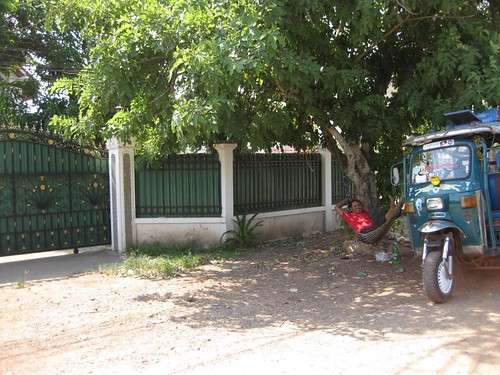
As I’ve mentioned before, tuk-tuk drivers often congregate outside our front gate, where a full leafy tree provides cooling shade. They’re usually friendly, sometimes jumping up to open my gate when I approach on my bike, but more often than not, they’re just annoying. Sometimes they actually park directly in front of our gate, so we have to drive the motorbike around their tuk-tuks to get to our house. Most weekend mornings, they rise with the sun and crank their tinny pop songs. Lately they’ve been dumping trash under the tree, which would be the final straw if I knew enough Lao to have a confrontation.
In late March, the shade tree lost all its leaves and looked near death. Tony and I did a little happy dance but immediately felt guilty for rejoicing in nature’s destruction. The tuk-tuk drivers found other places to park, and we savored the peace of our foliage-free front gate. Unfortunately, we underestimated the power of tropical regeneration. Within about two weeks, the tree stood tall and proud and superfoliaceous. (I just found that fabulous word on synonym.com!)
So the drivers are back.
Mr. Kek, our favorite smiley mango-stealing driver – who likes to take detours by his own home to show passengers “Mr. Kek house! Mr. Kek dog! Mr. Kek baby!” – has even rigged up a hammock between his tuk-tuk and that temptress of a tree.
So, Mr. Luther, I will take that gold-and-silver tree, please.
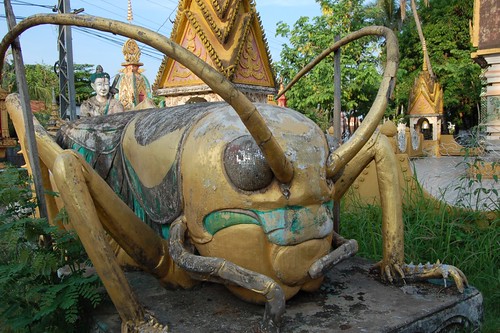
If you’re looking for an enormous cricket, the no-evil monkey triplets, a nasty concrete crone with a chicken cage full of scared people, and a massive reclining Buddha, have I got a temple for you!
Wat Chom Phet, located at the southern edge of Vientiane, is not your run-of-the-mill Buddhist temple. Just a short bumpy ride off the busy Tha Deua Road, this place resonates a mystical, whimsical vibe.
I pedaled here with Tony and my friend, Catherine, early Sunday morning at the recommendation of a friend. Parking our bikes inside the temple gate, we were greeted by a strange collection of sculptures. A Lao man was lighting incense at an adjacent Buddha statue, so I asked him in Lao if he spoke English (an essential phrase to learn here!). He did, kind of.
We asked him to explain the unusual yard art.
Gigantic cricket with a man in traditional dress yanking on one huge cricket leg? Hmmm … he rambled about how the name of the village translated to “cricket” or something like that.
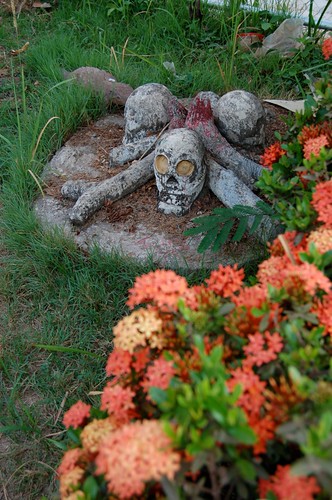
Skulls with red-painted fire and large aardvark-ish animals? Well, er, maybe those came from another temple.
Creepy looking witch with pendulous naked breasts guarding an overturned basket with three crouching captives inside? Ah, this one he could explain! The monks use this sculpture to teach that it’s easy to fall under the influence of evil people like this scary woman … or maybe not.
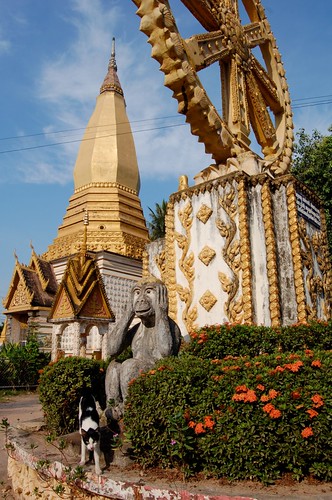
At least the hear-no-evil/see-no-evil/speak-no-evil monkeys were self-explanatory.
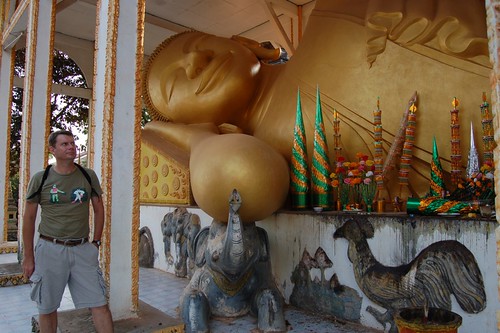
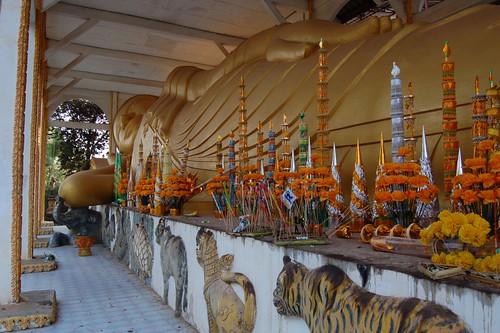
After chatting with us a bit more, the guy finished his prayers and drove off. We wandered around the temple grounds. The main attraction was the reclining Buddha, rumored to be 21 meters long and the biggest reclining Buddha in town. (I say “rumored” because nobody seems to know much about much at local temples.) I especially liked that Buddha rested his elbow on an elephant’s head; that was a creative touch.
Buddha’s bed was decorated with a menagerie of animals, including more elephants, a cat, chicken, naga, turtle, ox, dog, tiger and a couple I couldn’t identify – maybe a hyena or monkey?
There must have been some special event very early this morning. Ladies were cleaning up inside the big room, stacking trays used for eating while sitting on the floor.
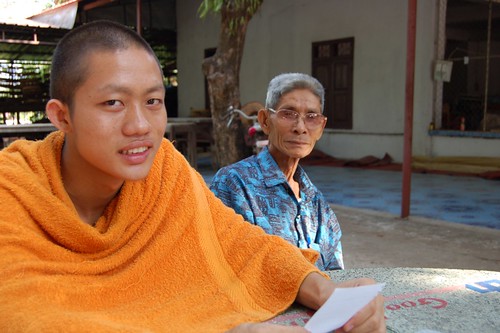
Catherine and I sat down in the shade to chat, and we were soon joined by a novice monk and an old man.
The monk, named Som Chith, spoke some English and asked whether we had any questions about the temple. Turns out he didn’t have any answers, though. Fortunately, the old man, named Du Peng, had some institutional knowledge. He would relay long stories in Lao to our monk friend, who would then pause and think for a bit before giving us much abbreviated versions in English.
According to the guys, most of the temple was built on donated land in 1942, although the big gold stupa was older, maybe from the early 1900s. We asked about the crazy sculptures, and after a particularly long Lao explanation from Du Peng, the monk told us a traditional folktale about a character named Khatthanam. Catherine and I think the story goes like this: The evil witch captured people and ate them (hence the cage and the skulls on the BBQ). Khatthanam got word that some of his friends had been captured, so he came to their rescue. In an ending reminiscent of Hansel and Gretl, he tricked the witch by replacing the people with crickets. Gigantic crickets like the statue? We never got a clear answer to that. And, to be honest, we may have completely misunderstood the whole thing.
I tried to find details on (a) the temple, (b) the cricket story, and (c) the big Buddha, but as usual, I came up empty-handed. I find it very disconcerting how little of the local history and culture is documented in an accessible form. When I mentioned this to the first temple-goer, he shared my dismay. He said the government is deeply suspicious of the internet and wants to keep its secrets private. Well, they’re doing a good job.