Wine tasting with the Voges

As a Third Culture Kid with no real roots in the United States, I spent a lot of time researching housing markets before buying our rental property back in 2007. I narrowed my search to the Southwest but ultimately picked Albuquerque based on conversations with our friends Dean and Elaine Voge, who worked with us in Shanghai. Dean taught in ABQ before they headed abroad, so they were back last week to visit friends and family. Spending an afternoon with them was the highlight of our trip!

We talked about hiking or going to a museum, but Elaine proposed the perfect activity for us: wine tasting! It was perfect because Elaine, Heidi (Dean’s daughter) and I could pound the wine, secure in the knowledge that Dean (not a wine lover) would be sober to drive. Tony (also not a wine lover) enjoyed the company and Tuscany-esque setting, so everyone was happy.

Here are the wines we tried at the Casa Rondeña Winery Tasting Room:
Viognier – A dry white wine with dense flavors of pineapple and honey, Viognier is the perfect expression of the Southwestern high desert growing region showing its rich mouth-feel and crispy acidity.
Meritage – This classic Bordeaux-style wine is a blend of 48% Merlot, 30% Cabernet Franc, 20% Cabernet Sauvignon and 2% Petit Verdot. Complex with a lingering finish, the Meritage Red shows flavors of vanilla, currant, blackberry and chocolate.
Cabernet Franc – The original red wine of the Loire Valley in France, Cabernet Franc grows well here in New Mexico. It exhibits fruit-forward flavors of blackberries, dark cherry and earthiness while being medium bodied and soft on the finish.
1629– A true Casa original: spicy Tempranillo; deep, dark Syrah; dense, soft tannins of Cabernet Sauvignon – blended and named in honor of the first vinifera plantings in North America, right here in New Mexico!
Rosé – A luscious off-dry Cabernet Franc based wine with crisp hints of strawberry and plum (and cool guys like Rich & Vince say cherries and watermelon). This wine has 1.75% residual sugar.
Serenade – With its floral bouquet and lively fruitiness, the blend of 87% Riesling and 13% Gewurztraminer give a perfect balance of sweetness and acidity. This wine has 2.25% residual sugar.
Animante (Port) – A deep, elegant and rich port with very soft tannins, made from Cabernet Sauvignon and a touch of Cabernet Franc. (18% alcohol)

Following the tasting, we took a bottle out to the garden and enjoyed a little picnic. Uninvited to the wedding that was scheduled later in the afternoon, we drove to Albertson’s supermarket to buy cheaper wine and food for a cookout at Heidi’s house. We met the rest of her family, lounged in their lovely garden, and lingered in the drowsy comfort of happy tummies and special friends.

Tipsy and happy.
IMG_0199

Oh! As we sampled the wines, Tony looked out the window and asked, “Isn’t that Andi?” Sure enough, it was one of our colleagues from New Delhi with two of her friends. So out of about 10 people in the tasting room, 50 percent were international teachers!

Petroglyphs, Volcanoes and the Bosque – playing outside in Albuquerque

Looking for something to do outside in Albuquerque? There’s no end to the options! How about a trek through a boulder-strewn canyon decorated 400-700 years ago by American Indians and Spanish settlers? Or consider strolling around the Three Sisters, a collection of volcanoes on the West Mesa. Both sites are part of the Petroglyph National Monument, a wonderful collection of trails managed by the National Park Service. Bike enthusiasts will find a 16-mile trail through the “bosque” (pronounced BOSS-key), a cottonwood forest along the Rio Grande River.

Tony and I started each day in Albuquerque with a hike or bike ride (after eating a ridiculously indulgent breakfast at our B&B, that is), and we truly loved being outdoors under that vast blue sky.

Rinconada Canyon
For our first outing, we headed to Rinconada Canyon. This description comes from the National Park Service website:

Rinconada Canyon offers an insight into the geologic, cultural, and natural resources of this region. From the parking lot a sandy path follows the northern escarpment, carrying you over sand dunes. As you walk into the canyon, the sounds and sights of the city fade away and may be replaced with the coo of a mourning dove or a collared lizard sunning itself on a basalt boulder. Here you see prehistoric and historic petroglyphs, rock wall alignments and shelters, and wildlife living in the vegetation growing throughout the canyon.
The geology of the area shows the remnants of volcanic eruptions of 200,000 years ago. The basalt from these flows caps the sandstone of the Santa Fe Formation. As the softer sandstone erodes away, the basalt breaks off and tumbles down the hillside. This action provided the escarpment where the petroglyphs were carved.

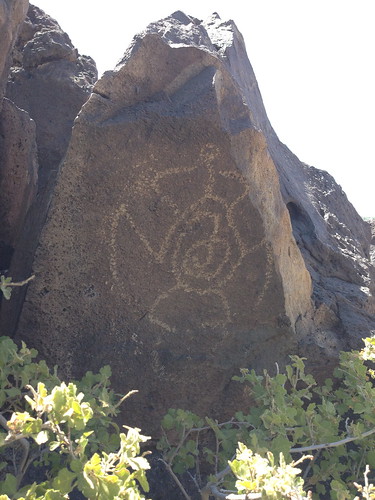
Archeologists believe most of the 1,200 petroglyphs in this canyon were pecked into the basalt boulders using a hammerstone to remove the dark color on the surface and reveal a lighter color underneath. Pueblo Indians use the images to pass on stories about history, culture and spiritual beliefs.

Checking out some petroglyphs.
IMG_0029

IMG_0090

Unfortunately, some relatively modern visitors felt compelled to carve their own petroglyphs. This guy visited Rinconada Canyon on my birthday in 1919!
IMG_0100

Some petroglyphs and rock formations hint at what life was like for the Spanish explorers and Mexicans who arrived here in 1540. We saw petroglyphs of Catholic crosses and what archeologists think could be livestock brands.

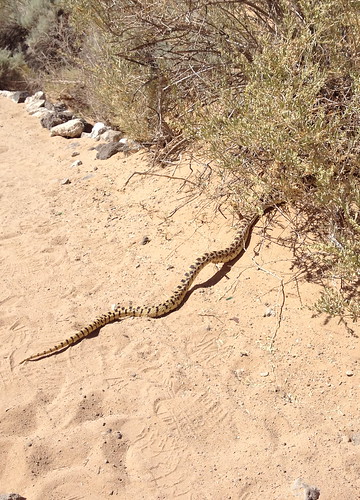
We had just started out on this trail, when a snake crossed the path. He took his sweet time, but Tony and I were too slow getting out our cameras, so we missed his face. Beautiful!
IMG_0084

The canyon is ringed with boulders, but the center is sandy with clumps of scrubby plants and lots of scrambling lizards.
IMG_0087

The Volcanoes
Here’s the scoop from NPS:

Known locally as the Albuquerque Volcanoes or the Three Sisters, they are a classic and rare example of a fissure eruption. In fissure eruptions magma rises along thin cracks in the Earth’s crust unlike most volcanoes in which magma rises through a vertical central vent. Here the fissure is over 5 miles (8km) long. Very long cracks like these may result in a row of aligned eruption craters—all active at the same time. Such eruptions create “curtains of fire” like those that occur today at Kilauea in Hawaii Volcanoes National Park.

According the the New Mexico Institute of Mining and Technology, all volcanoes in the state are “probably” extinct, meaning they are “unlikely” to erupt again. I guess I prefer a little more certainty about such things. Still, it was fun to walk around the volcanoes. We climbed up two of them, only to learn later that doing so was insensitive to the Pueblo Indians, who “believe the volcanoes and the petroglyphs pecked into the volcanic boulders provide a direct spiritual connection both to their ancestors and to the Spirit World, the place where time began,” according to NPS literature. Brochures urge visitors not to hike to the peaks. Dang.

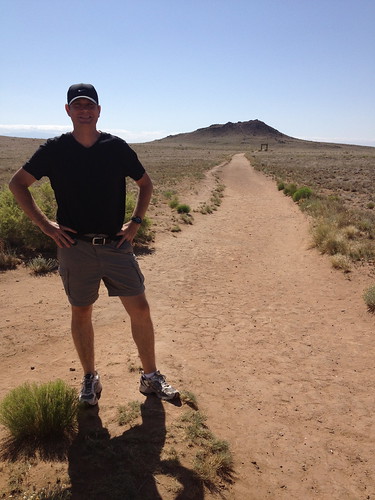
Tony with the JA Volcano in the background.
IMG_0113

On the top, overlooking ABQ.
IMG_0114

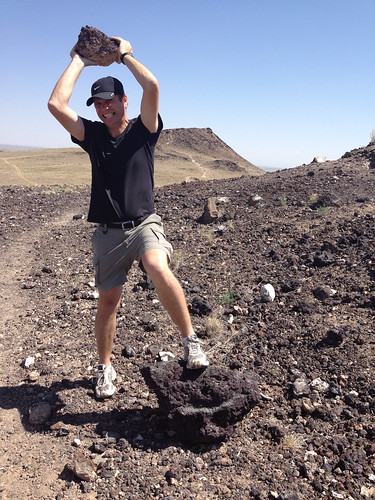
Too late to pretend we were culturally sensitive at the volcanoes. The big rocks are light because they’re filled with air! Tony looks so virile, eh?
IMG_0121

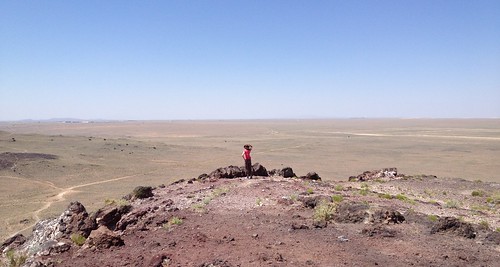
On top of the Vulcan Volcano, you can see forever.
IMG_0040

Walking back to the car. I love this landscape!
IMG_0125

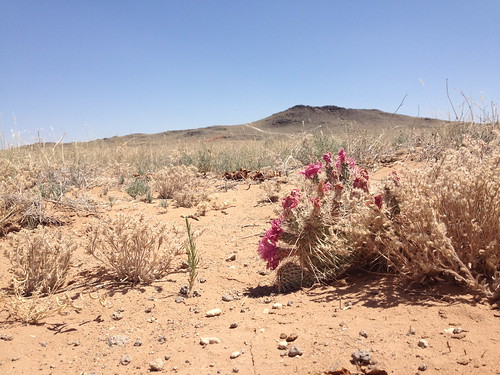
Tiny cactus flowers.
IMG_0130

Biking the Bosque
Albuquerque’s Paseo del Bosque recently made Sunset magazine’s list of the 20 best bike paths in the West. We concur. It’s pretty fantastic.

We rented high-quality mountain bikes from Routes Rentals & Tours. The bikes were a bit small for us, but they did the trick. We picked up the trail very close to our wonderful B&B and rode north to the Alameda trail head (for a roundtrip total of about 17 miles). Paved, flat and quiet, the trail never crosses roads or encounters motorized vehicles. We saw about 20 hot-air balloons rising into the early morning sky. Stunning!
IMG_0184

Here’s more info on the Paseo del Bosque, aka Riverside Trail. This article describes a fire that broke out while we were there, and we’ve heard they since closed the trail until the “fire season” ends.

There is WAY more to do in Albuquerque if you love being outdoors. We look forward to exploring other trails on our next visit.

The best first thing to do in Albuquerque

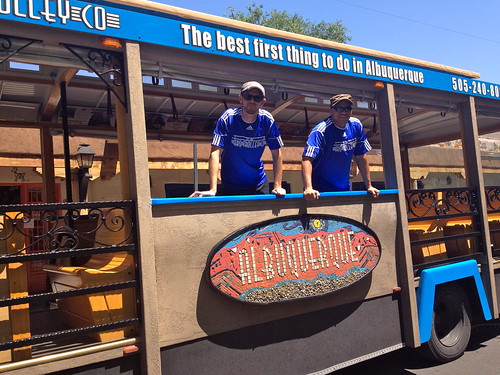
It wasn’t exactly the first thing we did in Albuquerque, but the ABQ Trolley Co tour will surely be one of the highlights from our visit. Tony and I climbed aboard the open-air stucco-ed trolley Wednesday afternoon with owners Jesse (left) and Mike for an entertaining and interactive glimpse into Albuquerque’s history, growth and present-day attractions.
IMG_0108

The guys said they take turns driving and narrating. This time, Mike was at the wheel, and Jesse led the tour. Although we came to Albuquerque with no real itinerary and feeling a bit uncertain that we could fill four whole days here, this tour made us realize we’ll have to come back (probably many times!) to see it all. We listened to fascinating anecdotes as we explored Old Town, Museum Row, Historic Route 66, downtown, East Downtown (aka EDO), Nob Hill, the University of New Mexico, sports stadiums, the historic Barelas neighborhood and railyards (which are now used extensively as movie sets), the zoo and several park areas.

I made Tony sit with me in the front seat of the trolley, and when Jesse offered Tootsie Pops as prizes for his trivia questions, our hands shot up so fast, those other passengers didn’t have a chance. Things we got right:
* Who called Route 66 “the Mother Road”? John Steinbeck in Grapes of Wrath (Tony)
* Who can spell Albuquerque? EASY! (me) Jesse said a lady once spelled it with three K’s. I really hope he’s joking.
* What is the official state question of New Mexico? We required a hint: it has to do with colors… oh yeah! Red or green? as in chile sauces, and yes, they spell it “chile” … weird. (Tony)
* Where was Don Knotts born? Albuquerque, duh. I didn’t really know this one, but I took a long shot.

They don’t call me the “Guide Hog” for nothin’! (by “they,” I mean myself…)

Jesse gave us three little homework assignments:
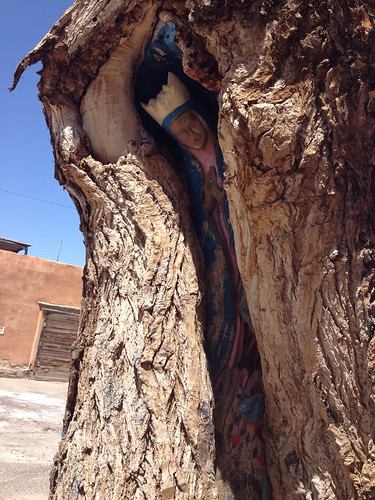
Check out the back of a tree next to the historic San Felipe de Neri Catholic Church, which we did right after the tour to discover this hidden gem.
IMG_0109

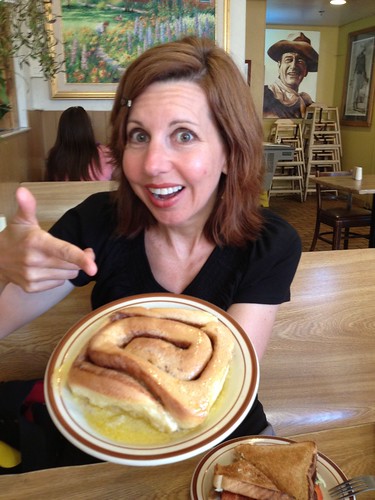
Go to Frontier Restaurant and eat a butter-drenched sweet roll. Twist my arm!
IMG_0111

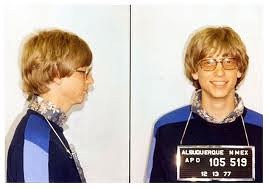
And, finally, look up Bill Gates’ mug shot from when he lived here and got arrested for speeding and driving without a license. Done! (To be fair, Jesse showed us the picture before we got off the trolley.)
gates

My favorite story from the tour related to the city’s baseball team, called the Isotopes. We naturally assumed the name stemmed from New Mexico’s connection to nuclear energy and atomic bombs. However, the story is much better and funnier. Here it is, as told by Sarah, the owner of the Adobe Nido Bed & Breakfast, on her blog:

Episode 15 of Season 12 of the Simpsons, was called Hungry, Hungry, Homer, and it first aired on March 4, 2001. The plot centered around Homer overhearing a conversation, seeing some incriminating evidence and discovering a secret – that Springfield’s beloved baseball team, the Isotopes, were leaving Springfield for Albuquerque, NM – but no one would believe him and the evidence disappeared.
Homer went on a hunger strike in hopes of exposing the plan, and he was chained to a pole in the baseball stadium getting thinner every day. Duff (BEER) Corporation, (their CEO is the team owner) is bored with Homer and decides to use him as an attraction and during a game. They unchain him and tempt him with hot dogs (now with a southwestern sauce!) Homer notices the sauce and that the hot dog wrappers have a new team name and logo – Albuquerque Isotopes. This was the evidence Homer had seen before, so the plot was finally revealed and Homer is the hero. As it turns out in the end, Albuquerque’s Mayor decides to acquire the Dallas Cowboys instead, and will make them play baseball. In the very last clip of the episode he declares his reason… “I AM THE MAYOR OF ALBUQUERQUE.”
This cracks me up because the Mayor of Albuquerque in 2001 was Martin Chavez, and he was thought of by many citizens of the Duke City to be a controlling egomaniac. I’m also amused that this episode ending was cut in all future reruns of the episode in America, but not in foreign countries.
Apparently, Burqueños love the Simpsons. Please come join us at the ballpark, but if you go to a game, and hear the call to cheer, don’t yell, “charge!” In Albuquerque we yell, “Marge!”

The trolley tour was perfectly organized with heaps of fun facts and quirky stories. I walked away with a greater appreciation for Albuquerque and the sense that this place doesn’t take itself too seriously. A sense of humor, spirit of historical preservation, lottery-funded free college education, ubiquitous public art, competitive food culture, ethnic diversity and sunshine 361 days a year … what’s not to like?

Mughal Warriors invade Shelby, MI

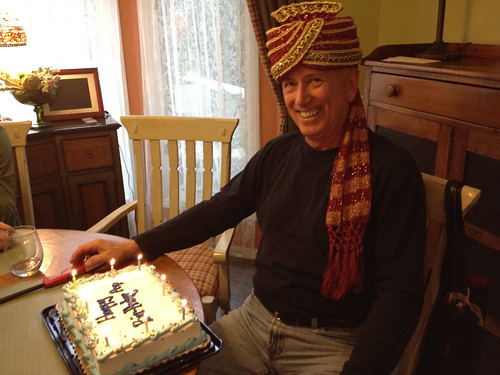
Shortly before leaving Delhi for the summer, I bought a fancy Indian hat for my dad, whose birthday was June 1. Doesn’t he look dapper?
IMG_0003

Indian men wear such hats in weddings. I’m not sure if they serve another purpose, but I was smitten. On a whim, I returned to Babu Market the day before our departure and picked up two more hats for my nephews. As I was leaving the market, I spotted some tempting outfits for little boys. They included a stiff shiny lamé shirt, sequined vest, coordinating scarf with silky tassles, and shimmery pants with a baggy bottom and tightly tapered legs. Again, I have no idea why or where boys would wear these clothes. Ceremonies? Weddings? How about a mighty battle in the Detroit suburb of Shelby?

If I were a little boy, I wouldn’t be caught dead in such a thing, so I knew I had to broach the topic carefully while babysitting Nico and Paul last week:
“Hey, did you know that where I live in India, they used to have powerful kings? They lived in big palaces, and they had tigers as pets. They rode elephants and had to fight in dangerous wars to keep the bad guys out of their awesome forts. And guess what? (voice drops to a whisper) I brought some of the king’s clothes just for you.”
Slowly, I pulled the garments out of my bag and touched them gingerly with great awe.
“Can we put this on now?” Nico asked, wide-eyed with excitement.
“Sure,” I whispered.
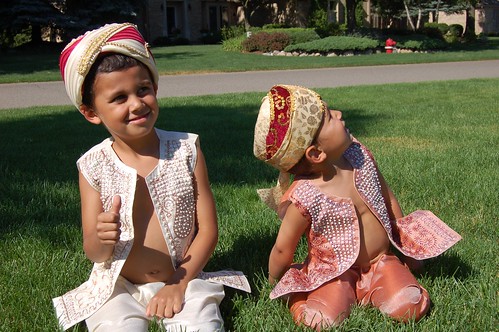
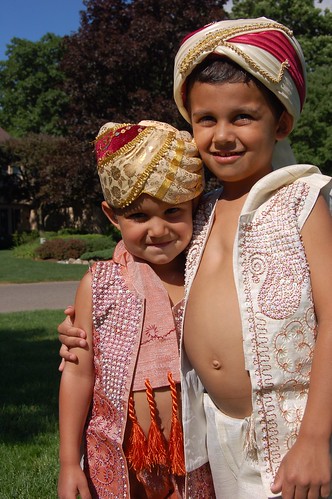
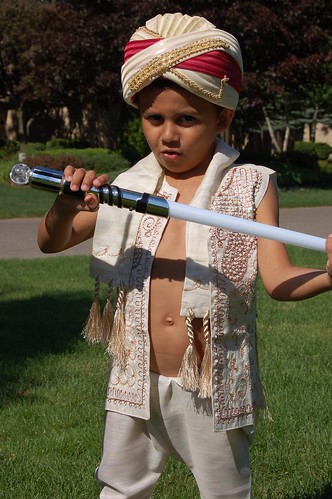
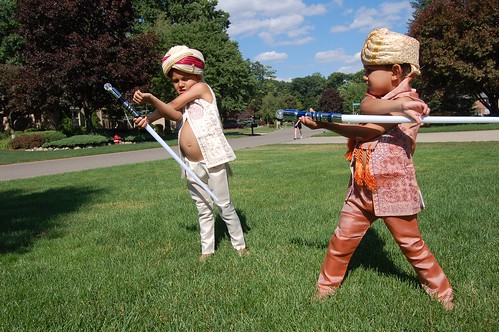
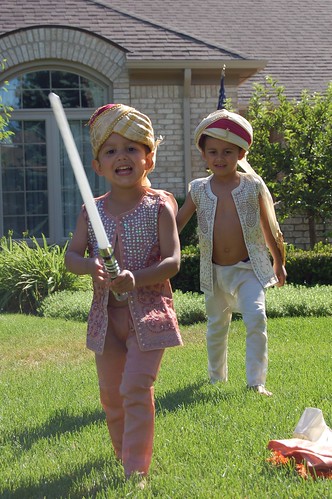
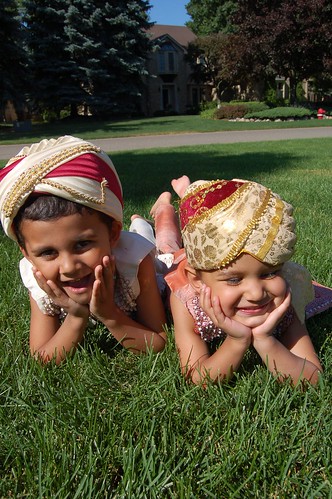
They quickly tore off their shorts and T-shirts. The Indian tops were impossibly small; we tried pretty hard but had to give up. They pulled on the ridiculous bottoms, which don’t have a waistband, so I had to fold the top over to make it smaller and then tucked the fabric in their underpants. They put on the vests, scarves and hats and TRANSFORMED into Mughal warriors.
“We need swords!” Nico shouted.
“Oh, sorry, I didn’t bring swords,” I said.
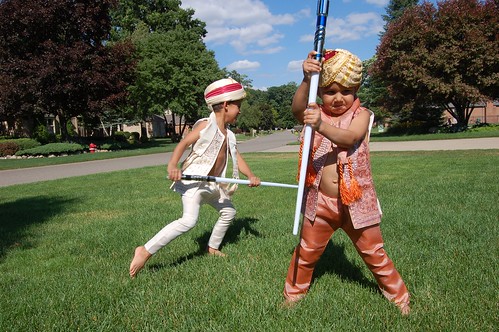
“We have some!” The boys flew down to the basement and returned with Star Wars light sabers.
“Can we go outside?” they begged.
“Well, heck yeah,” I said, still a bit shocked at the reaction to these costumes.

In their front yard, they fought battles, took turns being the good king and the bad king, hacked their way through the jungles of India, dashed back in to get a big rubber snake to dangle from a low-hanging branch (and then promptly whacked it out of the tree with their “swords”), demonstrated their finely tuned sword-twirling skills, struck yoga poses (?), and otherwise played non-stop for about half an hour.

I just wanted to kiss their royal little tummies, but I didn’t want them to break character.
DSC_0932

DSC_0915

DSC_0924

DSC_0913

DSC_0927

DSC_0940

DSC_0930

When Kate and John got home, the boys posted themselves on a loveseat with the light sabers shoved upright into the couch cushions.
“Come see the kings,” they said.
Their parents played along, bowing low and kissing the boys’ hands.

Best present EVER.

Here are some more shots from the Battle of Shelby.

Mackinac Island Lilac-less Festival

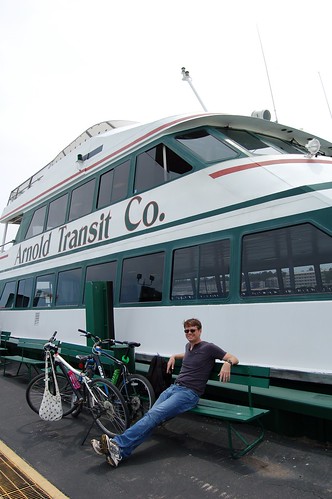
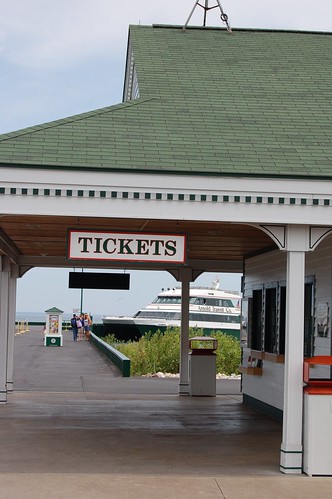
After just a week in Michigan, Tony and I hit the road for a little romantic get-away. We loaded our bikes on the rental car and drove about four hours north to Mackinaw City, where we parked the car and rolled our bikes onto a ferry. The short ride treated us to views of Lake Michigan to the west and Lake Huron to the east.
At the ferry dock.
DSC_0857

Waiting to board.
DSC_0858

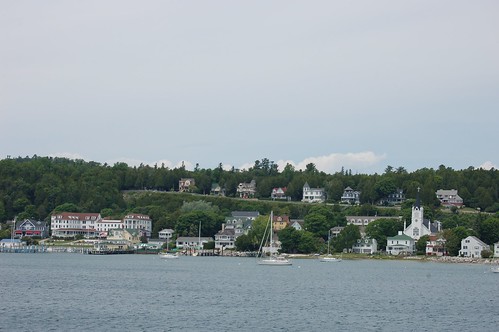
Approaching Mackinac Island.
DSC_0862

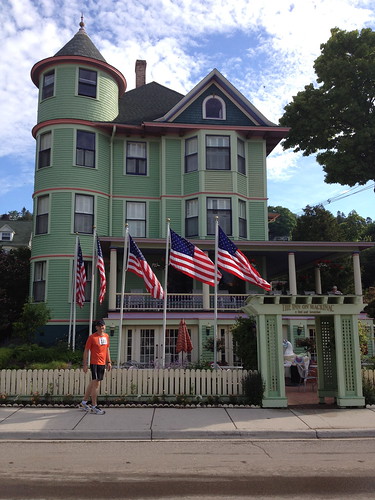
Disembarking on the island was like stepping back in time … or maybe more accurately, stepping in to a studio lot for a movie about horse-loving, bike-riding fudge makers. Our hotel’s porter greeted us at the boat and transported our bag to the hotel. We hopped on our bikes for the short ride along the harbor to our quaint weekend home, the Inn on Mackinac.
IMG_0019

After settling in, we walked back to Main Street for an alfresco lunch at the Pink Pony, followed by a stroll through the neighborhood.

Lunch at the Pink Pony. We liked this place so much, we ate here again the next day.
DSC_0866

Automobile-free since 1898, Mackinac Island has retained its turn-of-the-century charm. Juxtaposed against modern suburban developments and their cookie-cutter houses, the island’s homes range from dainty cottages with lace curtains and window boxes of red geraniums to elegant Victorian-style mansions – all turrets, verandas and stained glass. Horse-drawn carriages line the street awaiting fares, and tourists get around on rented bikes.

Home to a flourishing fur trade in the 1820s and later a commercial fishing hub, Mackinac Island’s biggest industry these days seems to be fudge. Since the first “Candy Kitchen” opened in 1889, fudge has been a popular souvenir. We popped in to several shops for samples. My favorite: dark chocolate with cherries and walnuts. (You can join a “fudge crawl” to the 14 candy stores, but that just sounded nauseating to me.)

Tony on Main Street.
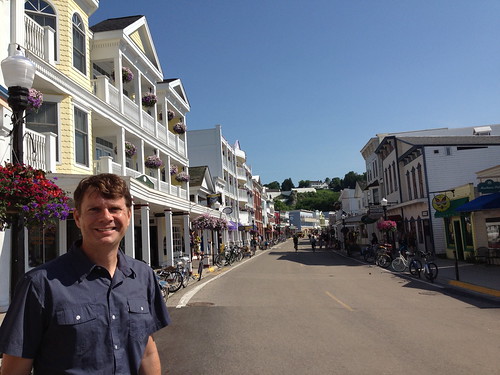
IMG_0054

We specifically picked this weekend to visit Mackinac Island for the Lilac Festival. Someone forgot to tell the lilacs, though. They had already bloomed and dropped their blossoms by the time the festival rolled around. Bummer.

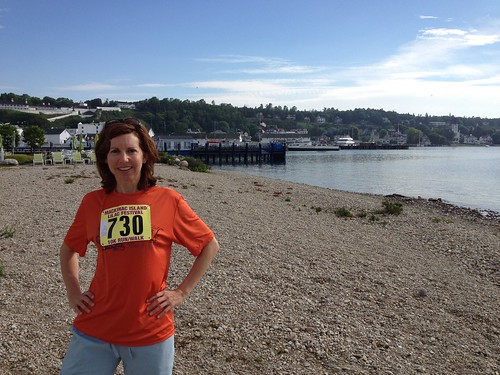
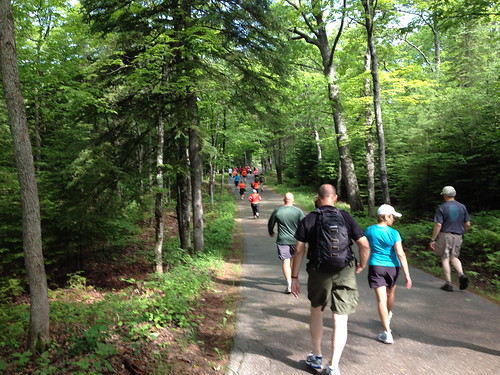
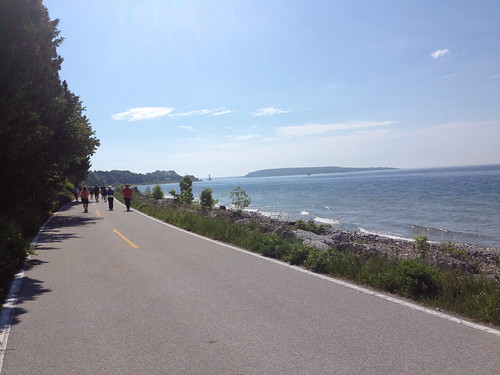
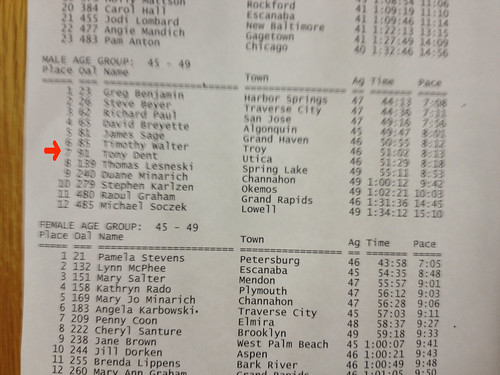
Tony and I were registered for the Lilac Festival 10K on Saturday morning. Fit and raring to go, Tony was looking forward to the run. Flabby and nursing a wonky neck, I was contemplating a big breakfast instead. That morning, however, I decided to do a 10-kilometer STROLL, stopping frequently to take photos and relishing the bright blue sky, fresh pine-scented air, and forest and waterfront trails. About 10 minutes into my walk and after snapping a few pictures, my reclusive competitive spirit suddenly surfaced and I felt the overpowering urge to kick everyone’s butts in this race. Totally out of shape, I knew I couldn’t run, but I speed-walked like a lunatic. By the time I loped across the finish line, I had pulled every muscle from the arch in my foot to my already-debilitated cervical spine.

At the beach before the race.
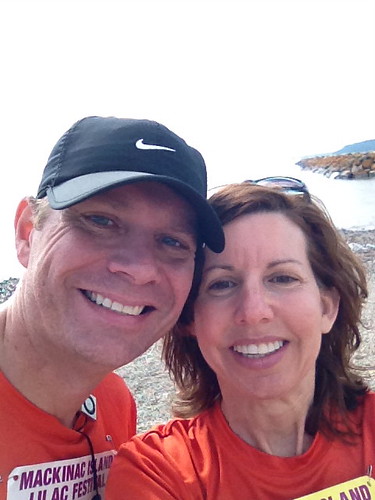
IMG_0022

IMG_0023

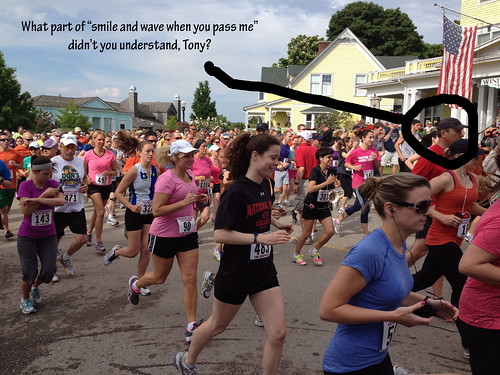
The runners got a head-start on the walkers.
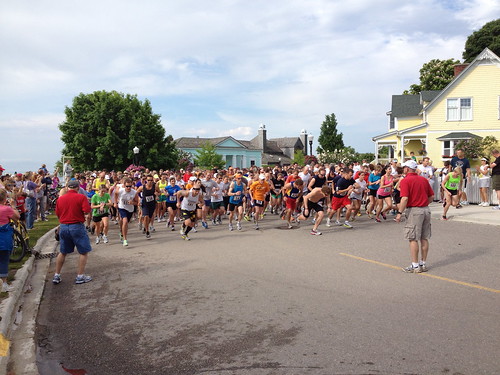
IMG_0027

IMG_0028

The walkers take off like a herd of turtles.
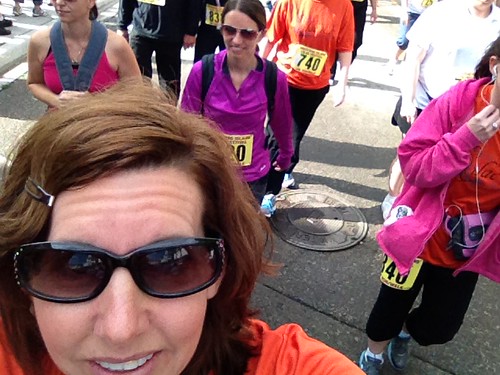
IMG_0029

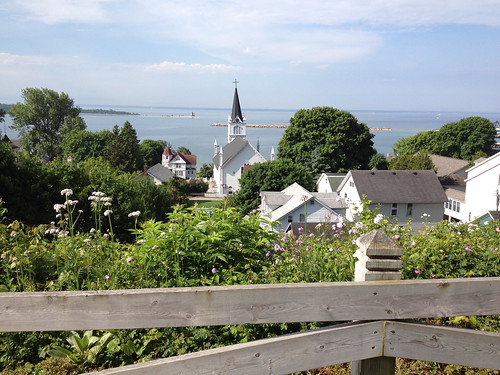
Photos I took while I was still “strolling.”
IMG_0030

IMG_0031

IMG_0032

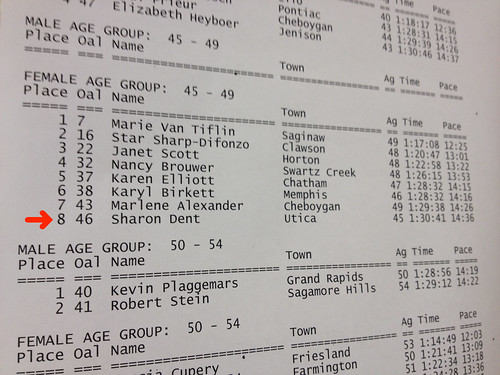
Not too shabby.
sharon's results

Tony was happy with his time, too. (I dropped a cookie and spilled my water on someone trying to get this shot, so it’s a bit blurry.)
tony's results

Much to Tony’s chagrin, I couldn’t possibly visit Mackinac Island and NOT take a carriage tour. So that’s what we did. It turned out to be quite interesting and informative. The island’s recorded history dates to 1,000 B.C., when Native Americans fished there for trout, pike, sturgeon, herring and whitefish. Early French settlers in the region named the hump-backed island Michilimackinac, which allegedly means “place of the great turtle.” The name was eventually shorted to Mackinac (pronounced Mack-in-aw). A French military outpost on the mainland was moved to Mackinac Island in 1761 when British soldiers took control. The fort and island became U.S. territory after the American Revolution, but the British recaptured the fort during the War of 1812. Peace negotiators restored the island and Fort Mackinac to the United States two years later.

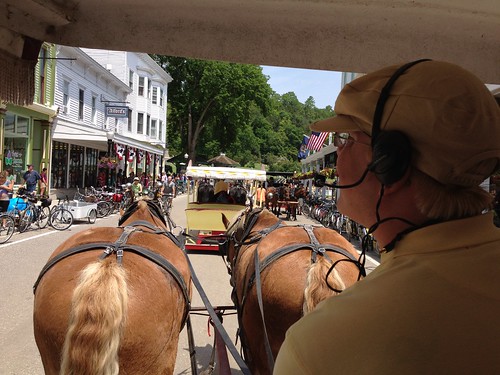
Starting the tour in town.
IMG_0036

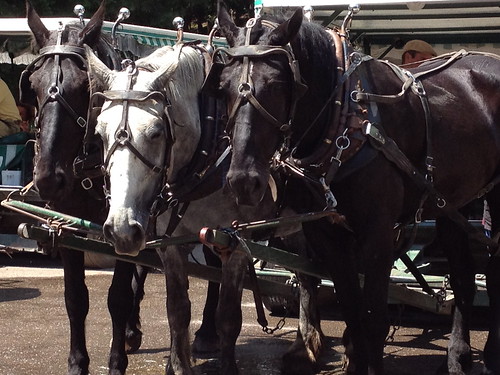
We switched to a different carriage to tour Mackinac Island State Park (which covers 80 percent of the island), as well as some historical and natural landmarks.
IMG_0041

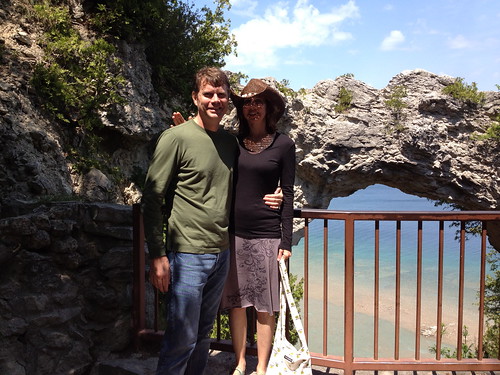
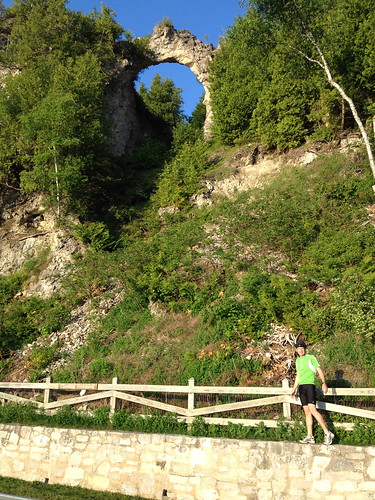
At Arch Rock.
IMG_0042

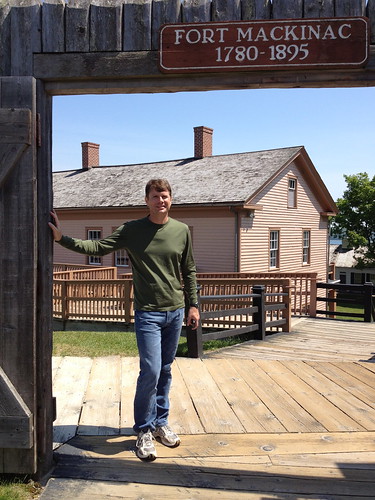
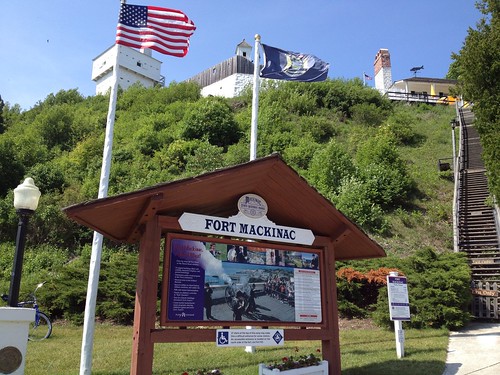
We opted to end our tour at the fort, which I LOVED! It sounds crazy, I know, but almost any military fort reminds me of my upbringing. The various buildings featured excellent interpretive displays with plenty of photographs, artifacts and stories from the 1800s. We visited the one-room schoolhouse, soldiers’ barracks, officers’ quarters, the quartermaster’s storehouse, the post hospital and the post bathhouse, which was constructed in 1885 during a “hygiene fever.” The post doctor implemented a revolutionary policy requiring soldiers to bathe at least once a week in the cast iron bath tubs.
IMG_0020

IMG_0043

IMG_0019

I am more than a little fascinated with medical history, so one of my favorite characters from Fort Mackinac lore is Dr. William Beaumont. Here’s the story, well told on Wikipedia:

On June 6, 1822, an employee of the American Fur Company on Mackinac Island, named Alexis St. Martin, was accidentally shot in the stomach by a discharge of a shotgun loaded with a duck shot from close range that injured his ribs and his stomach. Dr. Beaumont treated his wound, but expected St. Martin to die from his injuries. Despite this dire prediction, St. Martin survived – but with a hole, or fistula, in his stomach that never fully healed. Unable to continue work for the American Fur Company, he was hired as a handyman by Dr. Beaumont.
By August 1825, Beaumont had been relocated to Fort Niagara in New York, and Alexis St. Martin had come with him. Beaumont recognized that he had in St. Martin the unique opportunity to observe digestive processes. Dr. Beaumont began to perform experiments on digestion using the stomach of St. Martin. Most of the experiments were conducted by tying a piece of food to a string and inserting it through the hole into St. Martin’s stomach. Every few hours, Beaumont would remove the food and observe how well it had been digested. Beaumont also extracted a sample of gastric acid from St. Martin’s stomach for analysis. …Beaumont used samples of stomach acid taken out of St. Martin to “digest” bits of food in cups. This led to the important discovery that the stomach acid, and not solely the mashing, pounding and squeezing of the stomach, digests the food into nutrients the stomach can use; in other words, digestion was primarily a chemical process and not a mechanical one.
In early 1831, Dr. Beaumont conducted another set of experiments on St. Martin’s stomach, ranging from the simple observation of normal digestion to the effects that temperature, exercise and even emotions have on the digestive process.
Beaumont published the account of his experiments in 1838, as Experiments and Observations on the Gastric Juice, and the Physiology of Digestion. He and St. Martin parted ways, with Beaumont eventually going to St. Louis, Missouri, and St. Martin to his home in Quebec province, Canada. Off and on for the next twenty years, Beaumont tried to get St. Martin to move to St. Louis, but the move never occurred. Beaumont died in 1853 as a result of slipping on ice-covered steps.

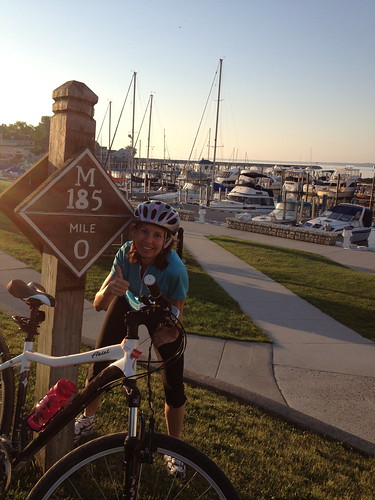
Sunday morning, we rose with the sun for a bike ride on Mackinac Island’s perimeter highway M-185.
IMG_0046

Here’s Arch Rock again.
IMG_0047

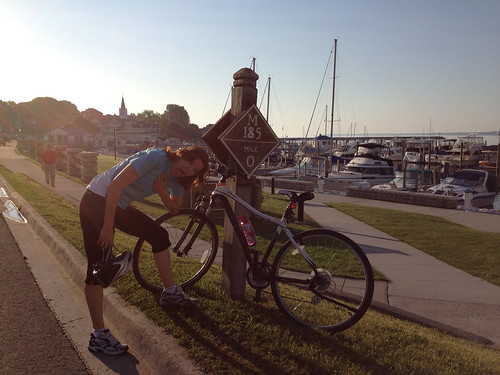
Whew! We rode around the ENTIRE ISLAND!!!
IMG_0049

(OK, the “entire island” is only eight miles…)

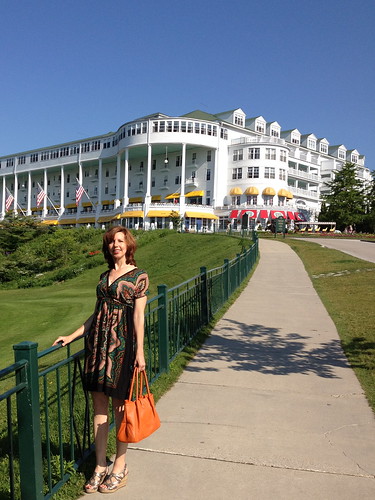
After breakfast, we put on our grown-up clothes and walked to the Grand Hotel. Built in 1887 for summer visitors, the hotel exudes posh nostalgia (especially if you squint enough to blur the bored teens with saggy jeans and dads with bellies hanging over their cargo shorts). The movie “Somewhere in Time” was filmed at the Grand. Remember? Christopher Reeve’s character goes back in time and meets the woman of his dreams, played by Jane Seymour, but then he finds a modern-day penny in the pocket of his 1912 pants and is transported back to the 1970s. Of course, I felt compelled to re-enact the penny scene for Tony more than once. He loved it. Not really.
IMG_0051

After our visit to the Grand, we decided to head back to reality on the next ferry. Maybe we’ll try to catch the lilacs in bloom next summer.

Home

Every day in India is an adventure of emotions. That’s not hyperbole. Some adventures are small and giggly, like riding home from a restaurant in a tuk-tuk with hot pink vinyl upholstery, disco lights and “Who Let the Dogs Out” blaring from the stereo. Some adventures are vast and spiritual, like strolling the prayer path around the Dalai Lama’s residence or standing in line with ecstatic Sikh pilgrims at the Golden Temple. Some adventures are ongoing and frustrating, like explaining to the plumber that he is nuts to think the lack of hot water is because the water has to come from far, far away and cools off along the journey (right, Nancy?). Some adventures are gut-wrenching despite their predictability, like shaking your head at tiny, dirty street children with outstretched hands. Some adventures are mesmerizing in their outlandish implausibility, like smearing psychedelic colors on your friends for Holi or watching a two-story effigy of Ravana explode in fireworks on Dussehra, or really anything that happens on any Indian holiday.

That’s all to say that Tony and I are quite content to spend a few weeks in a relative adventure-free zone. Although we love our international adventures, we also really, really, really love coming back to Michigan for summer vacation and …

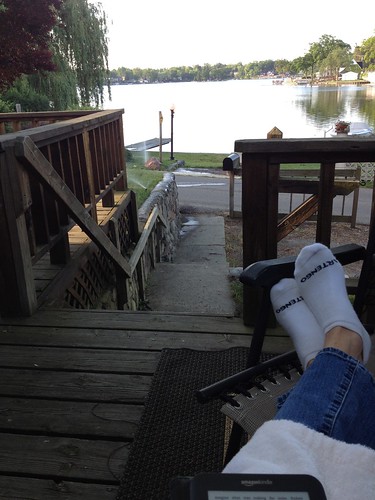
… chilling on our deck, overlooking Lake Orion,
IMG_0010

riding bikes on the myriad nature trails,
IMG_0014

eating insane quantities of American delicacies (I had a bacon cheeseburger with avocado at this restaurant),
IMG_0017

and hanging out with my wacky family!
IMG_0007

So bring on summer vacation!