A muse on my commute

I’ve had a couple glasses of wine, and you know what that means! My creative juices are flowing. Tonight, I’m writing about an unusual moment from today’s commute…

Prose first, then poetry? OK, then.
Driving home from physical therapy tonight, my taxi got trapped in Delhi’s usual snarl. I scooted across the back seat to avoid the scorching sun, but 110° F will bake you no matter where you sit. Waiting at a traffic light, I watched the regular beggars on the median. They were wilting in the heat, but desperation forced them off the curb. They circulated through stalled traffic, knocking on car windows and crying out, “Madaaaam! Madaaaam!” In an effort to affirm their humanity, I always make eye contact, smile and mouth, “No, thank you.” Today, there was a minor but interesting twist. A woman shuffled toward my taxi, carrying a drooping little girl. She approached with the usual appeal for money; her knocks on the taxi window inspired the baby, who gripped a coin. The youngster tentatively stretched out her skinny arm and tapped on the taxi window. Its “ting” jolted her out of heat-induced lethargy, her eyebrows shooting up in surprise. As her mother obliviously continued with exhausted moaning, the child smiled at me, conspiratorially. I couldn’t help but wonder how much longer a coin’s musical tapping would amuse her. Her time on the hip was winding down, and soon the window rapping would turn ominously purposeful.

Same story, poet’s eyes.
Balanced precariously on her mother’s hip,
bobbling with every sudden noise, so many sounds,
eyes momentarily unfocused on the tangled traffic,
skin peeling – no, simply patchy with sweat and dust.
Her mother, hand turned backwards,
raps with knotty knuckles on the window,
dink dink dink.
Her sequined sari limply draped across her face to block the sun,
Her thumb and fingers meet, gesturing at a hungry mouth.
Her silver ring makes contact,
tink tink tink.
This metal-on-glass melody startles.
The baby’s eyes glisten, suddenly alert, curious.
A precious one-rupee coin clenched in a tiny wet fist stretches out.
tink tink tink.
An innocent smile. A bounce.
A giggle of accomplishment.
A grimace from her mother, whose practiced pleas lose power in the presence of a gleeful child.
tink tink tink.
How soon before the coin’s music loses its magic?

Tibetan Children’s Village

With only two weeks left before SUMMER break, I’m finally writing my last post about SPRING break.

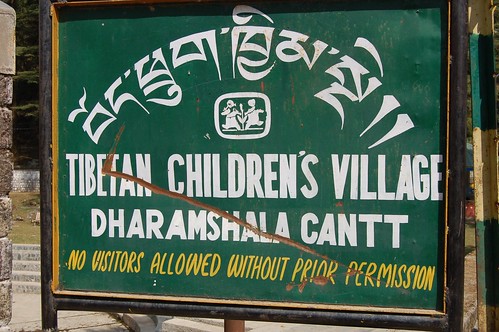
Theresa had read about the Tibetan Children’s Village, and my principal had mentioned that our school was a strong supporter, but I didn’t know what to expect when we decided to check it out on April 3. Oops, we hadn’t asked for prior permission to visit.
Untitled

Nevertheless, we walked up a short hill and entered a big play area, where young children in blue uniforms were eating snacks and running around. Unsure of what to do next, we found some shade and watched the youngsters until a woman pointed to the office and told us we needed to check in. Up a couple flights of stairs, we were greeted by a man who took us into the office of someone important looking. I told him that I worked at the American Embassy School and that we were interested in visiting his school. He immediately expressed gratitude for all AES has done to support the work of TCV and sent us off with a tour guide. We joined a Belgian family for a walk around the village.

Tenzin Tseten was born in India after his parents fled Tibet in the 1950s. He explained that the 1959 Chinese occupation of Tibet and ensuing protests led to more than a million Tibetan deaths and a mass exodus of survivors to India. Concerned for the thousands of children orphaned or left destitute, the Dalai Lama proposed a special center for them. The Nursery for Tibetan Refugee Children was founded in 1960 and eventually developed into the Tibetan Children’s Villages, which now manages five children’s villages and many schools, day care centers and other educational programs.
Untitled

According to a TCV brochure, more than 35,000 children have received education and family-style support.

Even with so much progress, there is still much work to be done as Tibetans continue to flee the persecution in their homeland. Parents still feel compelled to give up their children by the pervasive sense of hopelessness in Tibet, where educational opportunities for Tibetan children are extremely poor. There the school system is used to suppress the cultural identity of Tibetan children by teaching in Chinese and denigrating the Tibetan language and culture.

Tenzin said parents in Tibet often face the worst of decisions: (a) bring up their children in an increasingly oppressive political climate, where their traditional lifestyle is under attack, or (b) send their children away to the TCV, illegally and permanently, for immersion in the Tibetan way of life and greater hope for future opportunities. Families pay exorbitant amounts of money for smugglers to sneak their youngsters – even infants – over the Himalayas, through Nepal and into India, often during the winter when the chance of apprehension by Chinese authorities is less likely, he said.

We toured one of the “khimtsang” or group homes, where children live as brothers and sisters with their foster parents.
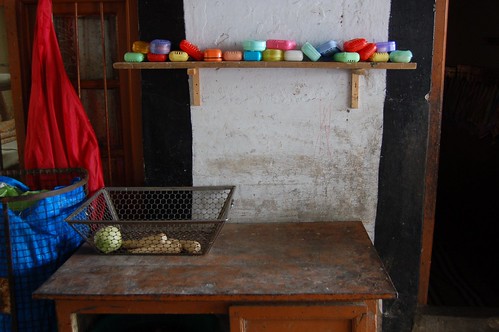
Toothbrushes and soap boxes.

Untitled

Untitled

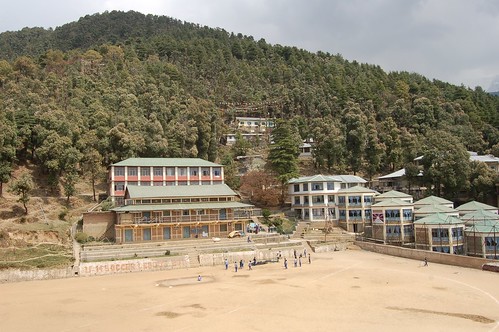
The high school field and classroom facilities.
Untitled

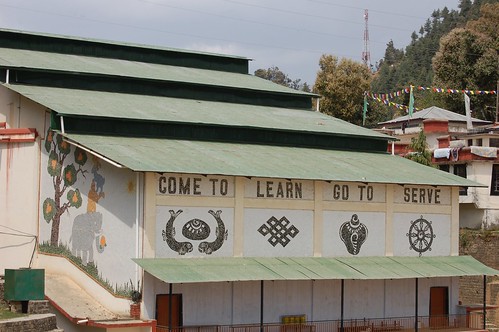
Darn close to our own school’s motto: “Enter to learn, leave to serve.”
Untitled

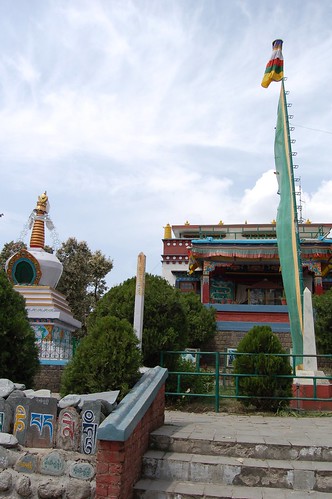
Temple on campus.
Untitled

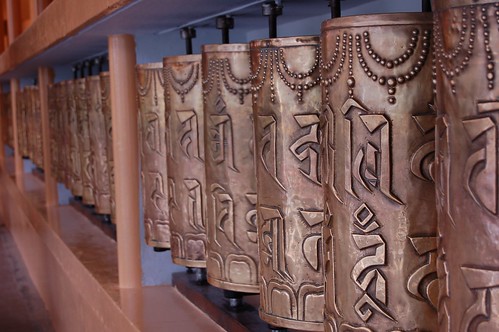
Om mani padme hum, a mantra in Tibetan Buddhism to invoke the attention and blessings of Chenrezig, the embodiment of compassion.
Untitled

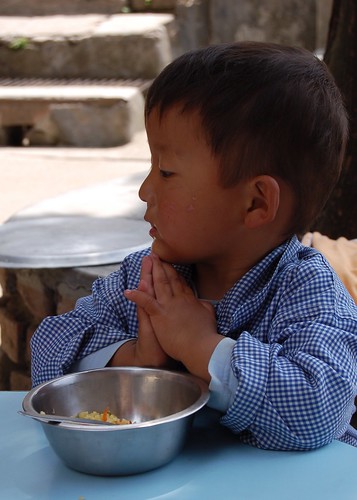
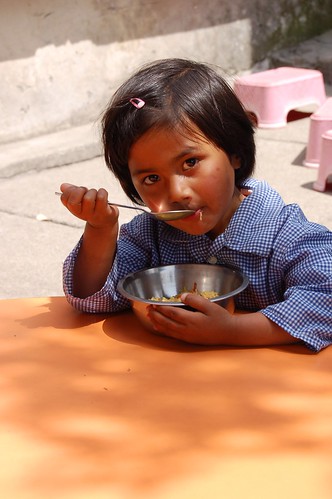
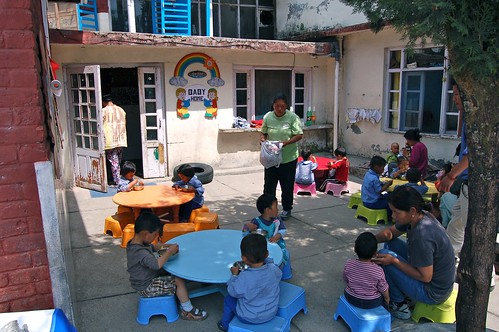
“Do you want to see the baby home?” Tenzin asked, leading us to the TCV nursery. We didn’t see any actual babies, but the toddlers were having lunch on the patio. They washed their hands at a row of sinks and then took their seats at small plastic tables with their hands folded. When everyone had been served, the teacher gave a signal and they recited a Tibetan prayer in unison before digging into their lunch.
Untitled

Untitled

Untitled

Untitled

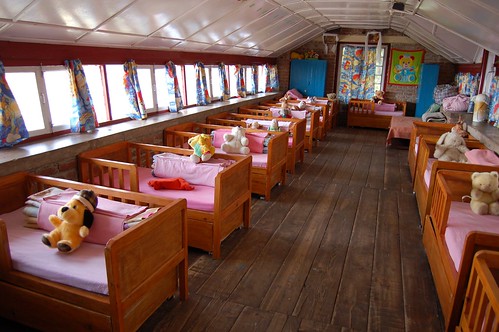
Baby dorm.
Untitled

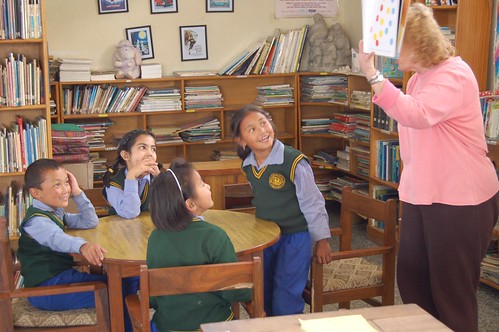
Knowing the American Embassy School had donated thousands of books to TCV, I wanted to check out the library. Tenzin introduced us to Nancy Corliss, a retired teacher from New York, who volunteers in the TCV library twice a year for two months at a time. When she’s back in the States, she promotes the TCV’s work through speaking engagements. We arrived at the library just in time to watch Nancy read Press Here, requiring the youngsters to interact with the book. You can see in the photos that some young boys are already studying to be monks; the others wear TCV school uniforms.
Untitled

Untitled

A sign on the library.
Untitled

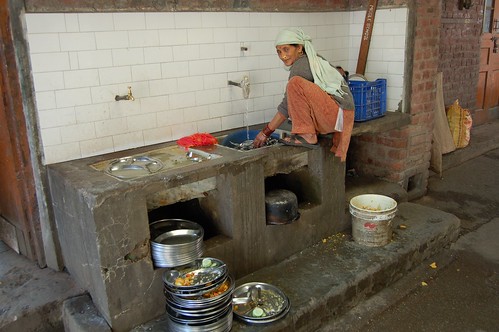
When we asked Nancy to recommend a restaurant for lunch, she quickly sought permission to treat us in the staff canteen. After a nice chat and tasty Tibetan food, we carried our metal plates to the dish washer. At AES, we do that, too, but the “dish washer” is actually a “dishwasher.” Here, the dish washer was a petite lady with a big gold nose ring and a friendly smile, perched on the edge of the sink.
Untitled

In addition to helping Tibetan refugees, the TCV also accepts other children whose parents want the Tibetan education. Theresa and I met a family in a Dharamsala cafe who live in Delhi but are thinking about sending their two kids to the TCV, specifically for the Tibetan Buddhism schooling. Here they are having a treat.
Untitled

I still feel conflicted emotions from our time in Dharamsala. Having visited Tibet (in 2009) and seen firsthand the Chinese oppression of the Tibetan people, I grieve for the parents who send their children away in a desperate attempt to provide a brighter future and salvage their Tibetan identity. I feel a sense of hopelessness for these people, who most likely will never see their homeland again. I feel angry than I was allowed to tour Lhasa, a place of profound spiritual symbolism for Tibetan Buddhists, but my TCV guide can only dream of such a journey. Still, this town is uplifting in that it promotes Tibetan culture while providing safety and security for the Dalai Lama and other Tibetan refugees.

After describing the TCV to Tony, we decided this was a cause worth supporting. We recently committed to sponsoring a child and were assigned a 10-year-old girl named Tenzin Nordon, whose father escorted her to Lhasa before sending her on to India with a group of other Tibetans. She attends the TCV school in Bylakuppe, India. A letter from the school says she misses her parents terribly but is happy to have two cousins at the school with her.
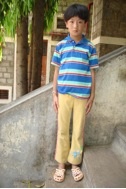
Tenzin

If you’d like to become a TCV sponsor, contact Nyima Thakchoe at nyima@tcv.org.in. And tell her I sent you!

Chillin’ at the Dalai Lama’s residence

For the love of Peter Rabbit, as my Nana used to say, why am I still blogging about spring break?! It’s been more than a month.

Well, here’s why: With less than four weeks before we head Stateside for the summer, life is crazy busy. My calendar is packed with the usual stuff in addition to report card writing, physical therapy appointments for my wonky neck, rehearsals for the elementary school play, professional development workshops, summer travel planning, end-of-year social functions, and meetings, meetings, meetings. It seems I rarely have time to think, much less think about what I did over spring break.
Nevertheless, it’s time to wrap it up. So, make those Scooby Doo arm-waving gestures and doodly-doo sounds to take yourself back to April 4.

Theresa and I were hanging out in McLeod Ganj up in the mountain state of Himachal Pradesh.

Walking around town, I kept feeling an odd mash-up of deja vu and country-confusion. I KNEW I was in northern India, of course, but I kept seeing people, architecture, clothing and food reminiscent of my visit to Tibet in 2009, as well as market stalls stocked with Chinese-made souvenirs like so many I had seen and purchased while living in Shanghai. Sometimes I actually had to remind myself: You are in India, dummy.

The town has a distinctly Tibetan vibe because it is home to the Dalai Lama, Buddhist spiritual leader and, until recently, political leader of the Tibetan government-in-exile. (Last August, the Dalai Lama handed over his political responsibilities to Tibet’s first democratically elected prime minister, Lobsang Sangay.) This excerpt from a BBC profile of the Dalai Lama explains how this Indian town became a Tibetan settlement:

The 14th Dalai Lama was born on 6 July 1935, in a small village just outside the current boundaries of Tibet. His parents, who named him Lhamo Dhondub, were farmers with several other children. When he was two years old, a search party of Buddhist officials recognised him as the reincarnation of the 13 previous Dalai Lamas and he was enthroned before he turned four. He was educated at a monastery and went on to achieve the Geshe Lharampa Degree, a doctorate of Buddhist philosophy. But in 1950, when he was 15, the troops of Mao Tse-tung’s newly-installed Communist government marched into Tibet. As soldiers poured into the country, the Dalai Lama – his title means Ocean of Wisdom – assumed full power as head of state. In May 1951, China drew up a 17-point agreement legitimising Tibet’s incorporation into China. When Tibetans took to the streets in 1959 demanding an end to Chinese rule, troops crushed the revolt and thousands of protesters were killed. The Dalai Lama fled to India on foot and settled in Dharamsala, in the north of the country, which is now home to the Tibetan government-in-exile. He was followed into exile by about 80,000 Tibetans, most of whom settled in the same area.

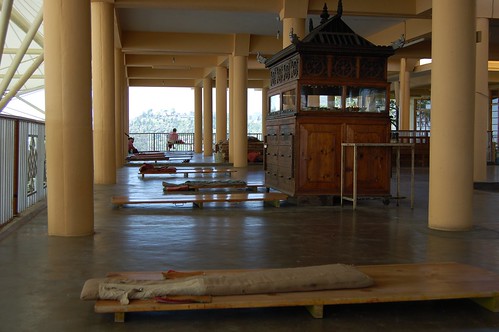
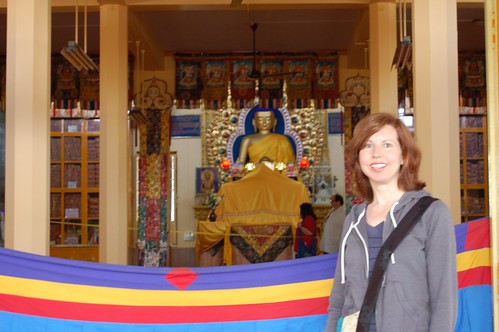
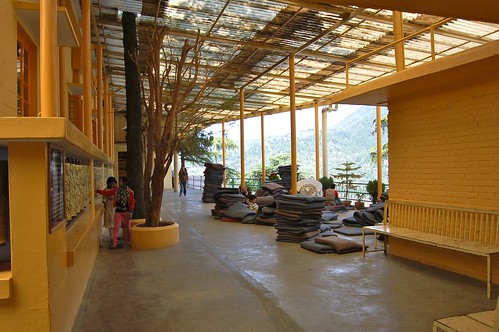
The Dalai Lama’s residence and Tsug Lakhang Temple are simple and unassuming, painted mustard yellow. White sails rise up from the temple, similar to those at the Denver airport, providing cover but plenty of natural light. Wooden platforms with sliding handrests and knee pads lined the area in front of the Buddha shrine for prostrating pilgrims. I only saw a couple people use them; it seemed to be a quiet day in the temple.

Untitled

Untitled

Untitled

Monks were mending those cushions on the right.
Untitled

We learned later that the Dalai Lama had been teaching at a nearby monastery. One of my colleagues, Sue, had tickets to hear him speak, but she said the audience was too thick to see him and the FM radio that was supposed to transmit his talk in English malfunctioned. Still, she said she enjoyed his soothing voice, even if she couldn’t understand the words. We regretted not doing our homework and thus missing his talk, but then again, I’m not a fan of crowds.

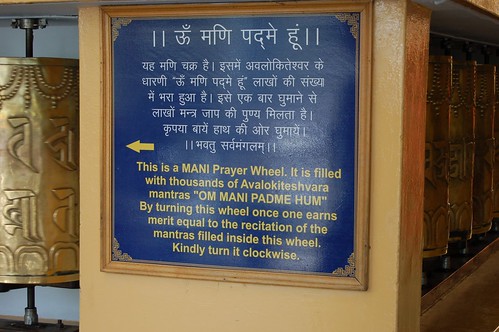
A sign next the prayers wheels.
Untitled

Untitled

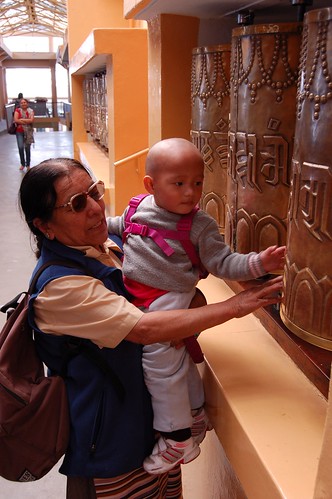
Multi-generational blessings.
Untitled

Theresa gets in on the prayer wheel action.
Untitled

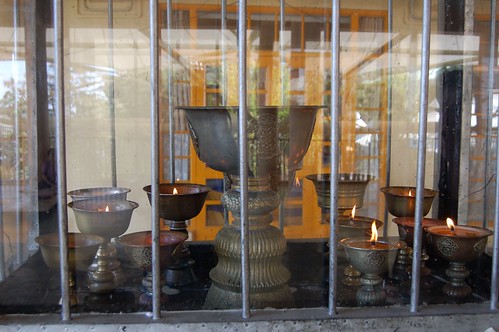
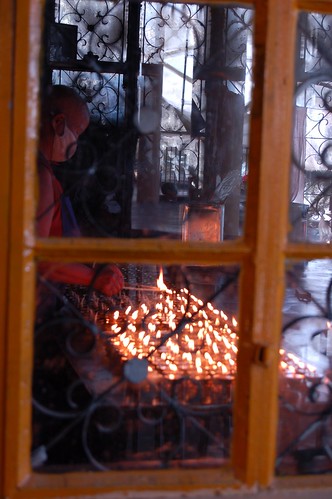
A monk was lighting candles in this small sanctuary.
Untitled

After turning all the prayer wheels in the temple, we headed outside to the “kora,” the circumambulation path. Buddhists walk the path clockwise in meditation. Trees along the path were draped with prayer flags, and other visitors had left colorful flat stones painted with Buddhist mantras. Benefactors funded sections of prayer wheels, marked with plaques explaining the blessings. The most common mantra was “om mani padme hum,” which calls forth blessings from the god of compassion. To learn more about the mantra, visit this excellent website: Om Mani Padme Hum – the Meaning of the Mantra in Tibetan Buddhism.

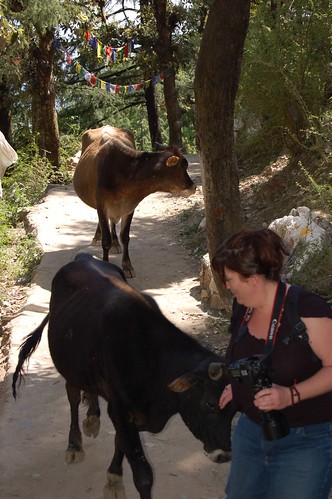
Cows numbered among the pilgrims on the path. Theresa tried to pose with them, but one poked her in the belly with its horn.
Untitled

I made a little movie so you could take a virtual walk on the kora! I love practicing yoga to the music of Deva Premal, and this recording of her chanting Om Mani Padme Hum is one of my favorites.

If you want to know more about the Dalai Lama, check out his website: His Holiness the 14th Dalai Lama of Tibet.