Patience and appreciation

Yesterday was Back to School Night at the American Embassy School, New Delhi. Here’s what BTSN tends to look like for English as an Additional Language teachers:

Me – Hello, everybody! Thank you for coming. (gesture at PowerPoint) I’d like to tell you a little bit about myself and our EAL program.

Hands go up. I call on a parent.
Parent – What does my child need to do to get out of the EAL program?

Me – (smiling) Well, I’ll get to that in a minute. First, I’d like to explain how I work with your child’s teacher to help meet English learning needs and ensure that all kids feel successful in third grade.

Same Parent – Yeah, but how long till they can go to Spanish or French instead?

Me – (still smiling) I promise I will explain our process for transitioning out of EAL, but I think it’s important for everyone to understand how the program works. I spend time in your child’s classroom every day …

Same Parent interrupting me – Yeah, but my son speaks English every day and he says he’s bored in EAL. So when can he get out?

Me – Maybe YOU should tell ME why in the world you would NOT want your child to have an additional TEACHER in the room providing EXTRA English language support and helping your kid to access the third-grade curriculum? Will you please explain WHY you wouldn’t want your child to learn strategies for building his vocabulary, strengthening his understanding of English grammar and developing his reading comprehension? Help me understand WHY you think learning French or Spanish is so important for a third grader who is still learning the language of instruction at our school???

No, of course I would NEVER say that. But … I admit I do think it. Instead, I usually just take a breath, remind myself that most parents don’t have a degree in language acquisition and suggest that we set up another meeting to chat about that specific child.

I’ve had THAT kind of BTSN many times over the years. Yesterday’s BTSN was NOT one of them! What a relief!

Parents asked important questions about learning English, choosing appropriate books, how to support English learning at home, expectations in the classroom and so on. With heart-warming sincerity, they openly discussed the challenges their children face daily as English learners in an English-medium school.

All teachers play therapist now and then. I hope I was able to reassure parents that their children are in good hands. Many of our teachers, including me, are Third-Culture Kids. We understand and empathize with students living outside their home culture, surrounded by peers of myriad ethnicities.

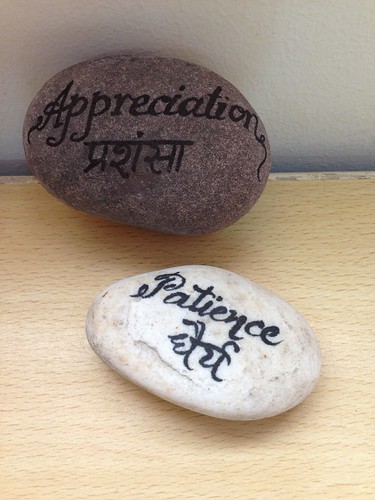
Our principal, Susan Young, started a tradition of giving teachers Power Rocks at the start of school. A local calligrapher writes inspirational words in English and Sanskrit on the rocks, and we choose the ones that resonate with us.

Last year, I chose “patience.” This year, I chose “appreciation.” Sitting on my classroom desk, the rocks remind me every morning to approach the school day with gentleness; assume children, parents and teachers have the best intentions; and to give even the most stubborn kids opportunities to shine and share what makes them special.

I hope the parents who visited school last night felt a spirit of patience and appreciation.
Untitled

Delhi Driving

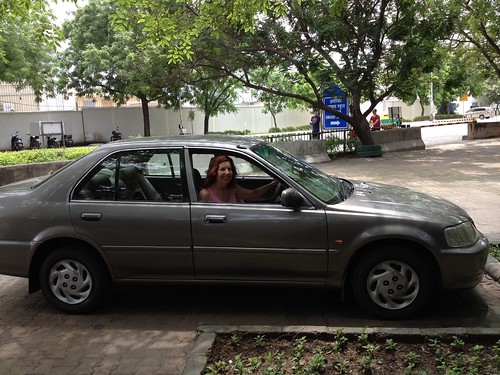
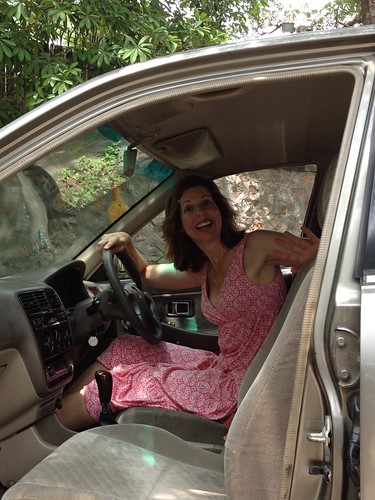
What’s your first reaction to this photo?
2012-08-15 11.54.07

If you gasped in shock and muttered, “What kind of fool would get behind the wheel in New Delhi, India?” then we’re on the same page.

That’s exactly how I reacted to the idea of driving here when we first arrived last August. After 10 months of taxi transport – flailing around in the backseats during death-defying U-turns, repeatedly hitting speed bumps/potholes/medians at full speed, seeking out physical therapy for my neck and then undoing those sessions on the roller coaster ride home, and dodging drunk drivers in the oncoming traffic – I guess I figure “if you can’t beat ’em, join ’em.”

As you know, we took possession of our new-to-us car and driver when we returned to India after the summer. Gilbert, a careful diligent driver, takes us to and from school on weekdays in our little air-conditioned comfy Honda. We’re on our own come Saturday and Sunday.

Last weekend, we awoke to yet another electricity-free morning. I knew it would come back on eventually, but I had work to do that required internet access. I could have called a taxi, but the car sat in front of our house, taunting me. “Seriously? You’re going to take a taxi to school when you own a perfectly fine car?”

I bravely climbed in the passenger side before remembering it’s all backward here. The steering wheel is on the right, and we drive on the left. “Keep your watch to the curb” was Tony’s mantra when we rented a scooter in Thailand, so I kept that in mind as I pulled out of our neighborhood. That was 7 a.m. and the roads were relatively free of traffic. Unfortunately, my driving efforts were rewarded with no internet and no network access at school, so I did a couple hours of lesson planning and then headed home, still early enough to beat the crowds.

Although that morning certainly was liberating, I broke through another barrier Wednesday (not LITERALLY, although that wouldn’t be so unusual here). I drove at night! Yikes! I have mediocre night vision under the best of circumstances, but Delhiwallas keep their brights on, thus blinding all oncoming drivers.

We had the day off Wednesday for India’s Independence Day, so I drove to school, picked up my friend Katrina, drove a couple blocks to a luncheon, drove back to school to work for a couple hours, got back in the car with Katrina and drove to the Australian High Commission for a Zumba class and then dropped my friend Nancy at her house on my way home!

That’s a lot of driving!
In. Delhi.

Katrina only had to remind me once that I was in the wrong lane, and my left arm did go limp with terror when I had to downshift while merging with fast-moving cars coming off the highway. But Nancy gave me lots of props, nonetheless.

Here are some ways driving in Delhi differs from driving in Michigan:

* As I mentioned, the steering wheel is on the other side. But who knew the windshield wiper and turn signal were switched? Every time I wanted to signal, I cleaned the windshield instead. Finally, I just followed the lead of my fellow drivers and stopped signalling my turns.

* Obviously, you have to shift with your left hand. If you are ambidextrous, this may not seem like a big deal. If your left arm is more like a jellyfish tentacle, you can relate to my anxiety.

* Because the steering wheel is on the other side, the bulk of the car is ALSO on the other side. Instead of your body riding close to the curb, your body has to stay near the center line or you will clip someone on the road shoulder.

* Oh, did I suggest there’s a shoulder? There’s not.

* Staying in a lane is not only optional, it’s actually unwise. You’ll never get through an intersection if you insist on lining up behind cars stopped at the light. You must inch around them and squeeze up to the front. Then when the light changes, you jockey for a spot in the crawling mass.

* Never use your mirrors or otherwise look behind you. If someone wants to pass, he’ll honk. If someone pulls into your blind spot, he’ll honk.

* You must remember to honk. This is not an automatic reflex for me. In addition to the honk-worthy situations listed above, you must honk your horn to warn anyone or anything – pedestrians, tuk-tuk drivers, cyclists, cows, dogs, kite-flying children, beggars, motorbikes overflowing with full families, fruit peddlers, parked vehicles, construction workers, packs of youngsters in school uniforms, bicycle rickshaws piled high with cardboard/mattresses/furniture/gas canisters/etc., fill-in-the-blank – lingering in the road that you are approaching.

* Bottom line: Anything goes.

I haven’t ventured too far from home yet, and I certainly haven’t encountered the worst that Delhi has to offer. However, my initial feeling is that I can do this. Freedom!

Dare to get in with me?
2012-08-15 11.55.00

Happy Independence Day, India!

India got a shout out from Google today.
india12-hp

Today marks India’s 65th birthday as an independent democratic nation. Here’s the scoop from wikipedia:

The Independence Day of India, celebrated on 15 August, is a holiday commemorating India’s independence from the British rule and its birth as a sovereign nation on 15 August 1947. India achieved independence following the Indian independence movement noted for largely peaceful nonviolent resistance and civil disobedience led by the Indian National Congress. The independence coincided with the partition of India wherein the British Indian Empire was divided along religious lines into two new states—Dominion of India (later Republic of India) and Dominion of Pakistan (later Islamic Republic of Pakistan); the partition was stricken with violent communal riots. The Independence Day is a national holiday in India. The flagship event takes place in Delhi where the Prime Minister hoists the national flag at the Red Fort, followed by a nationally broadcast speech from its ramparts. The day is observed all over India with flag-hoisting ceremonies, parades and cultural events. Citizens rejoice the day by displaying the national flag on their attire, household accessories, vehicles; varied activities such as kite flying, bonding with family and friends, and enjoying patriotic songs and films are seen.

Our elementary school assembly yesterday spotlighted many of India’s symbols, including the peacock, lotus flower, tiger and flag. Know India is a nice website with more information. A student led the school in singing India’s national anthem, “Jana Gana Mana,” a gentle beautiful song written by the late poet Rabindra Nath Tagore. Check out this YouTube video to hear it and read the English translation.

Lots of kite flying and bubble blowing in the ‘hood today. As for me, I’m planning to crash a single ladies pool party for lunch and then head to Zumba class!