Weird, wonderful, colorful, camelful Pushkar Camel Fair

Last year around this time, one of my students was absent on Friday and Monday.
“Were you sick?” I asked.
“No…,” she answered. “My mom told me not to tell you that we went to the Pushkar Camel Fair! It was awesome!”
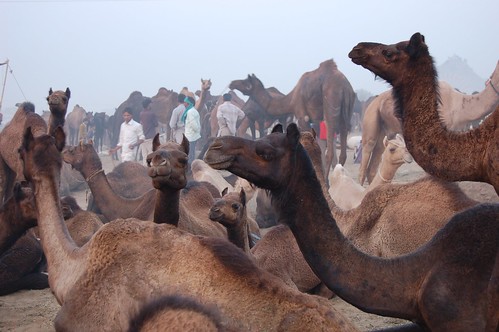
I soon realized many students (and teachers) were “sick” that weekend, so I did a little research on the fair. I discovered the five-day fair takes place every year during the month of Kartika on the lunar Hindu calendar, which falls in October or November. It transforms the sleepy town of Pushkar, in the Indian state of Rajasthan, into a bustling carnival of animal traders, performers, revelers and tourists. Depending on the source, camels at the fair reportedly number from 25,000 to 50,000. That’s a lot of camels. I had to see it. Good thing I didn’t call in “sick” too early – the 2012 Pushkar Camel Fair coincided with our Thanksgiving holiday! I booked the hotel and train tickets far in advance, so you can imagine how excited I was when last weekend finally rolled around.

I’ve done my share of lay-around-the-beach vacations that yield little in the way of blogworthy photos or stories. This was not one of those vacations. This was visual overstimulation like never before. In just 2 ½ days, I took almost 500 pictures. Looking at those snapshots on the computer, I recall the object of my attention at the time, but then I notice about 50,000 other interesting details I missed the first time – in the background, in the foreground, in the crowd, in the clothing, on the faces, on the buildings. It was hard to focus the camera on any one thing in Pushkar, and now it’s hard to focus mentally on any one thing as I recall the experiences from the weekend. The color, the dust, the juxtapositions, the flowers, the spiritual energy, the joy, the peace amidst the chaos. Everyone loves a good beach vacation, but I’m quite sure Pushkar will rank as one of my most treasured trips.

Prepare for an onslaught of photos. I’m struggling to cull.

Home away from home.
My little band of teacher-travelers included Becky, Isaac, Katrina, Nancy and Nancy’s two kids. While Becky and Isaac stayed at a nearby budget hotel, the rest of us booked rooms in two “haveli hotels” owned by a friendly man named Anoop. A “haveli” is a private mansion of historical significance. Anoop lives in the first floor of Dia, a small bed and breakfast, where I stayed in the breezy Anandi Room and enjoyed the company of several cats, two turtles and a happy yellow lab. Nancy’s gang and Katrina stayed at the larger Inn Seventh Heaven, where roots and vines crawl through the balustrades and dangle from the rooftop restaurant. We mostly ate at the Seventh Heaven restaurant, Sixth Sense, patiently waiting for our food to arrive by a rigged metal dumbwaiter, guarding our pancakes from Fat Dog and startling as pigeons took shortcuts through the open windows or landed on the ceiling fans.

Camel cart tour.
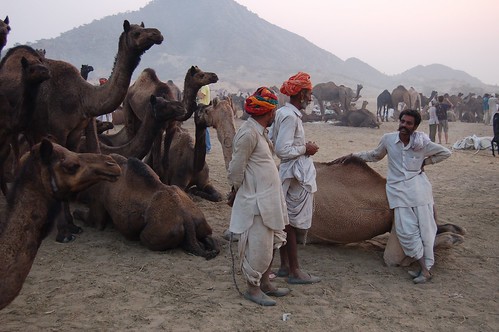
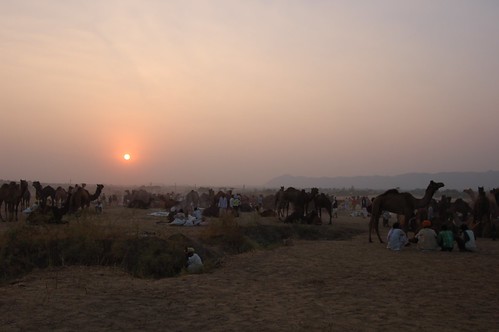
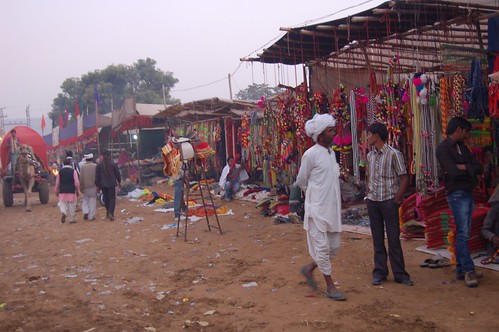
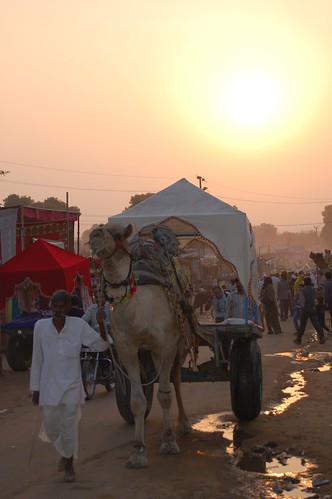
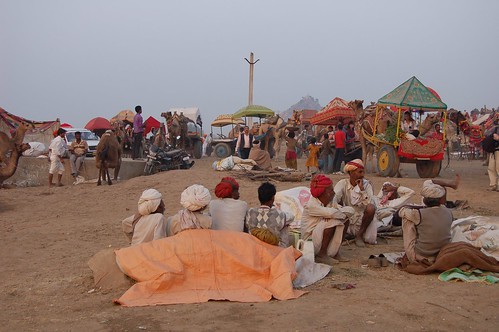
Despite waking at 4 a.m. Thanksgiving morning to catch our train and riding for more than six hours on the ironically named Shadtabdi Express, we were all eager to hit the ground running. We followed the crowds to the fairgrounds along a road lined with tempting shops and market stalls, repeating, “We’ll shop in the morning!” Upon arriving at the fairgrounds, we weren’t sure where to start. Fortunately, the camel handlers don’t give you time to think. We all piled into a camel-drawn cart for a ride without any idea where we were going or what to expect. The cart joined a caravan of like-minded tourists and hauled us the short distance to an expanse of desert where camel traders in colorful turbans crouched next to their animals, awaiting shoppers and tolerating the gawkers. The orange hazy sun setting in the dust-darkened sky provided an apt backdrop for this surreal scene.
Untitled

Untitled

Untitled

Untitled

Untitled

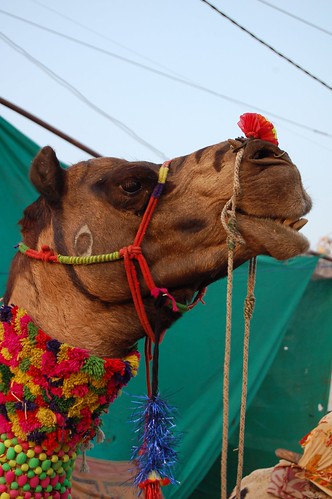
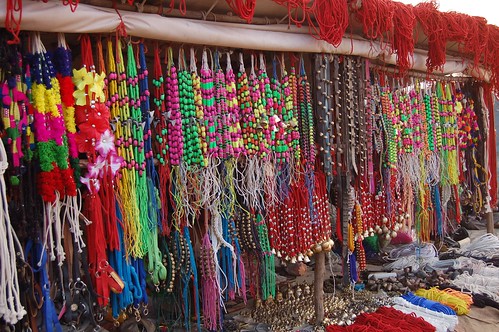
For camels who like to accessorize.
Untitled

Untitled

Untitled

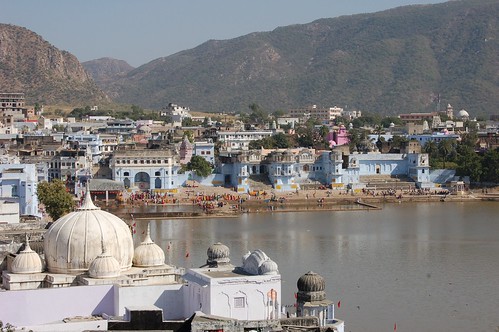
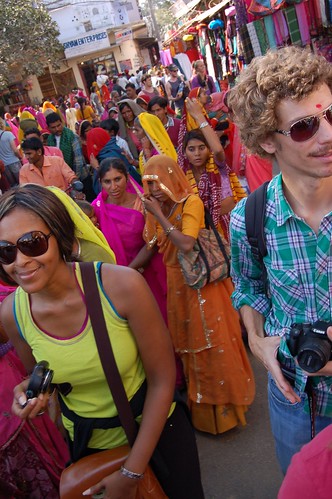
Pushkar is the home of the world’s only temple to Brahma, the Hindu god of creation, and devout Hindus believe a dip in the holy lake will wash away sins of a lifetime. All roads in Pushkar seem to lead to one of the 52 “ghats,” the stairways leading down to the lake. Pilgrims purchase offerings, which they drop into the water with prayers for health, happiness and prosperity. They fill the streets, ladies clad in their most stunning saris with bags balanced on their heads and barefoot men dressed in plain white “lungis,” a long stretch of fabric wrapped and tucked to cover the nether regions, and additional yards of fabric, often neon-bright, twisted into turbans. There was a different vibe here. Everyone seemed to exude a sense that this place was special. Women made eye contact and returned my smile with gentle “namastes,” encouraging their babies to wave. Children laughed and tossed out all their English phrases. “Good morning. Good afternoon. Good evening. Good night,” one boy said proudly. Most men seemed preoccupied by their families or their spiritual journey. We didn’t encounter the swarms of Indians obsessed with taking phone “snaps” with us. We didn’t get the creepy once-over so typical of young men in Delhi. There were stares, as usual, but they were fleeting and moved on quickly to other happy pursuits. I simply couldn’t put down my camera.

Let’s play “spot the foreigner.”
Untitled

Human touch.
Untitled

How gorgeous is that little girl?
Untitled

The colors almost hurt your eyes.
Untitled

More street shots… Note the motorcycles trying to drive through the crowd, the painted people promoting a music festival, Isaac strangely appearing in several backgrounds, the group of youngsters who ALL asked to shake my hand, little white balls of sugar offered at a shrine, the streetside parking (motorcycle, cow, motorcycle)…

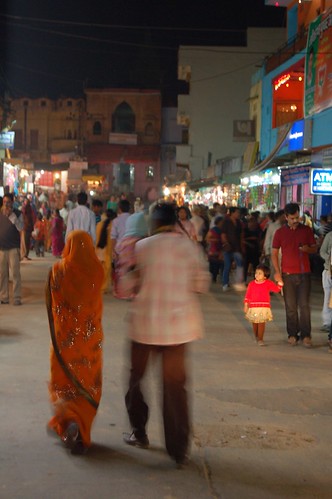
Walking around at night was equally interesting.
Untitled

Sweet, spicy tea in a tiny clay cup.
Untitled

More, more, more.

Temple hike
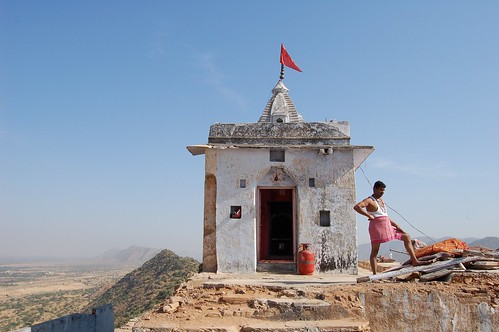
Anoop (the hotel owner) encouraged us to hike up a nearby hill to a small temple overlooking the valley. I do have a weird need to climb things when I’m on vacation, so I convinced Isaac, Becky and Katrina to join me. At the top, we took off our shoes to visit the little temple, where we heard a short Hind-glish version of the temple’s history and purpose from a quirky groundskeeper.
Untitled

The camel fair features a full program of fascinating events and attractions, including camel dancing, Indian bride competition for foreigners, temple dance, mustache competition, Rajasthani folk music, turban tying competition, and laughter show. I have no idea what most of those were. We only braved the crowds to watch one event: camel dancing, which seemed akin to camel torture. I asked a restaurant owner about another one of the events: Kabaddi.
He explained, “It’s very much like American football. You have a line in the middle with seven players on either side. Then you say ‘kabaddi, kabaddi, kabaddi.'”
…awkward lull while I stare in confusion…
His friend tries to help, “You no say ‘kabaddi,’ man tell you ‘sit down!'”
The two guys looked at each other like it all makes sense and is indeed very much like American football.
I just nodded and said, “Ohhh…Okayyy.”

Here are some scenes from the stadium during the camel dancing. Some of my friends paid to watch from a camel perch, but I just poked around at ground level. I’m kicking myself for not going to that circus!

Looking over the schedule of events and mapping out a tentative plan for our visit, we noted the rent-a-camel option. I wracked my brain, rewinding through 12 years of living overseas and a lifetime of travel … had I ever ridden a camel before? It’s possible I’m wrong, but I do believe Pushkar provided my first-ever camel ride! How is that possible?

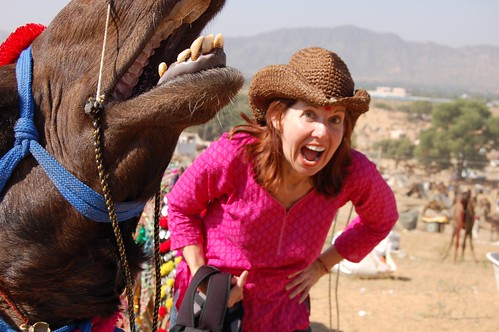
We all boarded camels at the fairground and rode out to the same area we visited on our cart ride. My camel handler was about 8 years old and tough as nails. He walked us through the horse market, where the swanky horse owners threw a hissy fit to see a grungy camel in their midst. While the boy was arguing with them, my camel slyly tried to nip a taste of fresh bundled greens clearly intended for the spoiled fancy horses, but he got yanked back before he could sneak a snack. Out in the camel field, the handlers made us dismount so we could shop at their makeshift souvenir tent. That was a bit annoying, but it gave us an opportunity to act like idiots for some silly pictures. I thought it would be funny to put my hat on the camel and strike a pose like, “Yo camel, why’d you take my hat?” However, the camel thought it would be funnier to snap his big yellow teeth at me and strike a pose like, “Yo dummy, I am way too cool for that stupid hat.” After the camel and I had come to an agreement, the handler said, “No touch camel. No hat to camel.” Yes, thank you, the camel already made that perfectly clear.
Untitled

Untitled

Untitled

More camel ride photos.

Sacred lake.
Hoping to spend some quiet time lakeside, we walked down the steps at one of the “ghats” that lead to Pushkar Lake. Immediately we were accosted and handed a metal pan of religious paraphernalia. A man guided me to sit on the steps while he led me through a litany of prayers using a coconut, flower petals, red paste to mark the third-eye on my forehead, rice to symbolize prosperity, sugar, and a string, which he tied around my wrist with a blessing. He told me to repeat after him, so I uttered the names of many Hindu deities (Durga, Ganesha, Shiva, Parabrahma…) along with random phrases like “happy father, happy mother, happy husband, everybody happy, everybody healthy…” Then he told me to hold the coconut and say my own prayers silently before taking my pan down to the water’s edge to dump the contents as an offering. Done and done.
Untitled

Untitled

Untitled

View from a rooftop restaurant.
Untitled

While the rest of our crowd headed home Saturday afternoon, Katrina and I stayed an extra day. After a chat with Anoop, we decided to enjoy a leisurely walk in the countryside. My hotel, Dia, sat at the edge of town. We were all prepared to check out hillside temples and freshwater springs until Anoop warned us about the red monkey. “He’s pathologically psychotic,” he said, explaining that someone at one of the temples used to feed him opium or something. Since that guy skipped town, the red monkey is off his rocker, attacking people without provocation and even climbing through windows to bite people in their own homes. So… change of plans. We still went for a walk, but we mostly stayed in the dry irrigation canal and steered clear of the temples and the springs. We didn’t see the famed red monkey, but on the way back to the hotel, we saw a monkey aggressively jump on the back of a pig, riding it for a bit while the pig squealed and ran in terror. Awesome.
Keeping it mellow in Bangkok

You know your life is getting weirder by the minute when you’re actually BORED at the prospect of blogging about Bangkok. Tony and I tried to figure out how many times we’ve been there, but we keep losing count. Still, I love it.

We skipped out of India for last weekend’s Diwali holiday, heading to Thailand for our annual medical check-ups. For a TMI version of a typical day at Bumrungrad Hospital, check out my post from 2009. Our most recent visit was very similar. Same hospital pajamas. Same checklist. Almost the same results. All good.

I had two shopping goals for this trip: a new camera and a bike trainer (a stand that converts a bicycle into a stationary bike). We spent a full day traipsing around to every major camera store in town with no luck. I just couldn’t find what I was looking for. We did, however, track down ProBike, a nice cycling store near Lumphini Park and, more importantly, near the relocated Crepes & Co. (We had sweated our way to the OLD Crepes & Co., only to find a sign saying it moved. Dang it.) Certain the bike shop would deliver my trainer to the hotel, I had envisioned making the purchase and then strolling around the neighborhood before enjoying dinner at Crepes & Co.

Good news: I found the trainer I wanted, and it was on sale!
Bad news: The store wouldn’t deliver it.
Good news: We found a taxi willing to drive around the block to the restaurant, where we had a delicious meal.
Bad news: It would have taken hours to get back to our hotel by taxi, so we had to haul the heavy trainer a few blocks and up a LOT of stairs to the Skytrain.
Good news: Tony did it!

As always in this city of 8 million people, we ran into a few friends – at Chatachuk Market, on the Skytrain AND at the hospital.

Chatachuk Market, one of my favorite places in the WORLD, was amazing, as usual, but it’s always discouraging when the shopkeepers give you the once-over and say, “Come in my shop! I have big size!”

Massages are another highlight of visits to Bangkok. We can get Thai massages in India for about $25, but in Bangkok a good hour-long massage will run you about $8. Such a great way to re-energize after a long hot day of exploring. Lek Massage was a little hole-in-the-wall place right next to our hotel. The ladies were friendly, but not TOO friendly, if you know what I mean. I got what was probably the best foot massage of my life one evening, and we decided to get full-body Thai massages the next day. For Thai massage, you dress in fisherman pants and a loose top, provided by the salon. Tony couldn’t figure out how to secure the huge waistband, so he called out to the massage therapist. He thought she would gesture the answer to his question, but instead she grabbed the top of his pants, whipped them right down to his ankles and THEN gestured that they were on backwards. Good thing he kept on his underpants!

Another funny moment made us feel really old. Vendors selling anything and everything set up along Sukhumvit Road, catering to the mobs of tourists who stay in this district. One night, we passed a stall selling “oral jelly.” We had no idea what it was.
“Isn’t ALL jelly oral?” Tony asked. “You eat jelly with your mouth.”
We speculated a lot about what it could be, and since the vendor selling it was also selling Viagra and sex toys, we figured it wasn’t strawberry jam.
Back at the hotel, we googled it. Turns out “oral jelly” is like Viagra in the form of Listerine strips. It comes in myriad flavors.
“Guess which flavor I want?” Tony asked.
“Chocolate,” I said.
“No.”
“Butterscotch,” I said.
“Yes!”
“Don’t you really just want butterscotch CANDY?” I asked.
“Yes.”

So, our whole weekend basically comprised eating, shopping, getting massages and lounging around. Our new favorite place to lounge: rooftop bars. We met some friends at Red Sky, a bar on the 55th floor of the Centara Grand Hotel (attached to Siam Paragon Mall). Getting there took forever, as we didn’t take the most direct route. We actually went up 23 floors on ESCALATORS before we found the elevator! Ridiculous.

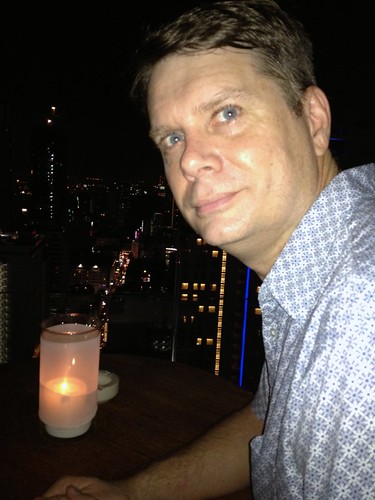
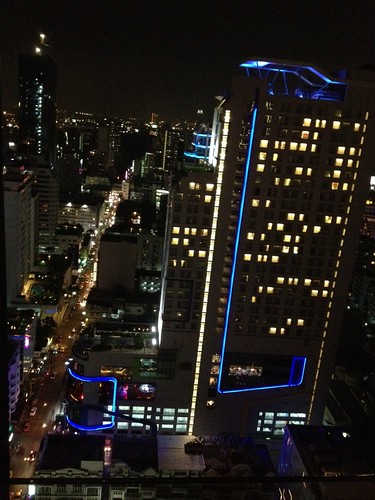
We loved Above Eleven, on the 33rd floor of the Fraser Suites hotel.
Here’s Tony, enjoying the view. Remember, I don’t have a camera. These are phone snaps.
Untitled

Bangkok is so quiet and pretty from up high!
Untitled

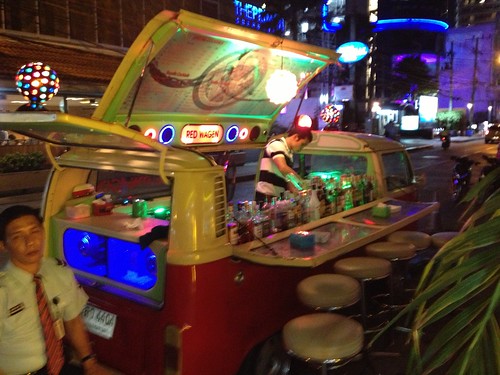
This street-level converted VW Bus bar was also very cool.
Untitled

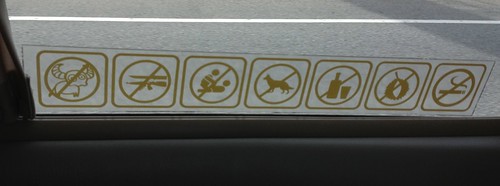
These stickers were in our taxi back to the airport on Sunday.
Untitled
As I wrote on FaceBook: Dang it, just when I was all ready for some post-coital durian fruit with a glass of whiskey and a smoke while petting my German shepherd and using a sword to whittle my initials in a big-horn sheep skull… How’s a girl supposed to have any fun in this town?

Just kidding, of course. We ALWAYS have fun in this town!

Tibetan spiritual leader tells students in search of peace: Just relax

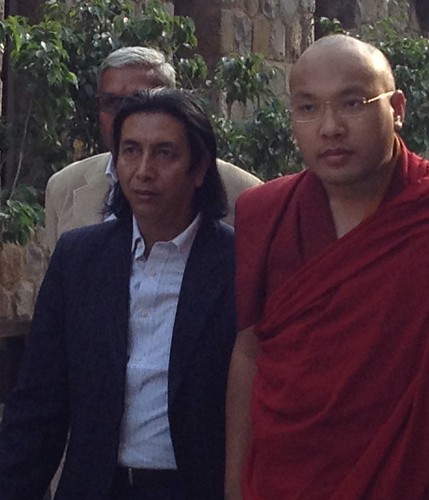
The most important Tibetan spiritual leader, after the Dalai Lama, visited our school today as part of our Peace and Global Citizens initiatives. His Holiness the 17th Gyalwang Karmapa arrived with little pomp and sat in the theatre, answering questions from students. Born into a family of nomads in Tibet, Ogyen Trinley Dorje was recognized as the 17th Karmapa as a young child. In 1999, at the age of 14, he left Tibet to meet the exiled Dalai Lama and other teachers in India.

According to the website kagyu.org,

In the case of an enlightened being, rebirths are taken consciously, motivated by a desire to benefit all living beings and made possible by the depth and clarity of an individual’s realization. The first such reincarnation (tulku) was recognized in thirteenth-century Tibet. His name was the Gyalwa Karmapa, “The Victorious One of Enlightened Activity.” Thereafter, he continued to return, generation after generation, until the present seventeenth Karmapa. The Karmapa is said to embody the activity of all the buddhas of the past, present, and future. Citing ancient texts, traditional histories trace his lives back for eons and continue it forward into the distant future.

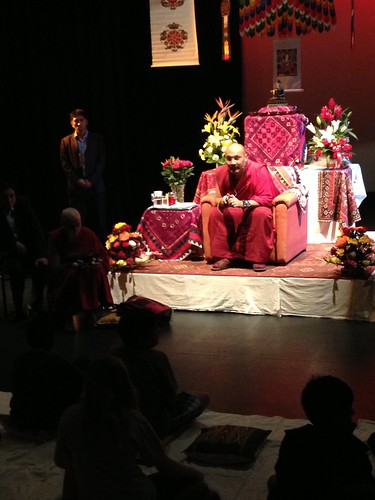
The Karmapa held several Q&A sessions with students from all grade levels; I attended his session with some middle school kids. The Karmapa leaned forward in his chair to address the students, carefully mulling over each question.

One student asked, “What is the most important value of the Tibetan culture?” The Karmapa responded in a low voice, interspersed with English words, and shared with the audience by a translator, Sister Damcho, an American who lives in a Dharamsala nunnery and frequently works with the Karmapa. “The life that we live is a pretty simple life,” she quoted. “We put at the center of our life altruism, the wish to benefit others. We’re pretty direct and straightforward. I think if you look at Tibetan culture, the most important values at the center of our culture are loving kindness and compassion, and we develop these feelings not just for other human beings but for all forms of life. Whatever we do, whatever activities we engage in, whatever studies we do, we always try to put the value of other beings in the center.”

He was open about neither choosing nor necessarily having fun in his role as Karmapa. In response to the question, “How did you decide to be a Karmapa?” he shook his head and laughed. “Decide?”
Sister Damcho translated: “So actually, I did not decide to be a Karmapa. In the west, people have a lot of choice and generally you decide what you want to study and when you finish your studies, you decide what job or career you want to have, but that was not the case with me. When I was 8 years old, I was just a normal boy. I played with other kids. I had a normal boy’s life. Then some people came and they told me, ‘You’re the Karmapa.’ At that time, I didn’t even understand what the Karmapa was … I thought, if I’m the Karmapa, I’ll probably get a lot of toys. I found out later being a Karmapa is not all that fun. It’s a lot of work and a lot of responsibility and a lot of studying. So becoming the Karmapa was not something I decided. It was more like something that just fell from the sky.”

My favorite bit of advice was the Karmapa’s response to the question, “What can we do to maintain peace?”
“We have so many different things that we’re constantly doing, and there are all these changes going on all the time, so it’s really not that easy, is it? I would say, to put it simply, just relax. Just relax and stay quiet. Generally speaking, this is a difficult question. For you, as kids, to be able to make peace, maybe don’t make it too complicated. Make it simple. Just relax.”

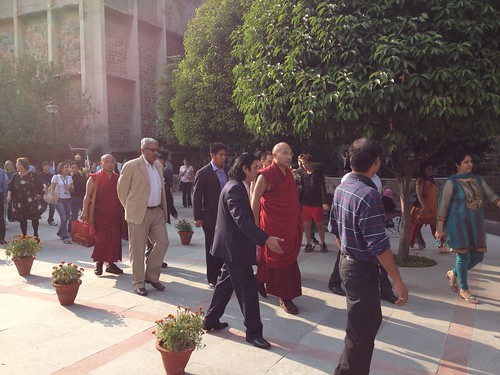
Arriving at AES, the Karmapa gets mobbed by the paparazzi (aka our director, principals and other interested onlookers).
Untitled

Getting escorted to the theatre.
Untitled

Untitled

Speaking to the students.
Untitled

I feel privileged and grateful today for my school and its commitment to fostering peace. What an honor to share a bit of time with this humble man.

Oh, say can you see … how weird Delhi is?

Not too far from my neighborhood, there’s a fab Japanese restaurant, Kylin, that offers an amazing deal on an upscale Sunday lunch. We celebrated my friend Nancy’s birthday at Kylin last weekend. As we gorged on tempura, satay, tasty salads and dim sum, we jammed to 80s rock, techno dance tracks, mellow flute-y tunes and other random musical selections blasting from their loudspeakers. Nothing distracted us from socializing … until THIS! As you can see, the Canadians at our table are thrilled. Peter tried to interject “O Canada” to no avail, and you can hear his daughter ask, “Is this their national anthem?” I’m sure the waiters thought a table of expats would appreciate the “Star Spangled Banner,” never mind their nationalities.
Just a typical day in New Delhi.

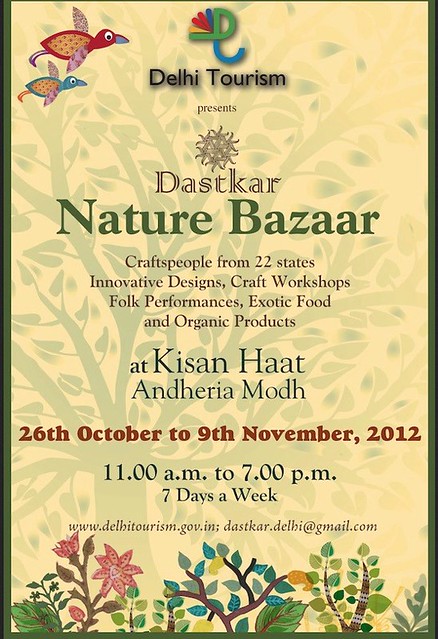
Dastkar Nature Bazaar – my first mela of the season

Woo hoo! It’s mela season in New Delhi!

“Mela” is a Sanskrit word meaning “gathering,” and it’s used to describe all kinds of get-togethers in India. One upcoming mela is the Kumbh Mela, held every twelve years. More than 60 million people gathered in January 2001, making it the largest gathering anywhere in the world, according to Wikipedia. I’m skipping that one for obvious reasons (although some of my friends are going). The melas I’m excited about are big markets of handicrafts, home decor, clothing, food and random tchochkes. I’ve even planned my parents’ visit to India around my favorite New Delhi mela in February.

Nearly everything produced in India stimulates at least one of the senses. Silky soft scarves, quirky colorful bags, organic oils and soaps, music for chillaxing, and all sorts of tantalizing treats. (Much of the time, India OVERstimulates our senses–particularly with sounds and smells–but the melas are much more pleasant than daily life. I’m digressing…)

This morning, I drove to the Dastkar Nature Bazaar (almost 10 kilometers, the farthest I’ve driven in Delhi so far, by the way) with my friend Nancy. We arrived just as the mela was opening, so we enjoyed a peaceful stroll through the booths. The Dastkar organization does good work in this country to support and promote Indian crafts.
Screen Shot 2012-11-03 at 5.52.00 PM

I still haven’t bought a new camera, and whenever I took out my phone to take pictures, I set it down at a booth and nearly forgot to take it. So eventually I stopped shooting. Anyway, here’s what I got.
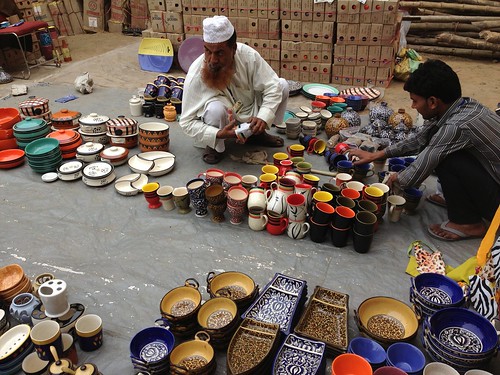
Pretty ceramics.
Untitled

Dangly things in a doorway seem to be good luck here, so you see them everywhere. I love them.
Untitled

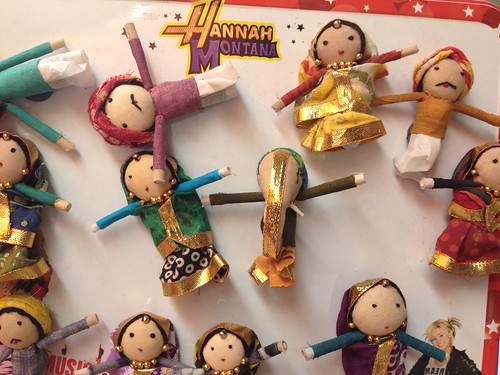
These little magnets of Indian men and women cracked us up, but we had an even bigger laugh when we saw they were stuck on a Hannah Montana board.
Untitled

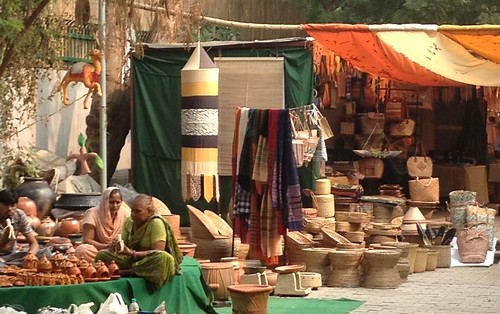
Vendors enjoying a snack.
Untitled

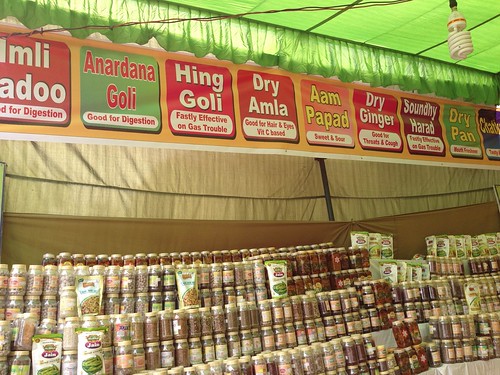
I spent a LOT of money at this booth. The dried fruit and other snacks are so delish! Does anyone need any Hing Goli?
Untitled

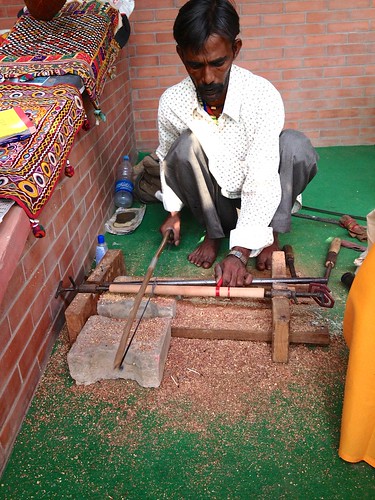
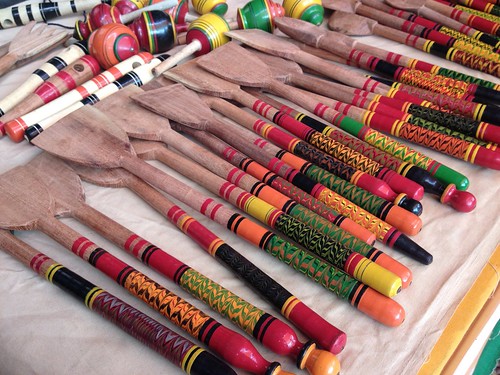
This guy demonstrated how to decorate wooden spoon handles with lacquer designs. He stuck the dowel in a little lathe and spun it with a sort of bow while rubbing lacquer on the wood. Every time I watch someone make something, I feel compelled to buy it. Savvy craftsman!
Untitled

Untitled

Nancy and I shopped so much, we had to make a trip to the car halfway through our mela circuit to unload some of our bags. Speaking of the car, getting out of the parking lot was no small feat. Let’s just say a tree, a tuk-tuk and a man sorting garbage were all involved. It worked out though, and with Nancy as my trusty navigator, I actually got us home with no problems.

The next mela is next week! Again, woo hoo!