Loving Life in Leh

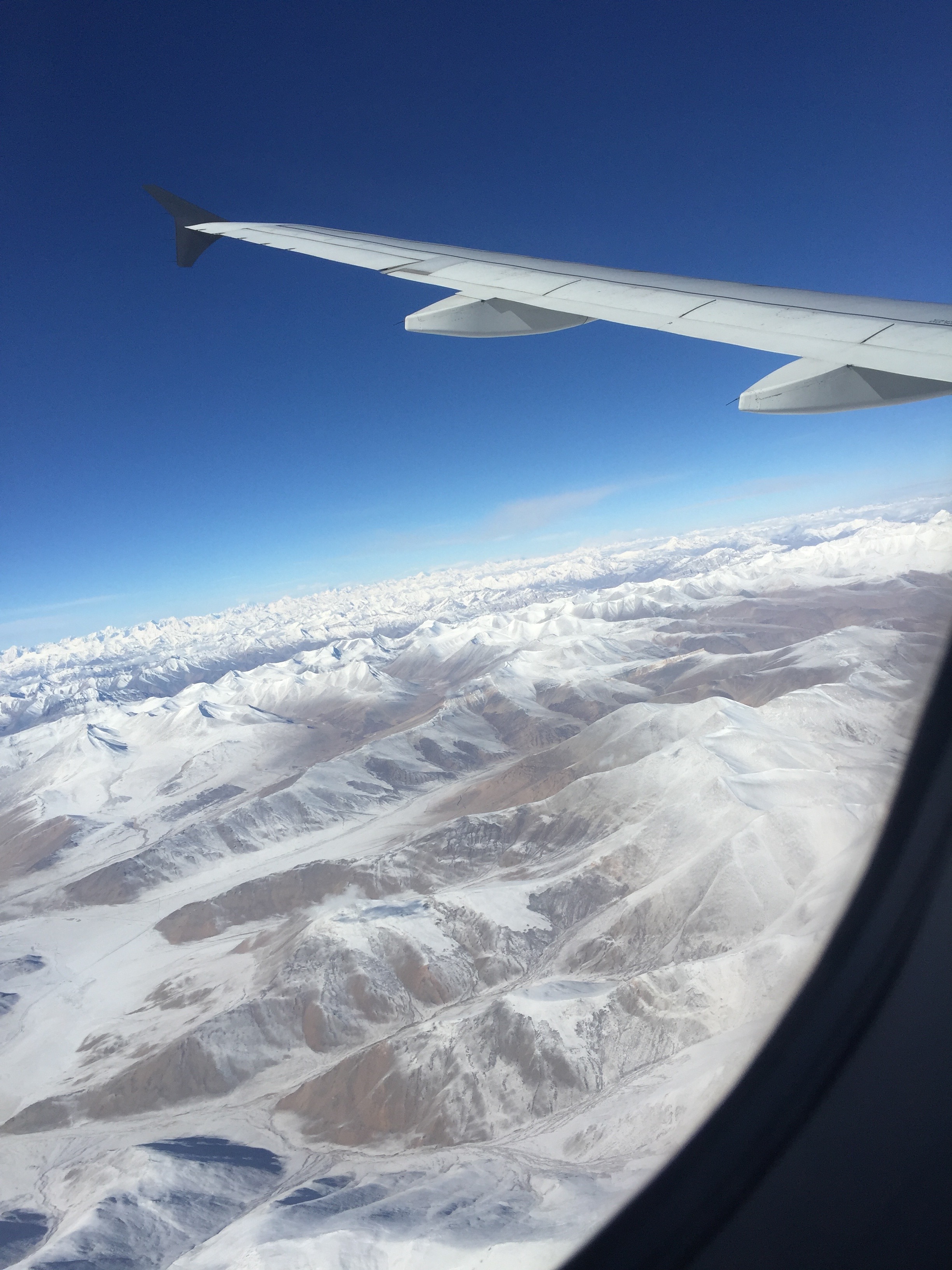
Leaving Delhi Wednesday morning, November 11, the smog was so thick one of the kids in our group asked, “Can the plane really take off in this?” Just an hour later, though, we looked out the plane windows at the snowcapped Himalayas and a sapphire sky.
IMG_1161

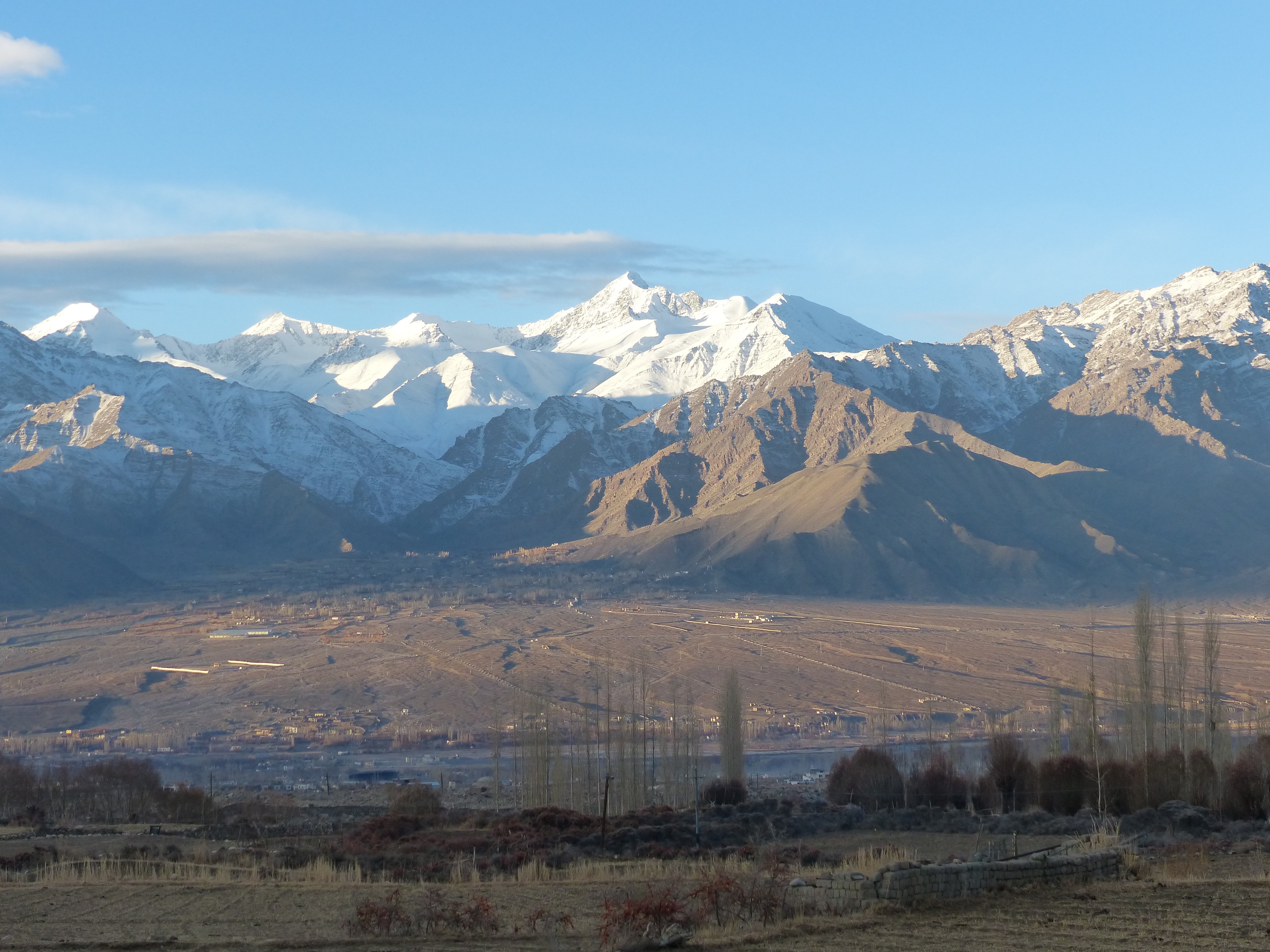
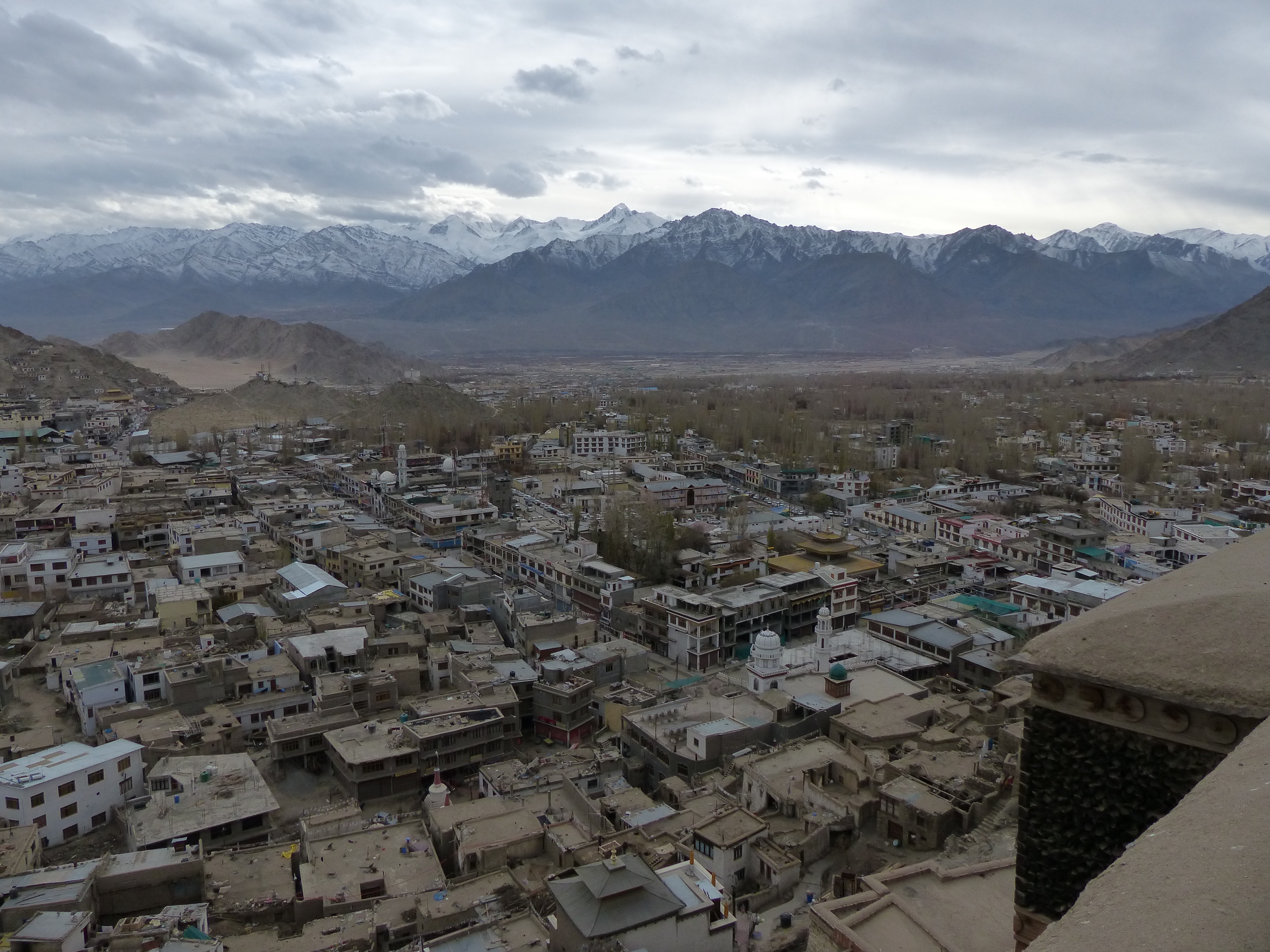
At Ladakh Sarai, our home for the next few days, we sucked in big breaths of fresh cold air and looked out at the horizon, where mountains rose up to the clouds. “What you see there is called ‘the distance,’” I explained. “It’s been a long time since we’ve been able to see into the distance!”

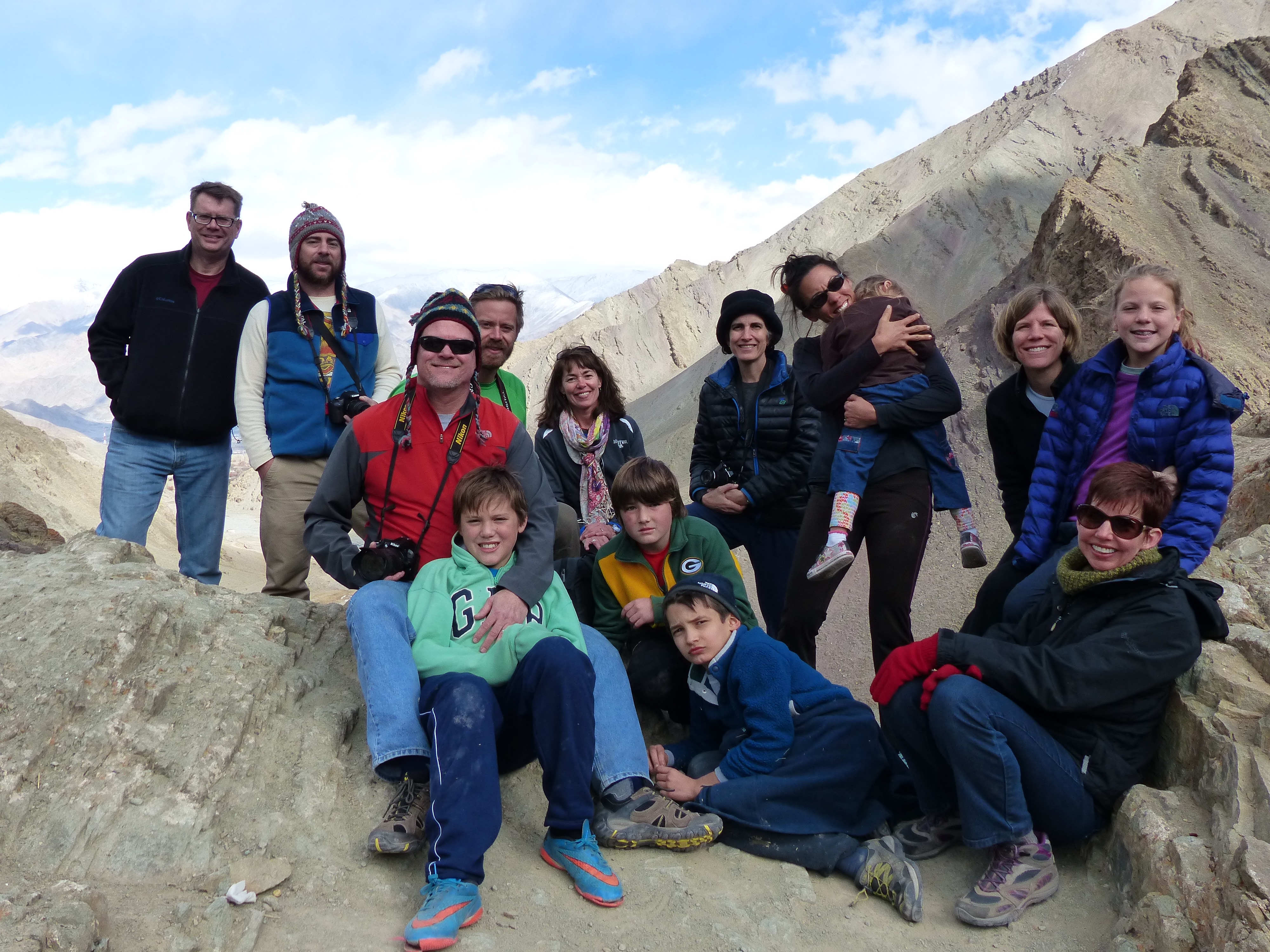
Tony and I were among 26 people – teachers and their kids – who traveled to Leh for the Diwali long weekend. Leh is the high-desert capital of the Ladakh district in the northern Indian state of Jammu and Kashmir.

The Ryder-Walker Alpine Adventures website explains:

Situated on the western end of the Himalayas, Ladakh has four major mountain ranges – the great Himalayan, Zanskar, Ladakh, and the Karakoram all passing through it. A maze of enormously high snow capped peaks and the largest glaciers outside the polar region dominate the terrain where valley heights range from 800 to 15000 feet with passes up to 20,000 feet and peaks reaching 25, 000 feet can be seen all around. Ladakh is also home to the world’s largest glacier outside the polar region, the Siachen.

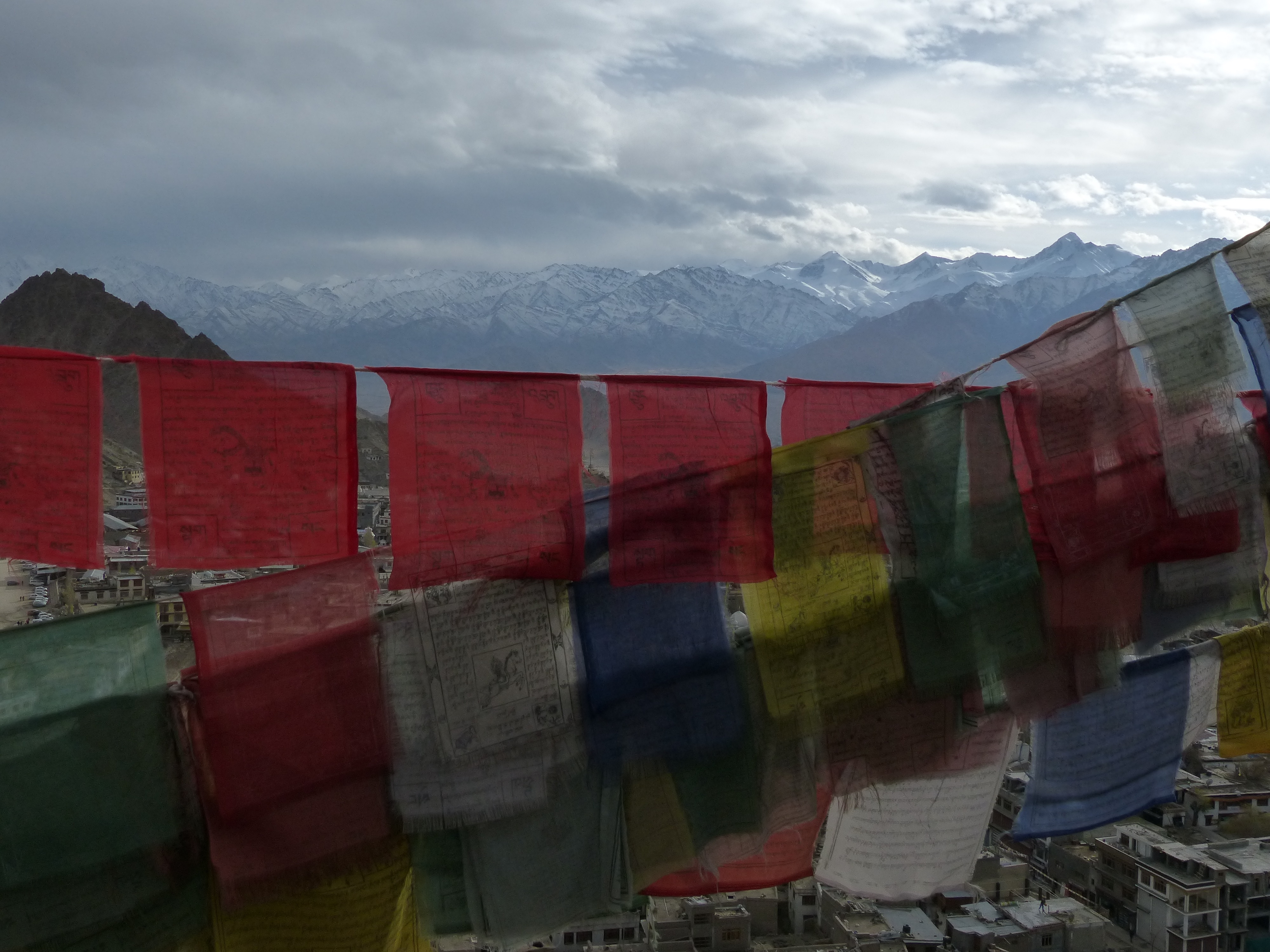
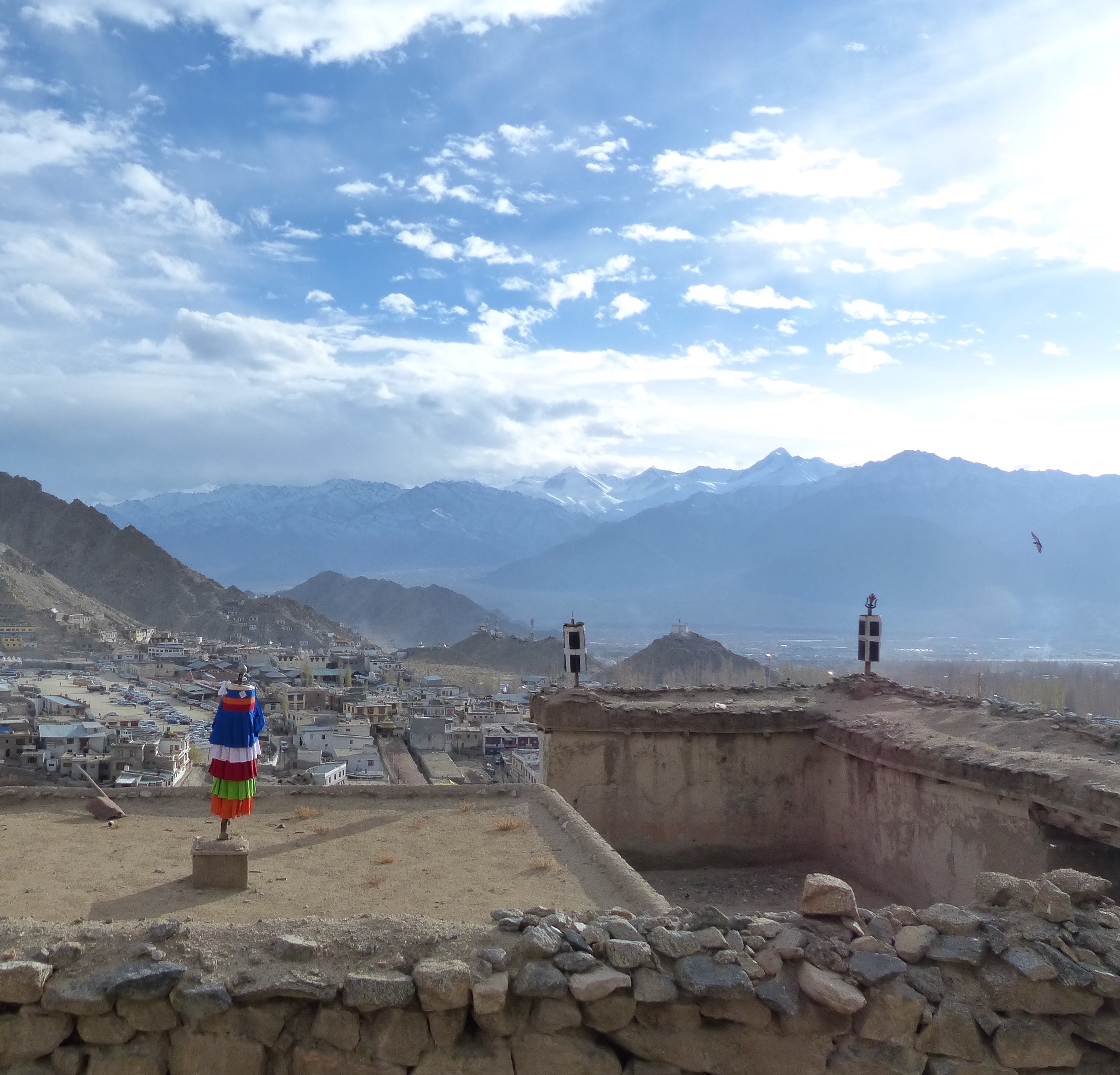
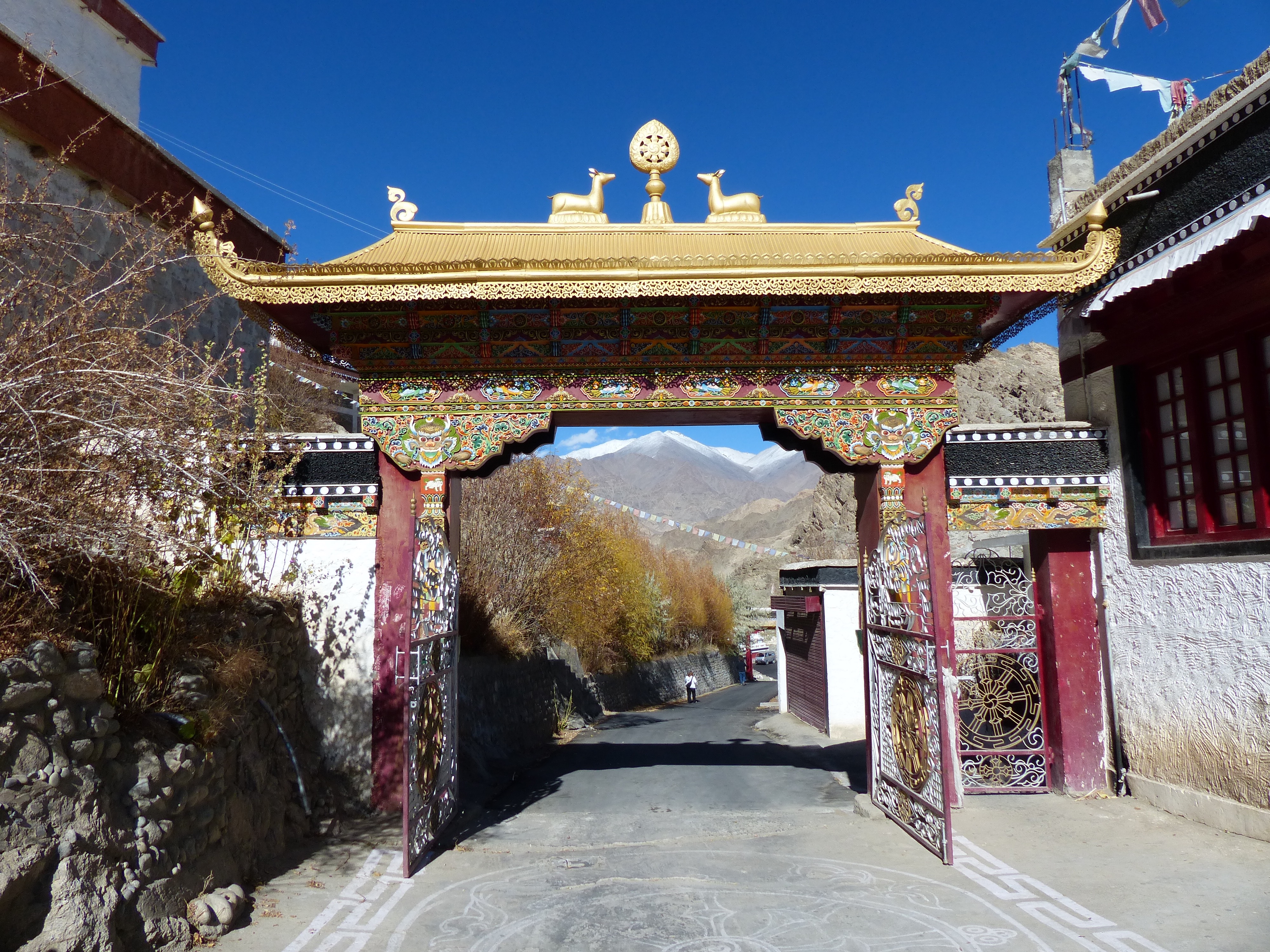
Known as “Little Tibet,” Leh definitely reminded me of my trip to Tibet in 2009 (see my Farewell China Tour posts). In fact, I kept forgetting I was in India. The Tibetan influence was evident in the architecture, temples, prayer flags strung from nearly every tall structure, language, and the smiley gentle nature of the people.

Most of us had taken Diamox, a drug for preventing altitude sickness, in the days leading up to our trip. Although my symptoms included a racing heart, tingly fingers and long stretches of lethargy, I didn’t feel the horrifying sensation that my eyeballs were about to explode, as I did in Tibet.

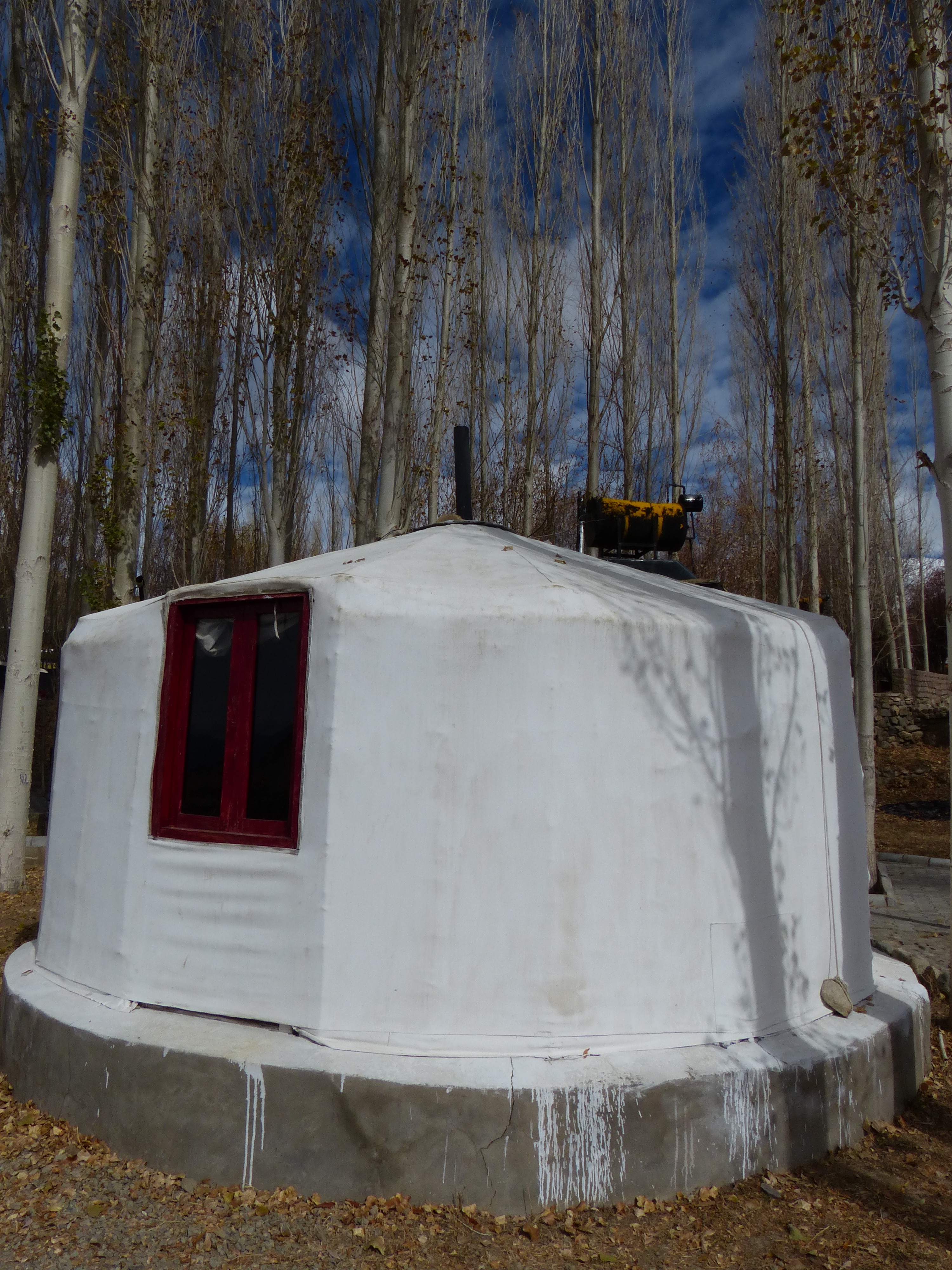
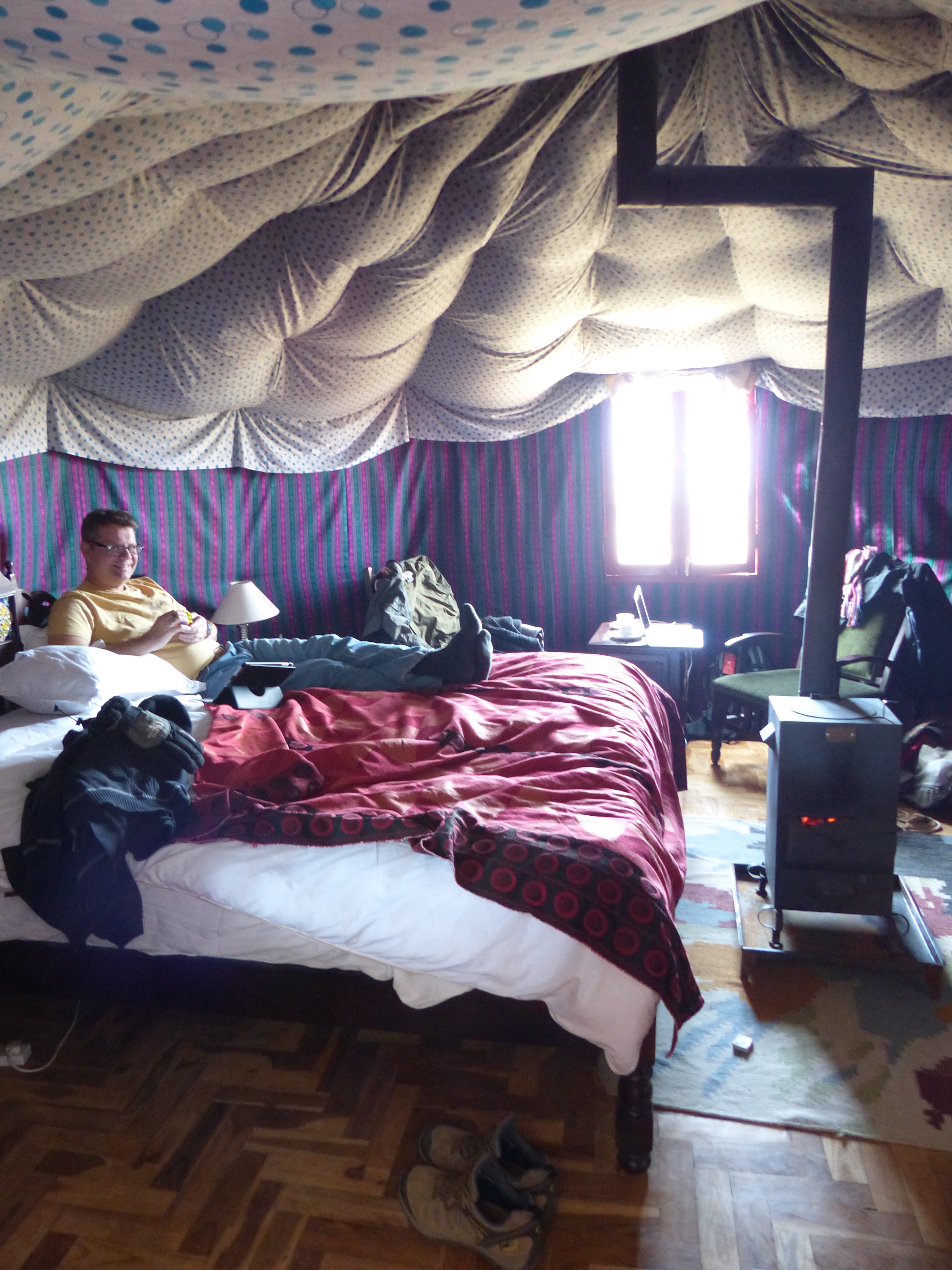
Tony and I were assigned a yurt at the edge of Ladakh Sarai’s property. Inside, pink and green woven cloth draped the bedroom walls, and beige fabric with turquoise polka dots billowed down from the ceiling and attached to the walls about 5 feet from the floor. The double bed was comfortable with a thick, heavy duvet for the chilly nights. A cabinet painted with colorful dragons and traditional designs held another blanket, just in case. A wood-burning stove sat in the middle of the room with a pipe carrying the smoke out a hole in the ceiling.

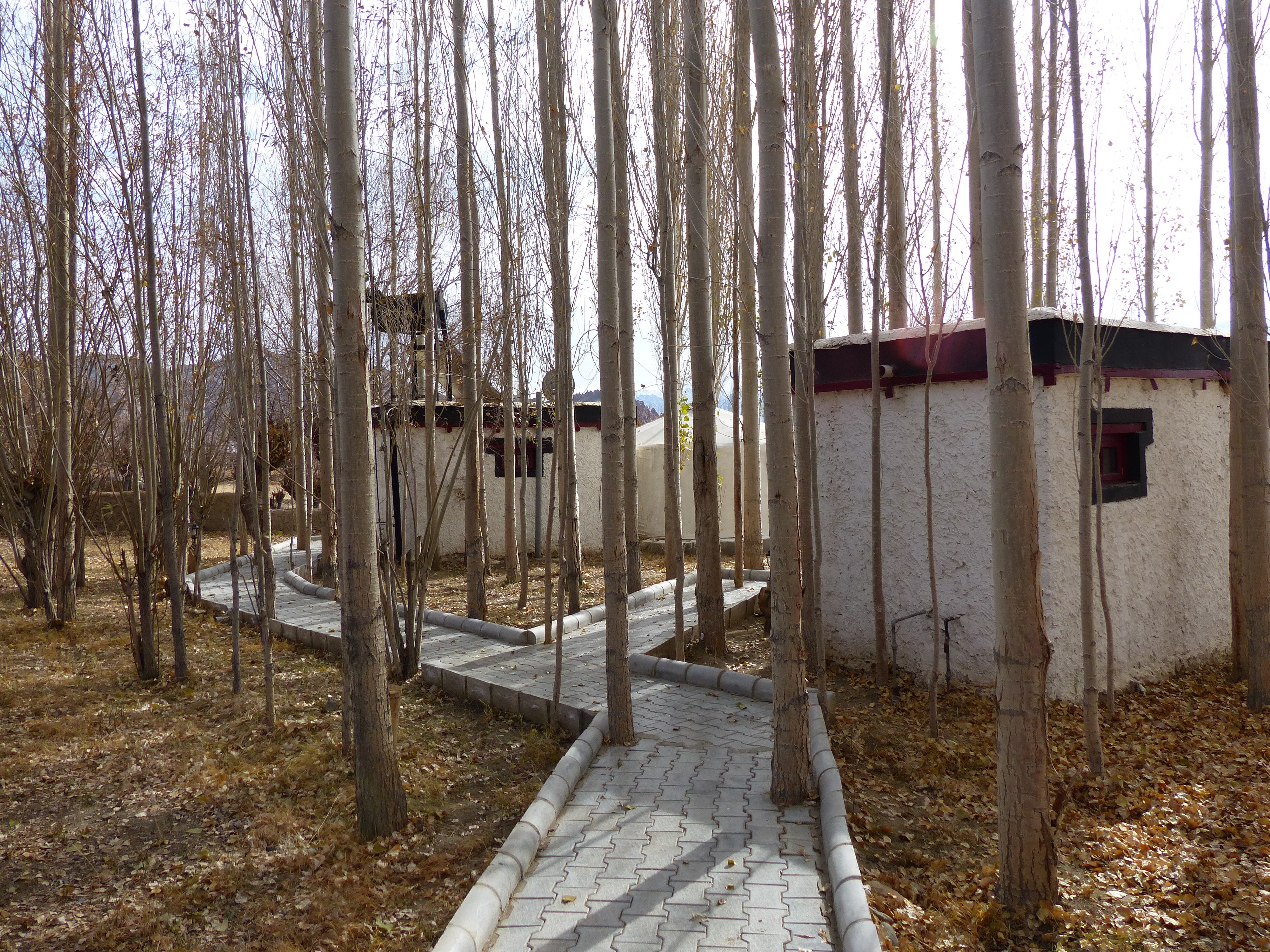
Entering the Ladakh Sarai camp.
P1070319

The path to our yurt.
P1070326

Honey, I’m home!
P1070269

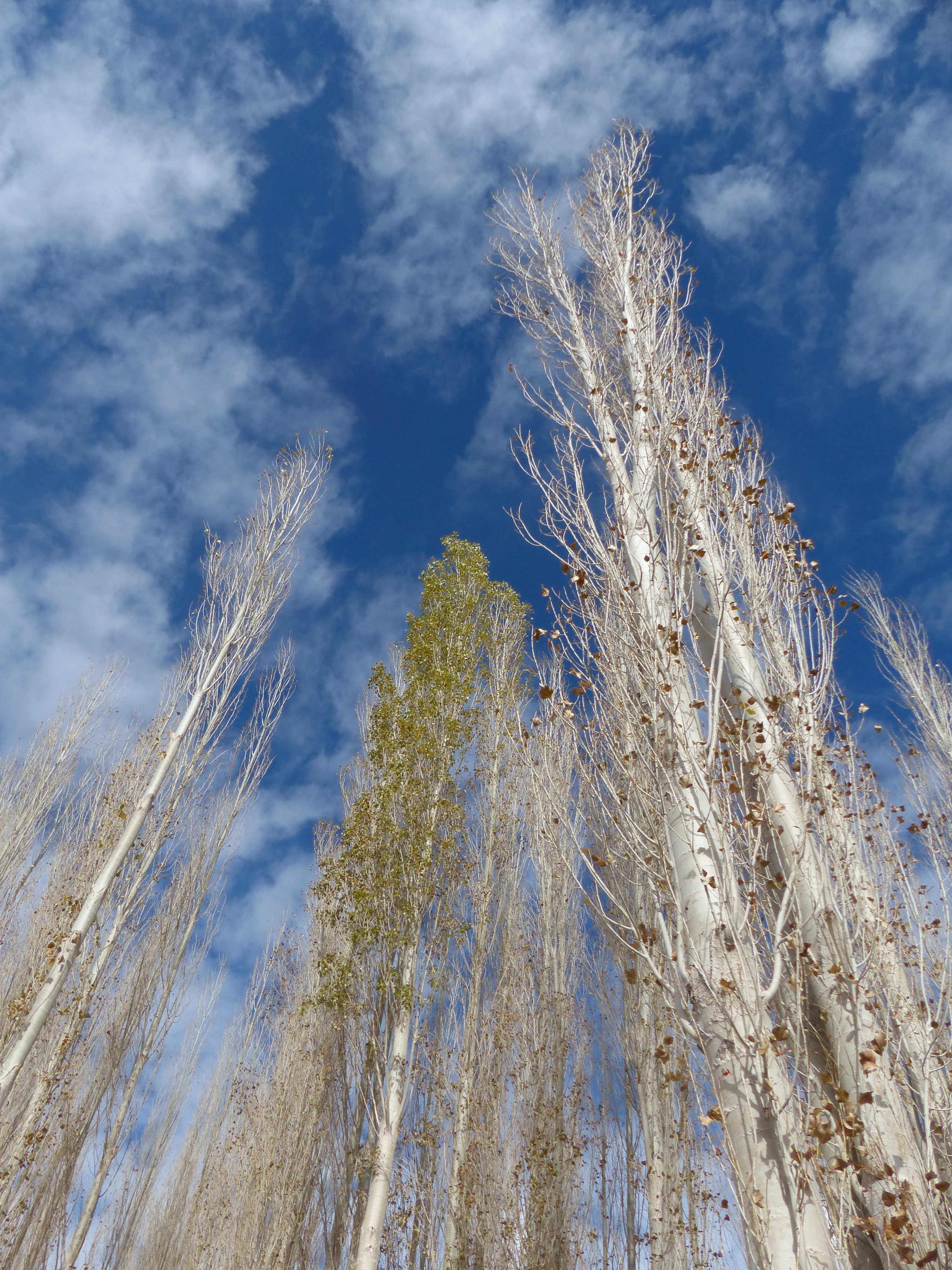
Looking up.
P1070267

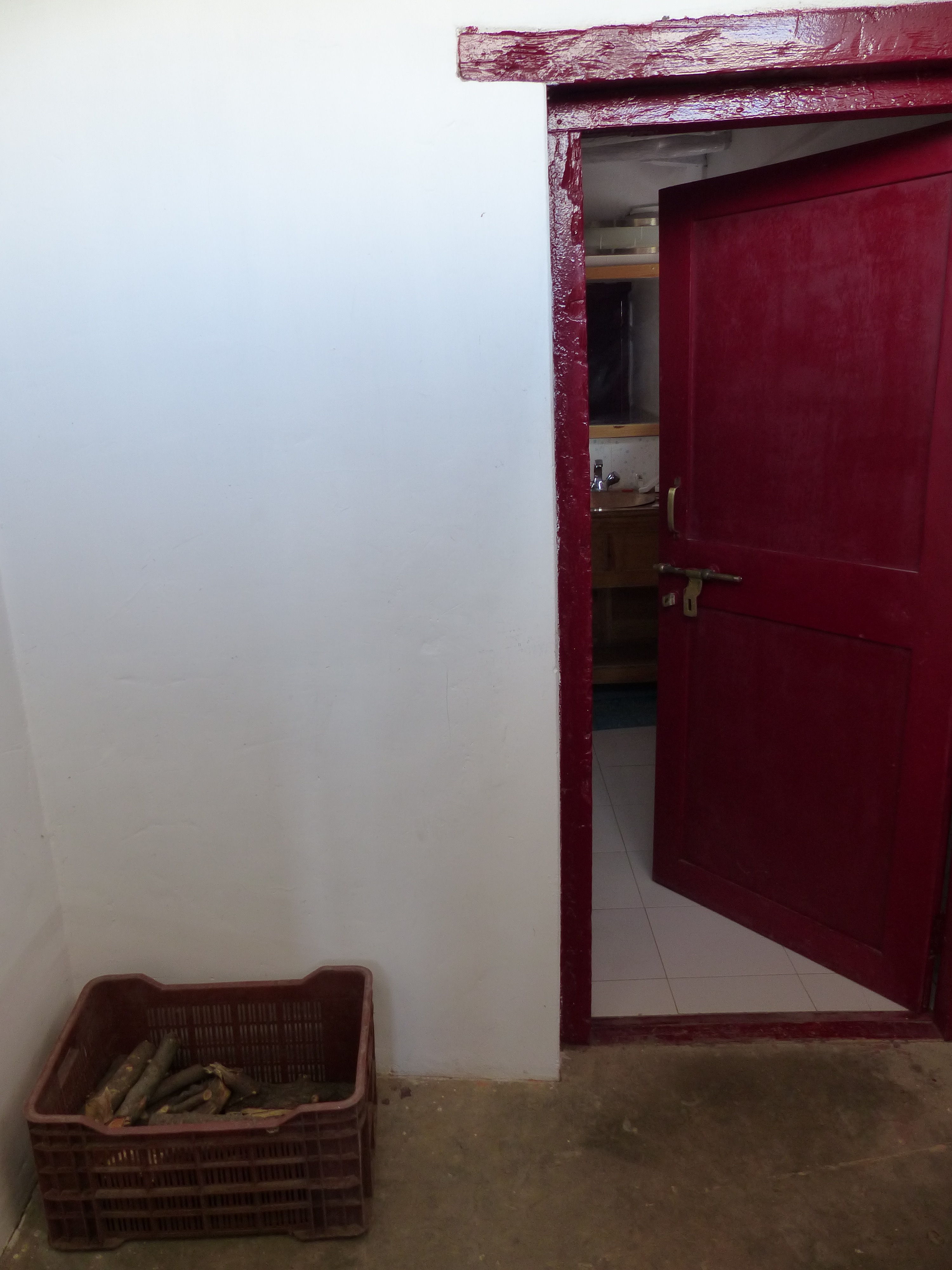
The “foyer” and entrance to the bathroom.
P1070332

Home, sweet home.
P1070334

The first night, we discovered the stove was not at all easy to regulate. It got the room cozy warm, then swelteringly hot, to the point where I had to get up in the middle of the night, strip off my pajamas and go into the adjoining icy cold bathroom for a few minutes. When the fire burned out in the early morning, the room turned frigid. Tony and I had watched the workers light our stove several times, and we thought we were doing exactly the same thing, but our fire simply wouldn’t stay lit. It flared up and then petered out after about 10 minutes. We used about a liter of kerosene and 73 matches, but we finally generated a big enough blaze to warm up the yurt for a couple more hours.

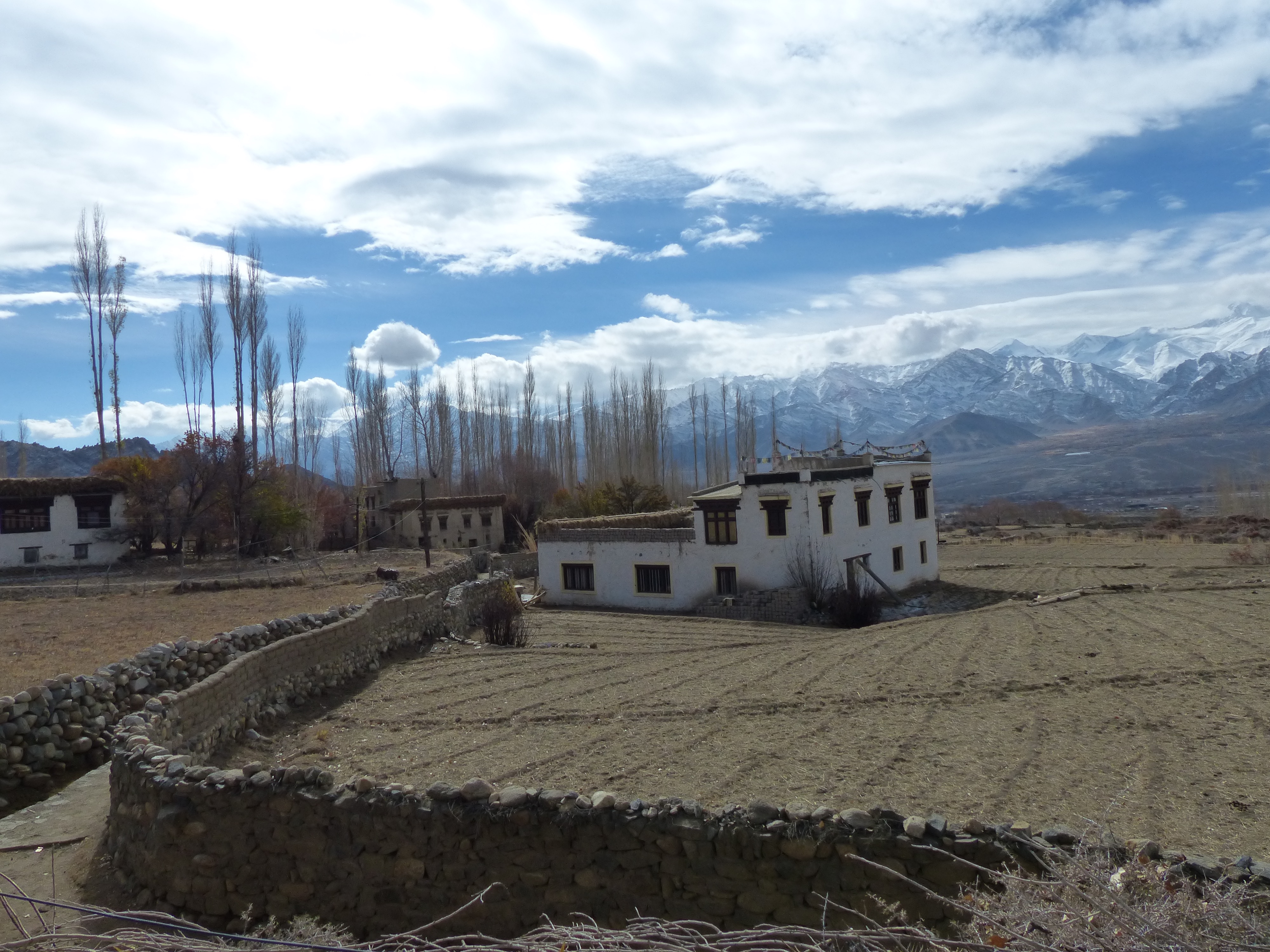
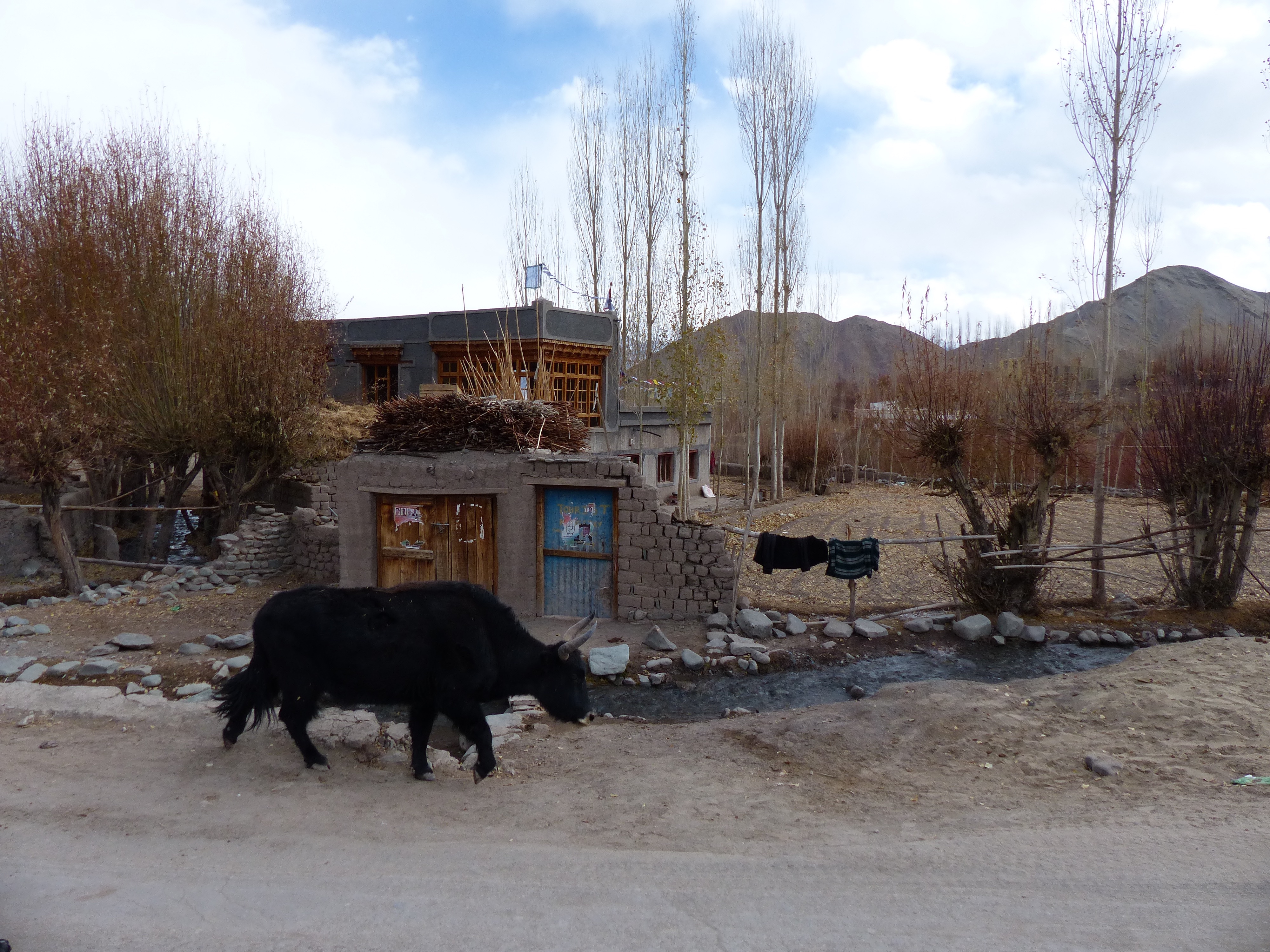
Our yurt overlooked a neighboring farm with terraced fields strewn with straw and a lone black yak. Tibetan prayer flags fluttered from the farmhouse rooftop. The land sloped gently down to a treeline, beyond which the town of Leh nestled in the valley. From our bed, we could watch the morning sun glitter on the snowy mountaintops, turn the barren rocky hillsides a warm gold, and then slowly creep toward us, brightening the valley, then the farm and finally creeping up and over the mud-brick wall to our yurt.
P1070264

P1070329

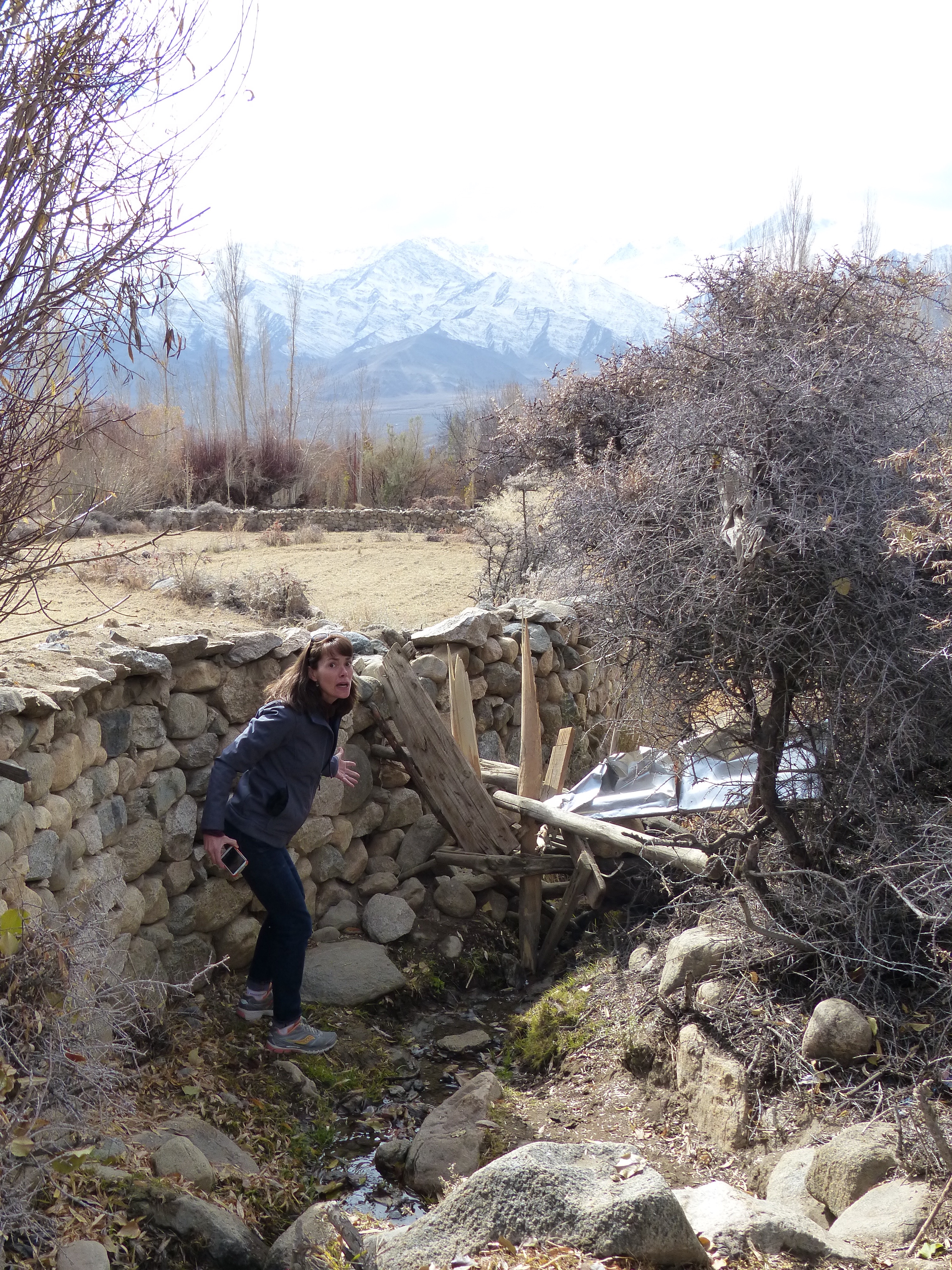
On our first day in Leh, Sarah and I took a quick walk around the camp’s perimeter. Sarah was hoping to pet the yak, but alas, the farmers had constructed a serious blockade.
P1070286

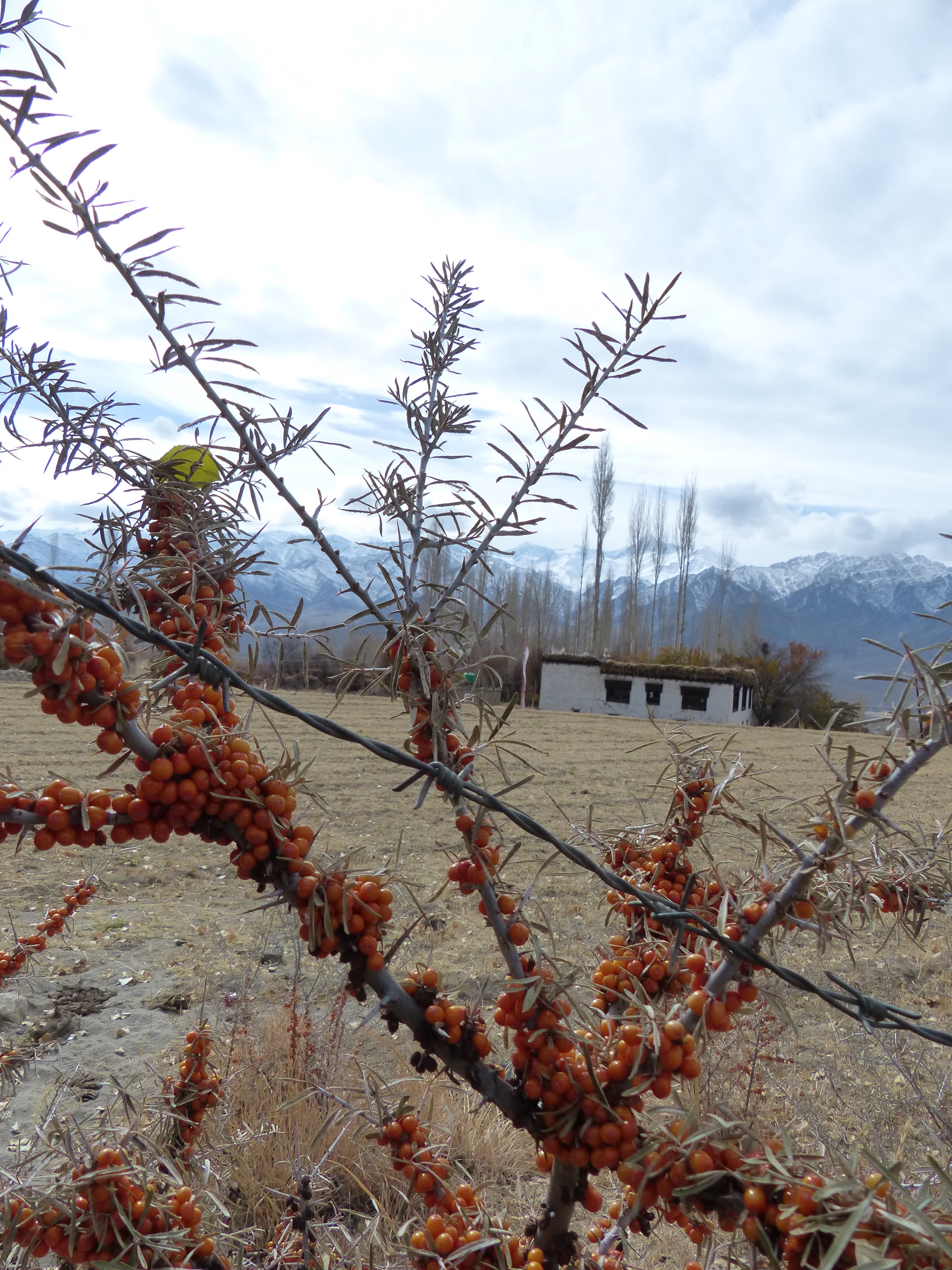
I loved the contrast of these orange berries against the brown-ness of everything else.
P1070307

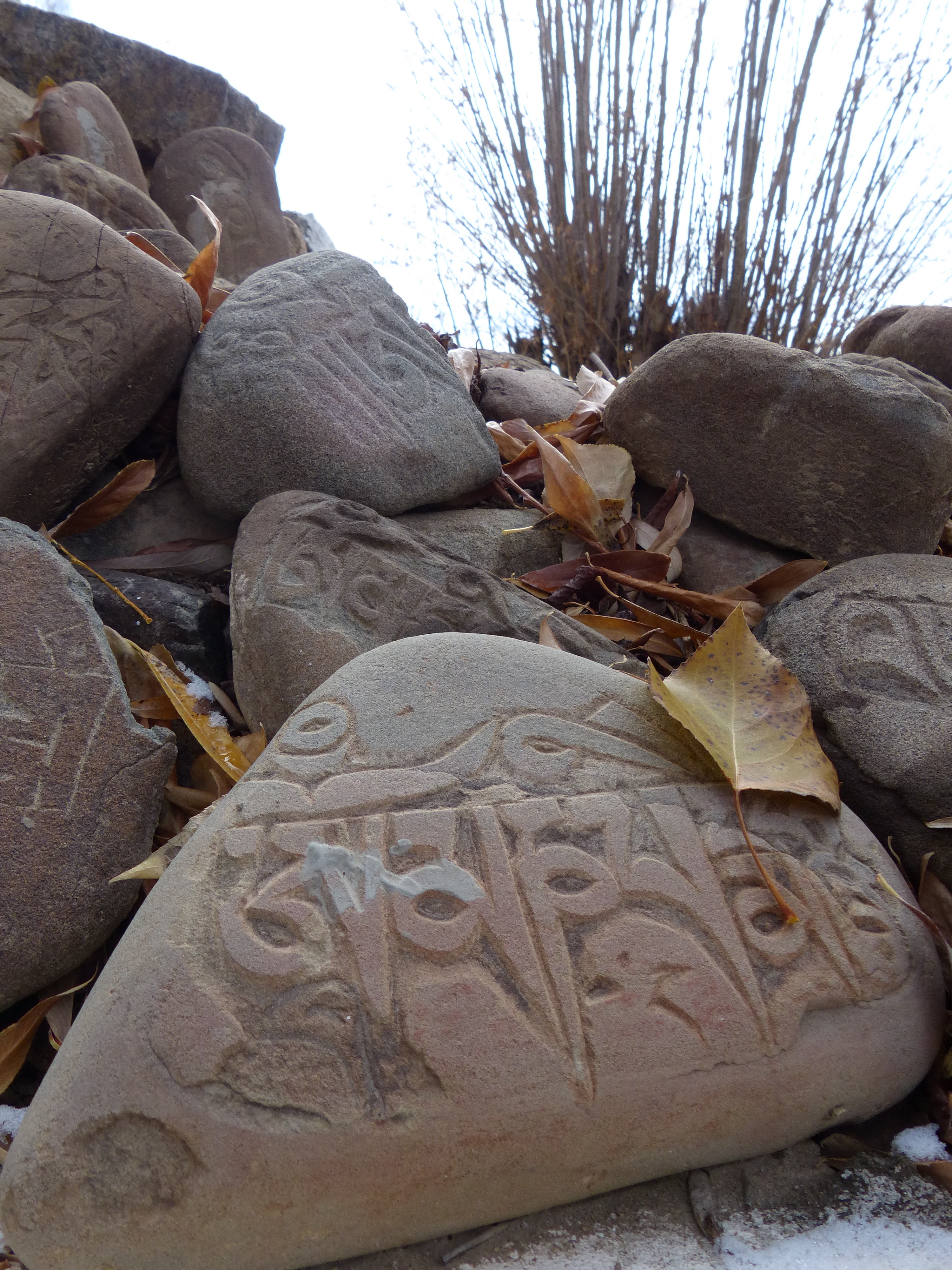
We found a small “mani wall” with prayer stones.
P1070288

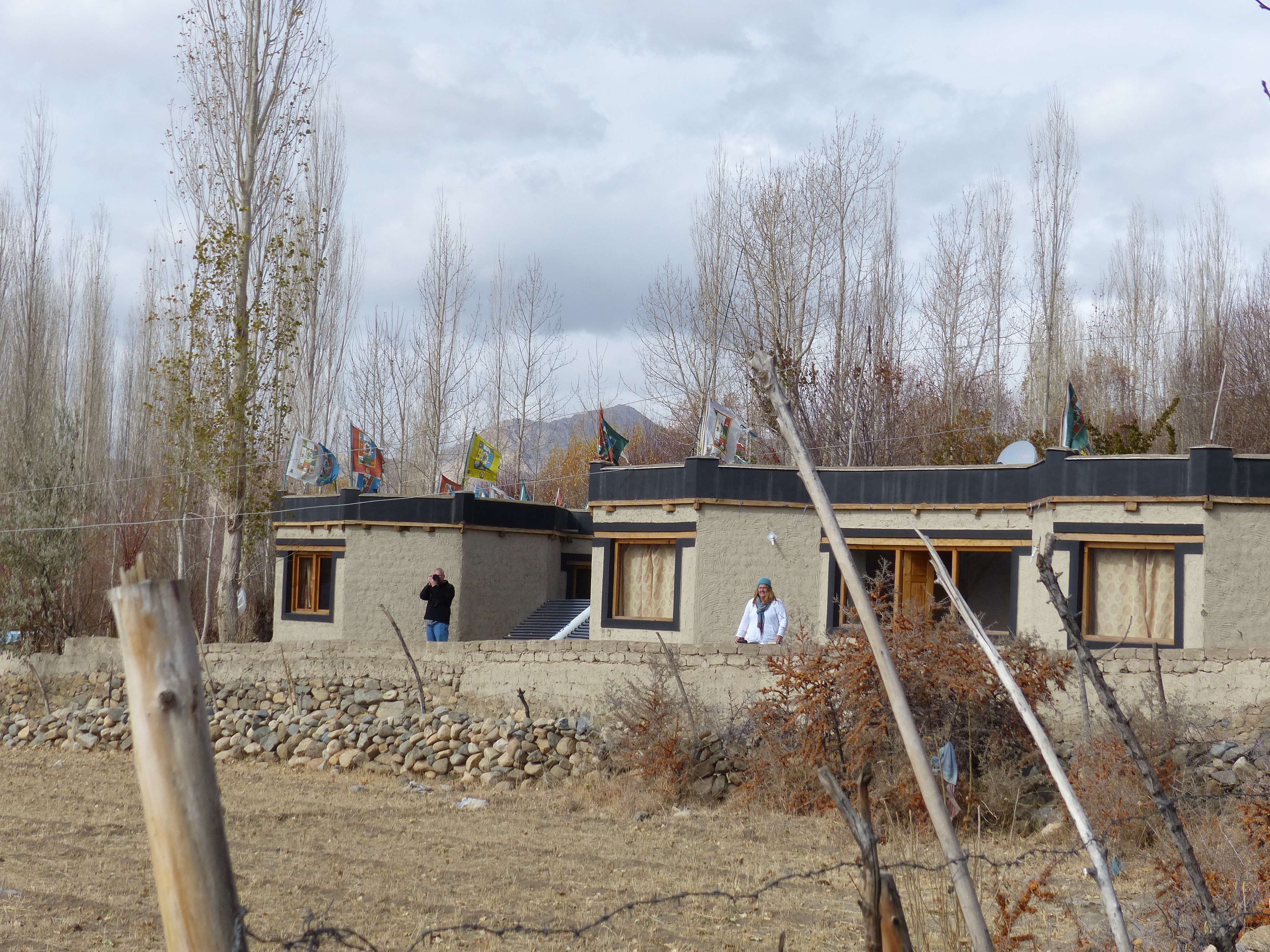
Looking back on our camp, where Kevin and Beth were hanging out in front of the duplexes.
P1070282

Later, Sarah, Emma, Tony and I started off in search of “the village.” Following the advice of a Ladakh Sarai worker, we exited the gate and turned right to walk uphill. We crossed a metal bridge over a riverbed with only a rivulet of water rushing through. We saw signs of high water and past flooding, though, as well as efforts to contain the banks with blankets of chicken wire and intentional rerouting of the water through a smaller channel down the center of the rocky floor.

We had only walked about 10 minutes when we reached a fork in the road. To the left, a large group of villagers were doing some kind of work with shovels and mounds of soil. We hesitated to walk through them, so we considered taking the road to the right. Sarah asked a man, “Which way is the village?” He pointed toward the workers. “Saboo Village.” Sarah pointed to the other road and asked, “Is there another village?” He laughed and pointed in all directions. “Nothing village,” he said. So we ventured into the crowd.

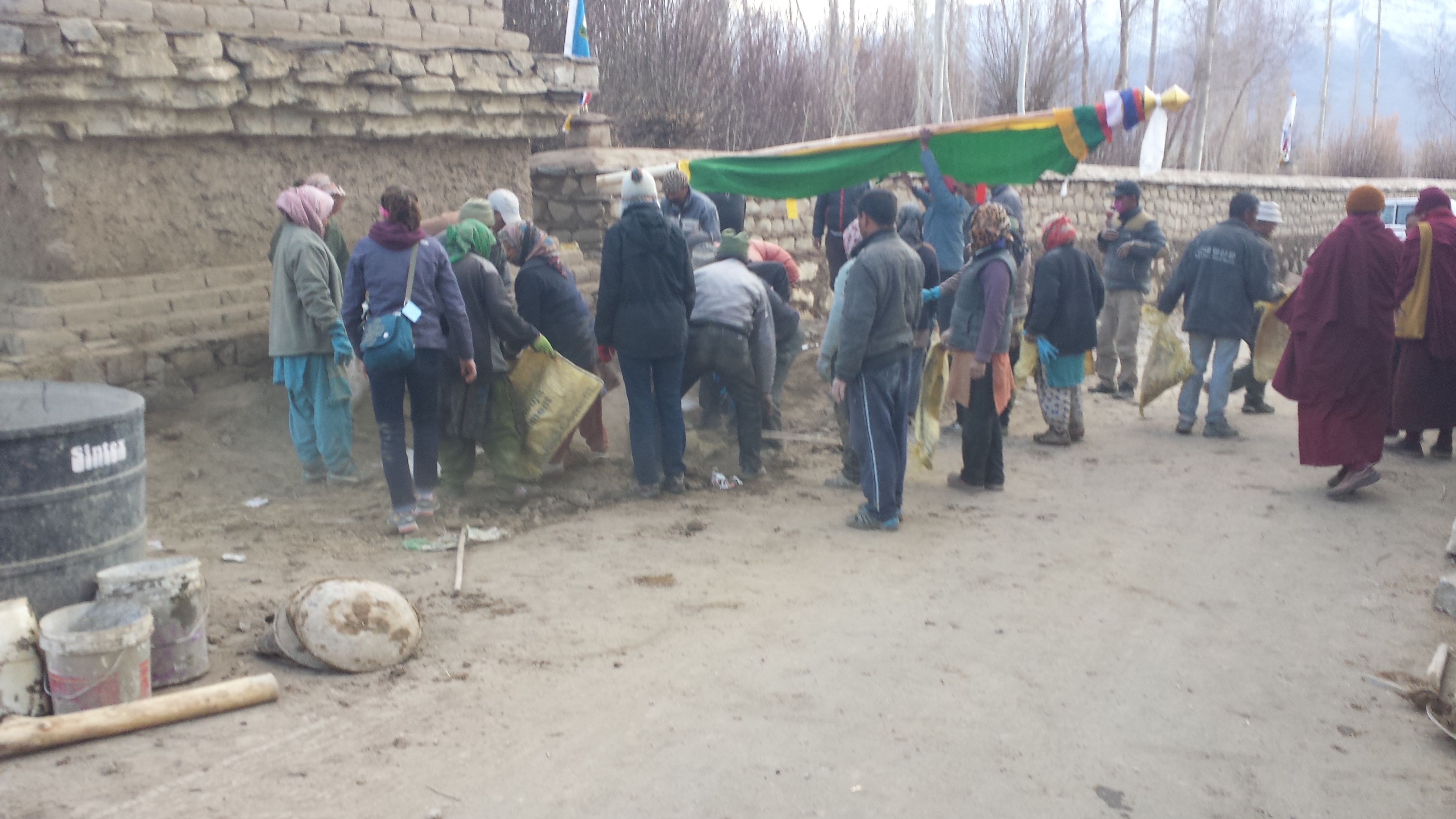
The workers smiled at us as they shoveled soil into piles on the right side of the road next to a tall wall. At the uphill end of the wall was a small stupa made of mud bricks, topped with a pole and a prayer flag. The workers had clearly just built a reinforcing wall out of mud bricks, about 4 feet high, at the base of the taller wall. Upon closer inspection, we saw the top half of the wall comprised large smooth rocks inscribed with the mantra “om mani padme hum.” The website Dharma-Haven has a nice explanation of that complicated mantra.

We paused to watch them work for a moment, and soon a lady called out to me, “Tea?” At first I declined, but then the whole group stopped working for a tea break, and we decided to join them. They kindly served us cups of chai and crackers for dipping. As soon as everyone finished their tea, they got right back to work. It seemed only fair to pitch in. The ladies grabbed empty rice sacks from a bin, threw them down on the ground and waited for the men to shovel some soil on top. A woman would then pick up either end of the bag and carry it to the far end of the wall to heave the soil onto a big pile. Sarah and I each found a partner and hauled a few bags of soil. “Very good!” one lady said to me after we dumped our load. Everyone sang as they worked, a tune simple enough that we could somewhat follow along, although we didn’t know what we were singing.

As we mingled, Emma took some photos with Sarah’s phone, and Tony chatted with a young man whose foundation had organized this volunteer effort. Sonam Wangchock, founder of the Himalayan Cultural Heritage Foundation, told us village elders say the wall is more than 300 years old. Heavy rains had eroded much of the base, threatening to topple the whole thing. He explained that Buddhists come to pray, making the traditional circumambulation on the path circling the wall. The extra soil was moved off the road to protect it from passing vehicles, he noted. It will be used to make plaster in the spring, when volunteers return to plaster over the mud bricks and finish the work they started on the historical wall.
20151111_165613

20151111_170519

See more photos at the HCHF’s Facebook page.

Back at Ladakh Sarai, everyone was hanging out in the communal building, made up of several connected round rooms – two for dining and two for lounging, as well as a few other small work spaces. The dining rooms had trapezoidal tables painted with lovely Tibetan designs and lined up so everyone could sit on the perimeter benches and face each other. The two lounging areas featured wood-burning stoves in the middle, surrounded by cushions or sofas. Such a comfy spot to play cards or chat while sipping a hot ginger-lemon drink.

Breakfast and lunch were served buffet style from a low stove in the center of the communal yurt. Dinner, on the other hand, was an elegant affair with candles, pleated napkins and metal trays in lieu of plates. The waiters brought course after course of delicious Western and Indian food.
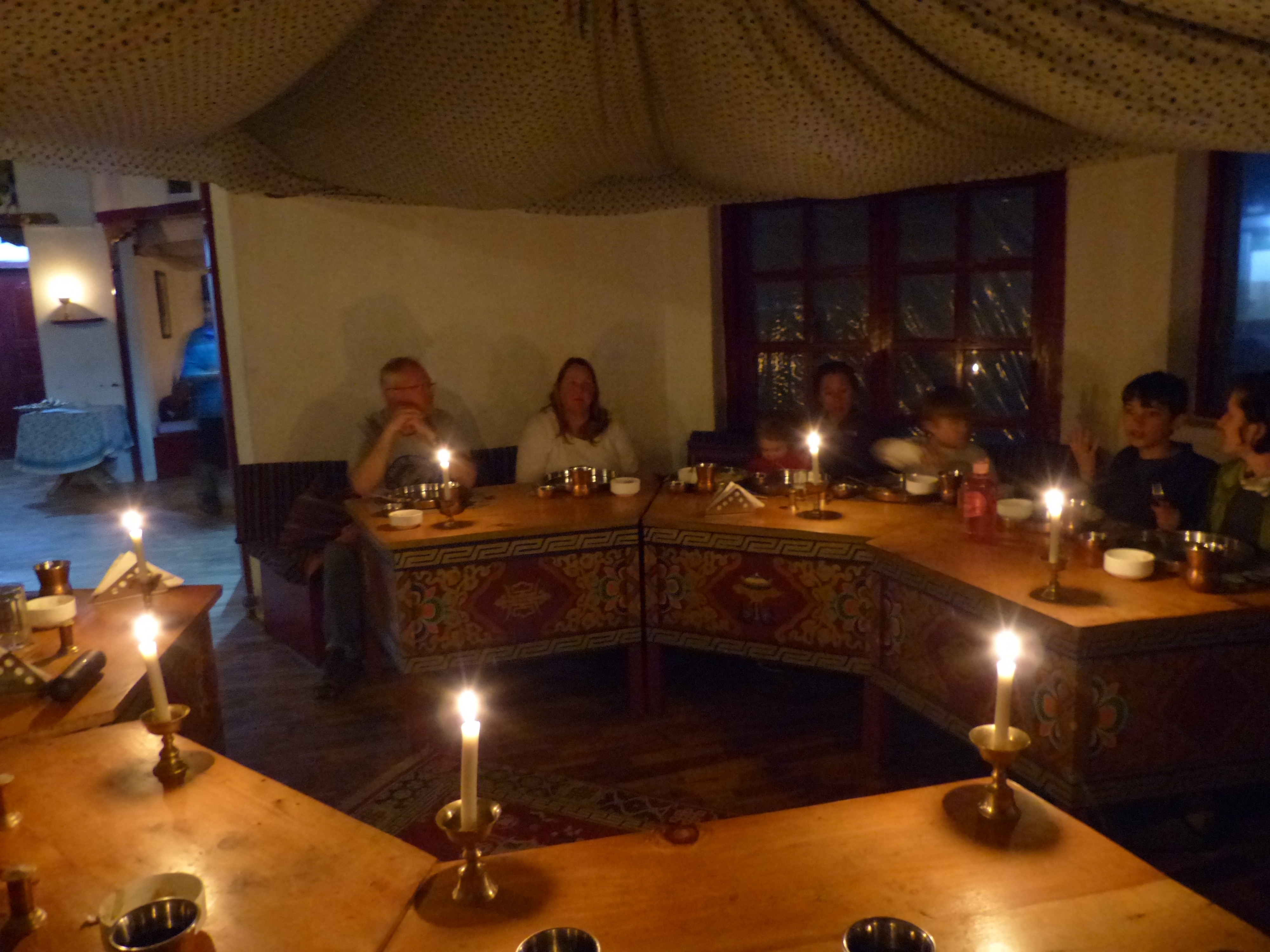
P1070527

One night, we all sat around a fire outside, roasting marshmallows and playing games.
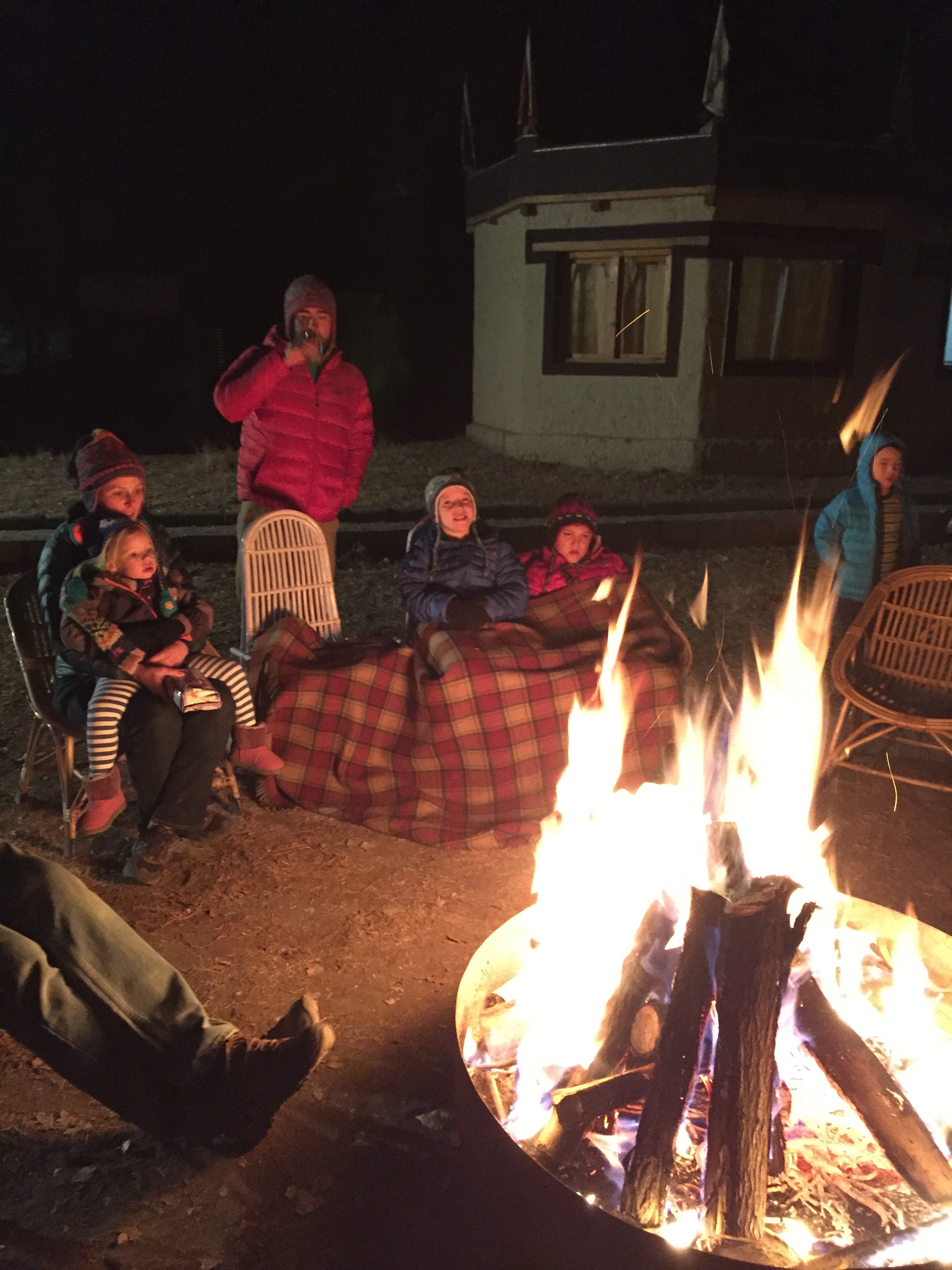
IMG_1162

Day two in Leh, we all piled into vans to visit the Tibetan market in town and Leh Palace. After 15 years in Asia, there’s not much that Tony and I haven’t bought at one time or another. Still, it was fun to poke through the piles of toasty yak wool blankets, cases of silver jewelry, Tibetan handicrafts, and knock-off name-brand bags and clothing. We filed up several flights of stairs for a lunch of soup and momos (dumplings), and then headed to the palace.

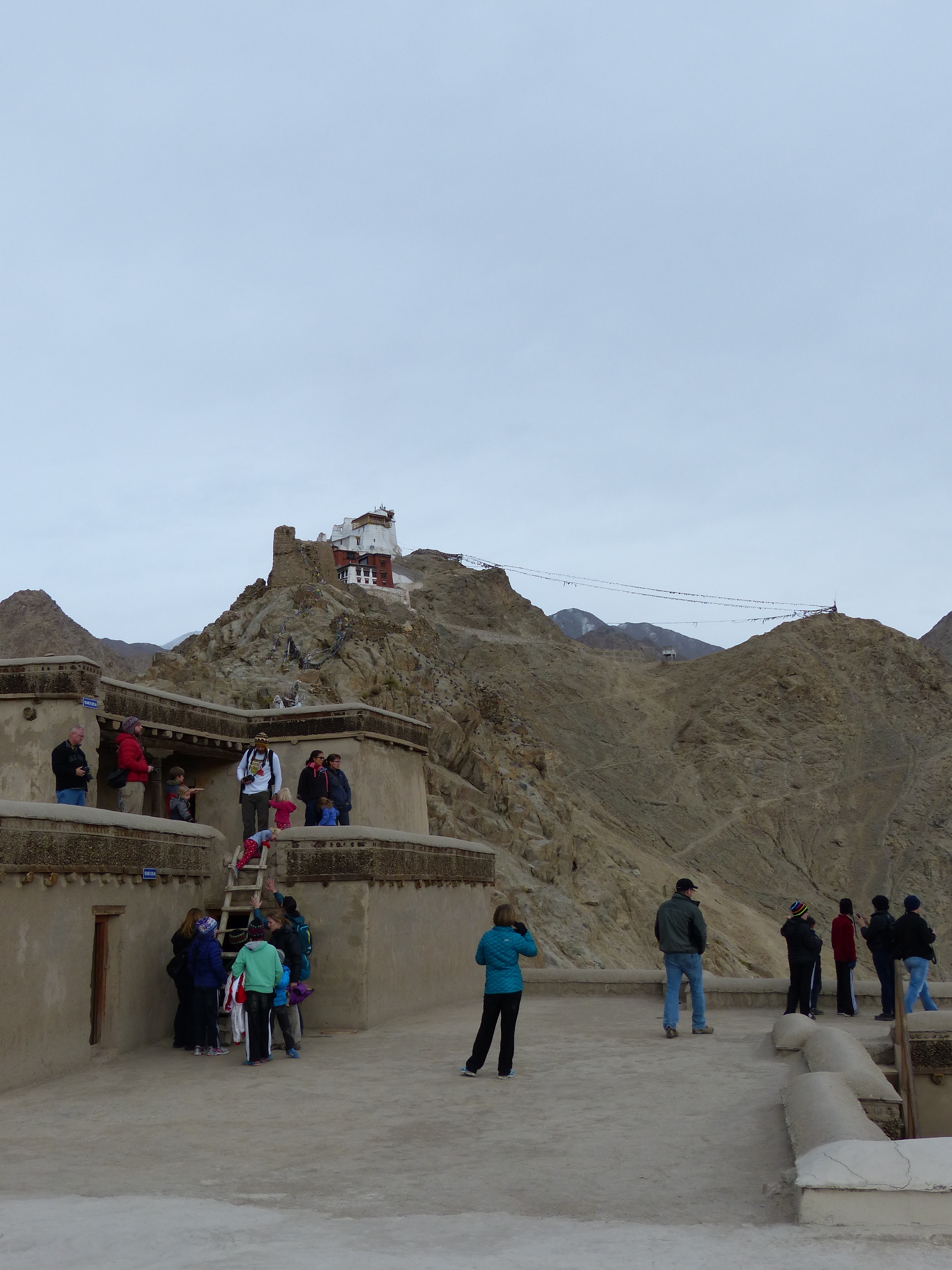
According to the book Ladakh – The Complete Guide by Nicholas Eakins, Leh Palace was constructed “using traditional Ladakhi methods, with dried mud-bricks constituting the upper levels, and the lower levels constructed on a natural plinth of stone using rammed earth, stone and timber,” and the walls slope inwards for additional strength. A sign outside the 9-story palace said construction started in 1553 by Tswang Namgyal, founder of the Namgyal Dynasty, to be a miniature version of Potala Palace in Lhasa, the capital of Tibet. At the very top, we could see faded painting, which made me wonder whether the whole place was once brightly painted. Today, it’s mud colored and very cold, dark and dusty. If I were queen back then, I think Tswang would have heard a lot of complaining.

Nyla photobombed our palace pic.
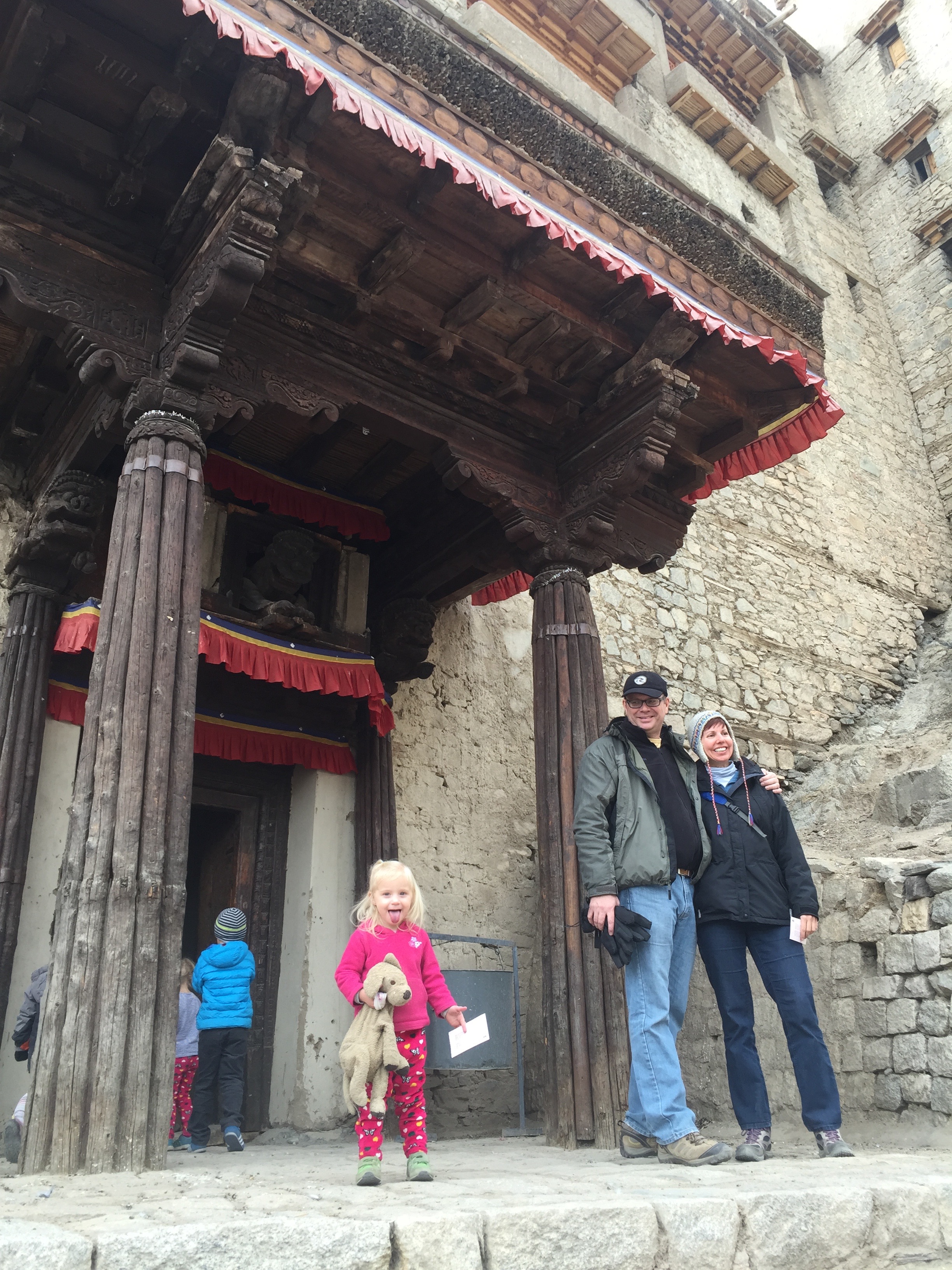
IMG_1758

P1070348

P1070359

P1070361

P1070350

P1070365

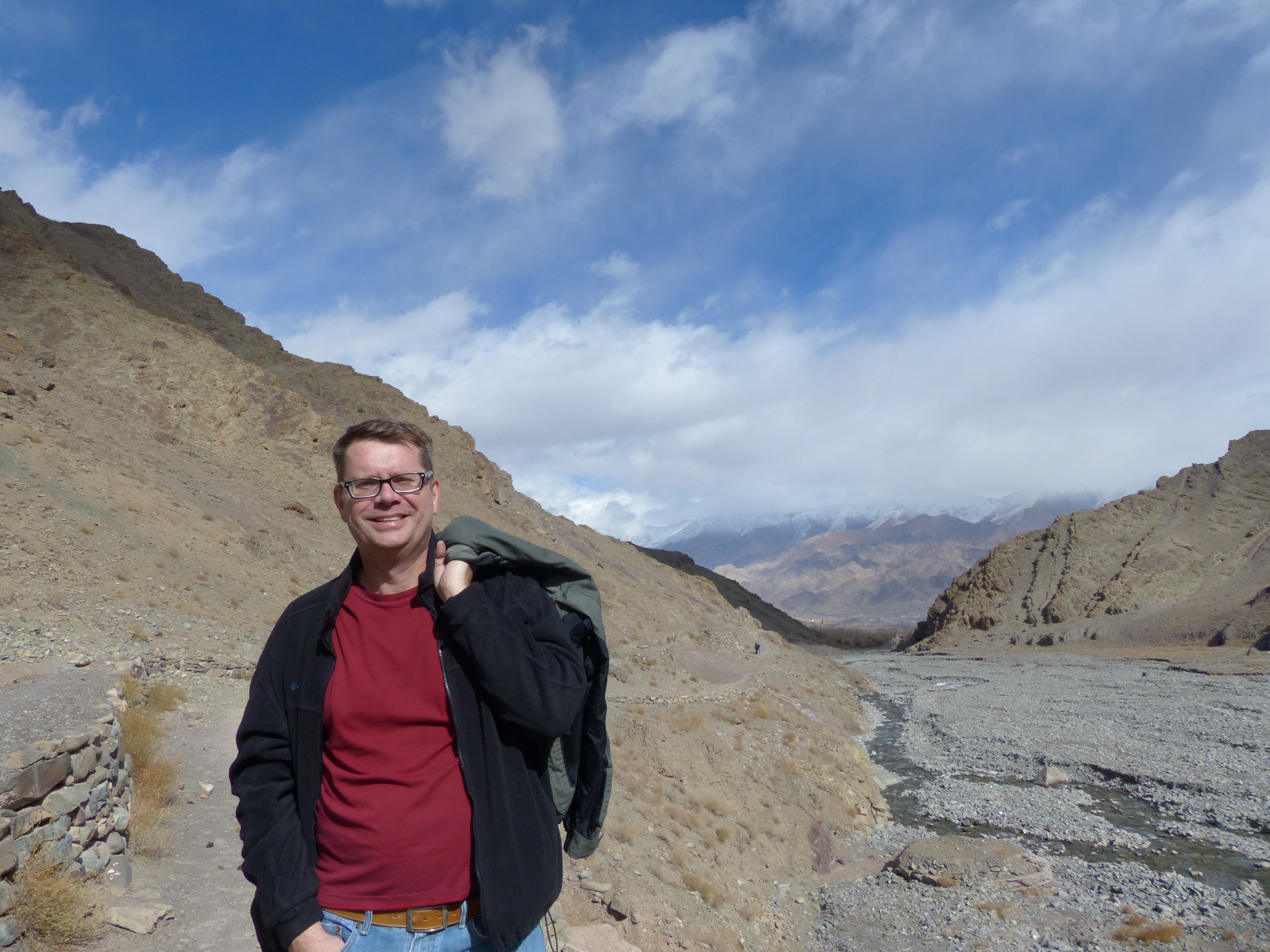
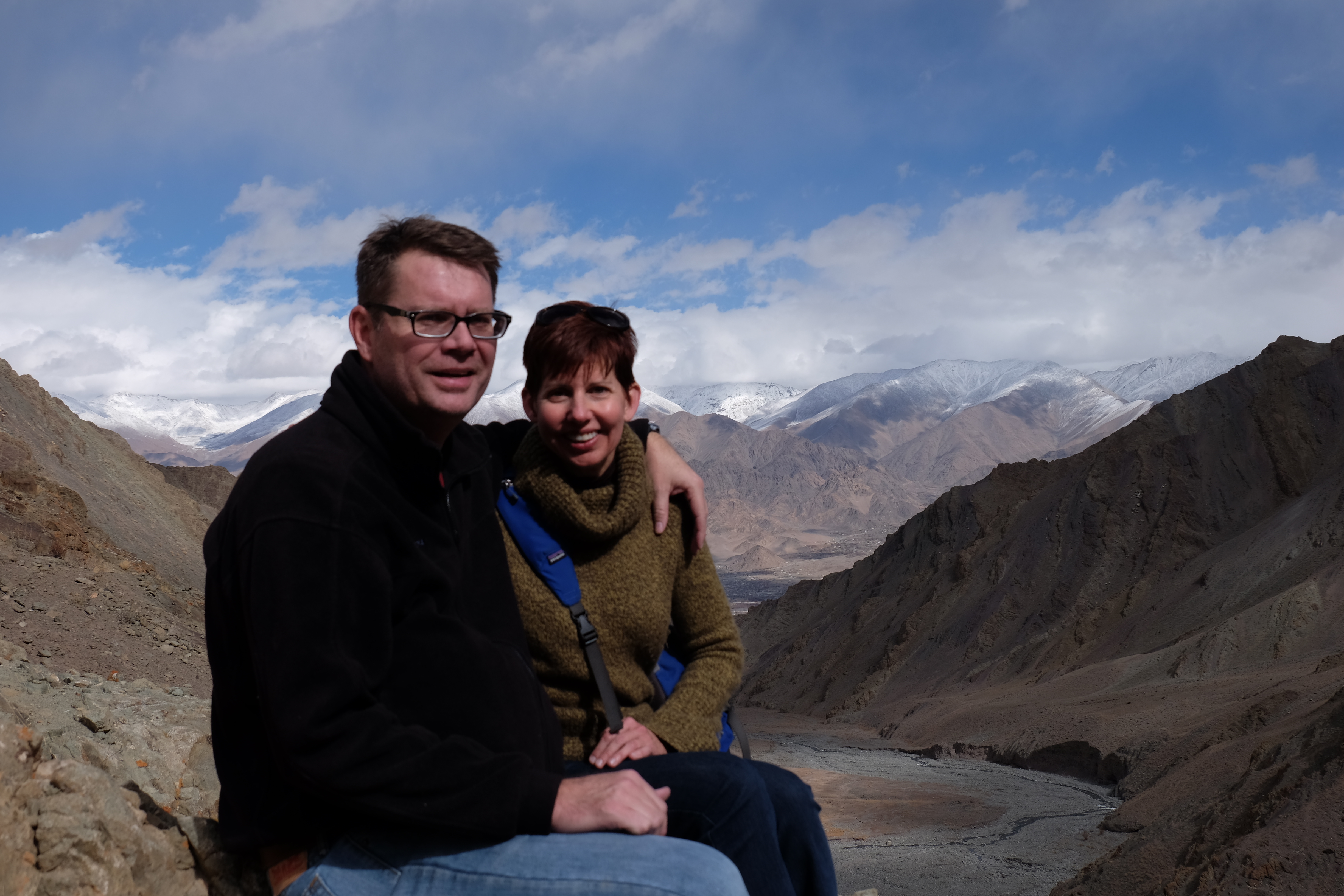
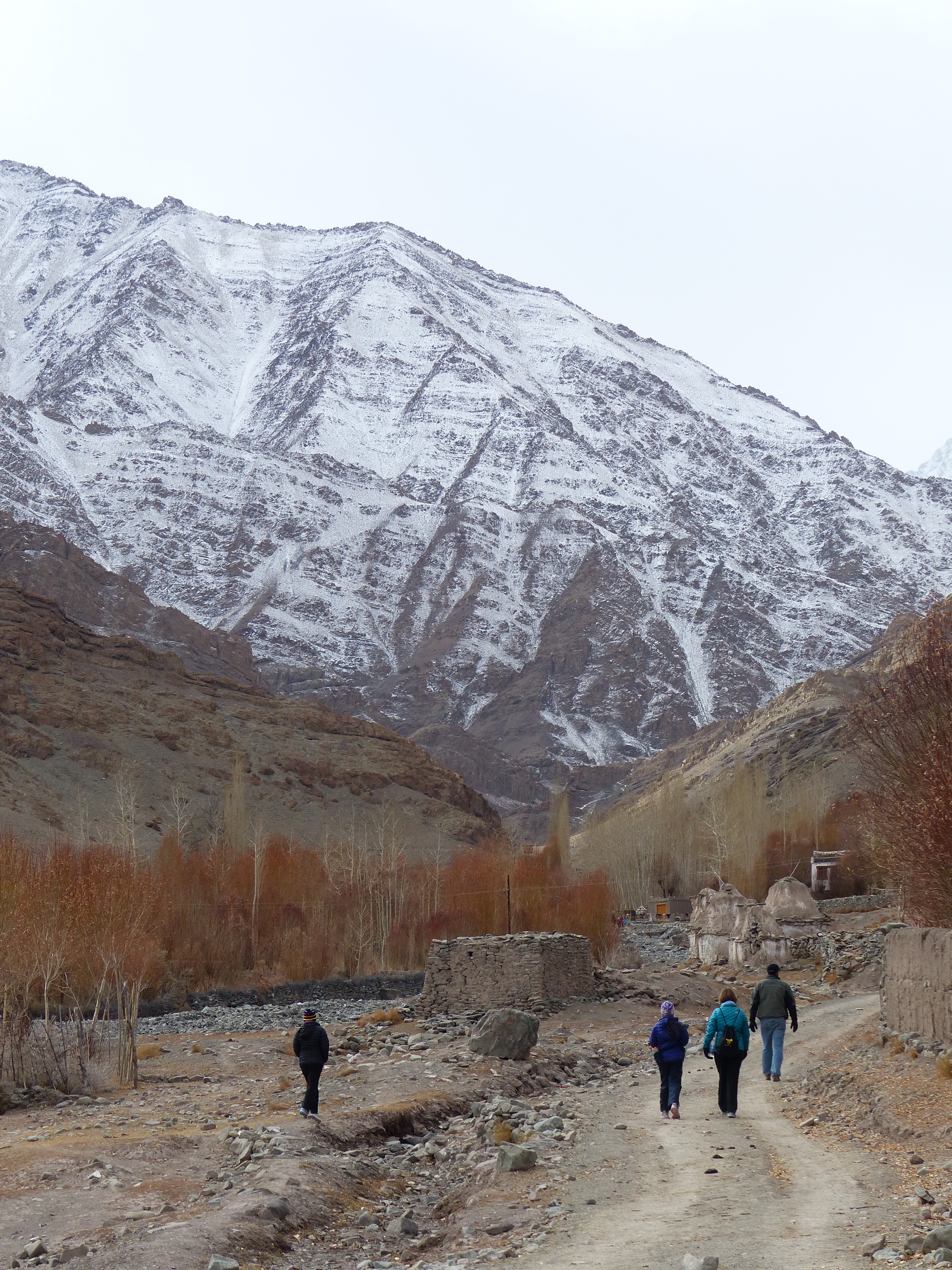
On the morning of day three in Leh, we drove about 45 minutes to a trailhead near the village of Stok. The trail ran alongside a streambed with mountains on either side. Several of us hiked up to the top of a big hill, about four hours round-trip. If we had continued on the path, we could have reached the snowy peak of Stok Kangri, 6123 meters high. That wasn’t going to happen.
P1070369

P1070376

P1070388

IMG_1167

DSCF8848

P1070418

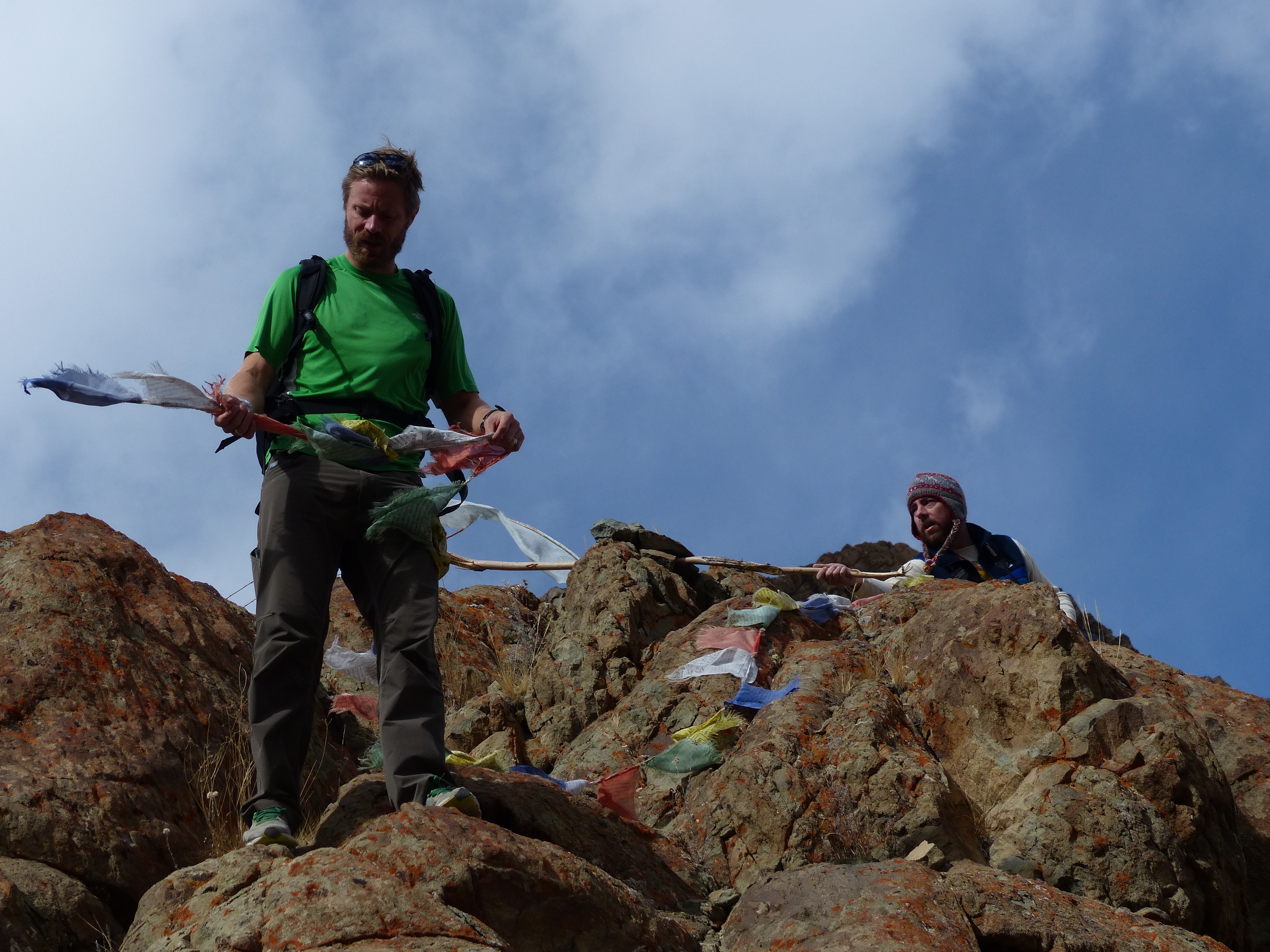
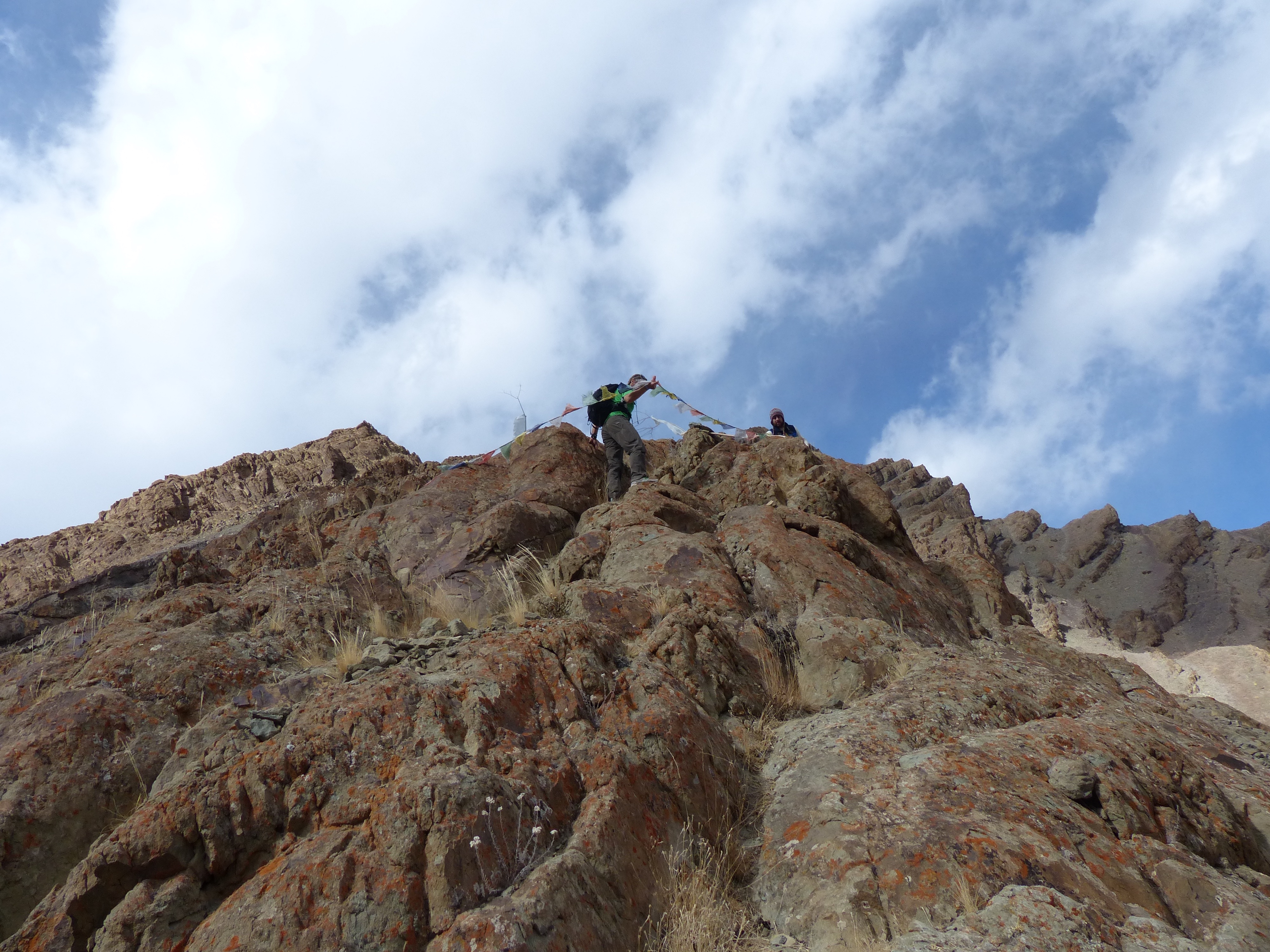
Evan and Bernie climbed up a bit further to re-string some fallen prayer flags.
P1070411

P1070413

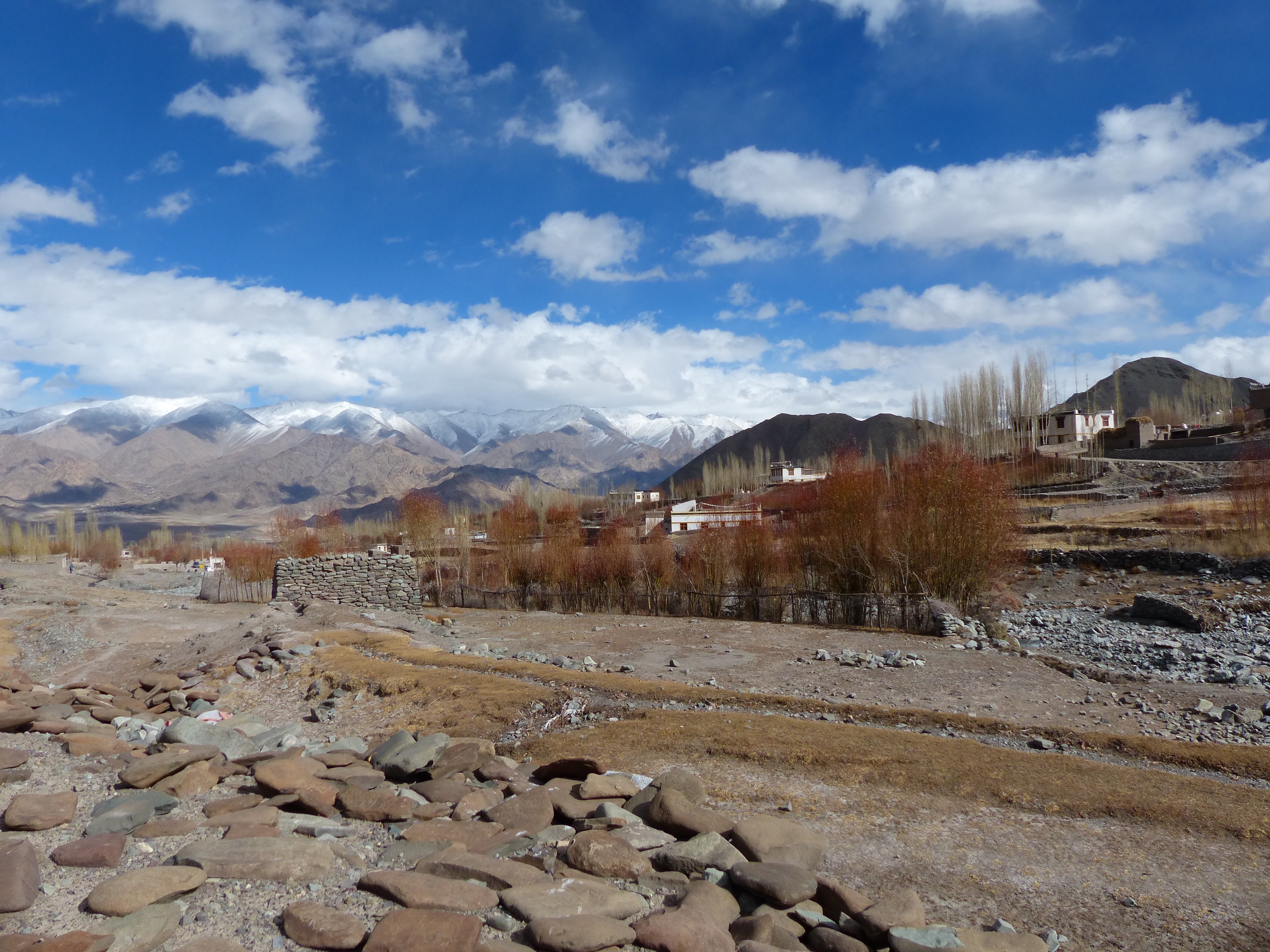
Gorgeous colors on the way back to the vans.
P1070430

Day four in Leh took us to a couple monasteries, known as gompas.

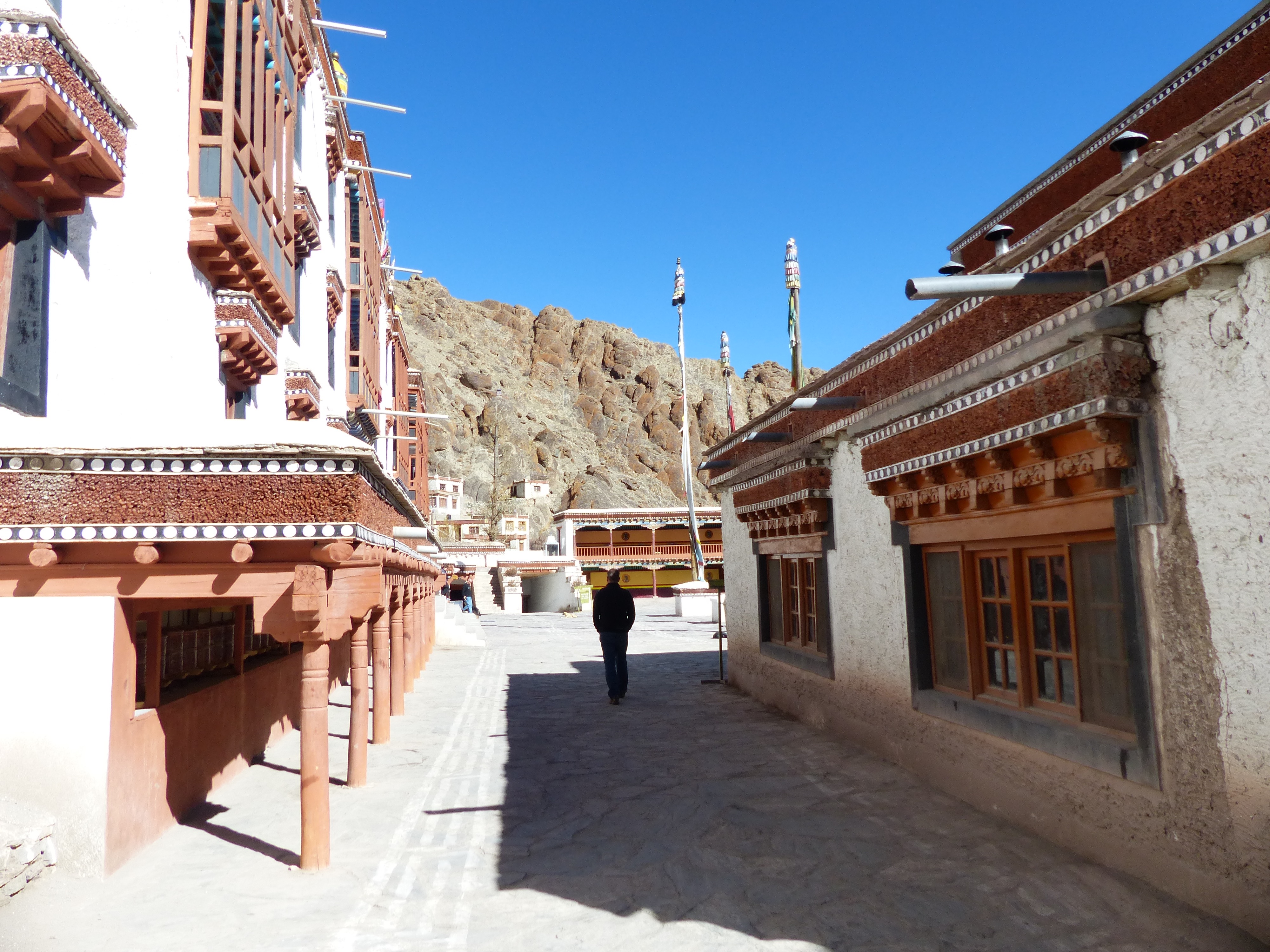
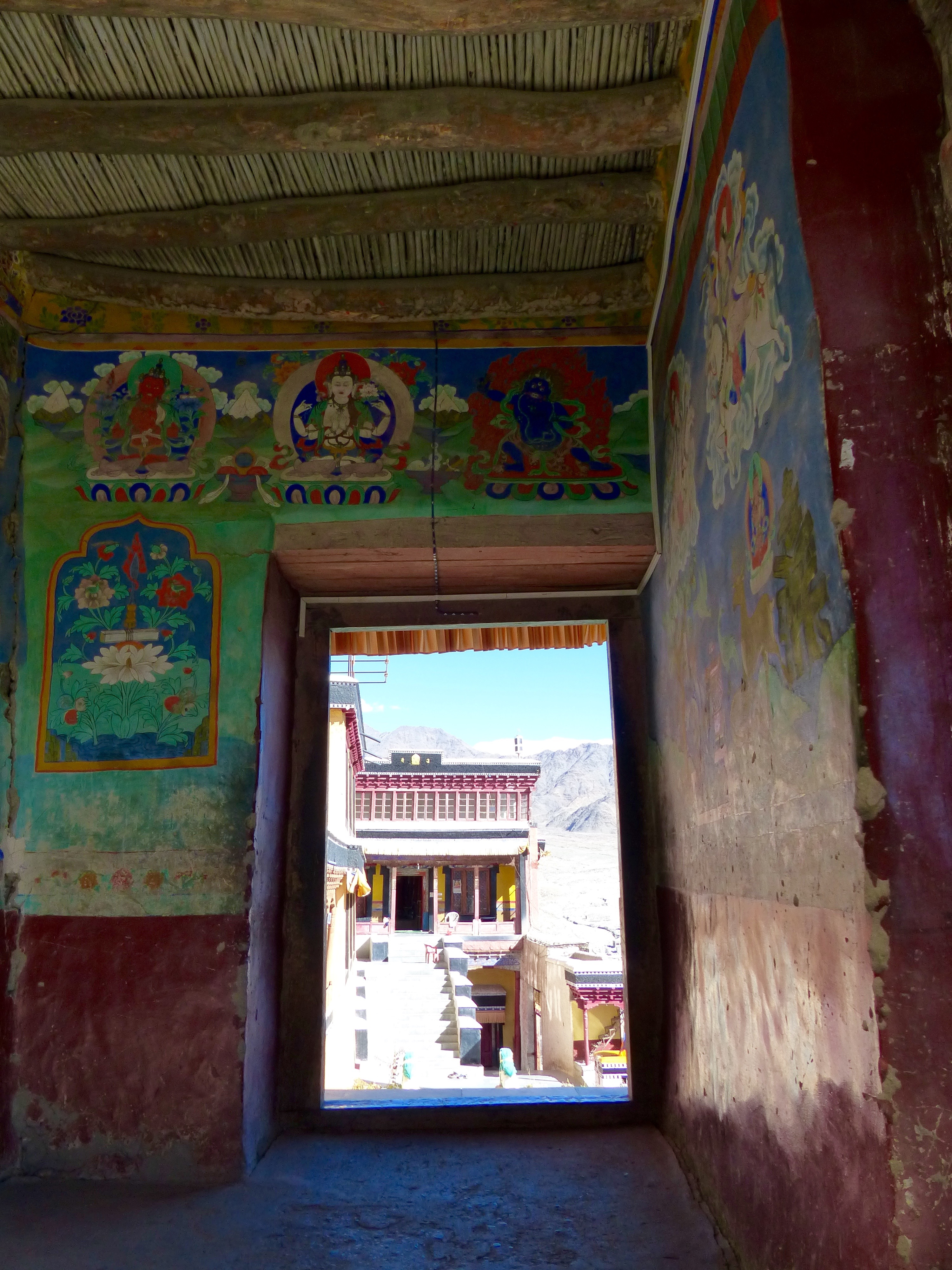
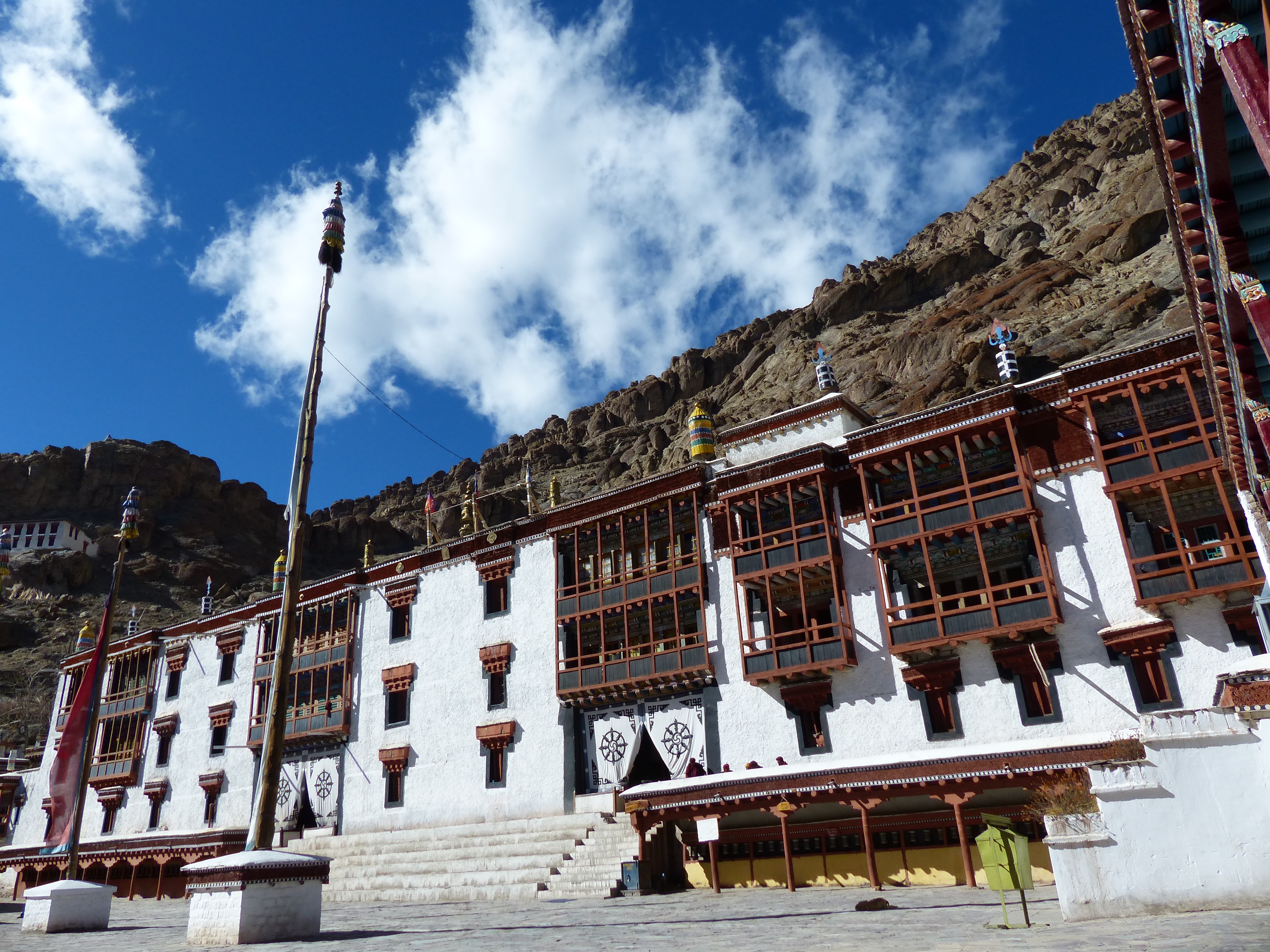
We drove a long way Hemis Monastery, the largest monastic institution in Ladakh. To get there, we crossed the Indus River on a metal bridge draped with Tibetan prayer flags. Our vans crawled up a switchback road through dormant barley fields and grazing yaks until finally, we turned a corner and found the monastery hidden behind towering sand-colored hills.

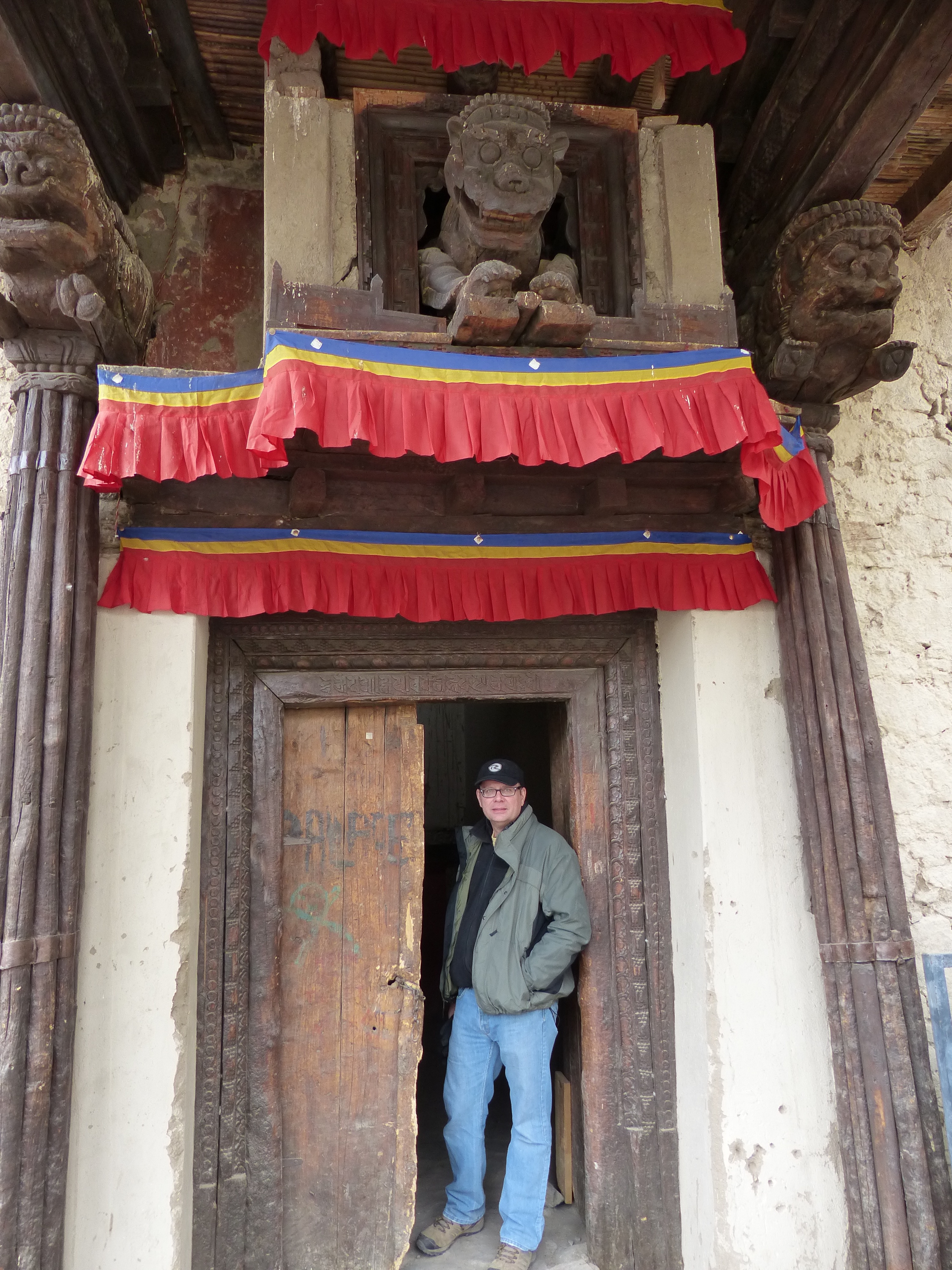
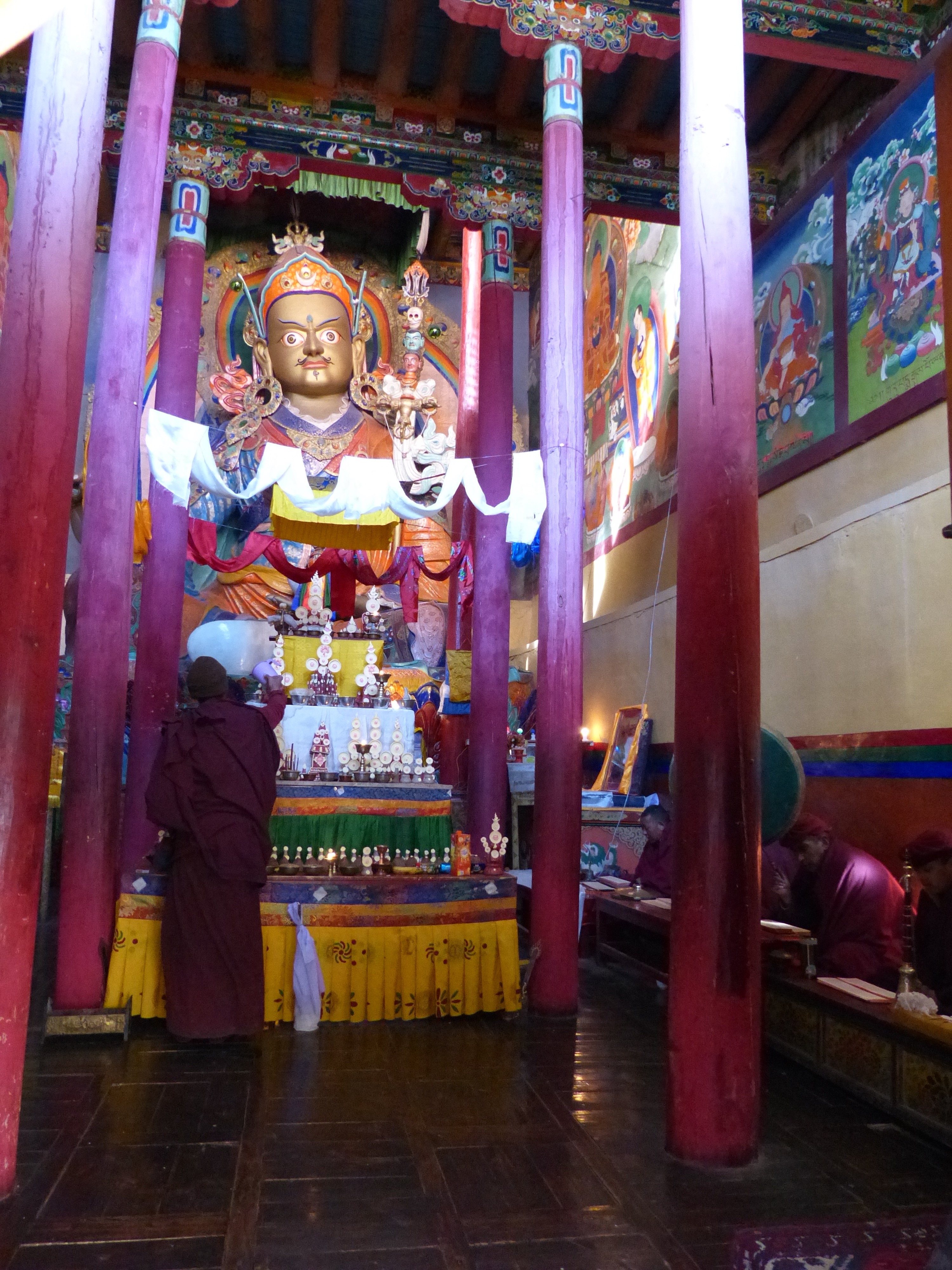
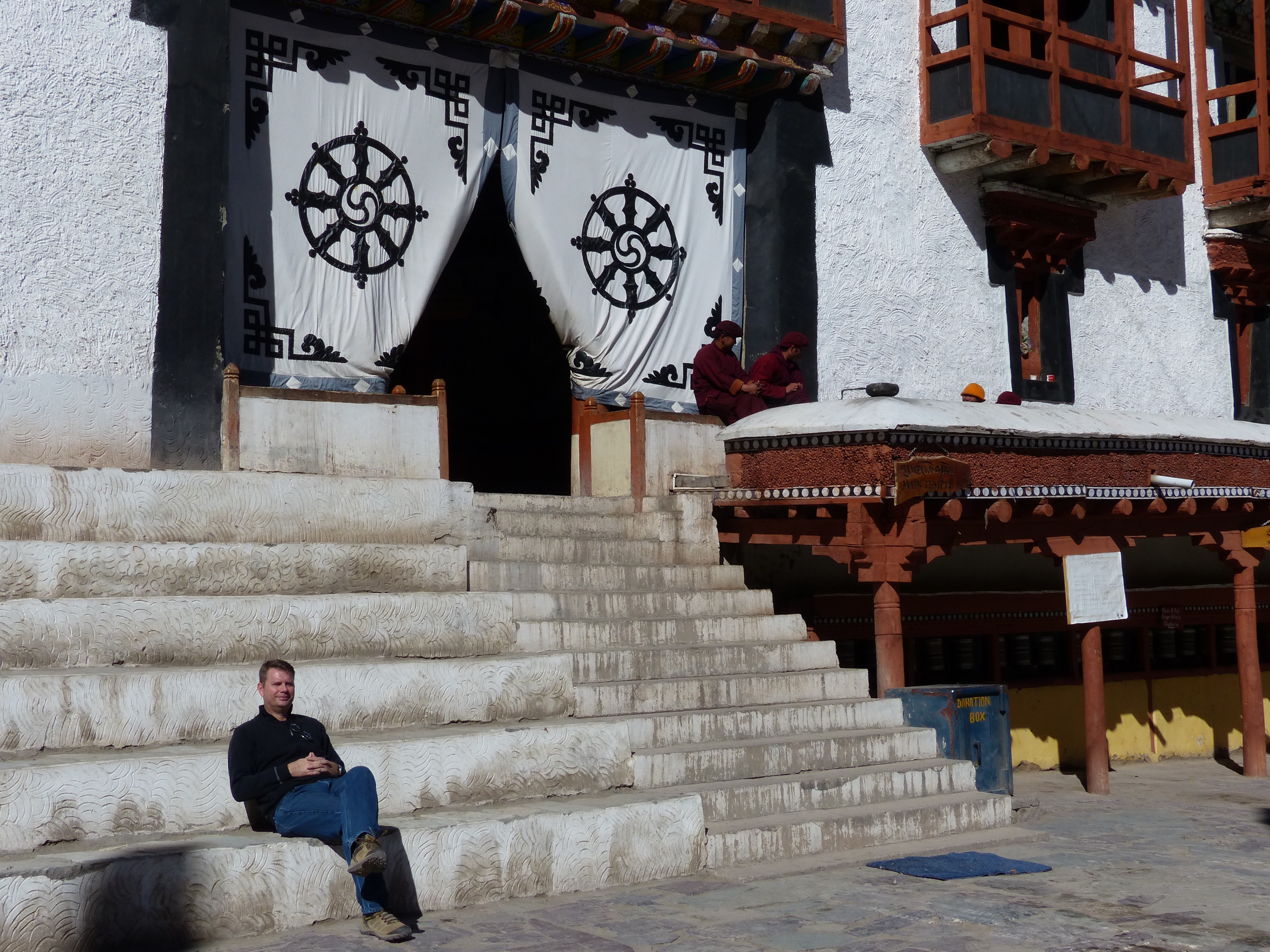
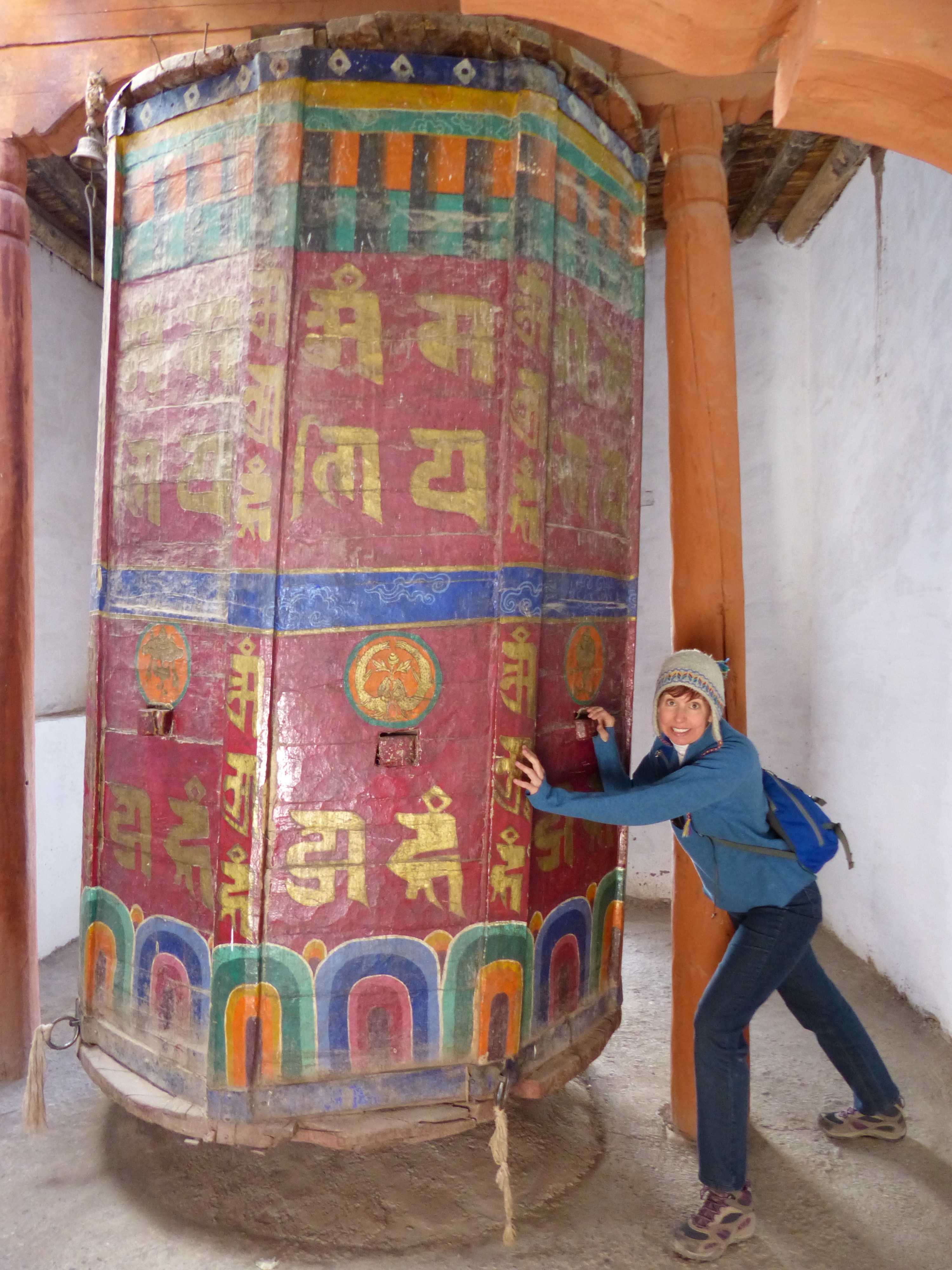
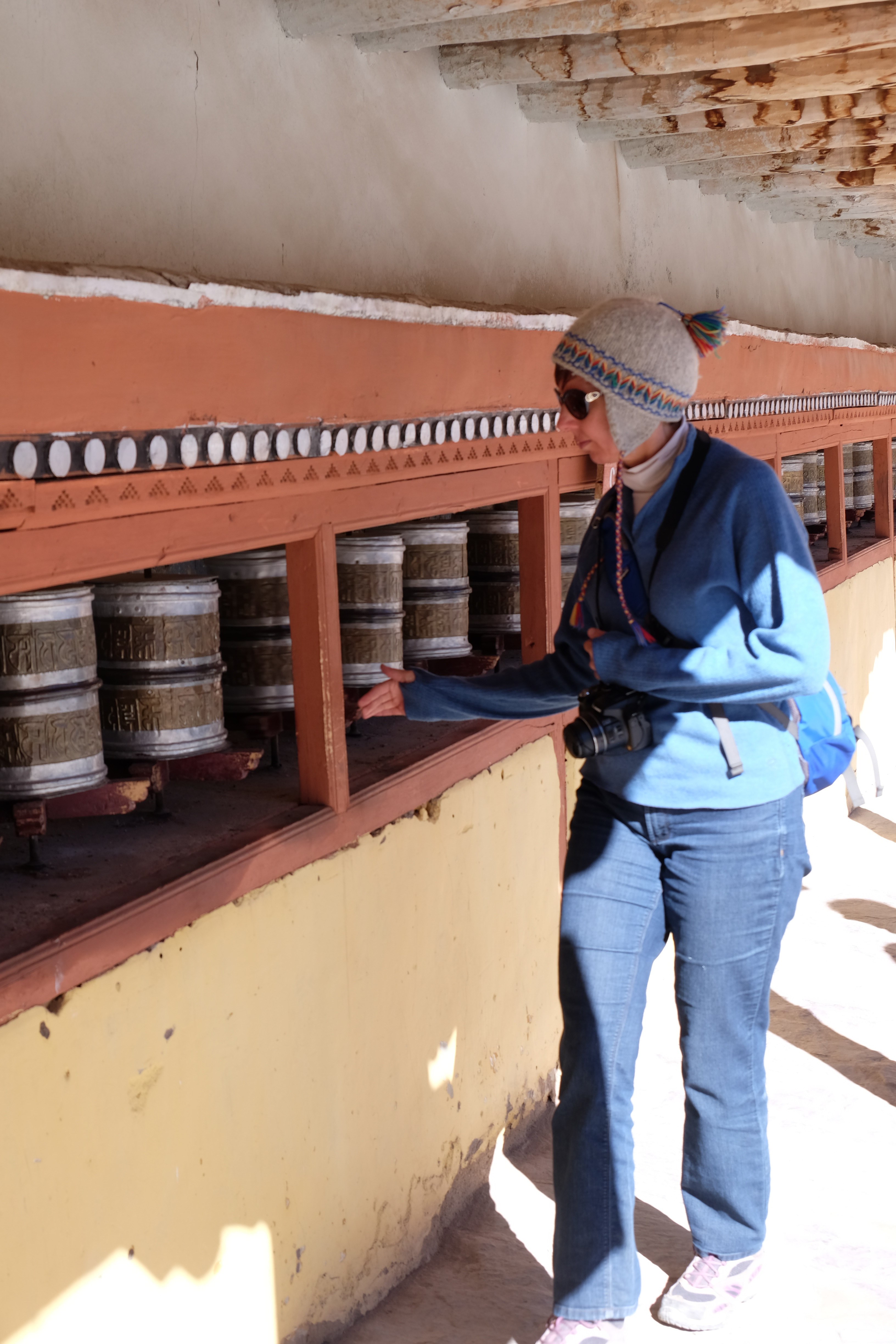
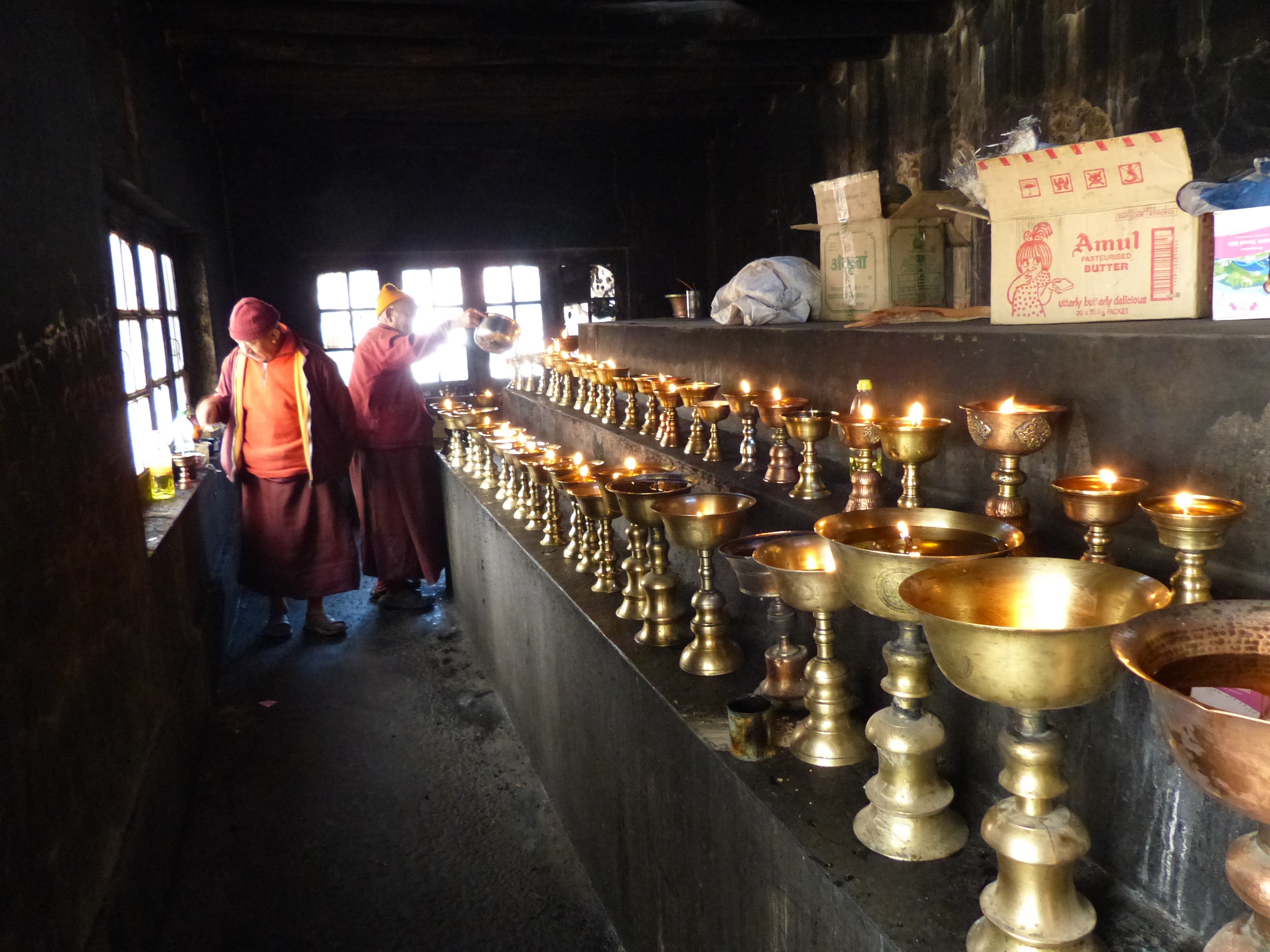
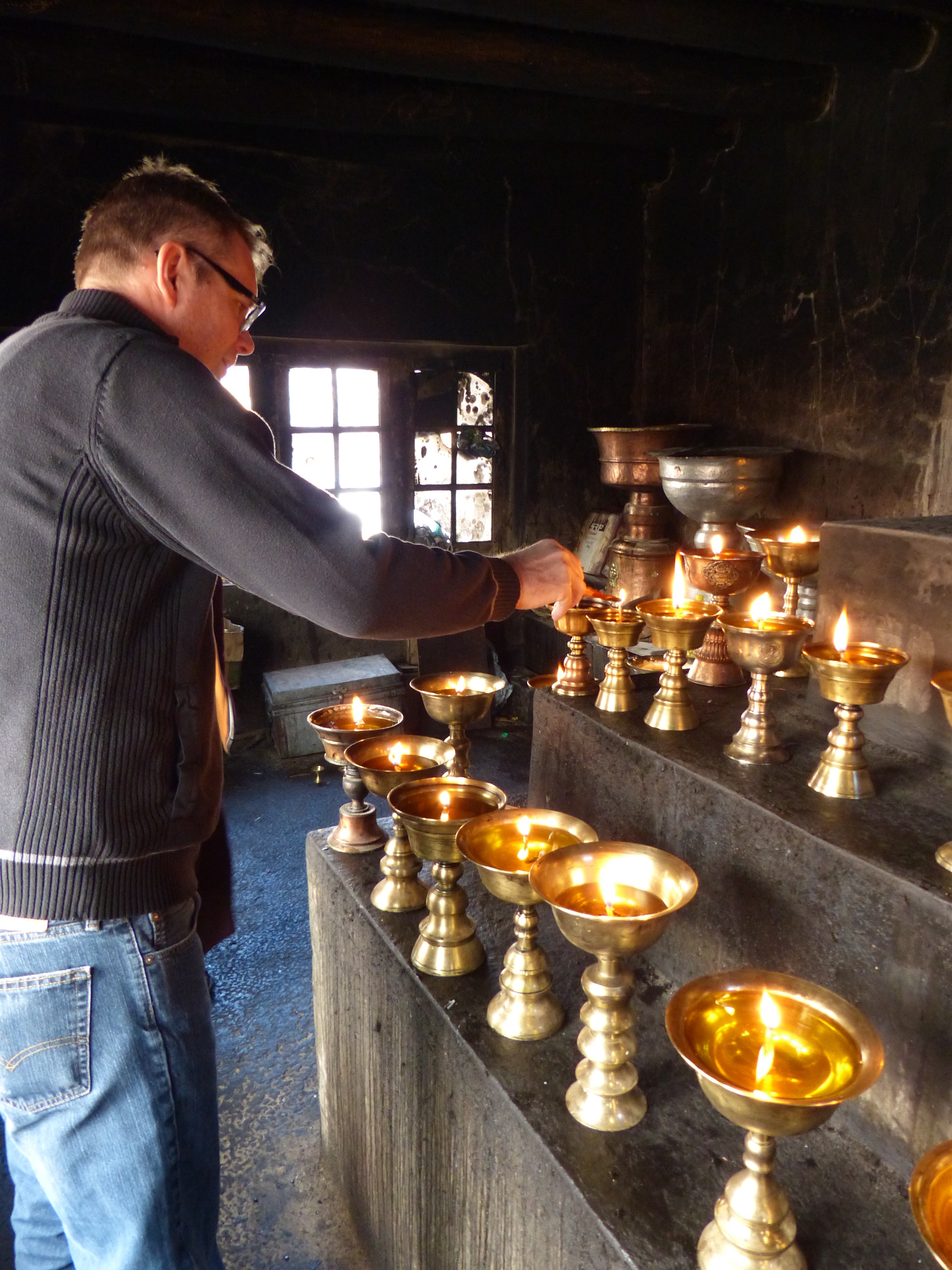
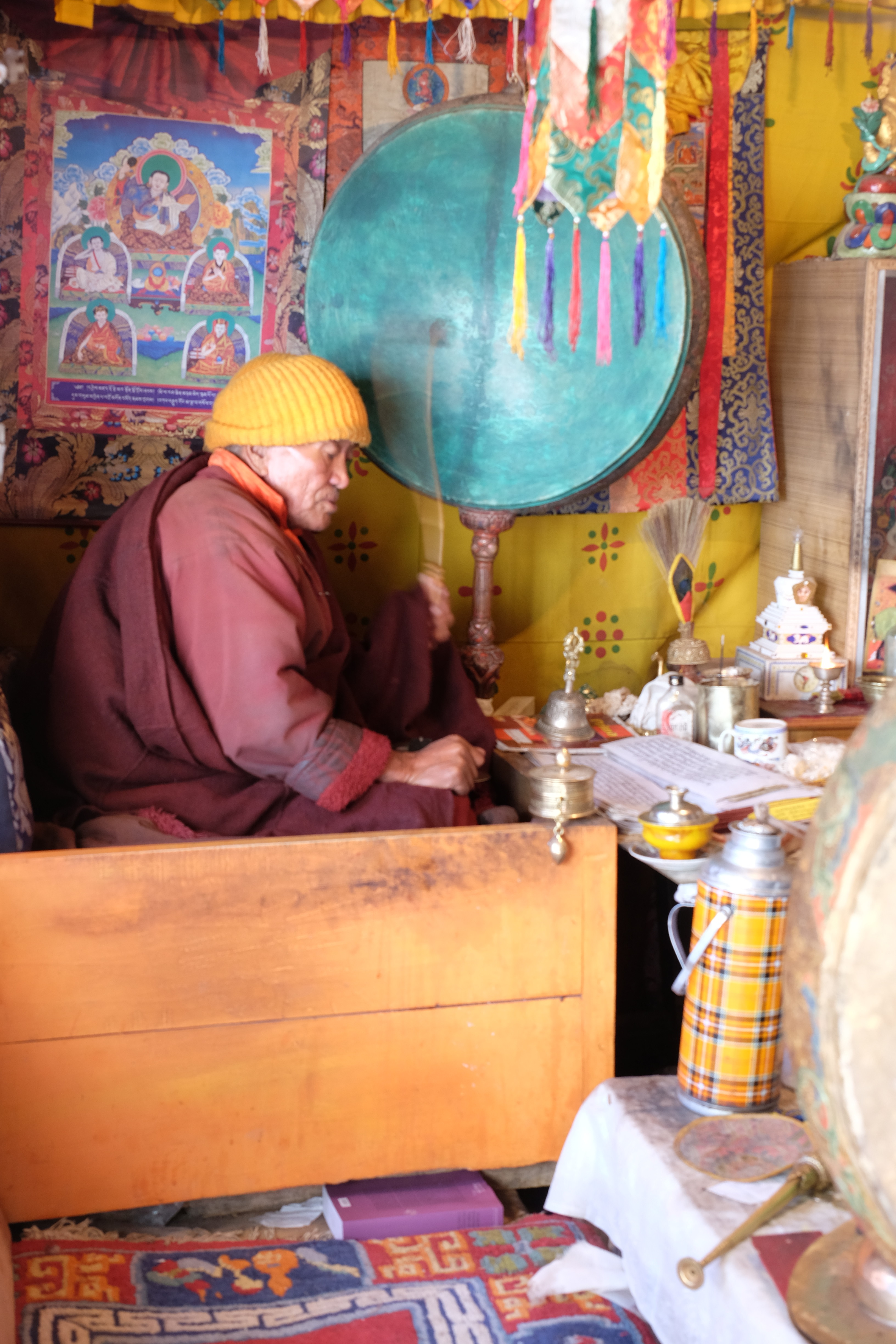
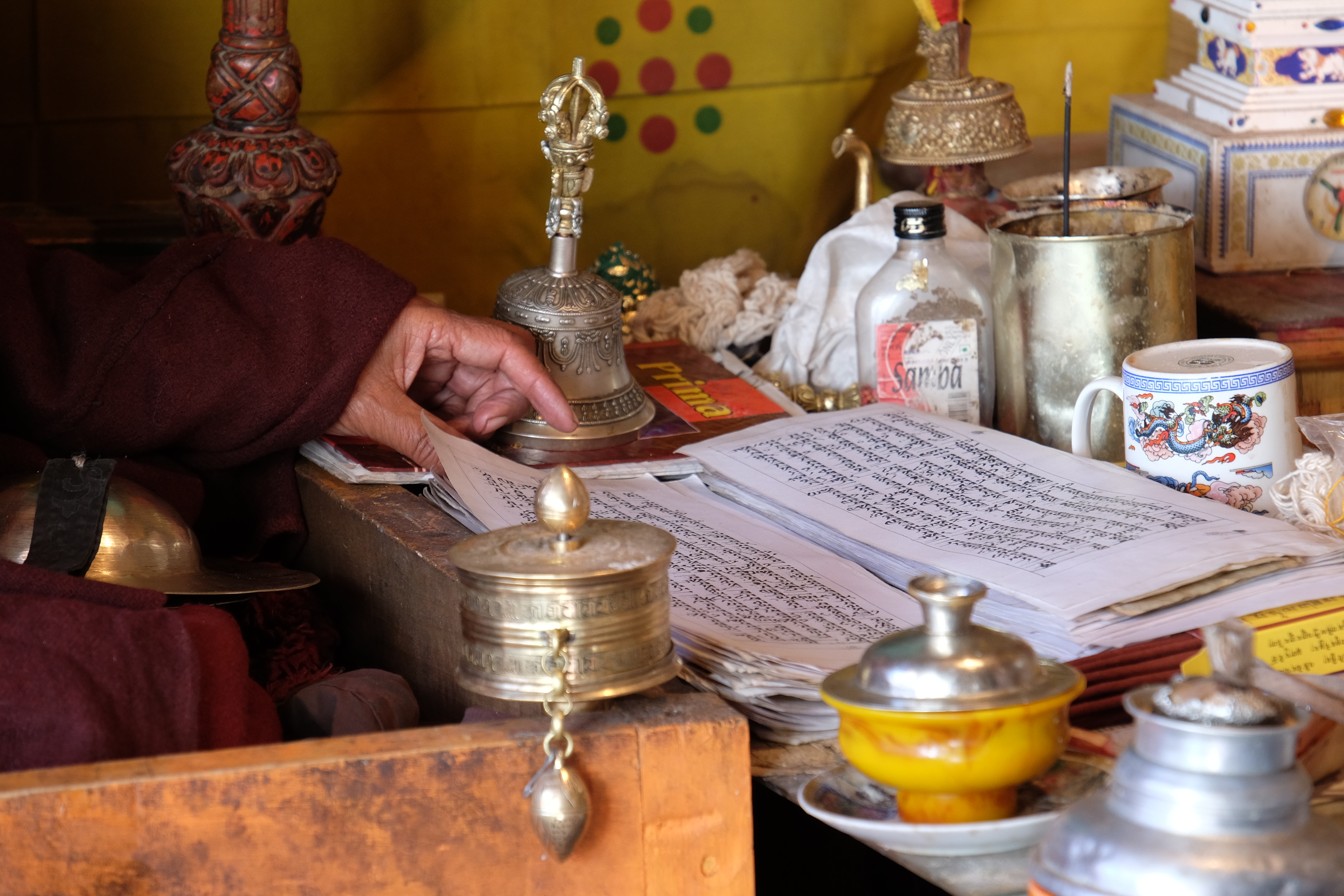
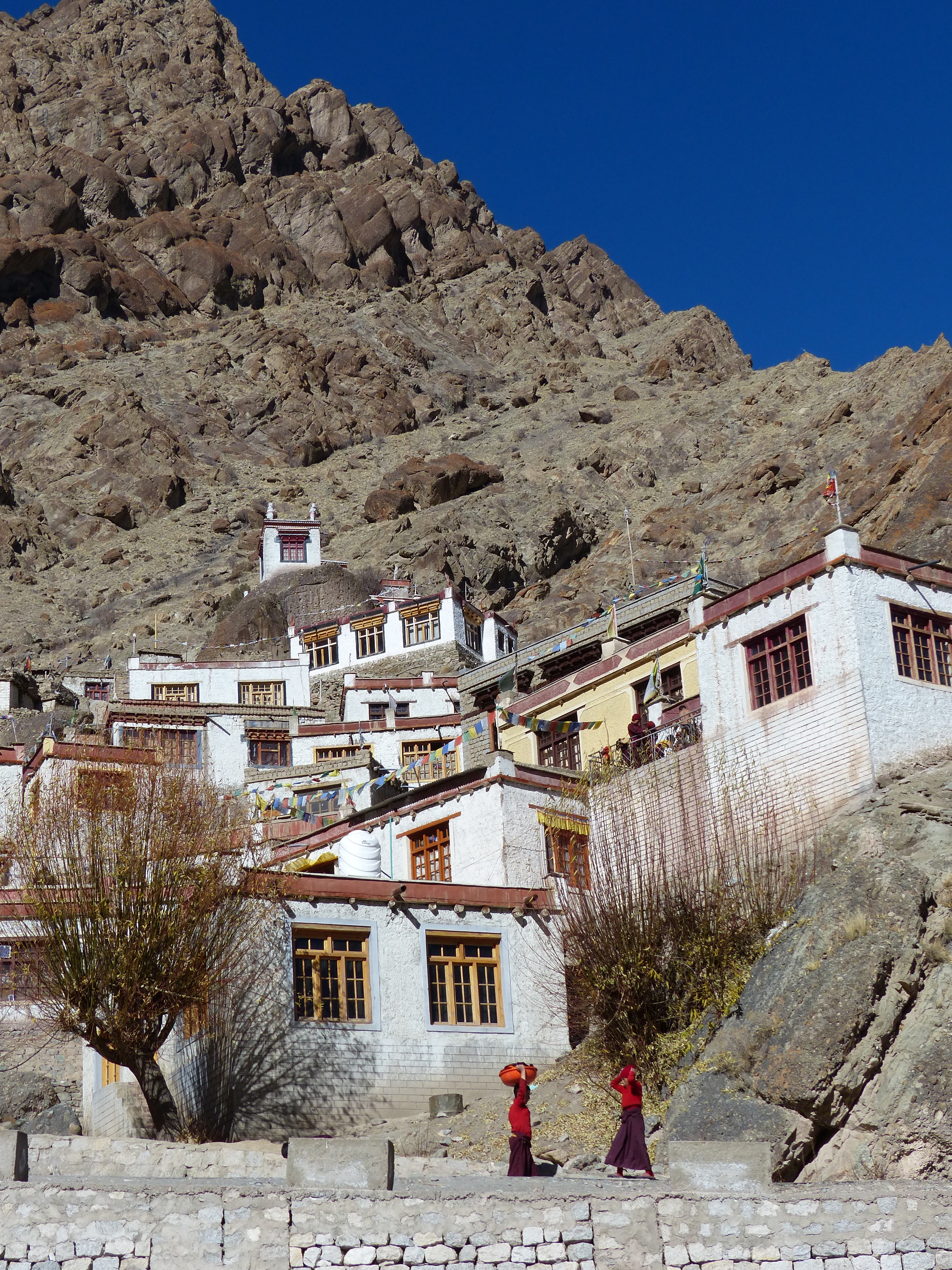
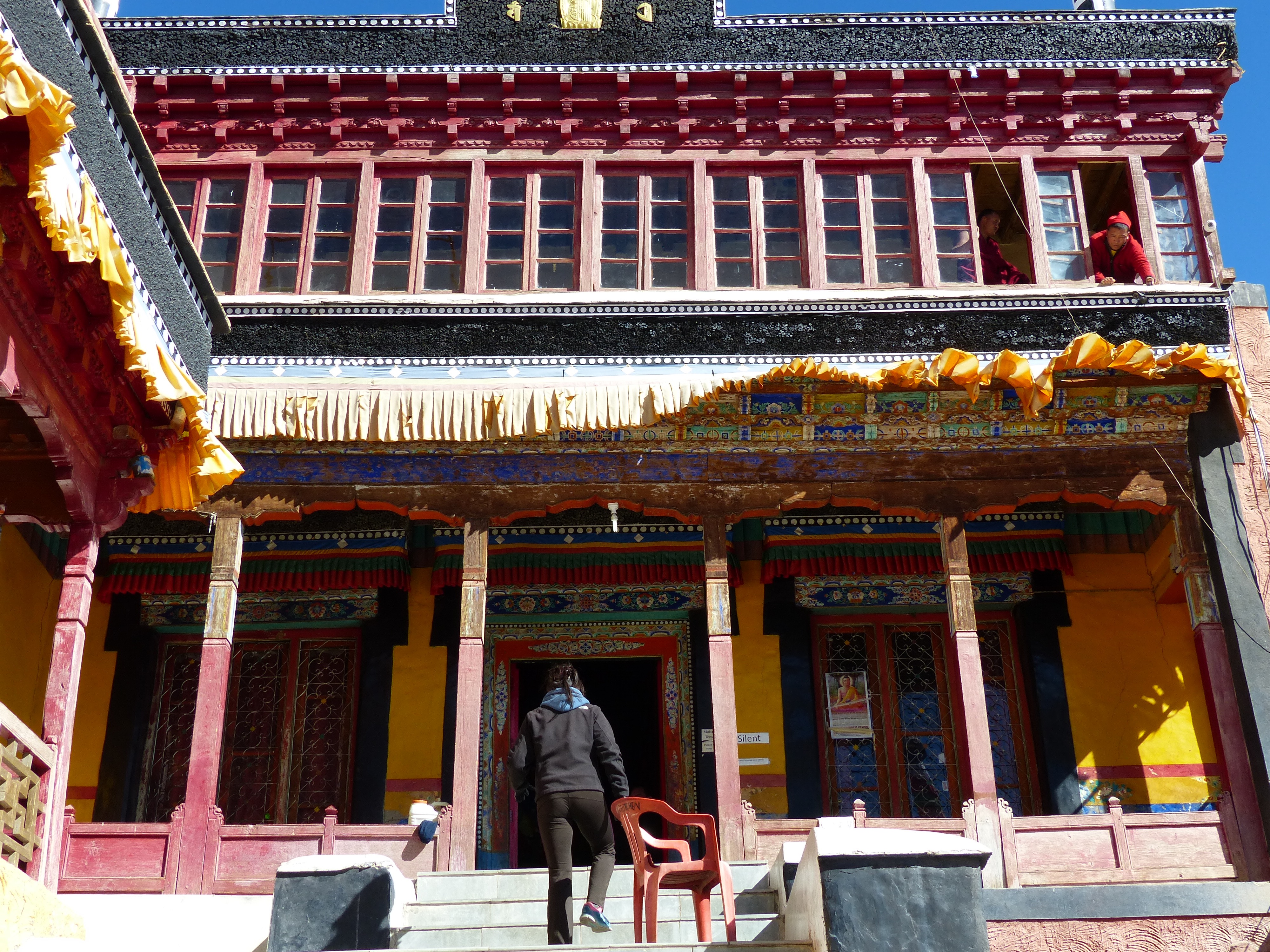
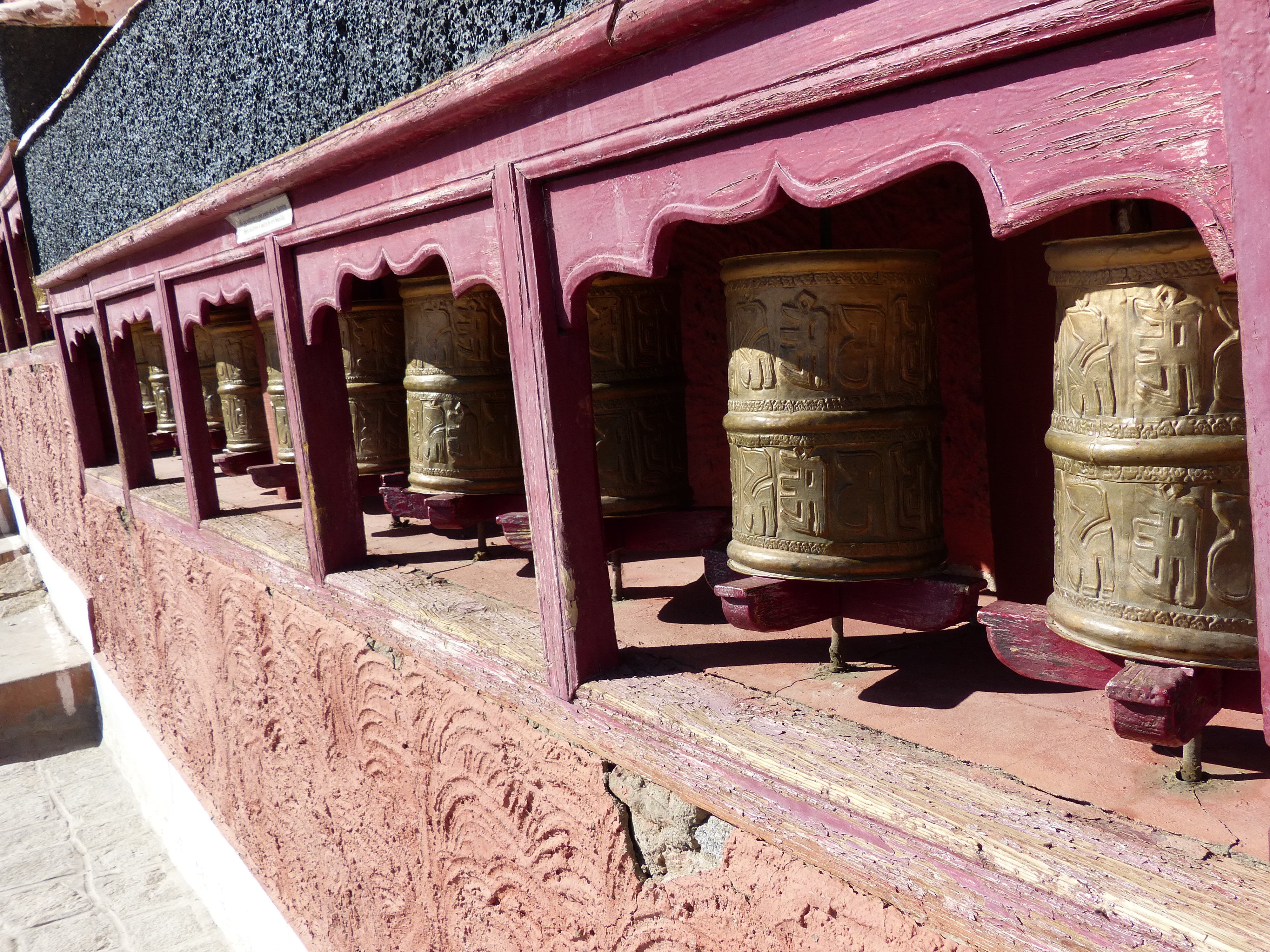
Inside, we took off our shoes to enter a temple, where monks were chanting prayers. One monk kept time on a painted vertical drum, and occasionally the others would chime in with a bell, cymbals or a horn. Upstairs, we visited the Kali Devi temple, full of ominous images of the vengeful goddess. We climbed up the roof and enjoyed the vista for a while. Tony and I turned the prayer wheels and then wandered by a small room, where two monks were lighting lamps of ghee. The older monk invited us in and handed Tony a candle to light the lamps. He showed us one huge lamp that apparently burns for a whole month. Later, that same monk did a little laughter therapy/clapping game with others in our group. Outside the monastery building, young monks were busy with chores – fetching water, washing robes, mixing concrete, sweeping, and we realized the “village” clinging to the hillside was really living quarters for the monks.
P1070466

P1070448

P1070449

P1070457

Photo by Scott.
DSCF9109

P1070458

P1070461

P1070463

Photo by Scott.
DSCF9091

Photo by Scott.
DSCF9092

P1070473

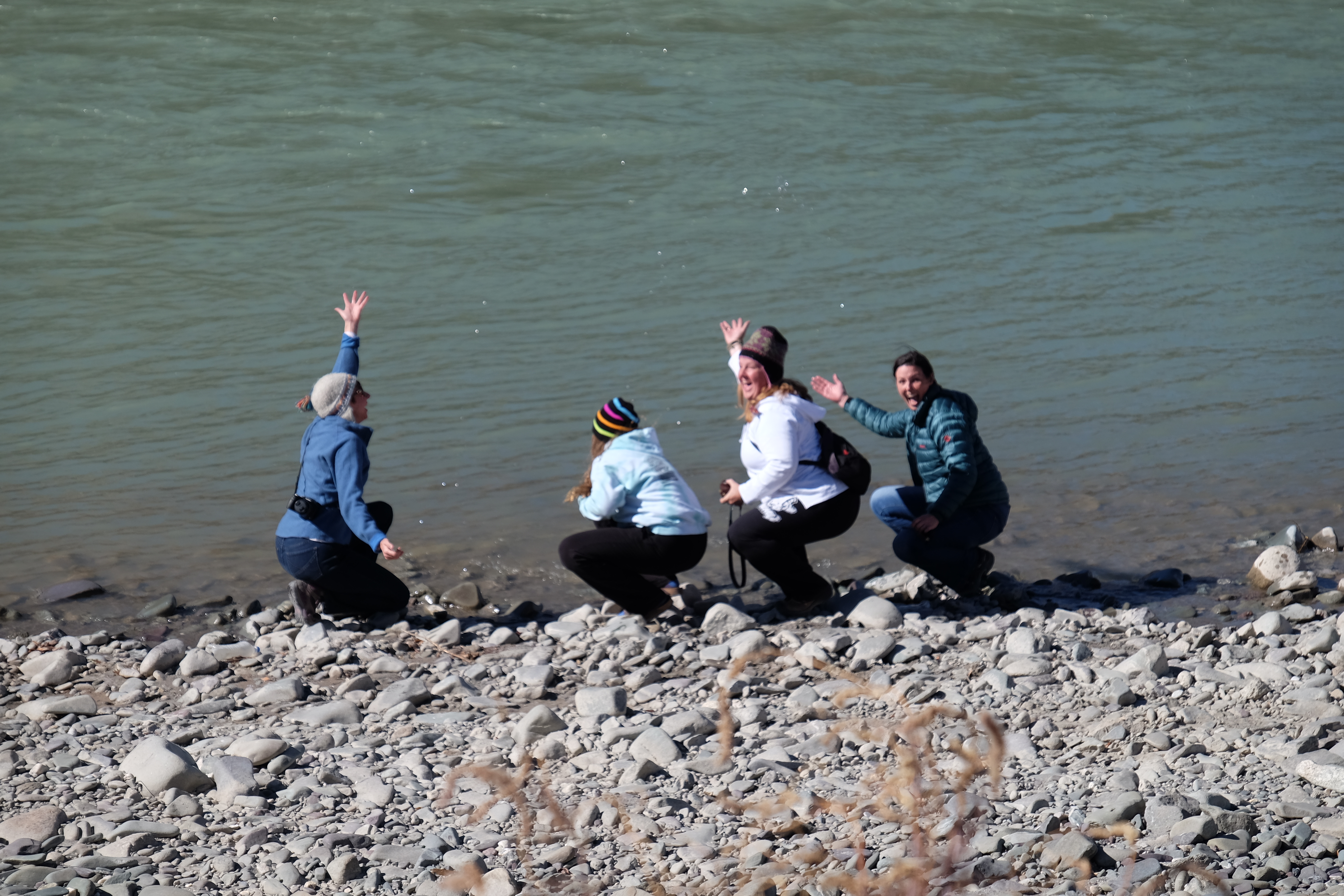
Leaving the monastery, we paused for a quick splash in the icy Indus River.
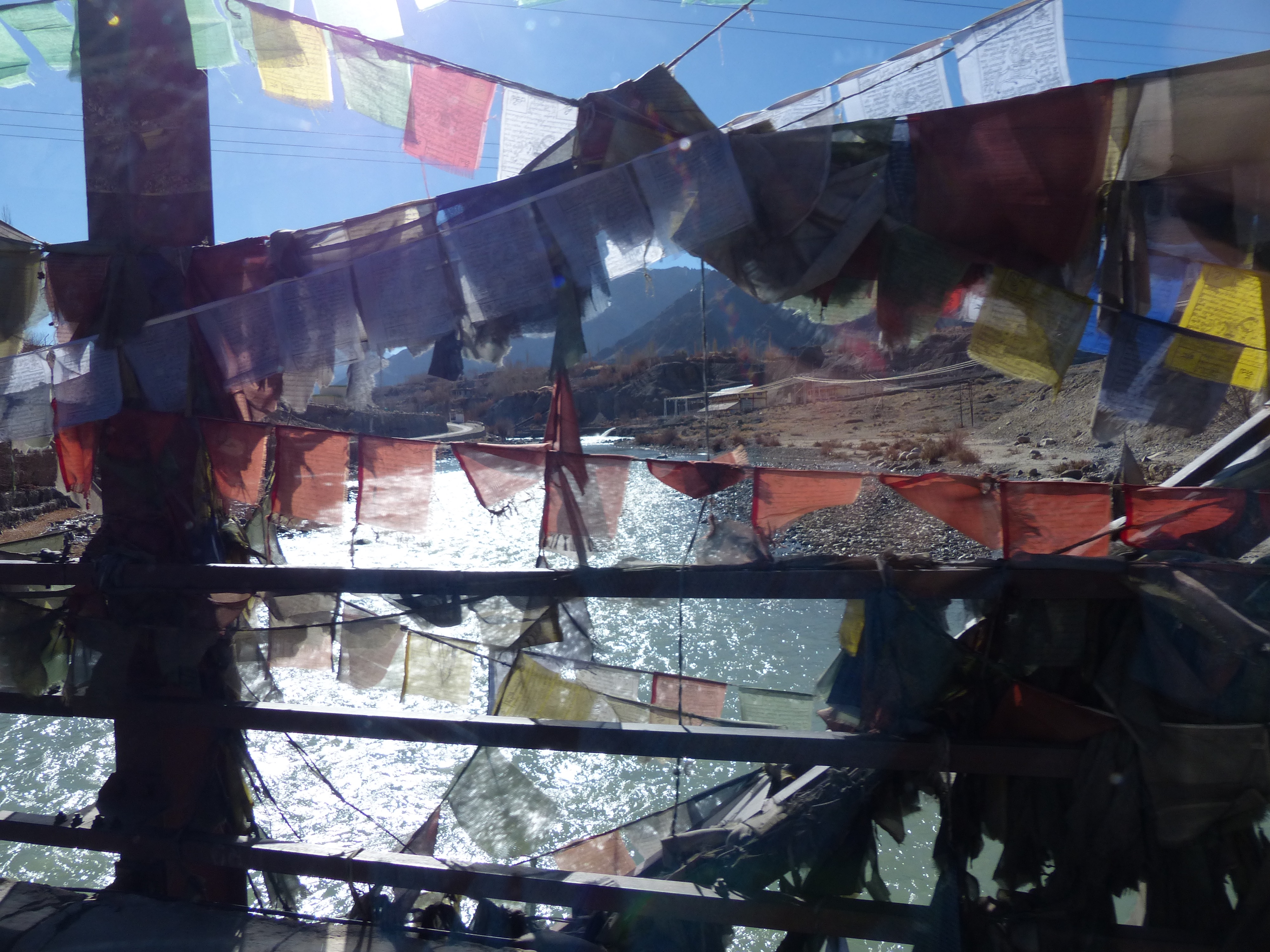
P1070438

DSCF9196

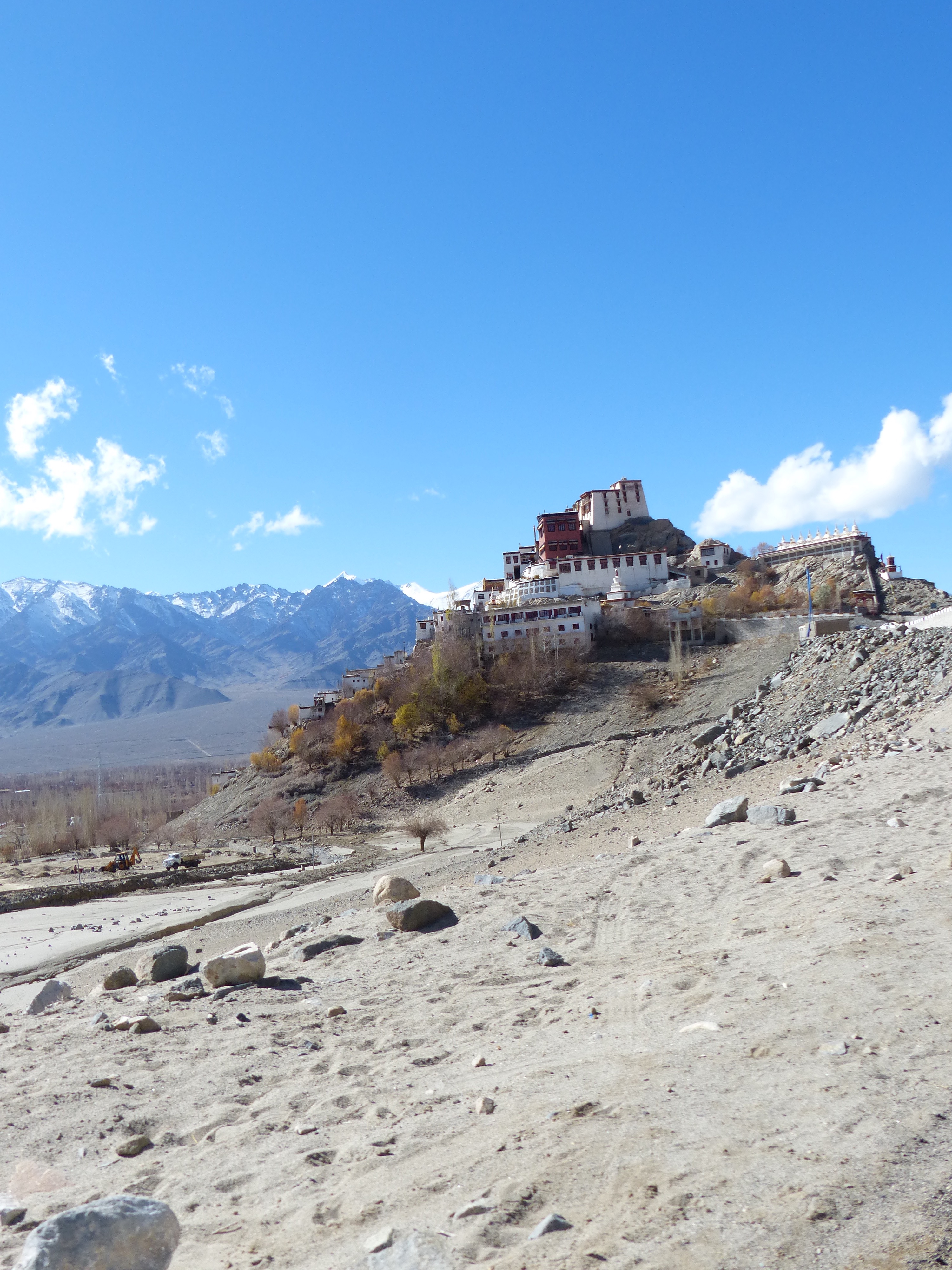
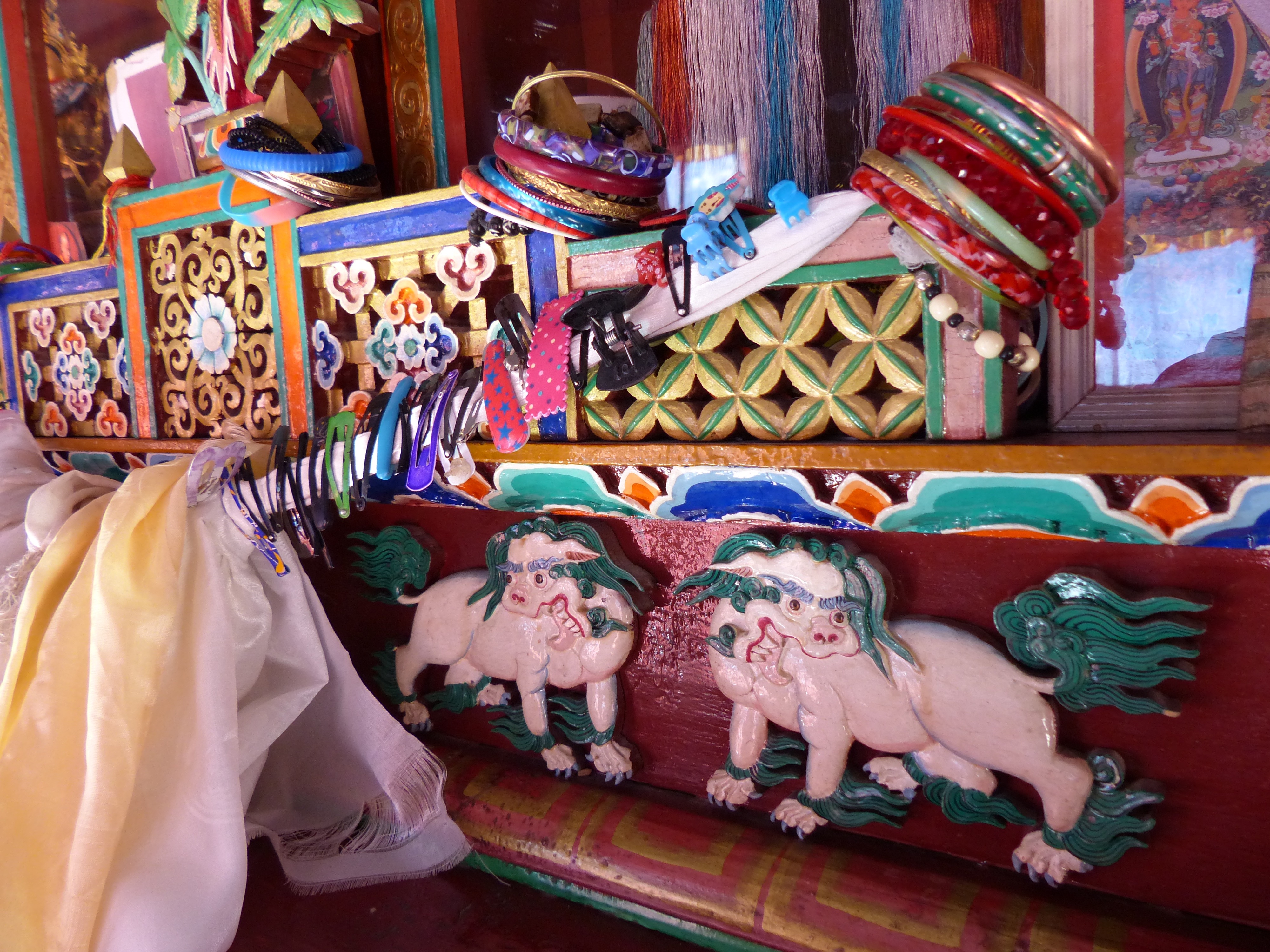
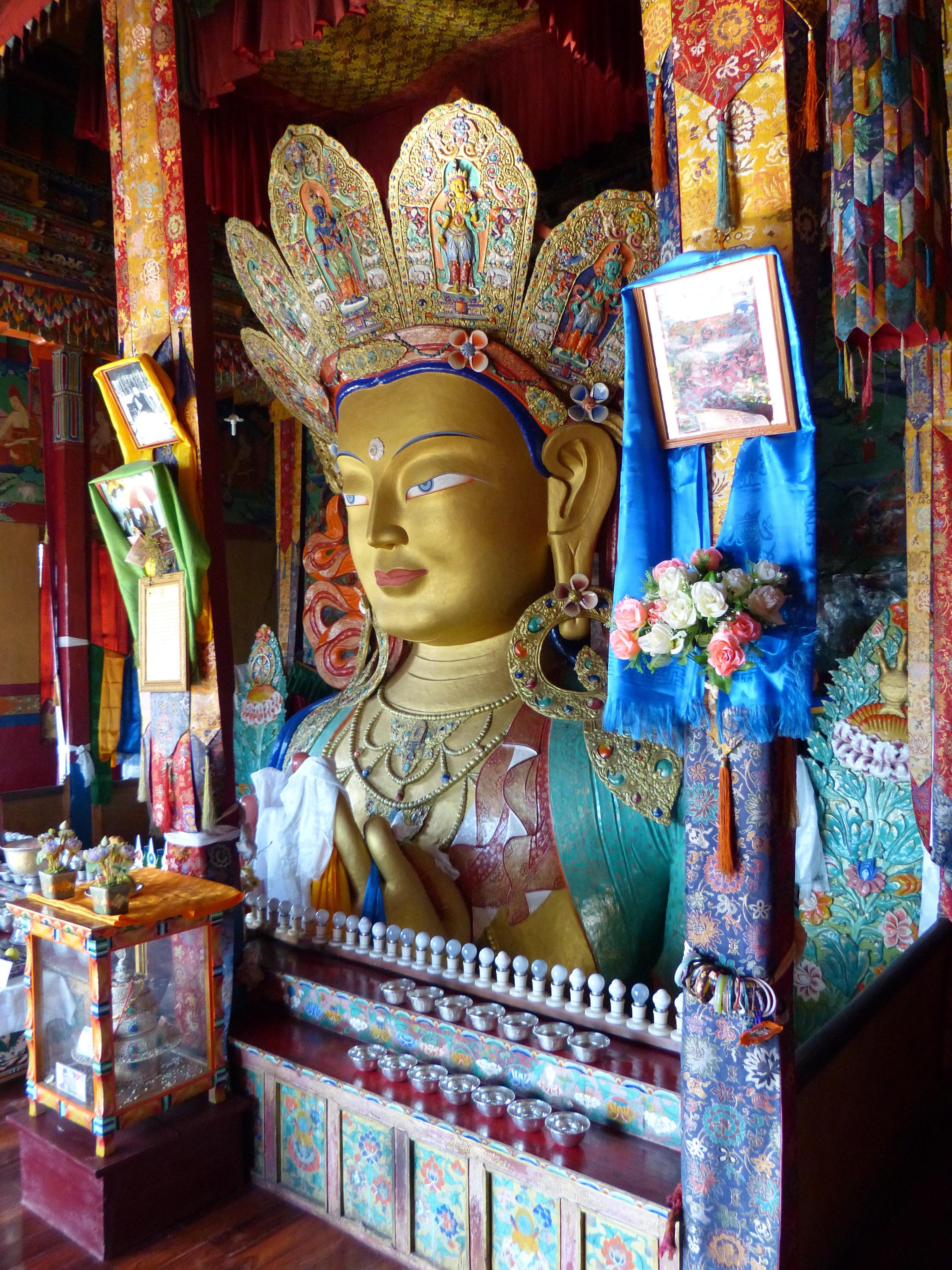
From there, we headed to the 15th-century Thiksay Monastery, perched on a hilltop overlooking the river valley. Only two rooms were accessible. The Maitreya Temple featured a 2-story gilded statue, inaugurated in 1980 by the Dalai Lama, and murals depicting scenes from Maitreya’s life. The other open room included many glass boxes with small dolls representing various Buddhist entities. It’s not unusual for temple visitors to leave money or other auspicious gifts, but this room had an unusual collection of bangles and hairclips left as offerings. If you know why, please do tell!
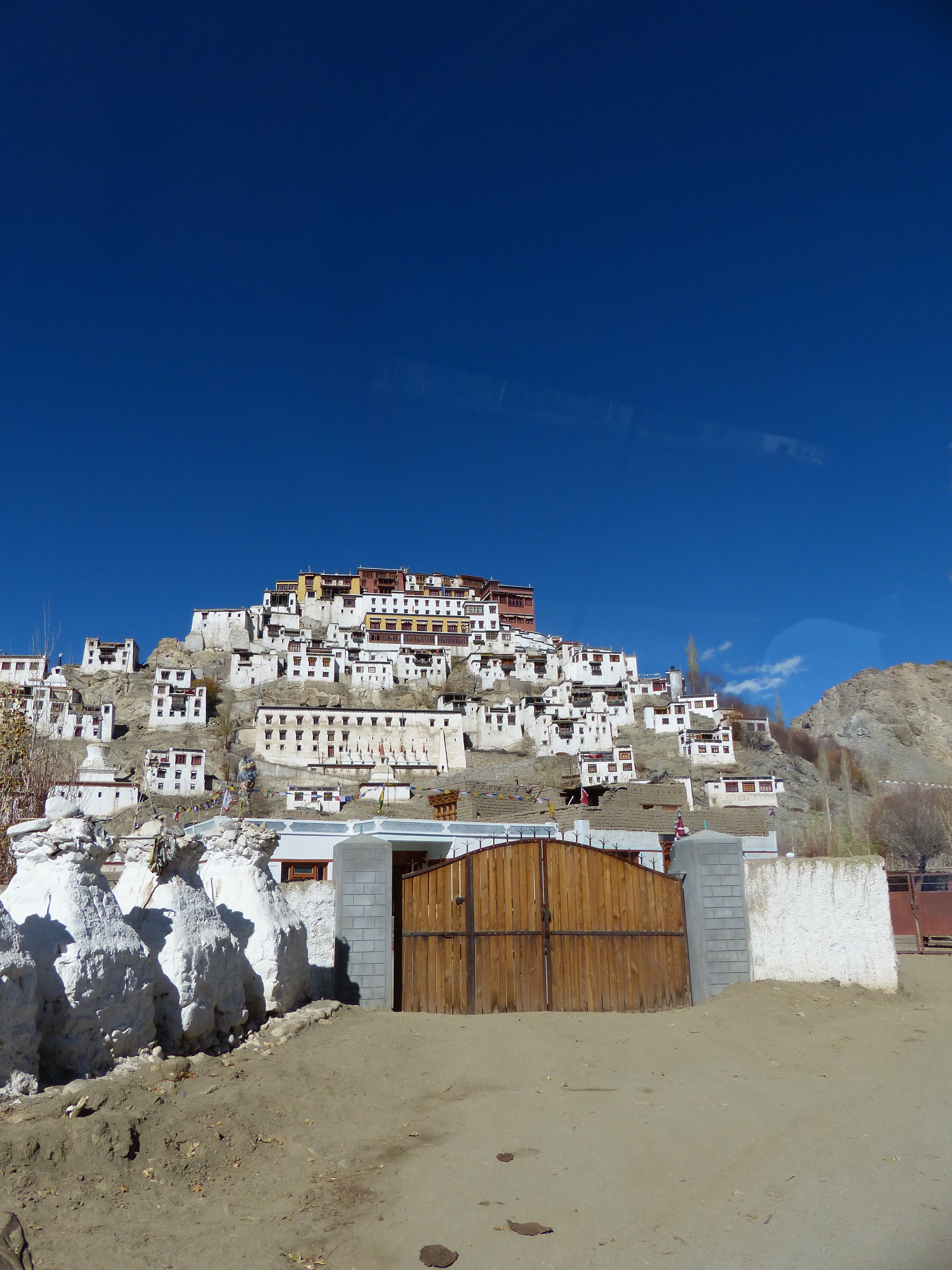
P1070494

P1070497

P1070499

P1070503

P1070520

P1070508

P1070505

P1070512

P1070522

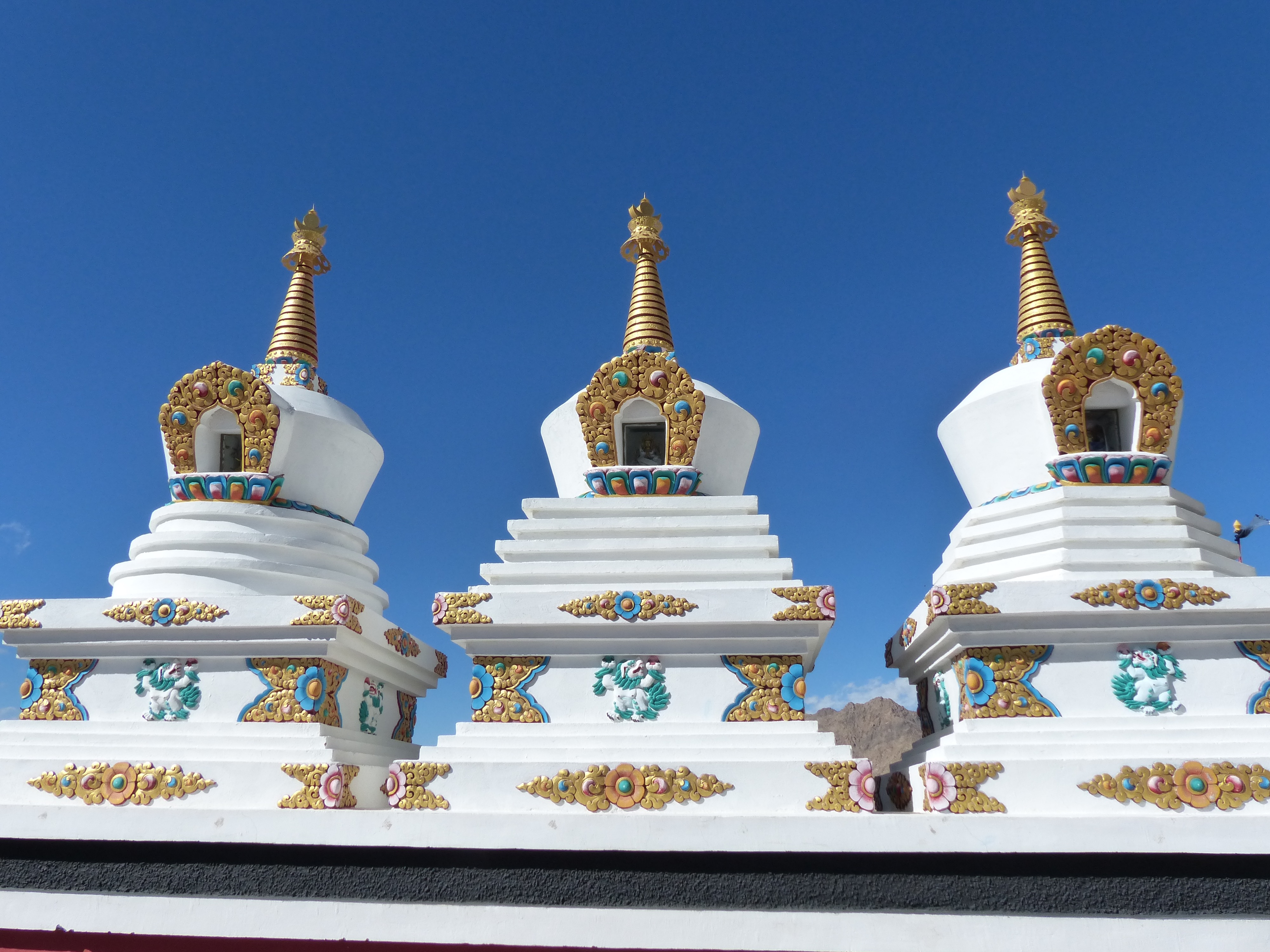
Driving back to camp, we passed through the former Ladakhi capital of Shey, where hundreds of white-washed chortens (stupas) dot the countryside. According to The Rough Guide to India:

Among the more visible expressions of Buddhism in Ladakh are the chess-pawn-shaped chortens at the entrance to villages and monasteries – large hemispherical burial mounds-cum-devotional objects, prominent in Buddhist ritual since the third century BC. Made of mud and stone (now also concrete), they are imbued with mystical powers and symbolic significance: the tall tapering spire, normally divided into 13 sections, represents the soul’s progression towards nirvana, while the sun cradled by the crescent moon at the top stands for the unity of opposites, and the oneness of existence and the universe.

While my heart sank at the thought of leaving Leh, I vowed to return home with a smile. It’s been a week, and that Leh-induced joy lingers. When can we go back?
Culture clash, courtesy of a cricket

“Sorry I’m late, but traffic was insane this morning,” I moaned to Anil, my tennis coach. I left my water bottle and towel on a bench and walked across the clay court to greet him. He was staring through the chain link fence, past the bleachers, but he turned with a smile and replied, “I know, I got stuck, too. So many big trucks. That’s why air is so bad.” His eyes darted back beyond the fence, and then, distractedly, he pointed at the net where two baskets of tennis balls awaited. “Warm up,” he said.

We both stood on the same side, with Anil at the net and me at the baseline. He tossed balls to my forehand and backhand, and I attempted to hit them to the other side. Each hit elicited a comment:
“Beautiful, girl!”
“Nice try, girl!”
“Amazing form!”
“That’s your stroke!”
And so on. This is how my weekly lessons usually start. Very much still a beginner, I revel in Anil’s consistent praise and positive attitude. He has a bright genuine smile, and his cheerleading boosts my spirits. But on this day, he seemed fixated on something and his words fell flat.

When the baskets emptied, he picked one up, flipped the metal legs around to serve as handles and handed it to me to scoop up the balls scattered around the clay court. Usually, he would take the other basket to help, but instead he looked exasperated.

“What is that?” he asked. I followed his gaze but saw nothing unusual.
“What is what?” I asked.
“That sound!” he cried.
I set down my basket and paused to listen. Typical sounds in Delhi including drumming, honking, barking, mooing and shouting, the shrill sawing of rebar and clattering of bricks at construction sites, auto rickshaws revving, car alarms shrieking, random bells ringing, more honking, more barking and more, more, more, often all at the same time.

Yet, weirdly, all I heard was the chirp of a lone cricket.

“It’s just a cricket,” I laughed and resumed by ball collecting.

Anil stomped over the to the fence, a cloud of red dust in his wake. Suddenly, silence. He turned and smiled, “It stopped,” he said, relieved.

“It will start again,” I said, popping the basket onto a ball. “Haven’t you ever had a cricket in your house? They chirp and drive you crazy, but then they stop so you can’t ever find them.”
Anil shook his head in frustration. I handed him the basket of balls, and sure enough. Chirp, chirp, chirp. My kind, patient coach smacked the metal fence with his hand, quieting the cricket once again.

“Rally,” Anil said, his smile tighter than usual, his voice edgy. He walked to the other side of the net and hit a ball to me, counting aloud how many times I hit it back. At one point, he let my return zip by him. He grabbed a ball from the basket and whacked it at the fence. “It’s making me crazy!” he said with a forced laugh. I hadn’t even noticed the cricket’s encore.

Soon, a young man named Sandeep showed up. “This is new ball boy,” Anil said. Sandeep hung out behind the baseline on Anil’s side, sprinting back and forth, trying to catch the balls I hit across the net. I’m pretty new to tennis, but that didn’t seem like typical ball boy strategy. After awhile, Anil stopped, called to me, “One minute!” and then turned to Sandeep for a spirited conversation in Hindi. He pointed his racquet toward the fence, and Sandeep started to move in that direction, abandoning his ball boy duties.

Incredulous, I slowly and sarcastically asked the obvious question, “Did you just tell Sandeep to go find the cricket?”
“I can’t stand it!” Anil said. We both cracked up.

I tried to explain the irony to Anil. I tried to express how expats desperately seek out the sounds of nature in Delhi. I tried to make him see the silliness inherent in his obsession with an insect. But he just let that big smile spread across his face and squinted a bit, suggesting nonverbally that I wasn’t making any sense.

Driving home at the end of the day, I sat in traffic, enveloped in the discordant sounds of a developing city – street children rapping on my window with their relentless heartbreaking pleas for money, the bleating blaring blasting horns of vehicles pinned to the sides of my car, the rumbling cough of diesel bursting out of overloaded teetering trucks, the whiny tinny tunes erupting from open taxi windows, the reverberatating jackhammer of metro construction sending waves through my feet and up to my teeth. No way to escape it. Nowhere to go. Nothing to do, but take a deep breath and channel that cricket.

Visiting Varanasi – finally!

As we kick off our fifth year in India, I knew it was time to stop avoiding Varanasi.

A key destination for any serious tourist to the subcontinent, this North Indian city dedicated to the god Shiva is also a place of holy pilgrimage for Hindus. They believe a bath in the sacred Ganges River will purify them, and moksha – a kind of salvation or liberation from the cycle of life – comes to those who die here. In fact, the elderly move to state-subsidized ashrams in Varanasi to wait out the last months or years of their lives, walking down the steep steps to the Ganges each day for a sin-absolving dip. The dead burn on funeral pyres along the shore, their ashes swept into the river.

It all sounded a little overwhelming, and frankly, when holidays roll around in New Delhi, I feel the need to escape the chaos. However, we don’t know how much longer we’ll live in India, and there are significant locations I don’t want to miss. Invited to join a group traveling to Varanasi last weekend, I knew it was time to check out one of the oldest continuously inhabited cities in the world.

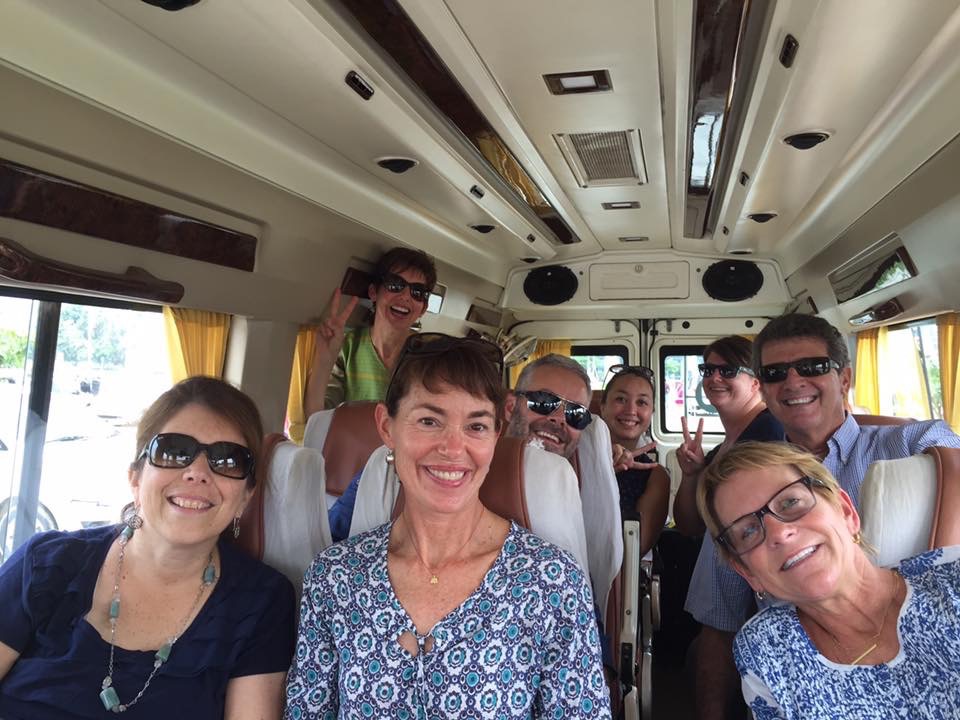
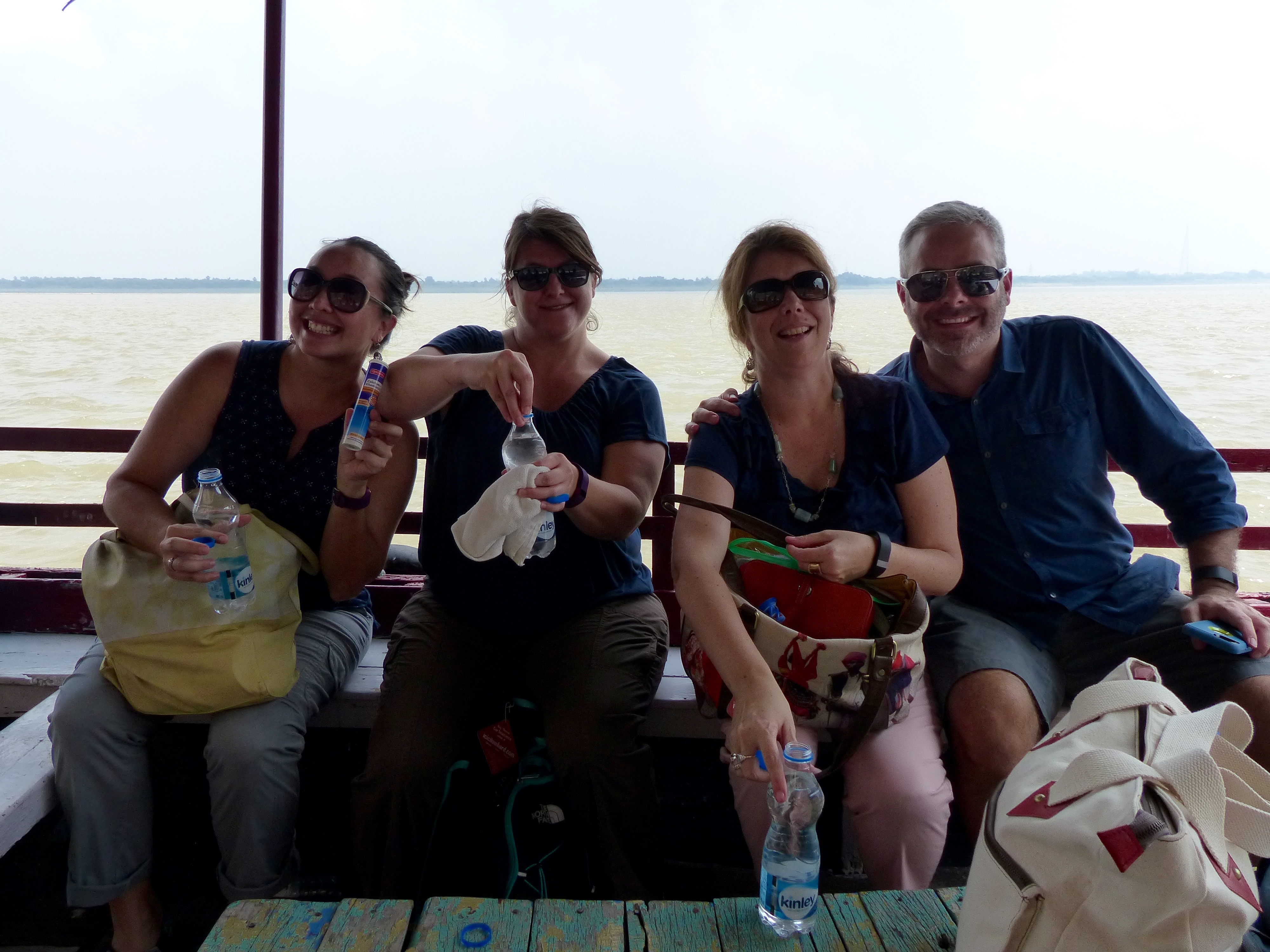
After a short flight and about an hour in a van, our group of eight teachers reached the Ganges River in Varanasi Saturday afternoon.
IMG_0904

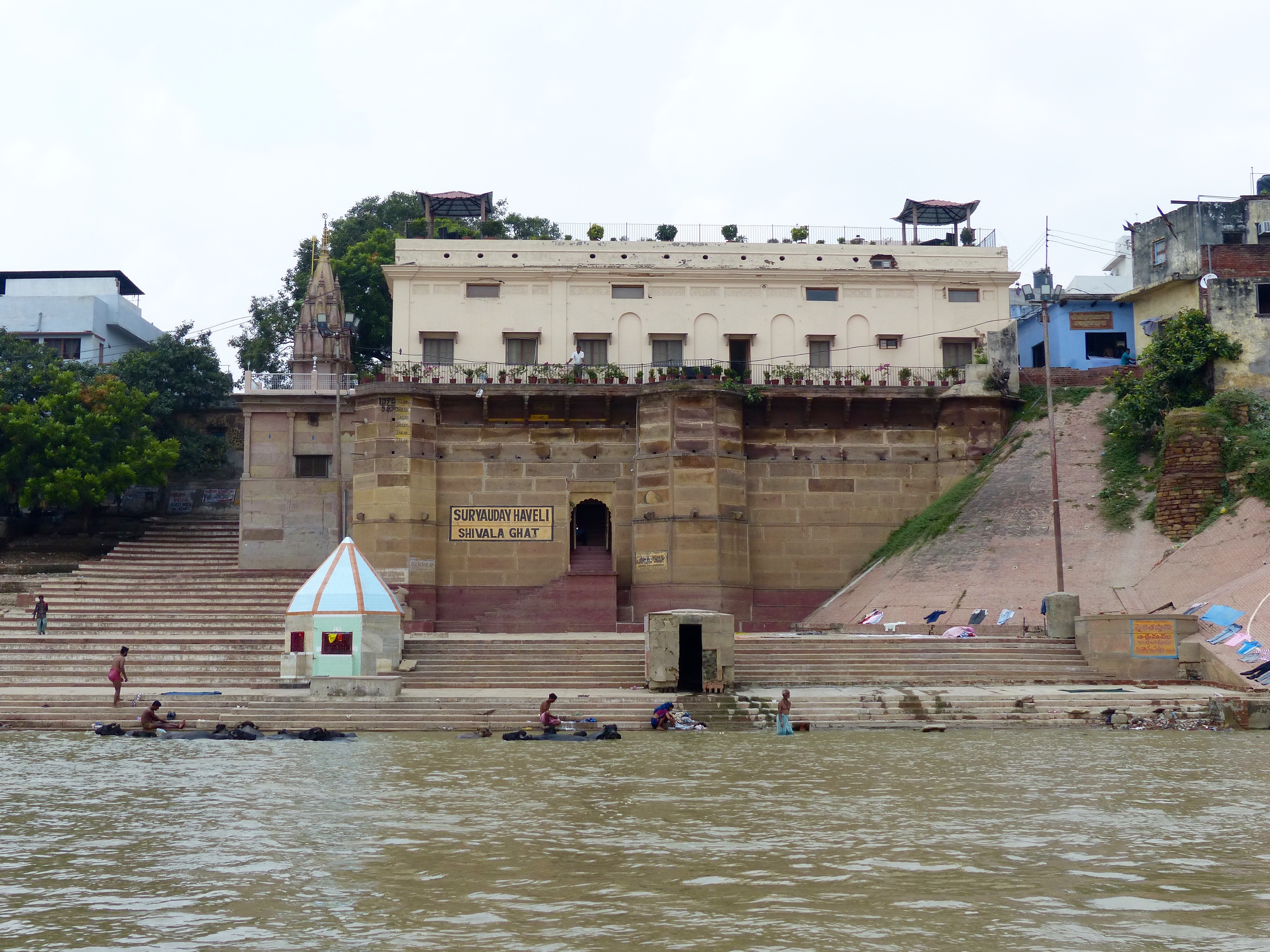
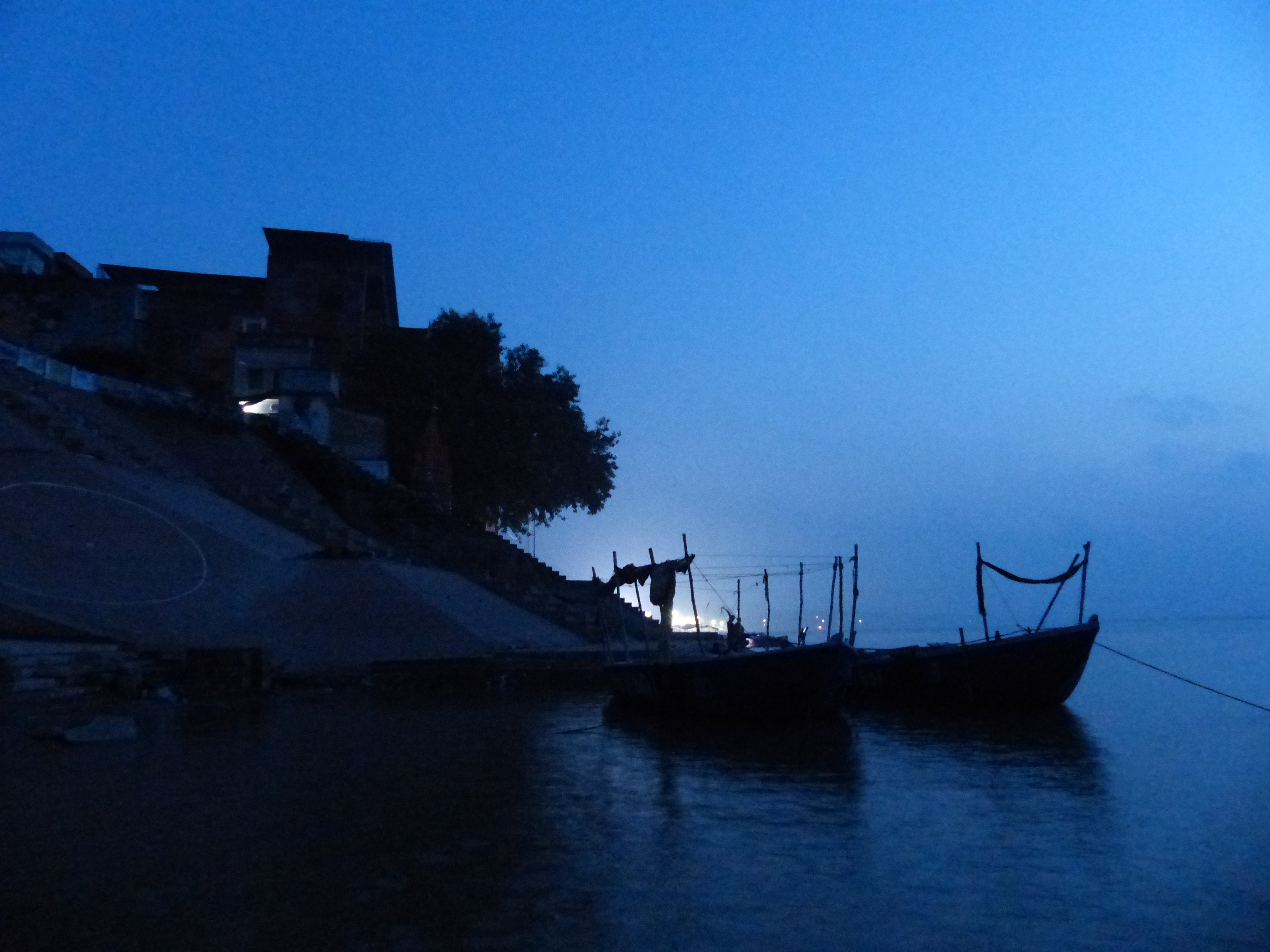
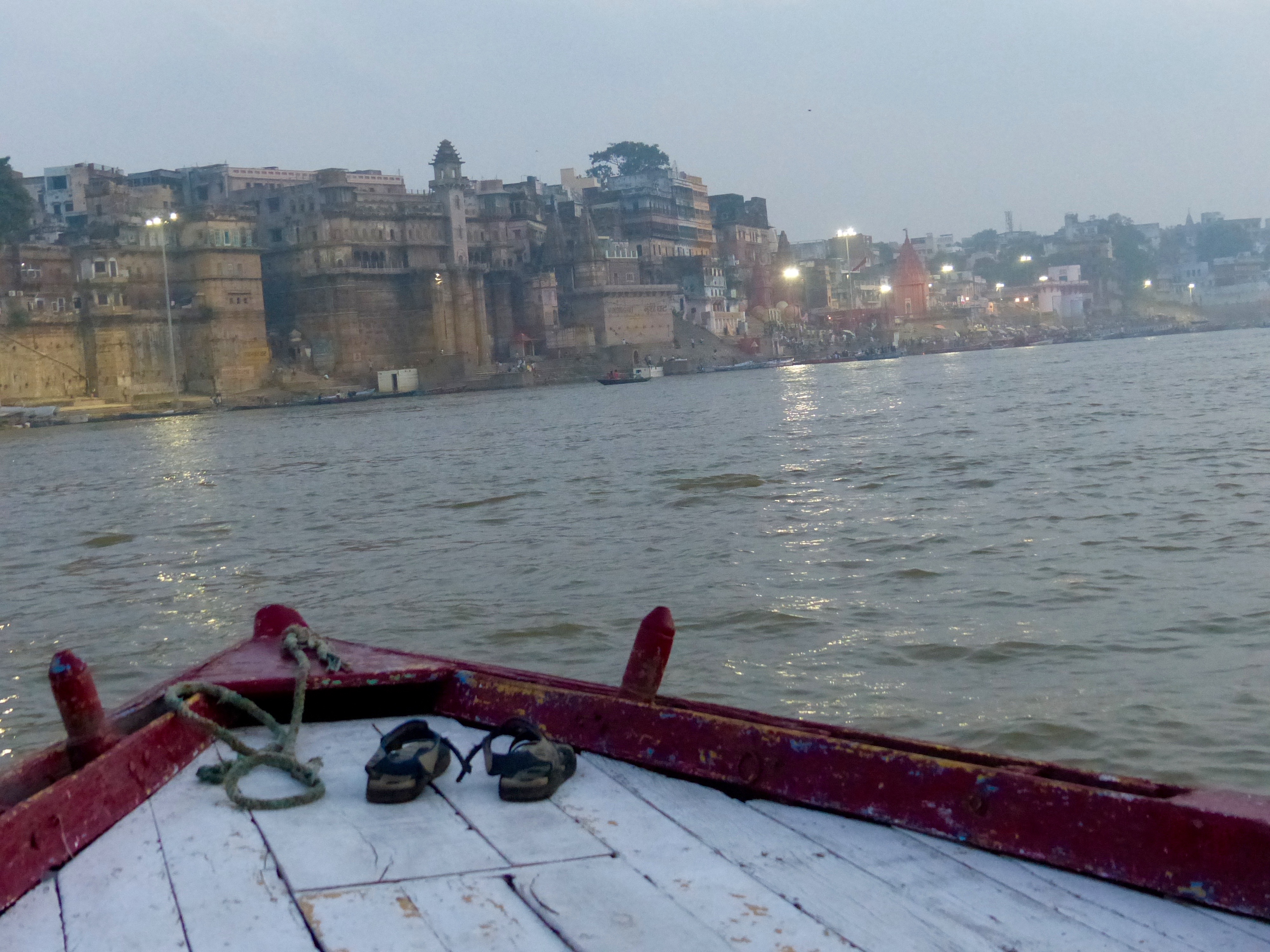
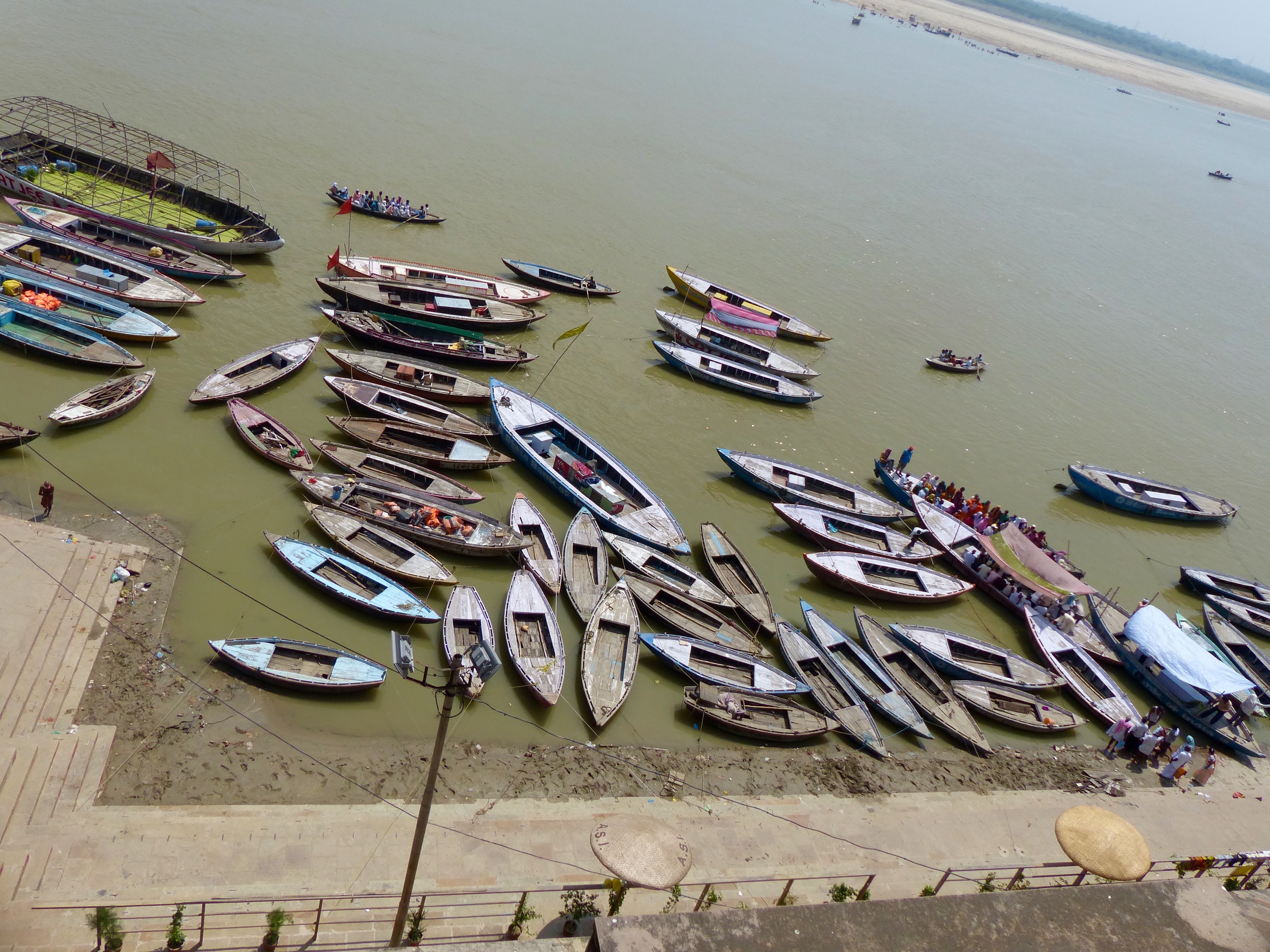
We piled into a wooden motor boat and put-putted upstream to our hotel, Suryauday Haveli.
P1060995

I tried to find some historical information about this beautiful riverfront structure, but every website parrots the blurb on the hotel’s home page (Benaras is another name for Varanasi):

Suryauday Haveli on Shivala Ghats is a reflection of the spirit of the holy city of Benaras. The Haveli traces its history back to the early 20th century. It was built by the Royal Family of Nepal as a retreat for the aged. It’s now been painstakingly put together again to provide the best ghat experience in Benaras.

P1070004

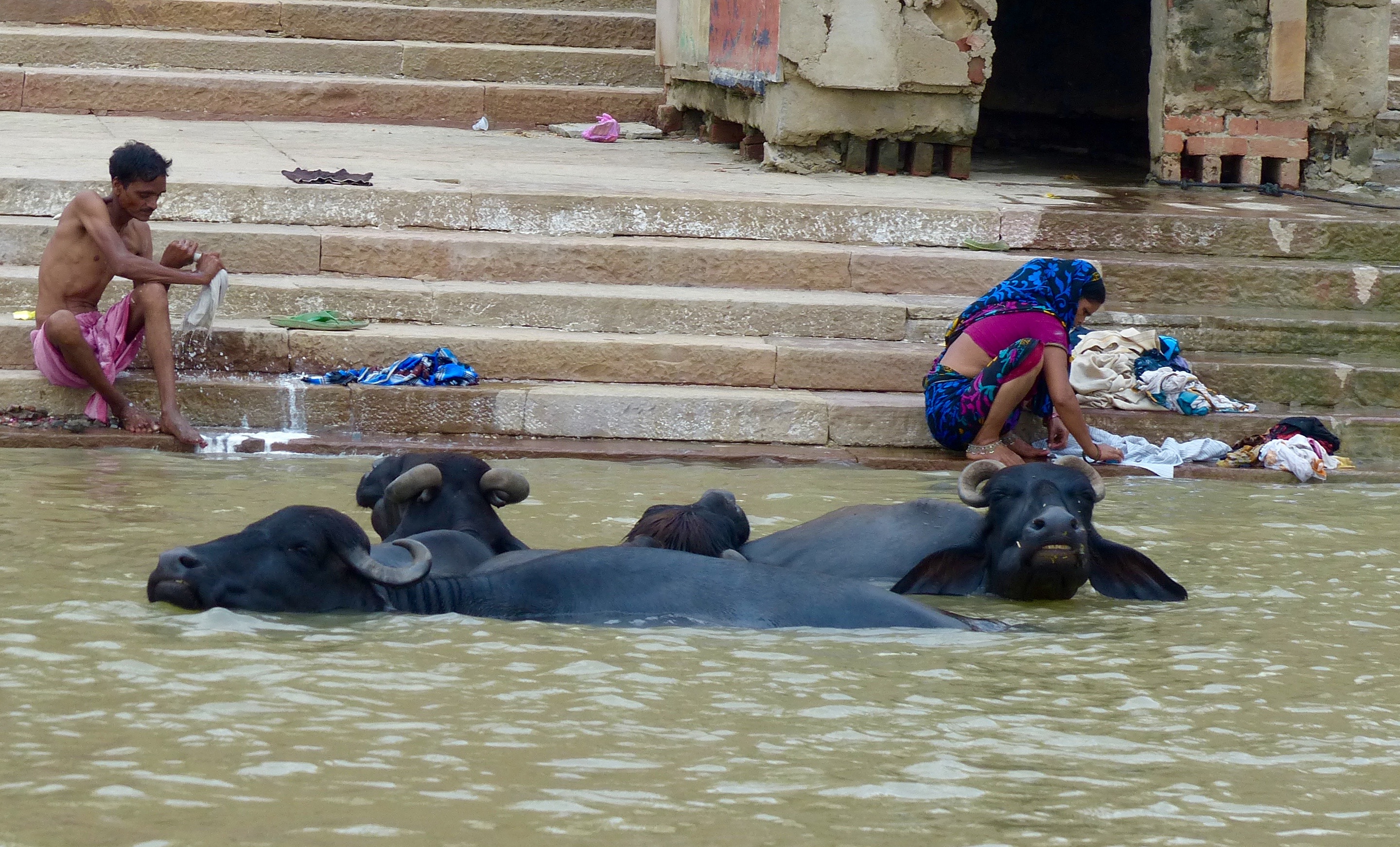
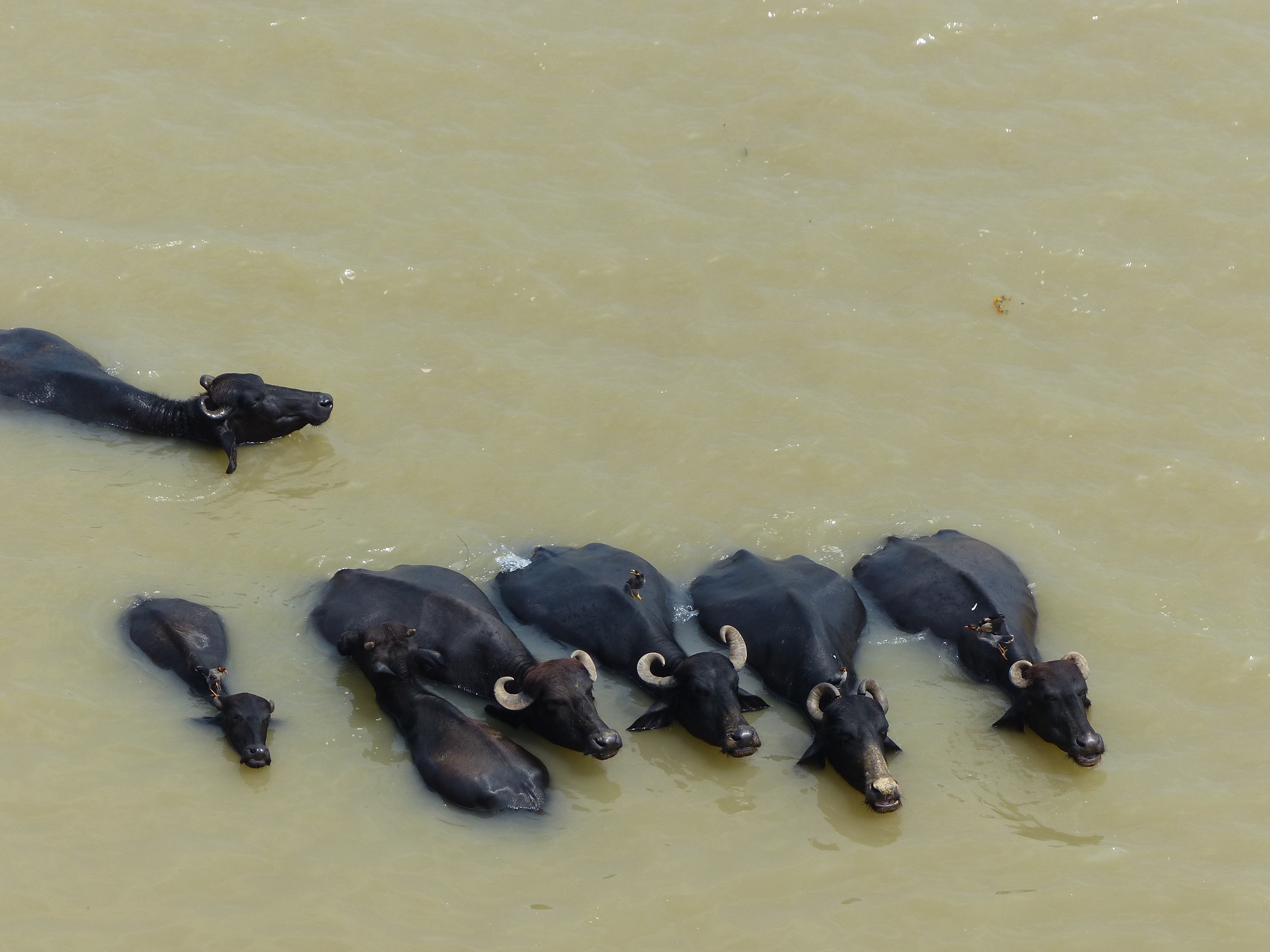
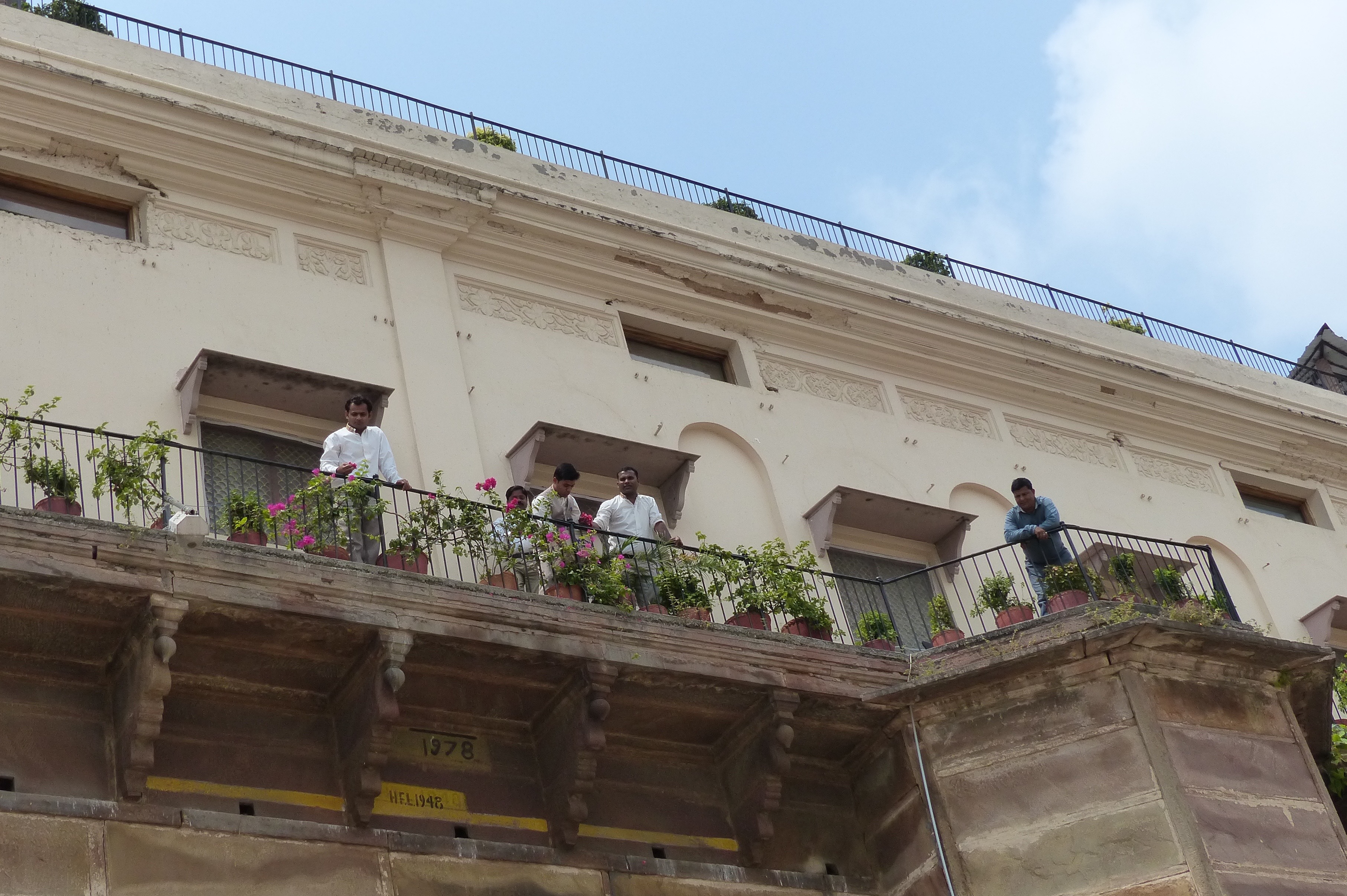
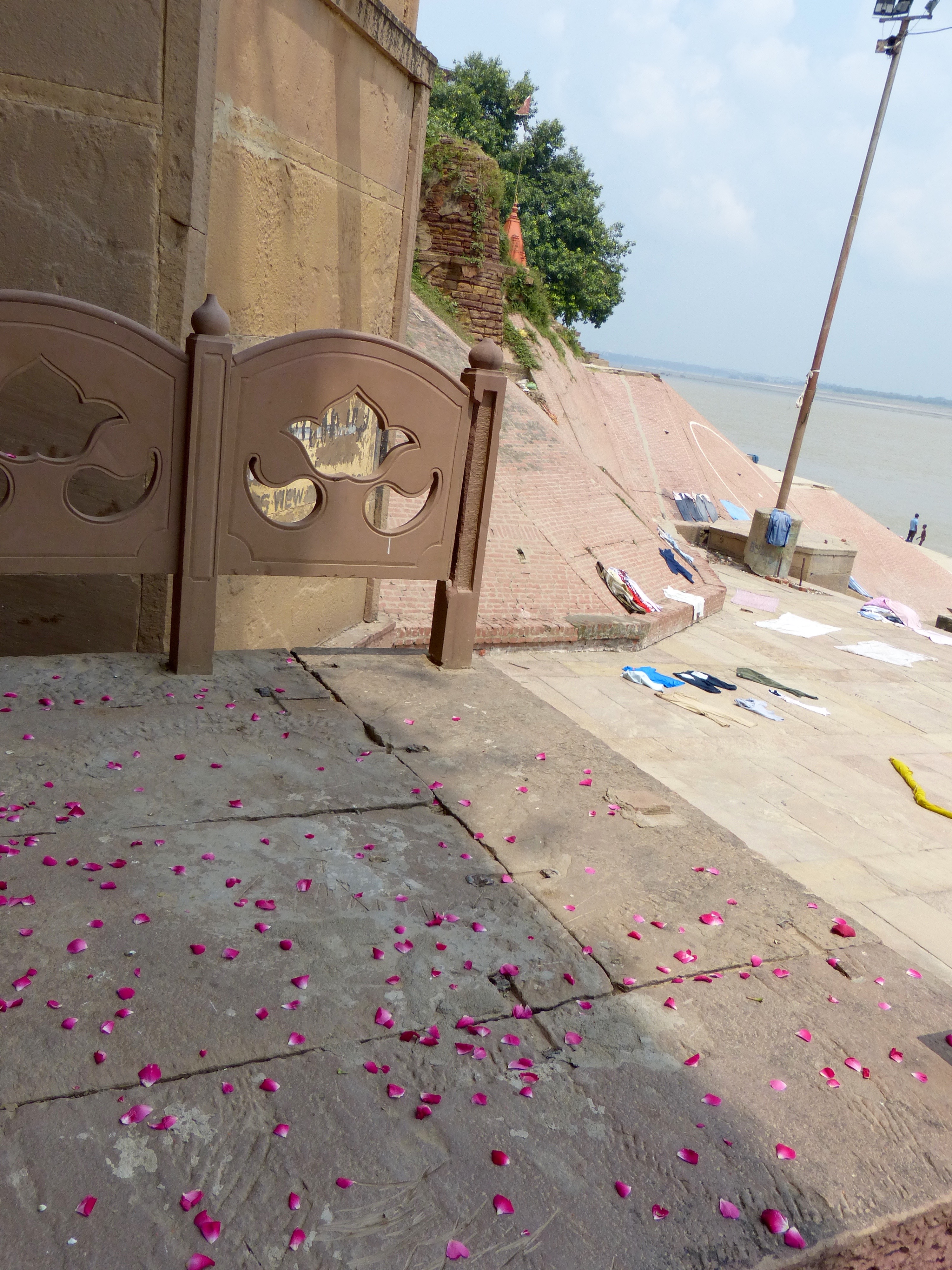
Ghat refers to the series of steps that lead from the building to the water. Suryauday Haveli is located at Shivala Ghat, which fortunately (and unlike many other ghats), didn’t have too many stairs. It did, however, feature a little herd of waterbuffalo cooling off ears-deep in the holy water. The hotel staff welcomed us with a shower of rose petals from the balcony.
P1070005

P1070021

P1070011

P1070013

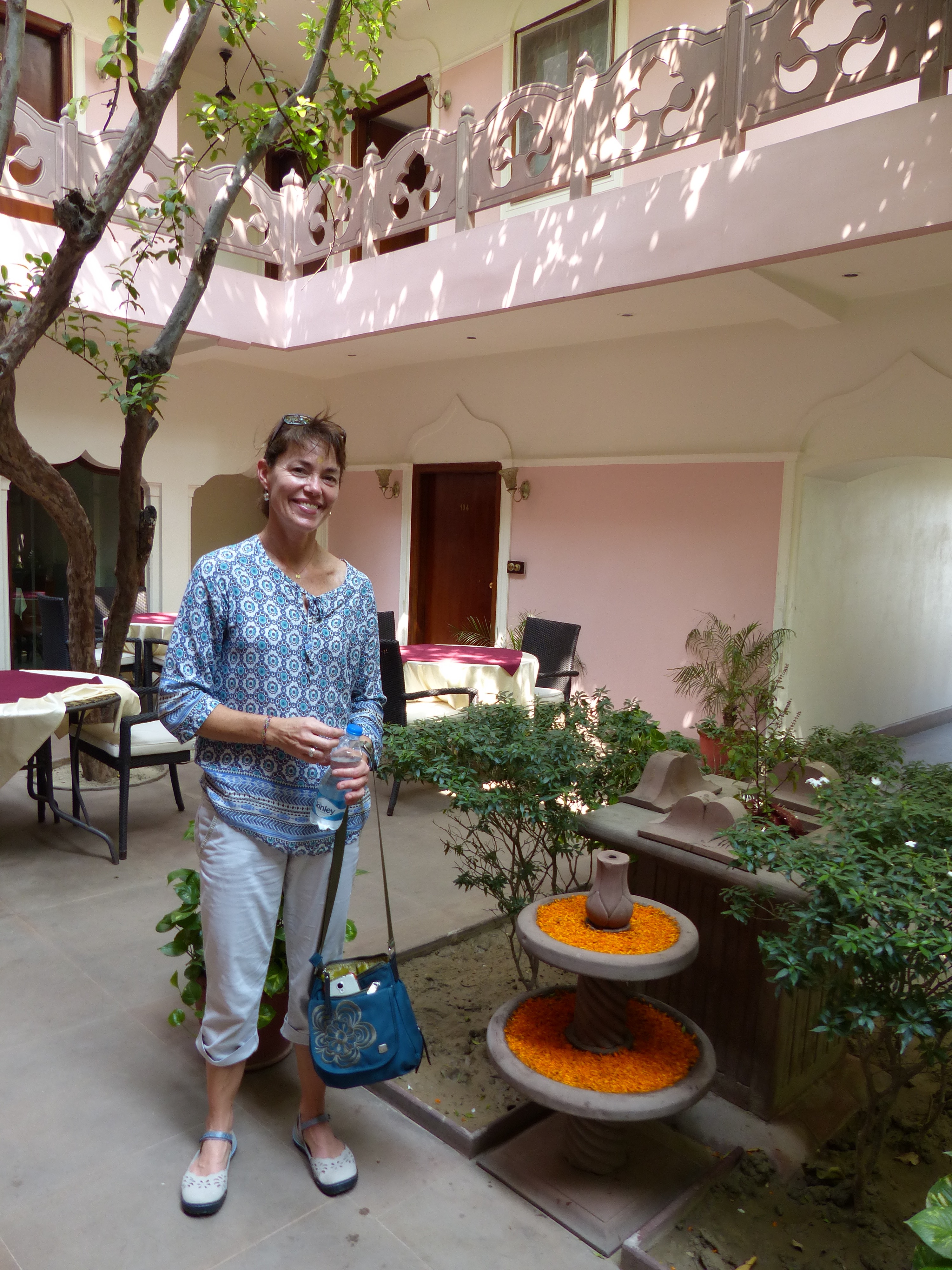
Our rooms all faced the river and opened to a courtyard shaded by trees and decorated with marigold blossoms.
Here’s Sarah, my roomie for the weekend.
P1070023

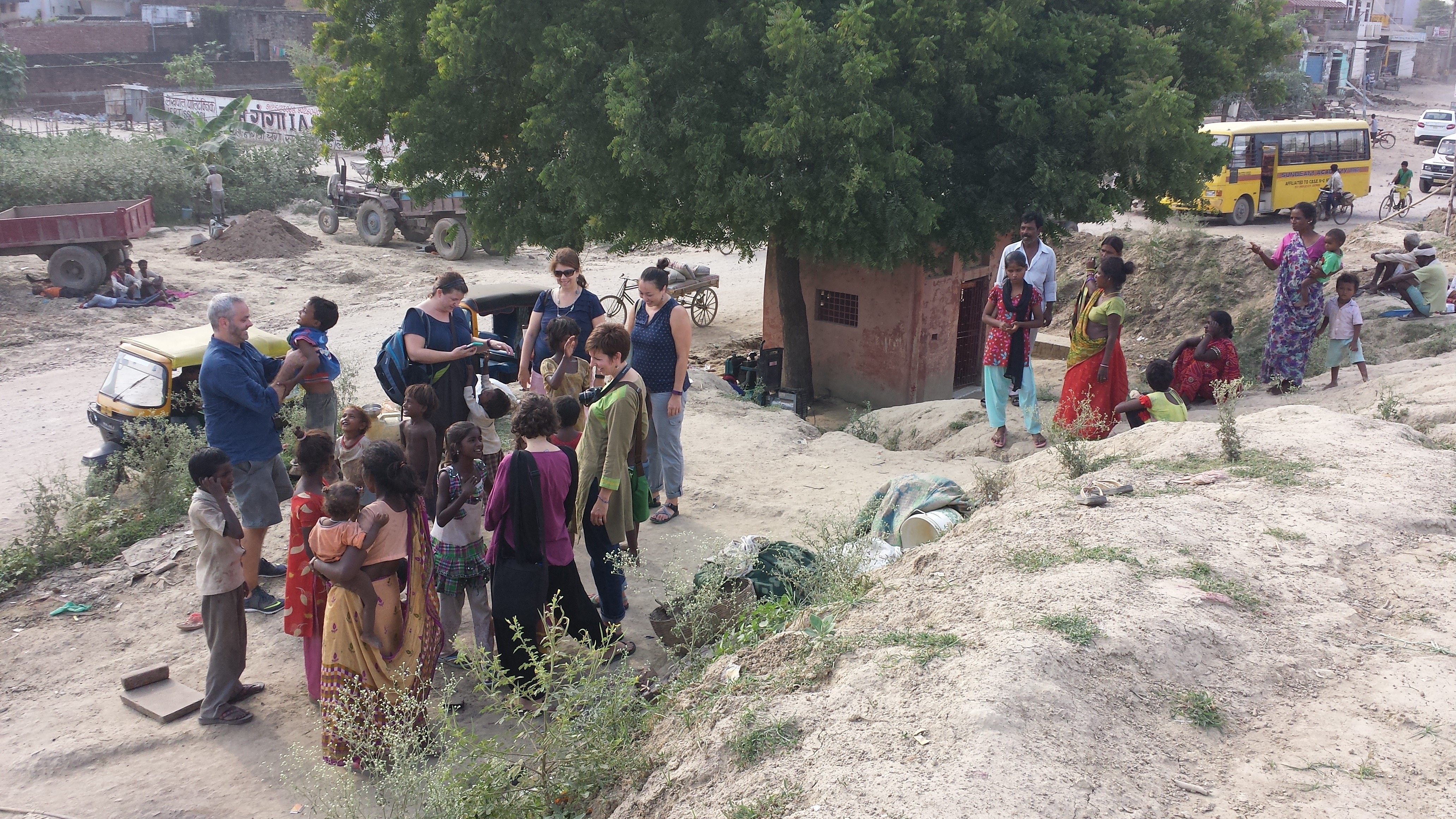
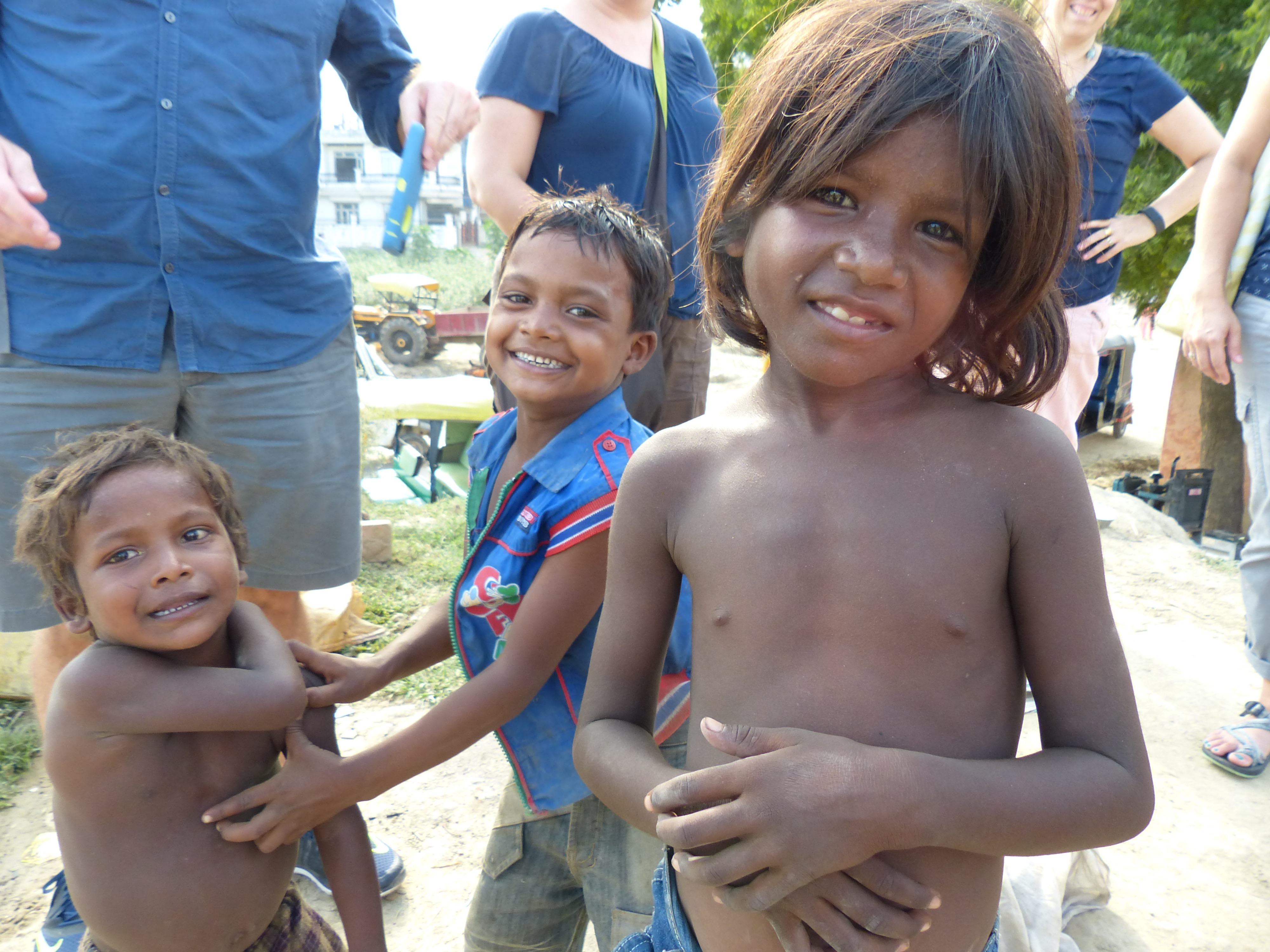
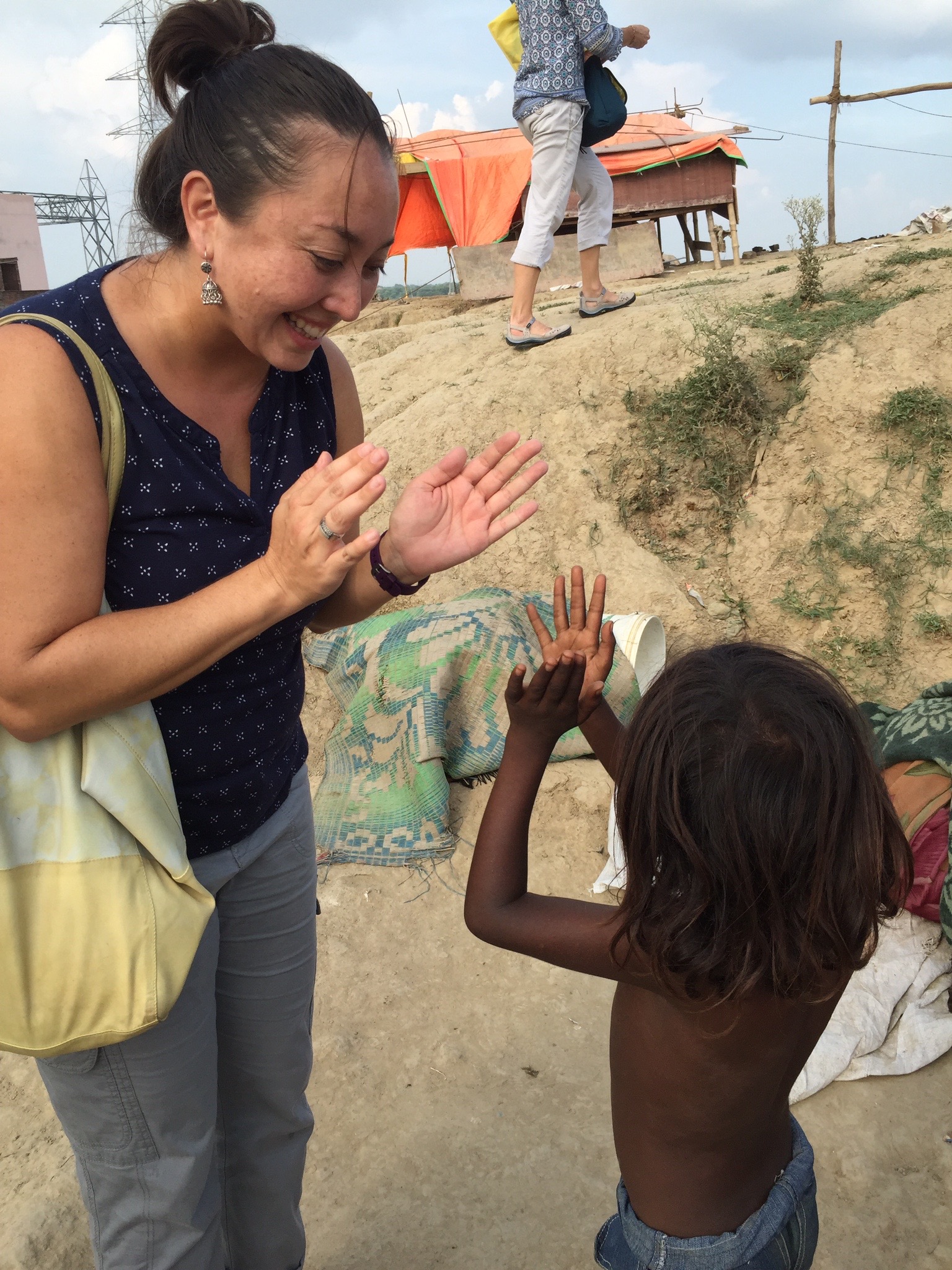
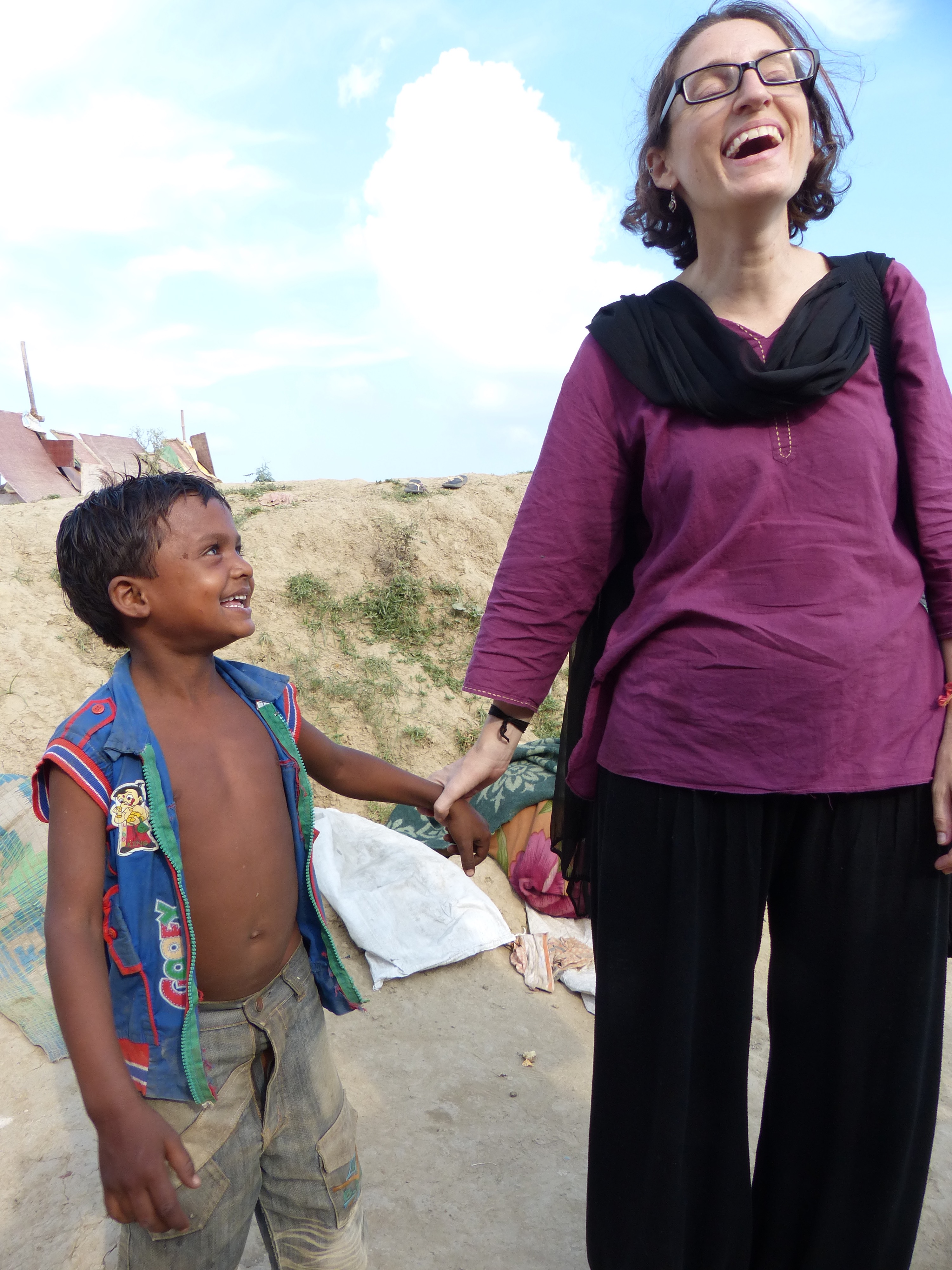
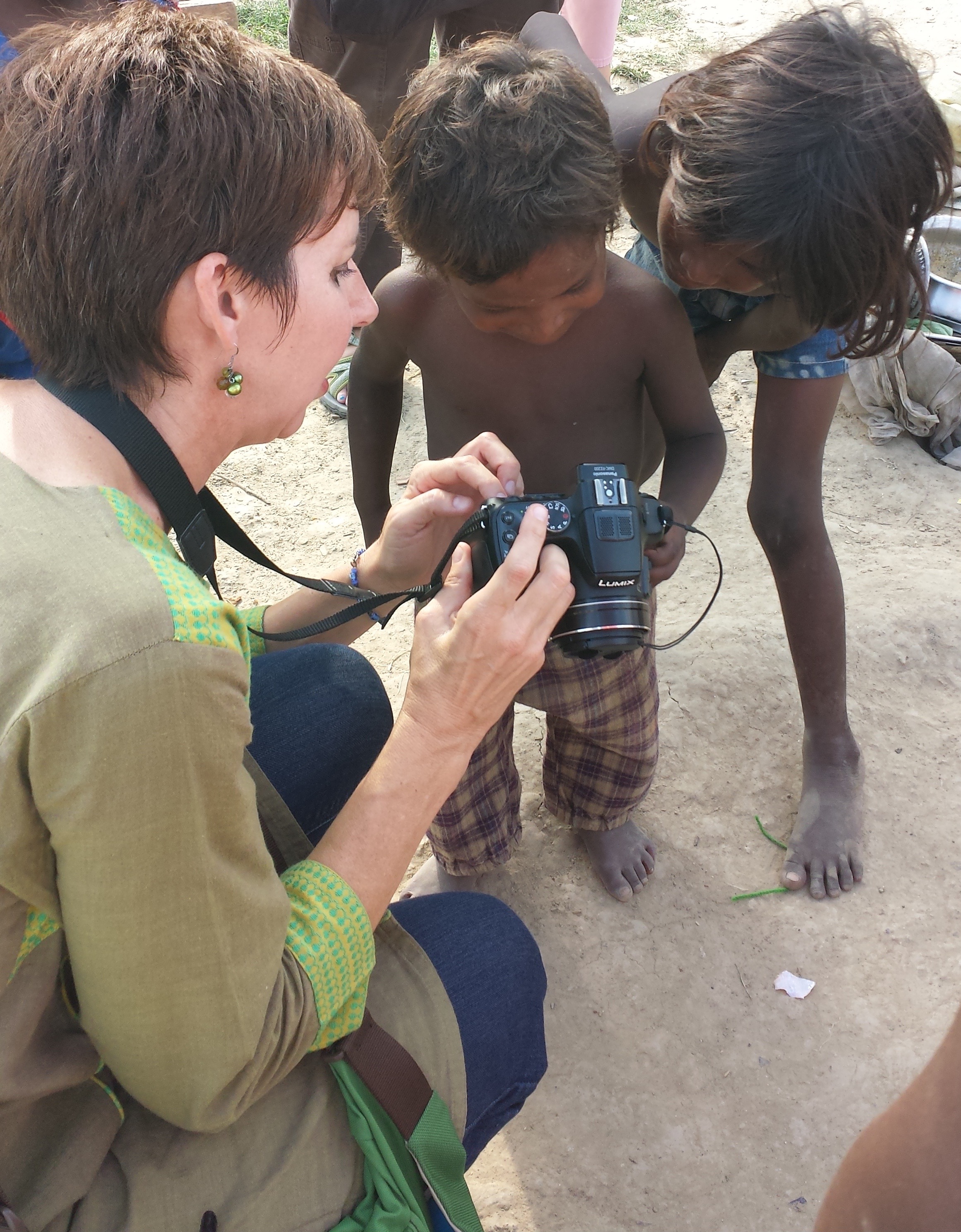
After awhile, we met up with former AES teacher, Jill, who started Lotus Foundation here to provide education, health care and job training to children and young adults from the Varanasi slums. On the way to see her school and hostel, we stopped to meet some of the children who benefit. As soon as we climbed out of the auto rickshaws at the banks of the Ganges, children and their mothers approached to meet the strangers and chat with Jill. The little ones immediately engaged us in jumping and clapping, despite the language barrier. We snapped photos and showed them the images, which triggered hysterical giggling. We also visited Jill’s humble school, where up to 20 students receive a free education, and her small hostel, where a few young girls can sleep safely. Her foundation is presently busy with renovations as they prepare to open a guesthouse and restaurant, offering job training to people living in poverty.

play with kids

P1070040

Marina plays a clapping game with Radha.
IMG_0014

Jill shares a laugh with little Veer.
P1070034 (1)

Showing my photos to the kids was hilarious.
20150912_154308 (1)

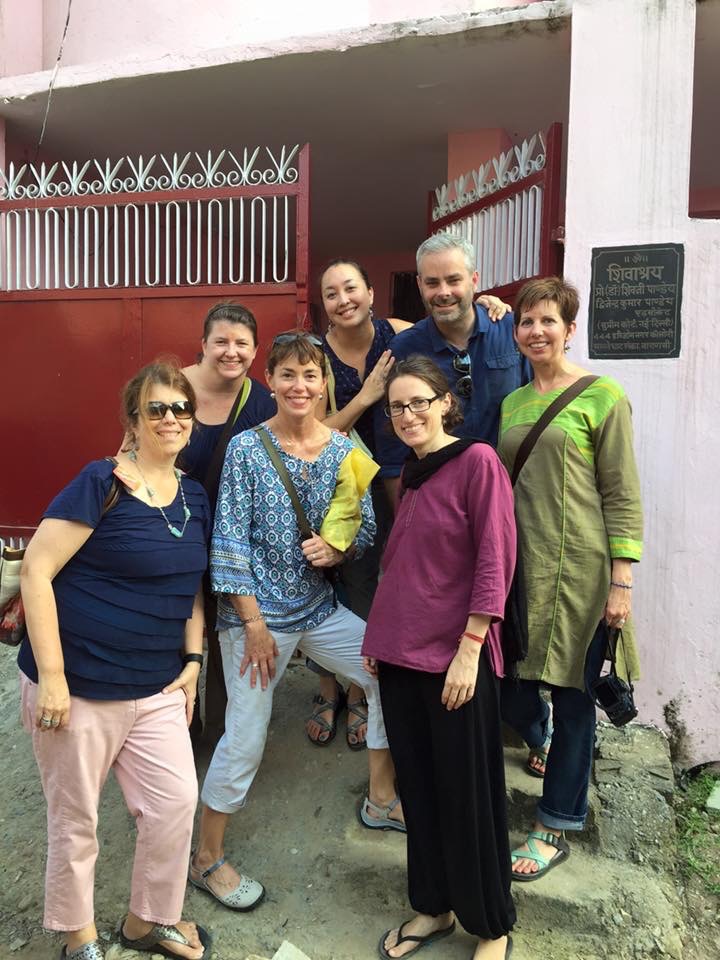
Posing in front of Jill’s school.
IMG_0906

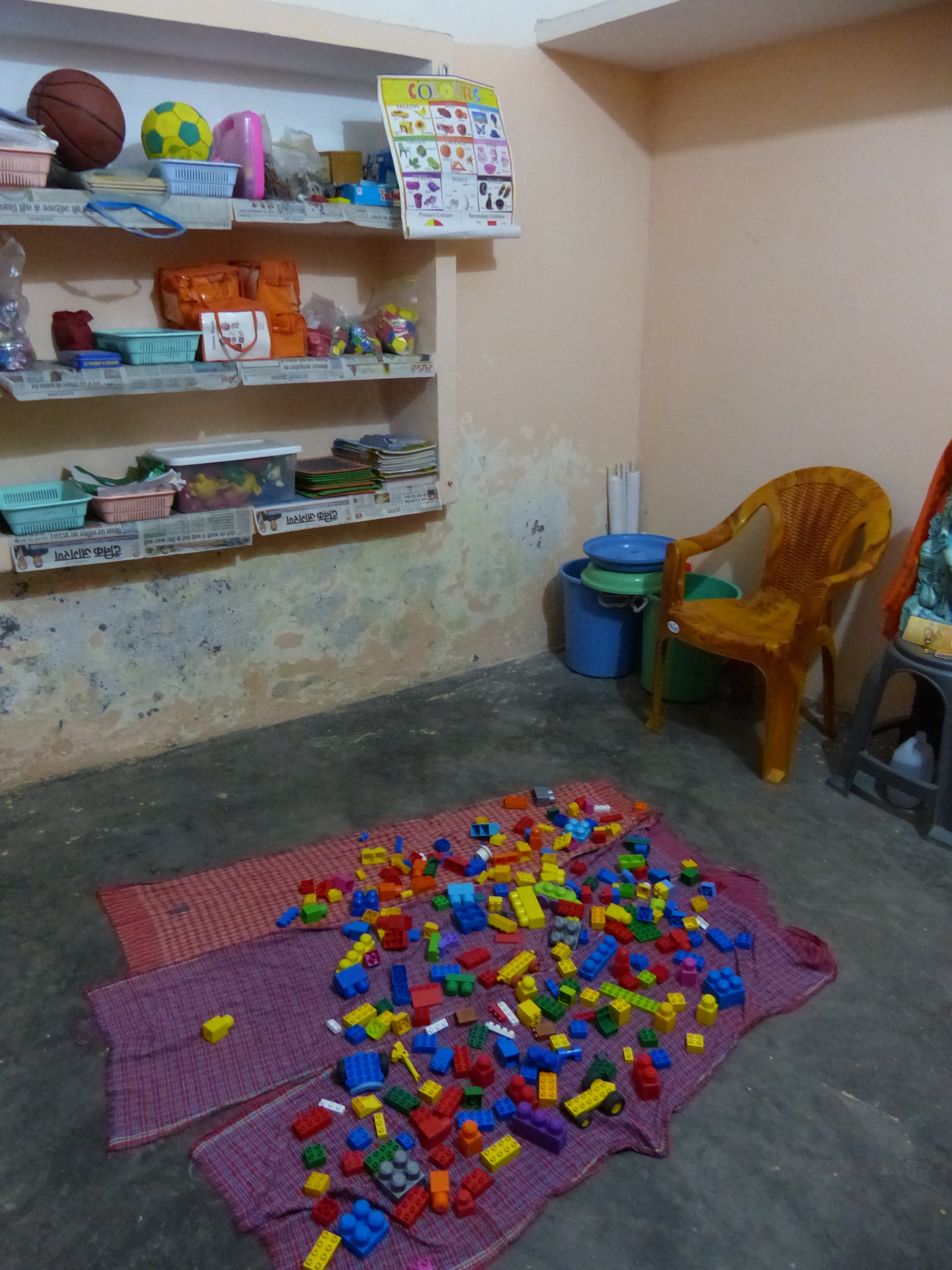
The playroom. Kids do most of their learning in another room, sitting on mats.
P1070056

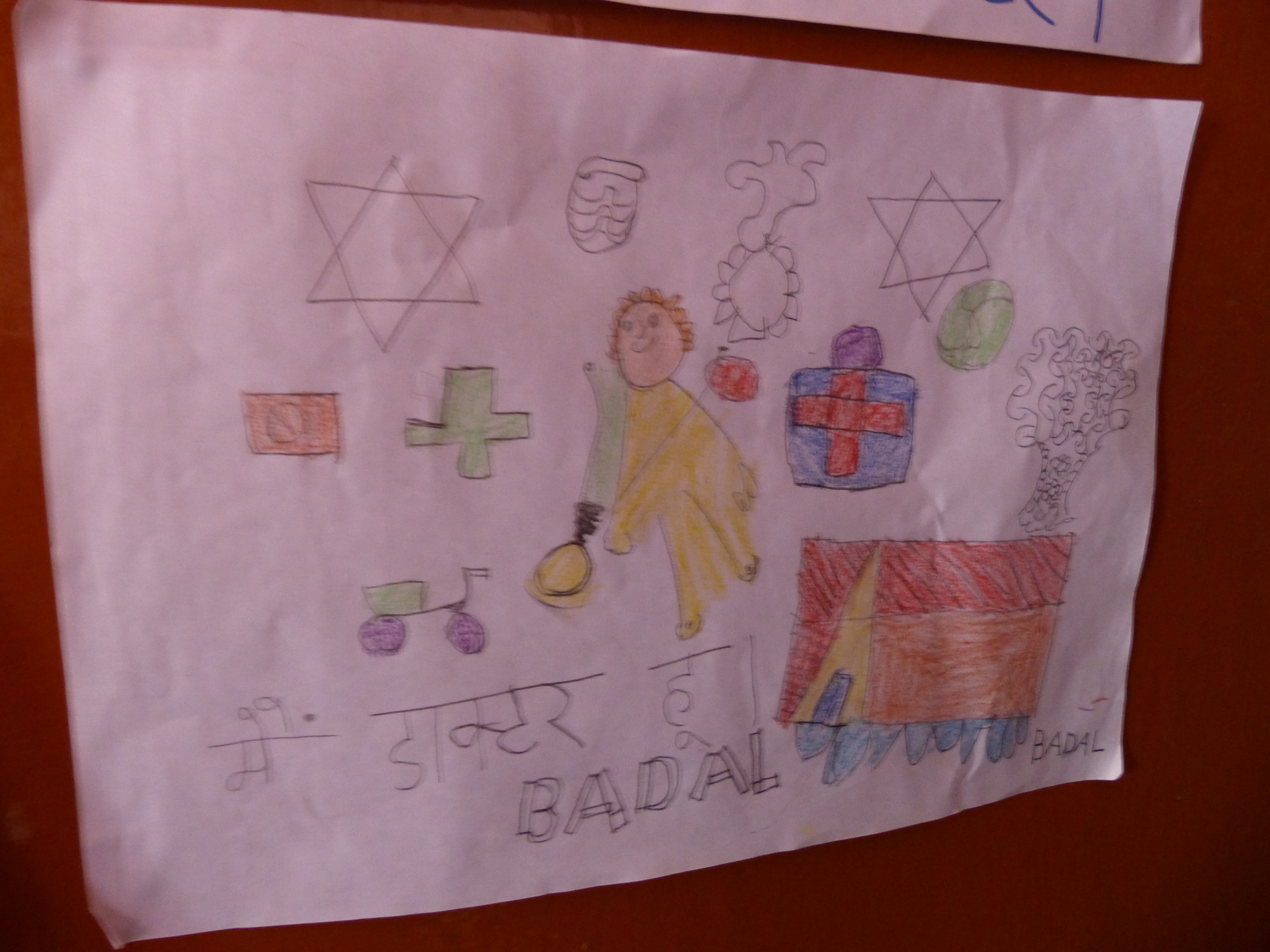
Badal wrote in Hindi, “I am a doctor.”
P1070057

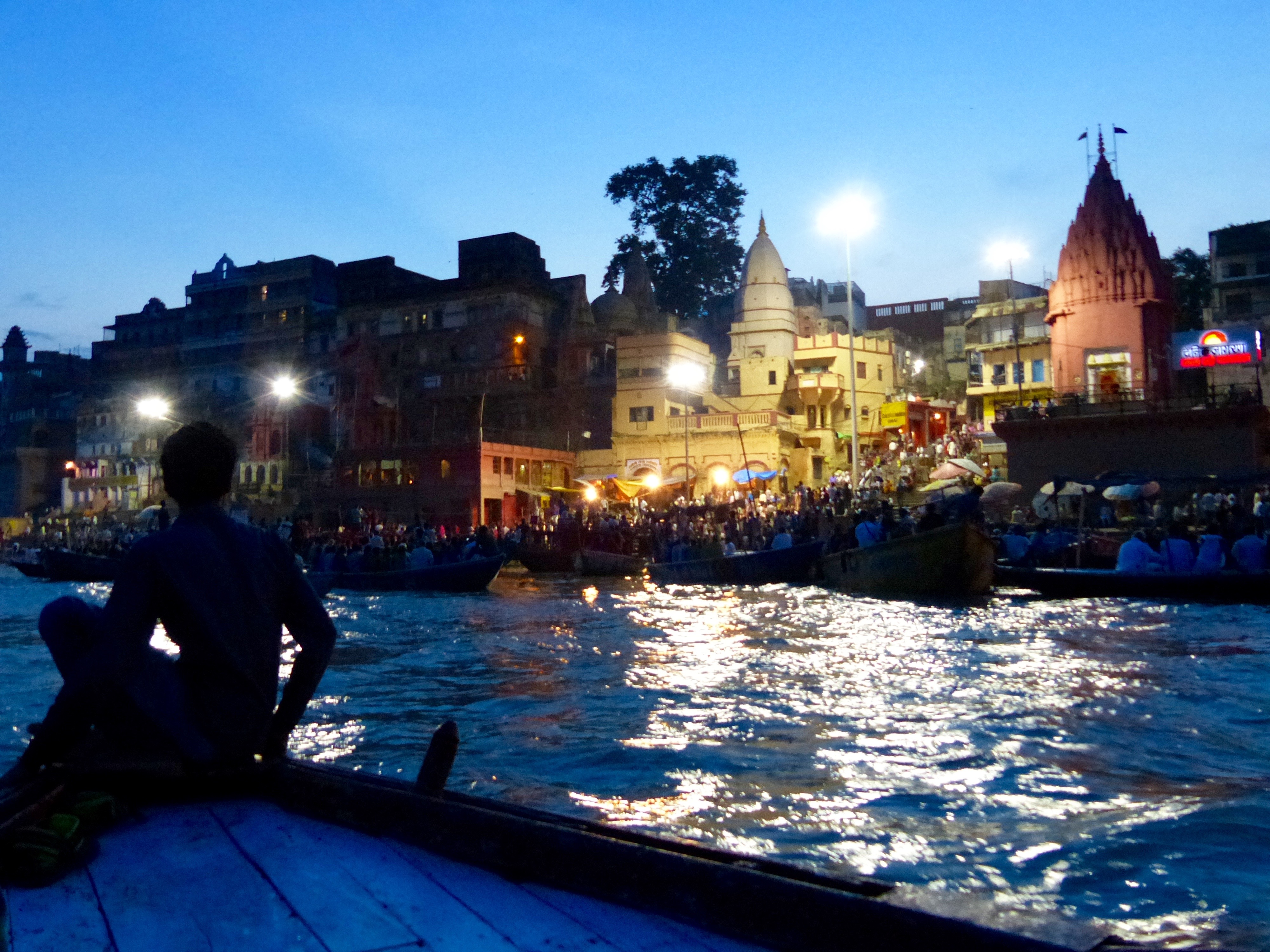
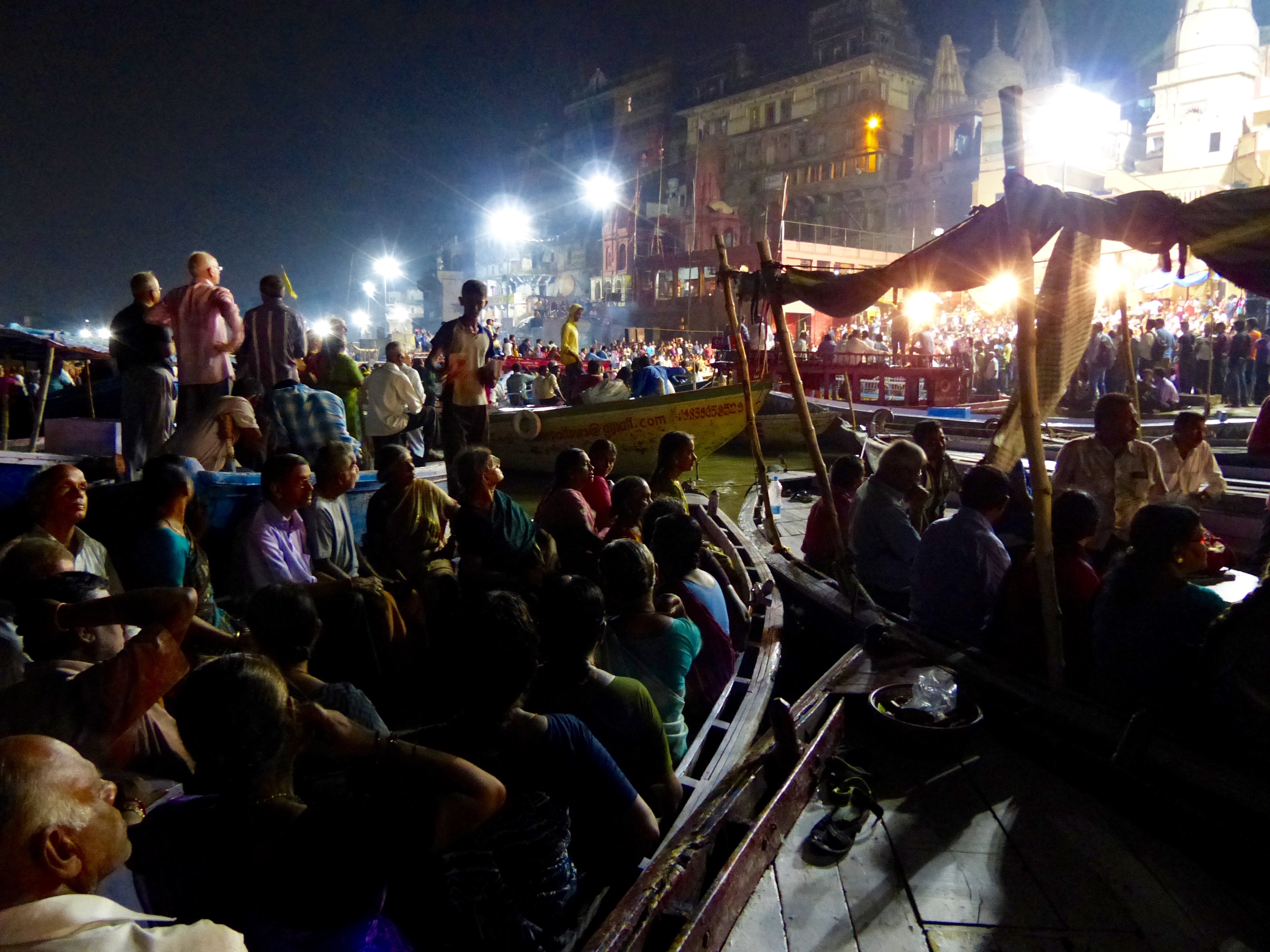
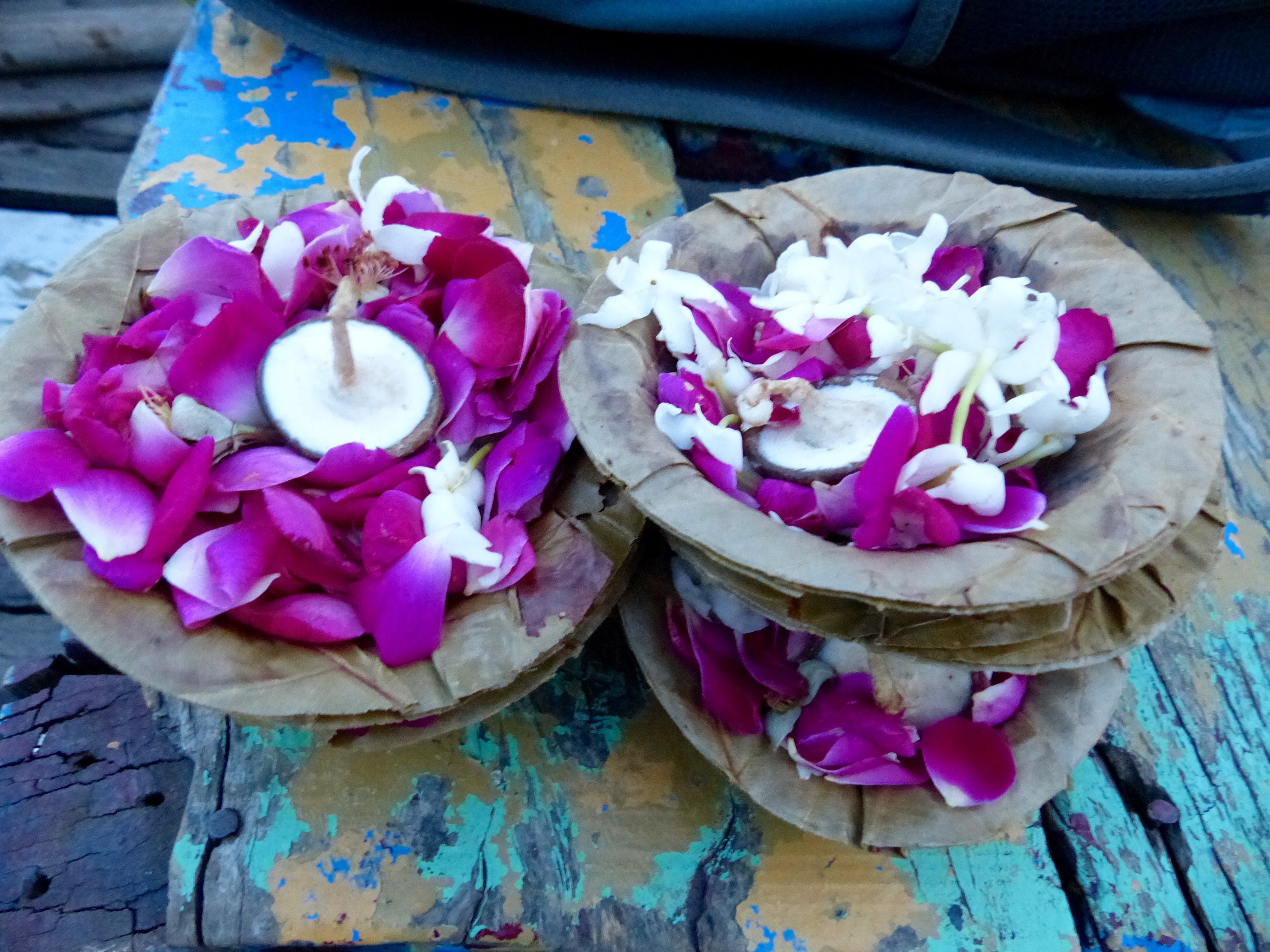
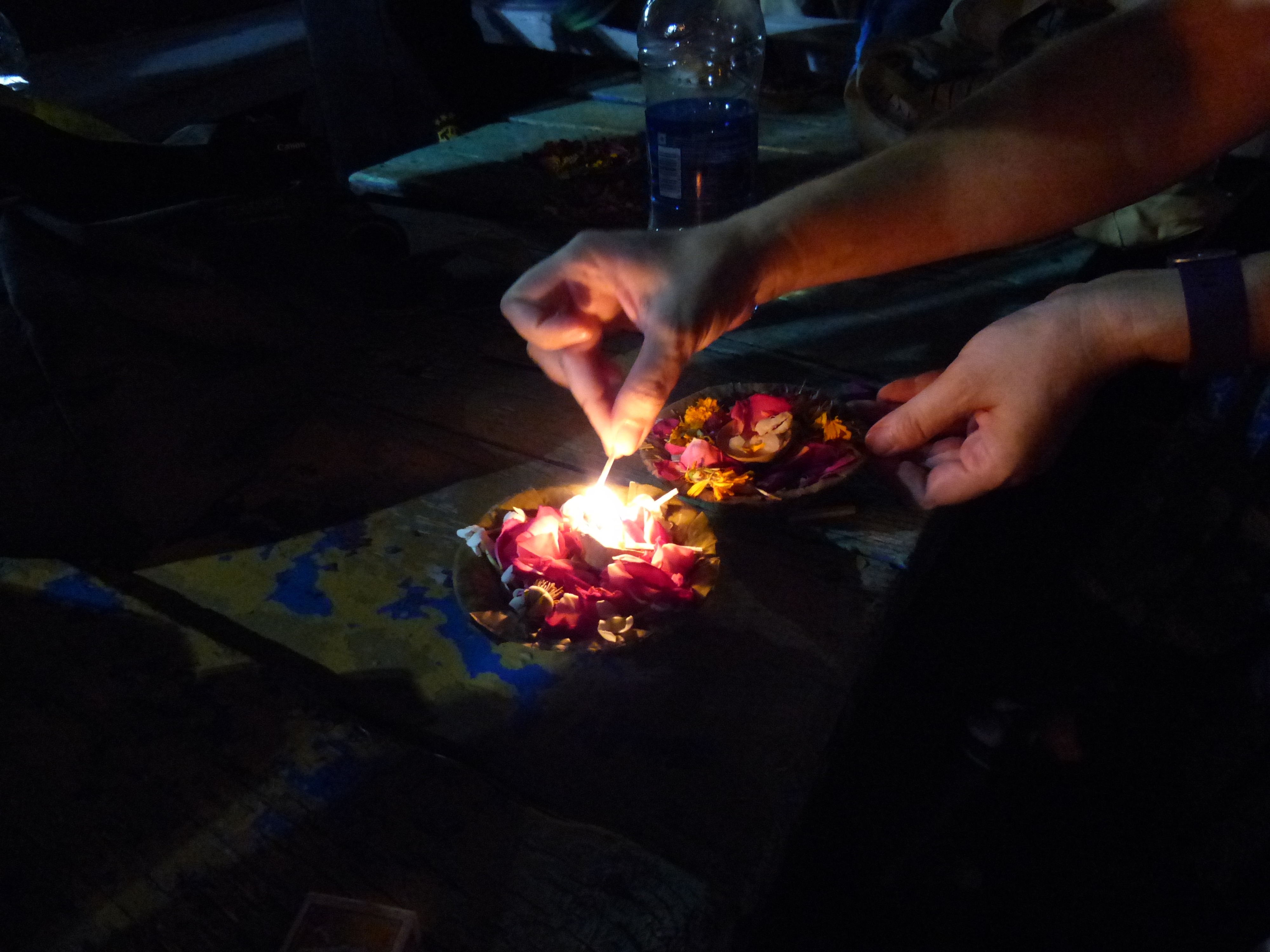
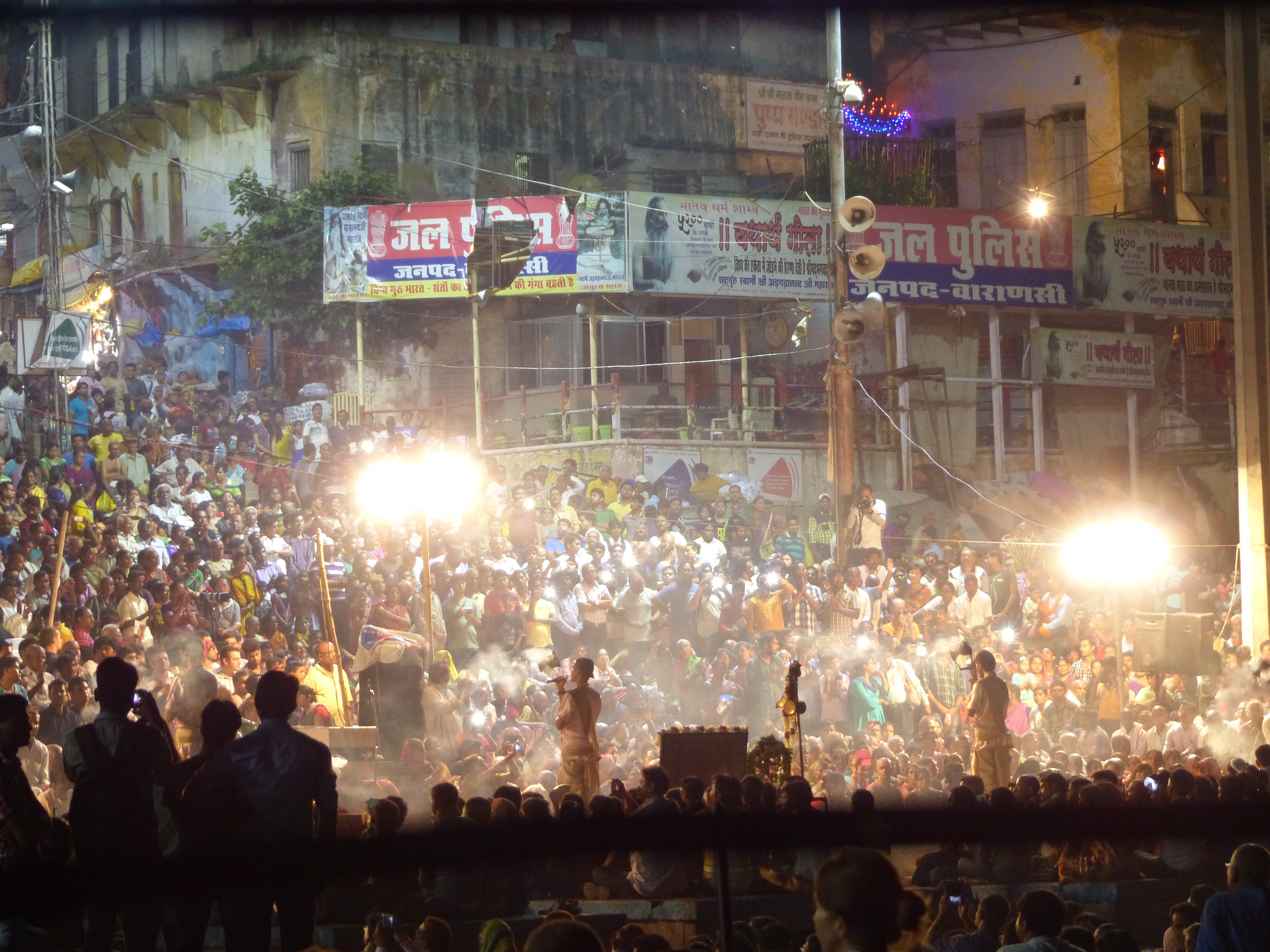
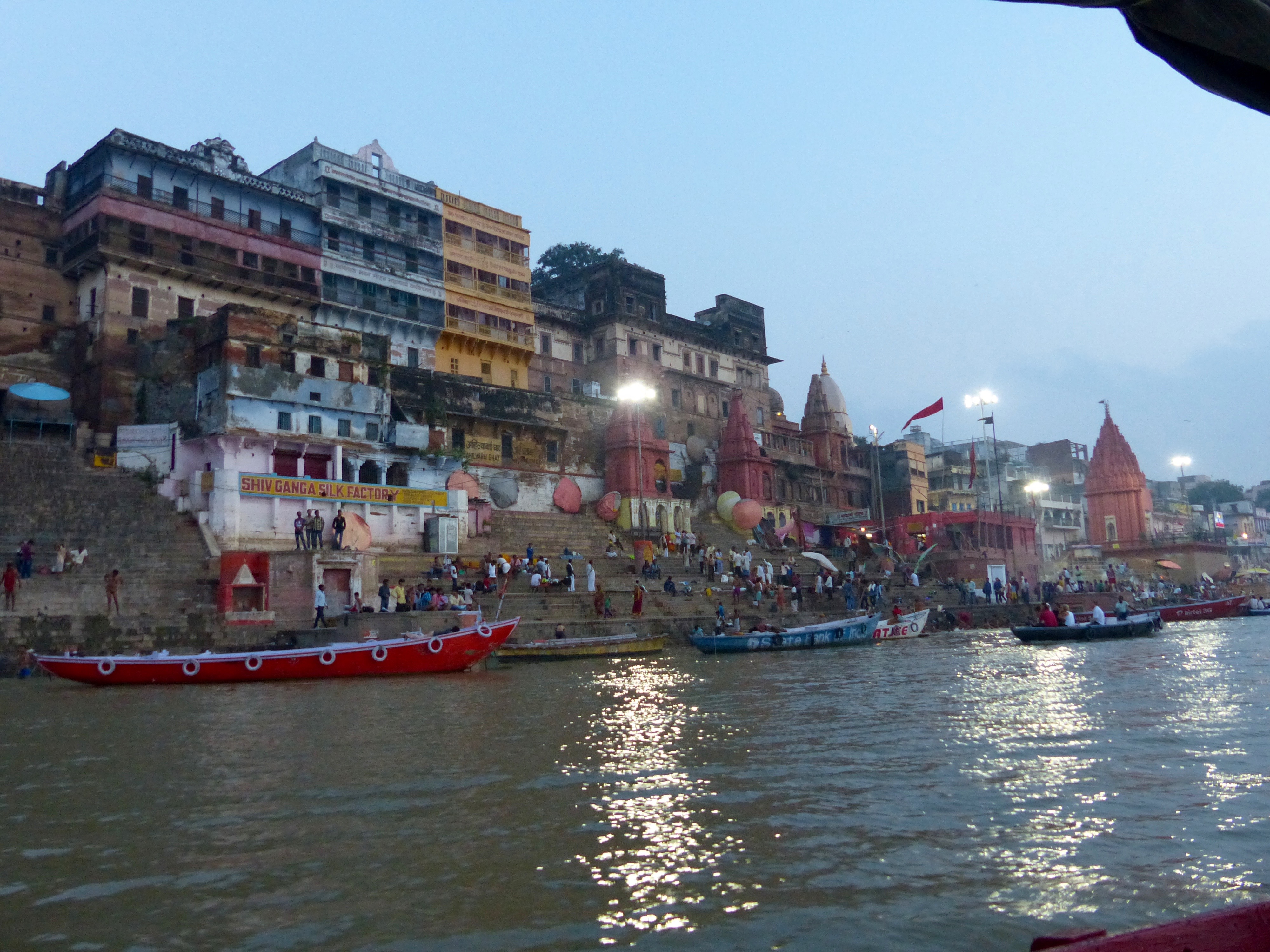
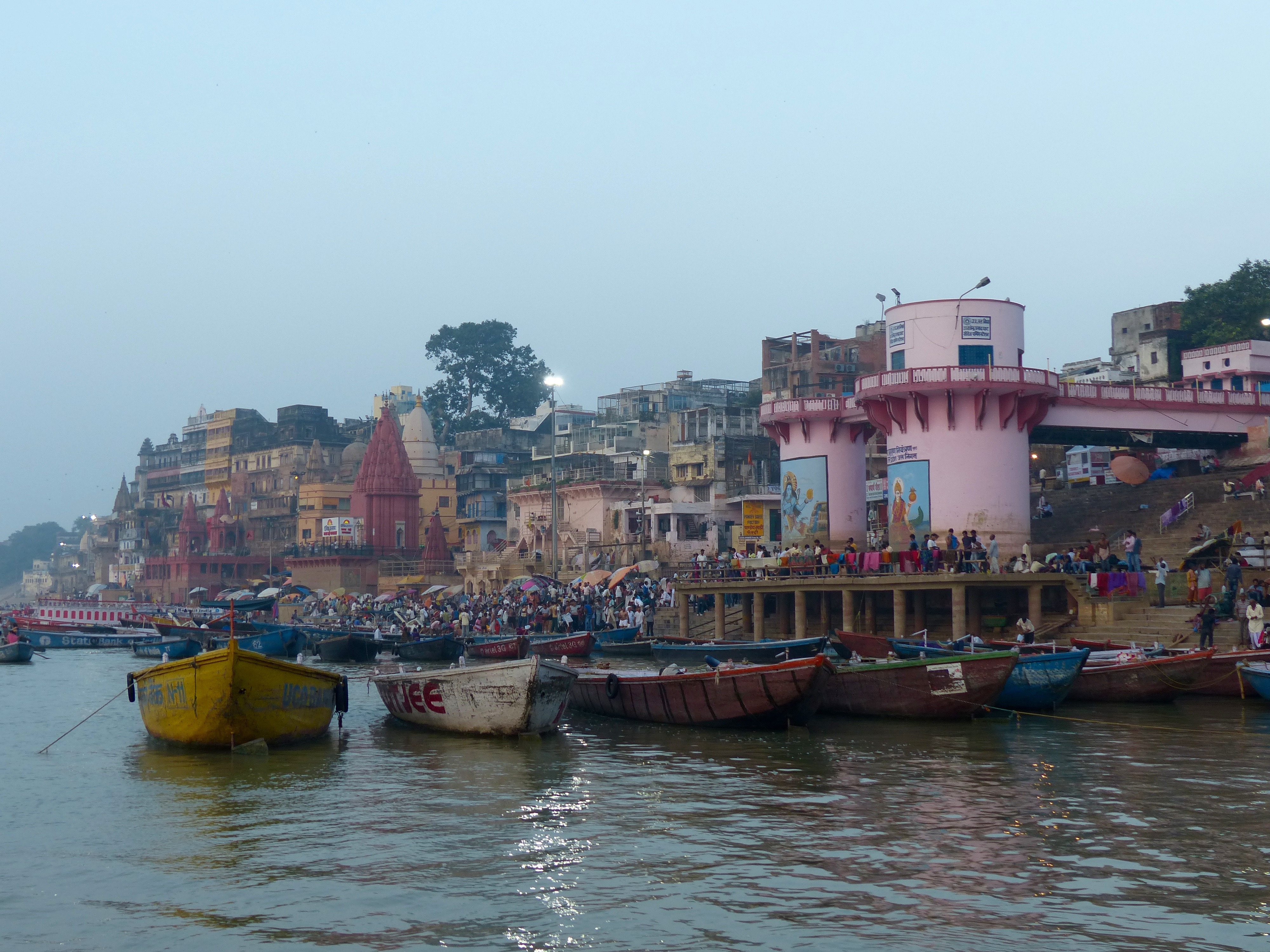
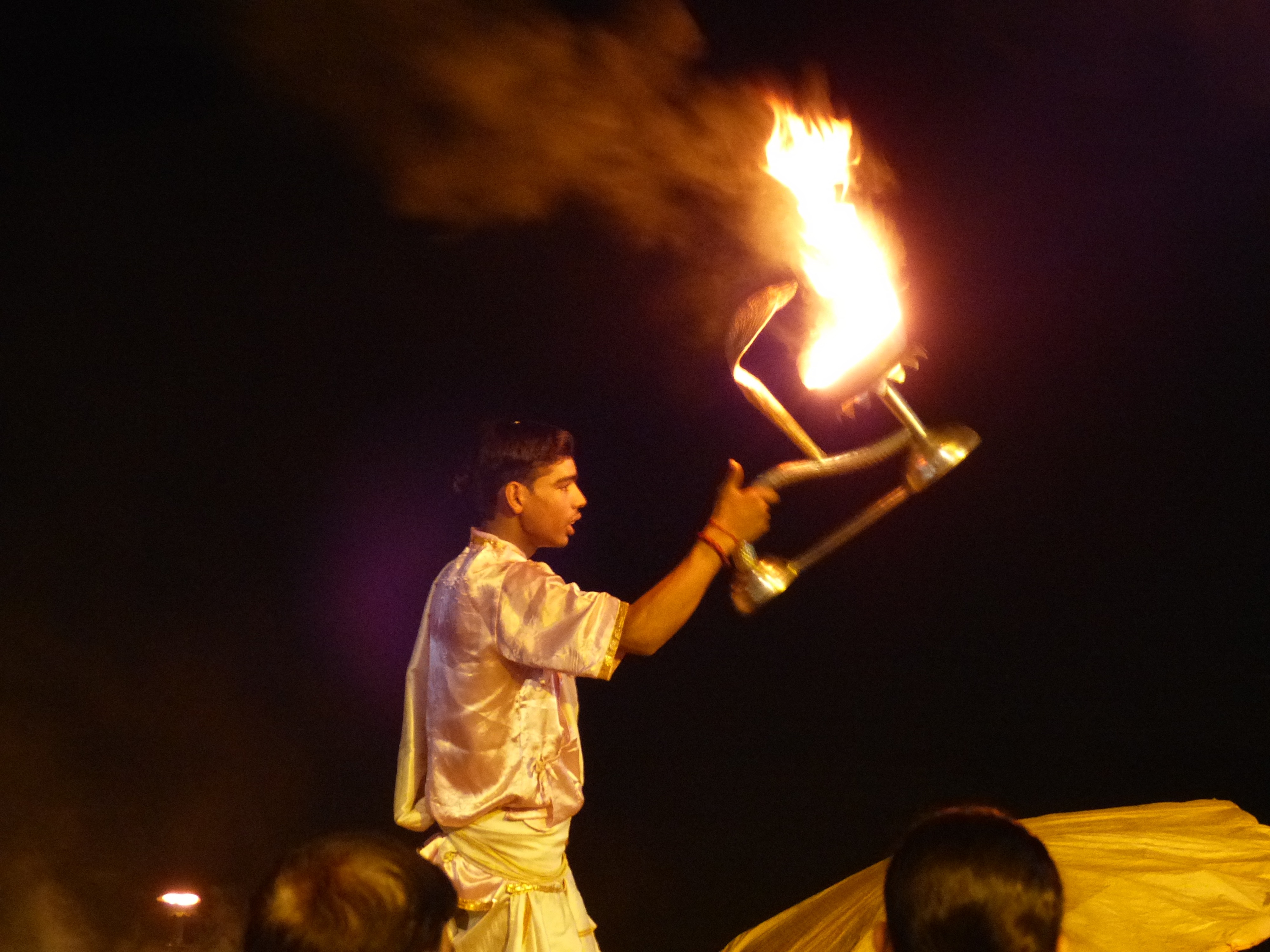
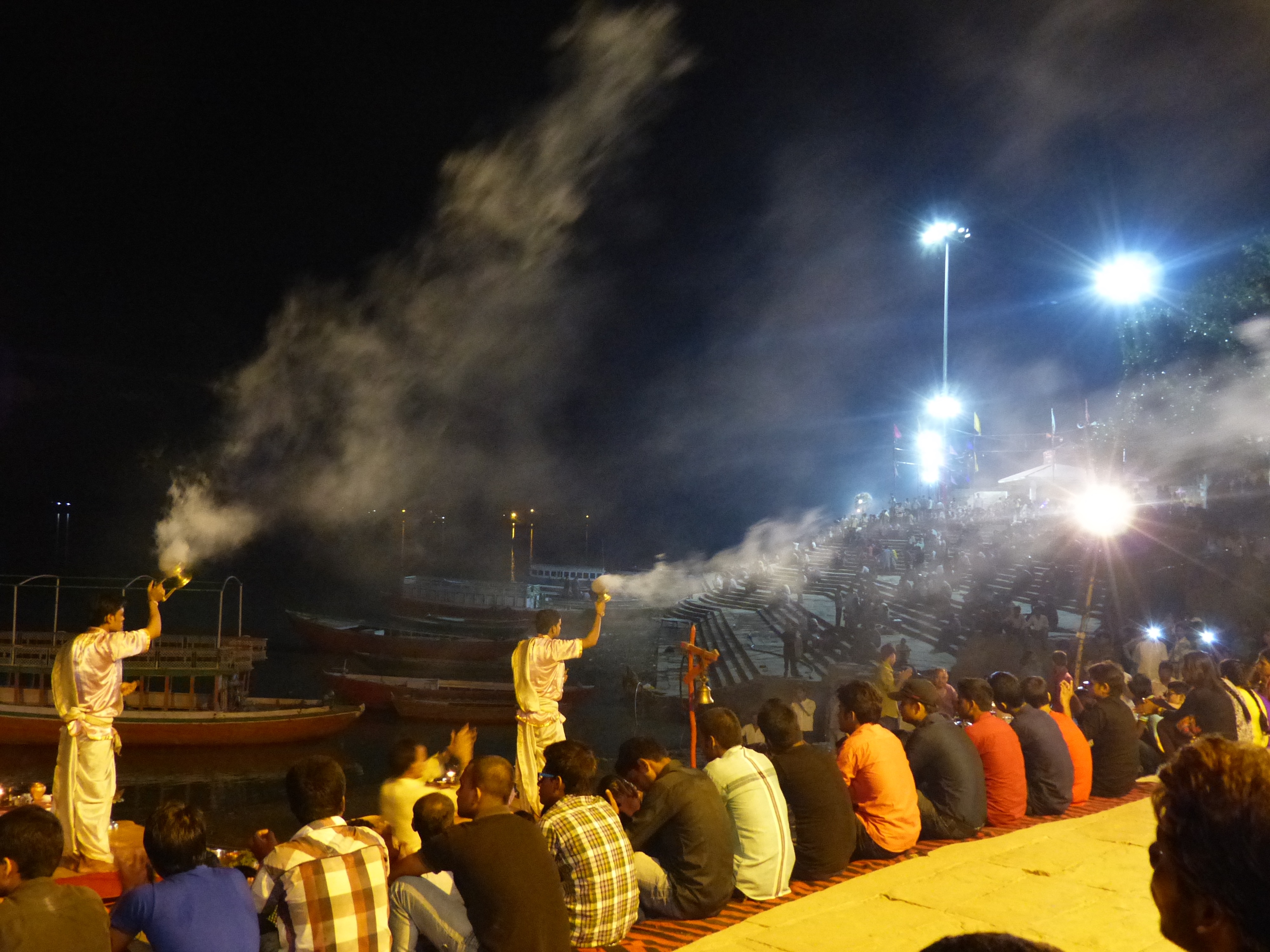
At sunset, our hotel offered a complimentary boat ride to see the ceremony at the Dashashwamedh Ghat, the main and most lively ghat on the river. The shore was already crowded with boats when we arrived, so we pulled up alongside them and waited for the ceremony. The nightly aarti – which honors the river goddess – features blowing of a conch shell, incense burning, waving lamps of fire, bell ringing, clapping and chanting. Although we really couldn’t see the action, I always love the energy of people at a religious pilgrimage site, and I often found myself facing the crowd to see their reaction to the aarti. Eventually, our guide, Sanjay, told us to light our offering and drop it into the water. I had hoped to see hundreds of candles floating on the Ganges, but the current quickly swept them away.
P1070070

P1070085

P1070062

P1070098

P1070094

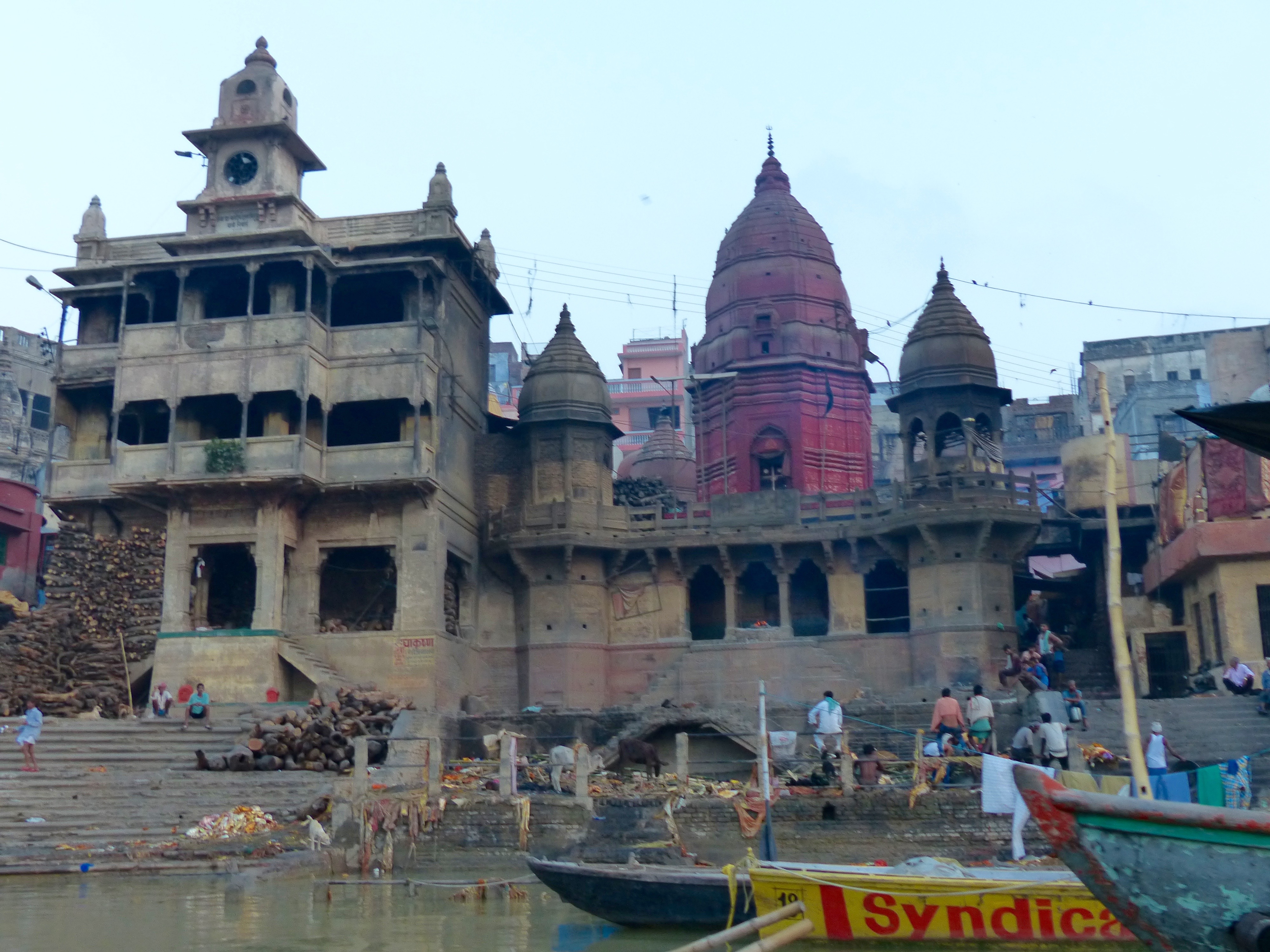
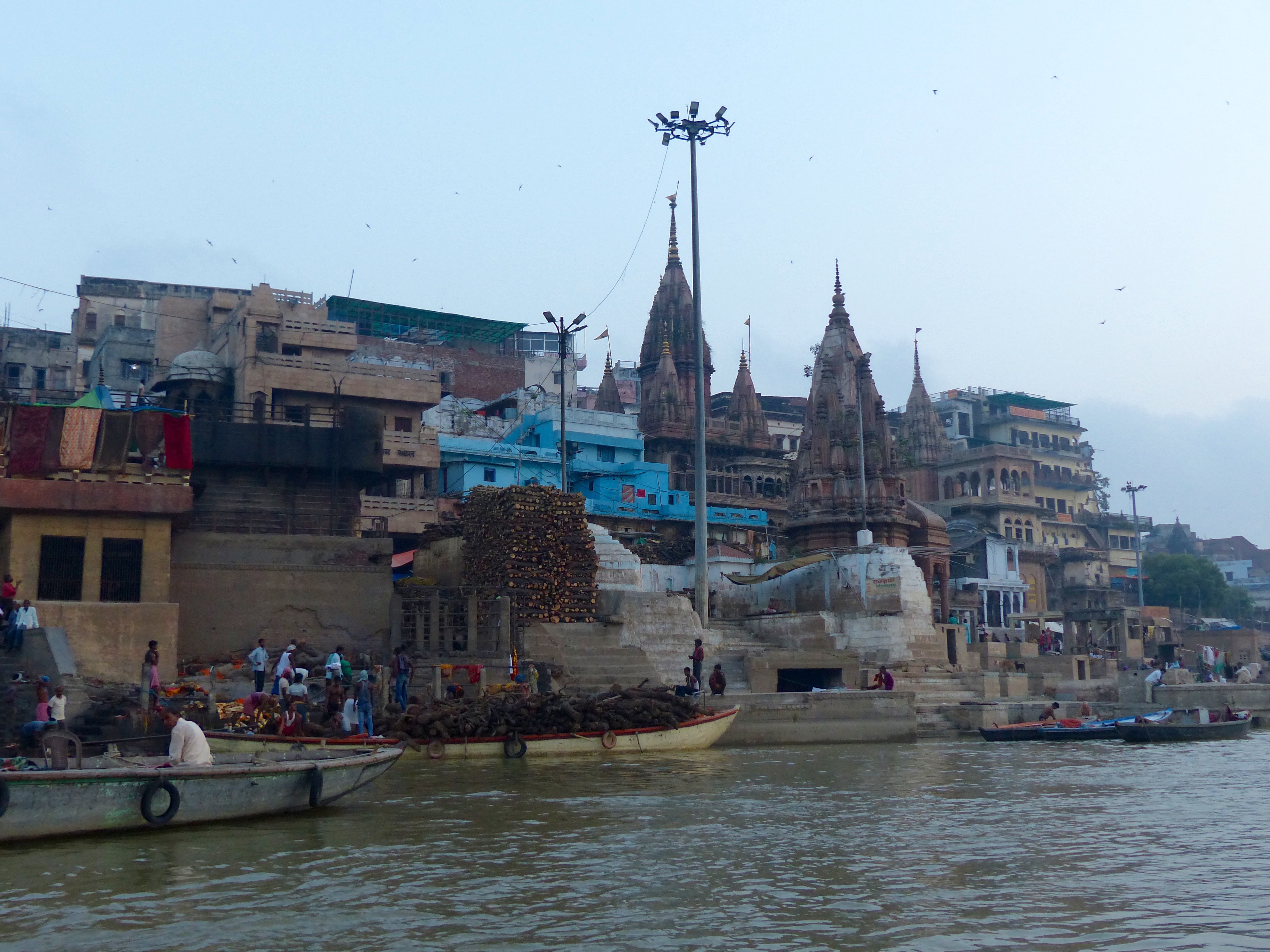
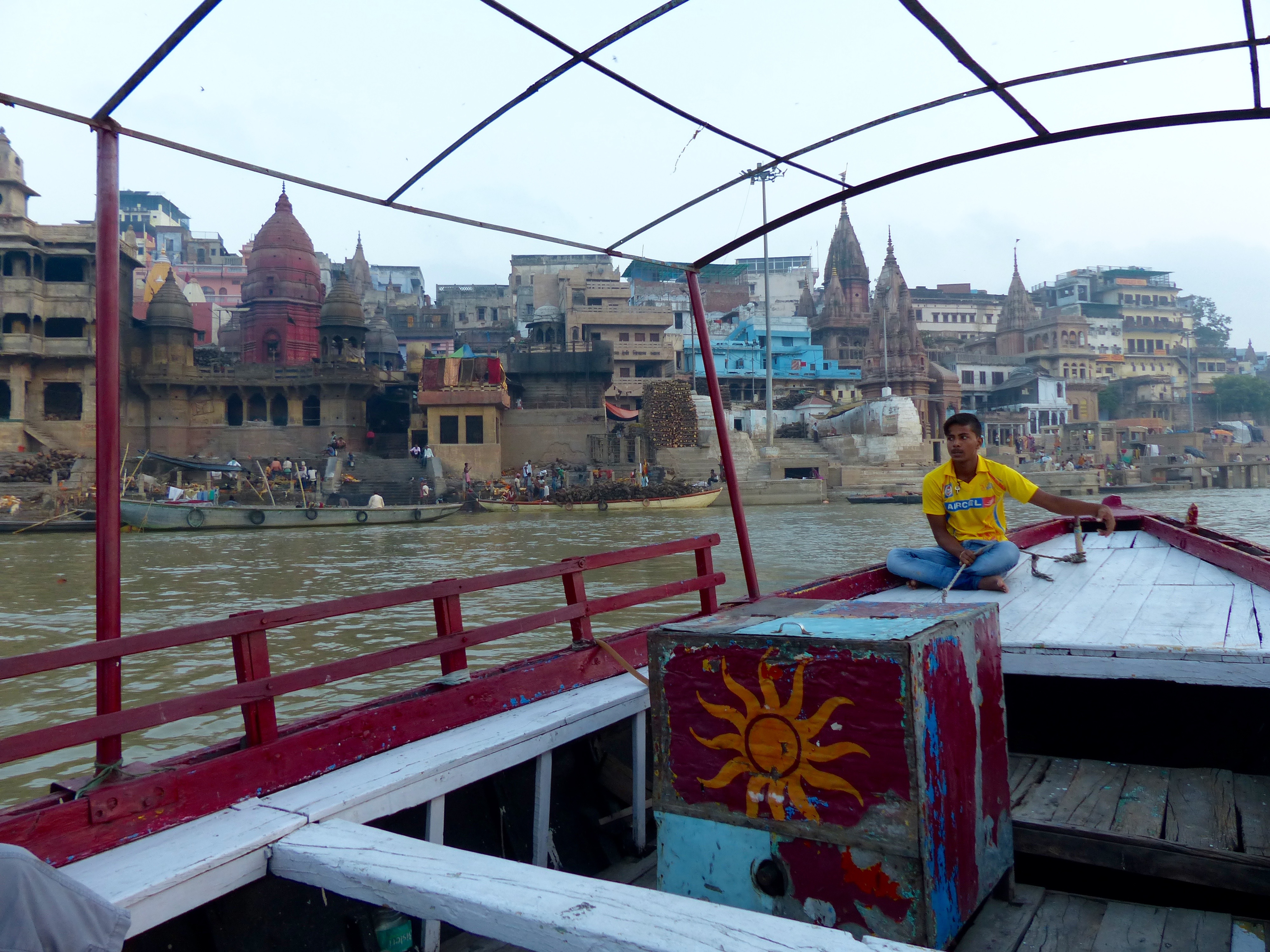
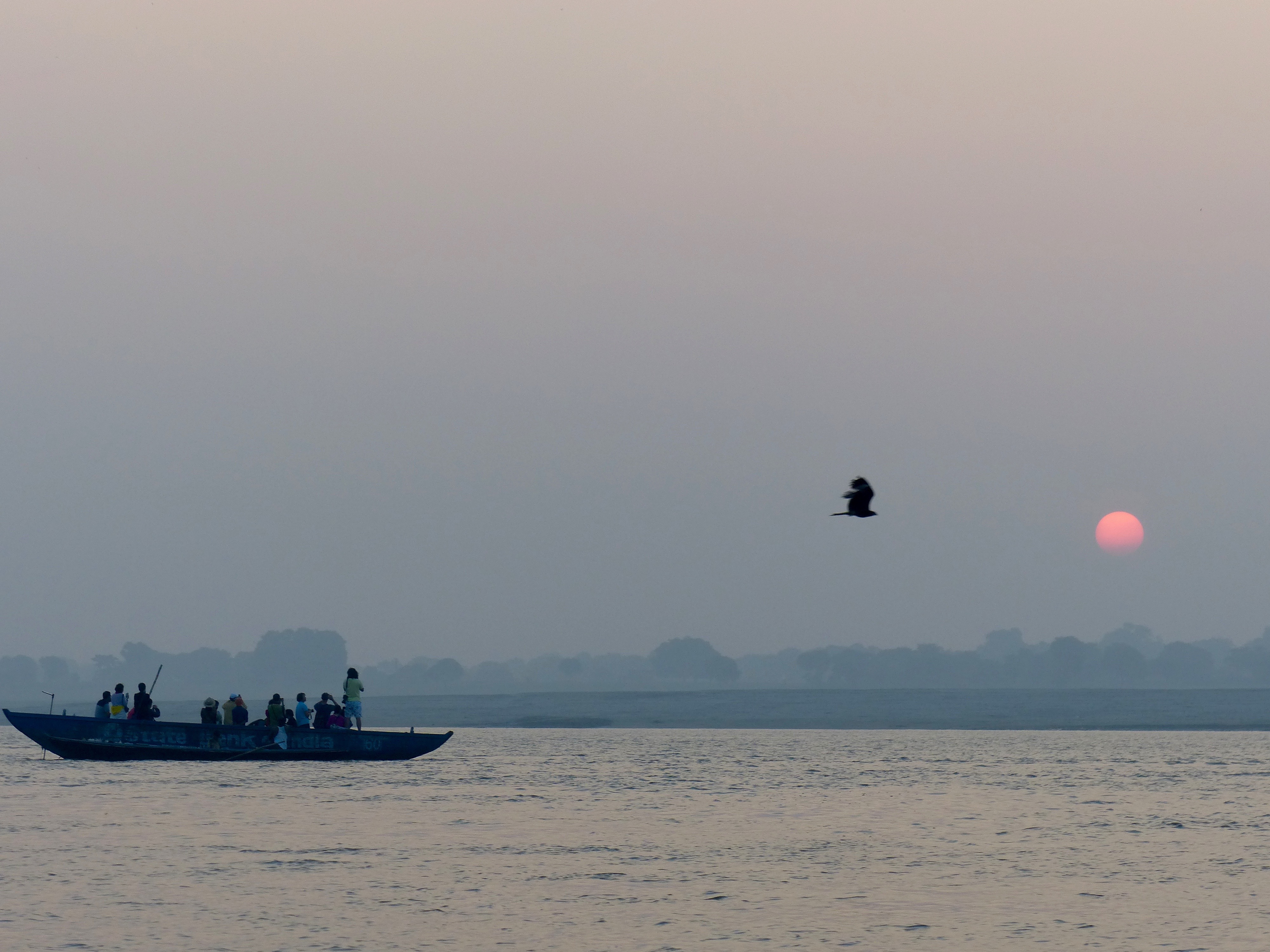
The next morning, a few of us met Sanjay again at 5 a.m. for a sunrise cruise. We slowly motored along the quiet shoreline to the Manikarnika Ghat. Although a body lay in wait on the ghat steps, the workers were mainly cleaning up from the previous day, sweeping, stacking wood, sorting through ashes.
According to Lonely Planet,

Manikarnika Ghat, the main burning ghat, is the most auspicious place for a Hindu to be cremated. Dead bodies are handled by outcasts known as doms, and are carried through the alleyways of the old city to the holy Ganges on a bamboo stretcher swathed in cloth. The corpse is doused in the Ganges prior to cremation. Huge piles of firewood are stacked along the top of the ghat; every log is carefully weighed on giant scales so that the price of cremation can be calculated. Each type of wood has its own price, sandalwood being the most expensive. There is an art to using just enough wood to completely incinerate a corpse. You can watch cremations but always show reverence by behaving respectfully.

P1070114

P1070124

The early birds were already starting to show up at the bathing ghats.
P1070128

Stacks of wood fill the building and line the steps at Manikarnika Ghat.
P1070141

Workers unload wood from a boat.
P1070142

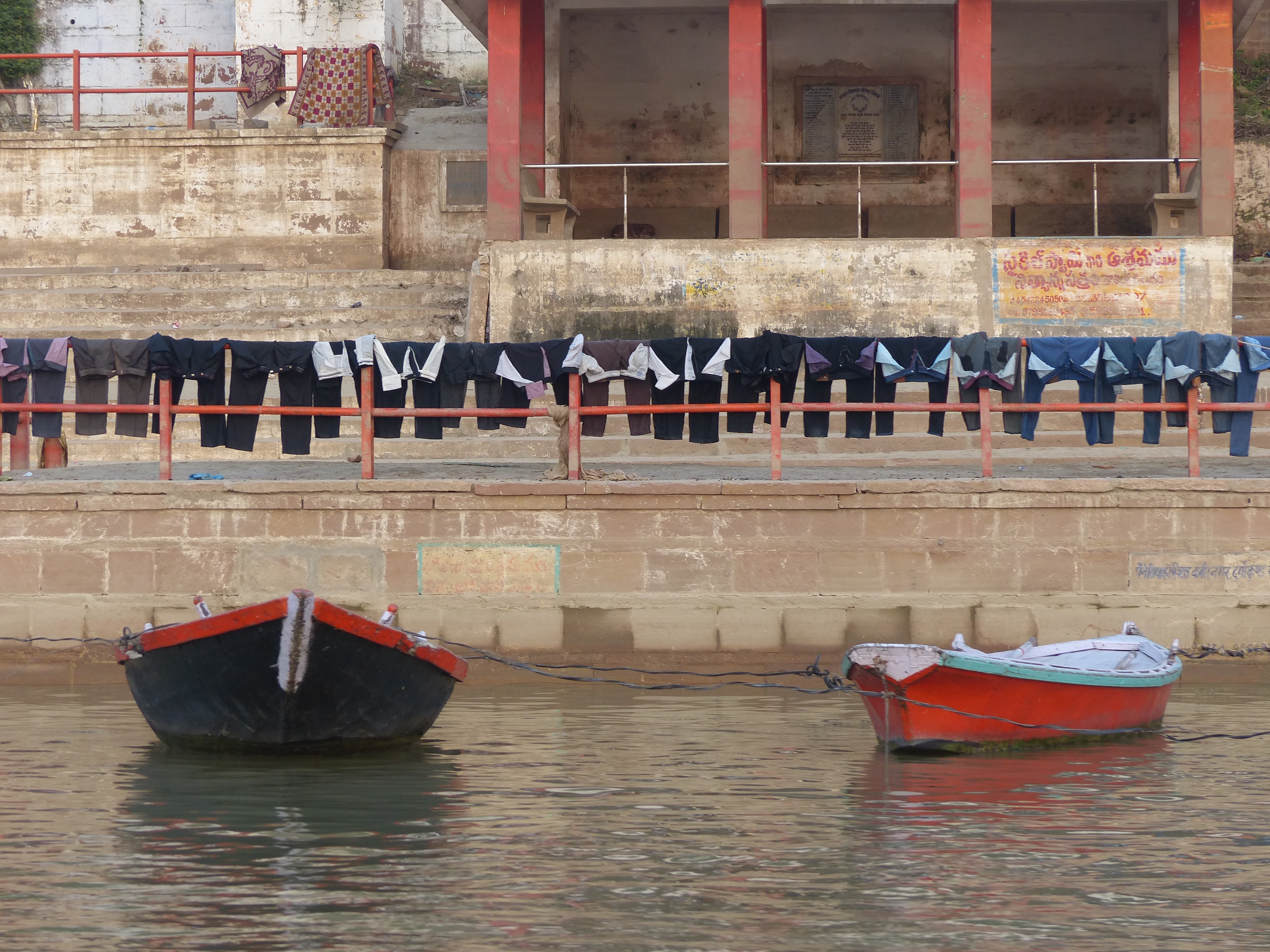
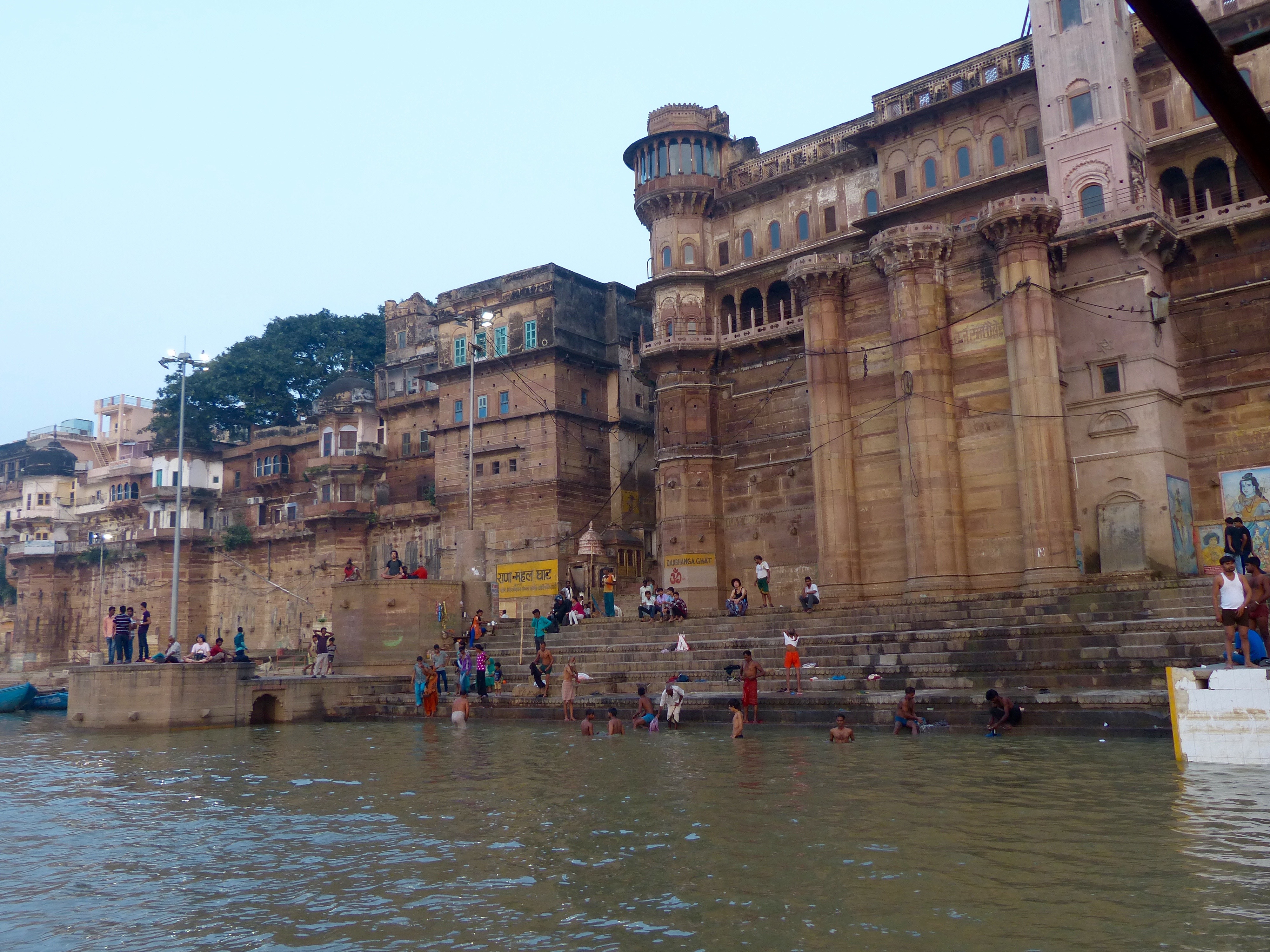
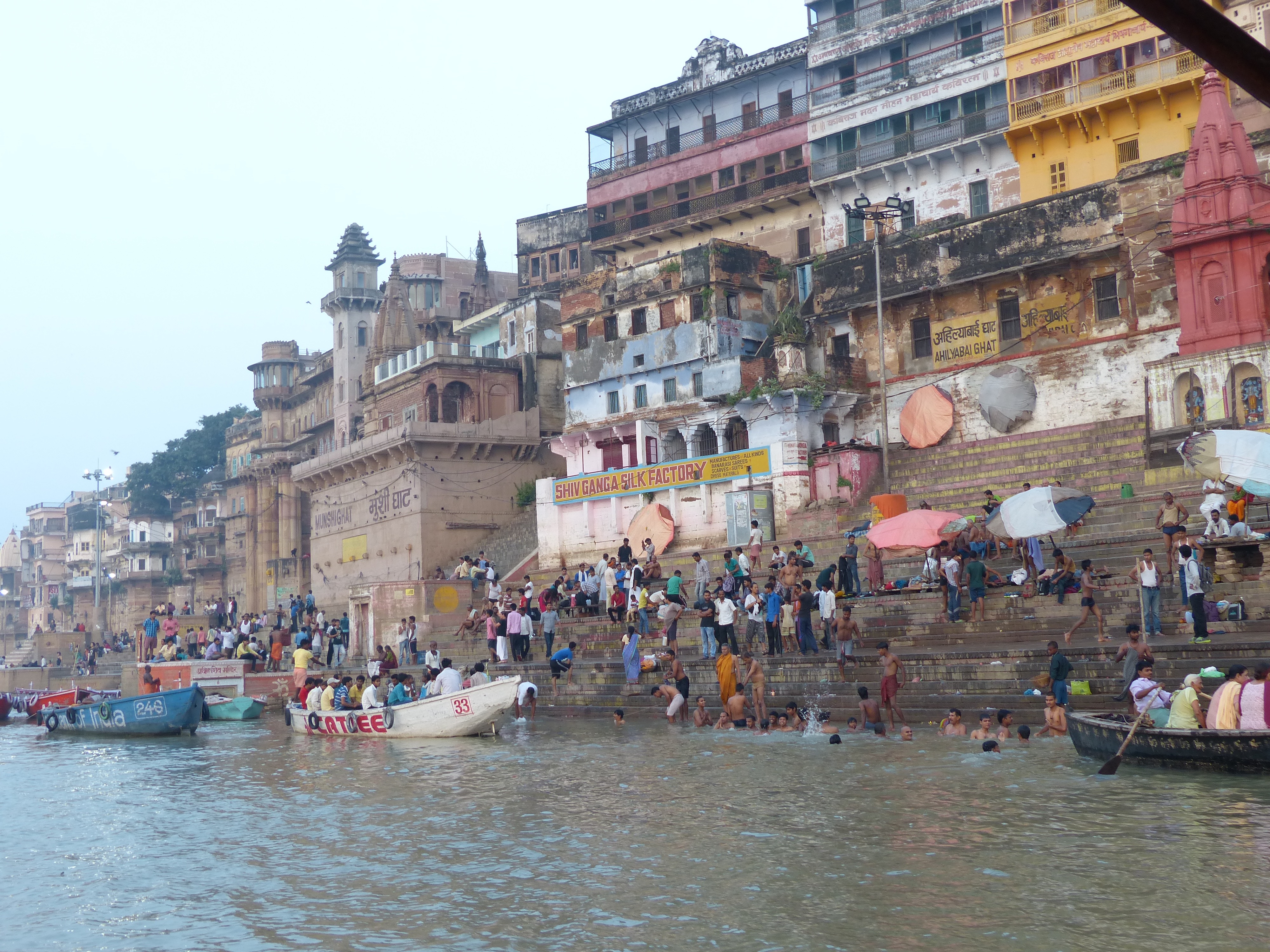
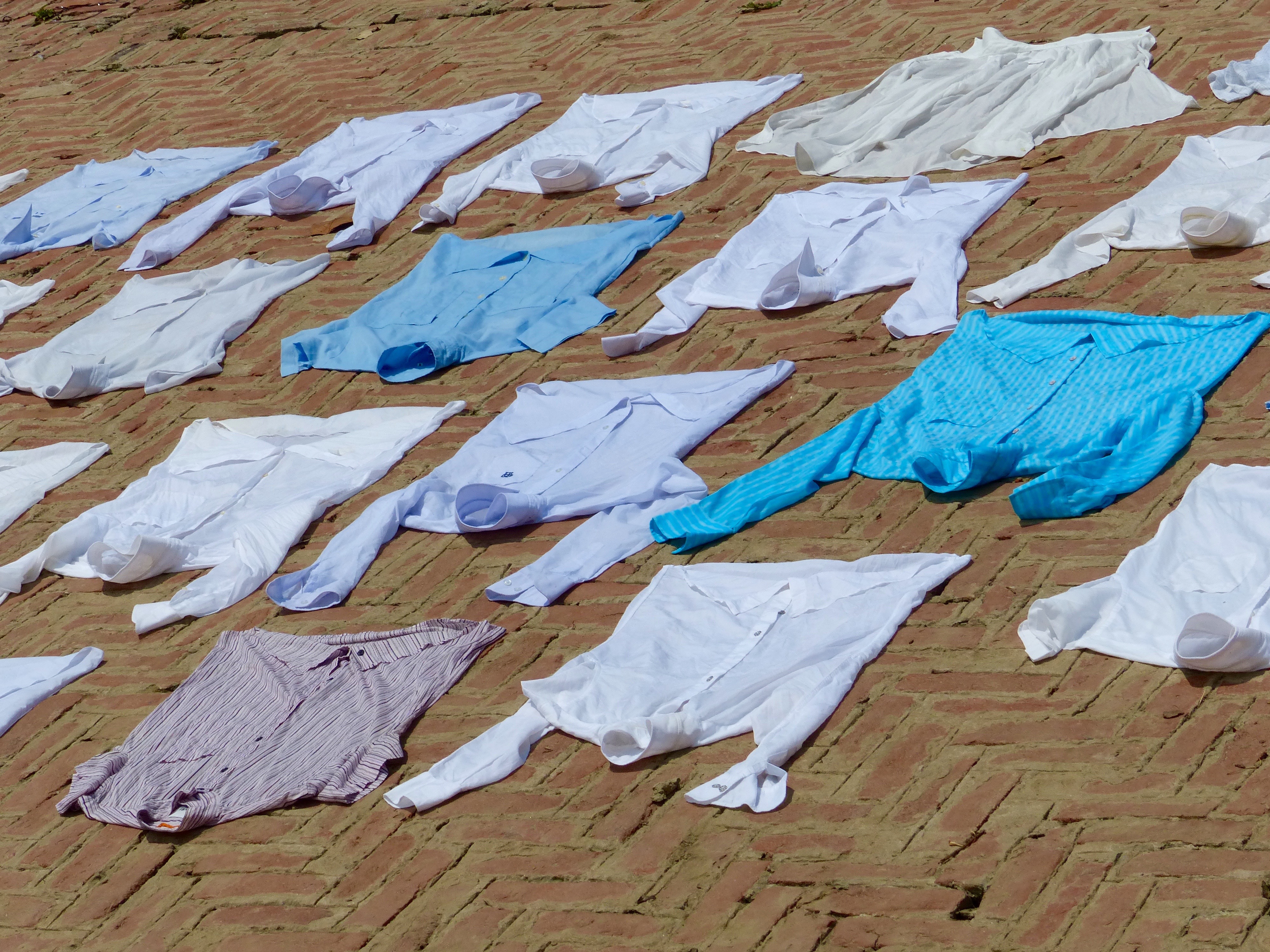
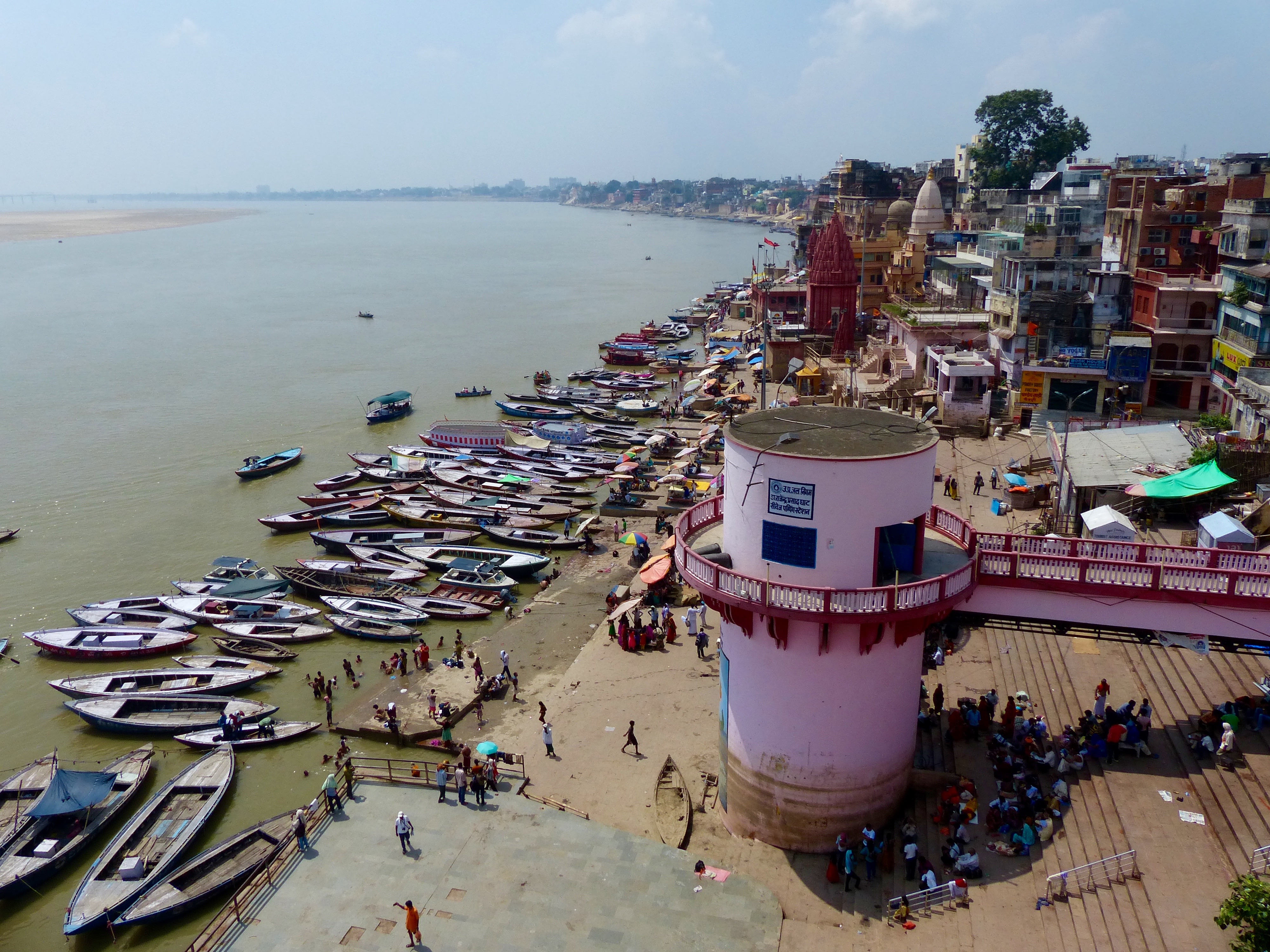
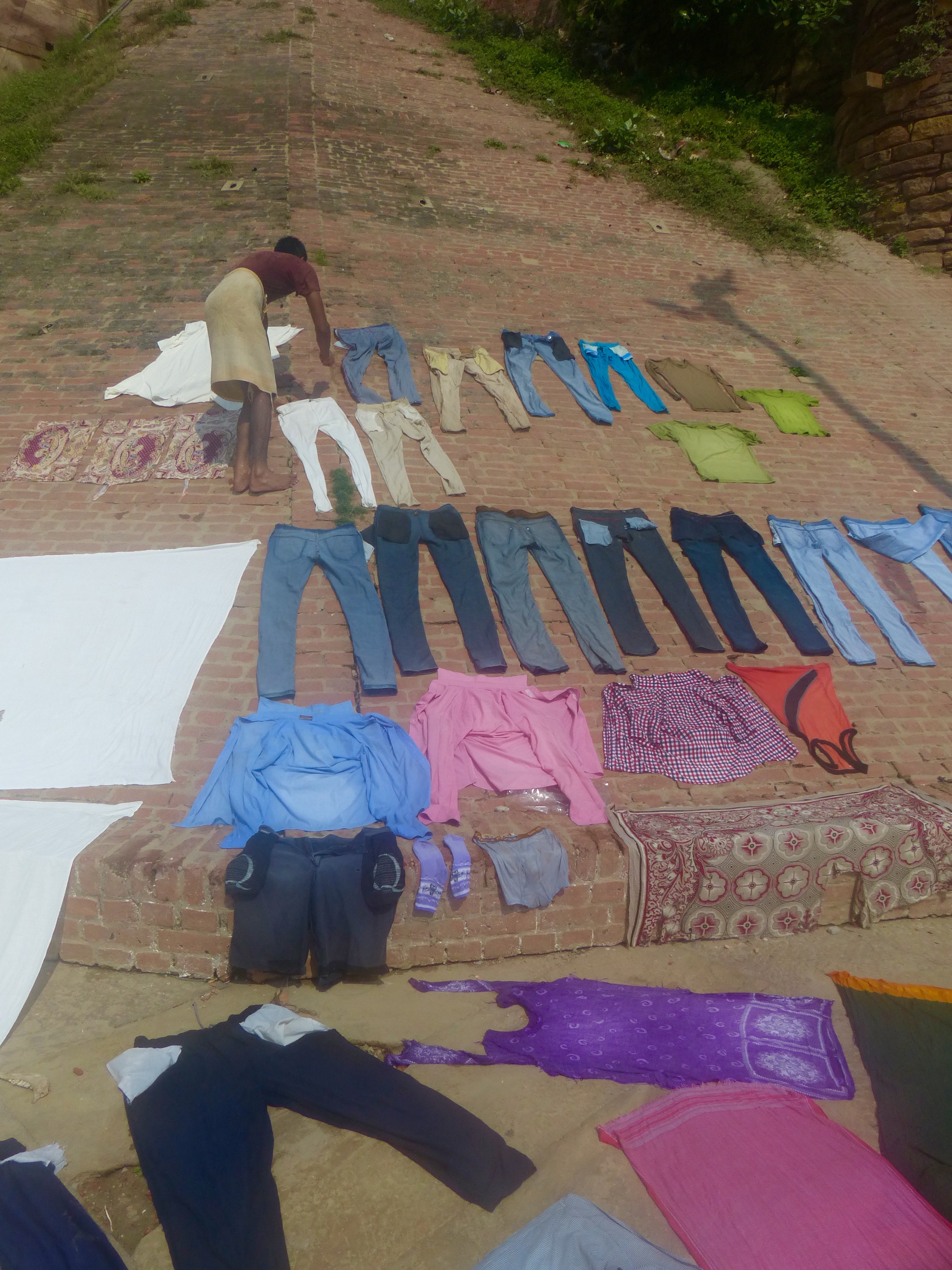
Boating back to our hotel, we watched the riverbanks come to life. Bathers soaped up their bodies, young men gleefully flipped into the water, and elderly couples stood chin deep while chanting. Ladies in colorful saris ladled water over their babies. Dhobis beat their river-washed laundry on the ghat steps and then put it out to dry in the relentless sun, spread on the steep stone hillsides or hung from railings. Small fires burned at the Harishchandra Ghat, a secondary cremation center near our hotel.

18-year-old Sanjay pilots the boat and shares stories about Varanasi.
P1070143

P1070146

Pants drying in the sun.
P1070180

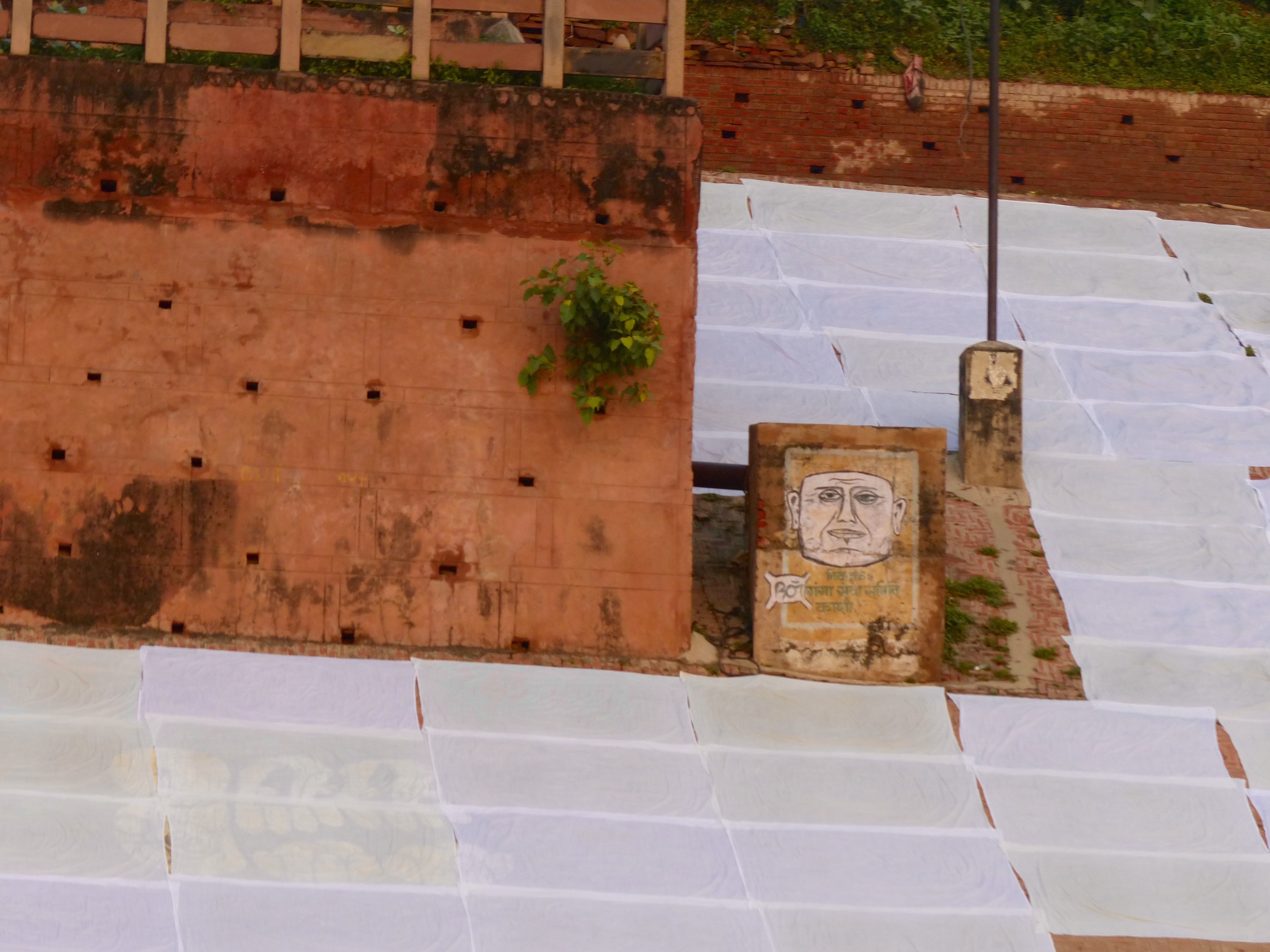
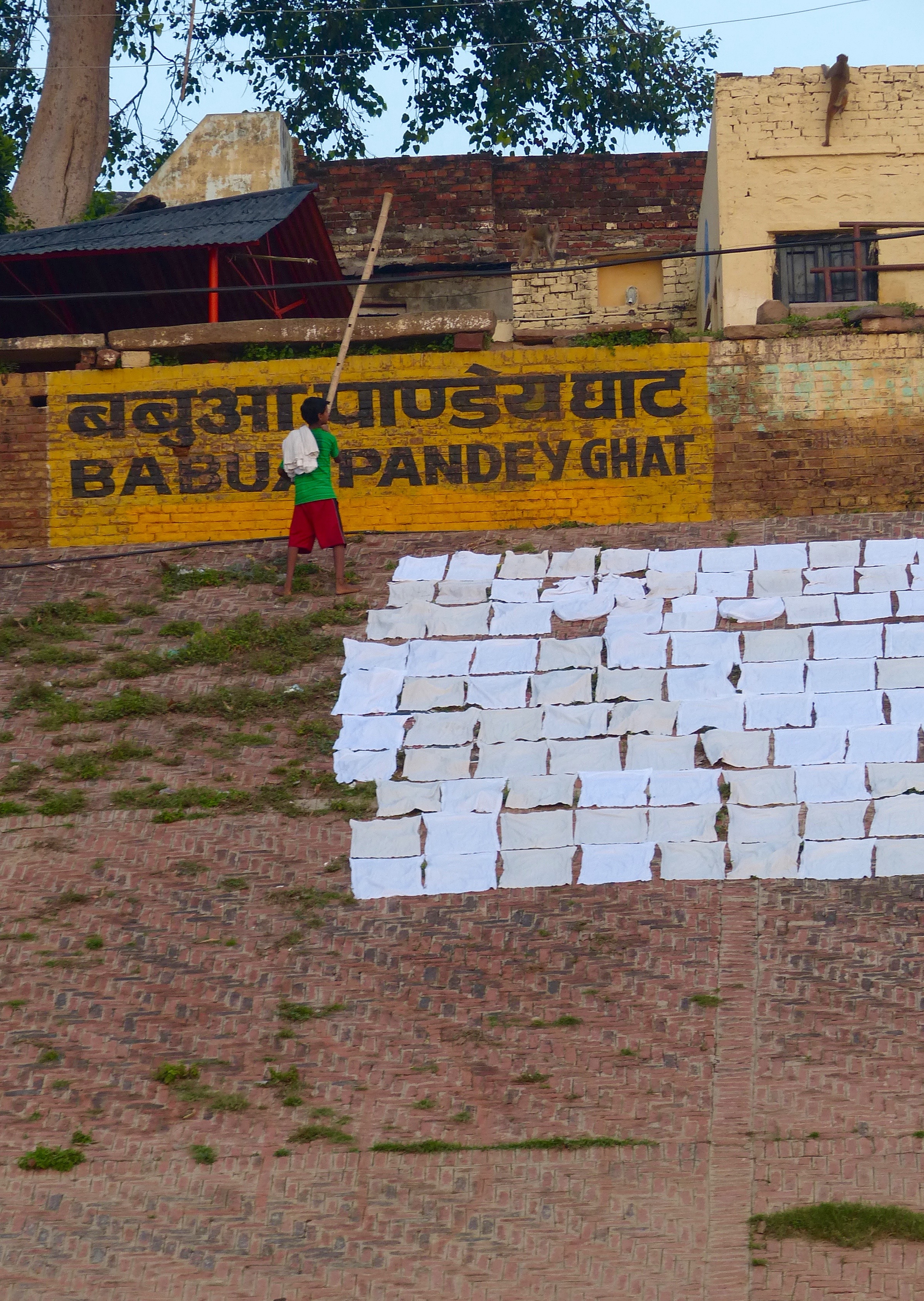
White sheets spread out on the brick walls were “hospital laundry,” Sanjay said.
P1070168

It’s no small feat to keep the monkeys off your clean sheets!
P1070167

P1070149

P1070162

P1070176

P1070157

P1070155

Maureen soaks it all up.
P1070163

After an extended breakfast (with delicious coffee, courtesy of Maureen’s Miracle Coffee Maker), our group headed out for a walk along the river.

More laundry. I just loved it.
P1070208

P1070190

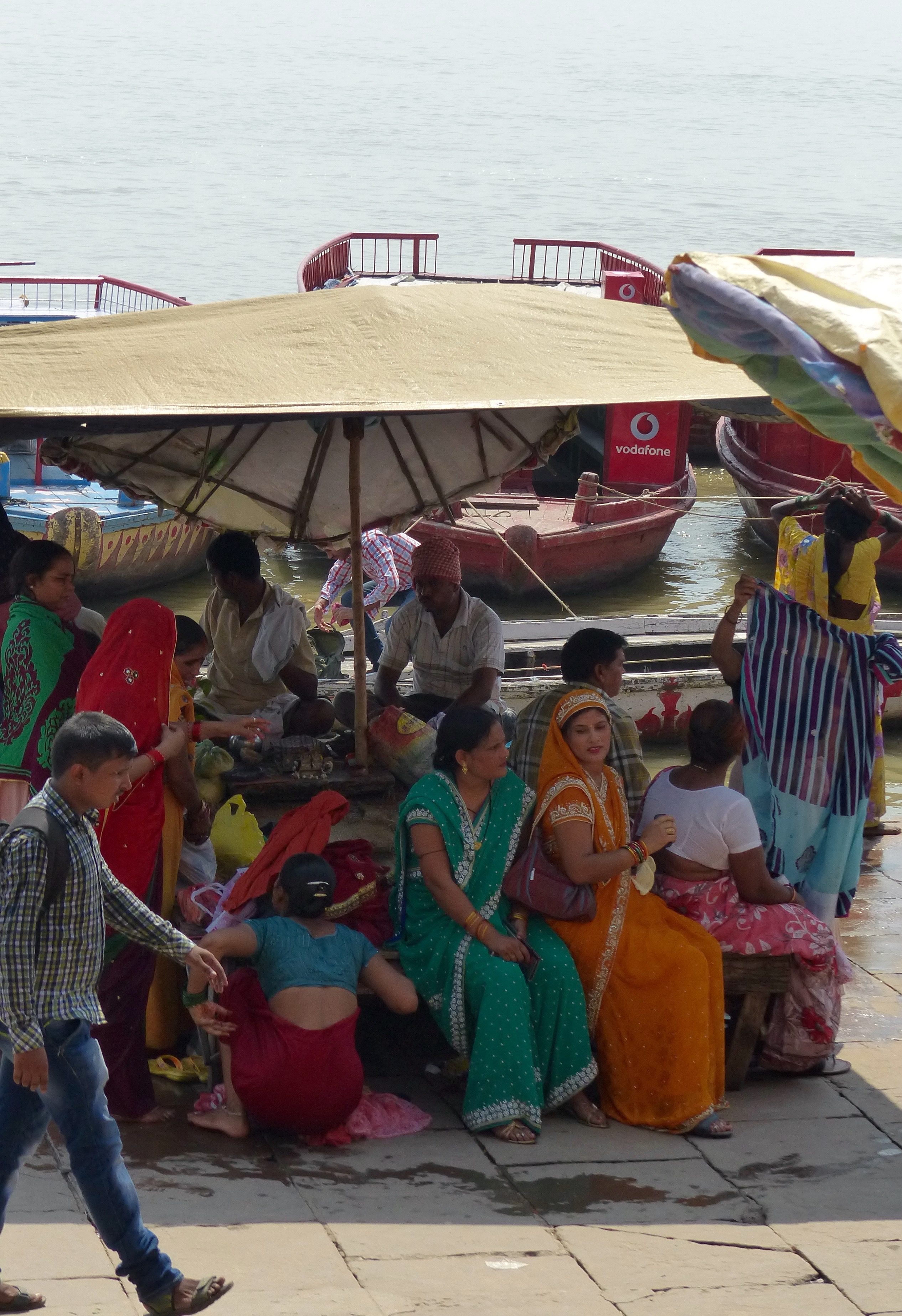
A little slice of life at Dashashwamedh Ghat. I was sweating my face off, but those ladies look remarkably cool in their saris.
P1070211

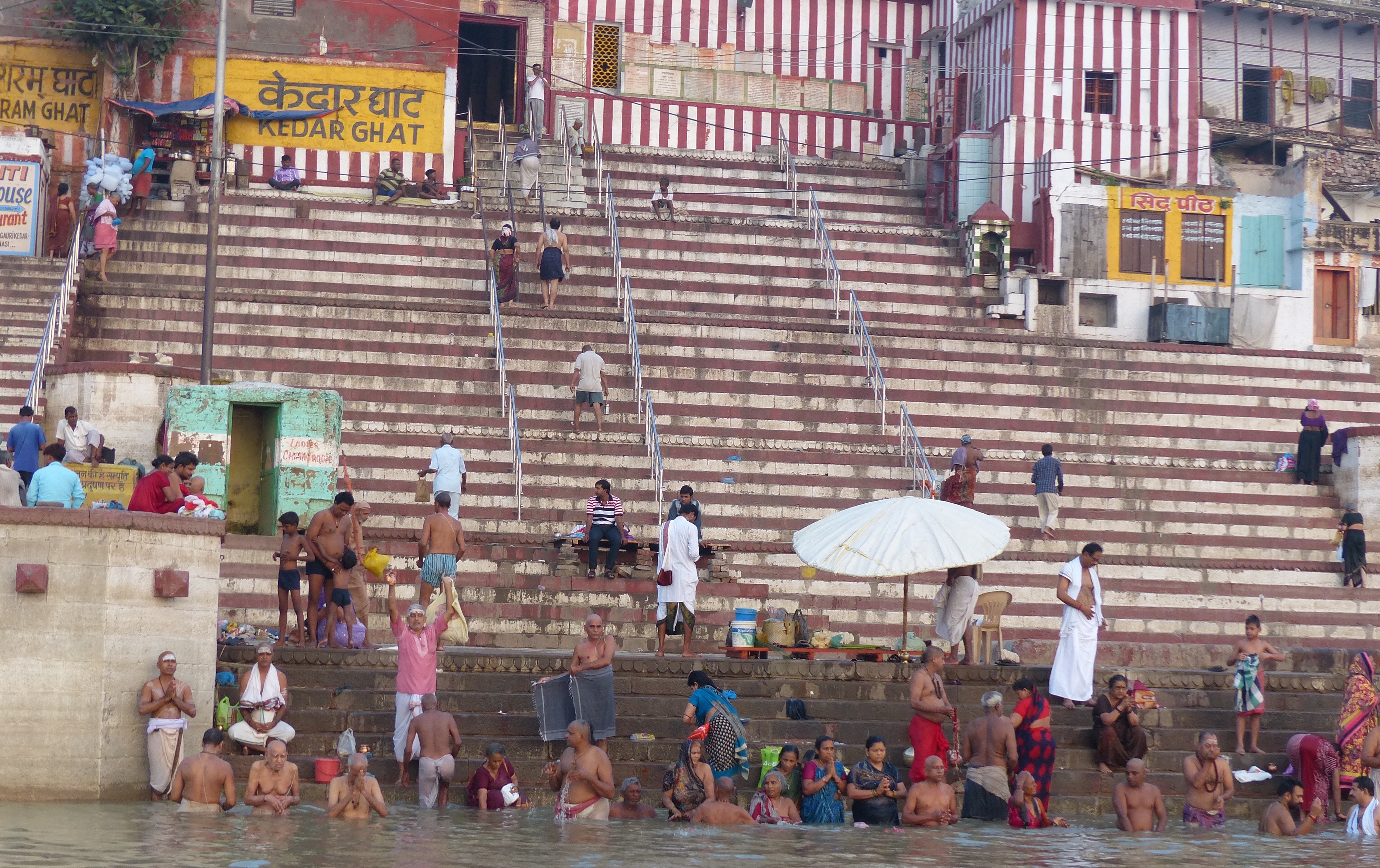
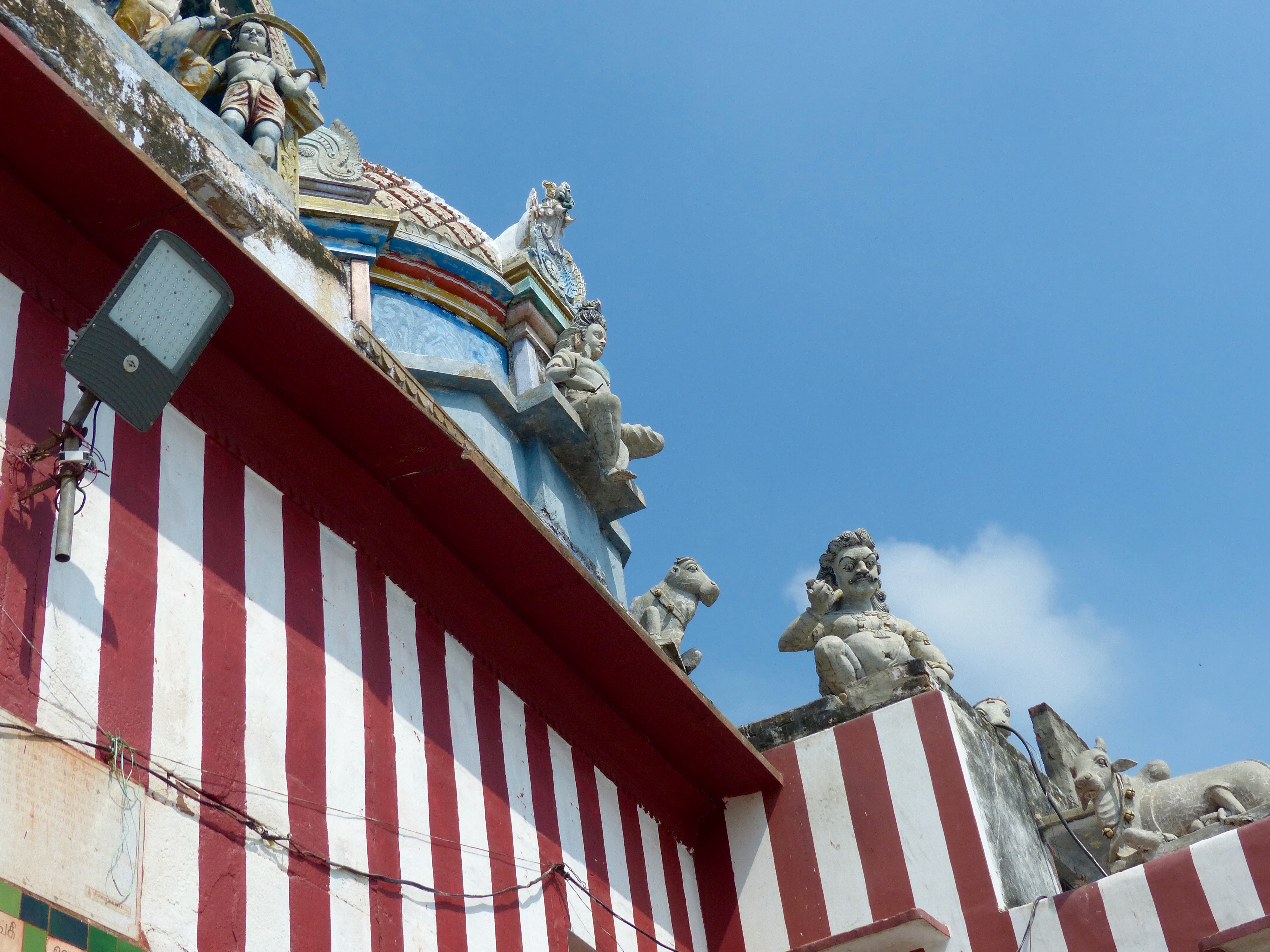
Sarah and I broke off from the group to check out the Kedareswara Temple, a squat red-and-white striped structure at the top of a long flight of alternating red- and white-painted stairs. I read conflicting and confusing stories about this temple’s history, but here’s one version from the webindia123 website, with a few edits:

Kedareshvara alias Kedareshwar temple, dedicated to Lord Shiva is a river temple situated right on the banks of the Ganga at the top of Kedar Ghat. The stone Shiva lingam is said to have appeared spontaneously and a visit to this temple is believed to give one the fruits of a visit to the great Kedareshvara Temple at Himalayas. Legends has it that a pure hearted devotee of Lord Shiva prayed for a chance to visit the famous Kedareshvara temple in the Himalayas. Pleased by the devotion, instead of bringing him to the mountain, the Lord brought his lingam which is emerged out of a plate of rice and lentils, to the devotee. It is this lingam that can be seen on the rough surface of the natural stone.

P1070201

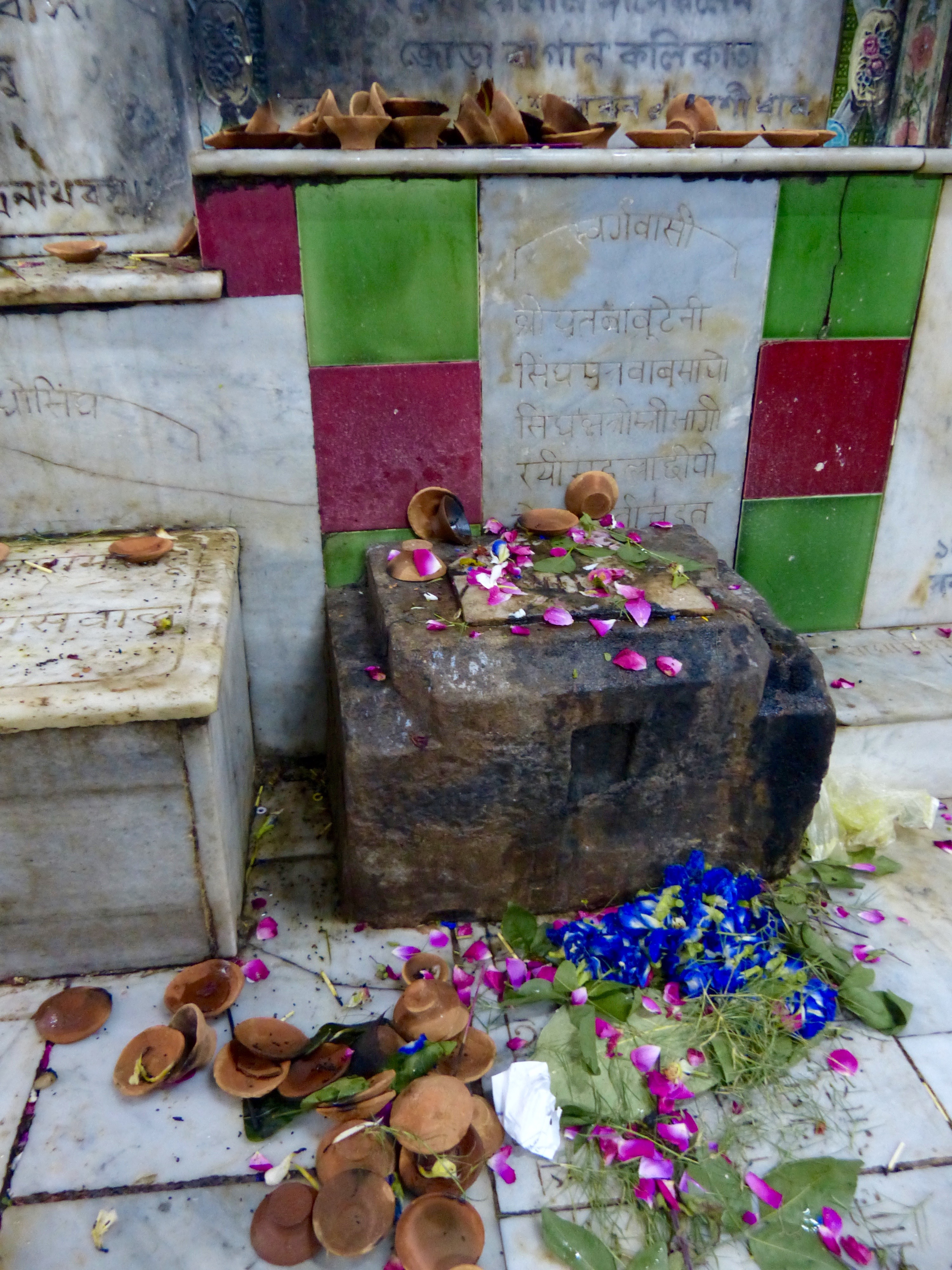
The remains of temple offerings. This was the only photo I snapped before I was scolded, “No camera!”
P1070199

By the time we met up again with the rest of our group at the Man Mahal Palace, we were all soaked in sweat and completely exhausted, depleted by temperatures hovering around 100F and relative humidity at 87 percent.

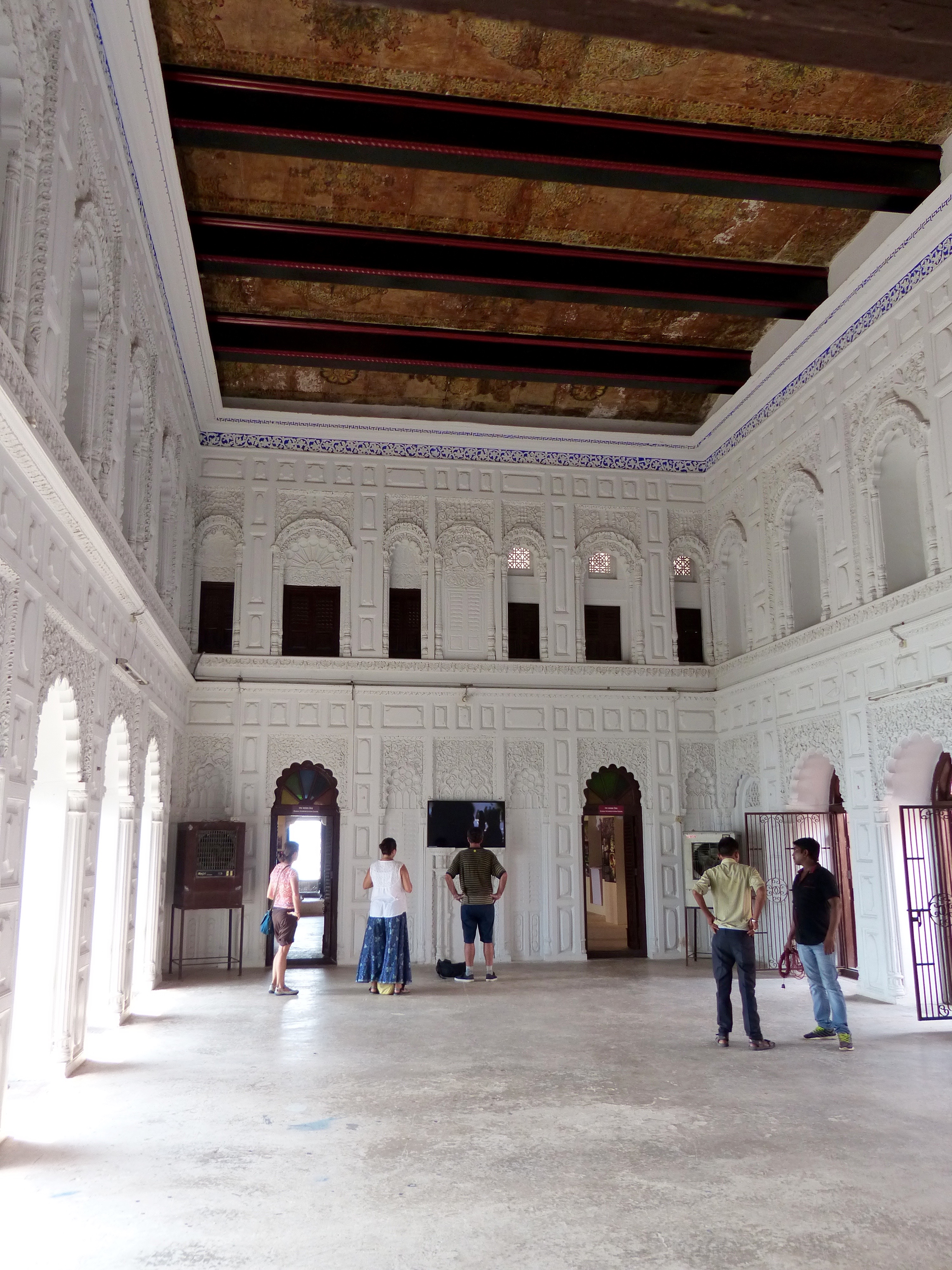
The palace was built around 1600 by Raja Man Singh, the king of Amber. More than 100 years later, Sawai Jai Singh II added on to the palace’s masonry observatory. According to The Archaeological Survey of India, Sawai Jai Singh II, a great astronomer and founder of the city of Jaipur, installed “instruments for calculating time, preparing lunar and solar calendars and studying the movements, distances, and angles of inclination of the stars, planets and other heavenly bodies.”

We lingered in the palace’s cross breezes, checking out photography exhibits and information about the astronomical observatory. Mark actually lay down on the cool stone floor to watch a looping TV video about the Ganges River.
P1070219

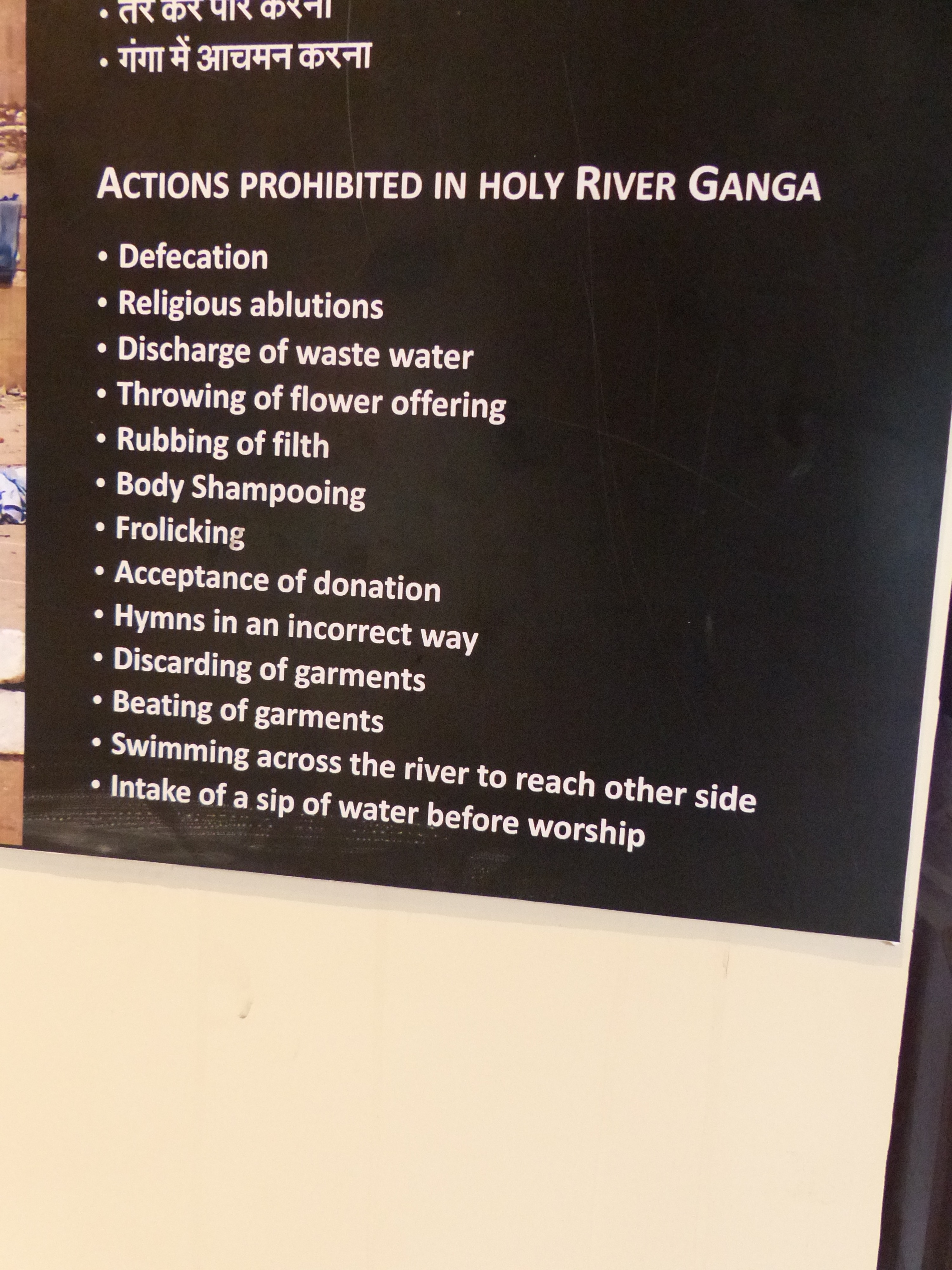
This sign was part of a Ganges River exhibit in the palace. During our walks and boat rides, we witnessed many of these “prohibited actions.” As Jill said, there’s little hope for the river as long as the city continues to pump it full of sewage, so these unenforced rules hardly matter. Read more in this bleak article from Down to Earth.
P1070220

Finally, we prepared to leave, and Craig asked a worker how to find the Thatheri Market.
“Up,” the guy answered, gesturing toward some steps.
“We just go up the street?” we probed.
“No, upstairs,” he said. “Observatory.”
Oh, yeah! The whole reason we had paid the Rps 100 ($1.50) admission fee! Clearly, we were dehydrated and not thinking straight.

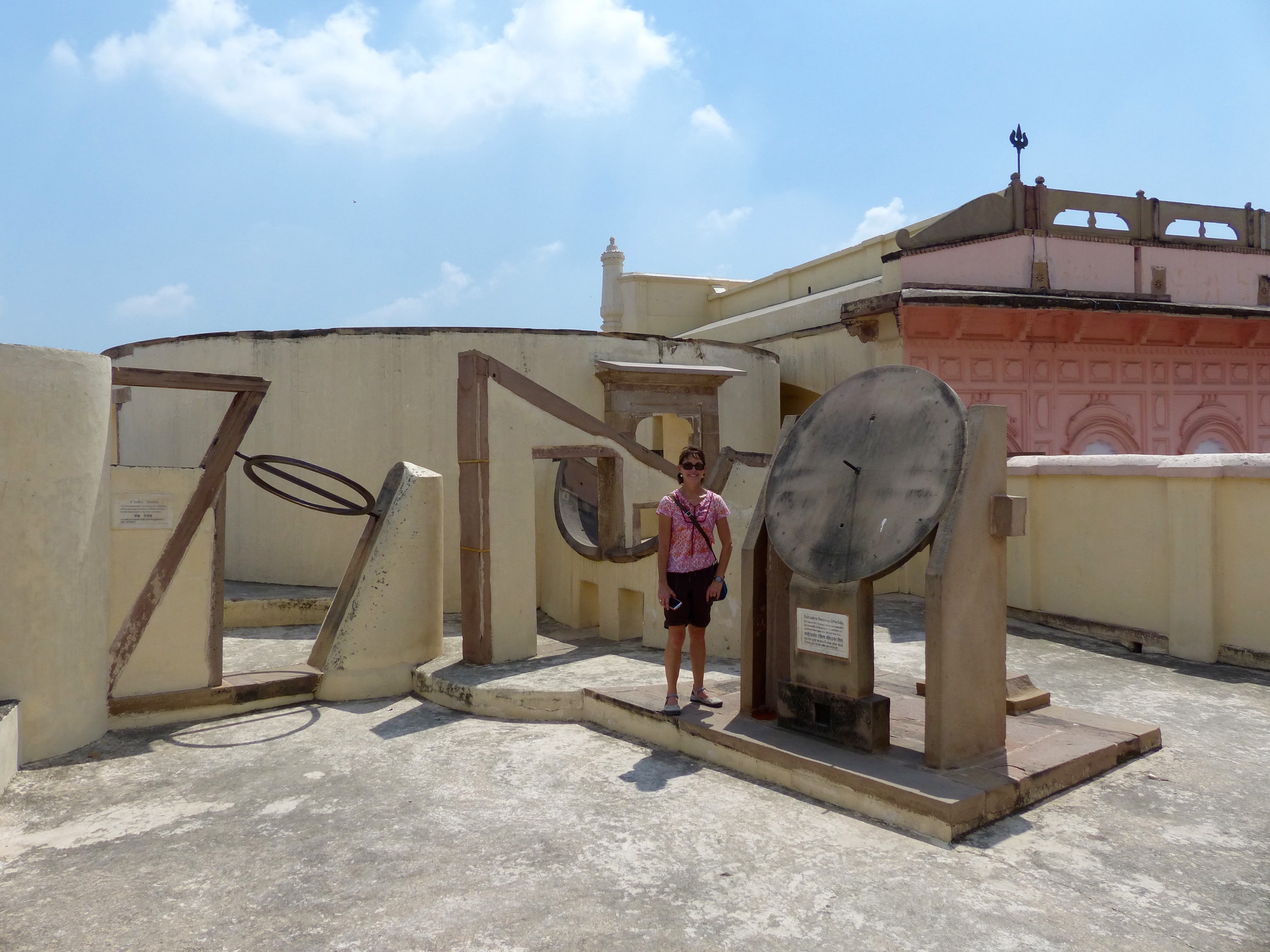
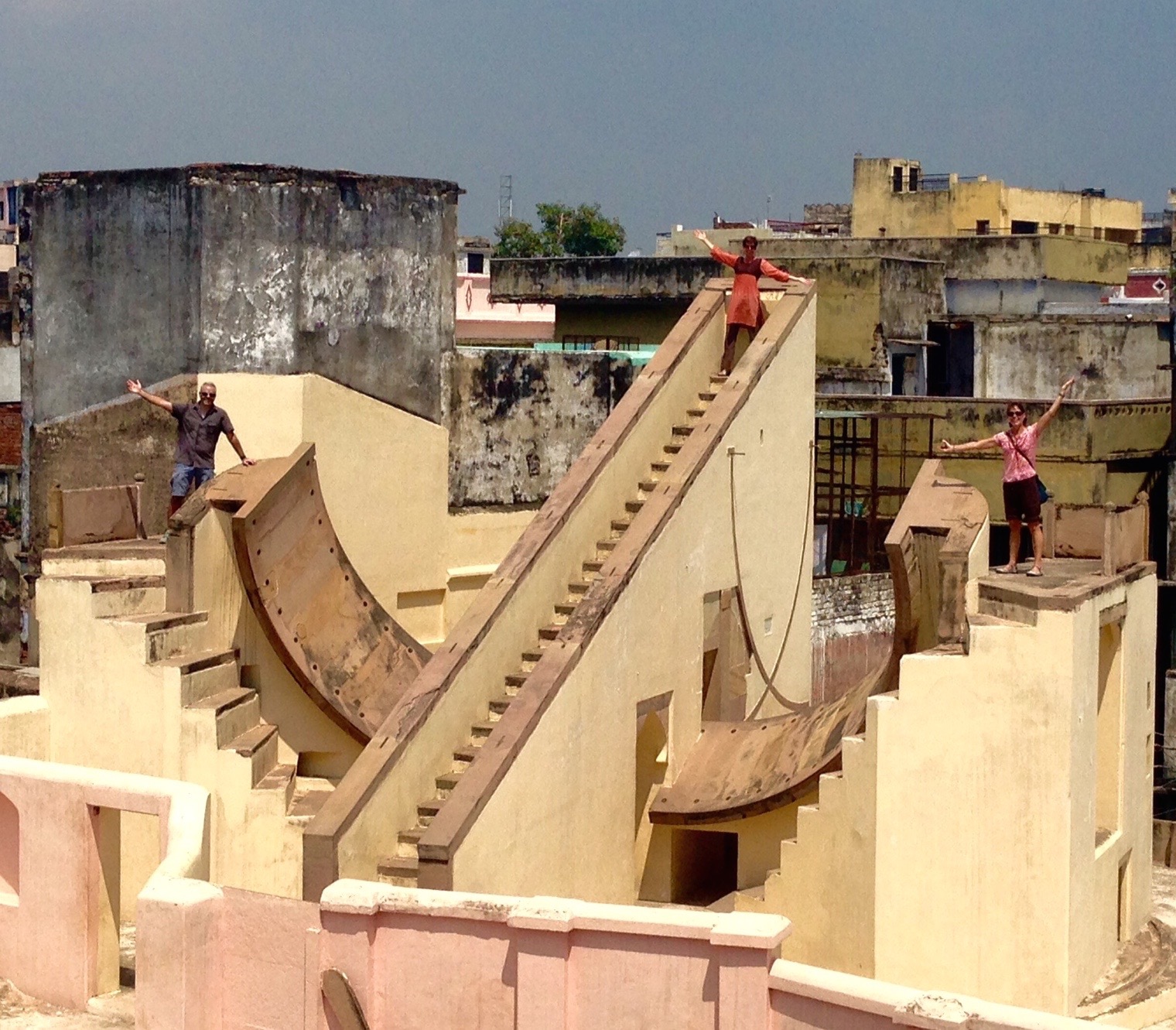
We climbed the steps to the observatory and checked out the hulking instruments and the fantastic views. (The sun dial’s time was just one minute off from Craig’s phone. Amazing.) This site is one of five masonry observatories constructed by Sawai Jai Singh II, including one in Delhi. They are known as Jantar Mantar, which ASI says is “a corrupt form of Yantra-Mantra, meaning the calculation with the help of instruments.”

(Tony and I visited the Delhi Jantar Mantar a couple years ago. You can read about it here: Celebrating 20 Years With an Imperial Anniversary.)

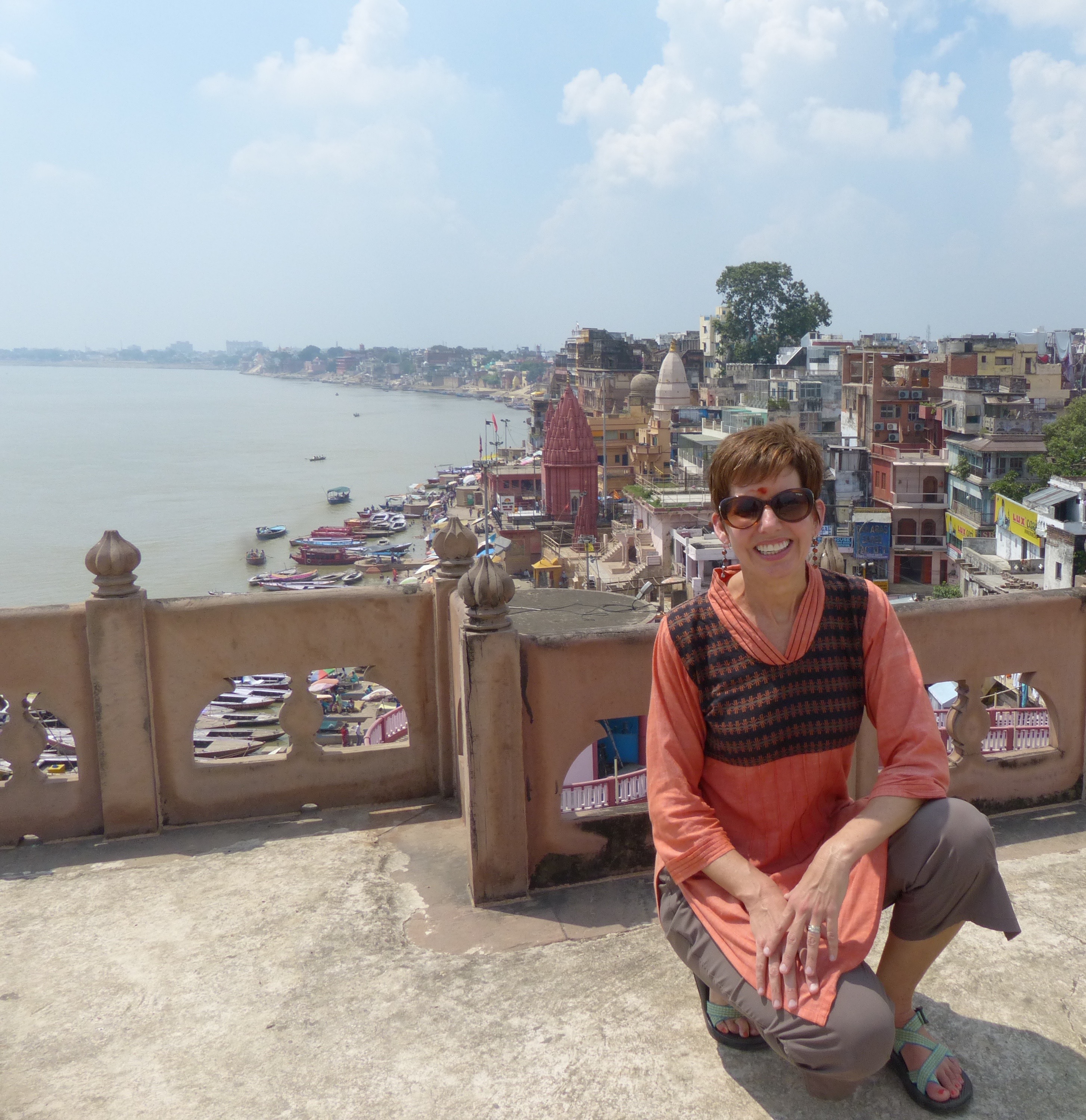
Views from the palace rooftop.
P1070223

P1070225

P1070234

Posing with the sun dial and the samrat yantra – aka “the supreme instrument” or, as we dubbed it, “stairs to nowhere.” The samrat yantra was an instrument for telling time and the coordinates of celestial objects.
P1070233

IMG_0010

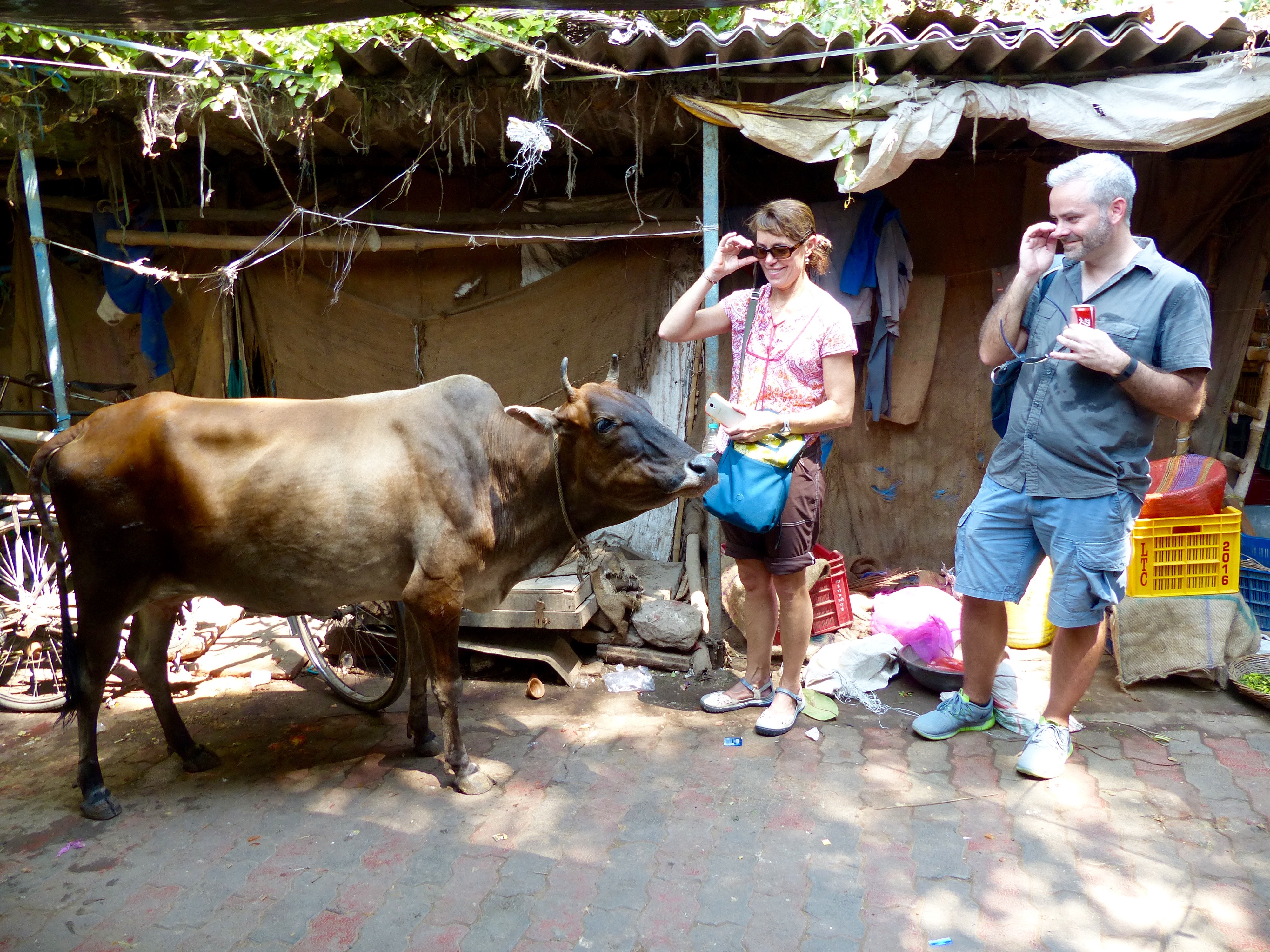
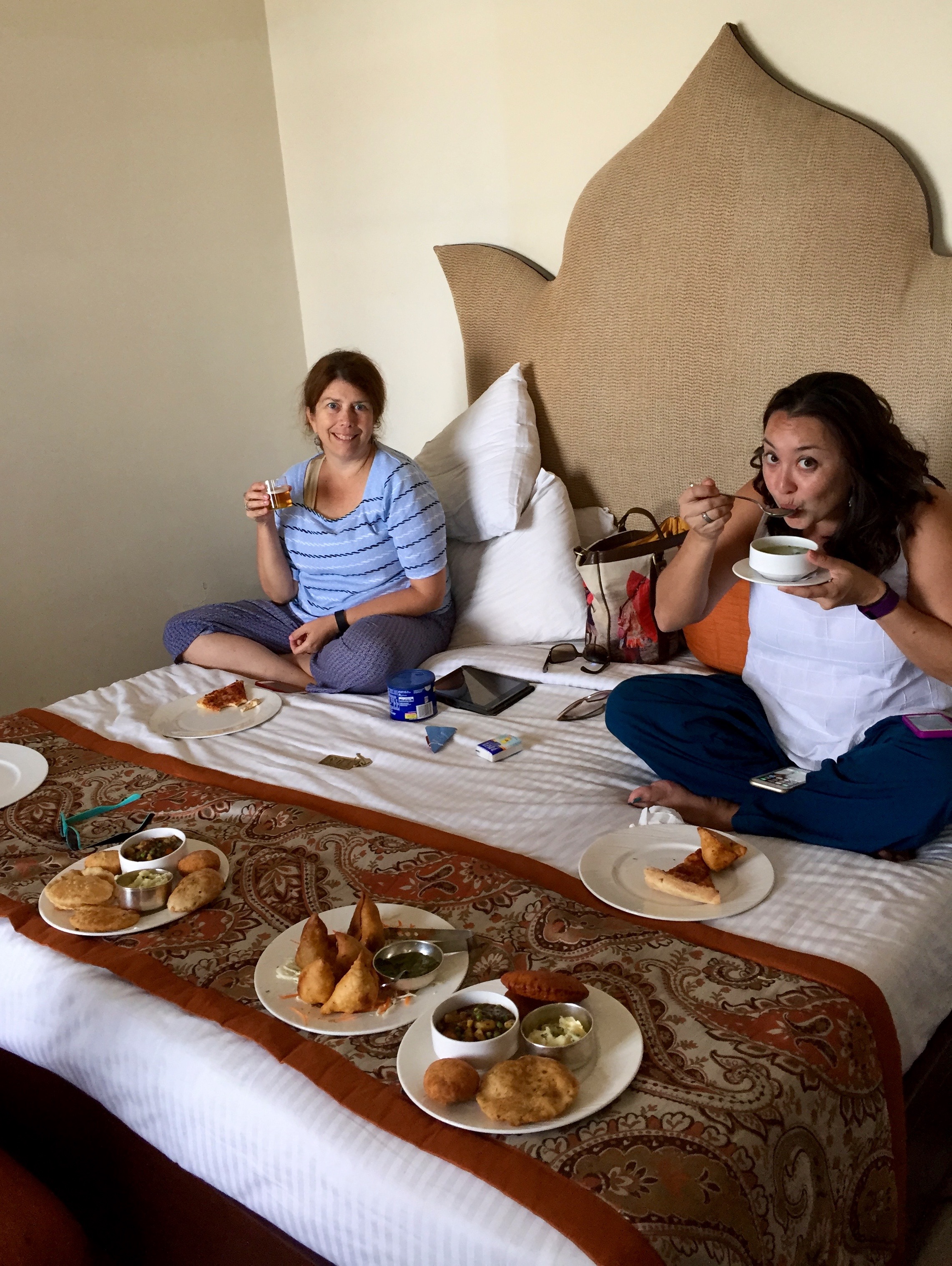
We climbed around the observatory for awhile and then checked out the nearby market area. After watching this cow steal a potato from a vendor and after searching in vain for a Varanasi magnet for Craig, we took bicycle rickshaws back to our hotel and ordered both Dominos pizza and room service for a huge lunch banquet in Maureen’s room.
P1070238

IMG_0908

Jill met us again later for another aarti. This time, we visited Assi Ghat and watched the ceremony from the shore, sitting on the stone steps close to the action.
P1070260

P1070248

Overall, I found the hype about Varanasi to be mostly unfounded.

True, the river was distressingly polluted. But the pilgrims who stepped or leapt into its murky water believed at that moment that it was pure and powerful. We couldn’t help but feel their visceral joy.

True, the weather was oppressive. But we returned each day to a historic hotel with air conditioning, water pressure and dry clothes. Just another reminder of how fortunate we were.

True, there was no avoiding the reality of death (both human and bovine, it turned out). But those who watched their loved ones burn at the river’s edge didn’t cry. In their eyes, this event was a gift: death had brought salvation through the glory of the holy Ganges. That’s a pretty powerful experience to witness. (I don’t know if the same rules applied for the dead water buffalo.)

With so many more adventures to be had in India, I am unlikely to re-visit Varanasi. However, I can honestly say it is a special place, not to be missed.

Jai Hind! Celebrating India’s Independence Day with unintended irony

It was only after sipping cappuccinos and filling up on pork products at a breakfast buffet,
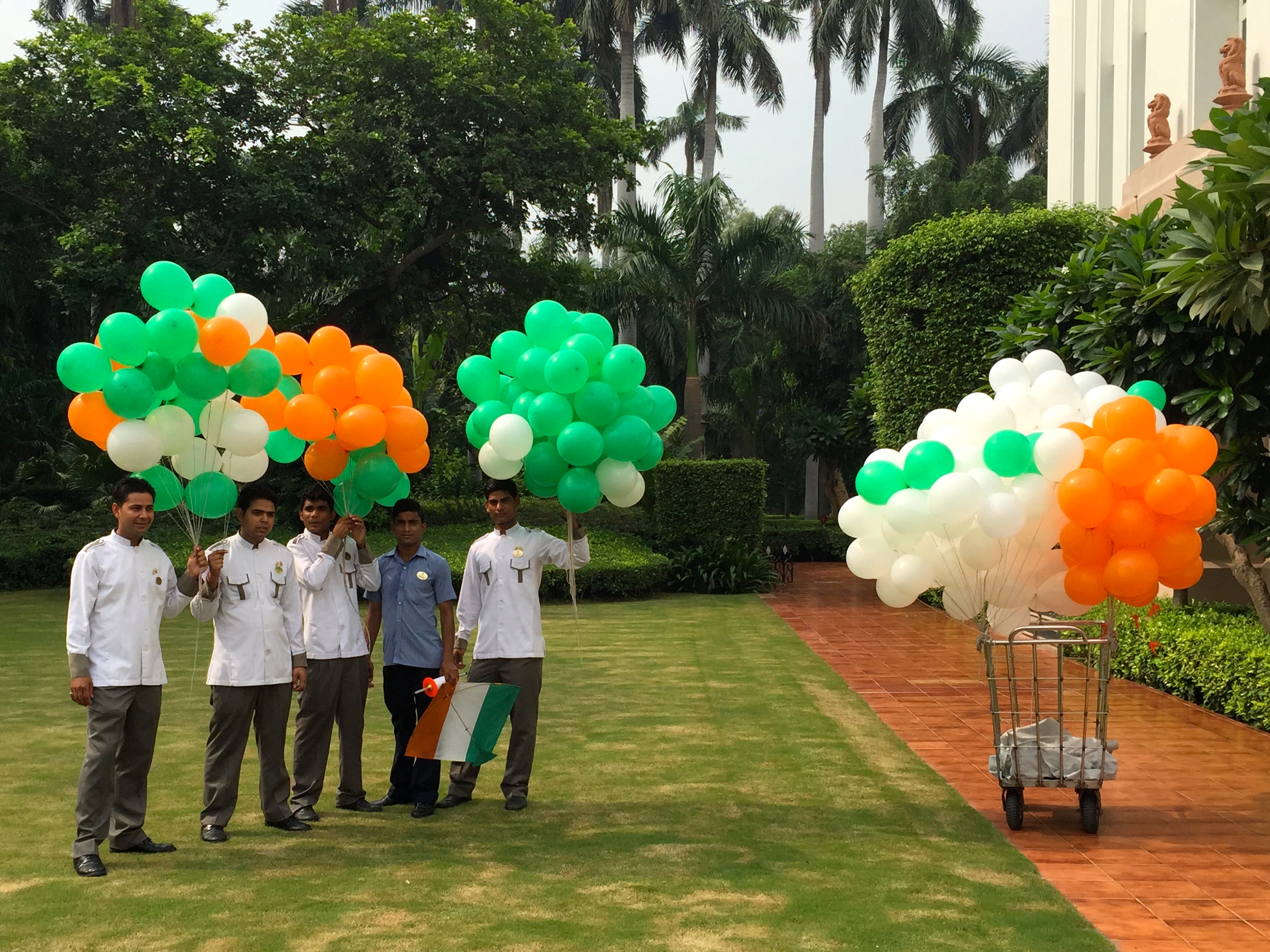
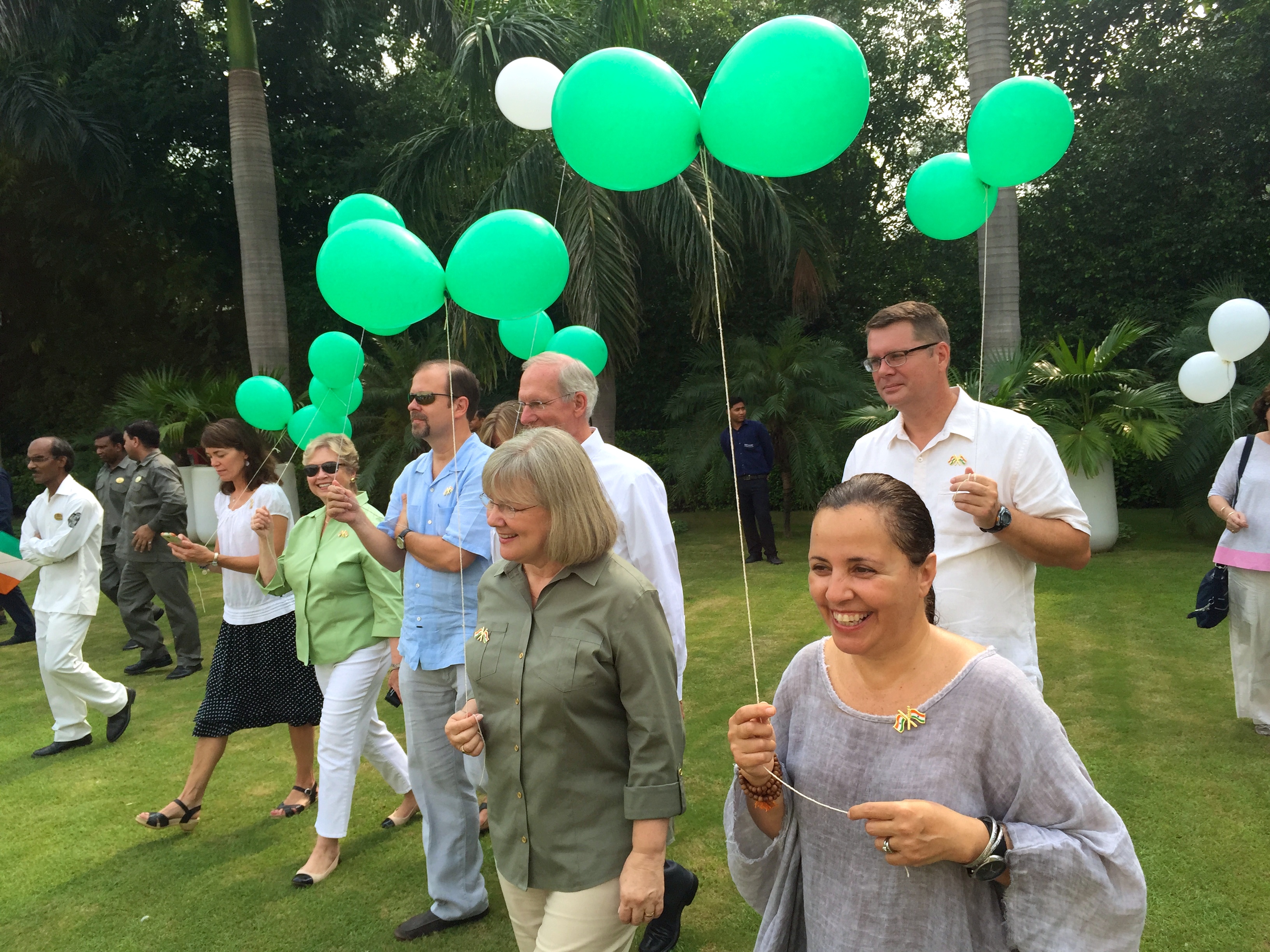
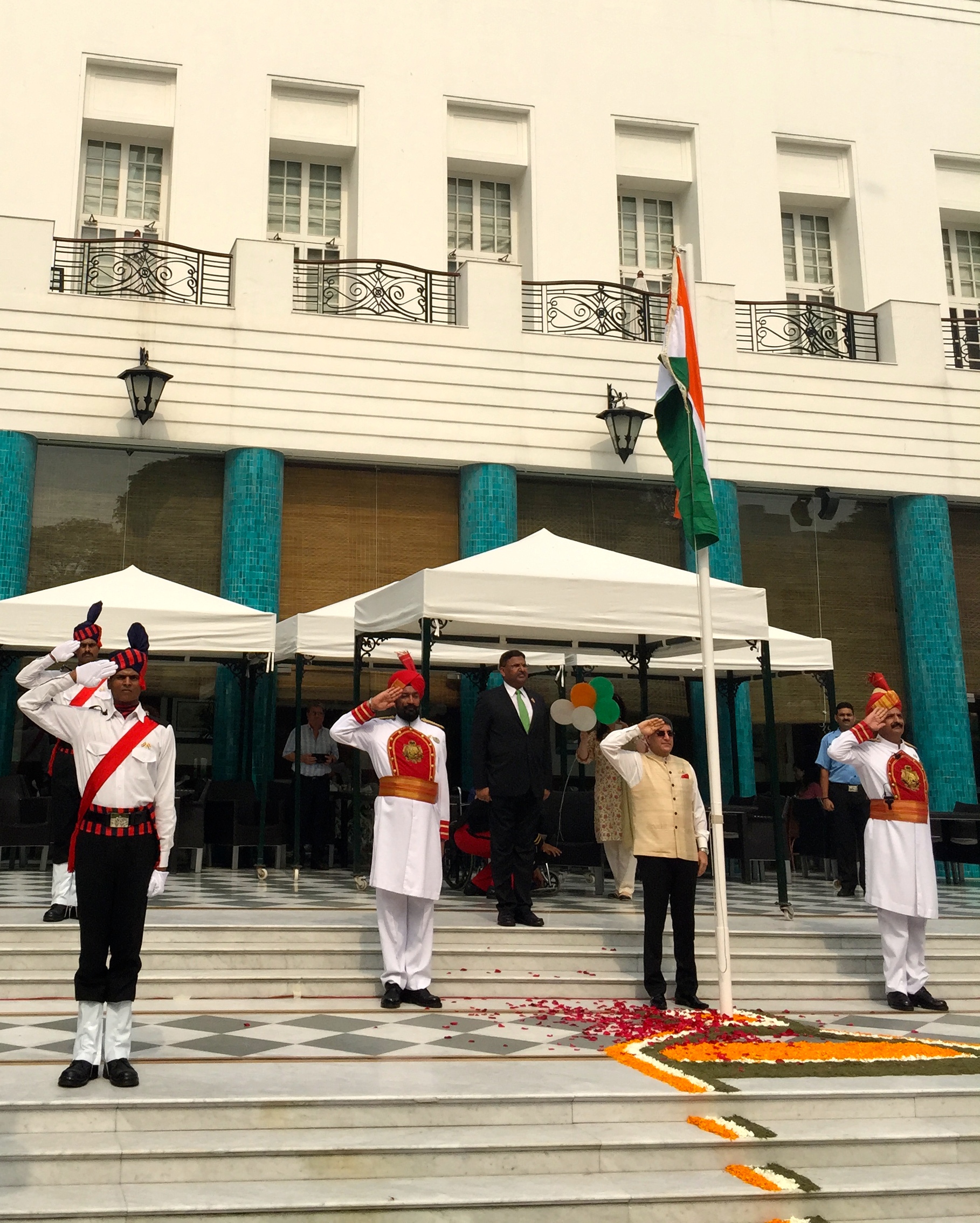
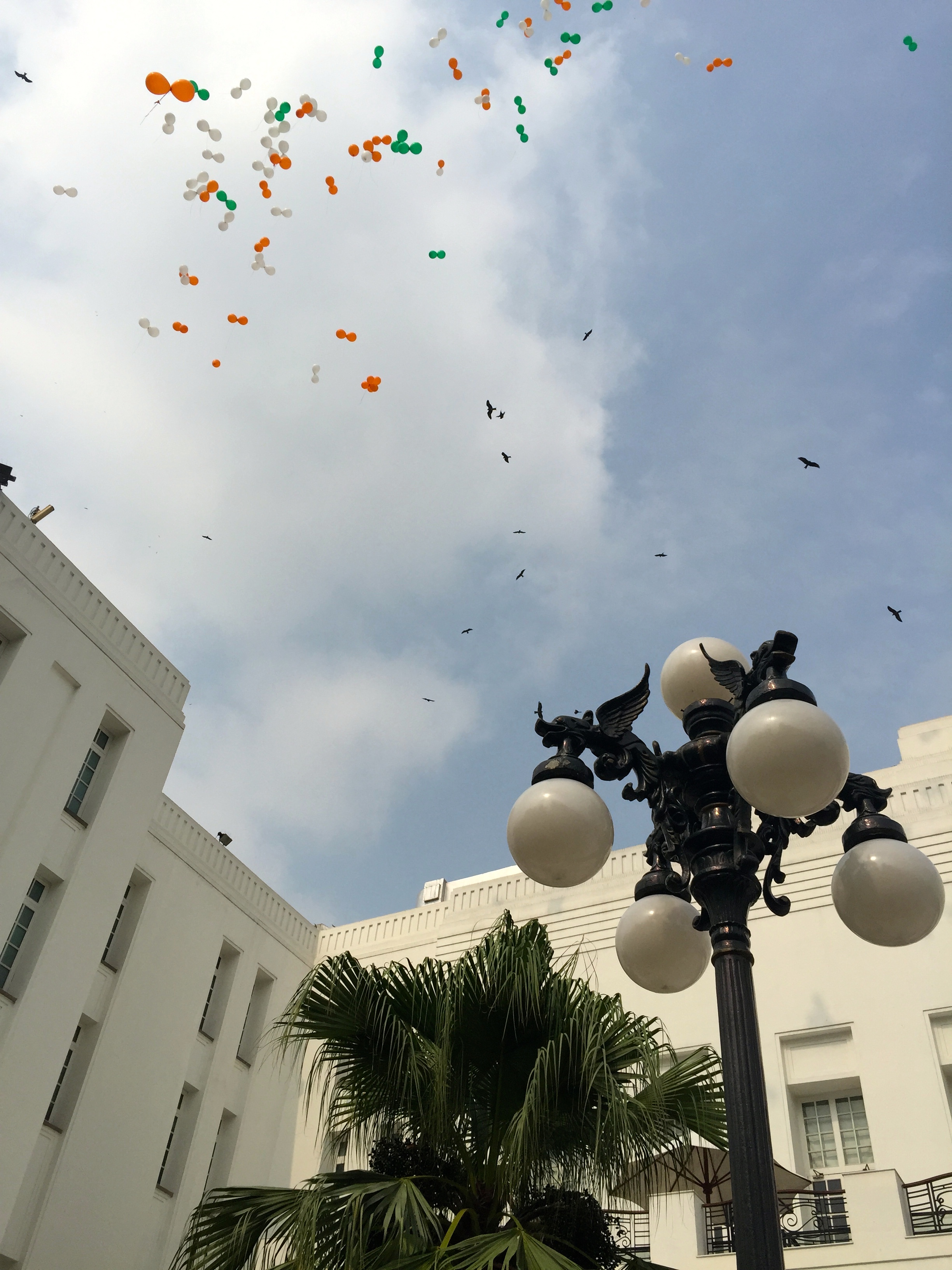
only after standing on the hotel lawn to sing India’s national anthem and release balloons in the colors of the flag,
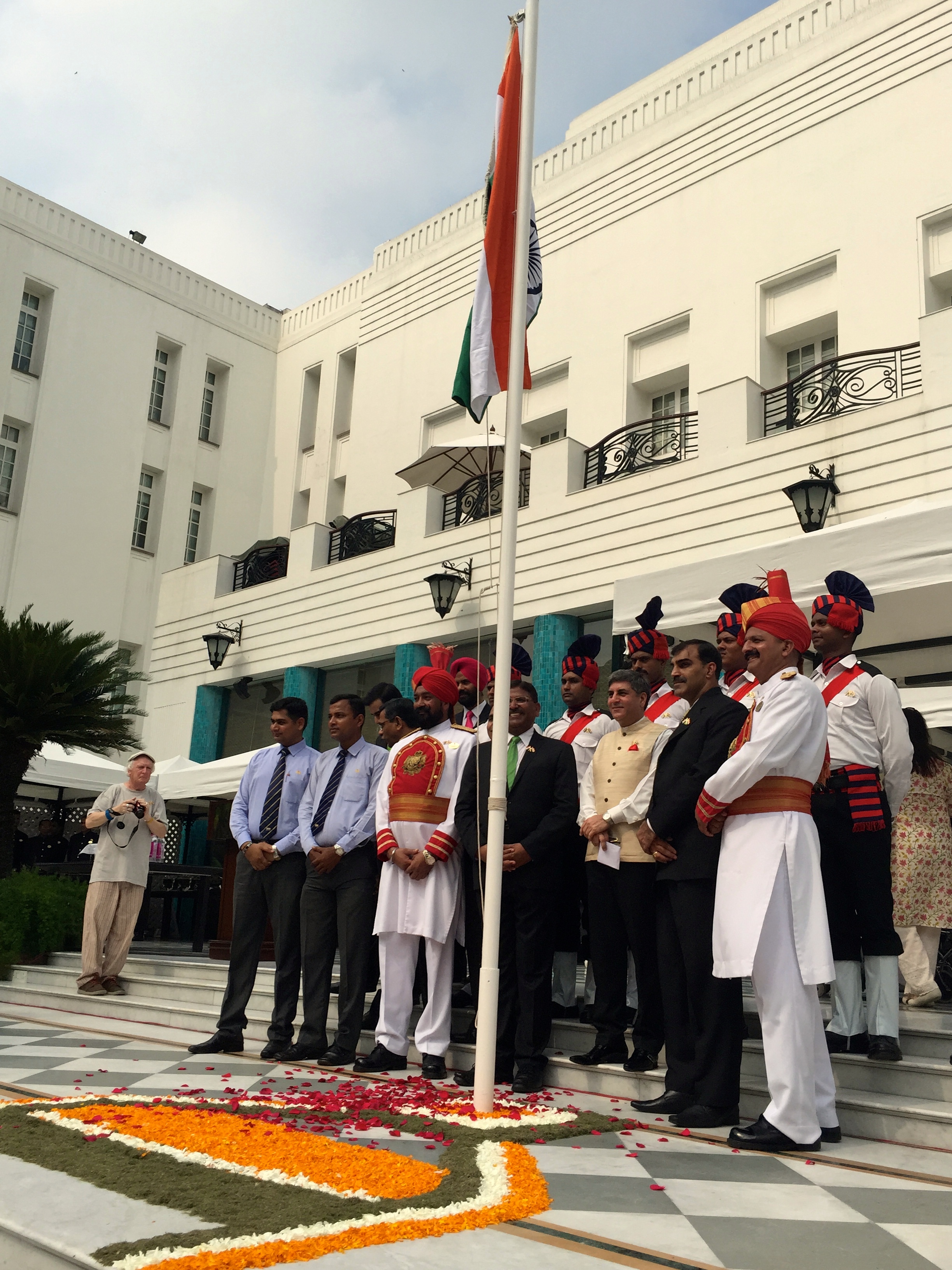
only after snapping photos of men in impeccable period costumes posing next to a rangoli created with flower petals,
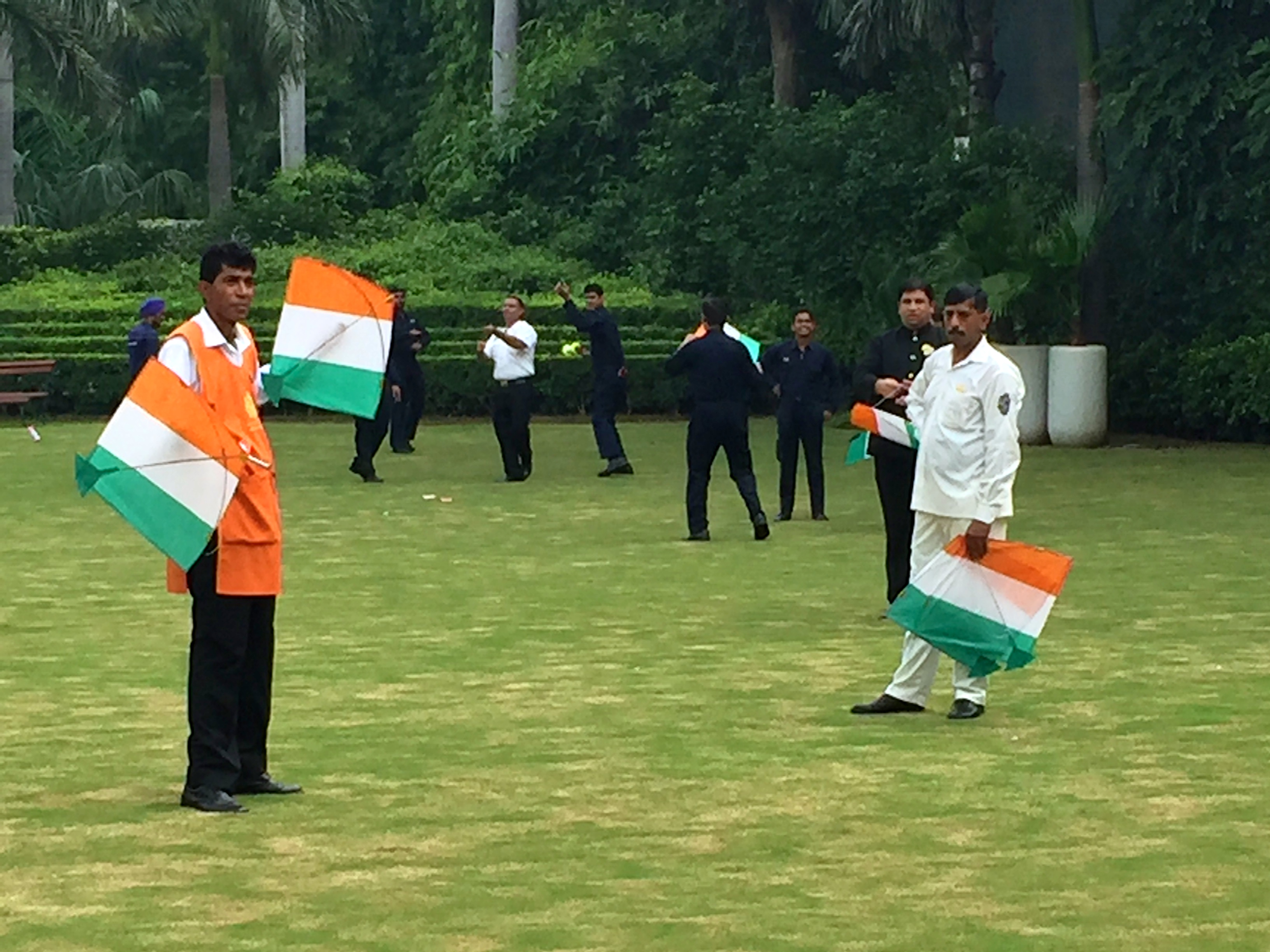
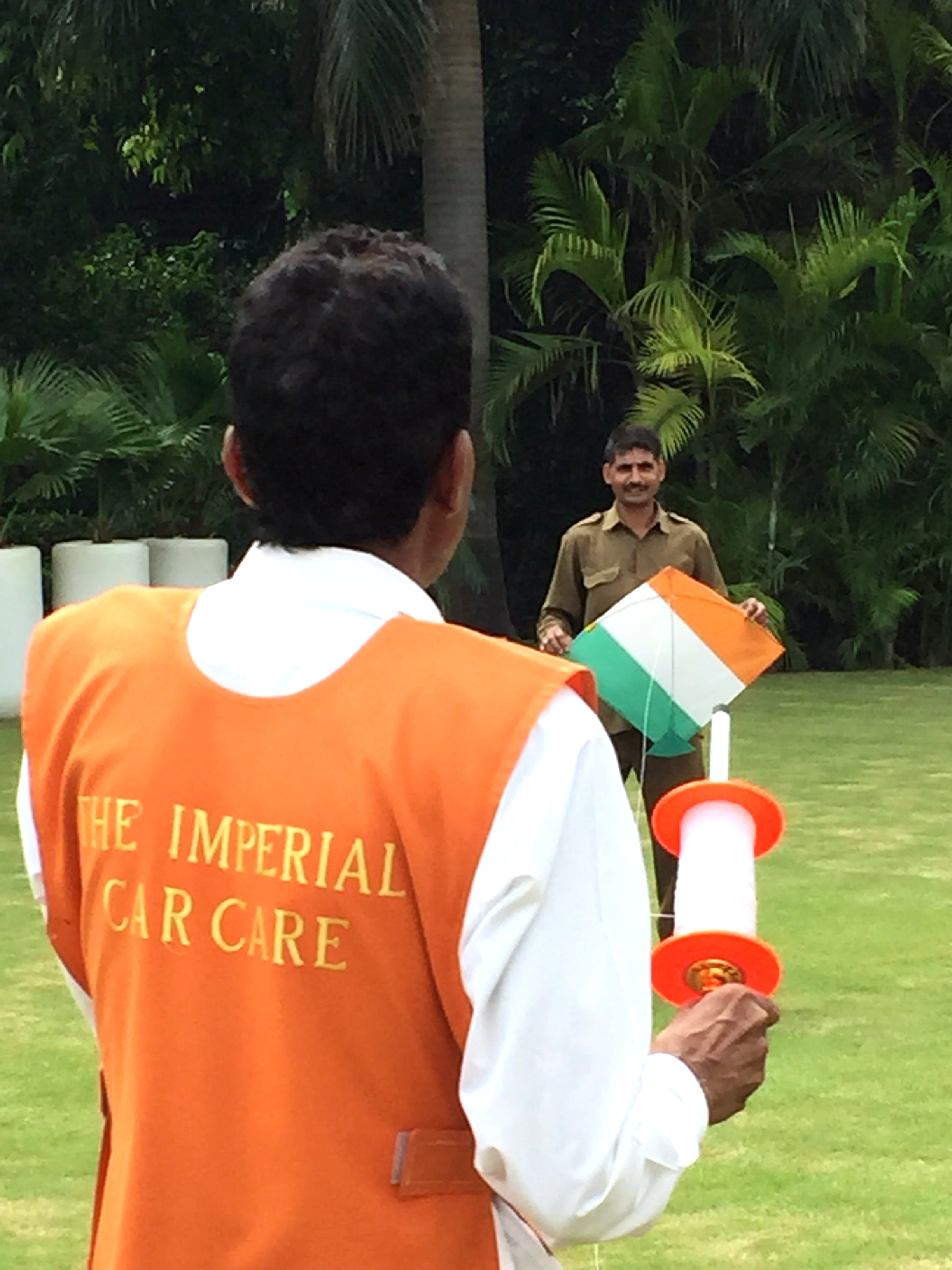
only after watching the groundskeepers and valet-parking staff try to fly kites in the still steamy air,
only on the way home,
did we realize the irony of celebrating India’s 69th Independence Day at a British Raj-era hotel.

On the very day our host country was rejoicing in its freedom from occupation, we were relishing the upscale jasmine-scented luxury of The Imperial, inaugurated by Lord Willingdon, British Governor-General of India, in 1936.

Just five years prior to that, Willingdon had ordered the arrest of Mahatma Gandhi.

So … that realization was a little sobering.

Still, irony aside, we had a lovely morning with wonderful company. Breakfast at The Imperial is always a treat, and the staff beamed with pride as they served traditional sweets, pressed their hands together in namaste and said, “Happy Independence Day!”

We listened to a speaker, who referenced India’s first Prime Minister Jawaharlal Nehru and his famous speech to the Indian Constituent Assembly on Aug. 15, 1947.

Long years ago we made a tryst with destiny, and now the time comes when we shall redeem our pledge, not wholly or in full measure, but very substantially. At the stroke of the midnight hour, when the world sleeps, India will awake to life and freedom. A moment comes, which comes but rarely in history, when we step out from the old to the new, when an age ends, and when the soul of a nation, long supressed, finds utterance. It is fitting that at this solemn moment we take the pledge of dedication to the service of Inida and her people and to the still larger cause of humanity.

(You can read the short but powerful speech at Fordham University’s Modern History Sourcebook.)

Reading that gives me goosebumps and makes me extra grateful today for the opportunity to live, work and play in the biggest democracy in the world.

IMG_0778

IMG_0783

IMG_0785

IMG_0789

IMG_0799

IMG_0805

IMG_0813

IMG_0819

Family Traditions: Ocean City, New Jersey

Some of my earliest memories place me in a small house at the end of the boardwalk in Ocean City, New Jersey, looking out the window at the beach while Great Uncle Herb offered me half a banana … listening as Great Aunt Iris reported on the newspaper’s tide and current tables … walking clumsily through deep sand full of prickers from the dune bushes … rinsing off sand and salt water in the cabana shower outside.

During my trip to the shore in July, I rode a bike along the boardwalk to that house. It’s still there – although no longer in the family, and it’s avoided the fate of many older homes that have been demolished and rebuilt as large multi-unit rentals. We actually rented one of those homes for our weeklong visit. I shared one floor of a house with my parents; my sister Kate, her husband, and three young boys; and my sister, Megan, and her two kids. My brother, Mike, and his wife and baby rented a nearby house to share with his in-laws.

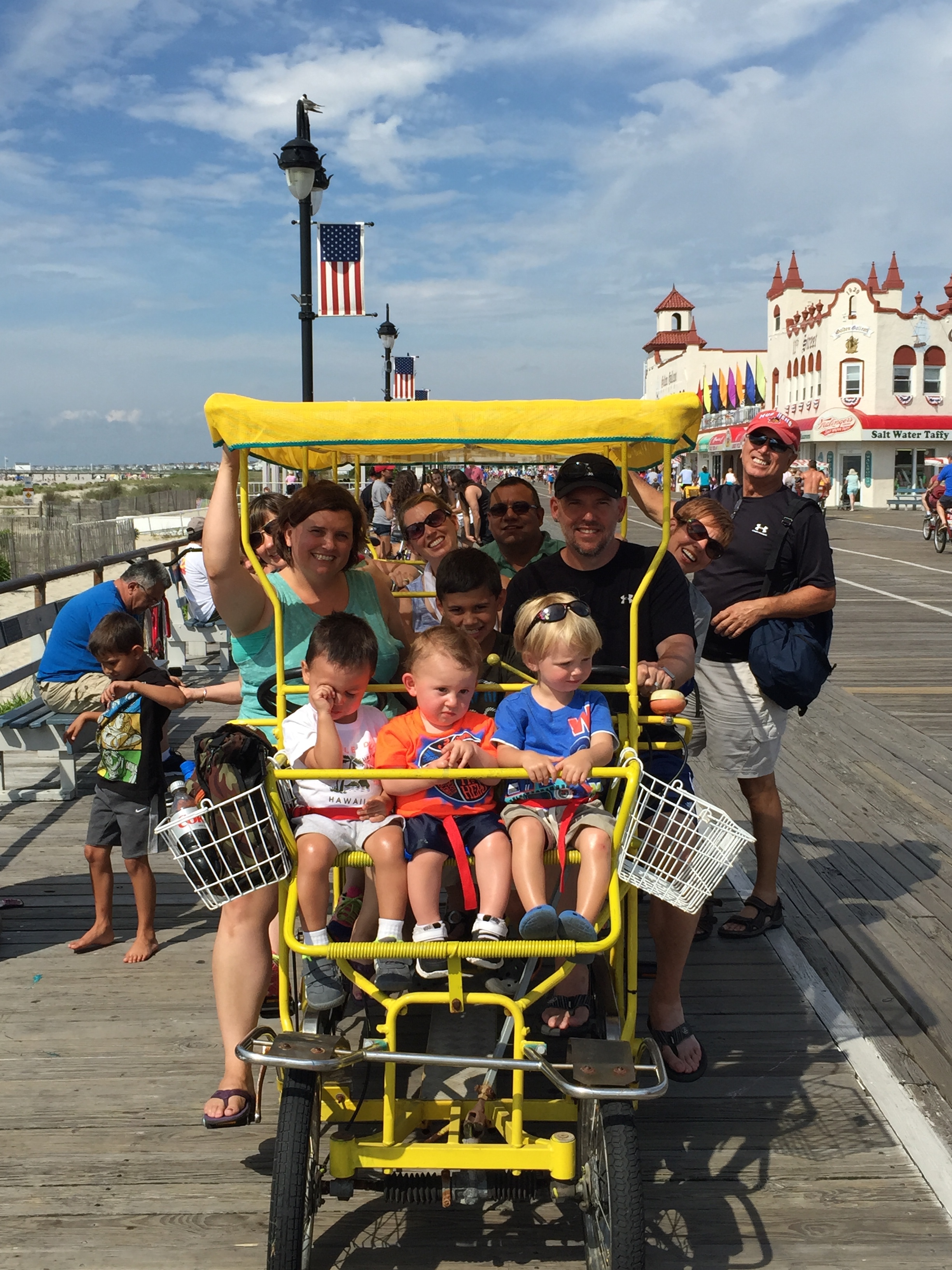
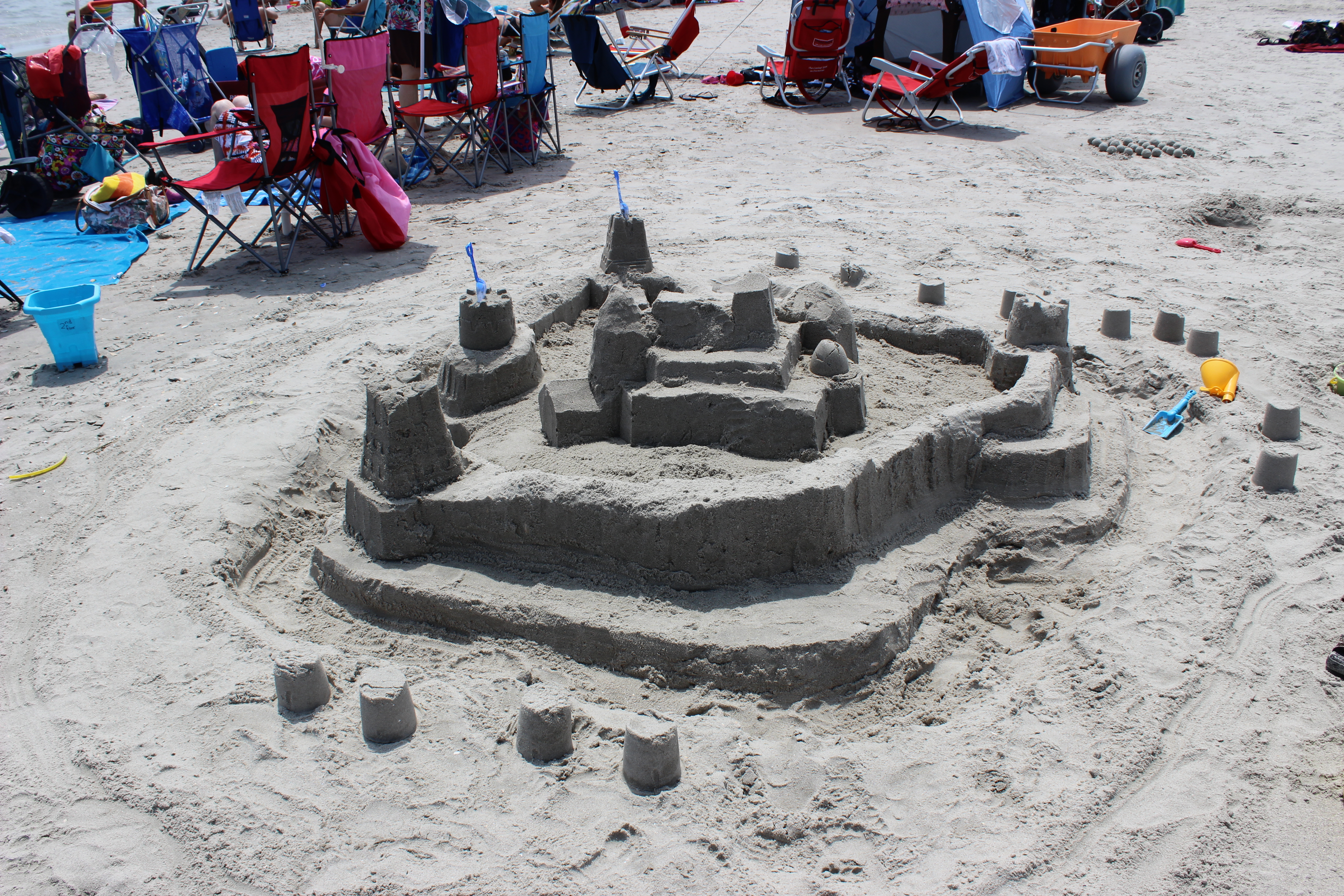
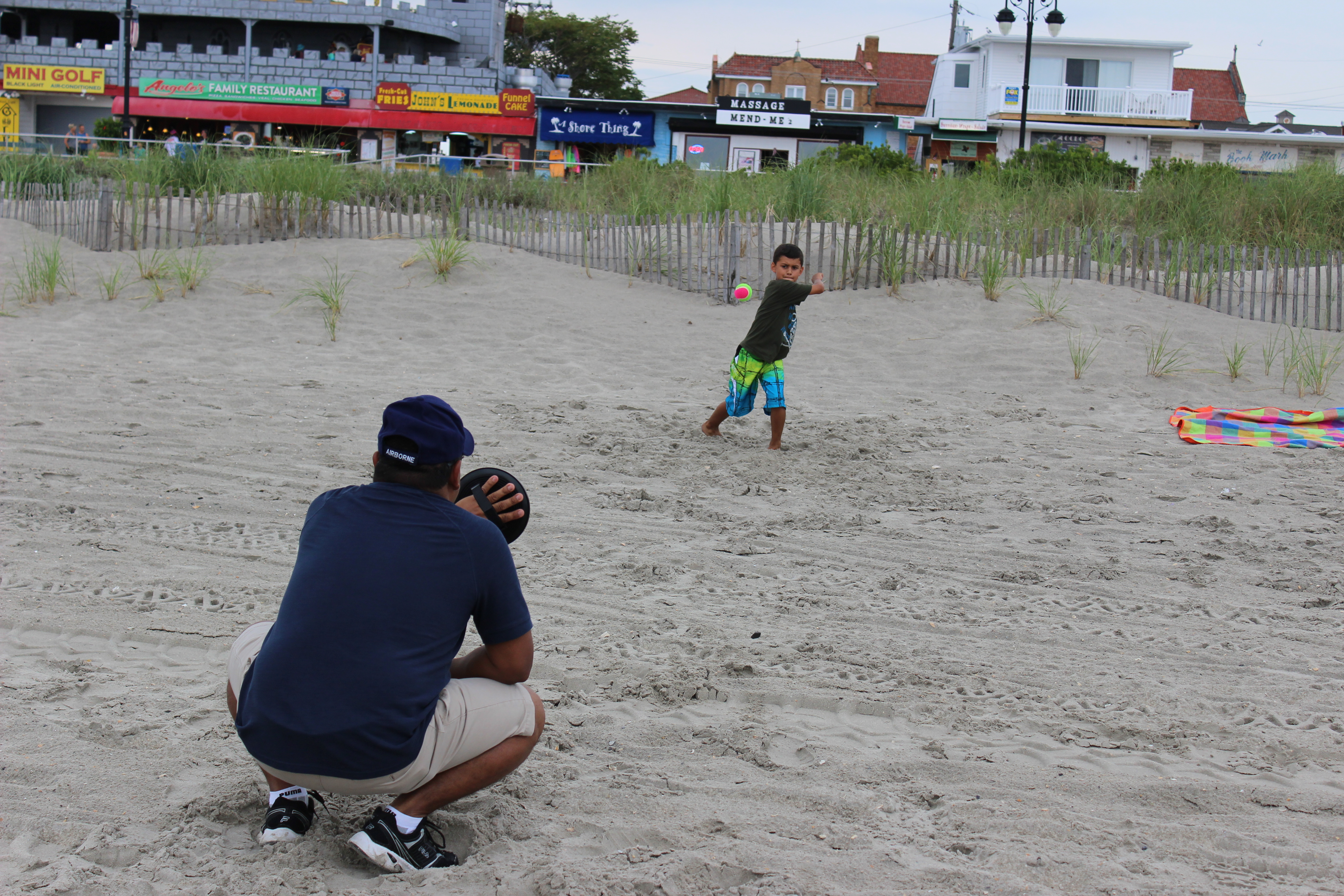
In the grip of nostalgia, we tried to do it all: beach time, boogie boarding in the ocean, sand castle construction, early morning bike rides, breakfast at Uncle Bill’s Pancake House, arcade games and rides and miniature golf on the boardwalk, ice cream and cheesesteaks and sticky buns and pizza and crab legs, beach combing for shells, crabbing off the 34th Street dock, and cramming the whole family onto a rented surrey (for a short ride on the boardwalk, but mostly for the photos).

I can’t count how many times during this week I paused to tell myself, “Remember this moment,” especially when my little nephews expressed unrestrained joy at being in this place. My face ached with laughter while boogie boarding with 8-year-old Nico or splashing in the surf with dare-devil Will, who is not yet three. My heart swelled when little Max danced to the boardwalk band and 6-year-old Paul rode his first roller-coaster with his adored cousin, Jake.

My brother always makes the ridiculous just a little bit more so, as evidenced by our surrey ride. “Let’s pull up next to random strangers and sing ‘Surrey With the Fringe on Top,'” he begged. And so we did.
IMG_0601

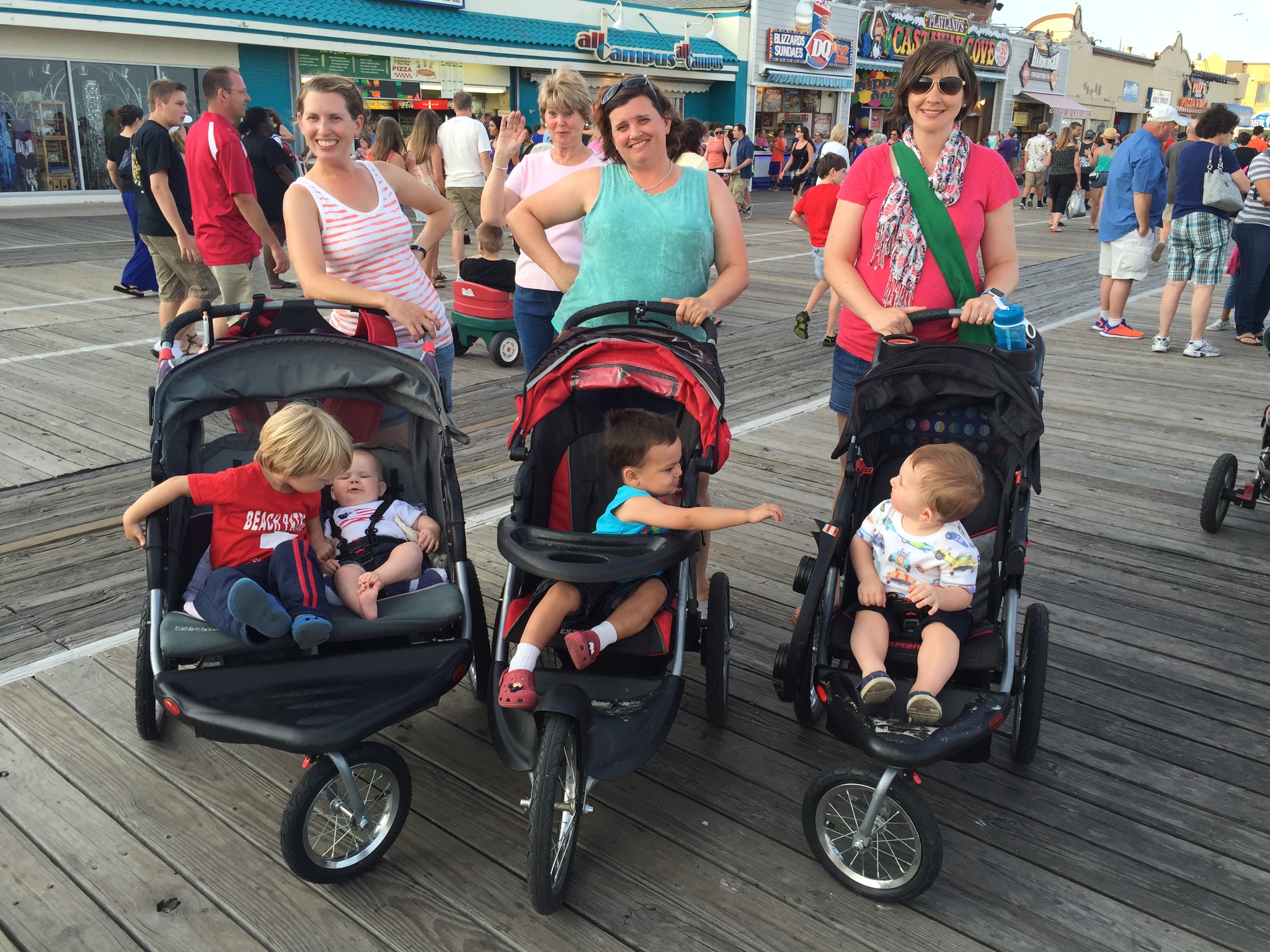
Mamas and babies on the boardwalk (photobombed by my mother).
IMG_0351_2

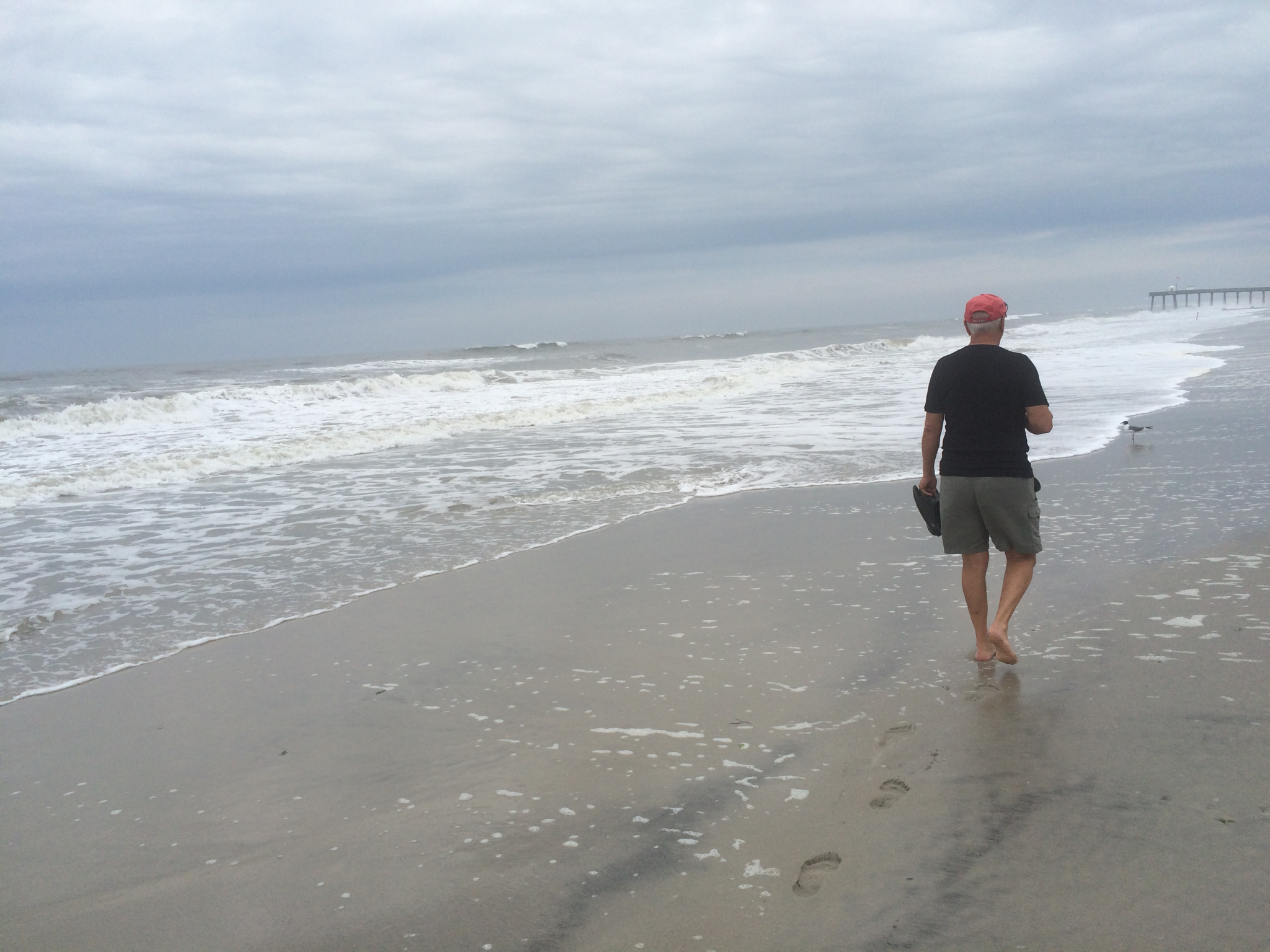
Early morning walk on the beach with my dad.
IMG_7243_2

The Ocean City, NJ, boardwalk.
IMG_0559

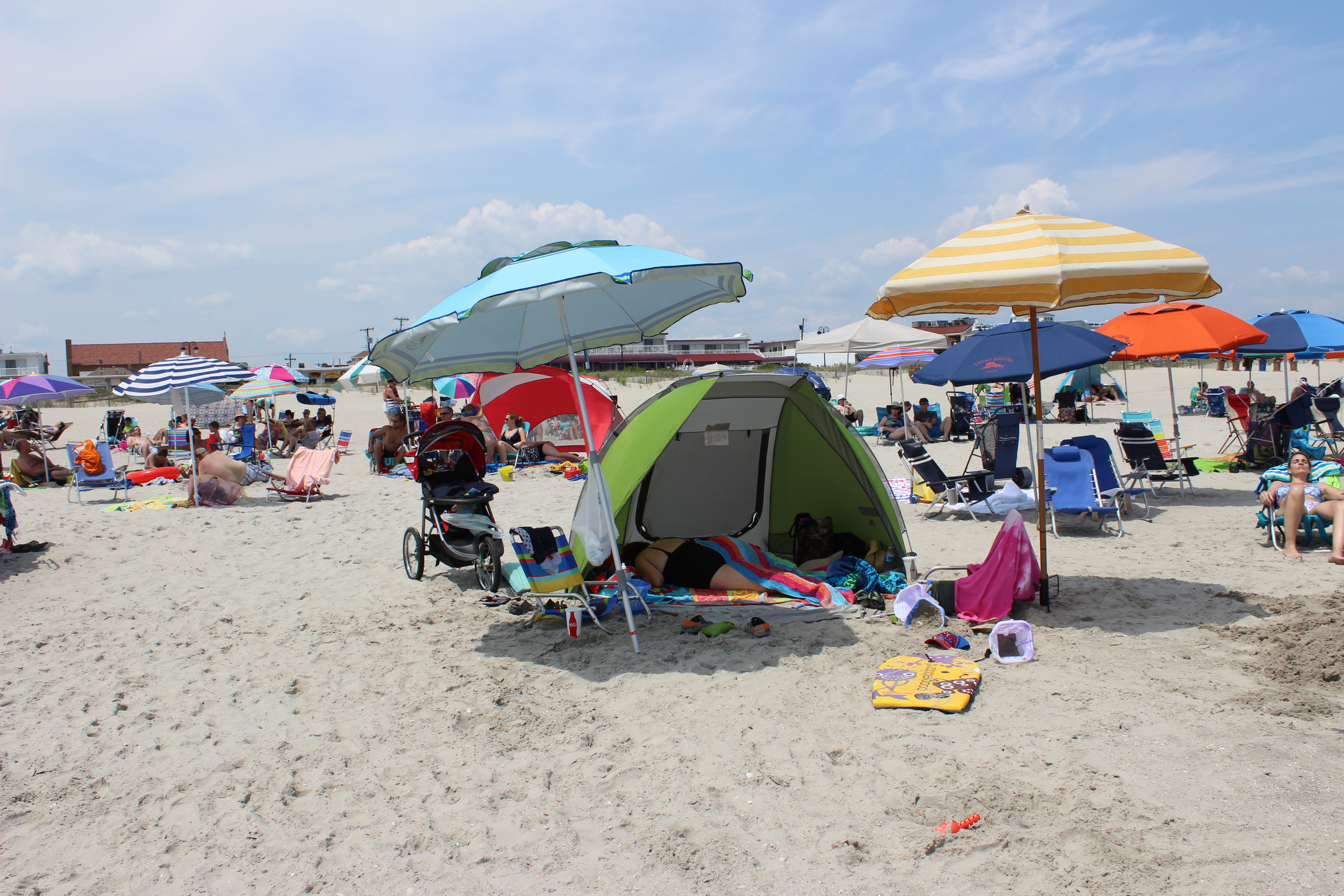
Beach time!
IMG_0632

IMG_2809

IMG_2815

IMG_0509

IMG_0444

IMG_2827

IMG_2866

IMG_2860

IMG_2864

IMG_3025

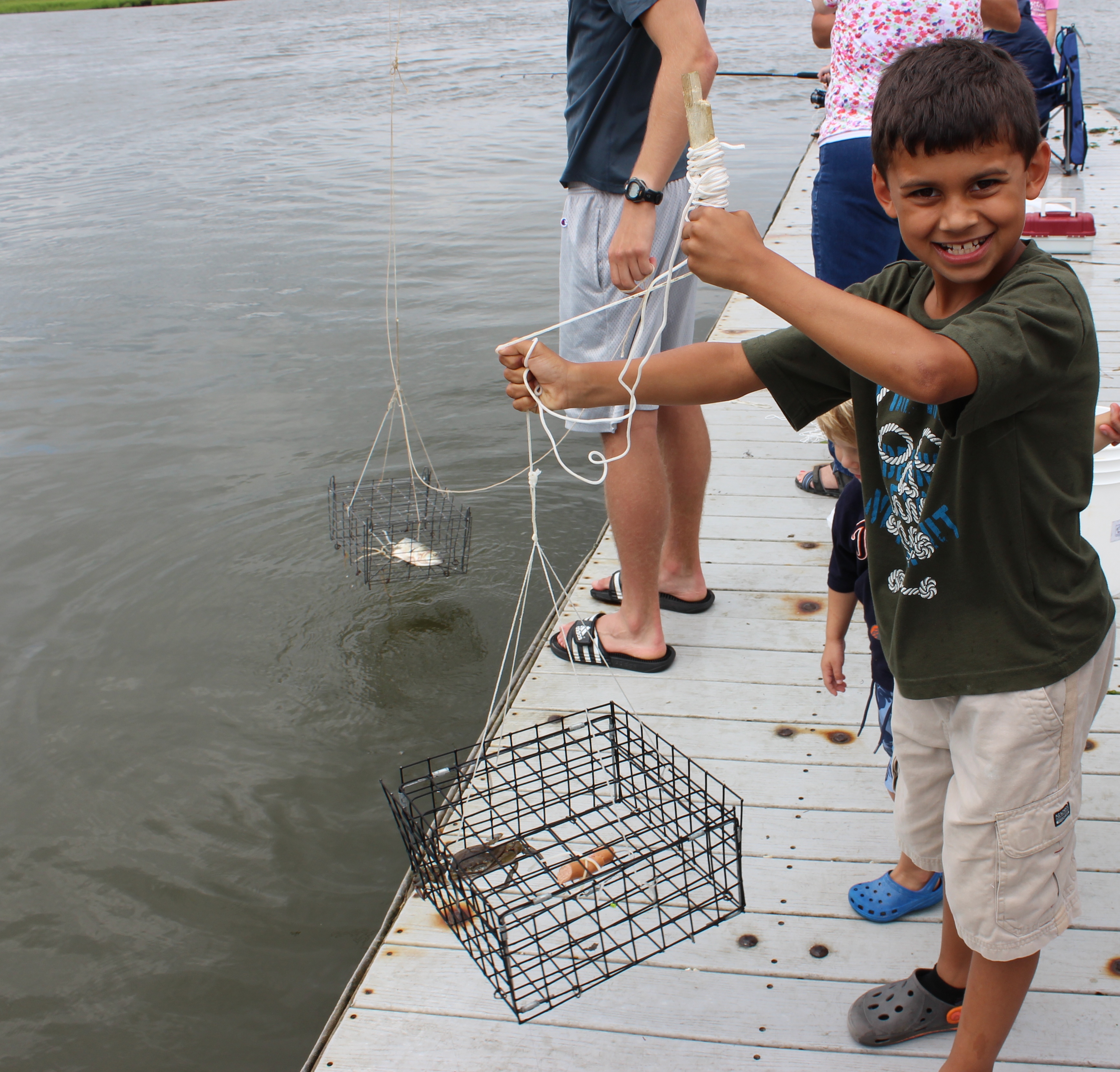
Our highly unsuccessful crabbing attempt yielded one crab. We used traps baited with hot dogs. We learned a different technique from a fellow crabber, who hung a chicken neck from a string and then scooped up the crab with a net. Later, Mike and Summer’s family reported catching piles of crabs that way!
IMG_2974

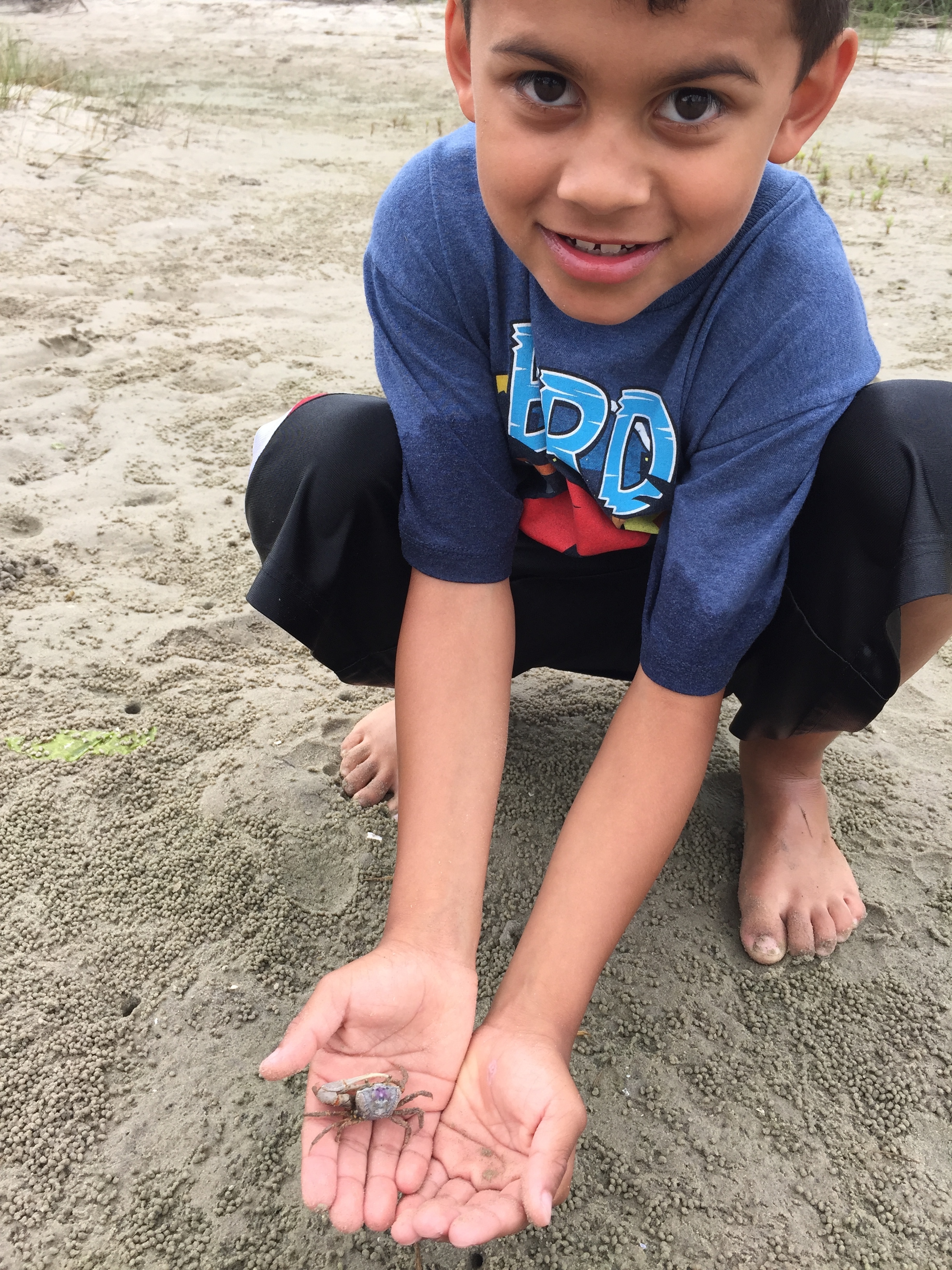
At Corson’s Inlet, we found many large clam shells, a live horseshoe crab, a couple jellyfish and hundreds of hyper-clawed fiddler crabs.
IMG_0656

IMG_0652

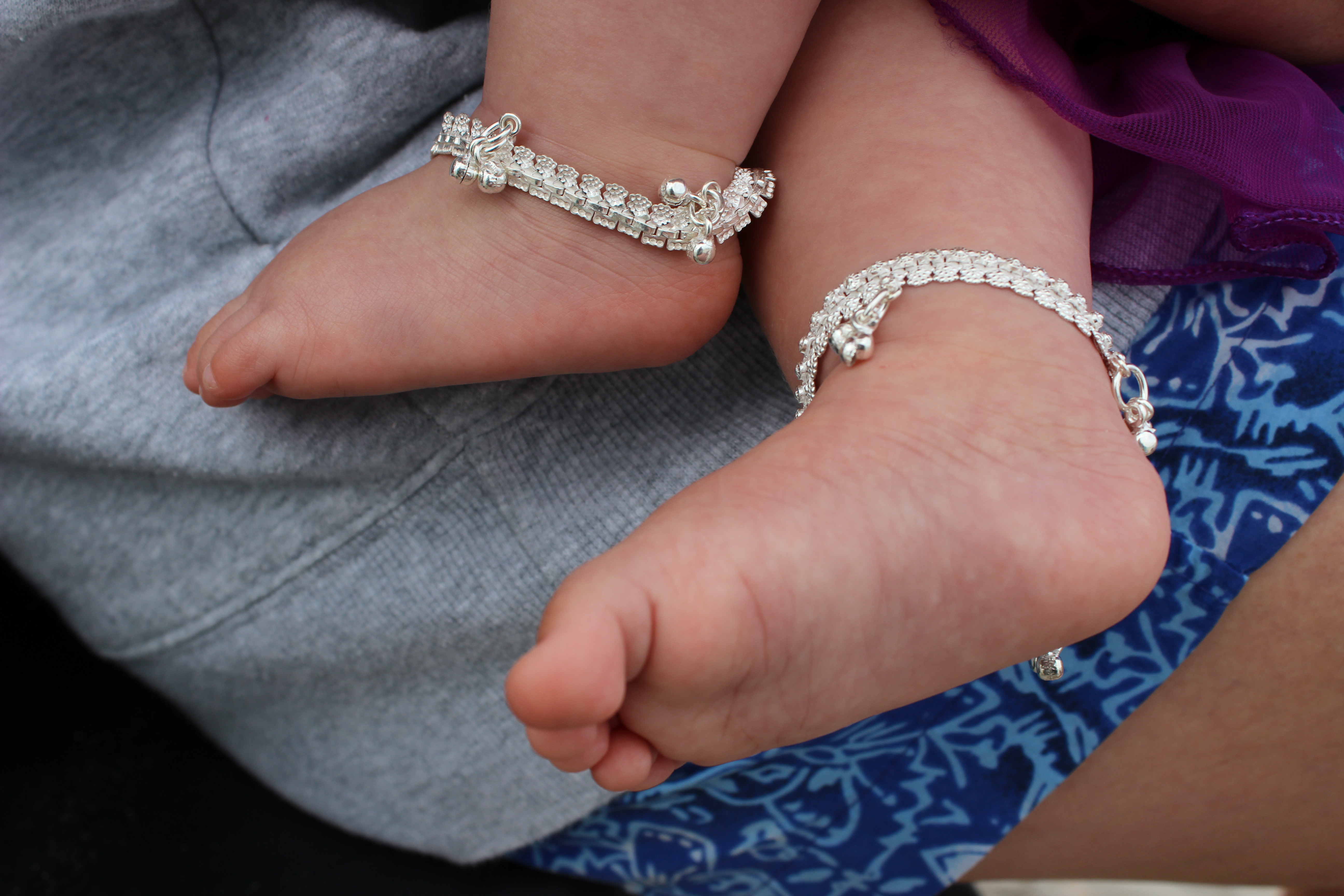
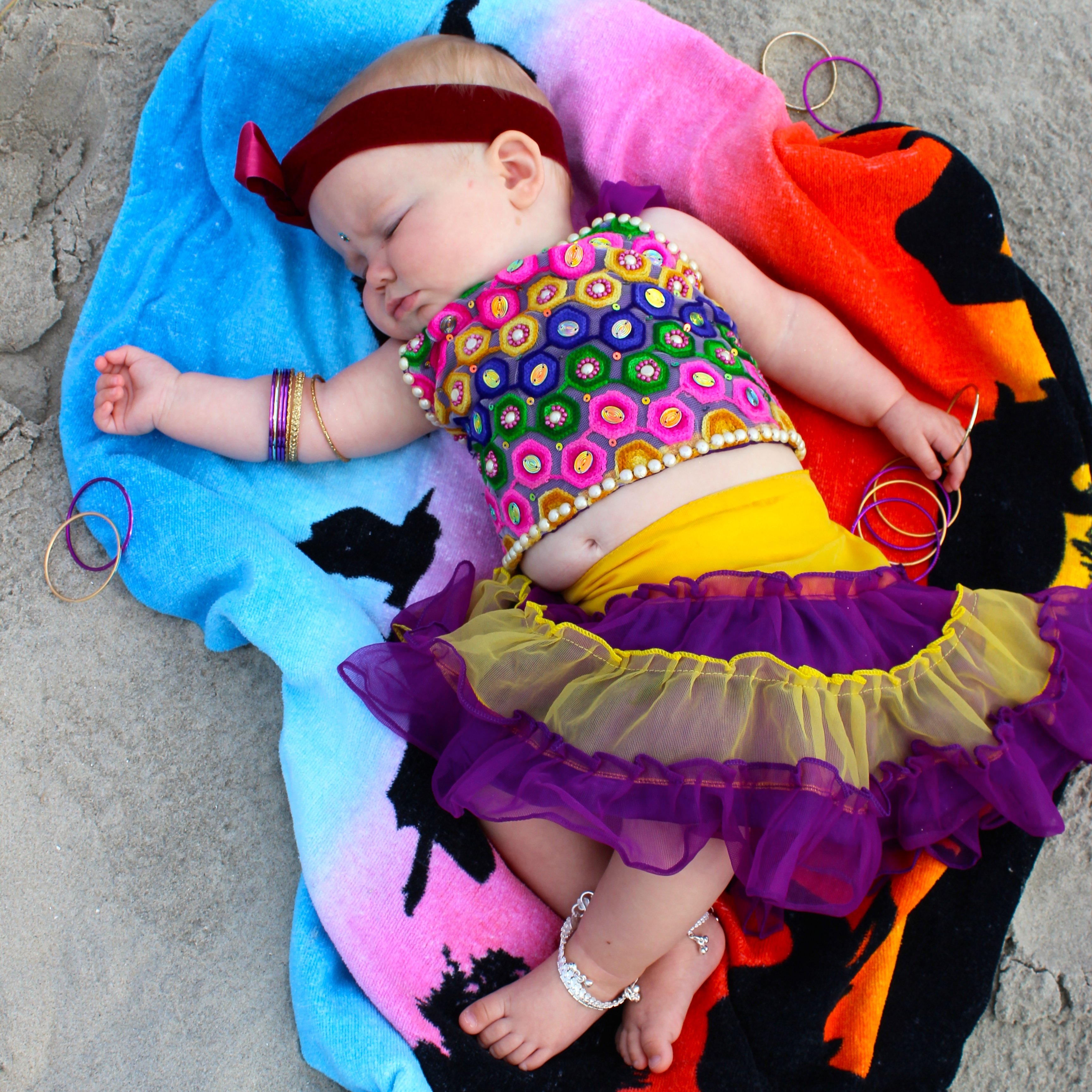
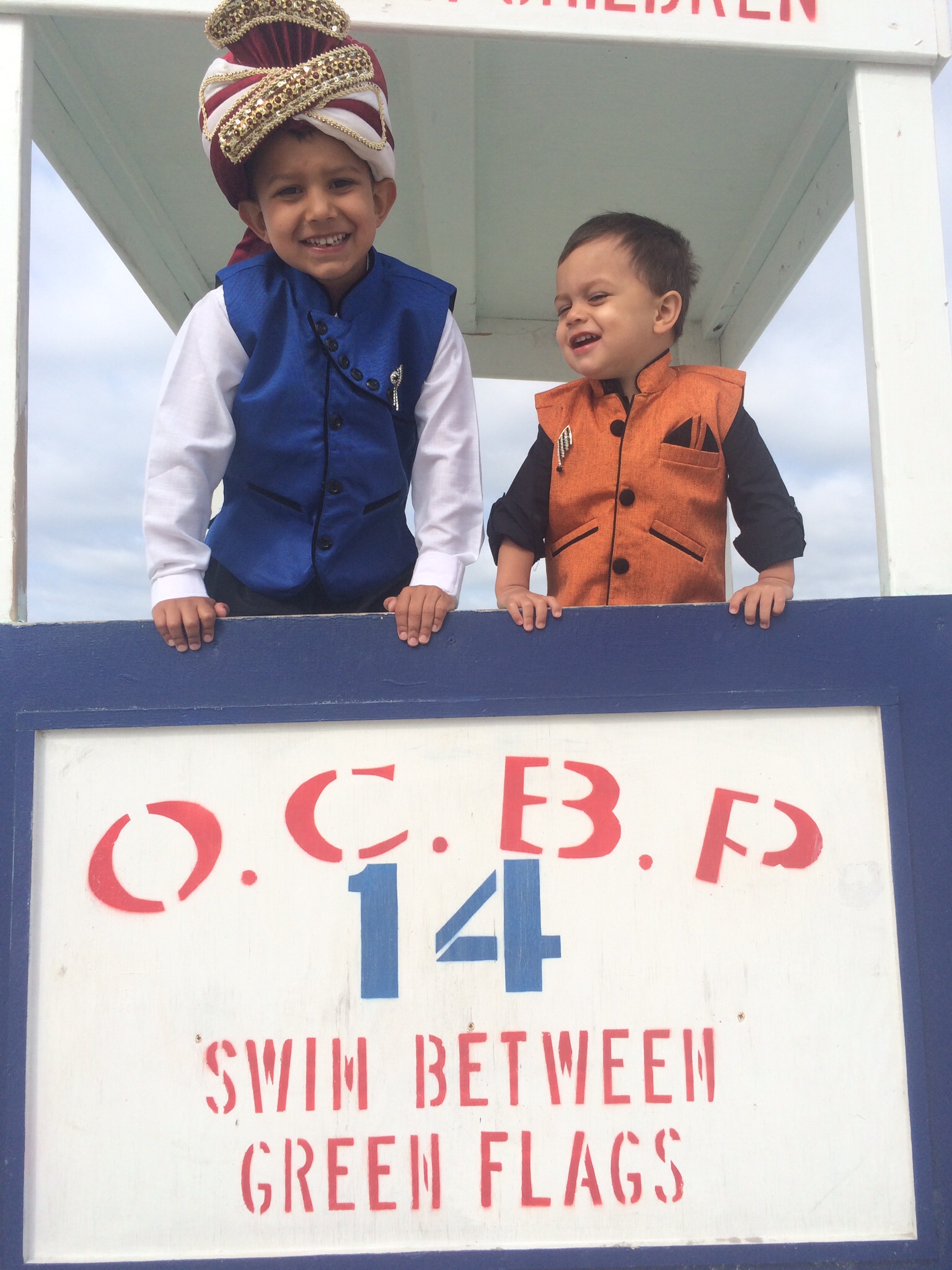
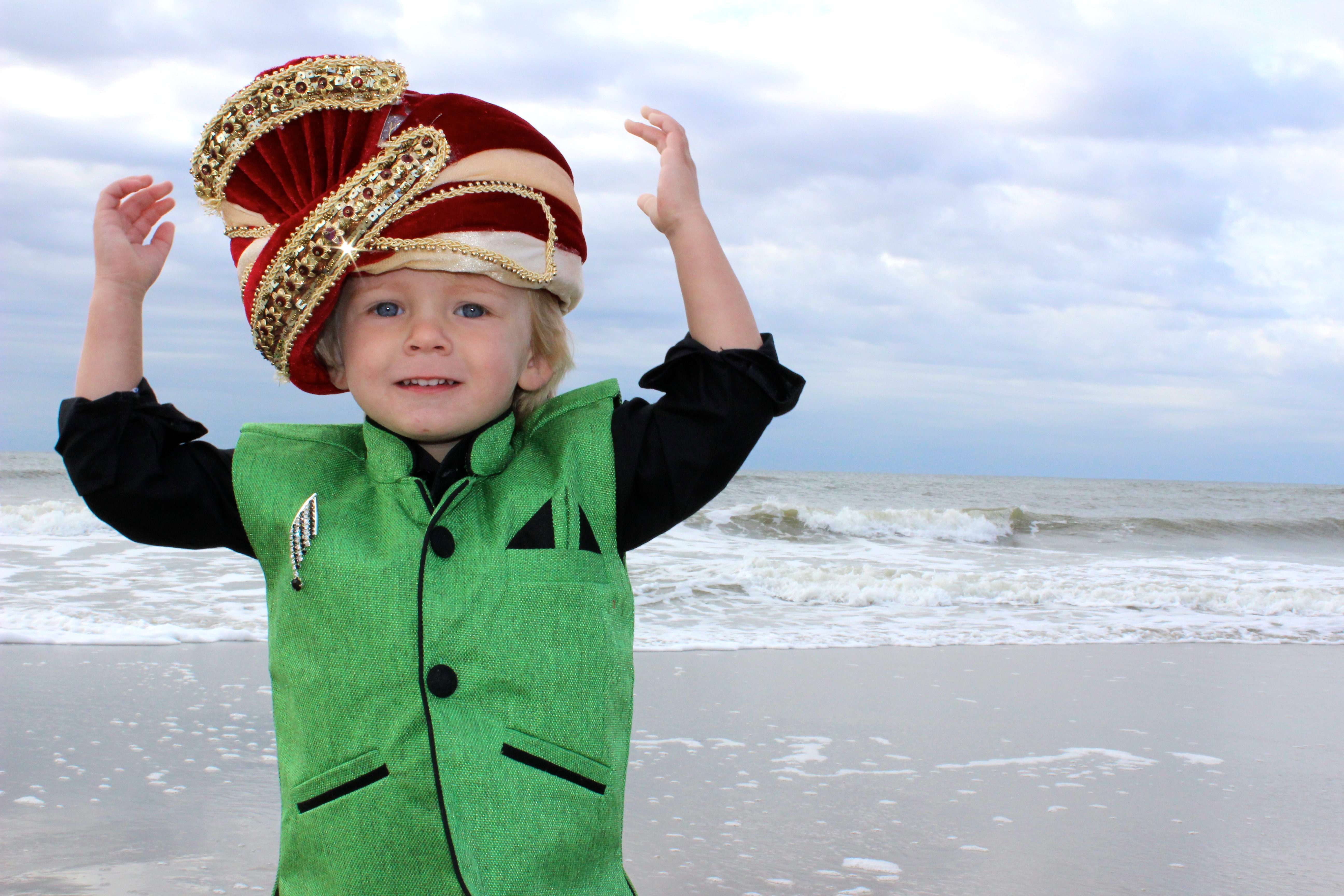
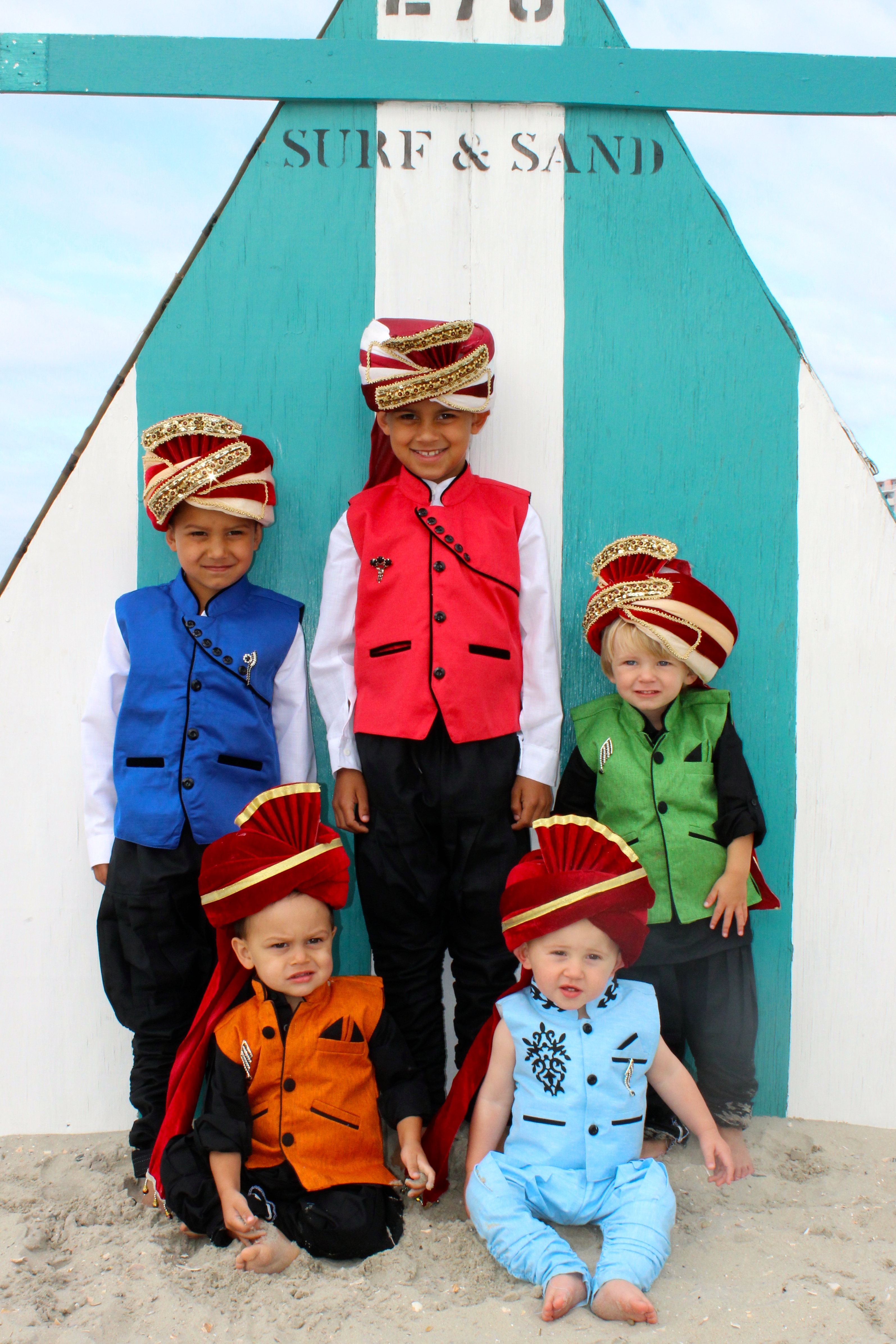
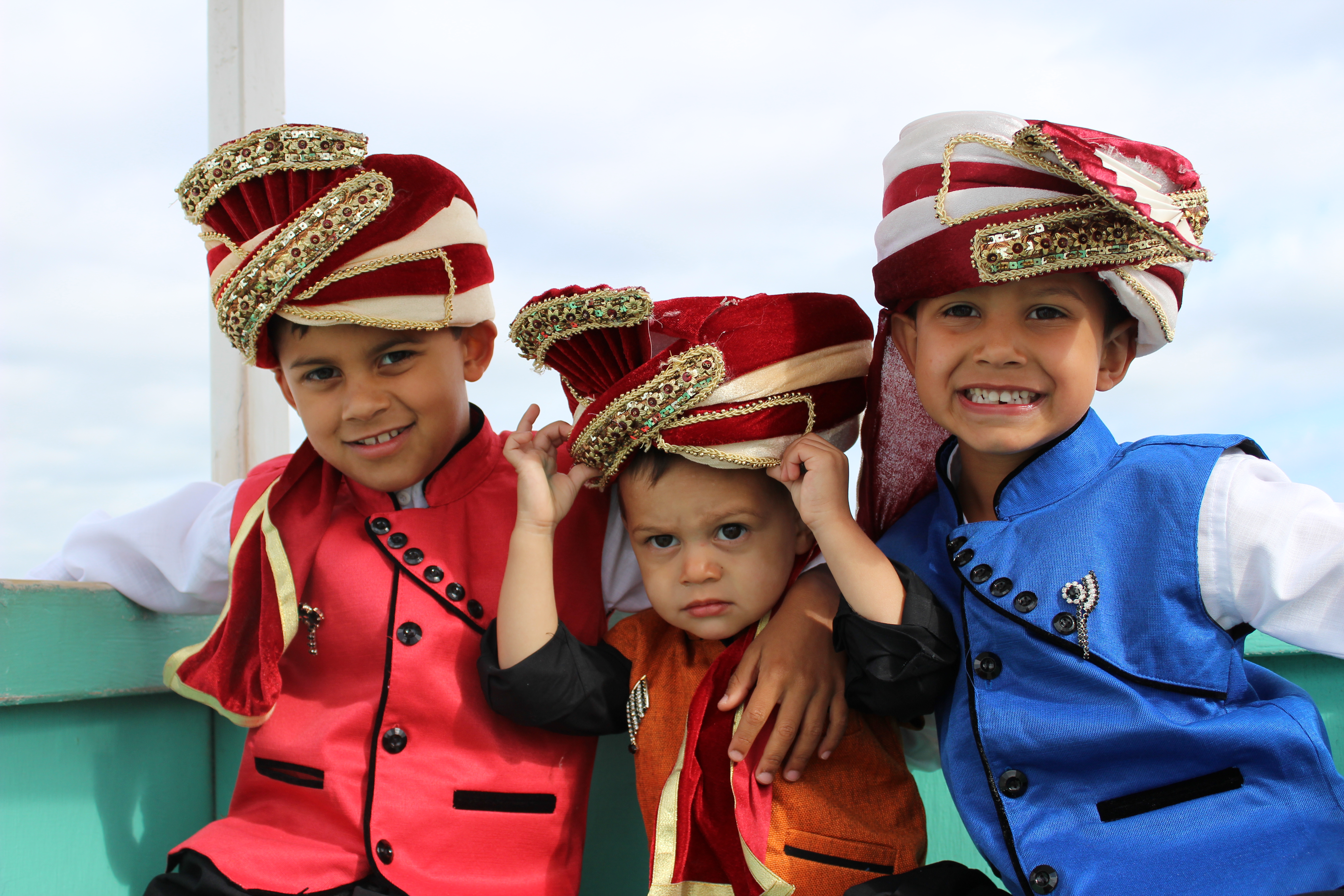
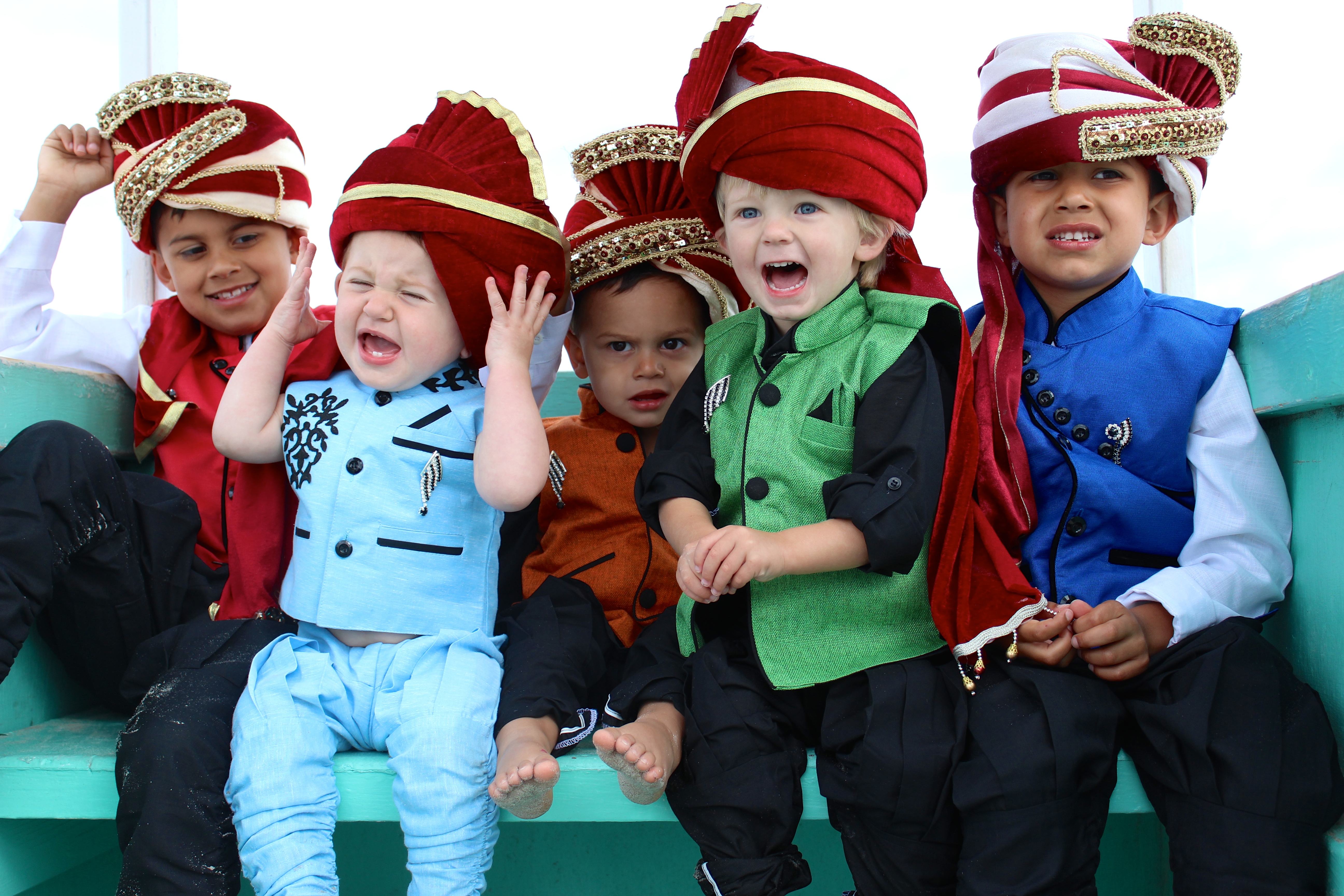
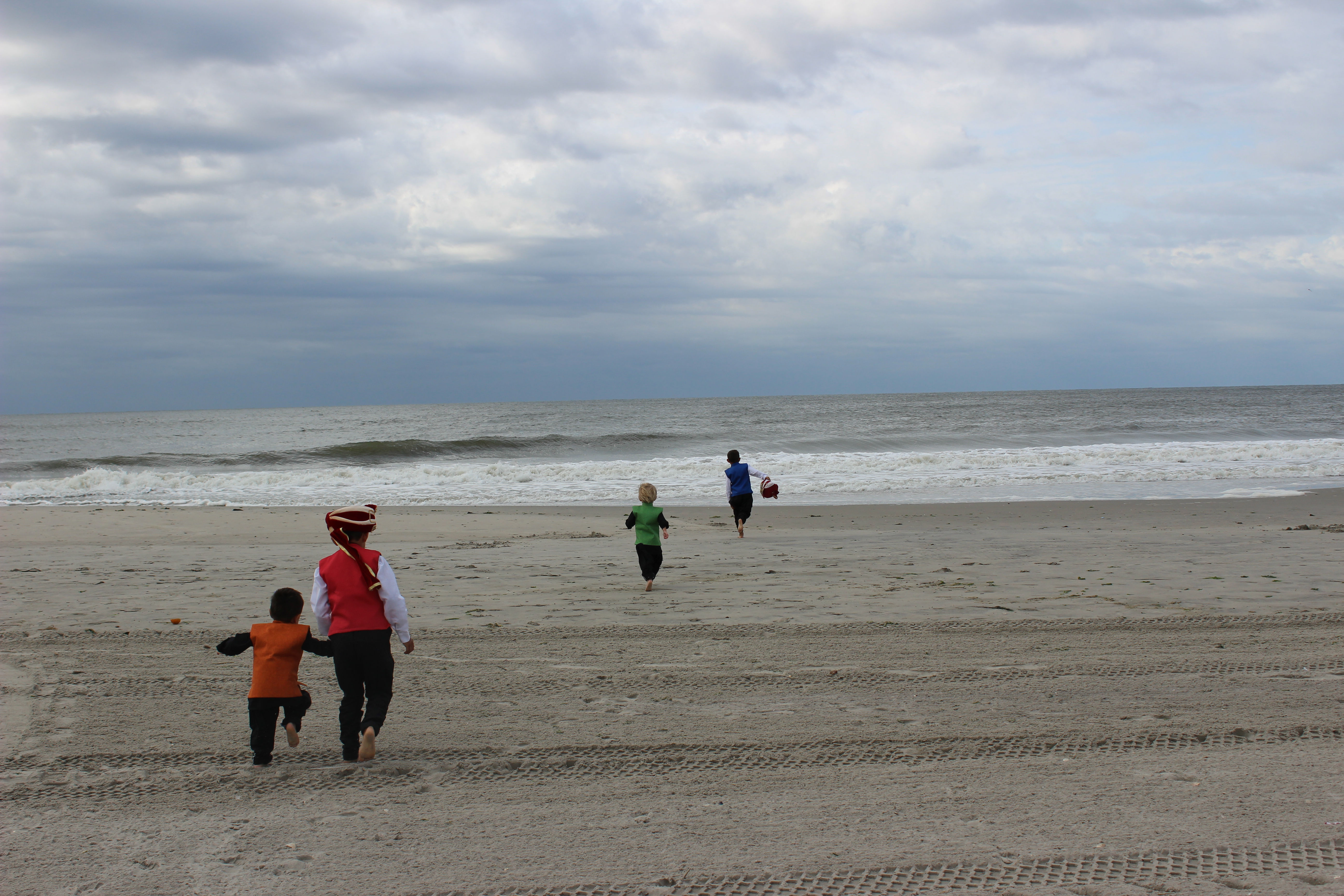
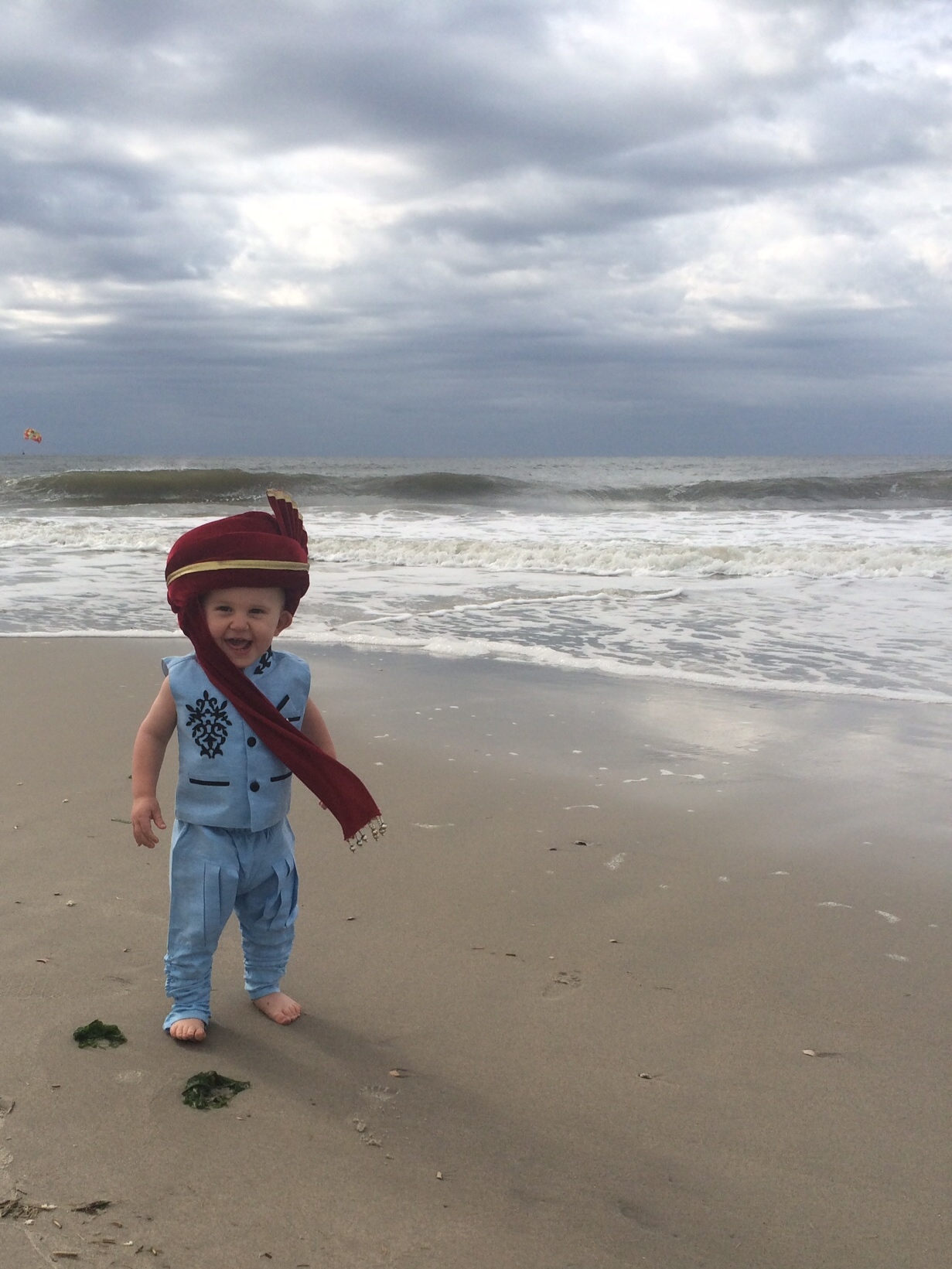
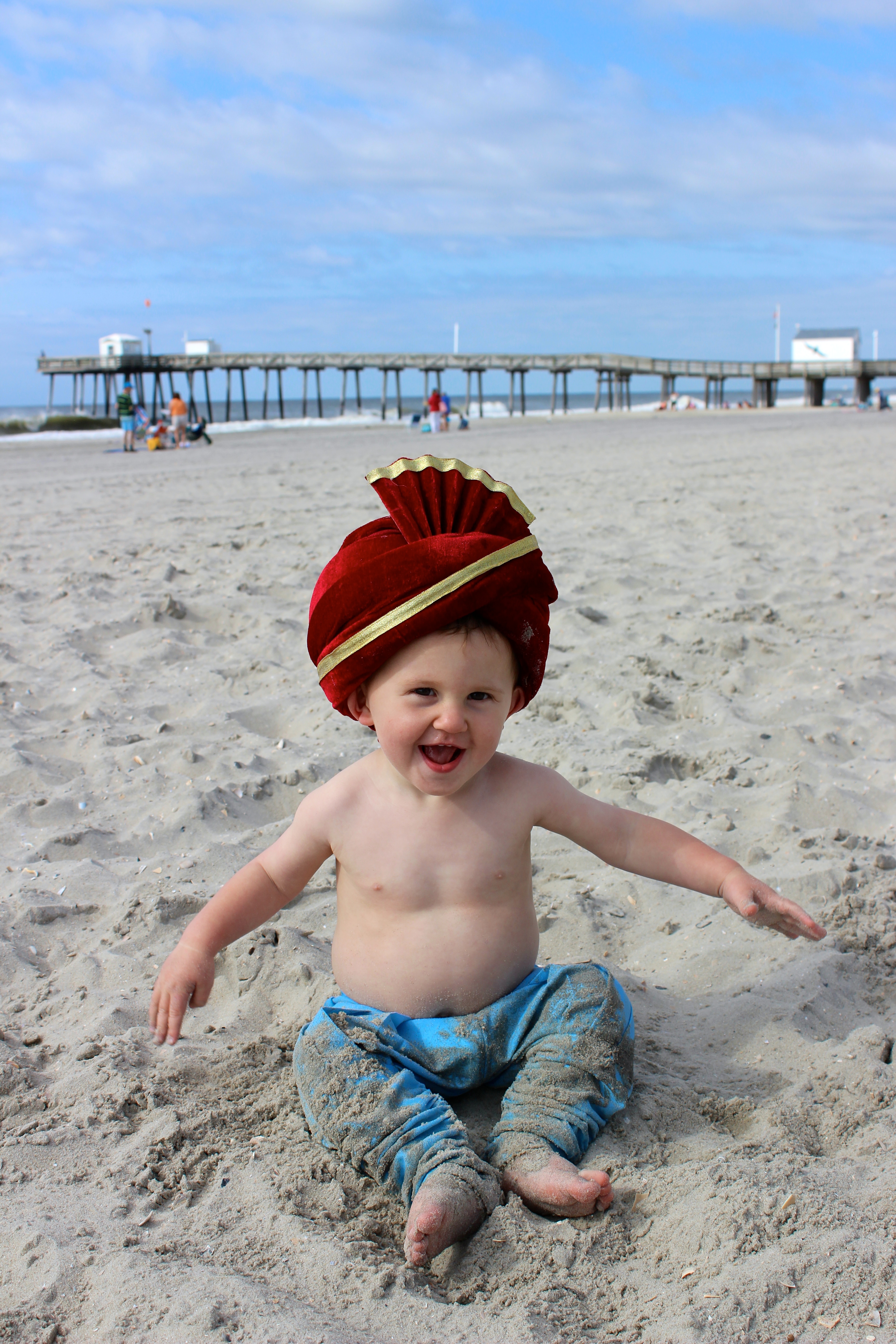
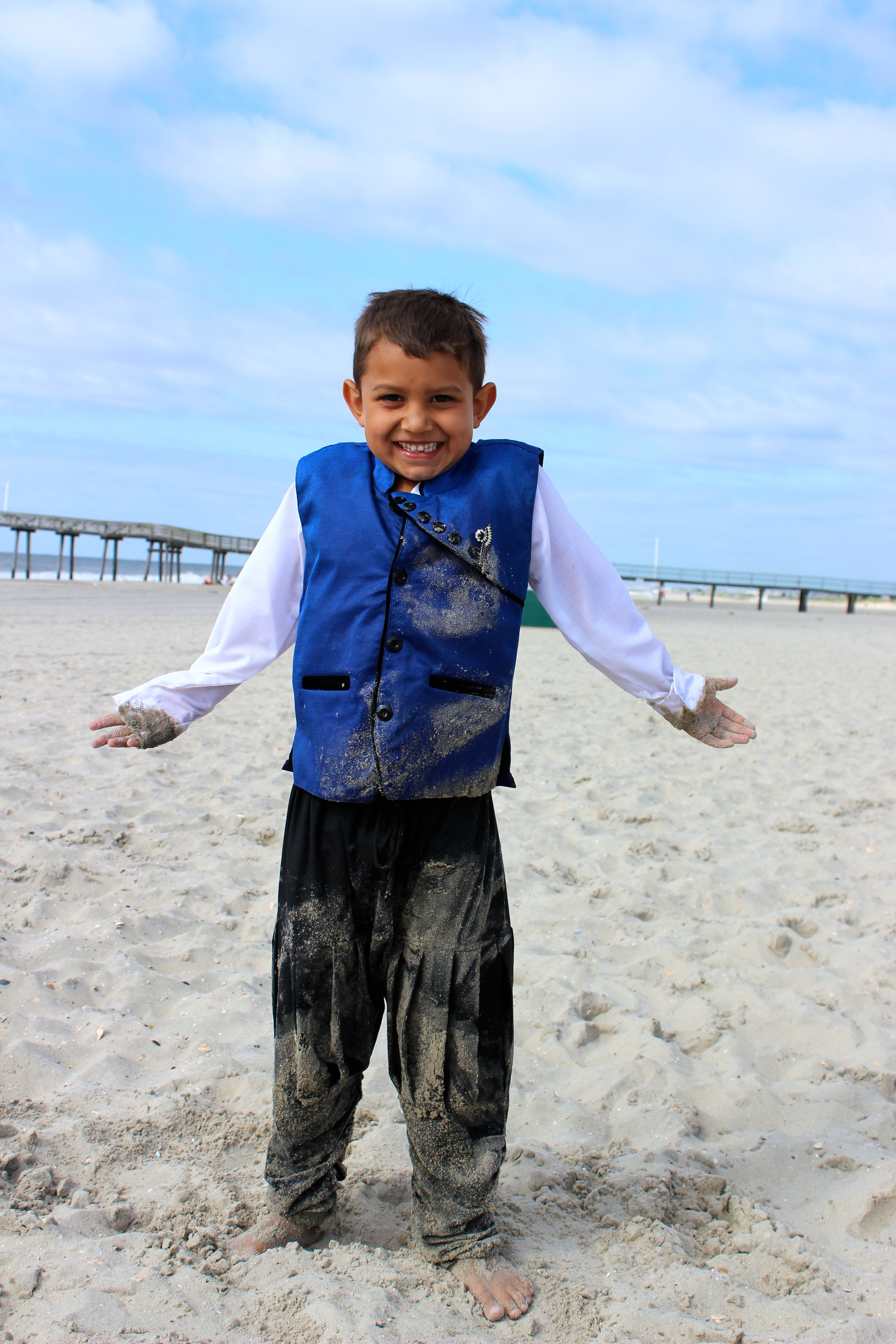
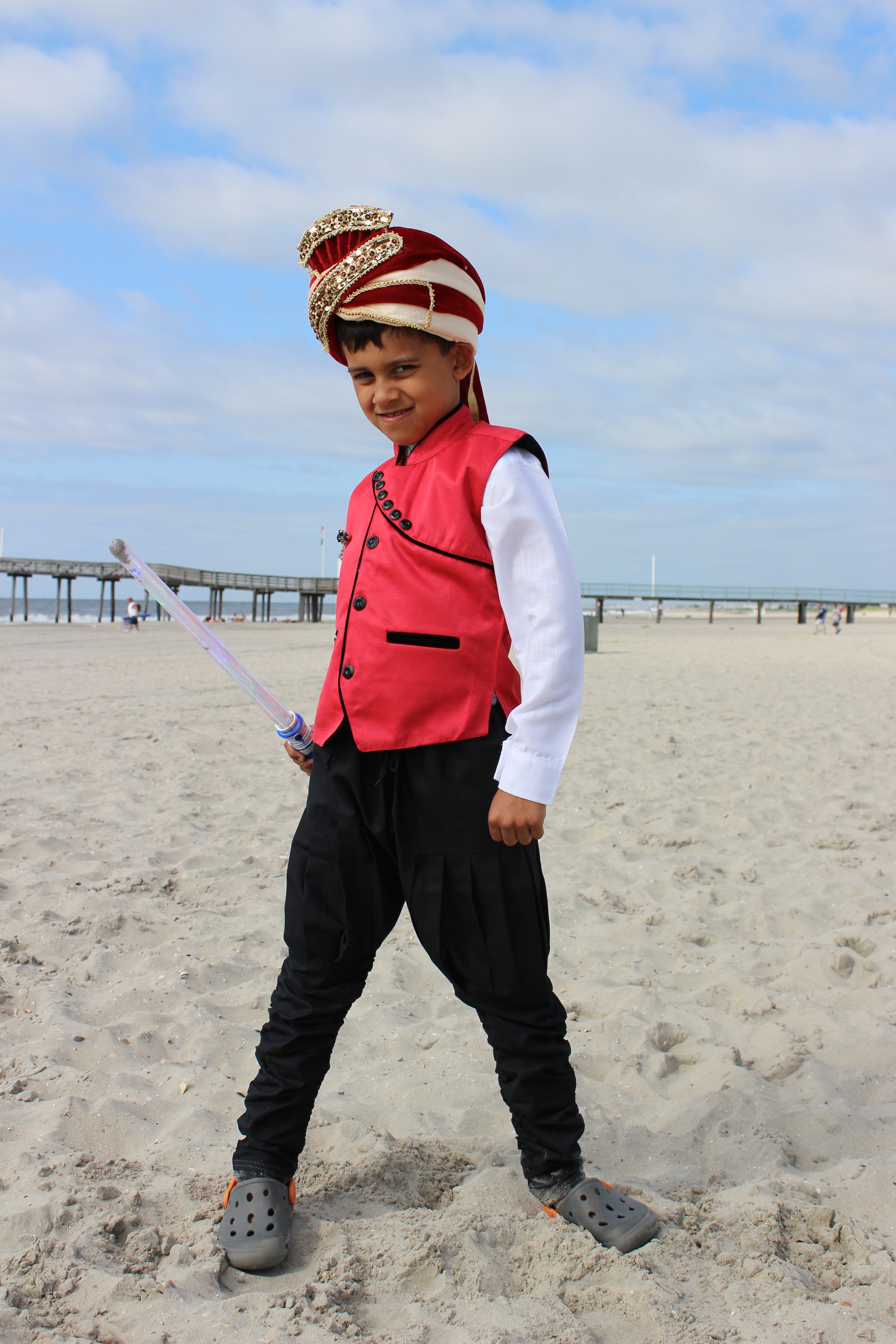
I have been wanting a picture of all five nephews and the one baby niece, but a normal family photo just wouldn’t cut it for this crew. I brought home costumes from India and staged a photo shoot one morning at the beach. Nico immediately morphed into a Mughal prince and chose regal poses rather than frolicking in the water like the other boys. The toddlers were surprisingly compliant, keeping their turbans on for the most part. Baby Annesley slept through the whole thing, unfortunately, and awoke just when the boys were too riled up for more group shots. All in all, pretty successful!

Bollywood at the beach!
IMG_3131

IMG_3141

IMG_0571_2

IMG_3153

IMG_3175

IMG_3198

IMG_3214

IMG_3188

IMG_0547

IMG_3248

IMG_3296

IMG_3273

IMG_3297

IMG_3300

A serious drawback of living abroad is that gatherings with extended family are rare. I have relatives scattered around the world, and there’s simply no time to see them all regularly. And so I felt deeply grateful for visits from my mother’s side of the family, who all live in the Philadelphia area.

Sisters: Aunt Iris and my mom.
IMG_0760

Cousin Amy with her husband, Billy, and their three boys, Jake, Dylan and Alex.
IMG_0696

Cousin Karen and her two boys, Robbie and Mario, spent the day at the beach with us. Here she is with my nephew Jack.
IMG_0758

Uncle Bill and his friend, Judy, also hung out with us that day. Seriously, nobody took any photos of them? Geez.

Funny how nostalgia and family connections can make you love a place. I’ve been to nicer beaches, cleaner boardwalks, and classier coastal towns. But my heart belongs “at the shoo-wah” in Ocean City, NJ.

New Delhi Book Club Does Door County

As an international teacher, I sometimes struggle to find friends who are not international teachers. My teacher friends are great, don’t get me wrong, but I also love to learn the stories of interesting people with experiences quite different from my own.

That’s why I felt particularly fortunate to join a small book club in New Delhi comprising a diverse group of fascinating ladies – a nurse, an actress, a scientist, a dancer … and more. We met monthly to discuss and recommend (or not) whatever each of us had read recently, and we maintained a lending library of books donated by the group. Occasionally, we joined a few other ladies for a dramatic reading of a play. Although their husbands’ jobs brought them to Delhi and, unfortunately, took them away again last year, these women all left their marks on the community and on my heart. I have missed the camaraderie, reflective conversations and laughter.

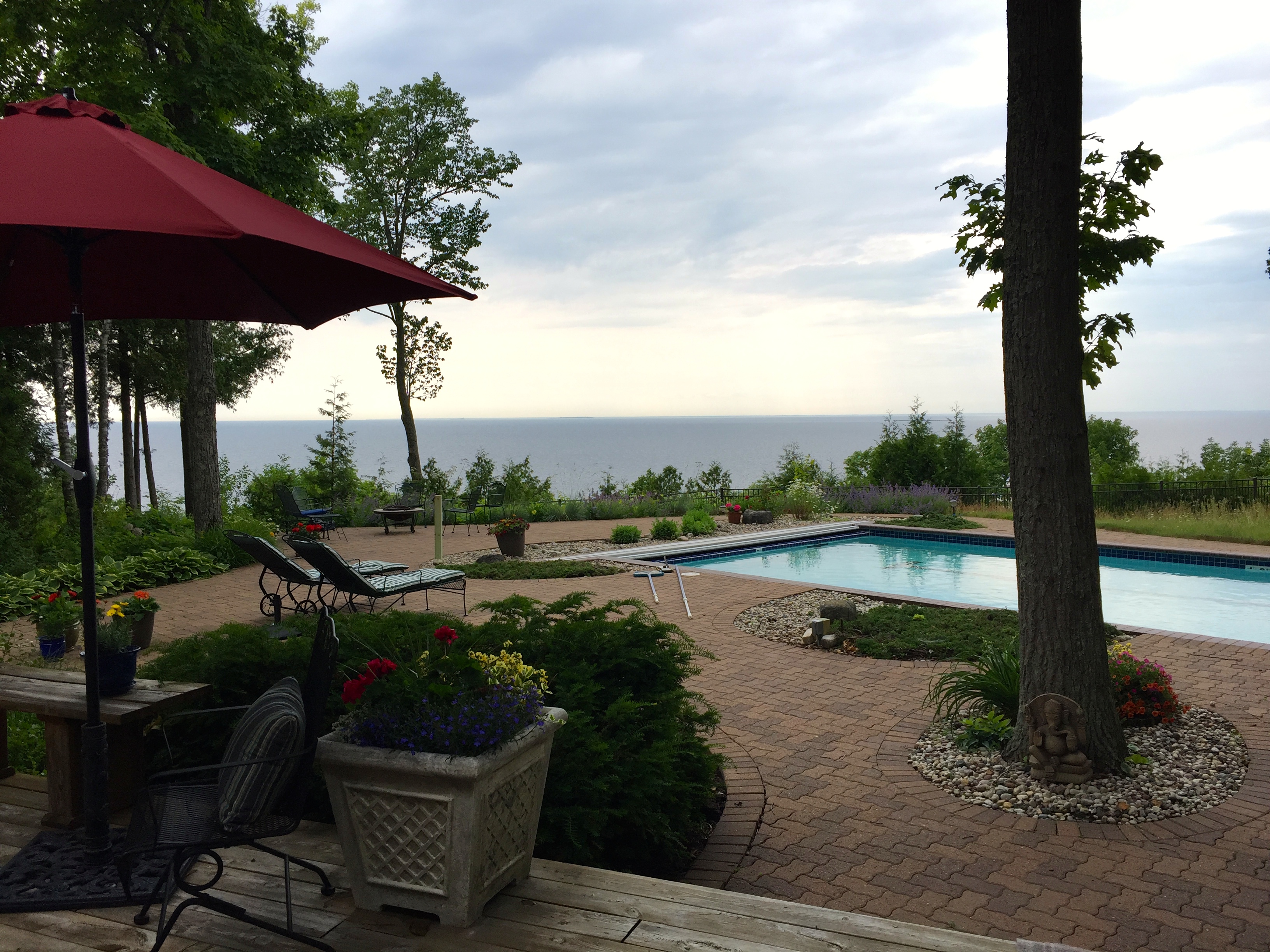
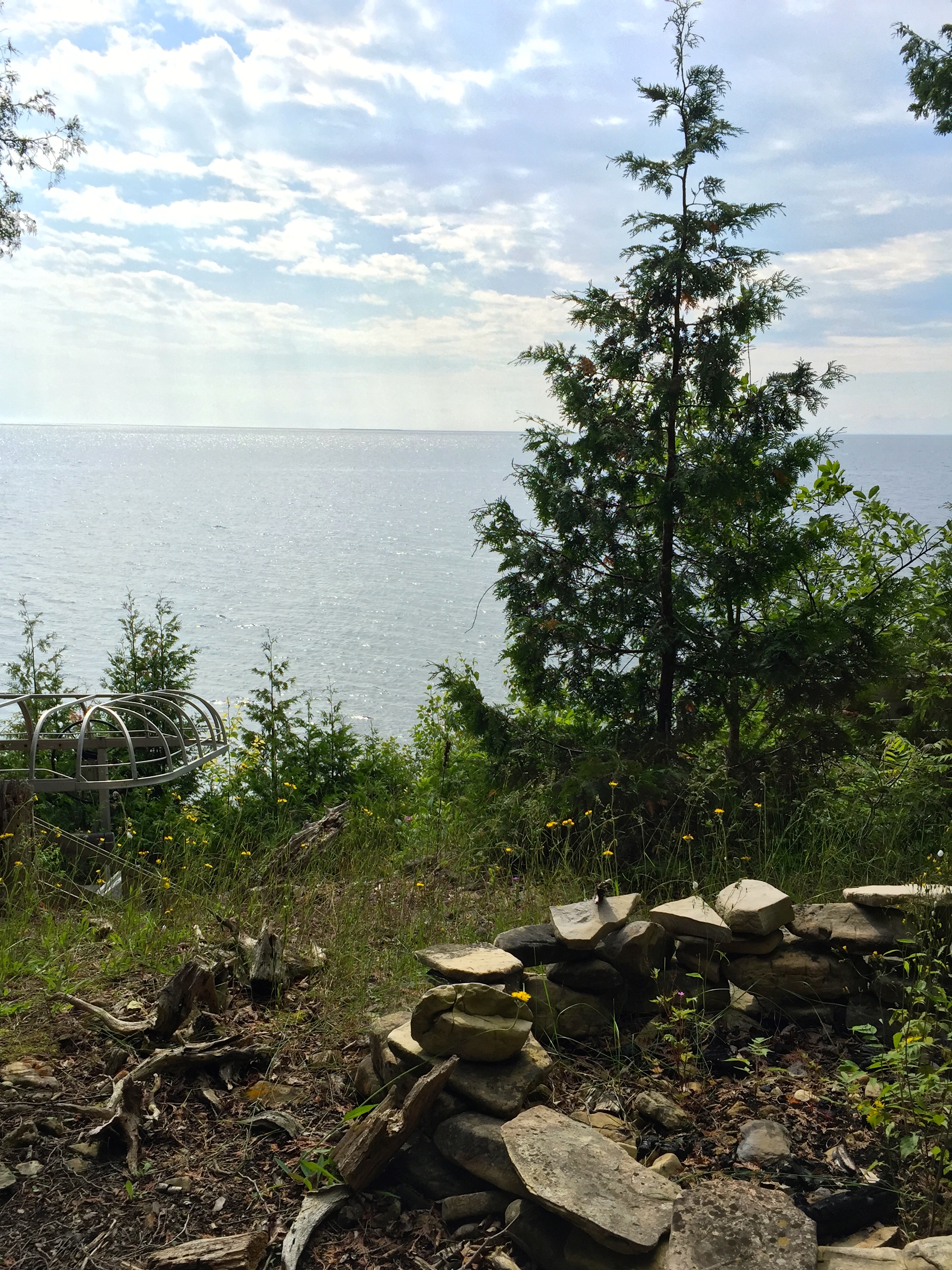
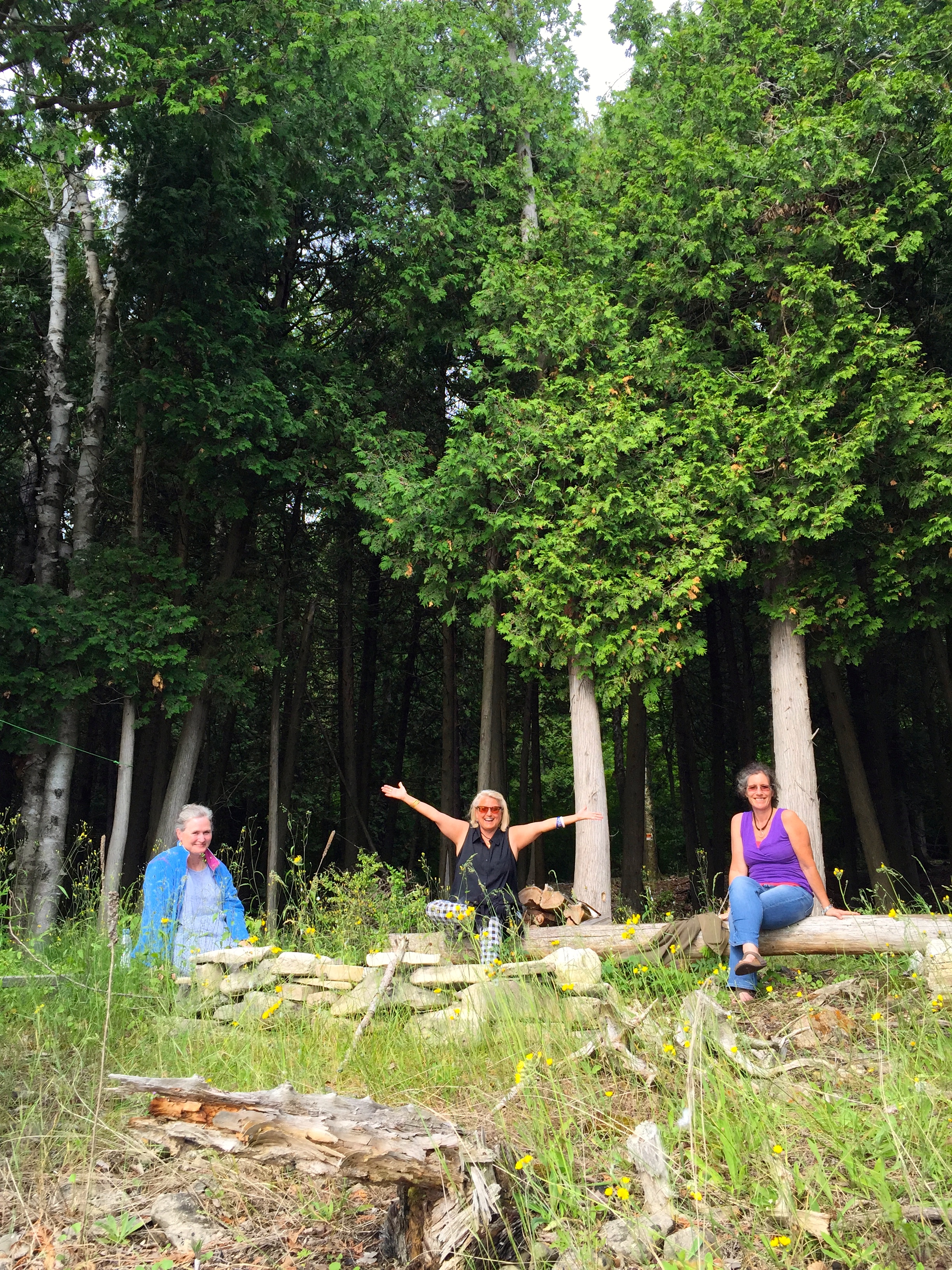
In fact, I don’t think I realized how much I missed them until a plan was hatched to hold a summer reunion. Not everyone could make it, but a few of us did, and we had a wonderful time hanging out at Sue’s home in artsy-fartsy Door County, Wisconsin, June 25-28. Sue’s husband is presently working in Afghanistan with the U.S. Agency for International Development while she settles into their retirement home (which they bought sight unseen while living in India). The house sits high on a hill overlooking Lake Michigan with a steep staircase leading down to the wooded waterfront. It was idyllic.

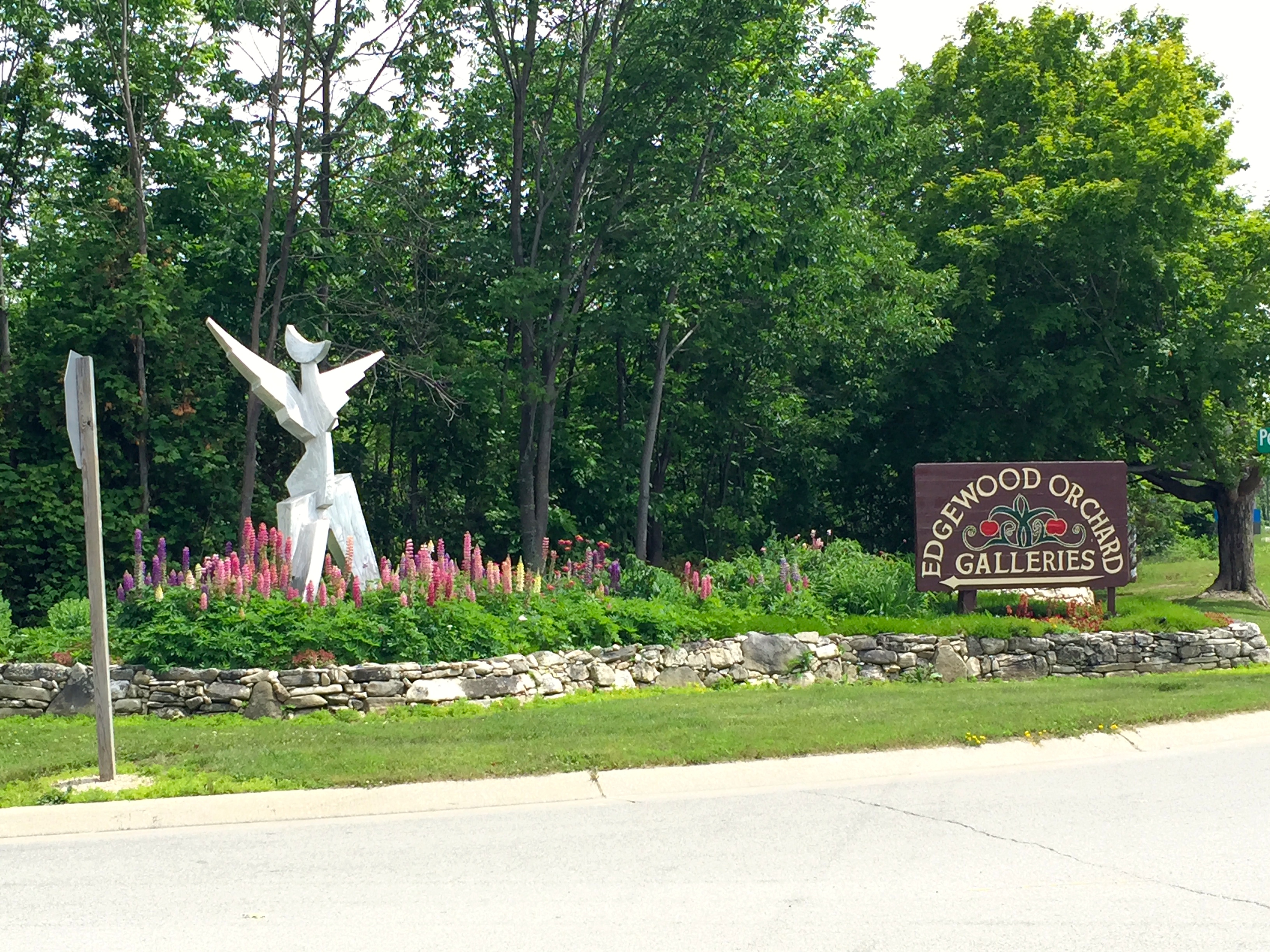
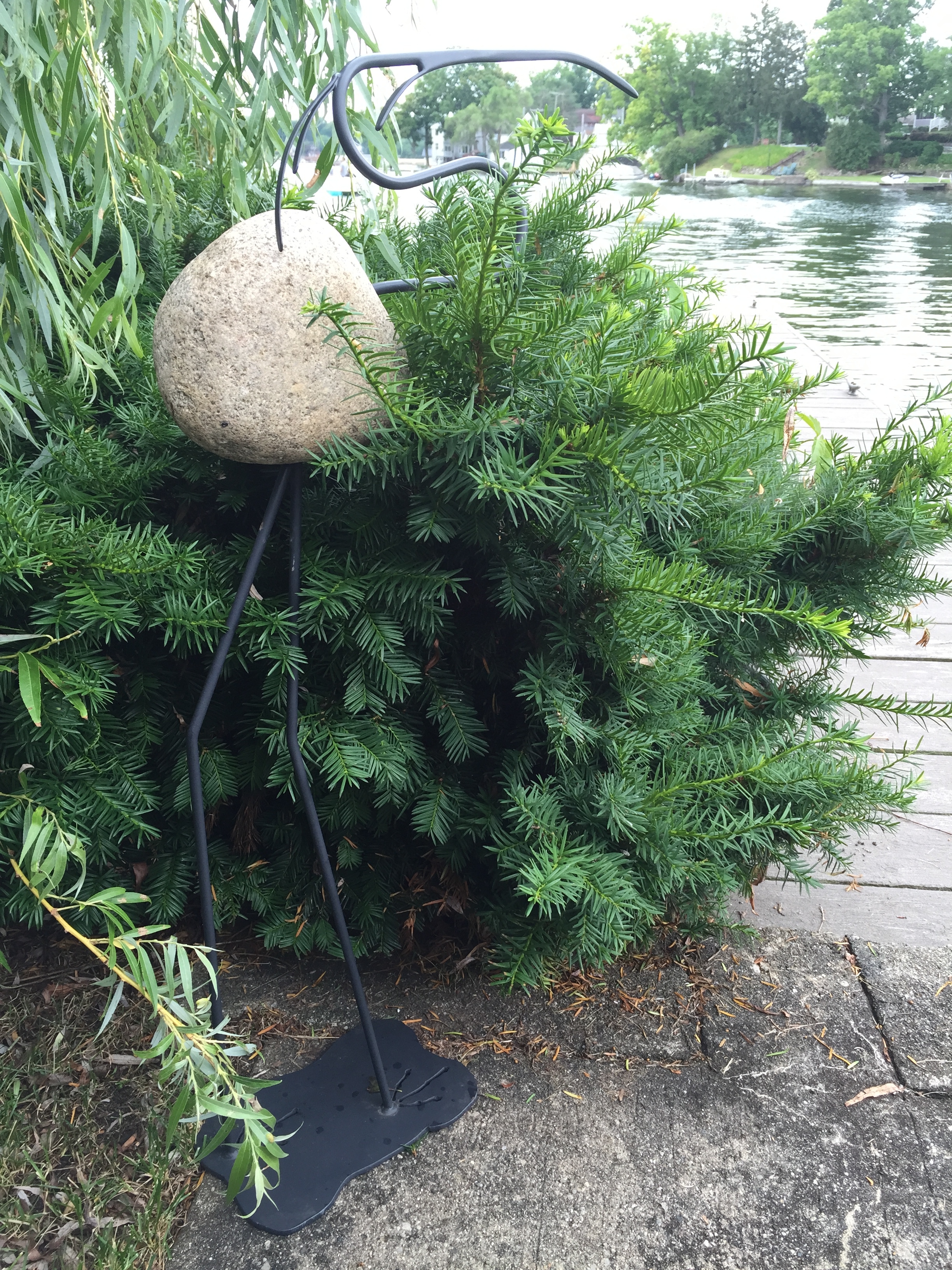
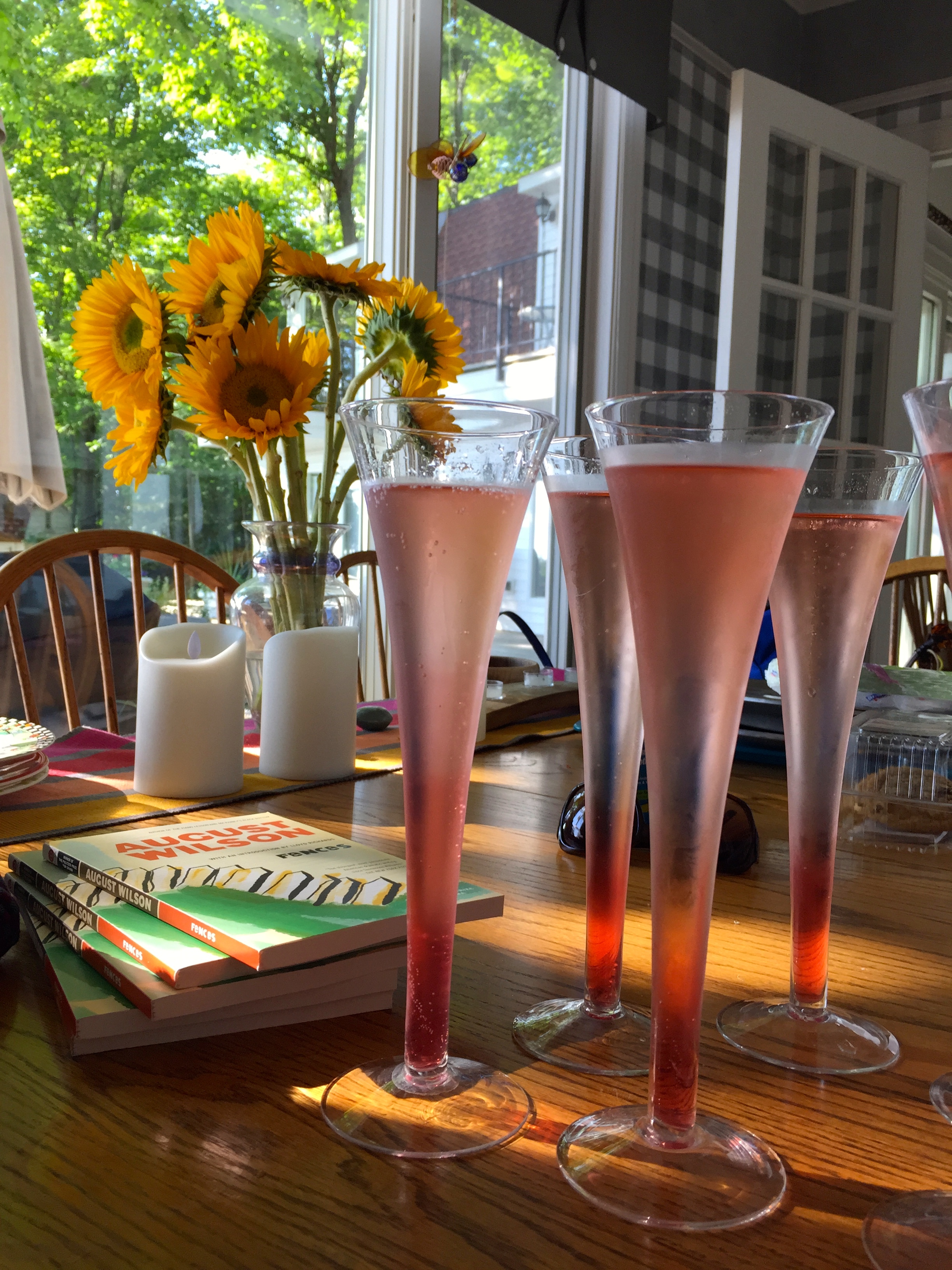
Each morning, we lounged poolside with coffee and breakfast treats, re-connecting and catching up. Over the four days, we also walked to the Edgewood Orchard Galleries, where I bought a sculpture for my own lake house; took a bumpy ride on Lake Michigan in a rented pontoon boat piloted by Sue’s son, Brent; participated in a dramatic reading of “Fences” by August Wilson; held an official book club meeting (see the book recommendations at the end of this post); and visited a food fair and an art show. Cocktails in hand, we returned to the backyard in the evenings to watch the sun set.

IMG_0137

IMG_0144

Adrienne, Catherine, Henrietta and I clambered down to the lakefront.
IMG_0147

Brent deftly handled the pontoon boat on choppy water, steering us to glassy Horseshoe Bay, where we lingered for a picnic lunch.
IMG_0150

IMG_0155

IMG_0362

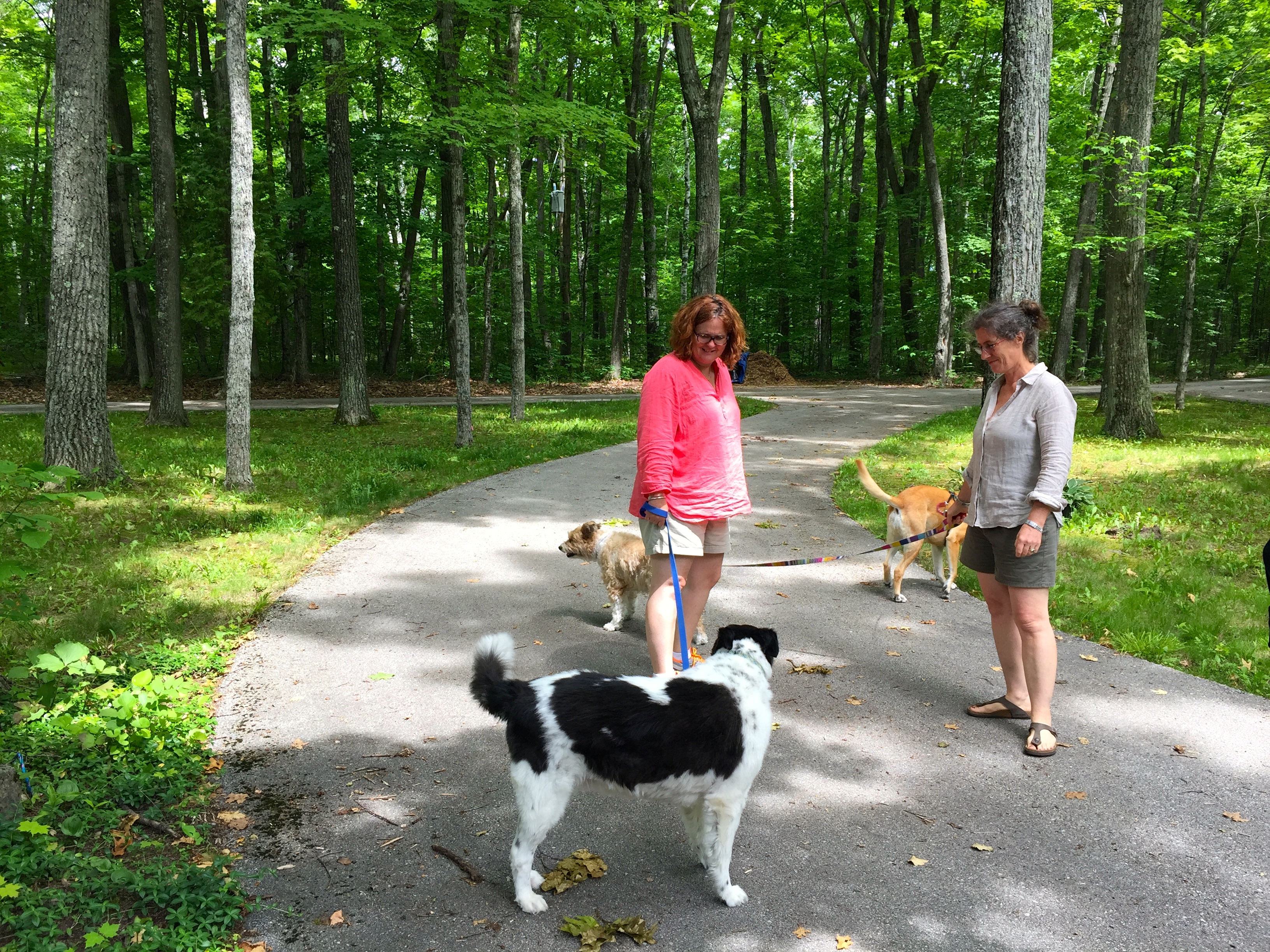
Monique and Henri take the dogs out for a walk to the art gallery.
IMG_0164

IMG_0165

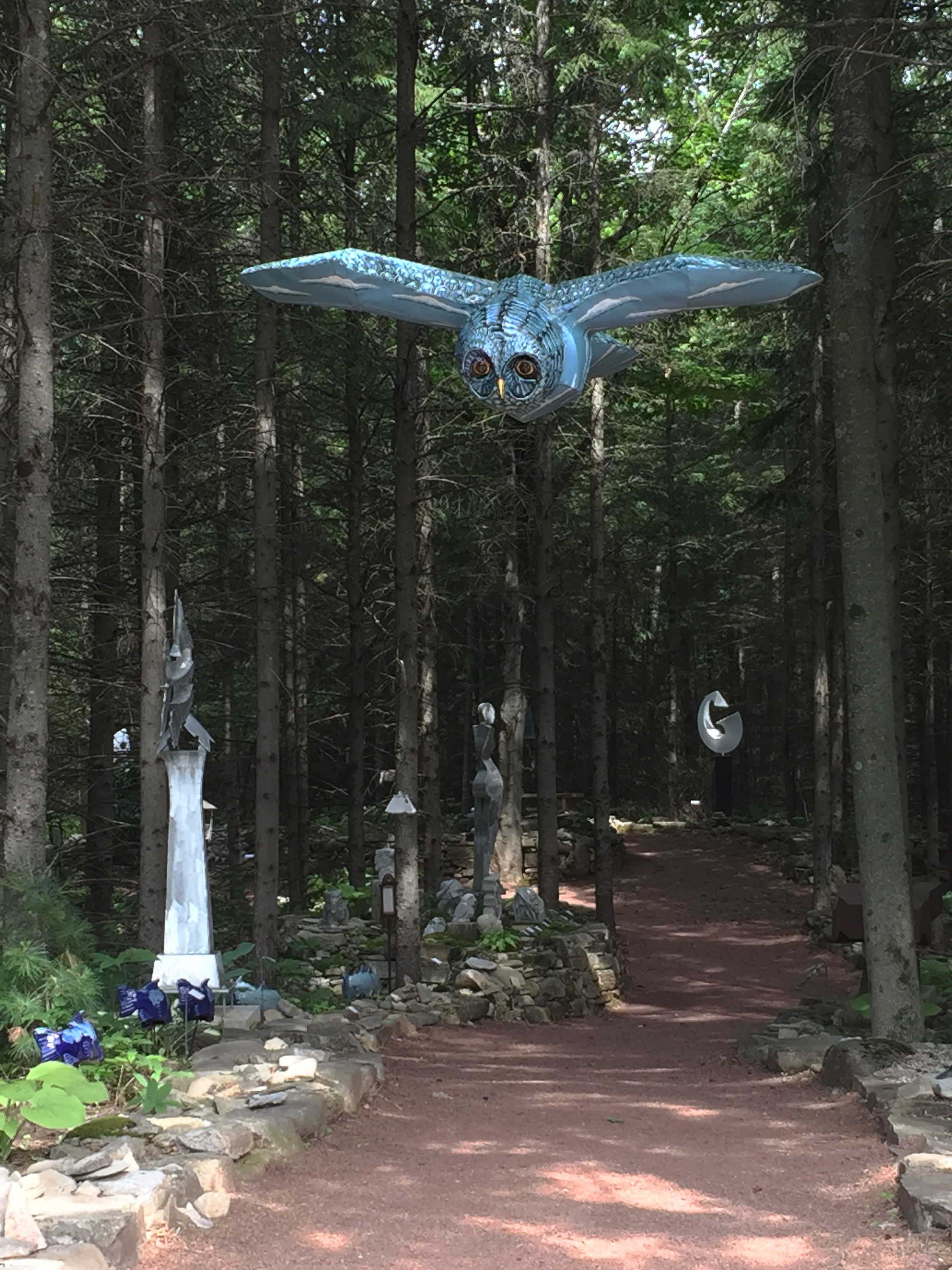
The gallery featured an art-lined path through the woods.
IMG_0183

I bought this sculpture of an ibis, which the gallery shipped to our Michigan house. Here she is at Lake Orion.
IMG_0320

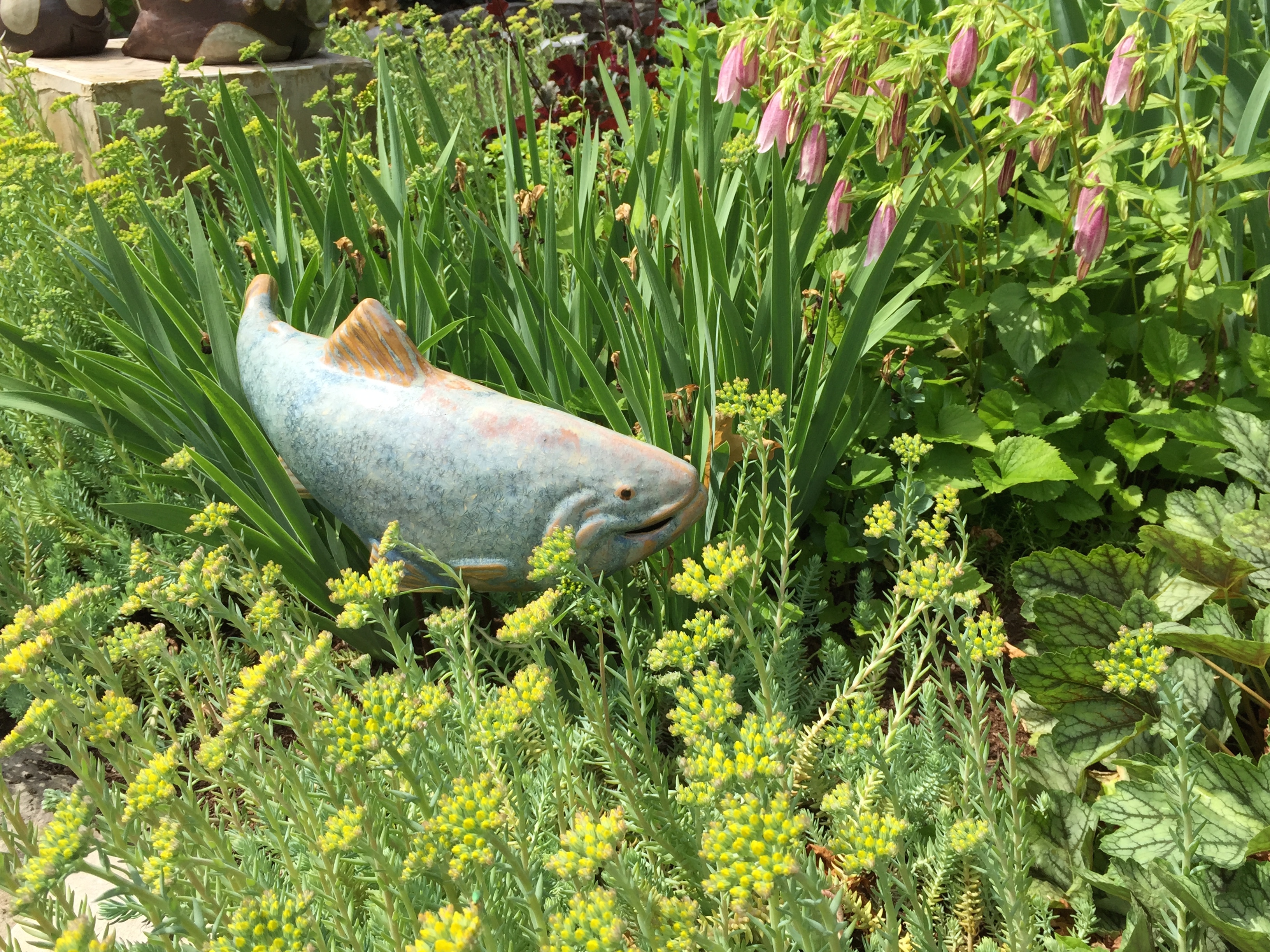
We bought this fish for Sue as a thank-you gift.
IMG_0186

Afternoon cocktails prepared by Adrienne!
IMG_0199

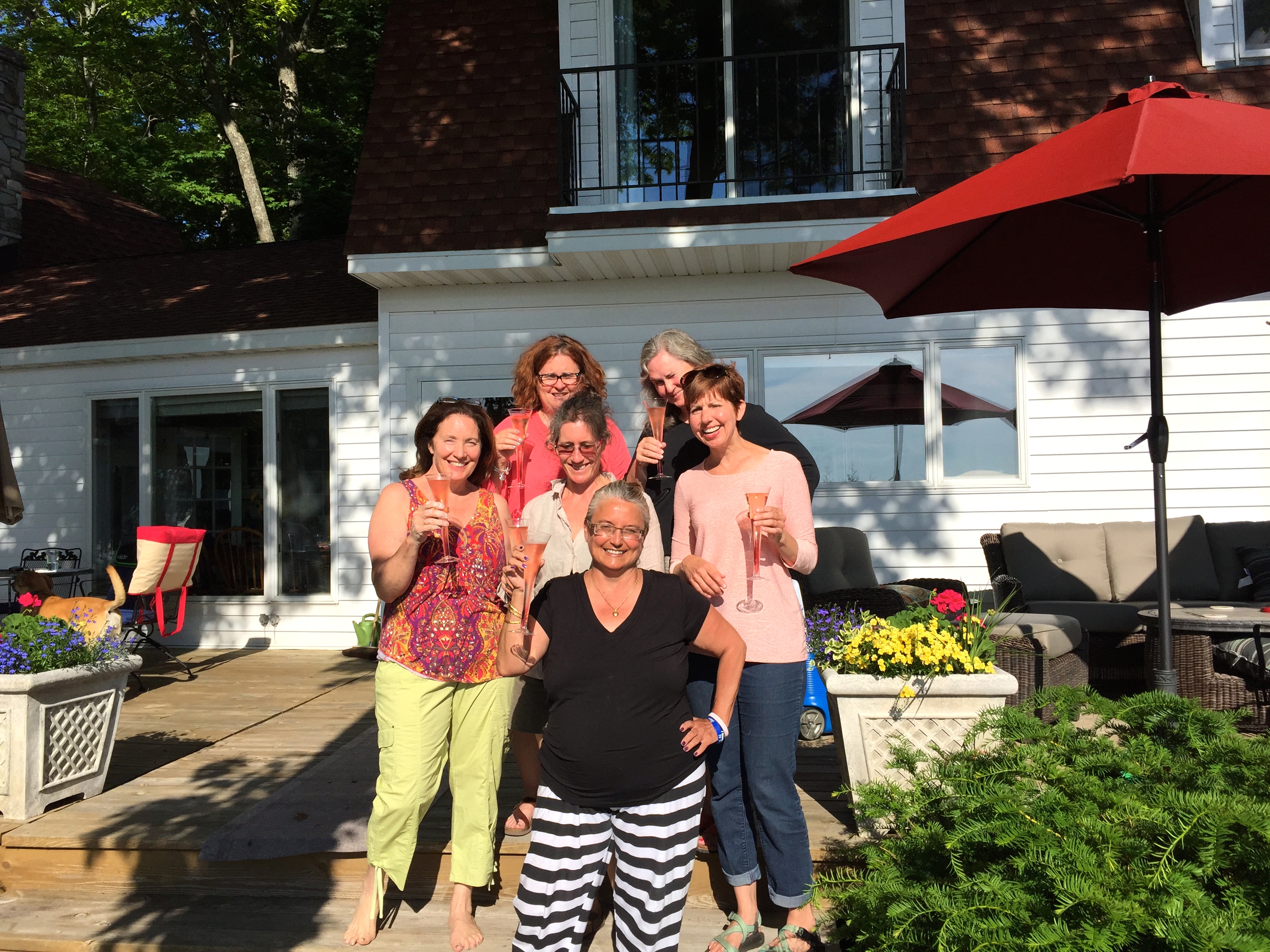
Back to front, left to right: Monique, Adrienne, Sue, Henri, me, Catherine.
IMG_0200

Catherine’s party pants.
IMG_0202

Henri and me at Gills Rock, the tip of Wisconsin’s mitten thumb peninsula.
IMG_0221

My motto.
IMG_0224

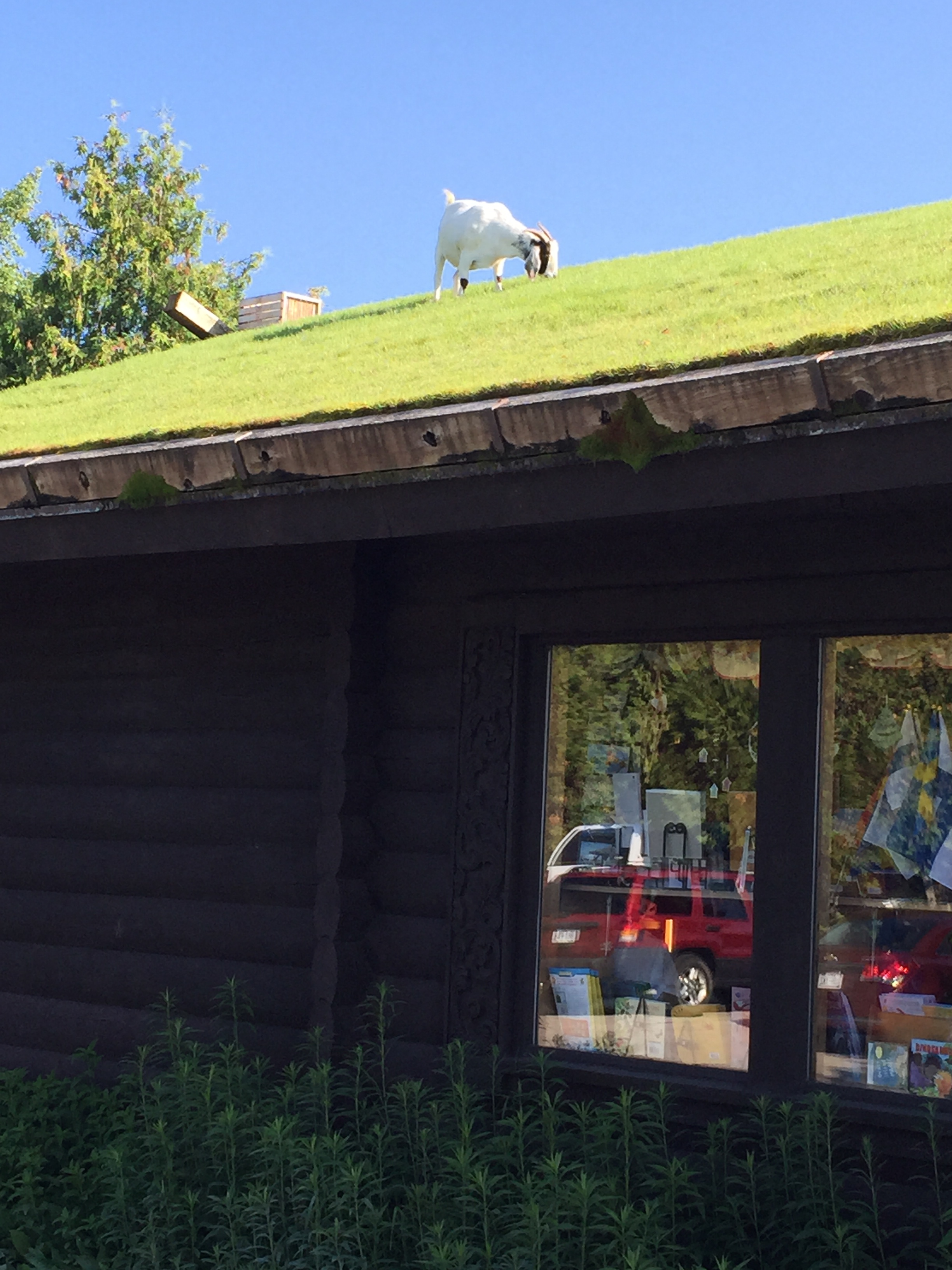
Brent took a summer job at Al Johnson’s Swedish Restaurant, where he herds the goats off the sod roof at night.
IMG_0225

Reading “Fences,” August Wilson’s Pulitzer Prize-winning play about black Americans in the 1950s.
IMG_0245

Sunset.
IMG_0251

IMG_0266

Here’s the list of books we discussed. Fiction and non-fiction, old and new … in no order.
Beautiful Ruins – Jess Walter
The Saffron Kitchen – Yasmin Crowther
Don’t Let Him Know– Sandip Roy
A Dog’s Gift – Bob Drury
The Martian – Andy Weir
The Hemlock Cup: Socrates, Athens and the Search for the Good Life– Bettany Hughes
The Children Act – Ian McEwan
Squatting with Dignity – Kumar Alok
Mornings on Horseback: The Story of an Extraordinary Family, a Vanished Way of Life and the Unique Child Who Became Theodore Roosevelt – David McCullough
The Expats – Chris Pavone
Mrs. Lincoln and Mrs. Keckly: The Remarkable Story of the Friendship Between a First Lady and a Former Slave – Jennifer Fleischner
A House Divided – Pearl S. Buck
Imperial Woman: The Story of the Last Empress of China – Pearl S. Buck
The Child Who Never Grew – Pearl S. Buck
Various books by Leon Uris
Clara and Mr. Tiffany – Susan Vreeland
The Great Bridge: The Epic Story of the Building of the Brooklyn Bridge – David McCullough
The Former People: The Final Days of the Russian Aristocracy – Douglas Smith
The Lunar Chronicles – Marisa Meyer
The Devil in the White City – Erik Larson
In the Garden of the Beasts -Erik Larson
Thunderstruck – Erik Larson
The Storied Life of A. J. Fikry – Gabrielle Zevin
I’ll Give you the Sun – Jandy Nelson
All the Light We Cannot See– Anthony Doerr
Catering to Nobody – Diane Mott Davidson
The Girl on the Train – Paula Hawkins
To be Sung Underwater – Tom McNeal
Wild – Cheryl Strayed
The Orphan Train – Christina Baker Kline
Quiet: The Power of Introverts in a World That Can’t Stop Talking – Susan Cain
The Cherry Harvest – Lucy Sanna
The Passion of Artemesia – Susan Vreeland
FDR – Jean Edward Smith
We Band of Angels: The Untold Story of the American Women Trapped on Bataan – Elizabeth Norman
I Served on Bataan – Juanita Redmond
Wild Swans – Jung Chang
Pillars of the Earth – Ken Follett

Until we meet again, happy reading!

Hungry Days of Summer

It took a couple weeks, but Tony and I are finally over jetlag and mostly decompressed from school stress. Time to get down to business. There’s so much to eat and drink before the end of July!

Here are some of my Michigan food-and-drink-related routines:
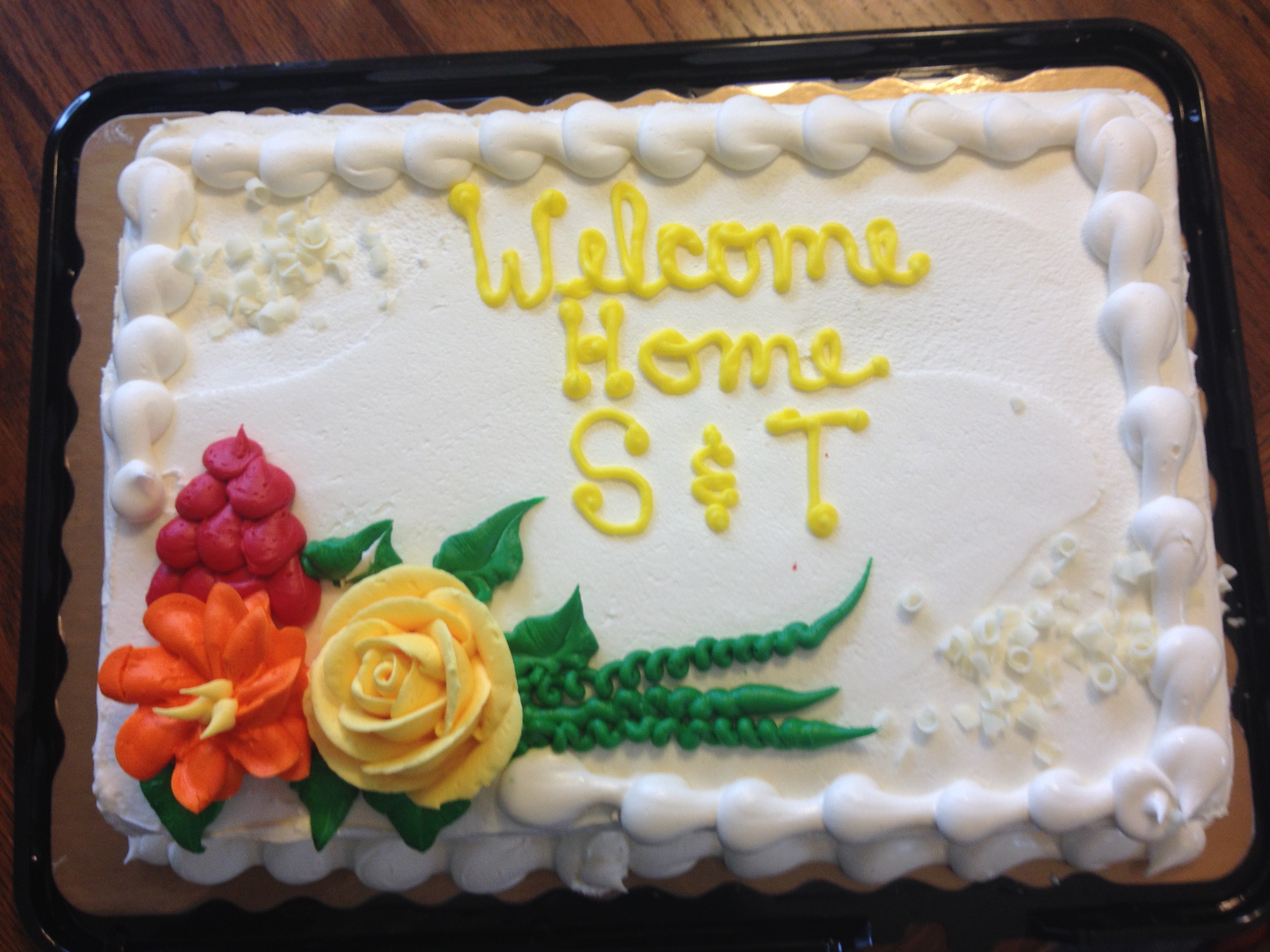
(1) I welcome myself home with a cake from Kroger’s. Usually I just pop in to the store and ask for a cake that says, “Welcome home, Sharon!” and then I eat it in secret. This time, I decided to be more inclusive and I had the hilarious plan of asking the baker to box in a corner and write, “… and Tony.” My sister Kate offered to pick up the cake for me, but when she saw the poor baker seemed to suffer from terrible arthritis, she said, “You can just write ‘Welcome home S & T’.” Lame.
IMG_2794

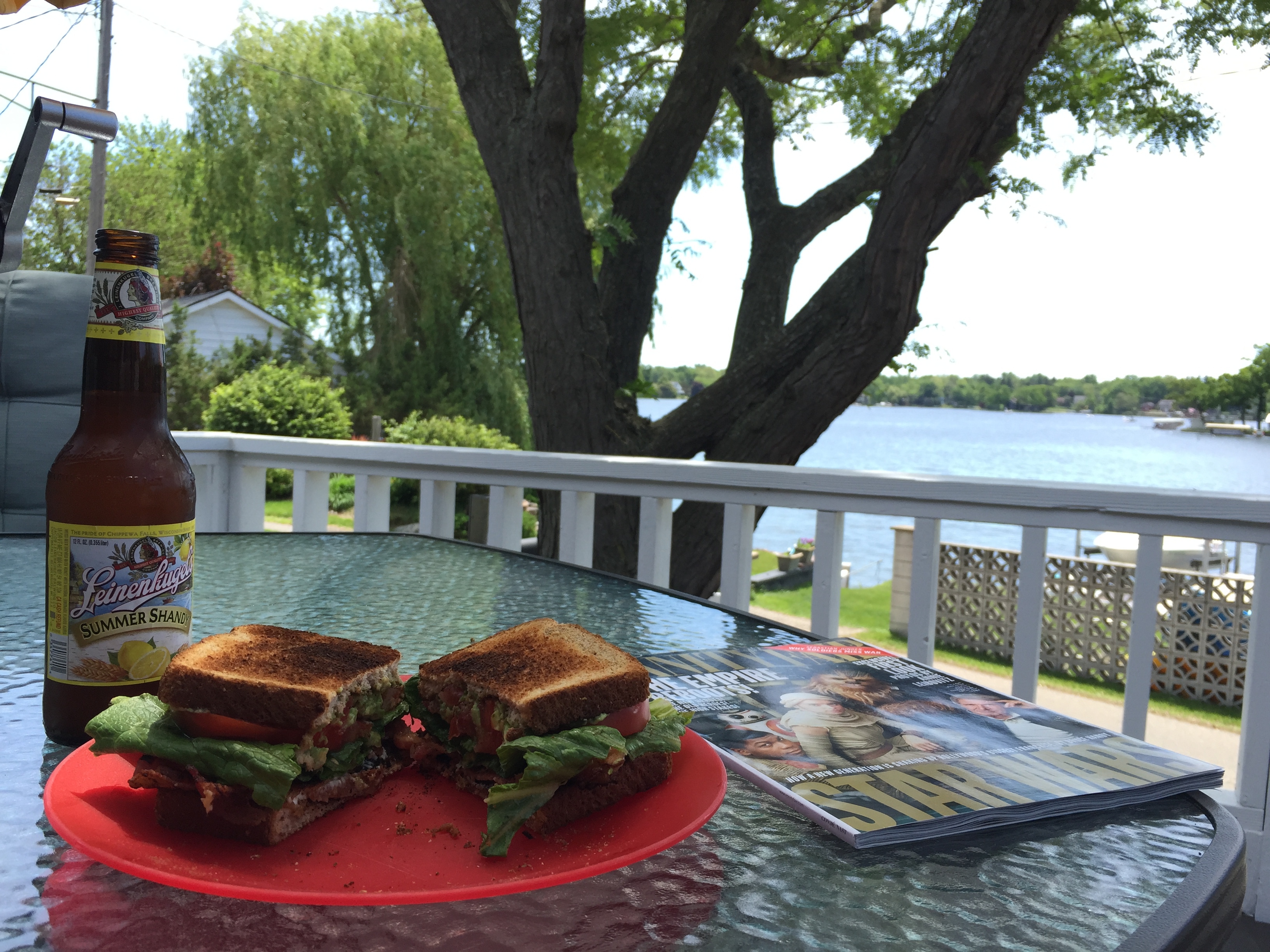
(2) I eat avocado every day. This is my Second Annual Eat Avocado Every Day Summer Challenge. It started last summer when I was stuck in Washington, D.C., with a fun group of ladies from AES, waiting for our new Indian visas to be issued. We found ourselves at the same Mexican restaurant most days, eating guacamole. Avocados in Delhi are rare and expensive, so it seems like a good plan to get ’em while I can. My favorite lunch time treat? A loaded BLAT sandwich.
IMG_0016

(3) I eat copious amounts of pie. My favorite? Strawberry rhubarb. Bring it. (And be sure to bring Breyer’s Natural Vanilla ice cream, too.)

(4) I drink a ridiculous amount of beer and wine. With import duties around 150%, booze is pricey in India. My go-to red wine in Delhi is Yellow Tail Shiraz, which retails at $30. Guess how much it costs in Michigan? $4.95! Less than five bucks! We have a beer pub in our Delhi neighborhood, where Tony and I go for dinner occasionally. A nice pizza and a couple glasses of beer costs us about $100. So, if most of my summer pictures show a drink in my hand, don’t judge.

(5) Bacon. Bacon. And more bacon. The Hindus in India don’t eat beef, and the Muslims in India don’t eat pork. So the only ubiquitous meat is chicken. Dang it, I am so sick of chicken. Bacon cheeseburger with guacamole? Yes, please!

By the end of the summer, I may be jonesing for a samosa, but for now, you’ll find me on my deck, beer in hand and gearing up for my next American snack.

Summer Paranoia

Tony and I have poured a lot of time, energy and money into establishing a home for ourselves in Michigan. After bopping around the country every summer, crashing with my parents or friends, we finally have a place of our own. When we head back to India every year, we winterize the house and leave it in the hands of a trusted neighbor. Still, we can’t help but worry.

When we returned to the States June 1, we opened up our house with a big sense of relief. Everything looked fine … for a few minutes. After throwing a load of laundry in the dryer, I smelled something funny. I turned off the dryer and checked the lint trap. It was clean. I had read about the danger of letting lint build up in the exterior vent, so I went outside to check it. The vent was bursting with dry, fluffy lint!

Years of watching Monk, Psych and The Mentalist prepared me for this moment. Somebody must have broken in to our house to do laundry! And they must have done it in the last day or so or the lint would have been wet from the rain, I deduced. As I was rubbing my chin reflectively, Tony came upstairs from our basement.

“Did you put the yellow kayak somewhere?” he asked.
“No, where would I put it?”
“Well, it’s not there,” he said.
“Someone broke into our house to do laundry and stole our kayak!” I exclaimed.

Paranoia gripped up both. We searched every inch of the house to find any more evidence of a prowler in freshly laundered clothes. In the guest bedroom, I stared at the dresser. “Where’s that green box and the fake fern that usually goes here?” I asked. I use the box for jewelry during the summer, but I didn’t leave any jewelry in it. I guess it did have some loose change in one of the drawers. We panicked.

“Why would anyone steal that box but not take our TV?” Tony asked.
“Well, it is a crappy old TV,” I said. “Who would want it?”

We asked the neighbors if they had seen anyone in our house in the days before our arrival. They hadn’t. We asked my sister, who lives about half an hour away, if she had sneaked in to do a few loads of laundry. Nope.

I called my dad to see if he had any ideas. He reminded me that the family who gave us the yellow kayak borrowed it back for a camping trip or something. As soon as he said that, I recalled the email correspondence. Then I got on the phone with my mom, who said the dryer probably just sucked all the lint in the hose out to the exterior vent when I turned it on for the first time in 10 months. OK, that explains the kayak and the dryer lint … but what about my fake fern and the green box?

Stumped, Tony and I quietly explored the house again. This time, I noticed a beach towel draped over the clothes hamper. When I pulled away the towel, I discovered the missing fern and box. I had obviously covered them to keep off the dust. Mystery solved.

After a couple days, our paranoia abated and we settled in to Michigan life again. God only knows what’s going on at our house in Delhi …

Old Delhi Walking Tour: Saari, Kinaari, Bazaari!

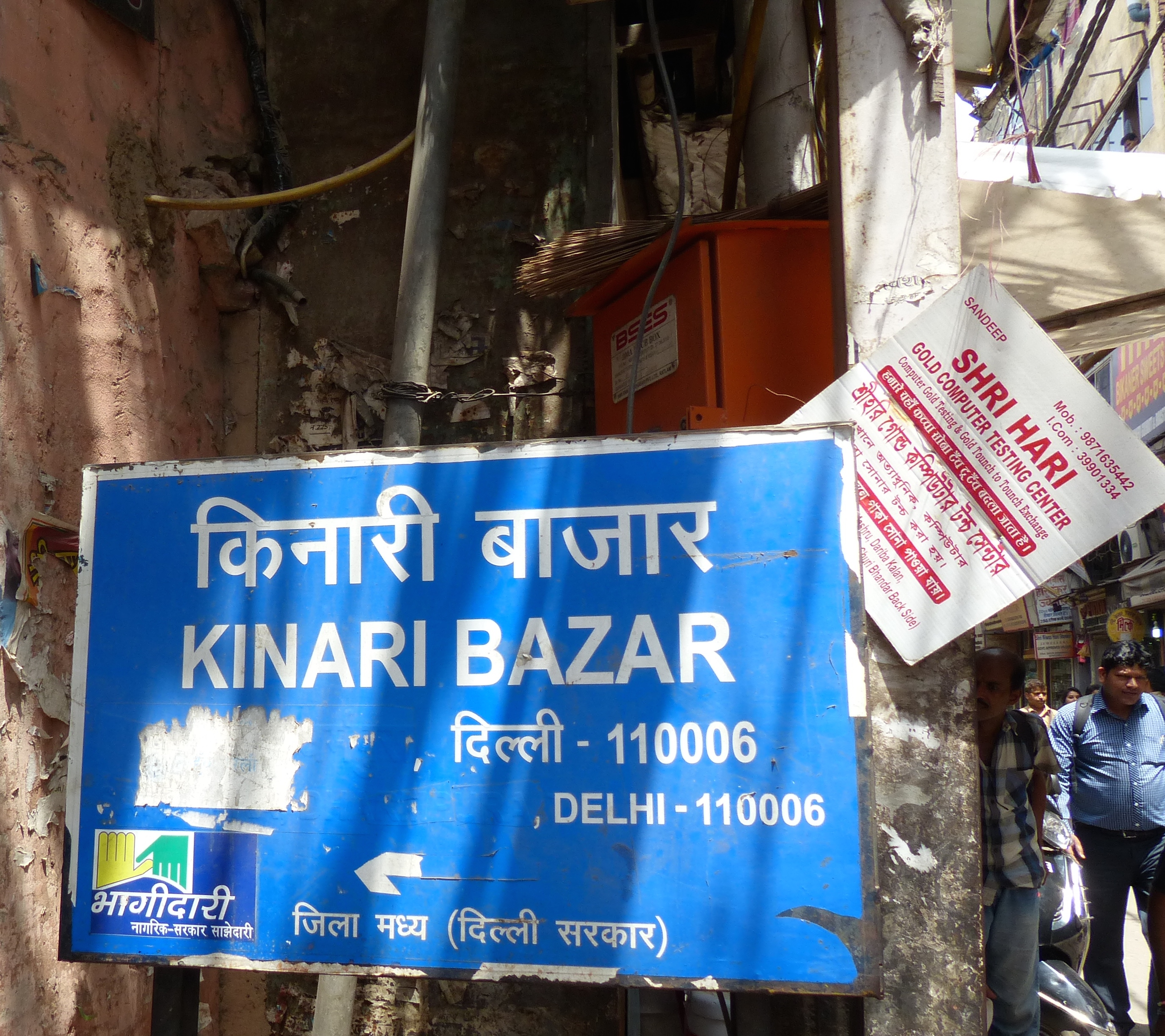
I own two saris – a turquoise bedazzled number that caught my eye early on in India and which I now realize is cheap and gaudy, and a quality bright-orange hand-spun cotton one I purchased after a special afternoon at Sari School last year. Both sit in a closet, never used. I’ve only worn a sari once, and it was borrowed. Still, I remain entranced by the “unstitched garment.” That’s why I jumped at the chance to poke through Old Delhi’s sari market April 18 with one of my favorite tour guides, Himanshu Verma of Red Earth India, on his “Saari, Kinaari, Bazaari!” tour.

The ad for Himanshu’s walking tour said,

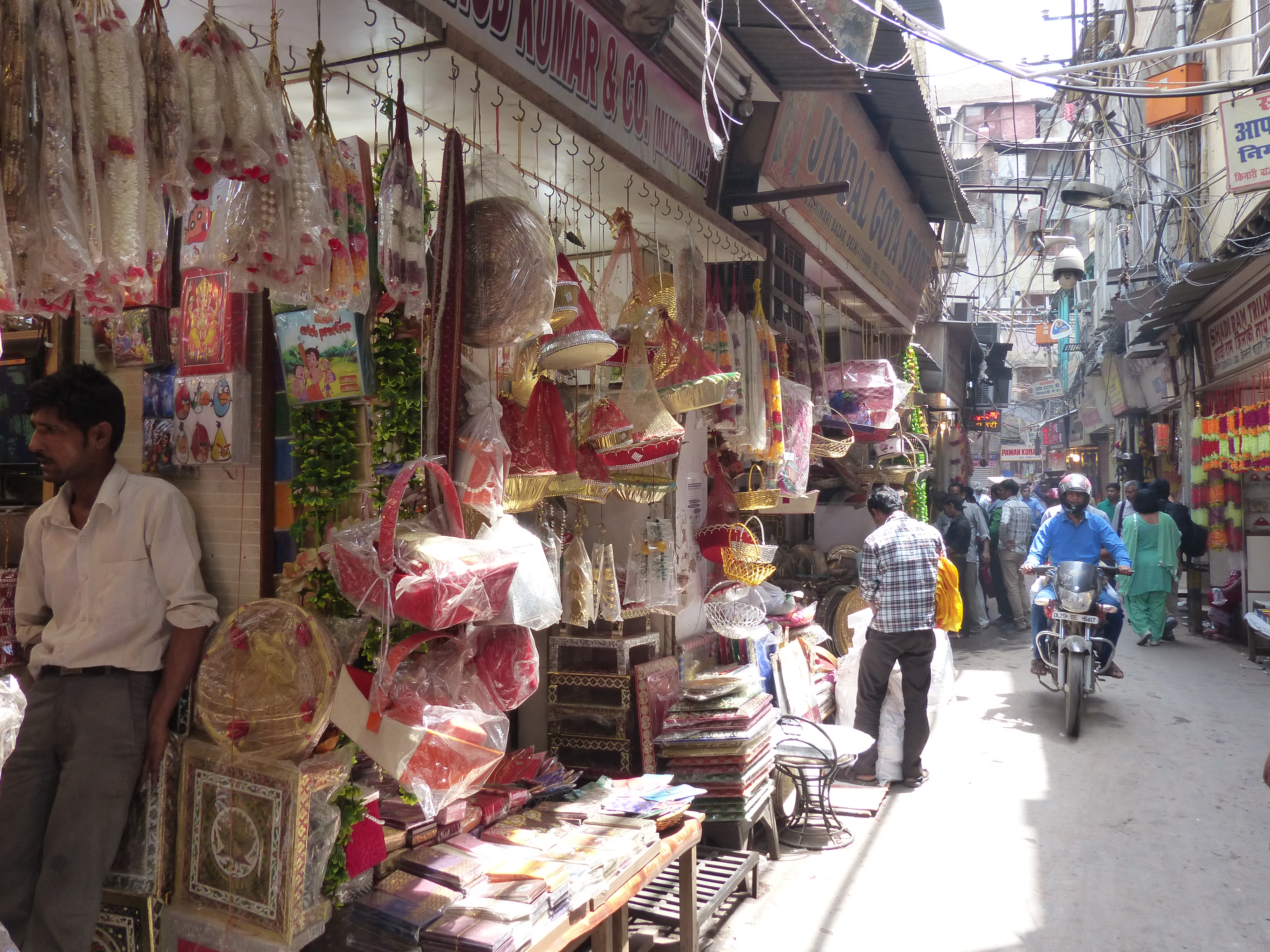
Chandni Chowk, the commercial centre of the city, presents a shimmering spectacle. On this Saree Walk, we will wander into Kinari Bazaar, the wholesale market for fabric trimmings and soak in this most colorful part of the city, where any saree can be accessorized with a relevant trim. A popular destination for bridal shopping, Chandni Chowk also offers us access to an array of Saree shops – from the hand-woven to bling and cheap synthetic sarees.

P1060681

P1060685

P1060748

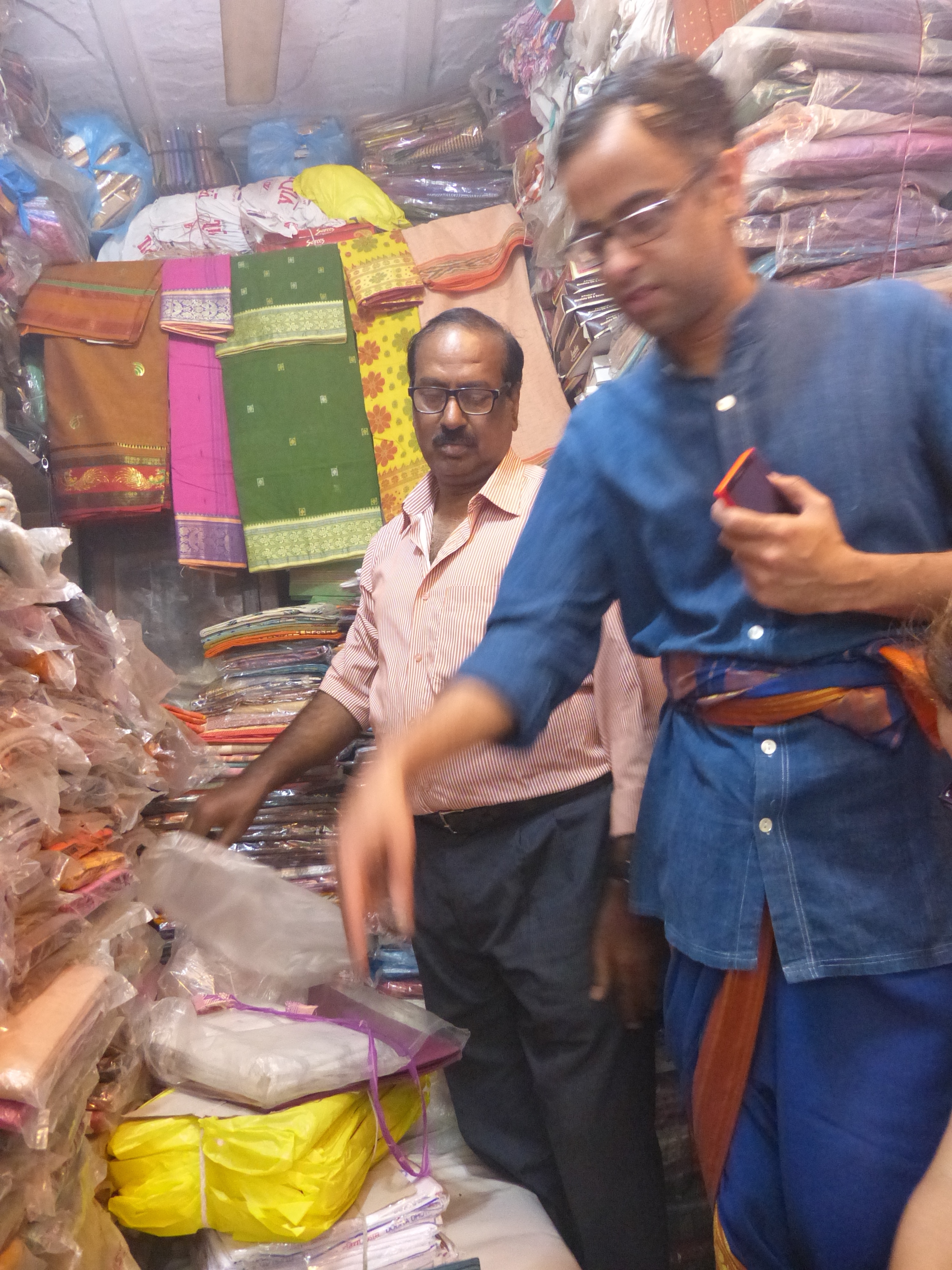
Himanshu took us into sari shops, including this tiny space.
P1060678

P1060679

At larger stores, he helped us distinguish between hand-woven and machine-made, traditional and trendy, silk and synthetic sarees. It was all so interesting, but also overwhelming. Rather than shop for my own saree, I far prefer watching Indian women do so. Often, the whole family sits together on low stools while the shopkeeper unfurls the sarees. A baby sits on his father’s lap. A woman holds up the end of a saree to her chest and looks to her sister for approval. A grandmother reaches out to pull a saree closer for inspection while the shopkeeper shakes the next one out of its plastic package. The sarees drape across everyone’s laps and pile up on the table. Soon, the group is swimming in a sea of silk. Mesmerizing.

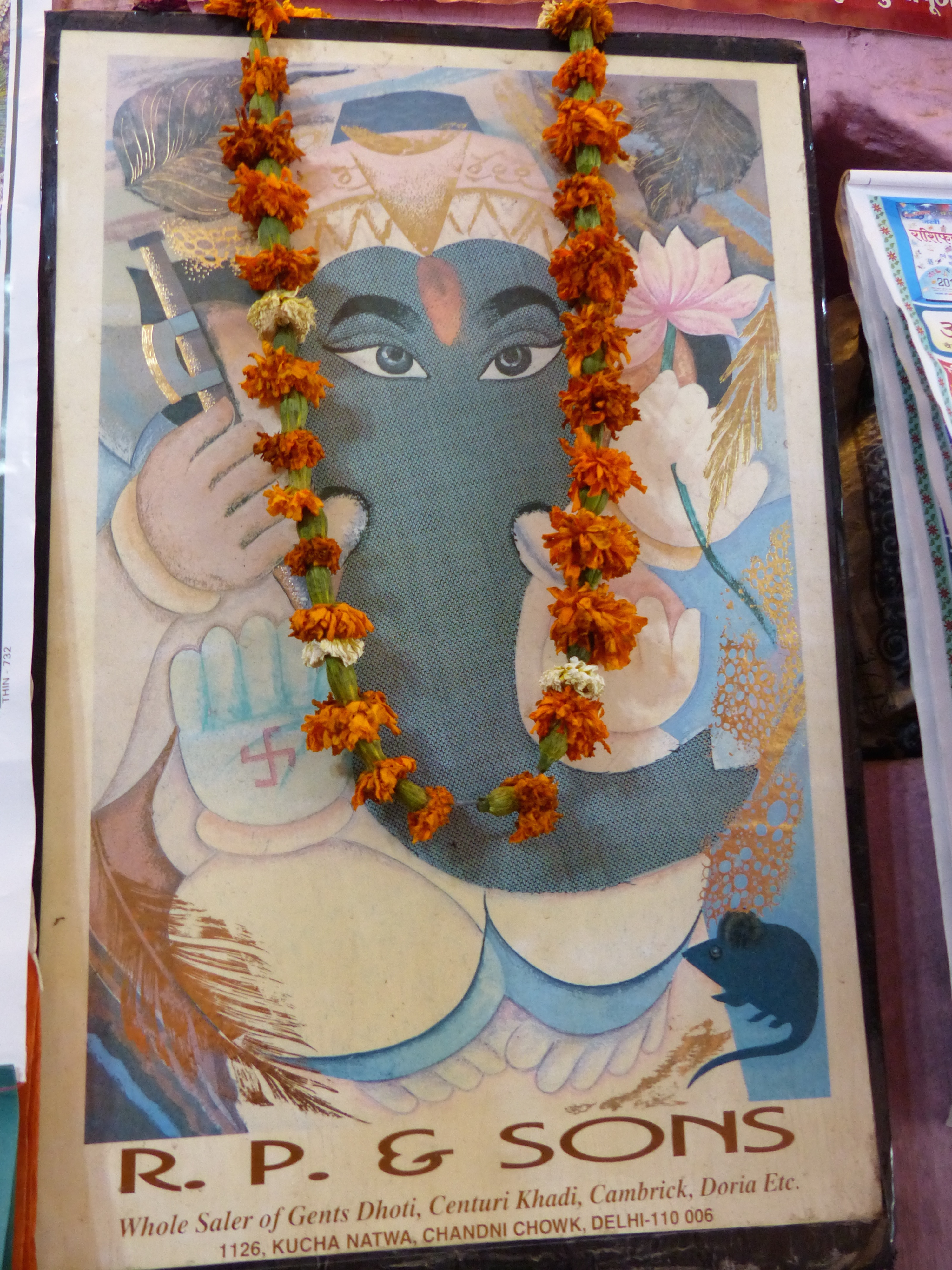
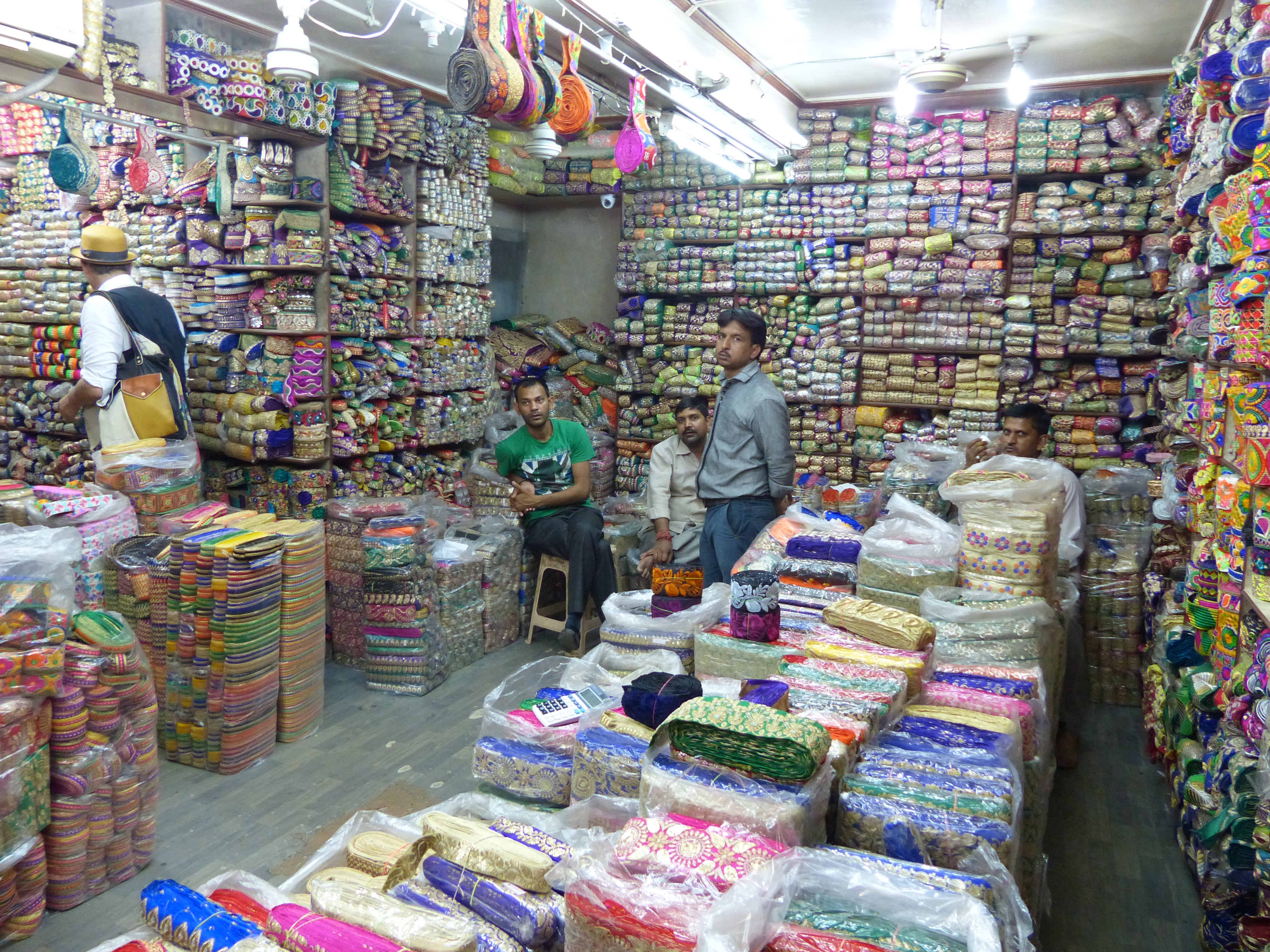
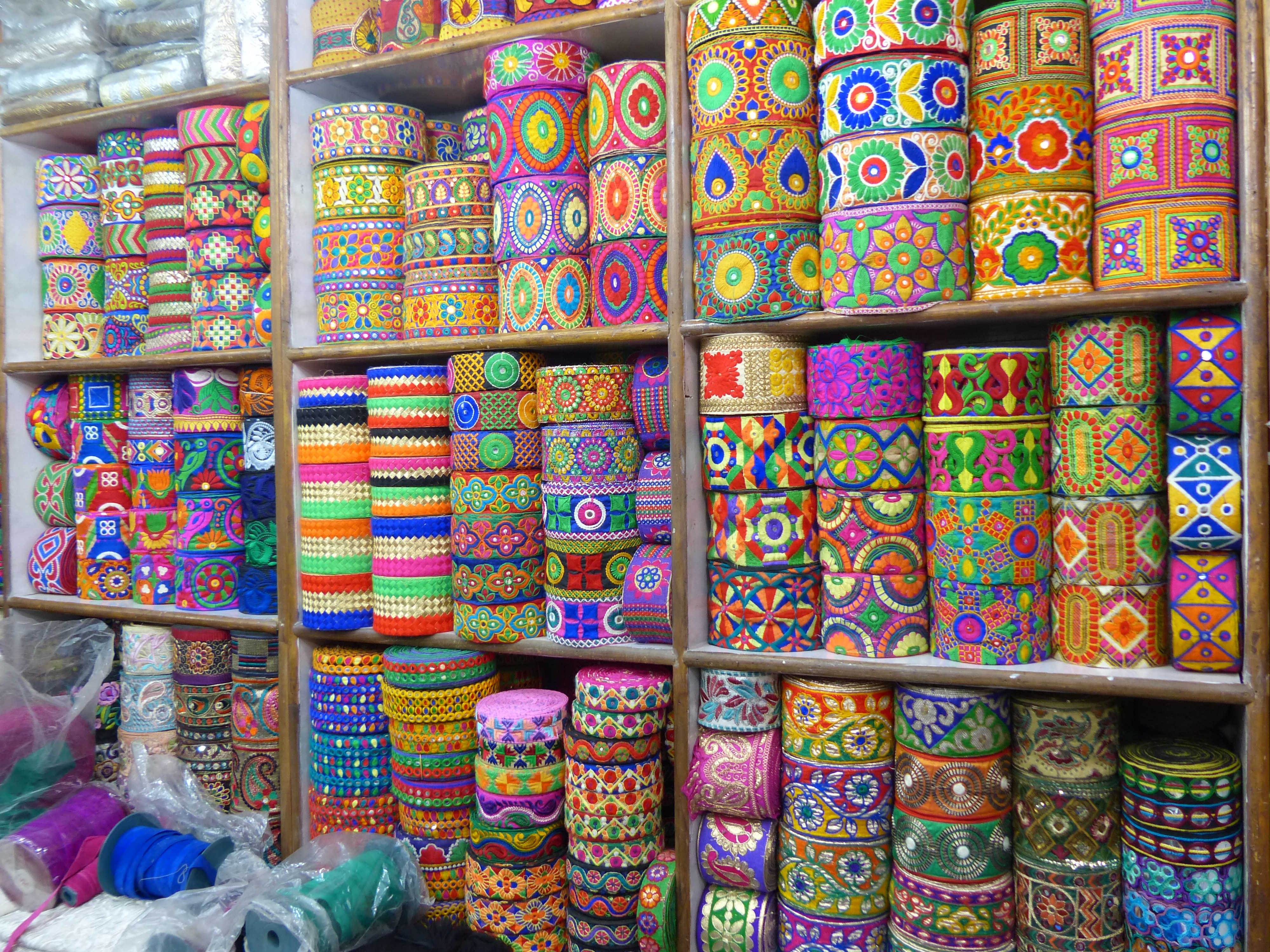
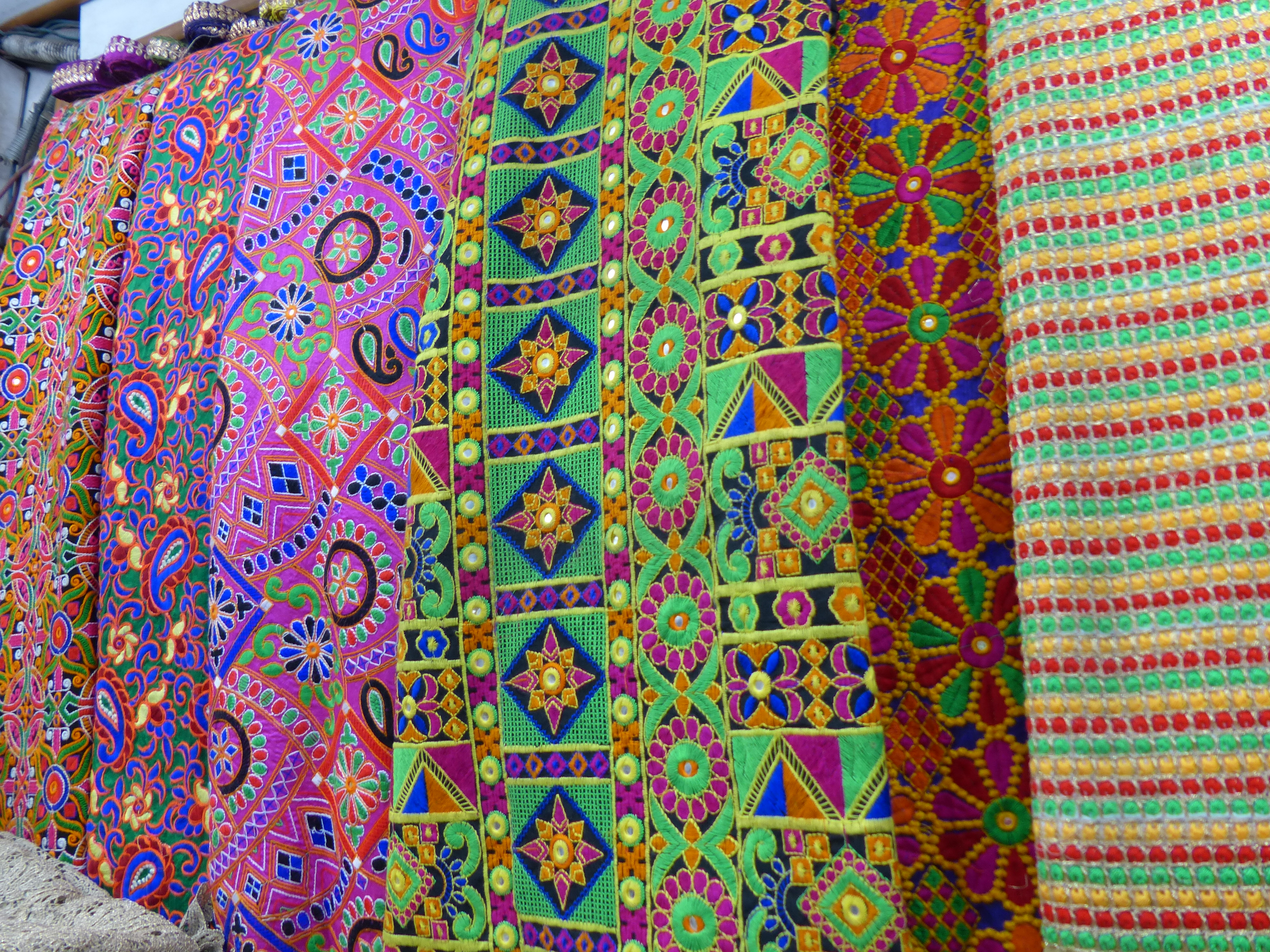
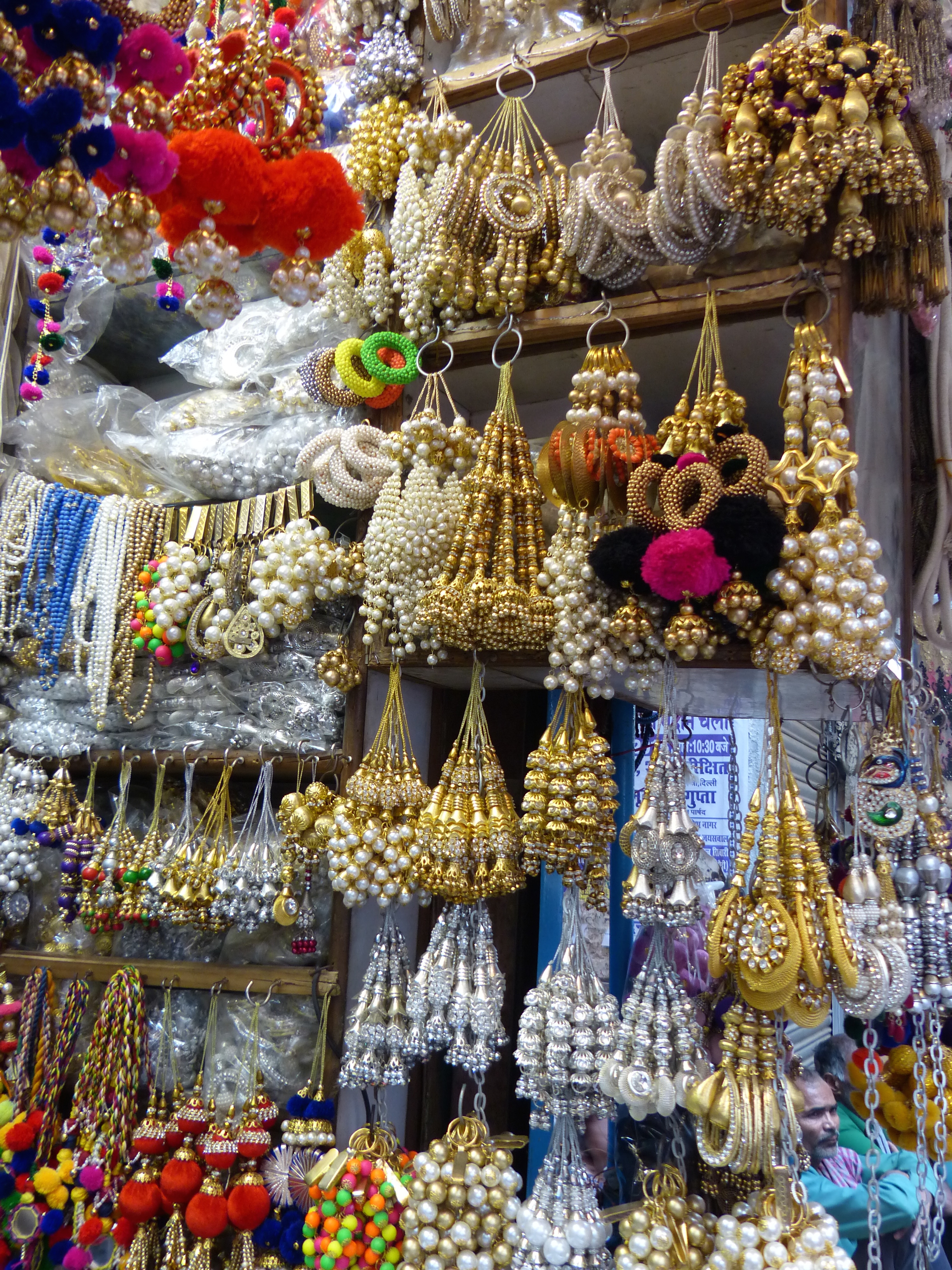
We also popped into several emporiums stocked from floor to ceiling with rolls of ribbon, lace and trim of every imaginable color and design for adding a kinari – or border – to a saree or other garment. Himanshu encouraged us to buy something fun to jazz up our clothes, and I eyed the collections with plans to add trim to a pair of jeans. In the end, I simply couldn’t commit to anything; I loved it all! However, now that I know where to find this stuff, don’t be surprised if all my western clothes get a touch of Indian flair.
P1060714

P1060712

P1060711

P1060708

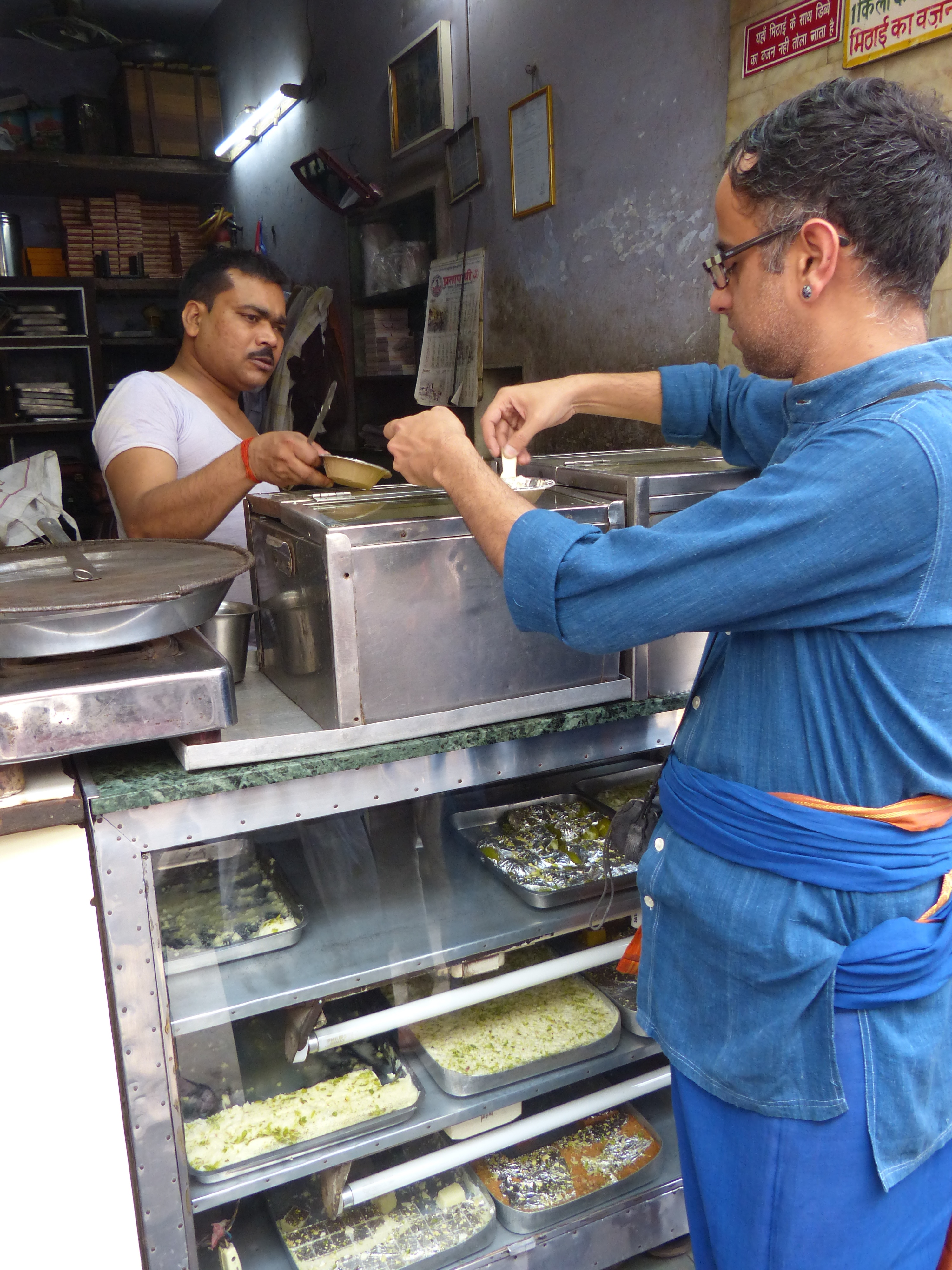
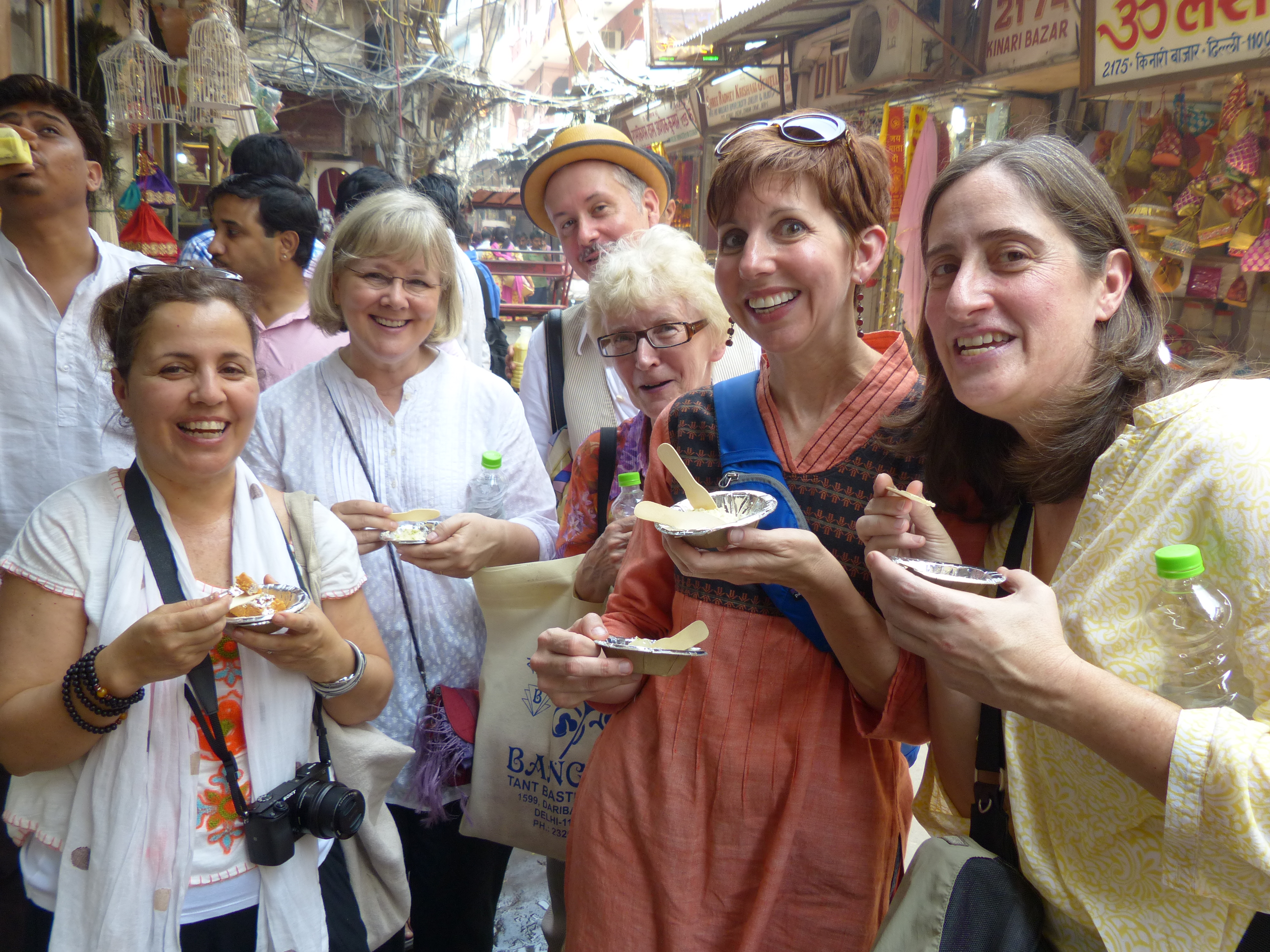
Our group paused for snacks a couple times at places we never would have tried without Himanshu’s trusted recommendation. This sweets shop offered up delicious milk-based desserts.
P1060691

P1060693

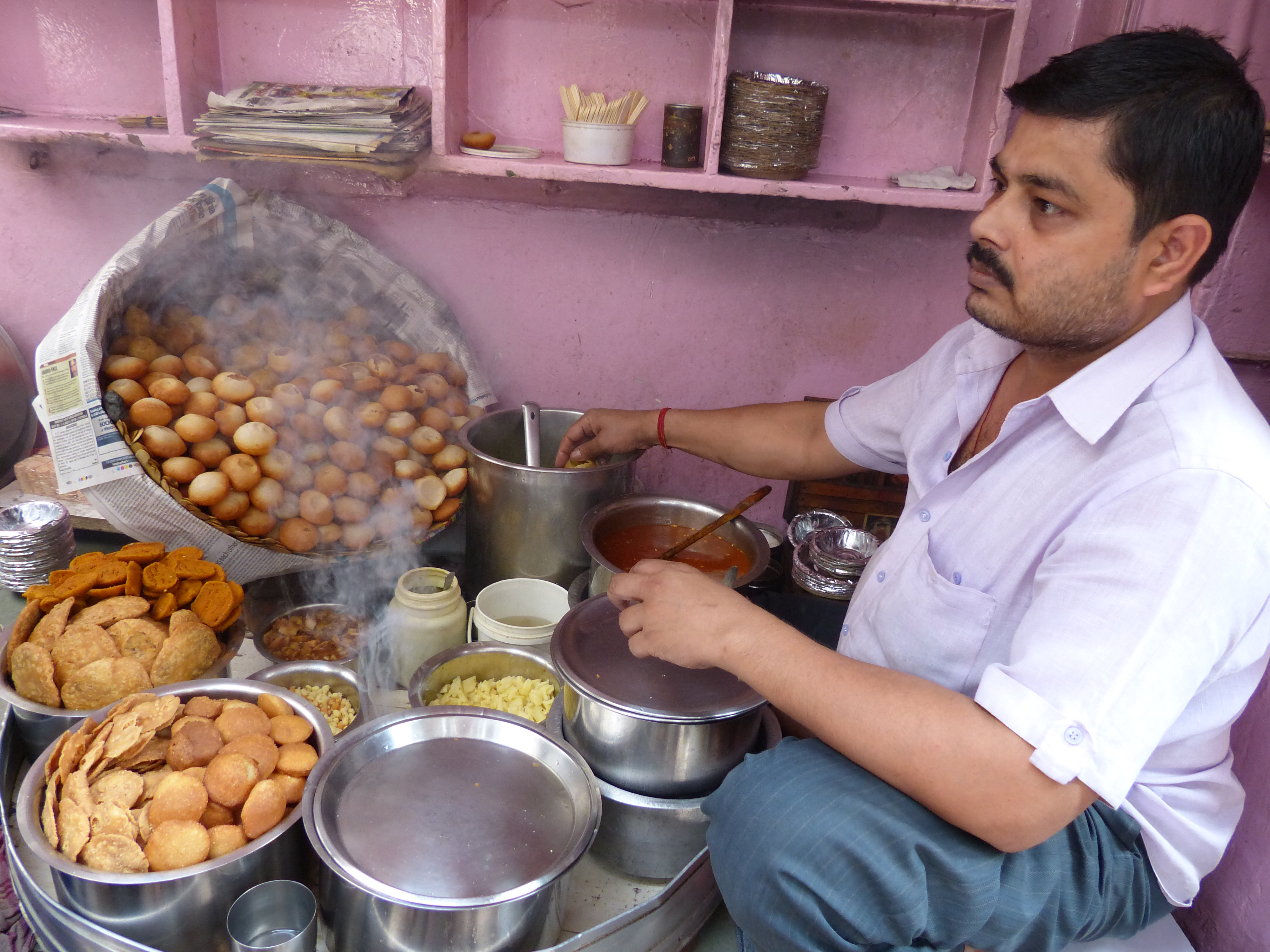
This man, whose little stand was unfortunately located directly across the narrow alley from an open urinal, whipped up golgappas, which are hollow crunchy balls filled with a watery mixture of tamarind chutney, chili, masala spices, potato, onion and chickpeas. He also served one of my favorite Indian street snacks – bhelpuri, a mixture of puffed rice, tamarind chutney and chopped veggies. Despite a momentary hesitation (no doubt triggered by the combination of the urinal smell and the sight of our snack-maker’s bare hands scooping the golgappa balls through the pot of water), we all gobbled up the treats and found them a bit spicy but tasty.
P1060719

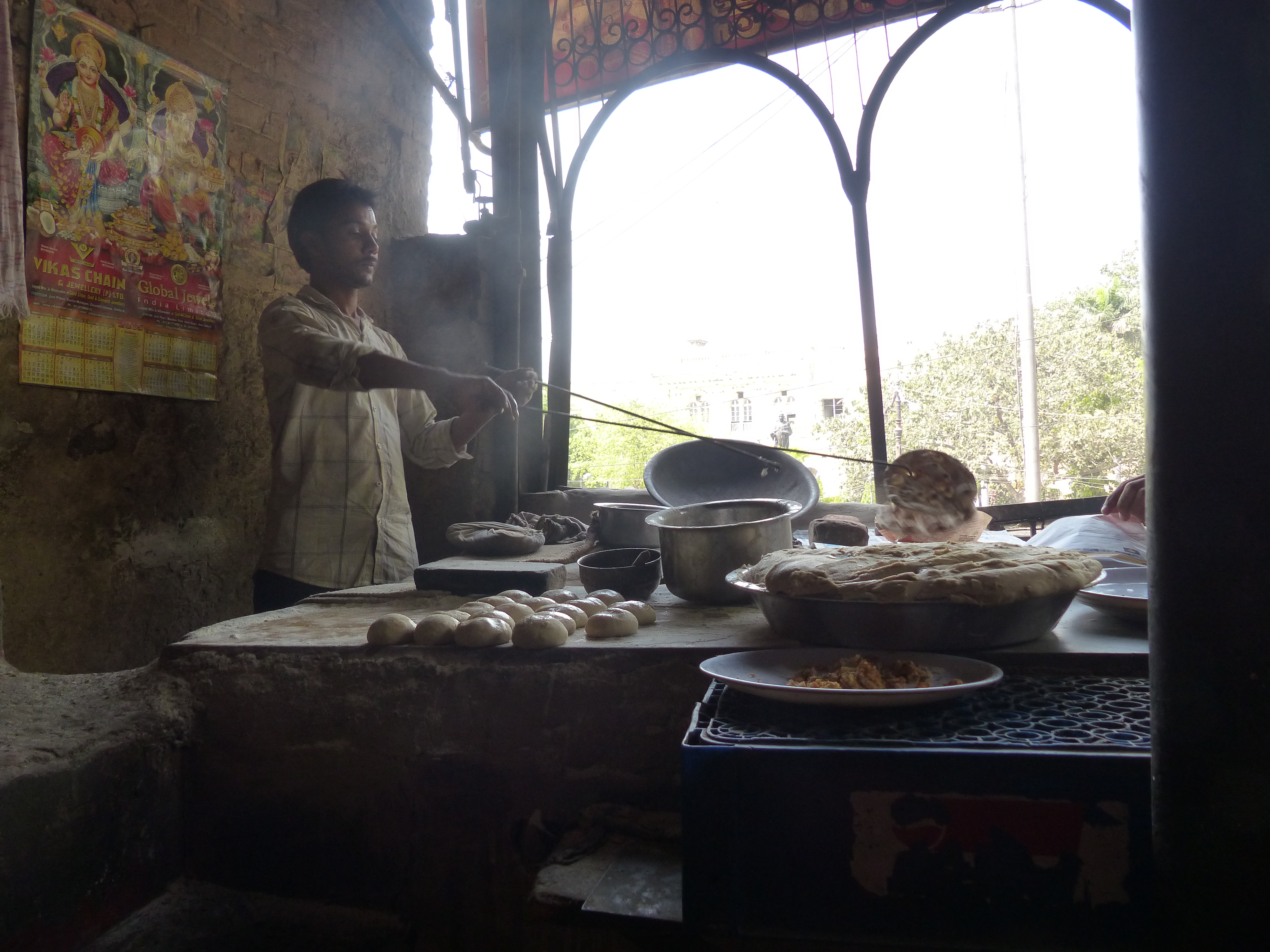
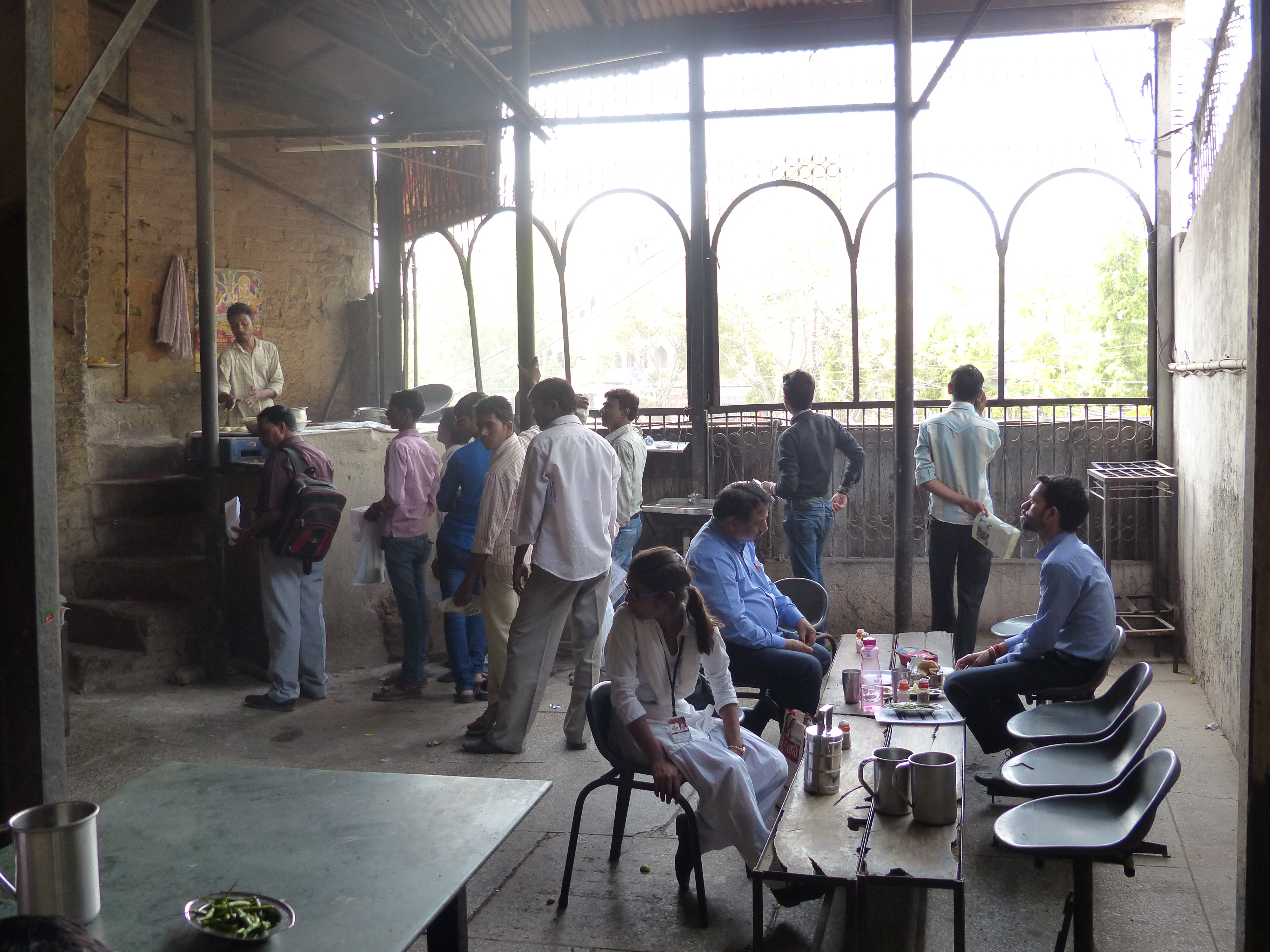
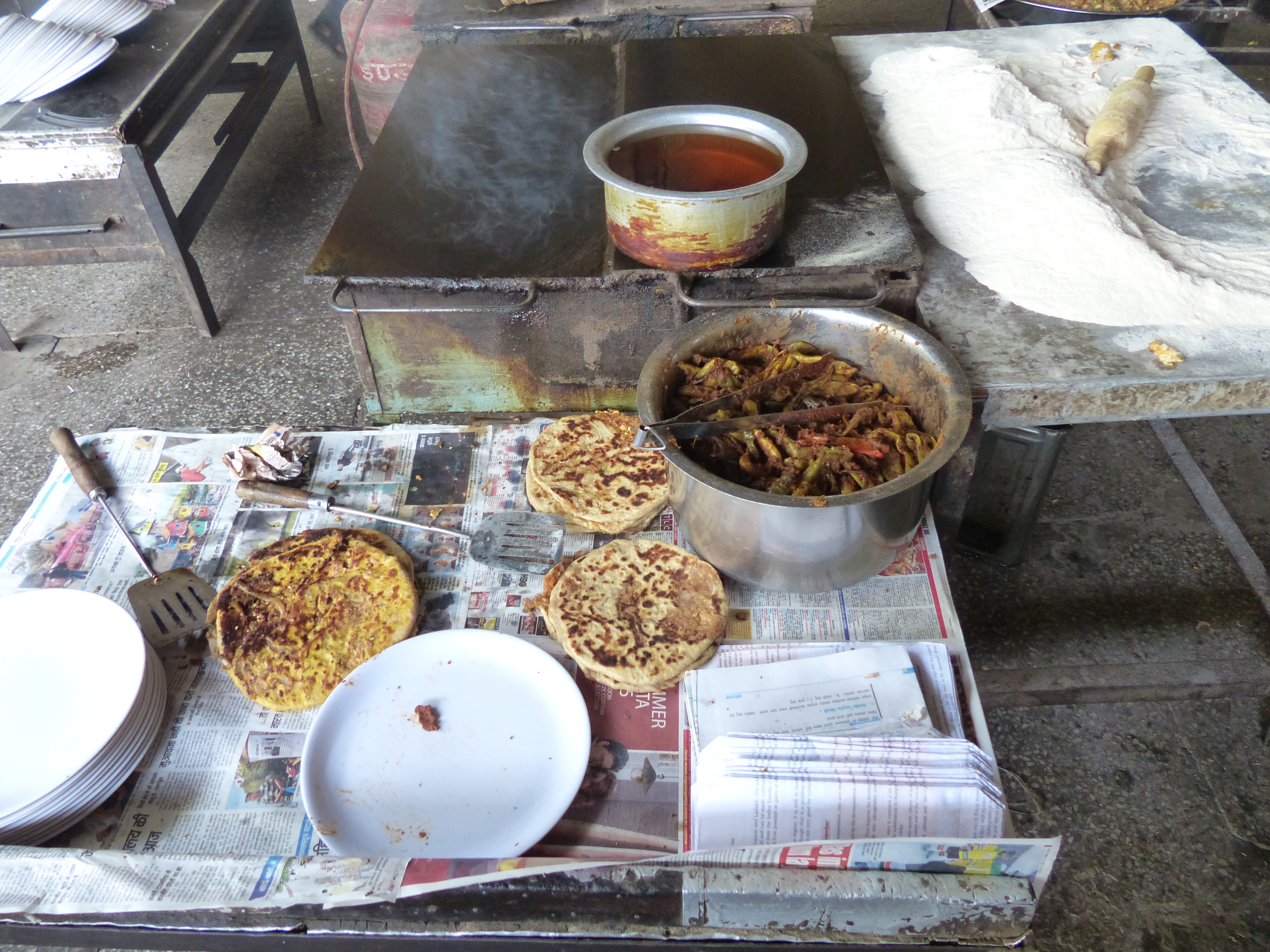
Eventually, Himanshu led us up a flight of dark narrow stairs to a busy eatery, where people lined up to get fresh bread straight from the tandoor. The breadmaker sat on an elevated structure and reached into the oven with long mental tongs to pull out the hot naan. We ordered paratha, a pan-friend flatbread stuffed with potatoes and spinach. Diners sat on cracked plastic chairs at long rickety tables; this was clearly not a place that catered to the hoity-toity expat crowd. In fact, I doubt any of us could find this place again. I always relish experiences like this, when I get a glimpse into the lives of locals in a way that doesn’t make me feel like a voyeur. It was pretty special, and the food was great!
P1060744

P1060739

P1060742

P1060746

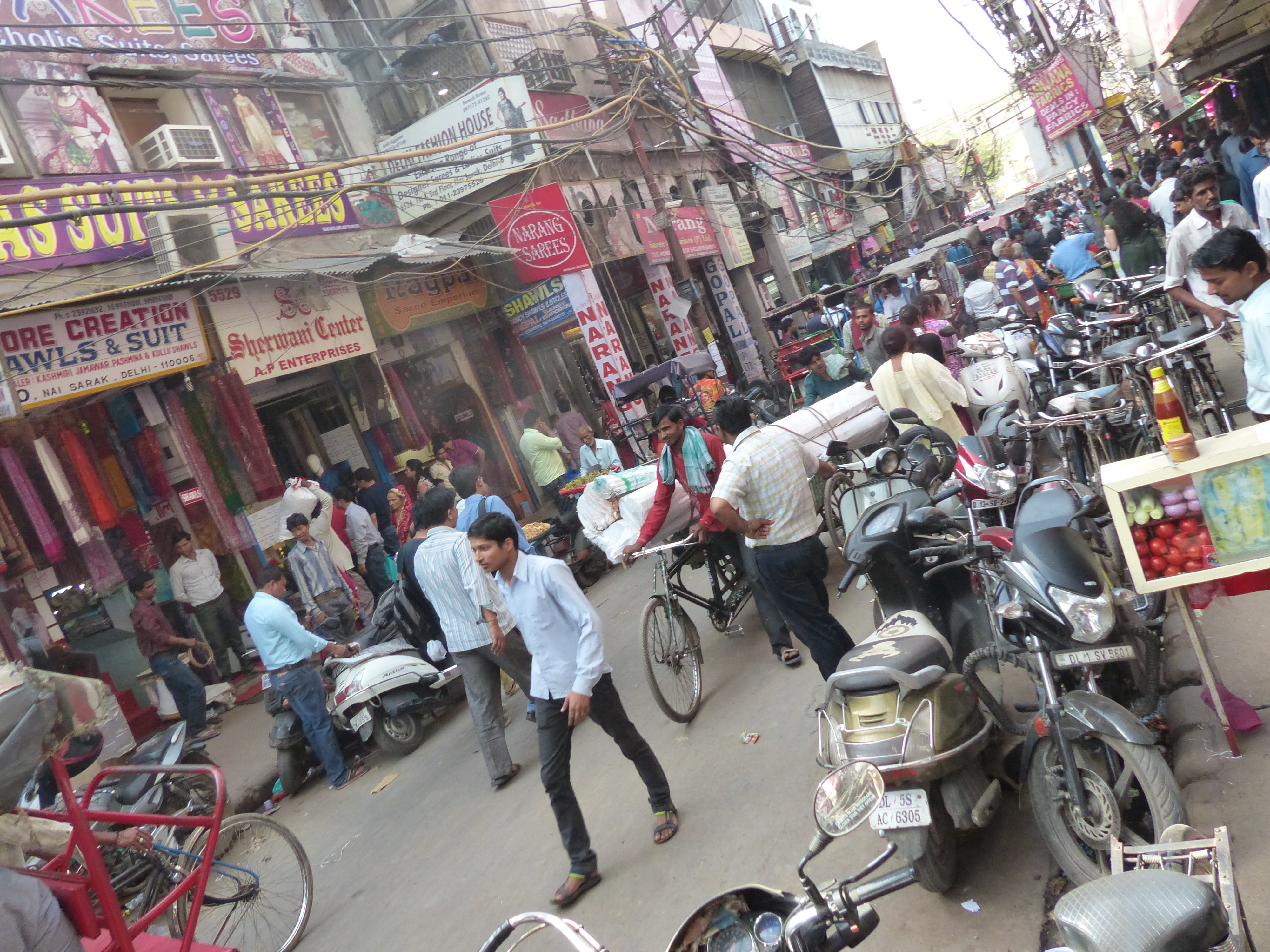
The labyrinth of Old Delhi can be daunting with its twisting alleys packed with pedestrians, motorcycles and bicycle rickshaws. Himanshu shared his expertise about the district and the iconic sarees, but he also brought a sense of curiosity and calm to a chaotic place, reminding us of its rich history and current relevance. I can’t wait to join him for another eye-opening tour.

Lip Sync Party: True Love

Everybody seems to be lipdubbing or dubsmashing all over the place these days. That’s why it’s a little tricky to explain why the Second Annual AES Lip Sync Party on May 16 was so special.

Was it seeing our friends and colleagues step outside their comfort zone? Was it the knowledge that a performance was the ticket for admission, so nobody was there to judge or heckle? Was it the face-cramping laughter? Was it the tables full of liquor donated by departing teachers cleaning out their cupboards? Was it the wigs, the costumes, the general silliness? Was it the video appearance of two stars from last year’s party or the surprise live appearance of friends who had left India?

Most likely, it was all that plus the genuine affection we felt for our school community. We’ve had some ups and downs in the last few years, and some of the downs have been doozies, but we stuck together. When a teacher breaks out a freestyle poem about #this place, and the crowd goes wild, well, you know you have something unique.

Much to my surprise, Tony agreed to perform with me. We sang the first minute or so of “True Love” by Pink, a song about sticking with someone despite their flaws. We dedicated the song to our cat, Khushi. If you’re one of the five people on the planet who don’t know how Khushi destroyed our lives this year, then read the backstory after the video.

Disclaimer: This party took place at AES with a bunch of AES teachers, but it was NOT sanctioned by the school, nor were any children present!

I would love to post the video of the whole evening because you can’t help but smile when see all the love in that room. However, I’ll respect the privacy of my peers and only share our own performance. Here ya go:

Back story: After summering in the States last year, we returned to Delhi to find our cat Khushi had gone bonkers. Our other cat, Ella, was totally fine, but Khushi screamed her head off day and night and peed on everything in sight. We took her to several different vets and tried a variety of interventions, including powerful anti-anxiety drugs in people form (no kitty prozac available in India). Nothing worked. At night, she would repeatedly run across our bed, howling maniacally. We took turns sleeping, with the other person sitting in another room to keep Khushi distracted. Tony was ready to euthanize her after a couple weeks, but I just couldn’t bear to do it. Instead, we suffered through almost eight months of sleep deprivation and zero quality of life. We couldn’t entertain because it stressed out the cat, but we couldn’t go out to dinner or visit friends because we worried she was peeing all over the house. Finally, a new vet speculated that her spaying had been botched. If any reproductive tissue remains in a cat, she will continue to go into heat until she gets pregnant. Awesome. The vet gave her a hormone shot, and – just like that – Khushi returned to relative normal. Needless to say, this experience consumed us for most of the school year. Everyone who asked, “How’s it going?” got an earful. Some days, that question triggered tears. That’s why we decided to sing our song in honor of Khushi.

Adventures in Teaching and Travel