5 weekends, 5 countries

Yowza.

Maldives
Thailand
Oman
Nepal
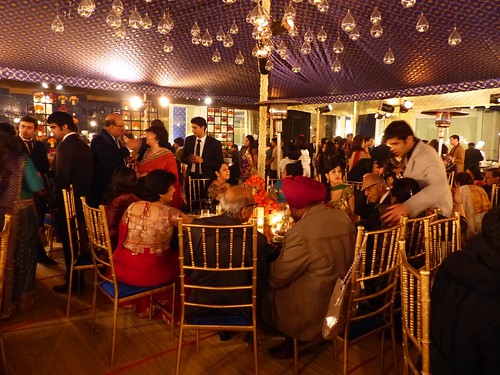
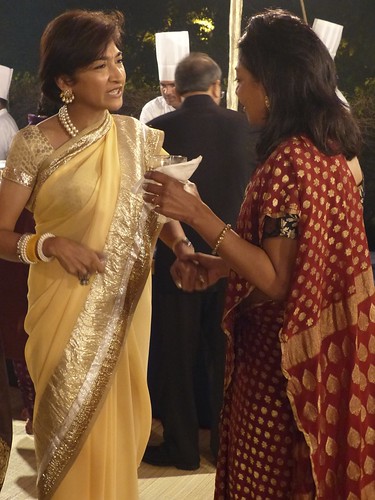
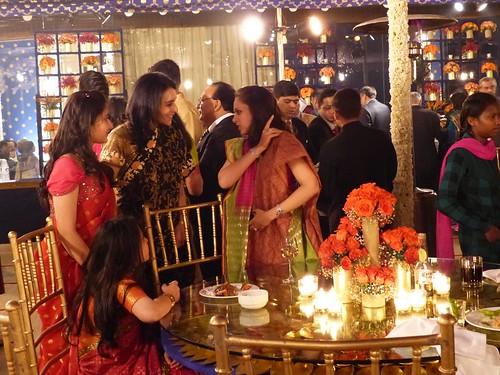
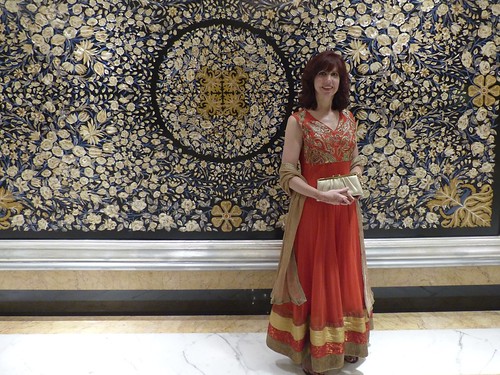
India

In the last five weeks, I spent only one weekend in New Delhi. Finally, a few moments to process. So much has happened in such a short amount of time, personally and professionally. Here’s the scoop in chronological order:

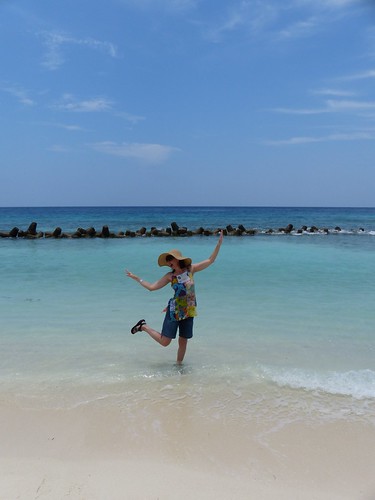
Maldives – Nothing soothes my soul like a little time by the sea. Tony and I escaped for a week in Paradise for Spring Break. See my post about our relaxing vacation – Maldives Diary.

Thailand – As an EAL (English as an Additional Language) specialist, I co-teach in grade-level classrooms, usually during the literacy block. The workshop model at our school draws heavily on resources from the Teachers College Reading and Writing Project at Columbia University. For years, I’ve heard teachers rave about the Teachers College summer institutes, but I’ve never had an opportunity to go. Unable to get to the mountain, I brought the mountain to me! Well, the Near East South Asia Council of Overseas Schools brought the “mountain” to its Spring Educators Conference, and I was lucky to land a coveted spot in The Writing Project’s Foundation Course. I can see the eyerolls and exaggerated snoring sounds, but seriously, I was like a kid in a candy store. Top-notch instruction with immediate take-aways. That’s the kind of stuff teachers drool over. Another perk was networking and sharing ideas with educators from other international schools.
After 12 years overseas, it would be impossible to attend an international teachers conference and not see friends from my past – thank goodness! This conference was no different; I ran into people from our days in Istanbul, Shanghai and Vientiane.

Oman – As arguably the least-sporty coach at our school, I gave a pathetically weepy speech at the Season 3 Awards Ceremony last week. For some reason, the Forensics Team (debate, public speaking and drama) gets recognized alongside softball, baseball, badminton and track-and-field athletes. Maybe the “real” coaches found me a bit overdramatic, but that’s what we forensics geeks love. As one of four coaches who traveled with the team to Muscat, Oman, in mid-April, I felt overwhelmed with pride for their accomplishments at the tournament. See details at O, Man! Forensics and Fun in Muscat.

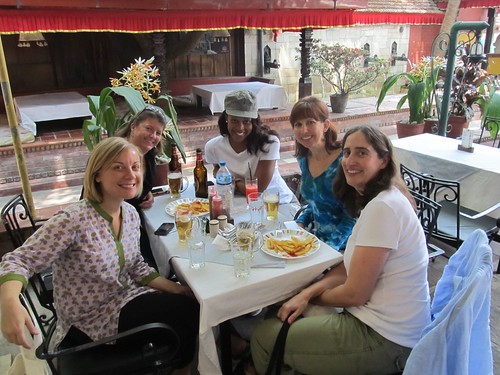
Nepal – With the end of the school year in sight, I joined four other ladies for a weekend get-away to Kathmandu to recharge our batteries and enjoy some quality time with two friends moving back to the States. Check out that post at Kathmandu – Ladies Weekend.

India – This is such a busy and emotional time in the life of a teacher abroad. Report cards, placement decisions for next year, language testing, farewell parties for friends moving on, big changes.

Looking back to May 2012, I can say our first year in India was hard, possibly the hardest first year we’ve had anywhere. As Bob Hetzel, our departing school director, is fond of saying, “Whatever is true about India, the opposite is also true.” That makes it particularly difficult to learn the ropes and settle in to this city that defies all western logic. By the end of our first year, we were feeling marginally better about our decision to move here but still overwhelmingly frustrated. Then a departing teacher, who spent five years in New Delhi, shared this snippet of wisdom: “Your second year will be exponentially better. And your third year will be exponentially better than your second year. And so on. You won’t believe it!” He was right.

Year two really WAS exponentially better than year one. Not perfect, but much much better. Despite the daily head-slapping confusion of living in a developing country, we also experience daily revelations. I cautiously look forward to an exponentially better year three. As we add two new members to our household, New Delhi is finally starting to feel like home.
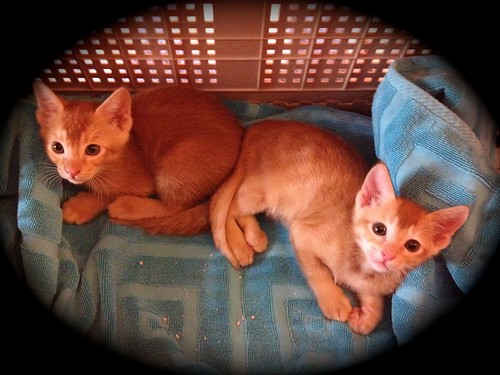
Introducing Ella and Khushi.
Untitled

Kathmandu – Ladies weekend!

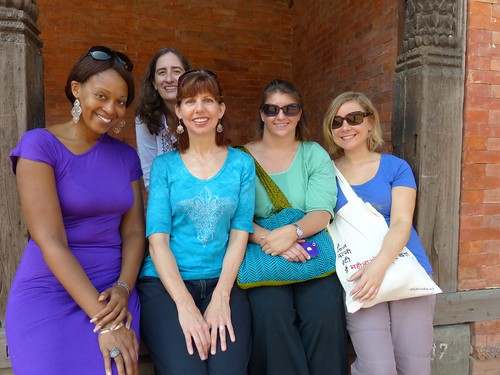
As the school year winds down, international teachers say a lot of farewells. Many of our friends and colleagues will depart for new adventures, and it’s hard to say good-bye. So we procrastinate. We drag it out. We have parties and dinners and weekend get-aways to stall the inevitable. In that spirit, a group of us took off for Kathmandu, Nepal, the last weekend in April to celebrate two ladies who will leave Delhi at the end of the school year – Katrina and Shannon.

In case you didn’t know, Nepal is the only country with a flag that is NOT a rectangle:

nepal-flag

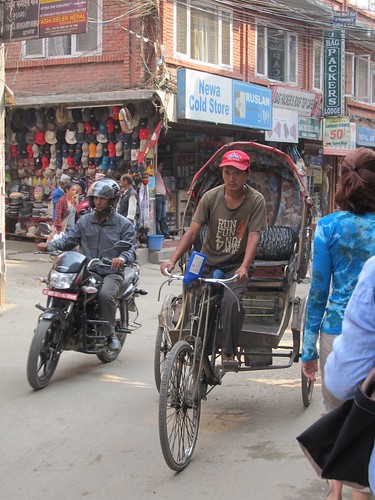
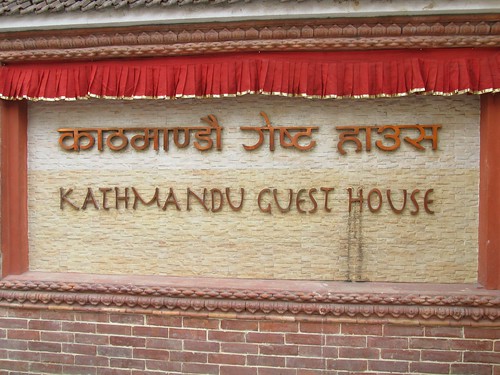
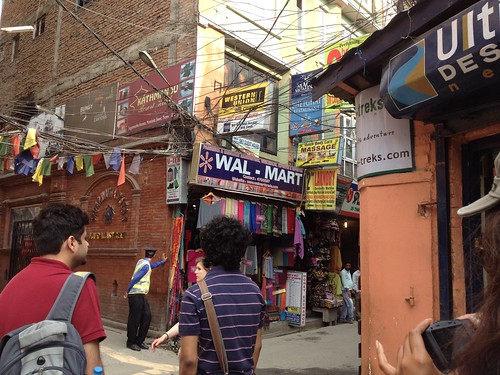
An early morning flight on Friday got us to the Kathmandu Guest House before lunch. I’ve actually outgrown guest houses, but this one came recommended, looked good online and, hey, it was good enough for the Beatles in 1968. As we settled in among the throngs of backpackers and trekkers, we realized the website may have exaggerated a bit. I awoke early each day to sip coffee and read my book in the guesthouse’s peaceful courtyard cafe, which was full of flowers and fountains. Outside the gate, however, the narrow streets clogged with tourists and traffic.

Inside the Kathmandu Guesthouse gate
(Photo by Katrina)
Untitled

Untitled

Untitled

Untitled

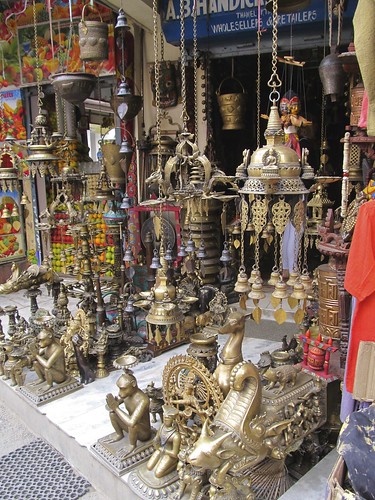
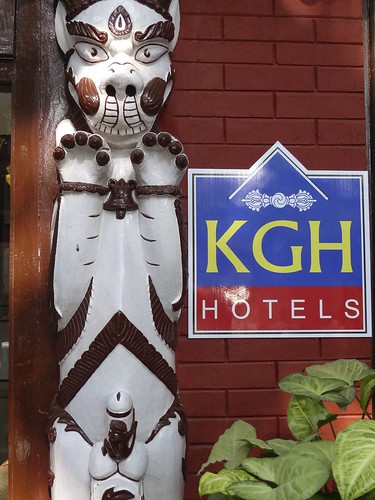
There were several of these statues with monkeys clinging to their wieners. I’m sure there must be a reason for it, but my research has yielded nada.
Untitled

Outside the Kathmandu Guest House gate
(photo by Tammy)
Untitled

(3 photos by Katrina)
Untitled

Untitled

Untitled

Bhaktapur – UNESCO World Heritage Site
(Everything that sounds factual in this section comes from the book Discovering Bhaktapur – A Guide to the Historic Newar City, which I found in pdf form online. So interesting! Now that I’ve read up on this place, I need to return and see everything I missed.)

Saturday morning, we took a car about 20 kilometers to the ancient town of Bhaktapur, which was one of three independent kingdoms in the Kathmandu Valley about 300 years ago. The city declined after unification in the late 1700s, and a massive earthquake in 1934 damaged or destroyed most homes and temples. Germany was instrumental in helping rebuild and revitalize Bhaktapur through a major project that tackled restoration of historic and religious monuments, the water and sewer infrastructure, health education, land development and housing, schools and more through the late 1980s. The rise in tourism has also renewed interest in conserving its unique culture, architecture and handicrafts.

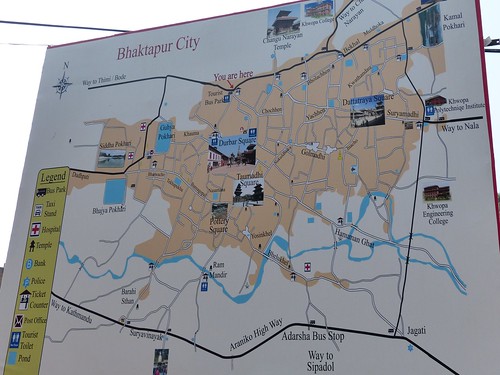
At the entrance to Bhaktapur, we bought a ticket and hired a guide, Shyam.
Untitled

Pausing so Shyam can tell us about Durbar Square.
Untitled

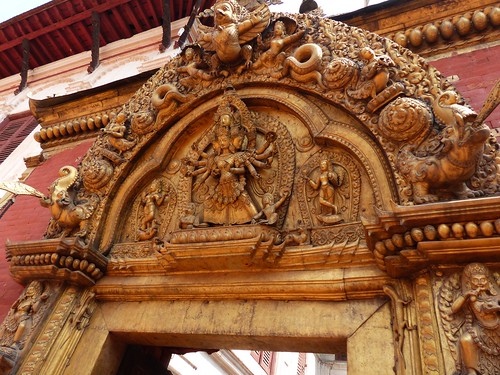
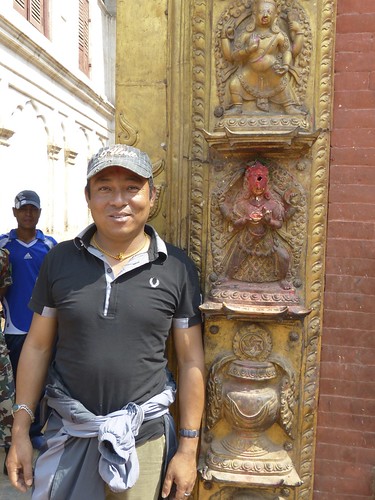
Shyam stands at the Golden Gate, the entrance to the religious areas of the royal palace.
Untitled

Untitled

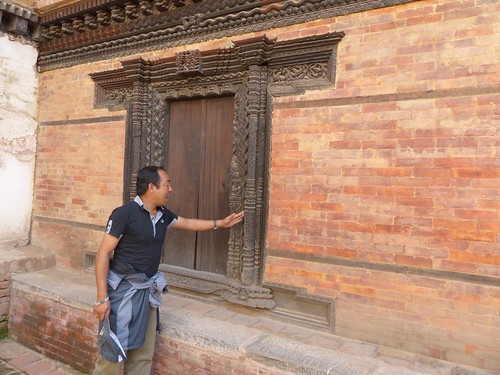
He explains that some of the wood carvings are original and others were created during the restoration.
Untitled

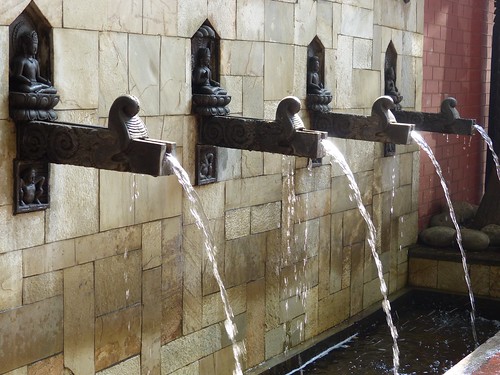
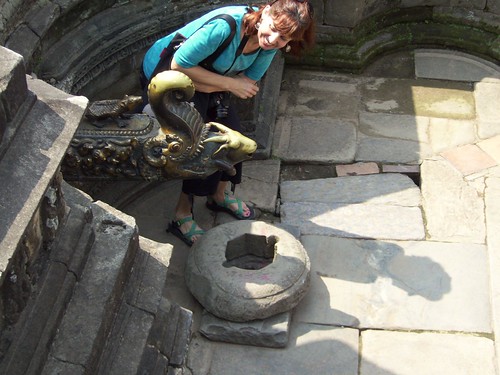
Only Hindus were allowed into Mul Chowk, home of the most holy temple of Taleju, the goddess worshipped by the royal family. We could, however, visit Naga Pokhari, a royal bath guarded by the gilded snake god Vasuki. I climbed down to check out the strange water spout. According to my book, such taps are typical of the era.

The spout itself is usually in the form of a makara, a mythical water creature that seems like a cross between a crocodile and an elephant. It is the vehicle of the water god Varuna. It often has a fish emerging from its mouth.

This one had a goat emerging from its mouth and a web-footed rat-like thing on its back.
Untitled

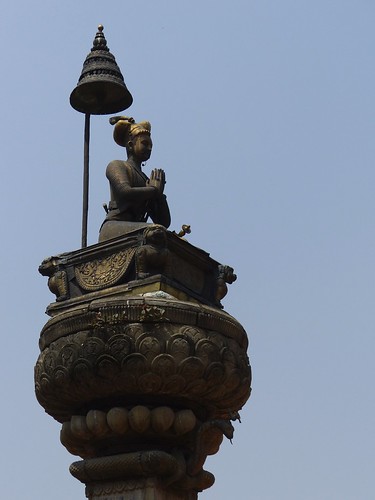
Facing the Golden Gate is the king who built it, Bhupatindra Malla (1696-1722), sitting atop a tall pillar. The statue was constructed in 1753 by his son, the last king of Bhaktapur.
Untitled

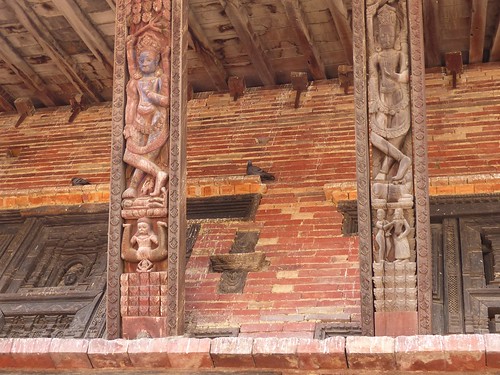
The Yaksheswar Mahadev Temple, dedicated to Shiva and dating back to the 1450s, features many erotic woodcarvings. Shyam said they represent the 24 sexual positions guaranteed to produce a son. “I know in Europe they have more than 24 positions, but here we have only 24,” he said with a laugh. My handy book says the carvings are actually associated with religious tantric cults of that time.
Untitled

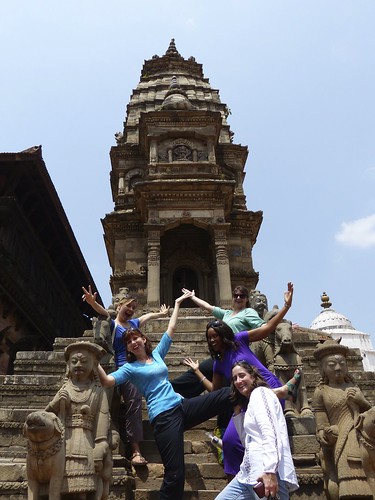
This whimsical little temple is dedicated to Siddhilaxmi, the goddess of success. My book says,

It has a delightful series of figures guarding its steps: a couple of chained rhinos (suggesting that the Mallas perhaps kept a menagerie), a pair of camels and what appears to be two naughty boys refusing to accompany their mothers.
Untitled

Another little temple.
Untitled

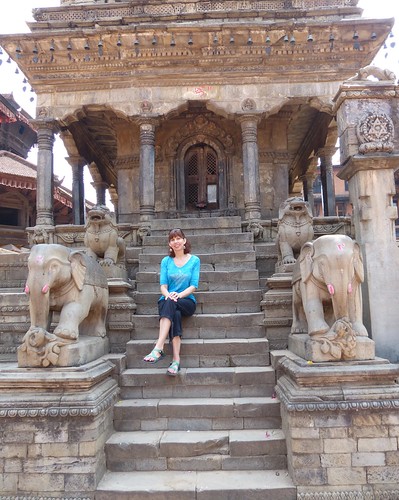
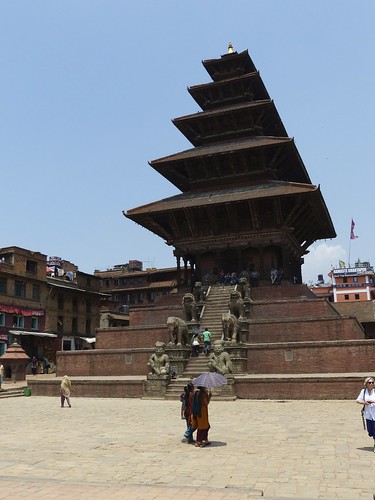
The Nyatapola Temple is the 30 meter-high pagoda in Taumadi Square. More from my book:

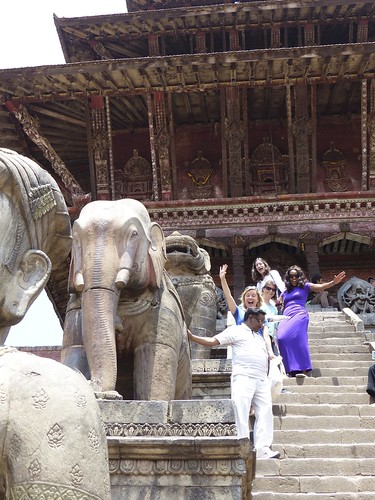
It’s thought to be dedicated to the beautiful goddess Siddhilaxmi and only special Taleju priests are allowed secret access to the inner sanctum. Nobody else worships there. It was built on the orders of Bhupatindra Malla in 1702. It is said that he set a fine example by carrying the first three bricks on his shoulder. This so inspired the population that all the remaining materials were brought up in the following five days. … Guarding the temple are ten mighty figures. At the bottom are two local wrestling champions called Jayamala and Patta. Next up, ten times stronger, are a pair of elephants. Then two lions, two griffins (sarduls) and two deities, Singhini and Byanghini. Each is ten times stronger than the pair below.
Untitled

Untitled

View from the top.
Untitled

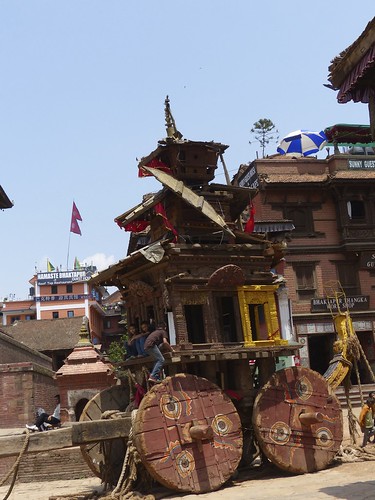
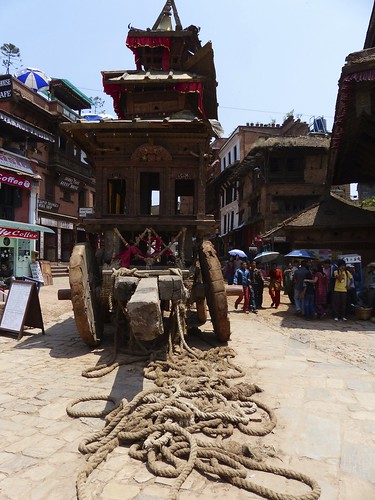
According to Shyam, this “vehicle” plays an exciting part in a big religious festival, sort of a tug-of-war thing to carry an image of the god Bhairav to meet up with the goddess Bhadrakali for a fertility ritual.
Untitled

My book says those rickety wheels inevitably crush raucous festival-goers.
Untitled

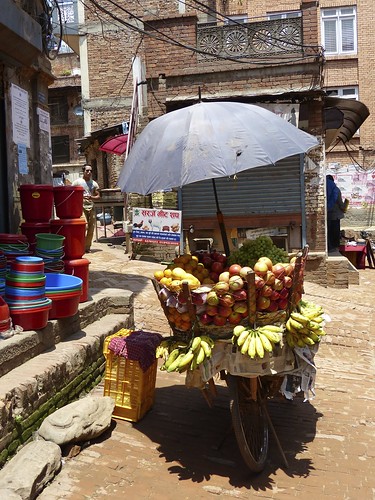
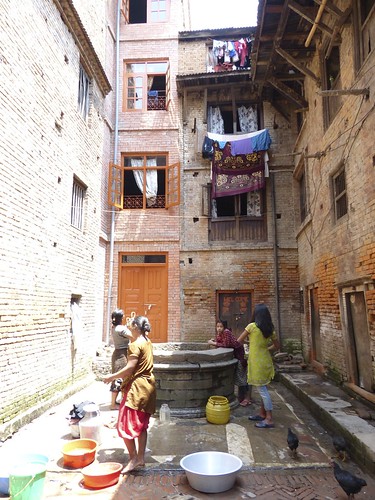
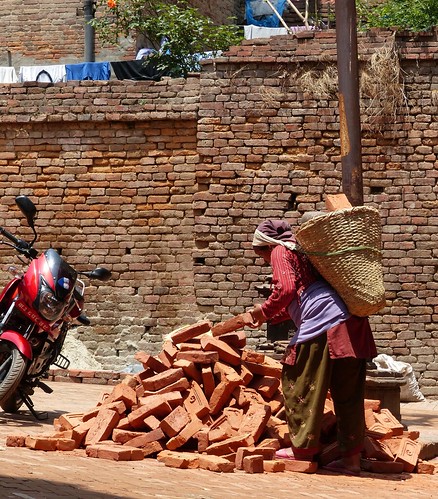
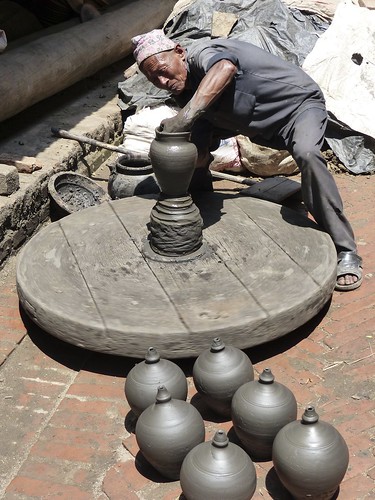
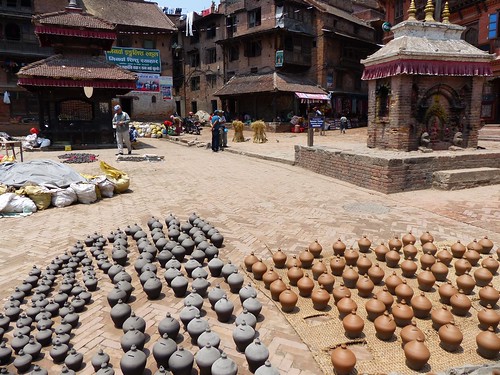
Shyam led us through a rabbit warren of alleys, where we witnessed the daily rituals of life: ladies drawing water from the wells, grannies minding toddlers and goats, workers hauling loads of timber and bricks, craftsmen carving wood and throwing pots, old men bent over a card table, children kicking around a ball or rolling a tire, vendors selling a little bit of everything. Here’s an interesting tidbit from my book:

The ancient route from Delhi and Kathmandu to Lhasa and Beijing went through Bhaktapur. A steady trade was maintained in salt, wool, gold dust, copper, medicinal herbs, spices and yak tails (used as royal fly whisks). Probably not much silk though. This trade peaked in the early 18th century and then declined after the national unification in 1767. A community of Newari traders has remained in Lhasa to import Nepali goods up to the present time.
Untitled

Untitled

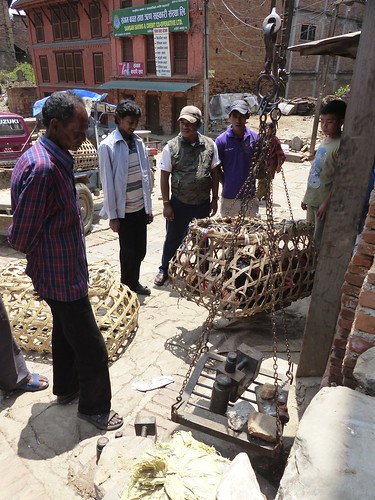
“Weighing” chickens for sale.
Untitled

Untitled

Untitled

Untitled

Untitled

Untitled

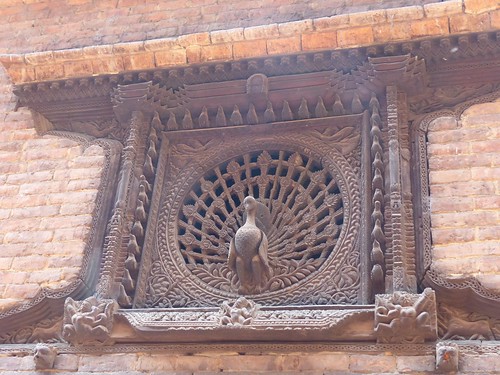
The famous Peacock Window.
Untitled

Untitled

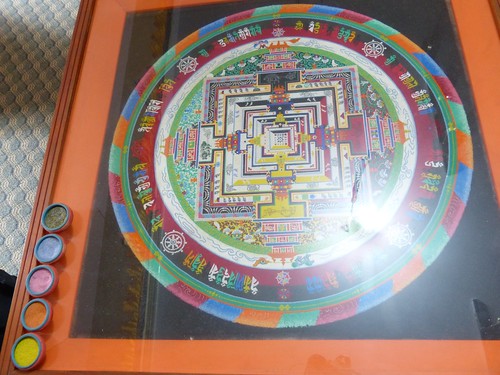
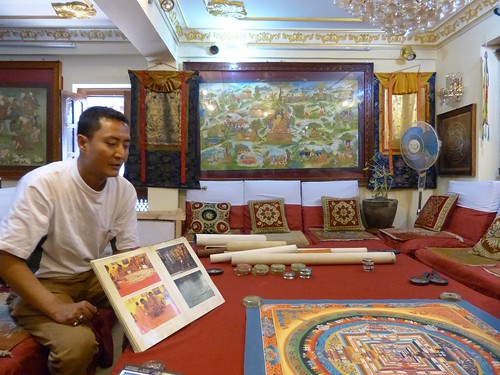
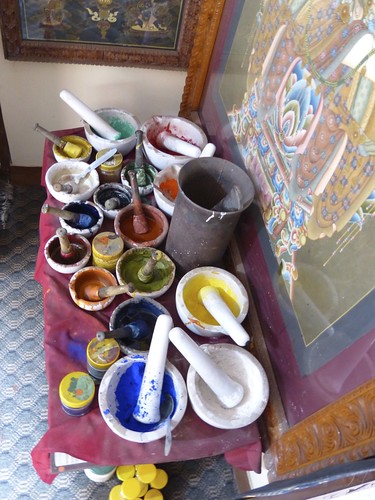
During our tour of Bhaktapur, Shyam took us to the Lama Thanka Painting School. We learned about the Dalai Lama’s sand mandala design.
Untitled

According to the Namgyal Monastery Institute of Buddhist Studies,

Sand mandalas are one of the most magnificent types of mandala construction and are associated with the most profound and elaborate Buddhist ceremonies in Tibet. Every color, dot, and line in the mandala represents an essential part of the deity and Buddhist philosophy. Each component must be placed in exactly the same place every time the mandala is constructed.
Although sand mandalas are made on a flat surface they are, to the devout, a three dimensional palace, representing the mind of the Buddha. The person contemplating the mandala enters into it, as they would a building or an enclosure.
The mandala construction itself is the result of long and disciplined effort, but it is nonetheless a temporary work. When the monks are finished, there is a dissolution ceremony where the deity is released by the dismantling of the mandala. The sand is cast into a body of water to emphasize and highlight the impermanence of all things and the importance of nonattachment. When the sand enters the water, the kindness and compassion of the deity are disseminated into the world to benefit all beings.
Untitled

Untitled

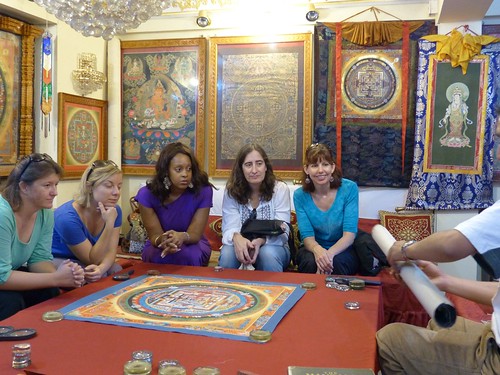
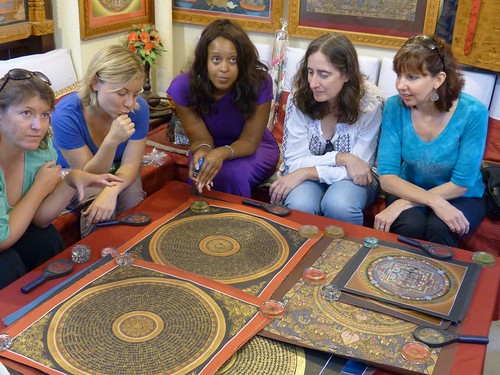
Then, of course, we started looking at paintings by students and masters, and then, of course, we couldn’t resist buying some. They really are stunning. Mine features a favorite mantra of compassion – om mani padme hum – painted in gold gajillions of times in concentric circles.
Untitled

Untitled

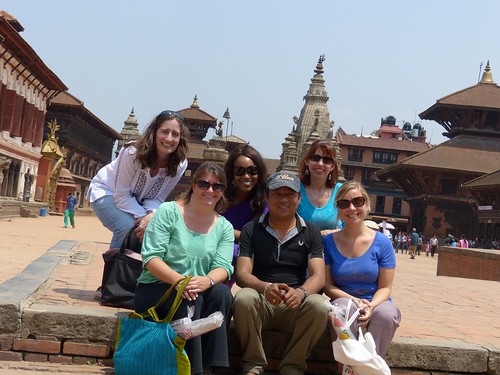
We had a fascinating day with Shyam.
Untitled

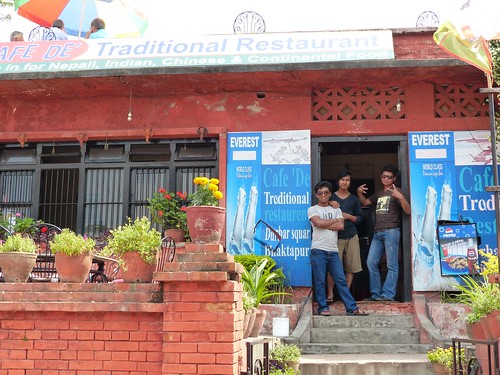
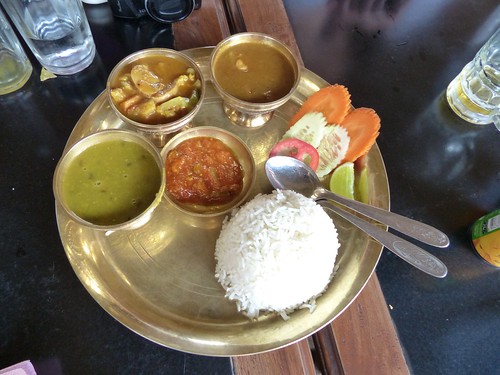
Before leaving Bhaktapur, we ate lunch at the redundantly named Cafe de Traditional Restaurant. I’m not sure what we ate, but I assure you it was delicious!
Untitled

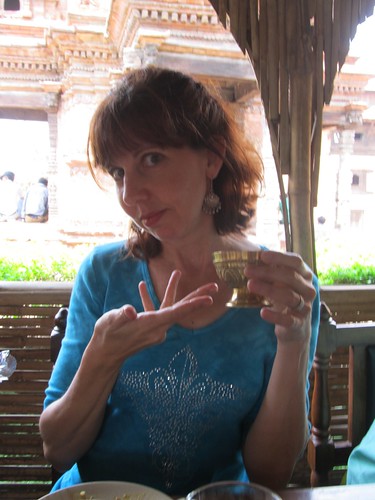
The best part was dessert: King’s Curd, a sweet scrumptious yogurty treat. Katrina took this shot of me loving my King’s Curd.
Untitled

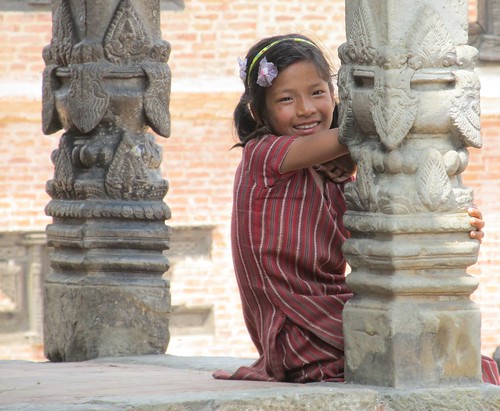
This little girl watched us eat. Katrina’s pic.
Untitled

These guys were our waiters.
Untitled

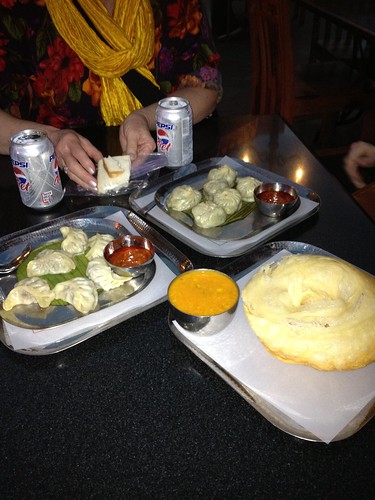
Back in Thamel, the backpacker part of Kathmandu, we popped into a Mexican restaurant for margaritas. I hung my camera, purse and bag of bananas on the back of my chair. (That detail will become important later.) We enjoyed a little siesta and then took off for a spectacular French dinner at Chez Caroline. Yes, before we left Kathmandu, we had devoured Italian, Mexican, French and Nepalese cuisine, including more than our fair share of momos.

In the morning, I wandered down to the courtyard for coffee but felt like something was amiss, you know, that feeling you get just after shutting the front door and realizing you don’t have your keys? I read my book for awhile, uneasy but unable to figure out why. Finally, I realized I hadn’t seen my camera that morning. I knew I had taken it to the Mexican restaurant, but I couldn’t remember having it after that. I wandered over to the restaurant and shook the metal grate over the door until a cleaning lady popped her head out the window. She came downstairs and let me in to search. No luck. One of the waiters shook his head. There were really only two possibilities: Another diner stole it or a staff member found it.

The camera had been an expensive Christmas present to myself (although Tony technically made the amazon.com purchase and put it under the tree). I was already mourning the loss, but even more, I was kicking myself for losing all the photos from this trip. Back at the guesthouse, Katrina wasn’t feeling well, so she stayed in bed while the rest of us headed out on another excursion.

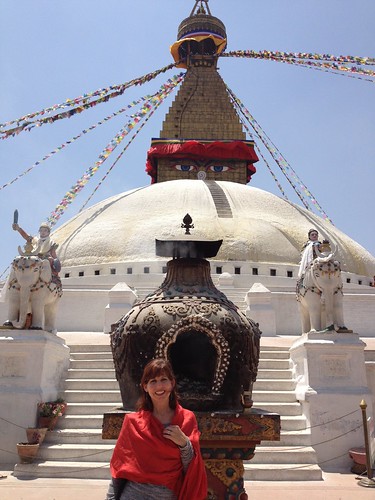
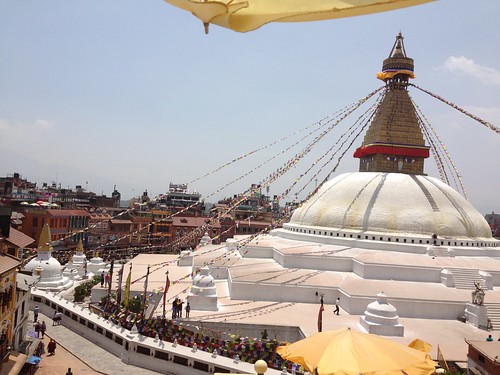
Bouddhanath Stupa
The Bouddhanath Stupa, first built in the 14th century, is one of the holiest Buddhist sites in Nepal and one of the largest stupas in the world. It was declared a UNESCO World Heritage site in 1979. As usual, one of my favorite travel websites – Sacred Destinations – has an excellent write-up about the stupa.

From above, Bodnath Stupa looks like a giant mandala, or diagram of the Buddhist cosmos. And as in all Tibetan mandalas, four of the Dhyani Buddhas mark the cardinal points, with the fifth, Vairocana, enshrined in the center (in the white hemisphere of the stupa). The five Buddhas also personify the five elements (earth, water, fire, air and ether), which are represented in the stupa’s architecture.
There are other symbolic numbers here as well: the nine levels of Boudhanath Stupa represent the mythical Mt. Meru, center of the cosmos; and the 13 rings from the base to the pinnacle symbolize the path to enlightenment, or “Bodhi” — hence the stupa’s name.
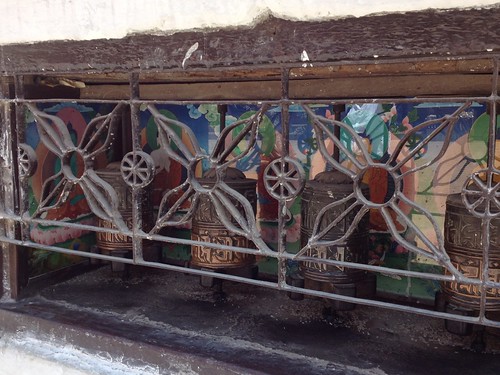
At the bottom, the stupa is surrounded by an irregular 16-sided wall, with frescoes in the niches. In addition to the Five Dhyani Buddhas, Boudhanath Stupa is closely associated with the Bodhisattva Avalokiteshvara (Padmapani), whose 108 forms are depicted in sculptures around the base. The mantra of Avalokiteshvara – Om Mani Padme Hum – is carved on the prayer wheels beside the images of Avalokiteshvara around the base of the stupa.
The base of the stupa consists of three large platforms, decreasing in size. These platforms symbolize Earth, and here you can look out at the mountains while listening to the chants of the devout doing kora, walking around the stupa praying.
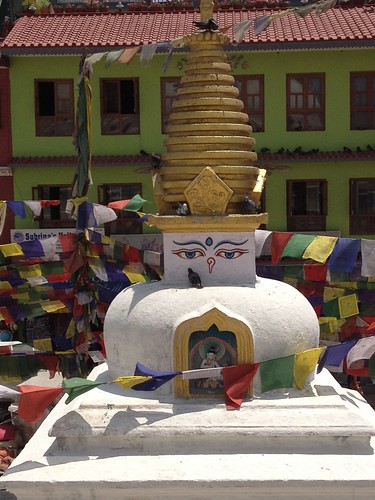
Next come two circular plinths supporting the hemisphere of the stupa, symbolizing water. As at Swayabunath, Bodnath is topped with a square tower bearing the omnipresent Buddha eyes on all four sides.
Instead of a nose is a question-mark-type symbol that is actually the Nepali character for the number 1, symbolizing unity and the one way to reach enlightenment—through the Buddha’s teachings. Above this is the third eye, symbolizing the wisdom of the Buddha.
The square tower is topped by a pyramid with 13 steps, representing the ladder to enlightenment. The triangular shape is the abstract form for the element of fire. At the top of the tower is a gilded canopy, the embodiment of air, with above it a gilded spire, symbolic of ether and the Buddha Vairocana. Prayer flags tied to the stupa flutter in the wind, carrying mantras and prayers heavenward.
The main entrance to the upper platform of Bodnath Stupa is on the north side. Here Amoghasiddhi, progenitor of the future Buddha, presides. Below Amoghasiddhi is the Buddha Maitreya, the future Buddha.
Surrounding Boudhanath Stupa are streets and narrow alleys lined with colorful homes, Tibetan Buddhist monasteries, and street vendors.

Buddhism is my go-to religion in times of strife. I like the mantras, the rituals, the karma. So I decided to follow the pilgrims on the circumambulatory path, turning every one of the prayer wheels while chanting the mantra adorning each one: om mani padme hum.
Untitled

Untitled

Untitled

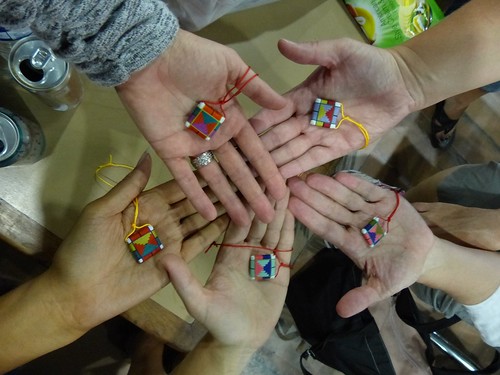
All of us gave a donation to a monk at the stupa in exchange for a blessing. The monk wrote the mantra on paper, folded it, wrapped it in colored thread and then blessed it.
(Photo by Tammy)
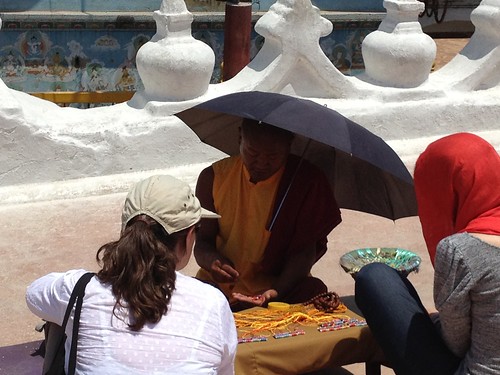
Untitled

Untitled

We climbed up to a rooftop cafe for a quiet break (and a good view of what seemed to be the filming of a cheesy music video) before heading back to our guesthouse.
(Photo by Tammy)
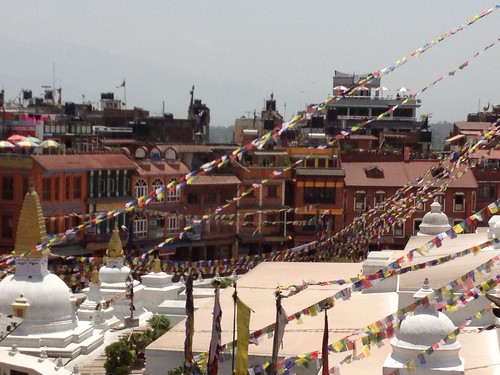
Untitled

Untitled

Well, I don’t know if it was the prayer wheels, the monk’s mantra necklace, Katrina’s rise from her sickbed to give the stink-eye to the workers at the Mexican restaurant or just dumb luck, but when we got back to Thamel, I ran up the stairs to the restaurant and the bartender said, “We found your camera! We already returned it to your guesthouse!” All’s well that ends well.

And that’s the end. We packed a LOT into a short girls get-away. Ladies, I’m gonna miss you!

O, Man! Forensics and fun in Muscat

Forensics – Not just for dead people.
That’s the slogan on the back of our team T-shirts.
As one of the MESAC Forensics Team coaches, I heard a lot of surprised exclamations such as, “Wow! You guys do forensics? I didn’t know you were trained in that!” Sigh … It’s not “forensic science” à la CSI. It’s forensics à la Socrates. In other words, the students compete in debate, public speaking and dramatic interpretation of monologues or duet scenes.

According to the American Forensic Association,

“Forensics” is a word rooted in the Western world’s classical experience. The Greeks organized contests for speakers that developed and recognized the abilities their society felt central to democracy. These exercises acquired the title “forensics,” derived from the Latin term “forensis” and closely related to forum. Because the training in this skill of public advocacy, including the development of evidence, found one of its important venues in the law courts, the term “forensic” has also become associated with the art and science of legal evidence and argument.

Our school is a member of MESAC (Middle East South Asia Conference), which also includes schools from Oman, the United Arab Emirates and Qatar. As one of four American Embassy School coaches (a fifth stayed behind in India), I traveled with 20 amazing high-schoolers to represent AES at the 2013 MESAC Forensics Tournament, April 17-21 in Muscat, Oman.

The American-British Academy (ABA) played host.
Untitled

Our fledgling forensics program fielded a debate team for the first time, and this was only the second year we participated in acting and speaking events. Nevertheless:
* Two of the debaters beat last year’s winners to earn a bronze medal.
* We sent 12 students to the finals.
* Seven kids came home with medals.
* AES placed second overall.

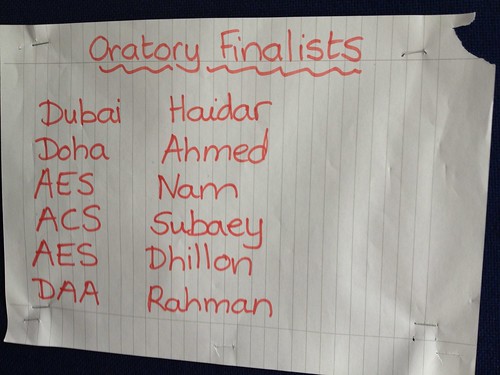
This is what we liked to see! Lots of “AES” on the results posters.
Untitled

We adults felt excited for the medalists, but our greatest fulfillment came from watching the growth that occurred over the course of our season. This is a unique team in that students have an opportunity to express themselves in ways that take them far out of their comfort zone. For the oratory event, they wrote, memorized and presented powerful speeches calling for action. Our students addressed mental health in children, women’s rights in India, care of HIV/AIDS patients, Asian stereotypes and parental pressure for perfection. They spoke from the heart, revealing their deepest fears and biggest aspirations.

We may have seen the greatest transformation in our students competing in oral interpretation. They chose challenging pieces of literature to read, and some of the English learners required line-by-line explanations of the meaning before they could start interpreting. They worked so hard, begging for extra coaching time, meeting on weekends, shedding their inhibitions. When one of our 10th-graders took the stage to read “The Orange” by Joyce Carol Oates, she gave it everything she had, leaving the audience disarmed but in awe. Our only senior had brilliantly edited down a scene from “‘Night, Mother” and read the lines for both characters. Her subtle sophisticated performance tricked my mind into thinking there really were two people on stage and her last line forced a catch in my throat as I fought back tears.

There were so many success stories … not a slacker in the bunch. In addition to their work, our kids were kind, friendly and outgoing. They bonded with students from other schools and demonstrated admirable sportsmanship. So proud of them all! I feel incredibly fortunate to work at a school with this caliber of young people.

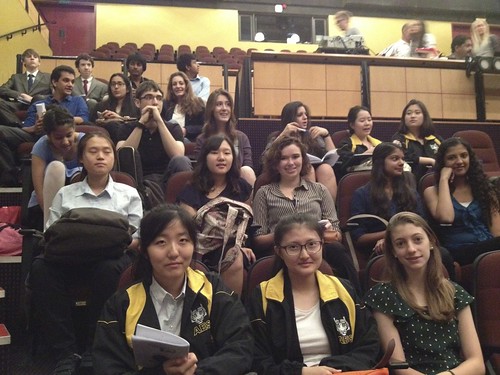
First day of the tournament at ABA … waiting in the auditorium.
Untitled

My good friend Jacqueline, who taught with us in Turkey, now works at The American International School of Muscat. I was hoping to meet up with her during our visit, but the tournament schedule was grueling. Imagine my excitement when she showed up at the ABA coaches lounge! She hung out with us at the school a few times and then surprised me with a ticket to see “Madame Butterfly” at the Royal Opera House. I almost declined, exhausted from a lingering cold and the intensity of the tournament, but I couldn’t resist the lure of a cultural event paired with some Jacq time. The two-year-old Opera House was stunning inside and out. In fact, I may have appreciated the venue even more than the show!
Untitled

So much elegance.
Untitled

I NEED one of these lamps.
Untitled

Jacqueline and me. (I’m the one who looks less like a posh opera-goer and more like a worn-out teacher at the end of a long day.)
Untitled

Here’s a cool promotional video from the Royal Opera House website:

Our only other foray into Muscat was a traffic-y bus ride with all the kids and coaches to a souk, a fun market with Omani souvenirs and crafts. We spent about 30 minutes poking around before heading back to our hotel. Students stayed with ABA families, so coaches enjoyed a little downtime. In fact, one of the other coaches had issued a challenge: Which coach could find the best souvenir for one riyal (about $3)? Back at the hotel, the coaches met to compare souvenirs. The AES coaches nailed it. We had purchased a bizarre plastic pull-string toy featuring a Barbie-ish doll riding a sort of bicycle rickshaw with a green alien-ish baby and a rotating umbrella. We turned it into a trophy and gave it temporarily to our MVP. (I’ll post a photo when we get it back.)

Gimme a break

I thought this would be the weekend I could slow down and take a breath. I have a month’s worth of backlogged blogs in my mind.
Then I remembered we coaches were taking our high school forensics team out to dinner Friday night.
Then I remembered I had compulsory CPR training Saturday morning, an awards ceremony for spring teams Saturday afternoon and a farewell party for some departing teachers Saturday night.
I’m finally getting my hair colored Sunday morning (after cancelling twice because of other commitments; my grey roots are staging a mutiny), but report cards are due next week, so there goes the rest of my day.
So, maybe I’ll slow down, take a breath and blog next weekend.
TTYL.

Spring Break – Maldives Diary

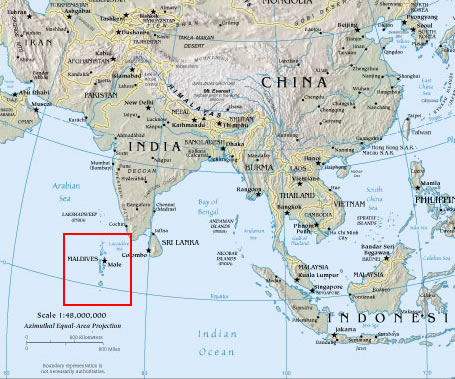
Spring Break! Off to the Maldives – a garland of islands in the Indian Ocean off the southern tip of India. Woo hoo!

According to Visit Maldives:

The Maldives lies in two rows of atolls in the Indian Ocean, just across the equator. The country is made up of 1,190 coral islands formed around 26 natural ring-like atolls, spread over 90,000 square kilometers. These atolls structures are formed upon a sharp ridge rising from the ocean, making way for their secluded uniqueness.

206jh_asia_map

Sunday, March 24
Air India recently cancelled our short flight to the Maldives via Colombo, Sri Lanka. We felt lucky the savvy travel experts of Sun Tours had our backs and rebooked us on another flight. It’s probably a good thing I was too busy to process the new schedule. On paper, it seemed OK: Delhi to Kochin (southern India). Kochin to Male (capital of the Maldives). Seaplane to our resort in the Lhaviyani Atoll.

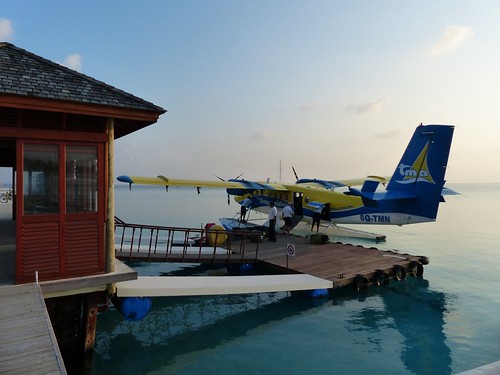
Here’s how it really played out: We left for the airport at 4:30 a.m. About half way into our “direct flight” to Kochin, the flight attendants made the stow-everything-and-get-ready-to-land announcement. After panicking momentarily that we had boarded the wrong plane, we soon realized we had been duped by the “fake direct flight” ploy. Grrr… uncool, Spice Jet. We dropped off about half the passengers in Hyderbad, stayed on board while the crew cleaned the plane, and then waited for the new group to board. Eventually, we reached Kochin and caught our connection to Male, where we traveled by seaplane to the Kuredu Resort (after a quick stop at another resort). We finally reached paradise after 13 hours and FIVE separate flights.

Our first seaplane ride ever!
Untitled

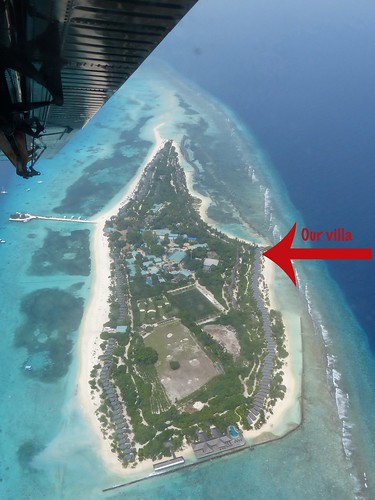
View from the seaplane.
Untitled

Unloading at our island.
Untitled

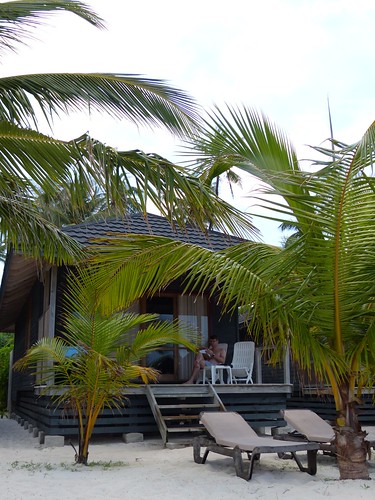
And now I’ll stop whining and start gushing … this place was fabulous! We came here at the recommendation of my brother and his wife, who vacationed on this island last year. Kuredu Resort has the whole island to itself. For six glorious days, Tony and I were living large in a beachfront villa overlooking the Indian Ocean. See?
ourvilla

Untitled

By the time we arrived and checked in, we barely had time for dinner before crashing for the night.

Monday, March 25
A compulsory informational meeting gobbled up much of our morning. We bought a power adaptor, signed up for a few excursions, and did a little exploring around the island.

At 2:30, we joined about 12 others for a snorkeling boat trip. Our guide, Greg, was from South Africa, but we and he were the only native English speakers. His onboard presentation about the snorkeling site was quite funny as he tried to make himself understood. Surely the Europeans spoke enough English to get the gist, but he kept miming ridiculous concepts like “brain coral.” Our favorite line was when he asked, “How do you say snorkel in German?” The Germans replied in unison: “Schnorkel.” Ha! Now Tony and I cannot stop saying, “Do you vant to schnorkel?”

Untitled

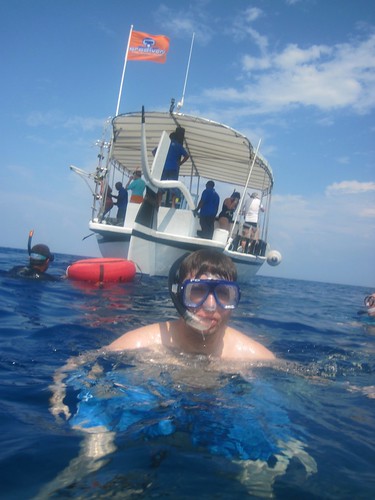
Oh, snorkeling was super fun. We swam around two different sites teeming with fish and took a few mostly lame photos with a borrowed underwater camera.

Untitled

Untitled

Untitled

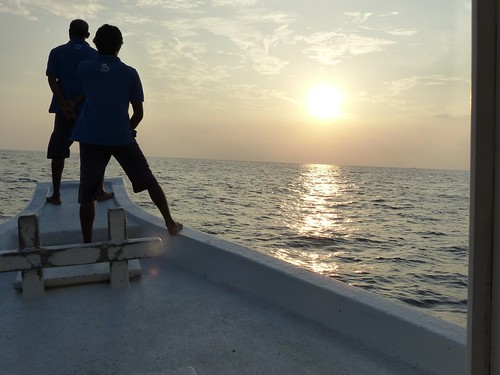
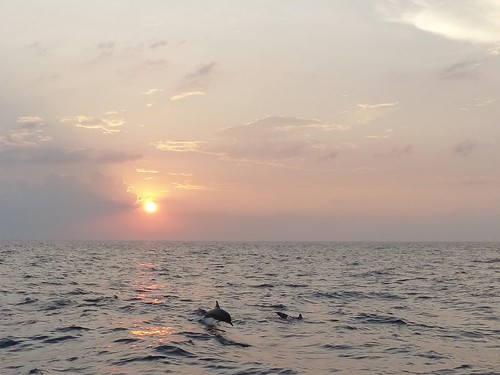
That evening, we were back on a boat for the complimentary sunset cruise. About 30 people sat stiffly on the benches of a dive boat, and I was beginning to wonder whether this was really worth our time. After motoring around for half an hour, the crew began shouting and clapping. Dolphins! They seemed to respond to the cheers, swimming right alongside our boat and leaping into the air. One baby dolphin repeatedly jumped out of the water and spun around like a corkscrew. Their playful demonstration had us all laughing and cheering. One of the crewmen pulled me to the front of the boat, so I sat on the deck with one foot in the water, getting soaked by the waves but loving every moment.

Untitled

The boat crew looks for dolphins.
Untitled

Jackpot!
Untitled

Untitled

Tuesday, March 26
My favorite way to start the day here was sitting on this porch bed with a strong cup of coffee (Nespresso machine in our villa!), cherishing the salty air, rolling surf, gentle breezes clicking the palm fronds together, and the sea’s gradual transition from clear cerulean at the shore to turquoise to jade and ultimately nearly black as it drops off the horizon.
Untitled

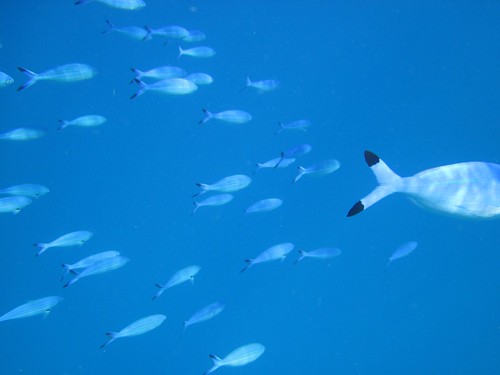
But enough with the poetic ruminations… there was no time to sit around trying to name the exact color of the water. I decided I wanted to walk the perimeter of the island today, so that’s what we did. Kuredu is part of the Lhaviyani Atoll, created gajillions of years ago when a volcano erupted. The volcano’s crater now forms the center of the atoll – a relatively shallow and calm lagoon with sloping reefs – ringed by small islands. That means one side of Kuredu faces the atoll’s interior, while the other side faces the open sea. Our walk revealed interesting differences on the two sides of the island – coarser sand, broken coral, crashing waves, and refreshing winds on the Indian Ocean-facing side (where our villa was located) and babypowder sand with gently lapping waves and no breeze on the interior-facing side. At one point, we peeled off our cover-ups and left them inside my sunhat on the sand while we walked, waded and eventually swam from a long skinny sandbar cutting through perfectly clear water. The strong current seemed to deter most fish, but we did see a small black-tipped reef shark. It felt like a Disney moment. You know that blue water in the Splash Mountain log ride? This water was THAT blue. How is that possible?

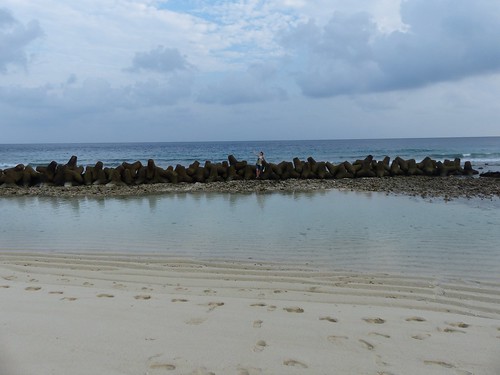
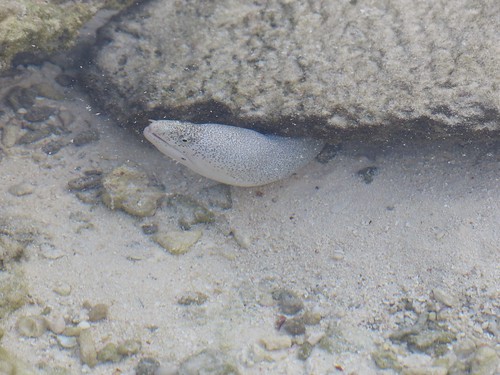
By the time we fully circumnavigated the island, we were exhausted. After a nap, a dip in the pool, a quick snorkel outside our villa, lunch, a visit to one of the wifi hotspots (which was not so “hot” of a spot as it lost power after a few minutes), we decided to go for another swim in the pool created by concrete pylons a short distance offshore in front of our villa. However, the low tide left little water for swimming. Instead, we donned a scuba mask, sat on the sandy bottom and bent over the rocks and dead coral to observe the tidepool ecosystem. Tiny technicolor fish, hermit crabs, eels and sea slugs seemed unconcerned about the receding tide. I guess they knew it would be back again soon.

Low tide. That’s me standing out by the concrete pylons.
Untitled

Untitled

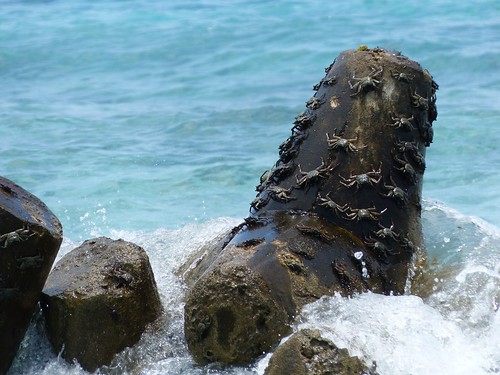
High tide. Hundreds of crabs crawl onto the pylons and hang on for dear life.
Untitled

Untitled

With set meal times at one of the three restaurants, we built our day around food, and then – like the street cows of New Delhi – we paraded en masse to the next feeding. Breakfast and lunch featured standard buffet fare, but the dinners raised the bar with culinary themes. Tonight’s “Arabian” seafood kebabs ranked among my favorite meals in recent memory.

The “O Resort” restaurant.
Untitled

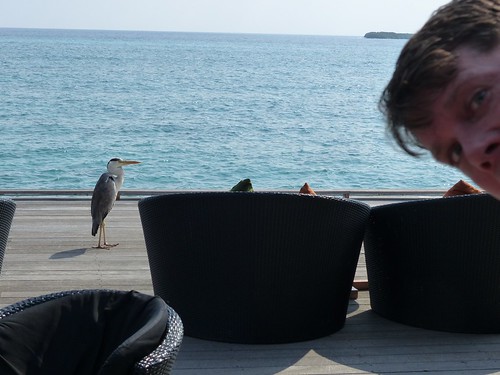
Tony photobombing my pic of this cool bird.
Untitled

Wednesday, March 27
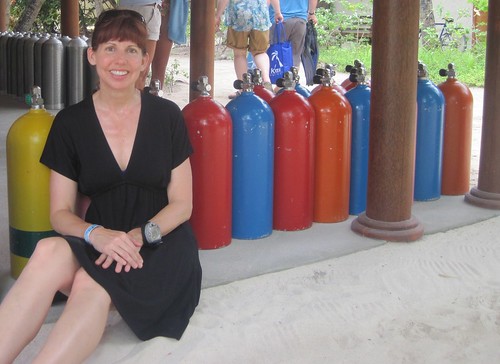
Because we hadn’t gone scuba diving in two years, we decided to refresh our skills with a scuba orientation class. Our instructor, Sebastjan, introduced us to the Prodivers dive center and the island’s “house reef,” a vibrant coral reef literally a short jump off the end of the jetty. It was our first time diving in water warm enough to ditch the wetsuit. (around 30C; 86F. Perfect!) We carried all our gear to the end of the pier (except for the tanks which arrived via wheelbarrow). I had a little trouble with a hissing inflator on my vest, so Sebastjan had to run back to the dive shop and switch it out for a new one. Once in the water, we went over a few basic skills: flooding and clearing your mask (I am an EXPERT at this because my upside-down-lightbulb-shaped face makes every mask leak…), losing your regulator (the oxygen source), and running out of air and using your dive buddy’s “octopus” (the extra regulator everyone carries).

Getting ready to dive. A man cut in front of me to steal the pink tank, but I got a funky orange one. Why does that matter? I don’t know, but it does.

Untitled

After ensuring we knew the basics, Sebastjan led us on an hourlong dive. We cruised along next to a nice coral reef and visited a boat wreck. Highlights: a sea turtle, puffer fish, a school of about 20 huge translucent orange-and-white angel fish, tons of geeky looking pointy-nosed unicorn fish, and zillions of colors darting in and out of the coral. One of the most amazing experiences on earth has to be floating silently into a huge crowd of ambivalent rainbow fish who make space but otherwise ignore your presence.

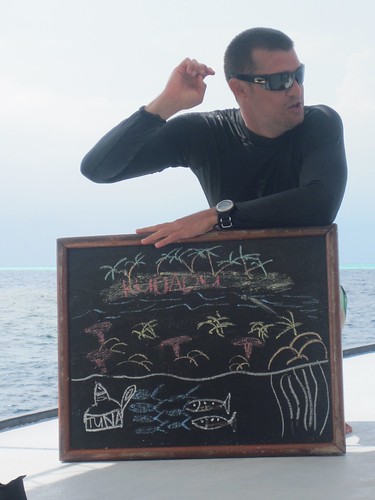
We loved this dive so much that we signed up for an afternoon boat ride to another dive site: Tinga Giri. It took just 10 minutes to get there, and it was such a treat not to wrestle into a wetsuit on a rocking boat. We just attached our BCDs to our tanks, slipped on our fins and masks and jumped in. This was another gorgeous coral reef with brilliant diversity. At one point, a huge tuna swam by. I thought it was a dolphin at first and I nearly hyperventilated with joy.

I had borrowed a mask from the dive shop to testdrive it before buying, and it worked beautifully! Sucked right on to my mutant face and didn’t leak a bit. It fogged up repeatedly, though, so good thing I’m a pro at taking off and cleaning my mask underwater. Later, we got some great tips from the divemasters: coat your mask with toothpaste overnight and don’t wear any sunscreen on your face. What?! I didn’t try the toothpaste, but the sunscreen advice made a huge difference. Who knew creams caused mask fog? Geez.

Thursday, March 28
Lazy breakfast.
Eventually, we headed to the dive shop to rent snorkel gear, and I turned in my borrowed mask and bought a new one. We walked out to the pier and hopped in the water for a snorkel on the house reef. My new mask leaked like crazy! So frustrating. It was the same exact model as the one that worked so well yesterday. I tried adjusting the straps a million times. If I let it fill about half way, I could still sort of see. Aaarrgghhh!

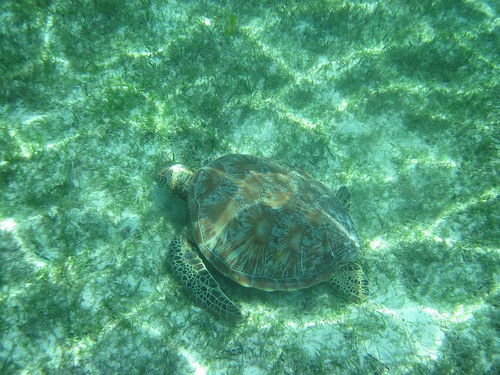
We did spot a turtle munching grass on the sea floor. She swam right at my face when she came up for air; I actually had to move out of her way.

Untitled

Untitled

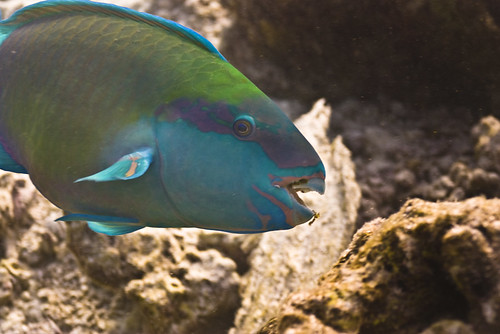
Back in the room, we rinsed the mask and discovered it had a piece of plastic missing, which caused the leak. After lunch, we took the leaky mask back to the shop, and they exchanged it for a new one. We repeated our morning snorkel with much more success in the mask department. Overall today we saw three sea turtles (although Tony thinks the one I spotted was the same one we had seen earlier). Several massive buck-toothed parrotfish chewing on the coral kind of freaked me out, but like all the other intimidating sealife, they left us well enough alone. (Photo from cruisemaldives.travel.)

parrotfish

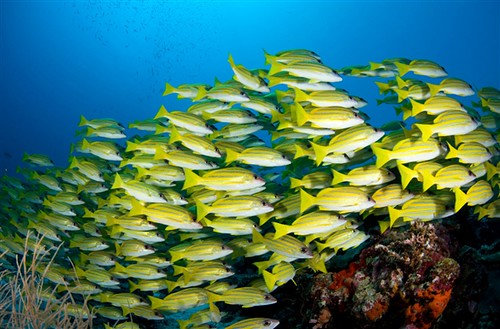
Another ubiquitous underwater attraction is the schooling of hundreds of fish into a blob that appears, from a distance, to be one enormous sea creature. I was fooled more than once, and believe me your stomach flips over when that happens.
We saw schools like this one many times. (Photo from US News Travel.)

yellow_school_of_fish

Friday, March 29
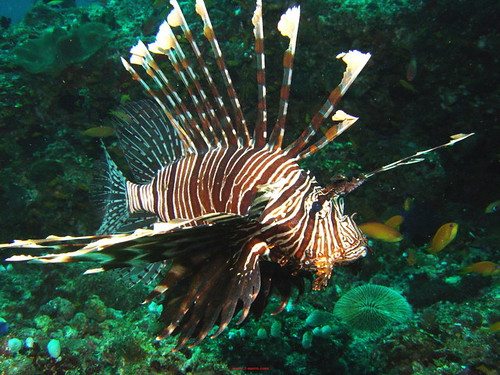
We snorkeled the house reef again and saw a huge turtle! Tony chased a ginormous black fish – a grouper, maybe? – which kept just out of reach with a quick flick of its tail. We also found three lionfishes like this one in a little coral cave. (Photo from Travel For Passion website.) Pretty, but venomous, so we didn’t linger.

LionFish (1)

While I’m a strictly stick-to-the-surface snorkeler, Tony bravely held his breath and dove to explore the depths, including the tip of the boat wreck.
Untitled

Later, we walked out to the barely visible sandbar at high tide. It was obvious how the sandbar was formed; waves crashed onto it from both sides. We struggled to stay upright, unstable on the soft sand with the surf pounding our shins, but we looked rather Biblical, as if we were walking on water. After trudging quite a ways out into the sea, we wondered whether the sandbar ever disappeared completely when the tide got very high. Just in case, we quickly paddle-sprinted back to shore.

For our last dinner at Kuredu, our waiter, Shareef, had set a fancy table for us with flowers and sand stencils of a turtle, dolphin and letters spelling out “See you soon.”
Bittersweet.
Untitled

Windy evening.
Untitled

Every night after dinner, we sat outside at the seaside bar, sipping drinks and staring at the underwater floodlights for passing sharks and big fish. Night after night, we watched between one and four large fish circle one of the lights repeatedly, hypnotically, breaking stride only when a reef shark or another unwelcome visitor approached.

Saturday, March 30
We were sad to say good-bye to our utopian island, but it was time for the long journey home. Even though Spice Jet tricked us with its pretend “direct flight,” we have to give them kudos for being on time or early each leg of the trip. We left Kuredu around 11 a.m. and got home shortly after midnight.

Have I piqued your interest in the Maldives? Check out the Visit Maldives website for more facts, photos and awesomeness.

I’m still Shazza from the Block

Couldn’t help it.
J-Lo circa 2002.
I think of that song every time I visit C-Block Market, the place for one-stop shopping in my ‘hood.

It’s not much to look at. Quite disgusting, actually. Blobs of sputum dot the path. Dingy concrete buildings with uninviting storefronts. Seedy looking youths at the liquor store’s take-away window. Bored men loitering by their motorbikes.

Untitled

Yet, almost every time I visit this place, I find something new, encounter a friendly face and/or have an “only in Delhi” experience.

Top 10 places in C-Block Market and why I love them:

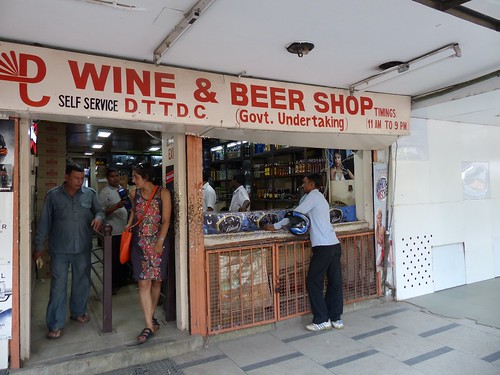
#10 – Liquor Store – You can’t swing a dead cat in Michigan without hitting a “Party Store” replete with beer kegs, 93 types of vodka, mixers galore and chipper clerks with helpful tips. I’m sad to report that is not the case in my ‘hood. If you get invited to a dinner party, or say, plan to watch 7 episodes in a row of Modern Family on Hulu, you will not easily find a place to meet your alcoholic beverage needs. This shop is not ideal. It’s staffed by surly men who clearly have strong feelings about women shopping for booze. There’s no air conditioning, so the wine is kept tepid at best and near boiling at worst. And unlike every other shop in this market, they don’t deliver. But beggars can’t be choosers.

Untitled

#9 – The Pet Food Shop – Tony and I have been thinking about expanding our family. The topic comes up a lot, but we just can’t commit. We still miss Ketta, our psychotic yet loveable cat, who died about 10 years ago. Now a friend’s cat is pregnant, and it looks like a kitten or two may be in the cards. So it’s nice to know this friendly little shop sells cat food, kitty litter and toys.

Untitled

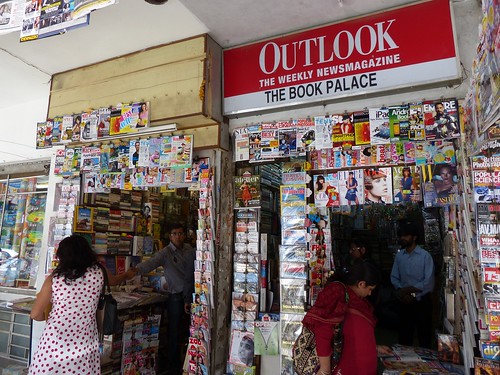
#8 – The Book Palace – No bigger than a walk-in closet, this shop stocks stacks of English-language bestsellers and classics. I recently read Sweet Tooth by Ian McKewan on my Kindle and wanted an actual BOOK to contribute to my lending library/book club. The shopkeeper said he didn’t have it in stock, but he promised to find it. The next day, he delivered it to my house!

Untitled

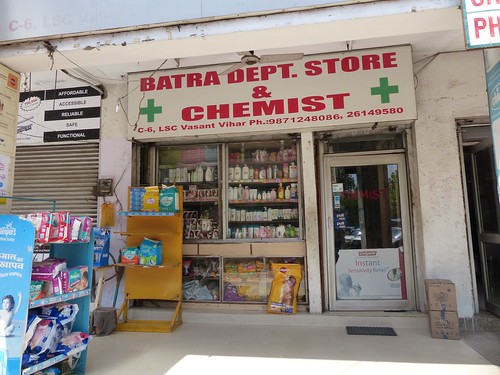
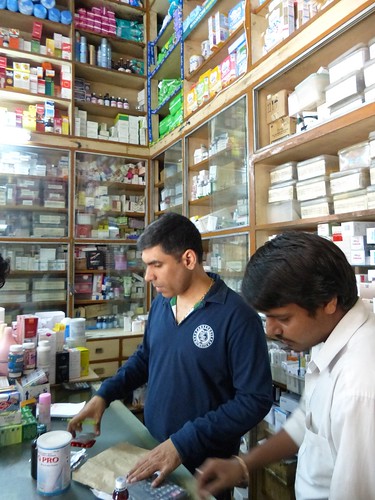
#7 – Batra Pharmacy – One hundred 5mg pills of Ambien for $5. Need I say more?

Untitled

Untitled

#6 – Sheviks Toys – When I need a birthday, Christmas or Diwali present for the little ones in my life, I head straight to this shop. From Legos to Bedazzlers, from The Very Hungry Caterpillar to Harry Potter, they have it all. Oh, and there’s a drycleaner in the back. Recently, I popped in to the toy store with my friend, Nancy, who tricked me into picking a belated birthday present for myself, one of the coolest presents EVER: Indian Barbie. Isn’t she beautiful?!
Untitled

Untitled

#5 – Electrician – Tucked in a side alley, the electrician sits in a tiny nook, leaning on his windowsill. All his wares lie within reach of his wobbly chair. One time, a power surge burned out one of our heavy-duty power strips, which caught on fire and melted. Seeking a replacement, I took it to the electrician and said, “I want a new one just like this.” He picked it up, studied it, set it down and said, “No new. I can fix.” I laughed, “It’s MELTED.” But no, he insisted and told me to come back in 15 minutes. I did, and sure enough, he fixed it.

Untitled

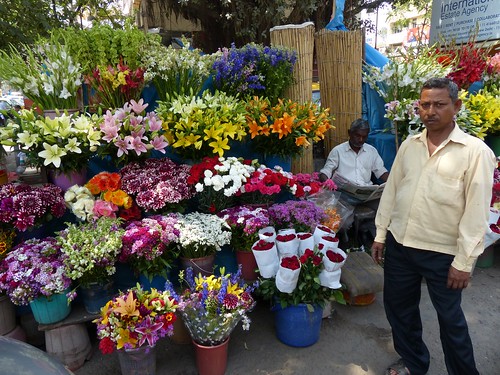
#4 – Flower Vendors – You have to get here early or the poor flowers wilt in Delhi’s heat. A huge bouquet that takes two hands to carry will run you about 400 Rupees, or $8.

Untitled

#3 – Golden Dragon Chinese Restaurant – Lotus Stem Honey Chilly Crispy Spinach appetizer. Yum! Plus, it triggers nostalgia for our Shanghai years with menu items like “Troublesome Chicken” and “Pork Globules.”

Untitled

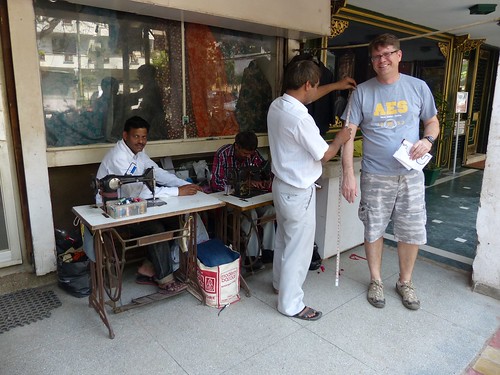
#2 – Sidewalk Tailor – You know how you hold on to clothes that need to be mended, no longer fit or look outdated? I had a whole stash of such things in the back of a closet until last weekend. I finally tossed them all in a bag and headed over to a tailor’s shop recommended by my friend, Mary Catherine. By “tailor,” she clearly meant “guy who sits at a sewing machine on the sidewalk,” and by “shop,” she obviously meant “not a shop.” So the guy went right to work while I stood there, taking in a hem here, replacing overstretched elastic there, cutting a few inches off the bottom of a dress. Then I posed the big challenge. I had bought a cute halter-top maxi dress for our upcoming beach vacation, but the back was too low-cut for a bra. “Can you insert some bra cups?” I asked. “Can do,” he responded, digging through a cardboard box of notions. Lace, elastic, buttons… no bra cups. “Other shop have,” he said. “Finish tomorrow.” Then he nervously spread the halter top over the palm of his hand and cautiously checked out my chest. “Oh, do you want me to try it on?” I asked. He nodded. I held the dress up to me and tied the halter around my neck, pulling the top taut over my T-shirt. This was attracting an audience. Next thing I knew, in front of God and all creation, he reached over and chalked my nipples. Had to be done, I know. And to be honest, it didn’t even seem that weird. Have I been in Asia too long? (Update: The bra cups – and the other alterations – worked out perfectly, all for the shocking price of $6!) Today I took Tony to the tailor to get sleeves cut off one of his dress shirts – done in 15 minutes for $2.

Untitled

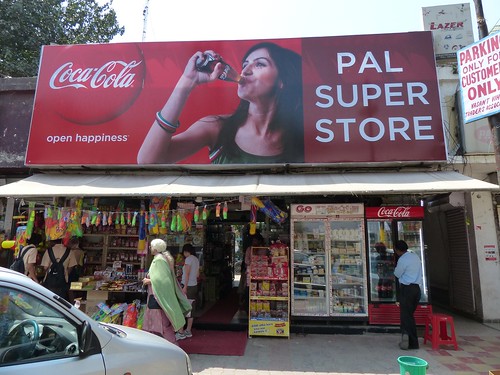
#1 – Pal Superstore – One word: cheese. And lots of it. All different kinds. About a fourth the size of a 7-11 in the States, this “superstore” is crammed full of goodies to meet our Western cravings. In addition to the cheese smorgasbord, it sells everything from cookies to cranberry juice, Pop Tarts to Perrier, Tostitos to toiletries. The other day, I stopped by to get some Clean and Clear Foaming Face Wash. The clerk found one remaining bottle, hidden behind 17 other brands of face wash. He dug it out and discovered the top had flipped open. He tried to snap it closed. No luck. He smacked it against the wall, but the top popped open again. This got the attention of two other men who may or may not actually work there. One grabbed the bottle, unscrewed the top and made a big show of blowing on it. When that didn’t work, the other guy snatched the bottle and dramatically pressed on the top with both thumbs to no avail. Finally, he gestured to me as though asking, “Shall I ring it up then?” Ummm… I’ll say no to six dirty hands and some spittle on my face wash, thank you very much. But I will take this cheese.

Untitled

Untitled

So, sing it with me, J-Lo fans:
Don’t be fooled by the rocks that I got
I’m still, I’m still Shazza* from the block
Used to have a little, now I have a lot
No matter where I go, I know where I came from.

* Shazza is my nickname bestowed by BFFs in Shanghai. Sounds way more hip than “Sharon from the block,” don’tcha think?

Cue the cows … and … action! Mom and Dad see REAL India

India kindly handed my parents a genuine slice of life during their two-week visit.

Untitled

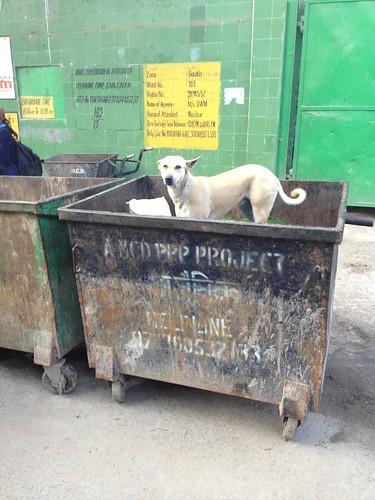
Their taste of New Delhi’s daily grind included: pollution in the “red zone,” several power outages, taps running dry, driver had a row with his wife and didn’t show up to take us to work, housekeeper/cook took a day off for her uncle’s funeral, car broke down, dogs in the dumpsters, cows in the road, street kids tapping on the car windows at stoplights, and oh so many more sights, sounds and smells that keep our anxiety levels higher than healthy.

Untitled

Untitled

But set aside your disgust and frustration, and you see another side of India that sparks appreciation, or at least fascination. My parents also experienced:

The costumes, arts, crafts and music from the state of Karnataka (as well as the exuberance of school kids) at the annual Surajkund Mela.

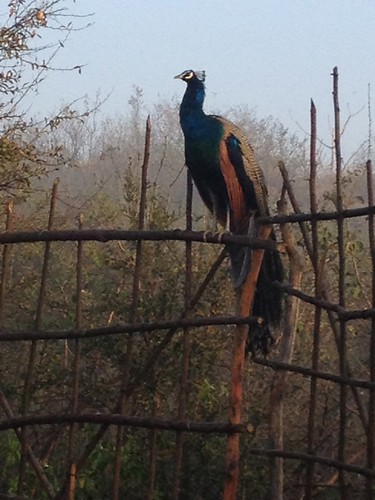
The get-away-from-it-all Aravalli Biodiversity Park‘s twisting path through scrubby acacia trees and wild peacocks, just around the corner from our house.

Untitled

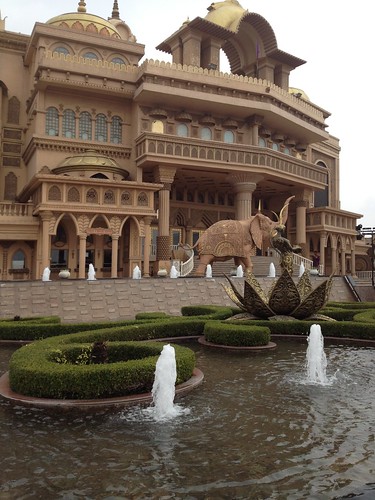
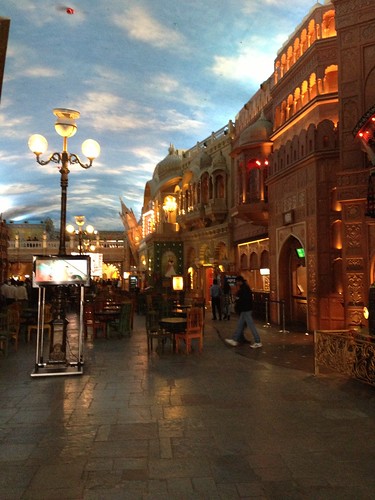
The drumming, the dancing, the sequins of the over-the-top Epcot-esque venue and Bollywood stage show at Kingdom of Dreams.

Untitled

Untitled

Untitled

Untitled

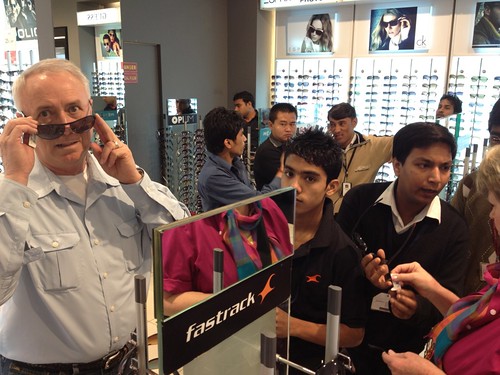
The levity and intensity of eight Indian men desperately trying to pick out sunglasses for Dad at Ambience Mall.

Untitled

The sneeze-inducing spice market, technicolor sari shops and gilded, spangly, tassled wedding accessories during a death-defying rollicking bicycle rickshaw ride through Old Delhi’s congested alleys.

The comfort zone of mini-America at our school and the American Embassy restaurant.

Untitled

Untitled

Untitled

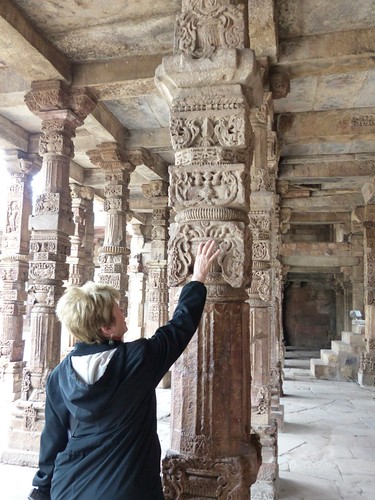
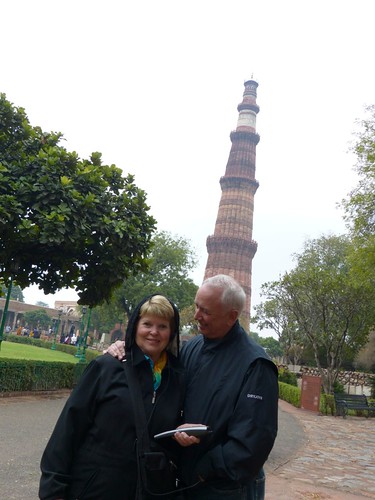
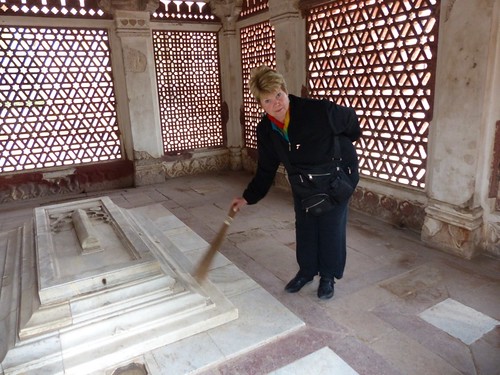
The time-travelling trip to the Mughal Dynasty in Agra (Taj Mahal, Agra Fort, Fatepur Sikri) and Delhi’s Qutub Minar.

Untitled

Untitled

Untitled

Untitled

Untitled

Untitled

Untitled

The saris, the chaos, the smiles, the 10-minute alterations on vintage sewing machines at the local Sarojini Market.

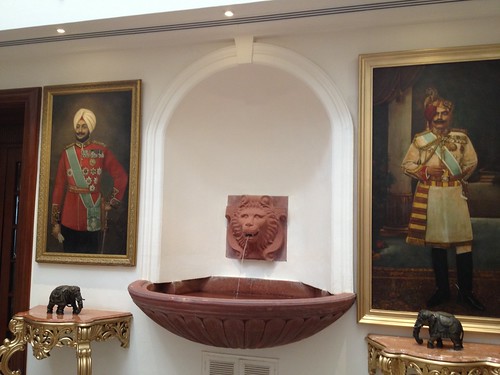
The posh indulgence of a proper breakfast at the Imperial Hotel – twice.

Untitled

Untitled

Untitled

Untitled

The relative peace – not counting slum drumming, the high-pitched drone of construction equipment, and bellows of strolling cows – in our leafy Vasant Vihar neighborhood, with help from lovely Raji.

Untitled

Untitled

Poor Dad came down with the flu, or a cold, or pollution-related respiratory problems, poor guy. But overall, we had a great time! Tony and I enjoyed sharing the ups and downs (and fast curves and U-turns) of life in this place! We wanted to show them what we love about Delhi, but ultimately, they saw it all – the stunning and the heart-breaking. Because, really, there’s no other way to experience India.

(The iPhoto slideshows are a bit lame, I admit. I’m looking for a way to easily link photos from Flickr to make slideshows visible on Apple devices… in the meantime, you can check out the photos at my flickr photostream.)

Wedding Friday

Our wonderful week of wedding festivities flew by, and I found myself consumed by work and other obligations before I had finished blogging about the wedding day itself. So here goes.

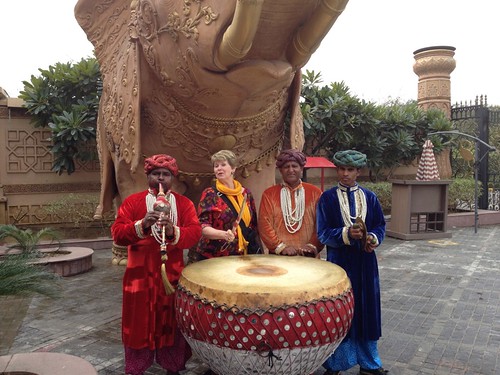
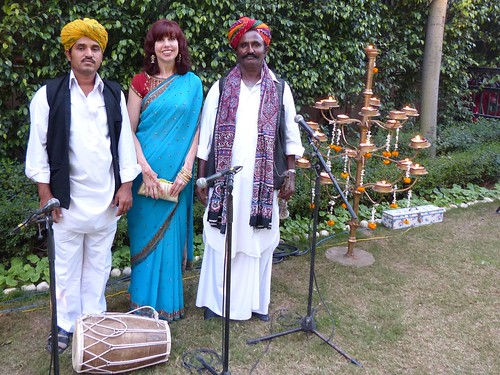
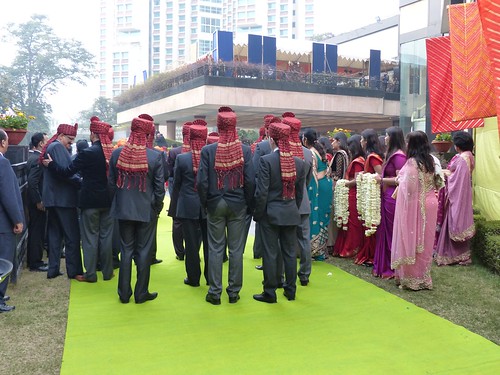
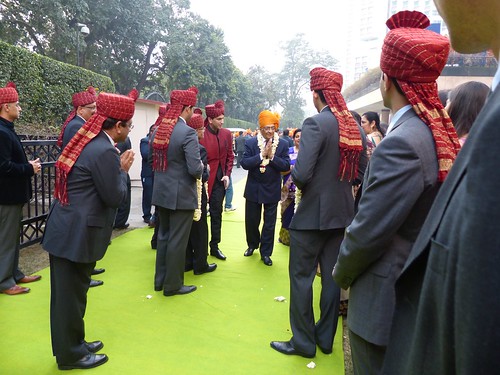
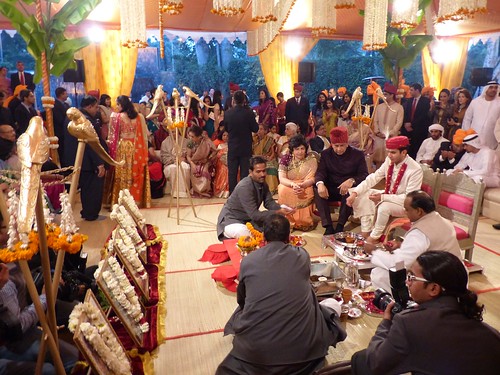
Sanna and Madhavkrishna tied the knot at the Shangri La Hotel on Thursday, Jan. 31. Tony and I arrived on time, having missed ceremonies and performances Monday and Wednesday in our attempt to be fashionably late. At the hotel, we were directed to follow the lime green carpet to a spot where Sanaa’s family lingered excitedly. They encouraged us to stand with them to receive the “baraat.” The entrance to the venue featured musicians playing a drum (called a dhol) and an auspicious traditional oboe (called a shehnai).

Posing with the musicians in my borrowed sari.
Untitled

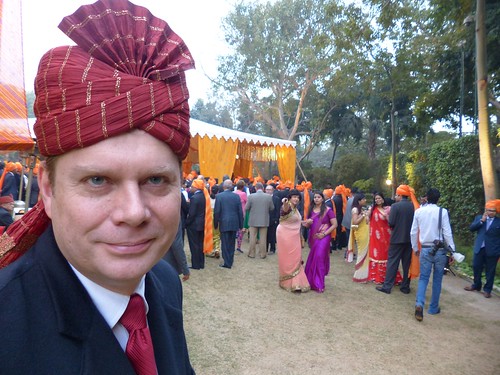
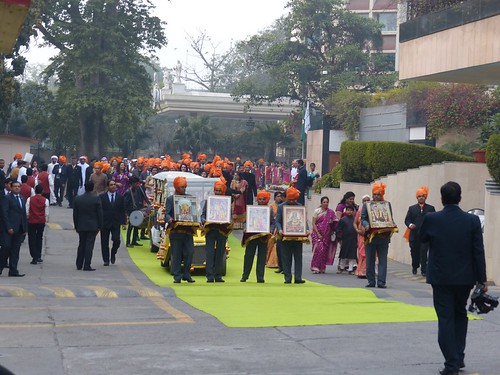
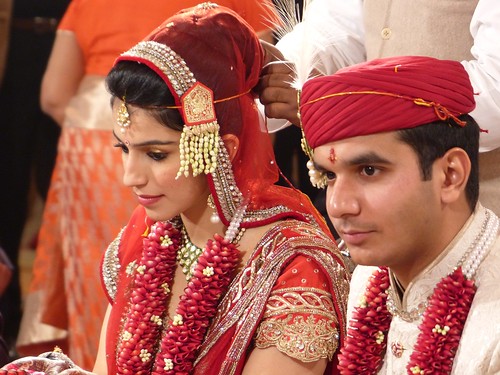
The baraat is a procession that brings the groom to the wedding venue. We’ve seen many of these processions around Delhi, often with the groom riding a white mare and accompanied by drummers and dancers. In this case, the groom arrived in a golf cart, preceded by a row of men carrying paintings of Hindu gods, and surrounded by revelers. His close male friends and family members sported bright orange turbans, while those on the bride’s side wore burgundy turbans. We later found out the turbans were a sign of honor, so we were touched that Sanaa’s brother, Karan, placed one on Tony’s head.

Untitled

Untitled

Untitled

When the baraat arrived, we watched Sanaa’s parents greet Madhav’s parents and other relatives ceremoniously with garlands.

Untitled

Untitled

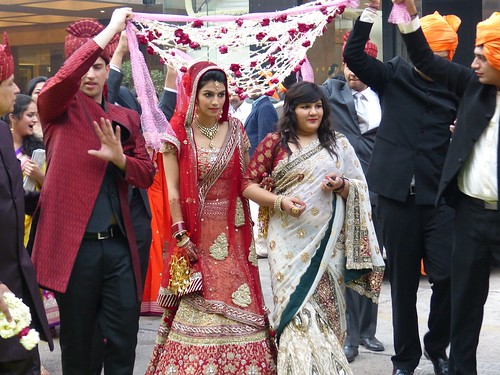
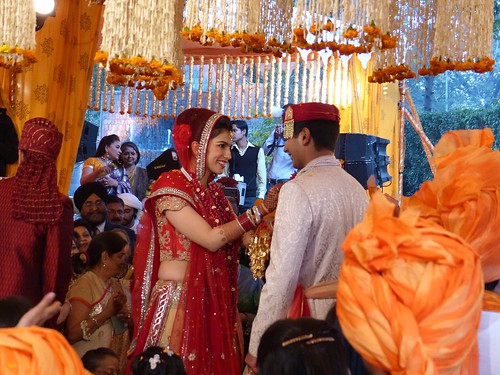
After all the groom’s guests had proceeded to the huge tent, the bride’s mother Alka started looking anxious. She craned her neck to see the hotel’s entrance, and then told us it was time for Sanaa to make her entrance. Finally, she emerged under a veil of flowers, flanked by her brother on one side and a girlfriend on the other. They walked her to a stage in the tent, where she and Madhav exchanged garlands.

Untitled

Untitled

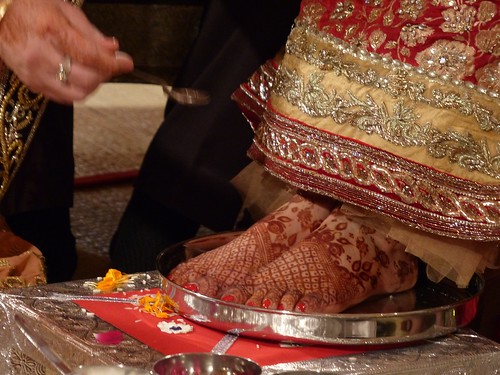
Researching the rituals of an Indian wedding is like trying to categorize India itself. The answers only lead to more questions. Hindus from different regions celebrate in different ways. At one point, even Sanaa’s brother couldn’t tell me what was going on. Sanaa’s parents sat with Madhav for quite a long time, following the priest’s directions, which included sprinkling various things on the groom’s hands and feet. I snapped a few photos, but I had no idea what I was shooting. After awhile, Sanaa was escorted over to join them, and a number of other rituals took place, some involving her beautifully hennaed feet.

Untitled

Untitled

Next, they performed “pheras,” circling a pious fire seven times. According to Wikipedia (which aligned with several Indian culture websites but with better English):

1. In the first round or phera, the couple prays to God for plenty of nourishing and pure food. They pray to God to let them walk together so that they will get food.
2. In the second round, the couple prays to God for a healthy and prosperous life. They ask for the physical, spiritual and mental health from God.
3. In the third phera the couple prays to God for wealth. They ask God for the strength for both of them so that they can share the happiness and pain together. Also, they pray so that they can walk together to get wealth.
4. In the fourth round the couple prays to God for the increase in love and respect for each other and their respective families.
5. The bride and groom together pray for the beautiful, heroic and noble children from God in the fifth step.
6. In the sixth holy round around the fire, the couple asks for the peaceful long life with each other.
7. In the final seventh round the couple prays to god for companionship, togetherness, loyalty and understanding between themselves. They ask God to make them friends and give the maturity to carry out the friendship for lifetime. The husband says to his new wife that now they have become friends and they will not break their friendship in life.

Untitled

Congratulating the proud papa.
Untitled

Jasmine and marigolds everywhere!
Untitled

Untitled

We left after the three-hour ceremony but before the dinner. (It was a school night!) Tony and I both feel deeply honored and grateful for the opportunity to participate in this gorgeous cultural experience, and we wish a lifetime of happiness to Sanaa and Madhav.

Sangeet Wednesday

If we felt confused about the mehendi party on Monday, this day was no different. The invitation said “Sangeet” and the bride’s mother had explained that it was the engagement party. An engagement party the day before the wedding? Clearly more research was needed. A google search yielded heaps of conflicting information, so once again it was trial by fire. In retrospect, this wedding planner’s website offers a Sangeet description similar to the one we attended Wednesday for Sanaa and Madhavkrishna. Bottom line: the Sangeet is a big party.

Untitled

Indians are not known for their punctuality. Apparently, members of the wedding party don’t know that. Tony and I didn’t want to be the only ones at the Sangeet, so we arrived at the Shangri-La Hotel ballroom about an hour late, unfortunately missing the ceremony. (Who knew there was going to be a ceremony?) We were told the bride, Sanaa, sang and danced, and other family members performed skits. Dang it! We got there in time to see Sreeram, winner of Indian Idol’s 5th season, though. He seemed disappointed at the empty dance floor. (I didn’t find out till later he was so famous, or I would have taken more photos.)
Untitled

Untitled

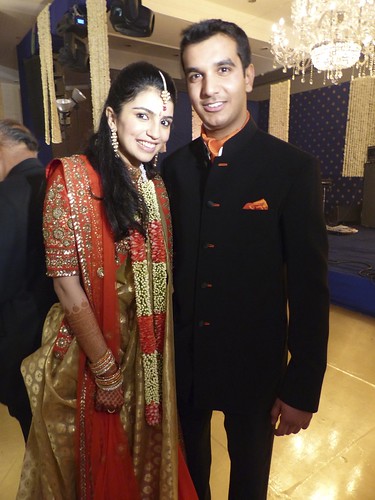
We greeted Sanaa and Madhu. I felt like a fluttery nervous schoolgirl in the presence of a princess.
Untitled

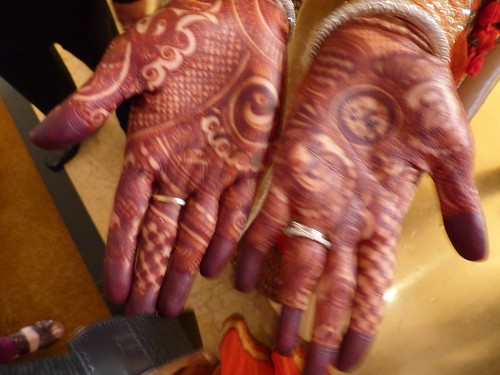
I asked to see Sanaa’s mehendi, and she pointed out her fiance’s name painted on one hand and his initial “M” hidden in the henna swirls of the other hand. The groom-to-be is supposed to search for his hidden name in a romantic little game. This photo is blurry because the bossy handlers were rushing me.
Untitled

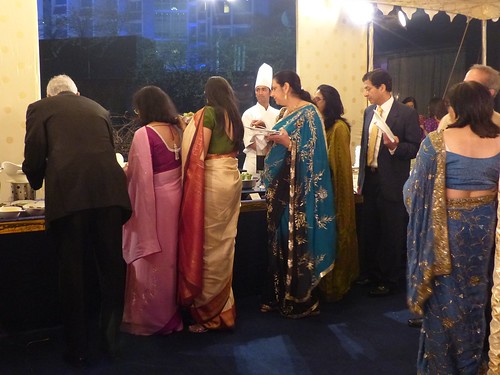
After mingling a bit, we followed the crowd to a large veranda, where dinner was being served. I couldn’t take my eyes off everyone’s clothes long enough to eat anything.
Untitled

Untitled

Untitled

Untitled

Untitled

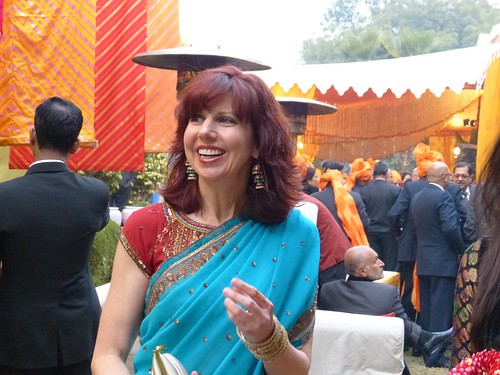
With help from friends, I dressed more appropriately for the Sangeet, borrowing this gorgeous anarkali from Nancy, the gold shawl from Deepa, and the purse from Katrina.
Untitled

Mehendi Monday

As we wrap up a week of wedding festivities, I hardly know how to start writing about it. Like everything in India, the events were hard to process at the time.

Our landlord, Ashwani, and his wife, Alka, live downstairs with their daughter, Sanaa. Sanaa completed a master’s degree in England last year, returned to work in Delhi and recently announced her plans to marry childhood friend, Madhavkrishna. The proud parents invited us to three of the celebrations: Mehendi on Monday, Sangeet on Wednesday, and the wedding ceremony on Thursday. This was our first wedding in India, so we had absolutely no idea what to expect.

Workers draped the entire house in lights, and enclosed the courtyard with orange and gold fabric, woven to create a roof and walls. Garlands of marigolds and jasmine adorned the courtyard and stairwell.
Untitled

Last week, I had a quick chat with Alka, mother of the bride. I was feeling anxious about what to wear to these events, and Alka calmly assured me that whatever I wore would be fine. (Note to all Indian women: You do foreigners a big disservice by acting so nonchalant about such things. Please, I beg you, give us explicit instructions about how to comply with your cultural norms.)

Alka told me a “suit” would be appropriate for Monday’s mehendi party. “Suit” does not imply an Ally McBeal mini-skirt and jacket, as it did in the States back in the days I actually wore business suits. In India, a suit is a long top with blousy pants. This outfit ranges from relatively casual embroidered cotton to flowy embellished chiffon. With that in mind, I planned to wear my gray silk kurta (long top) and mauve choridar (tight-legged pants that gather at the ankle). Fortunately, I sought advice one more time from a cousin visiting from the States for the wedding. “It’ll be pretty fancy,” she said.

Panic set in. Right after school, I dashed off to Sarojini Market and popped in to a tiny dress shop. The salesclerk plopped one kurta after another on the counter, but my brain froze. I didn’t even know what to ask for. Finally I blurted, “I’m going to a mehendi party TONIGHT!” He swept all the kurtas off the counter and said, “Come in.” At the back of the shop, he started pulling packages off the shelves, whipping the brightly-colored garments out of the plastic and piling them in front of me. “This is the latest fashion,” he said. I picked one, tried it on over my dress, and realized it needed a little altering.

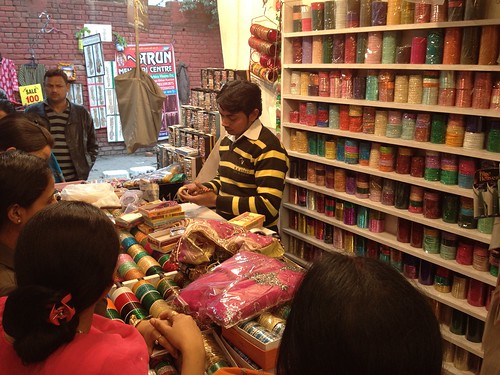
“Ten minutes,” the shopkeeper said. He then walked me around the corner to a bangle shop, which was packed with ladies. The bangle man stood behind a glass display case, surrounded by thousands of bangles in every size, color and degree of bling. Each lady in turn placed an item of clothing on the counter, and he quickly darted around his tiny space, pulling bracelets off the shelves and yelling requests to a worker in a storage space upstairs, who lowered bags of bangles through a hole in the awning. The banglemeister shuffled the delicate bracelets like cards, masterfully color-coordinating and arranging them on a wooden dowel, which he then held up to the light to dazzle the customer. I waited about 30 minutes for my turn. In the meantime, Tony had brought my perfectly altered dress (called an “anarkali”), so taking my cue from the Indian ladies, I placed it on the counter. Bangle Man gently felt my hand to determine the size and then flitted about, collecting fuchsia, black, green and gold bangles of varying widths and flashiness. I bought 20 bangles for each arm, which turned out to be excessive, but I couldn’t resist!

Untitled

Tony was an extremely reluctant chaperone on this night because his Indian colleagues at school had told him this was a ladies-only event. In fact, my online research supports their claims. Based on what I read, I was expecting an intimate but lively evening with ladies sprawled out on cushions, offering marriage advice to young Sanaa while classical musicians played in the background and mehendi artists painted henna designs on our hands. However, father-of-the-bride Ashwani explicitly invited Tony to the mehendi party. See why confusion is our constant companion in India?

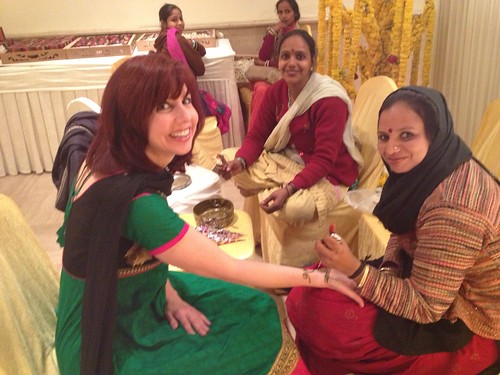
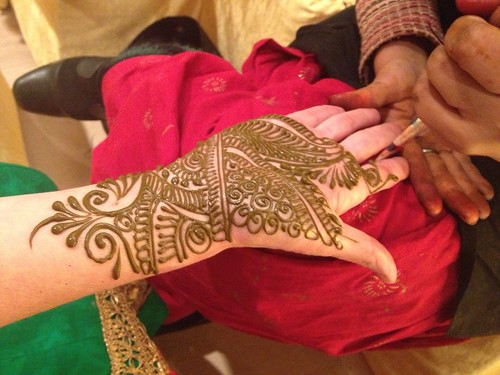
The mehendi party took place at a hotel, and the minute we stepped into the foyer, I knew we were out of our league. Far from intimate, the hotel ballroom filled with more than a hundred guests. My new anarkali felt extremely casual among ladies draped in saris and dripping with jewels. Feeling self-conscious, I quickly left the crowd to get my hands painted. The one fabulous part of my outfit – the glittery bangles – only made a brief appearance, as I had to remove them for mehendi. For most of the night, I walked around with wet henna, unable to hold a glass or eat any of the appetizers. While Tony took advantage of the open bar and omnipresent strolling waiters, I let go of my wardrobe worries and chatted with other guests, trying not to smear the mehendi. Eventually, I brushed off some of the crusty dried henna to sample the snacks and wine, but I learned my lesson. The more experienced wedding-goers explained that I should only get one hand painted next time to free up the other hand for eating and drinking.

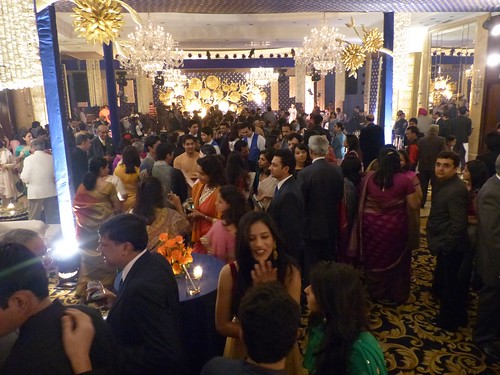
The bride’s brother, Karan, gave a sweet speech about his little sister, and the crowd began to dance.

Tony and I felt humbled by the family’s kindness and inclusive spirit. We never stood alone or felt left out, and we enjoyed interesting conversations with visitors from all over the world, including Denver, San Francisco, Singapore and other cities in India. Shortly before midnight, we said our good-byes.
“You’re not staying for the dinner?” people asked.
We didn’t even realize they were serving dinner! But, no thank you, we told them. It was already way past our bed time on a school night, and we knew it was going to be a long week.

Untitled

Untitled

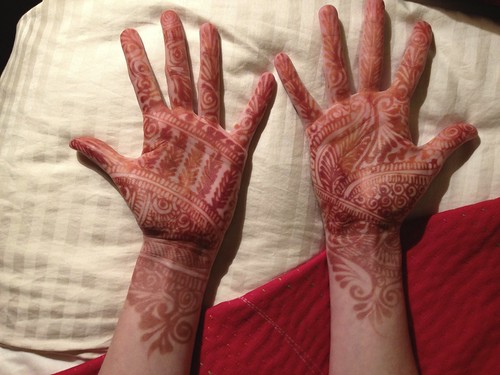
I brushed off the dry mehendi a bit prematurely, and I didn’t coat my hands in oil before going to bed, so the henna design isn’t as vibrant as it otherwise would have been. Still fantastic, though!
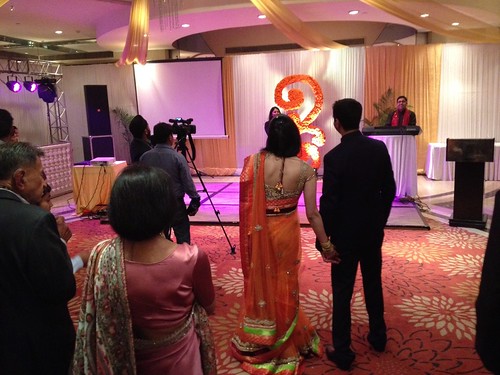
Untitled

This is a bad photo taken with Tony’s phone while I was trying not to mess up my hands, but I wanted to show Sanaa’s beautiful orange sari. She and her groom-to-be were watching the entertainment.
Untitled

Adventures in Teaching and Travel