Sok dee pii mai!

Pii Mai (Lao New Year) is next week, and Vientiane is getting ready. Today our school held an assembly to mark the occasion.

I had noticed Hawaiian luau-style shirts for sale all over town lately, and I just figured they were hot with the tourists. Fortunately, my Lao colleagues set me straight: Flowers play a major role in celebrating Pii Mai (pronounced Pee My), so floral tops are de rigeur.

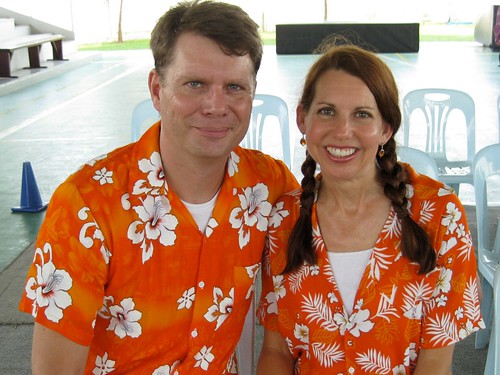
While running some errands on my bike, I stopped at a roadside stand and bought one for about $3.50. The guy looked me over and recommended an XL, but I grabbed a bright orange man’s style in a size large. Later, Tony bought one for himself, but his blue-and-white shirt was a size medium. It was even too small for me! Why, oh why, won’t men try on clothes before buying them? But I digress … At school today, he traded with my friend, Whetu, whose shirt was too big, so he and I both ended up in orange as though we’d planned it.
How cute are we?
IMG_1810

The floral shirts definitely brightened up the school today. I especially loved the little boys who wore matching flowery shorts.

Our assembly included explanations and dramatizations of the Pii Mai traditions, music, a demonstration of water blessings and finally a big circle dance (although the clueless falang turned it into more of a dreamy mosh pit).

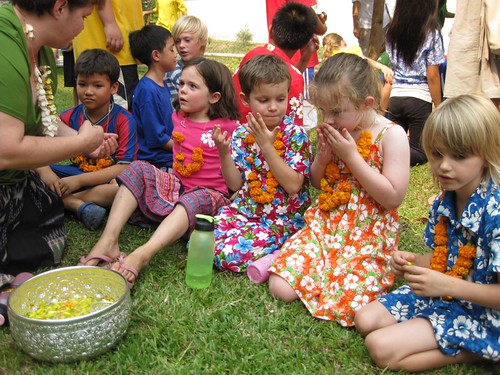
Afterwards, classes met on the lawn, where students blessed their teachers and asked for forgiveness. Isn’t that a fantastic tradition? Children dipped a small cup into a large silver bowl to scoop out some water and flower petals. They poured a little water on their teacher’s hands or neck and said, “Sok dee pii mai!” (Happy New Year!) and offered other good wishes. The teacher then used his or her wet hands to sprinkle some water back on the student. Because I’m not a grade-level teacher, I didn’t have a designated spot, but many of my students called me over to receive their blessing. It was really beautiful. I expected the children to get wild and silly with the water, but they were shockingly respectful.

A few shots from the assembly:

Out on the grass, we all participated in the water blessings.
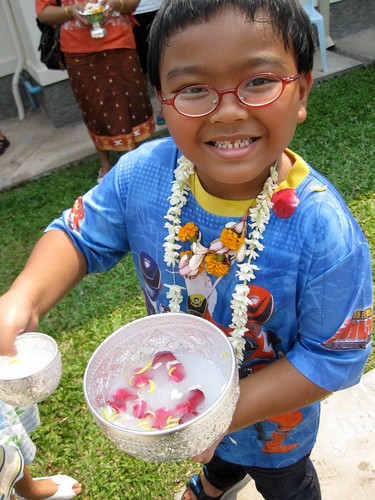
IMG_1817

IMG_1820

Kindy kids

Here are some details about the Pii Mai holiday lifted from Wikipedia. According to our Lao staff, this is pretty accurate:

Water is used for washing homes, Buddha images, monks, and soaking friends and passers-by. Students first respectfully pour water on their elders, then monks for blessings of long life and peace, and last of all they throw water each other. The water is perfumed with flowers or natural perfumes. The idea of watering came from the legend of King Kabinlaphom, whose seven daughters kept his severed head in a cave. The daughters would visit their father’s head every year and perform a ritual to bring happiness and good weather.

Sand is brought to the temple grounds and is made into stupas or mounds, then decorated before being given to the monks as a way of making merit. There are two ways to make the sand stupas. One way is to go to the beach, and the other way is to bring sand to the wat, or pagoda. Sand stupas are decorated with flags, flowers, white lines, and splashed with perfumed water. Sand stupas symbolize the mountain, Phoukao Kailat, where King Kabinlaphom’s head was kept by his seven daughters.

Another way to make merit at this time is to set animals free. The Lao believe that even animals need to be free. The most commonly freed animals are tortoises, fish, crabs, birds, eels, and other small animals.

Flowers are gathered to decorate Buddha images. In the afternoons people collect fresh flowers. Senior monks take the younger monks to a garden filled with flowers, where they pick flowers and bring back to the wat to wash. People who didn’t participate in the flower picking bring baskets to wash the flowers so the flowers can shine with the Buddha statues.

There is an annual beauty pageant in Luang Prabang to crown Miss Bpee Mai Lao (Miss Lao New Year). There are many beauty pageants in Laos, but Luang Prabang – the old capital – is widely known for its Nangsoukhane pageant. There are seven contestants, each one symbolizing one of King Kabinlaphom’s seven daughters.

During Lao New Year, there are many spectacles including traditional Lao music, mor-lam, and ram-wong (circle dancing). During the daytime almost everybody is at the temple worshipping, hoping to have a healthier and happier life in the new year. During the evening, people of all ages go to the wat for entertainment.

Earth Hour in Vientiane

Earth Hour Logo

Earth Hour came to Vientiane for the first time on Saturday, March 27. Our little city was the 92nd one to join the movement, which aims to raise awareness about climate change by promoting one hour without electricity. It wasn’t as dramatic as the footage of Sydney or Shanghai, where global landmarks and big sections of the city suddenly went dark. Still, the event attracted an enthusiastic crowd to the Patuxai Monument, where a stage featured speeches and entertainment under electricity-sucking spotlights. After the countdown, the lights turned off in the vicinity around the monument, and even the stage lights dimmed a bit.

Apparently Laos had wanted to make participation compulsory, but Vientiane’s patchwork power grid precluded the flipping of a switch to cut off all the electricity. Another quirky note: The rest of the world celebrated Earth Hour at 8:30 p.m., but Vientiane decided to do it at 7:00.

Our internet’s been quite unreliable recently (maybe Laos figured out how to impose compulsory limits on THAT…), so I’m a bit late posting this. I finally got it on YouTube this week. Here’s the Vientiane countdown from four.

Bureaucracy and blessings

Getting government approval to operate a business in Laos apparently takes quite a bit of time and savvy finagling. My friend Catherine, an Aussie teacher at VIS, learned that firsthand when she rented space for an art gallery. Hoping to spotlight the work of local artists, she set up her living space upstairs and did some minor remodeling downstairs to create two display areas flooded with natural light.

When her official paperwork finally came through, Catherine shared the news with her landlord, Mr. Boulein, who immediately began planning a baci ceremony. Pronounced “bah-see,” the ceremony is held frequently in Lao communities to commemorate a special event, honor important people, cure sicknesses and celebrate just about anything.

Catherine had hoped to hold the baci on Tuesday, when a friend would be visiting from Australia, but Mr. Boulein explained that April 5 was an auspicious day and therefore the baci couldn’t wait.

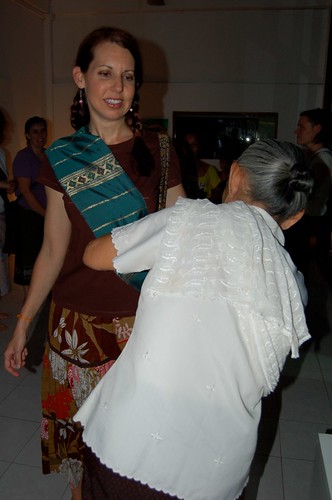
As guests arrived at the i:cat gallery, Mr. Boulein’s mother (hereafter called Grandma) assessed our attire and pinned on colorful silk sashes. I enjoyed mingling and chatting with the well-wishers, an eclectic group of people from myriad countries and all walks of life. Catherine was surprised to find that some of her Lao friends actually knew each other and were conspiring to keep tabs on her.

Grandma pins a sash on me.
DSC_0004

Soon Grandma ushered us in to the air-conditioned gallery room for the baci, where we sat on woven mats. She encouraged us to scoot close to the pah-khwan centerpiece – a large silver vase with a massive arrangement of marigolds and braided white strings. A collection of offerings surrounded the vase, including a roasted chicken, a plate of eggs, bags of potato chips, a basket of sticky rice, cans of soda, and thin beeswax candles.

The spiritual leader and the pah-khwan.
DSC_0008

Each of us sitting next to the pah-khwan grabbed a white string tied to the centerpiece and clasped the other end between our prayerful hands. I felt fingertips on my shoulder and realized that everyone in the room was connected to each other – and thus the sacred pah-khwan – by touch. The spiritual leader then chanted long rapid monotone prayers, which were loosely translated by the lady on my left, Jackie, owner of another international school here in Vientiane. In a nutshell, he was praying for Catherine’s good luck, prosperity and overall happiness. At a couple junctures, he said something that elicited a few yelps from the crowd, which apparently were calls for the spirits to pay attention to his prayers.

Finally, we pulled the braided strings off the pah-khwan to offer individual blessings: Using the frayed end of the string, you first brush bad energy out through someone’s fingers on the top side of the hand. Then you turn the hand over and offer a number of blessings while brushing positive energy in over the palm and wrist. After all possible wishes have been offered, you tie the string around your partner’s wrist, giving the tight knot a final twist and rub for extra luck.

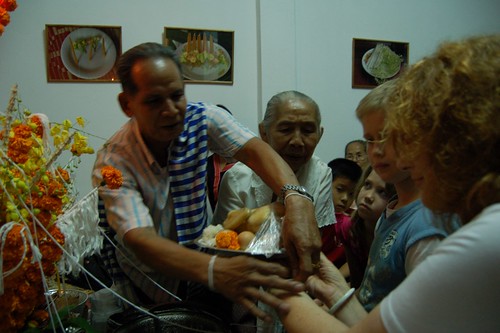
A highlight of the experience was when Grandma put the plate of chicken in Catherine’s hands, and the spiritual leader proceeded to do the string blessing with deep reverence and sincerity.
DSC_0011

One young lady, Daeng (whose family owns my favorite breakfast place in Vientiane – Kung’s Café), was tying a string on my wrist when she started to offer up the omniscient prayer for me to have a kid. “Tell those spirits NO babies!” I said. She laughed and went along with it.

Daeng brought this beautiful basket of fruit.
DSC_0019

With the Lao New Year holiday – Pii Mai – just around the corner, traditional water blessings followed the baci. We paraded outside, where Grandma had a silver bowl filled with water and flower petals. One by one, we crouched down for her to pour a bit over our hands.

I can see why Lao people treasure the baci ceremony. In her six years in Laos, Catherine has cultivated many friendships, and this brought us together with a common purpose. By the time we gathered outside for pizza and drinks, the ceremony had generated a palpable vibe of support and optimism for Catherine and her new enterprise.

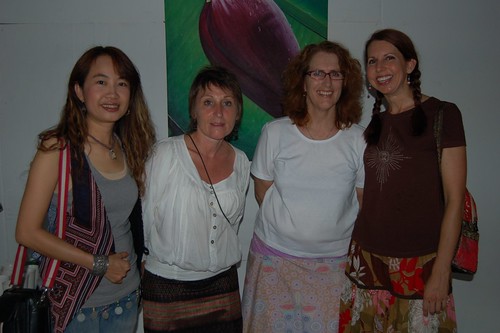
Pretty, Sheila, Catherine and me. Pretty’s husband, Tommy, is a professional photographer, so I hope to get copies of his pics on here soon.
DSC_0003