Category Archives: On the Road

Costa Rica or Bust! Stop 1: Tortuguera

Although our airline debacle had sucked away a whole day of our vacation, Tony and I were ready to kick it into gear. We spent the night in San Jose (with our luggage and our rental car!) and got up early to drive to the Caribbean coast. Two quick notes: The traditional Costa Rican breakfast is like a little Latin party in my mouth. Black beans and rice with fried plantains? Yes, please! Also, our rental car is a Suzuki Jimmy, which looks like a small SUV in pictures but is, in fact, a moped wearing an SUV costume.

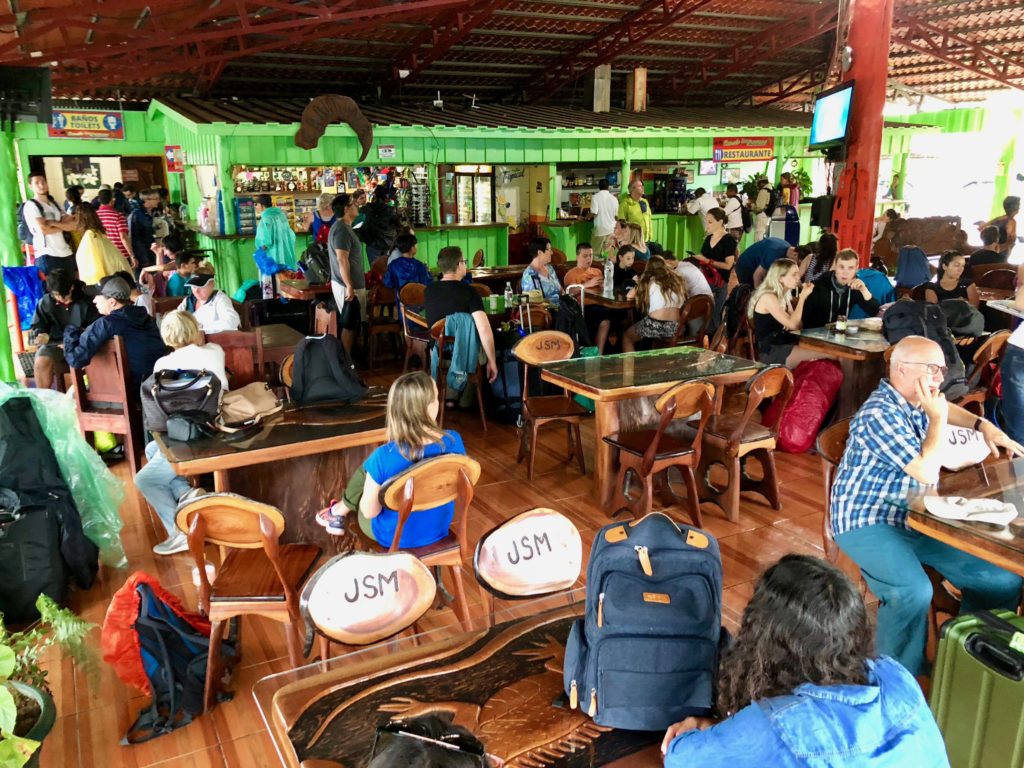
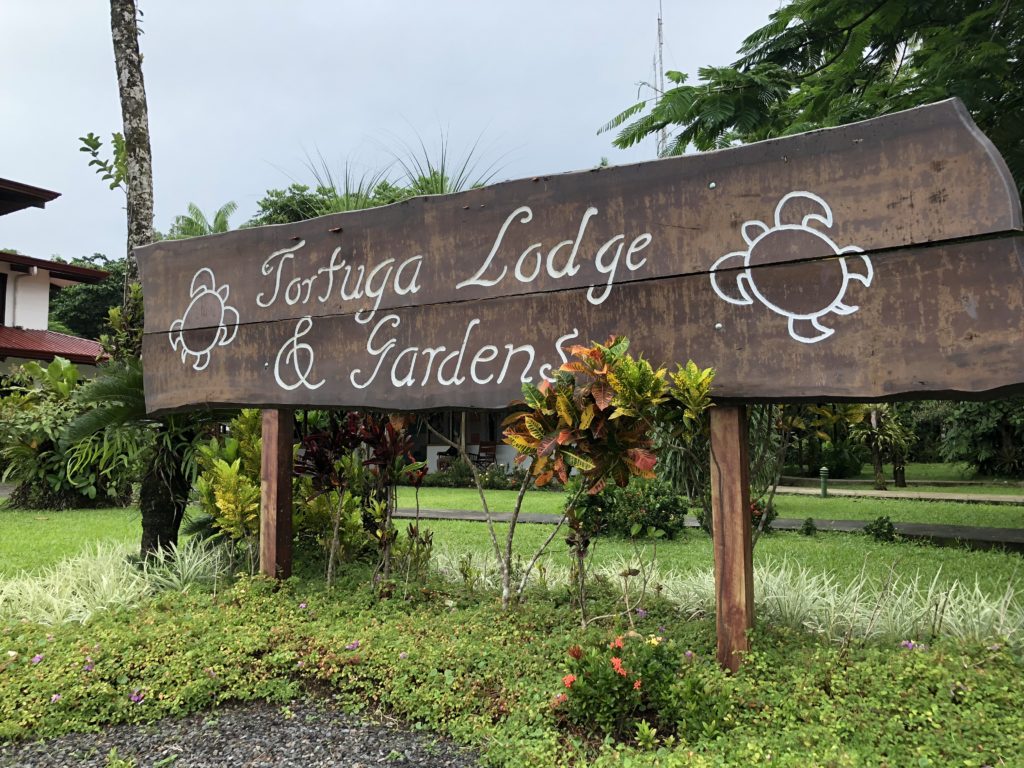
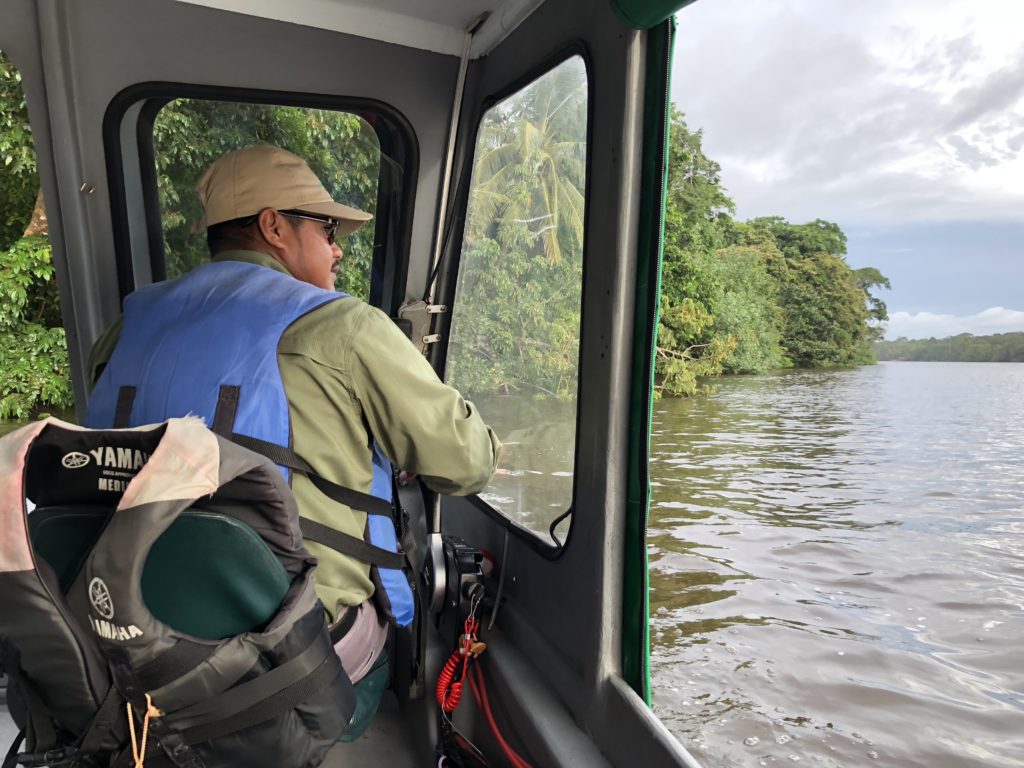
Our drive to Puerto La Pavona took about 3.5 hours, including convoluted city traffic, misty mountainous curves in the Braulio Carrillo National Park, and country roads that passed through quiet villages. We arrived at the riverfront during a torrential downpour and hauled our luggage into the expansive waiting area, along with other waterlogged tourists waiting for buses and water taxis. Eventually a guide from Tortuga Lodge and Gardens arrived and led us to a small boat for a one-hour cruise to our hotel.
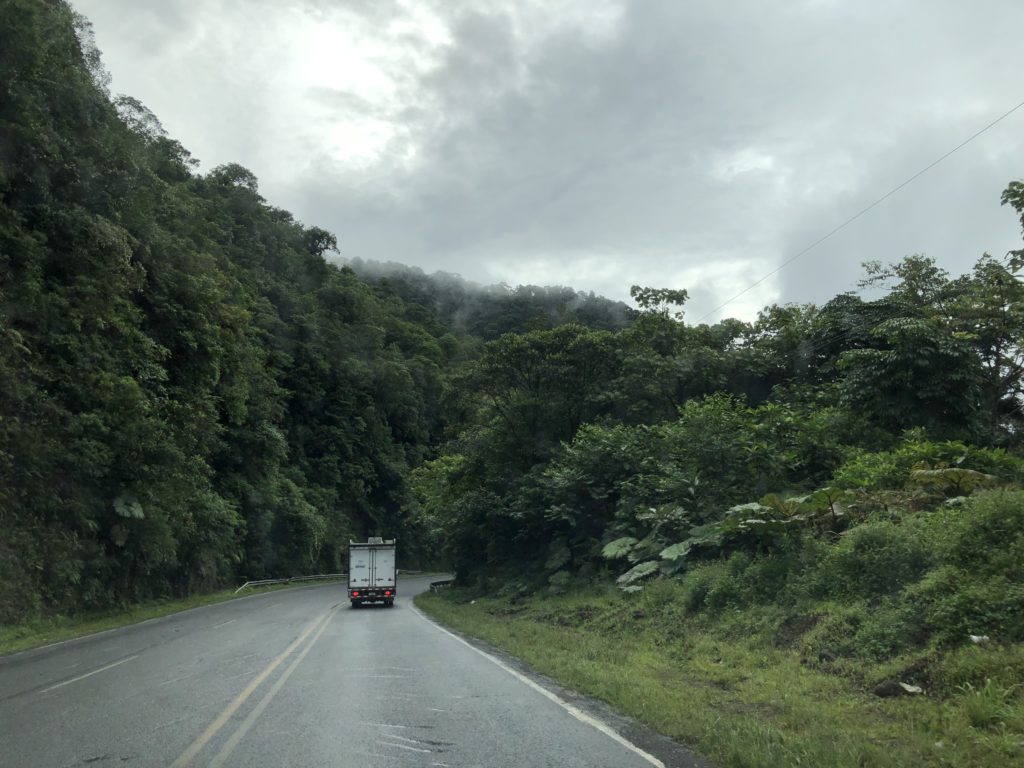
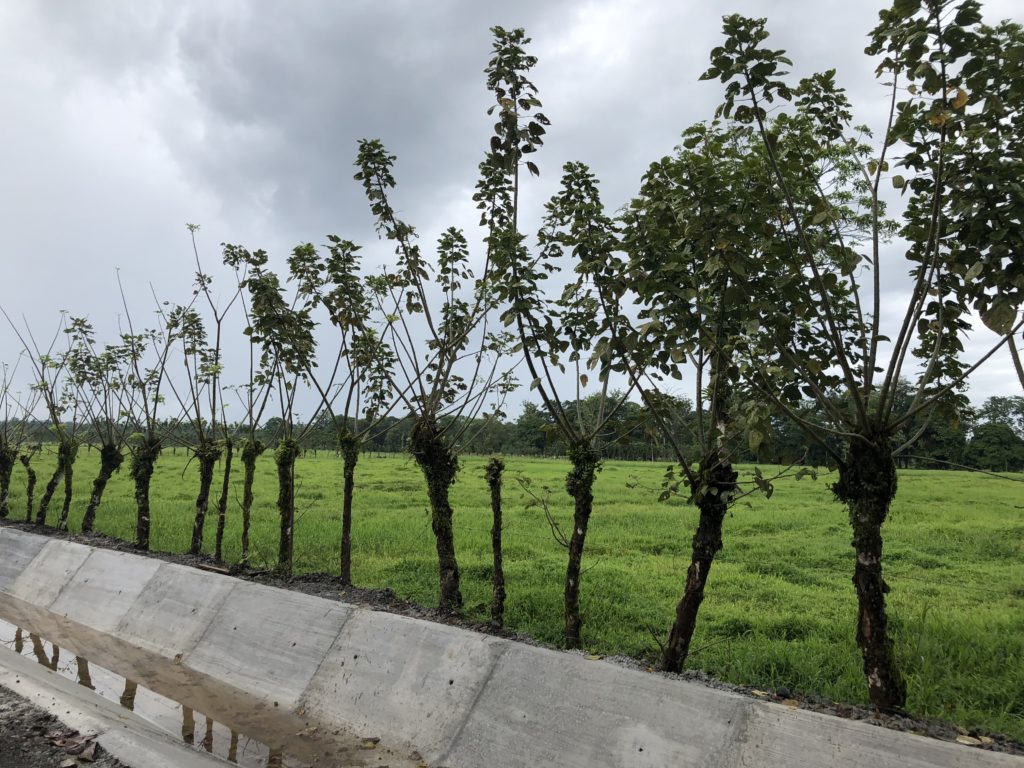
Tony and I are both reading a book by Jack Ewing, an American who came to Costa Rica as a cattleman and ended up a naturalist. The book, Monkeys are Made of Chocolate, creates the perfect backdrop for our journey with heaps of information about wildlife and conservation efforts. We learned about “living fences” from reading the book, and on our road trip, we saw many of them. Fence posts that can’t help but burst into life in this rich, lush ecosystem.
The waiting area at La Pavona.
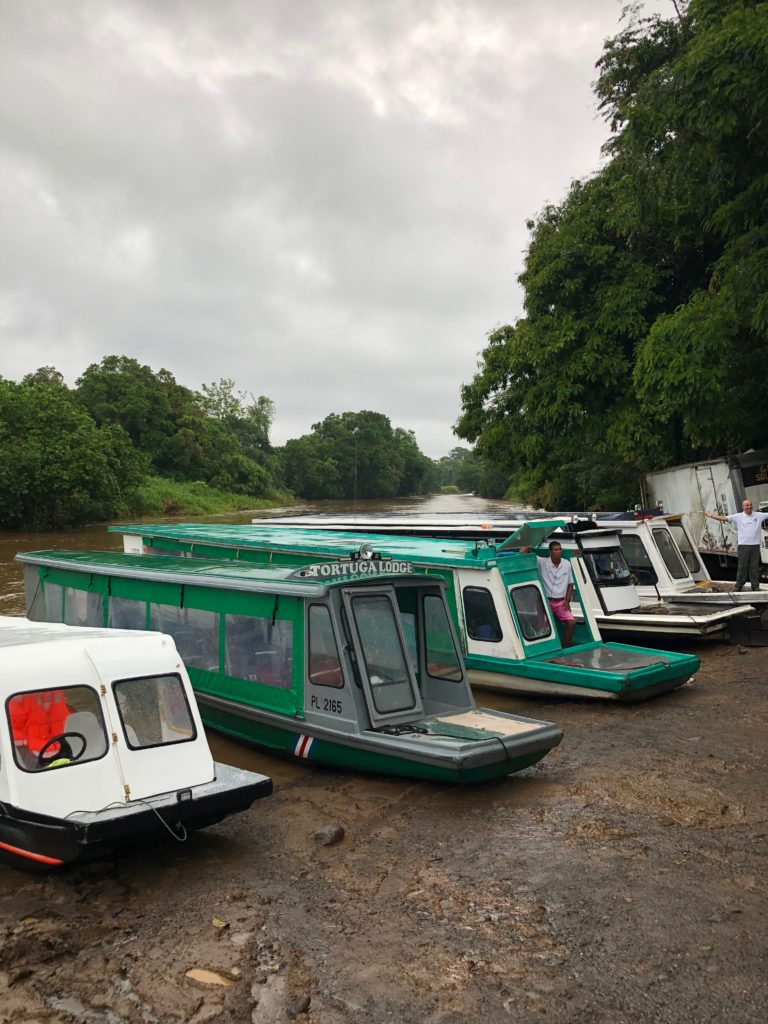
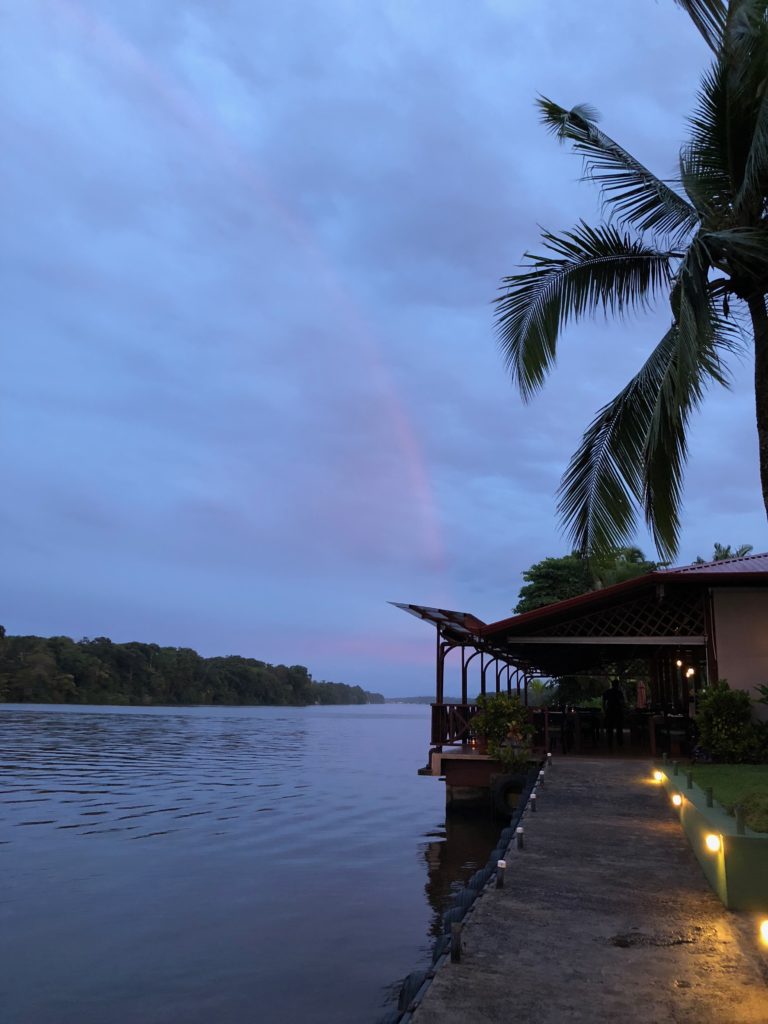
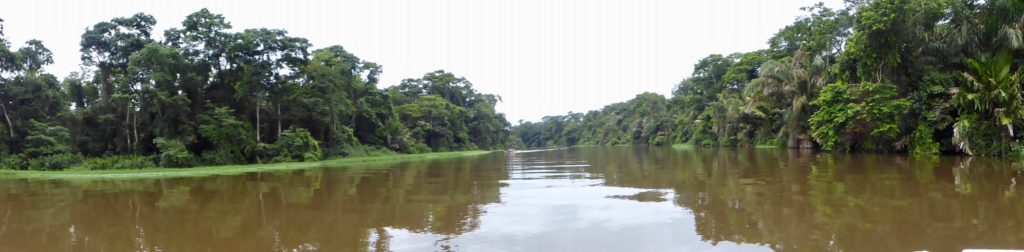
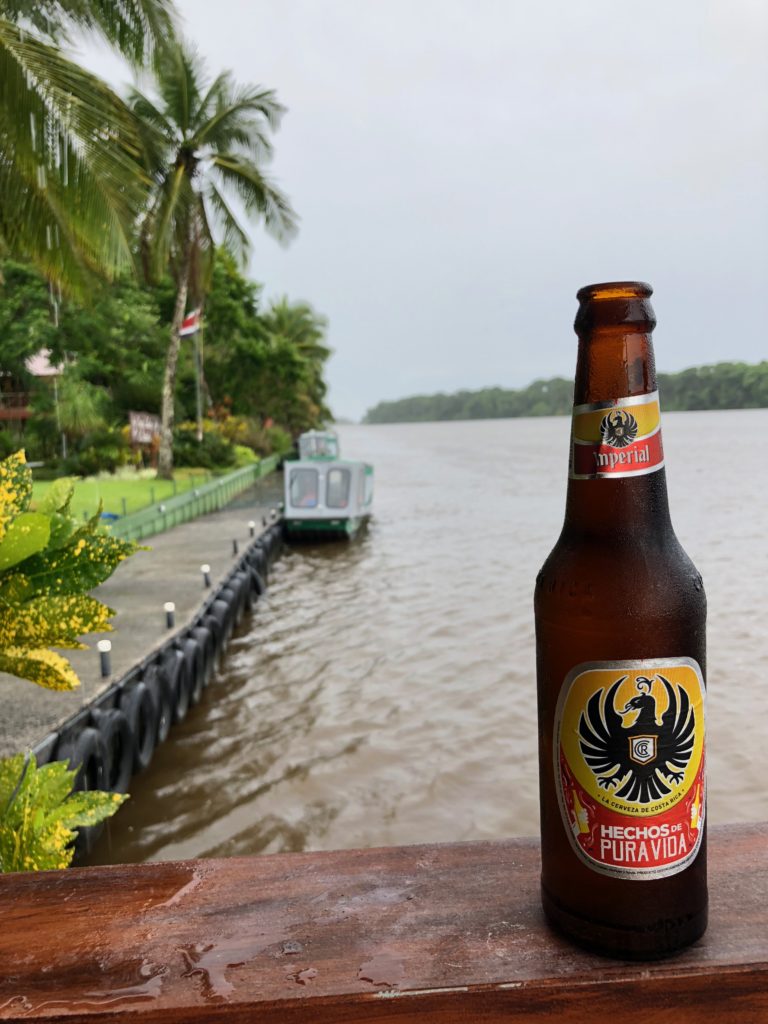
Our boat puttered along the Río la Suerte (Lucky River) until it merged with the Tortuguero River and ultimately fed into Penitencia Lagoon. Our lodge sat on the banks of the lagoon, accessible only by boat or plane. Across the water, another stretch of land provided views of dense foliage and macaws nesting in the tall tress, and just beyond those trees was the volcanic sand beach of the Caribbean Sea.

Our first afternoon at the lodge, we mostly pottered about, checking out the premises, reading our books in the terrace restaurant.
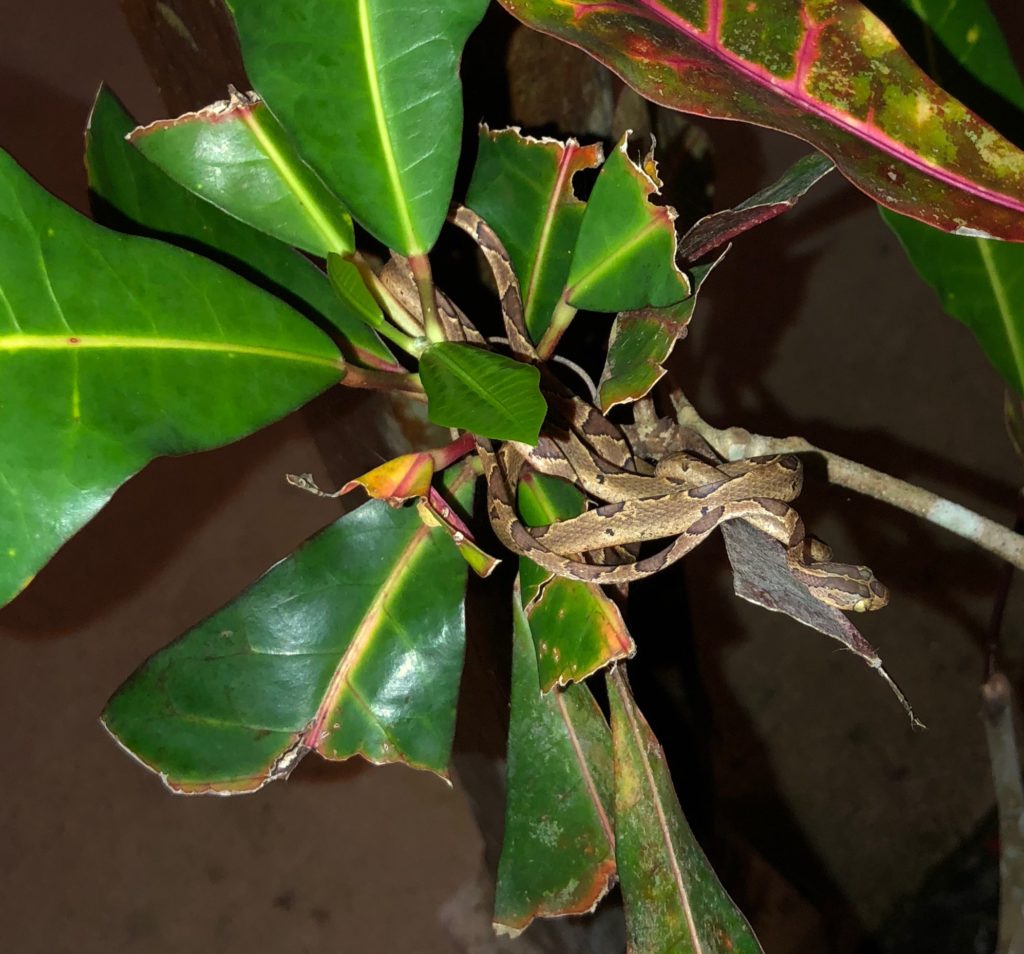
One of the guides pointed out a tiny leptodeira “cat-eye” snake, which was wound around the branches of a small bush.
I became a bit obsessed with the montezuma oropendula bird, which builds suspended nests and has a gurgling call like an old-fashioned bicycle bell. This tall palm in front of the reception area featured many nests, including one uninhabited one for visitors to see up-close.
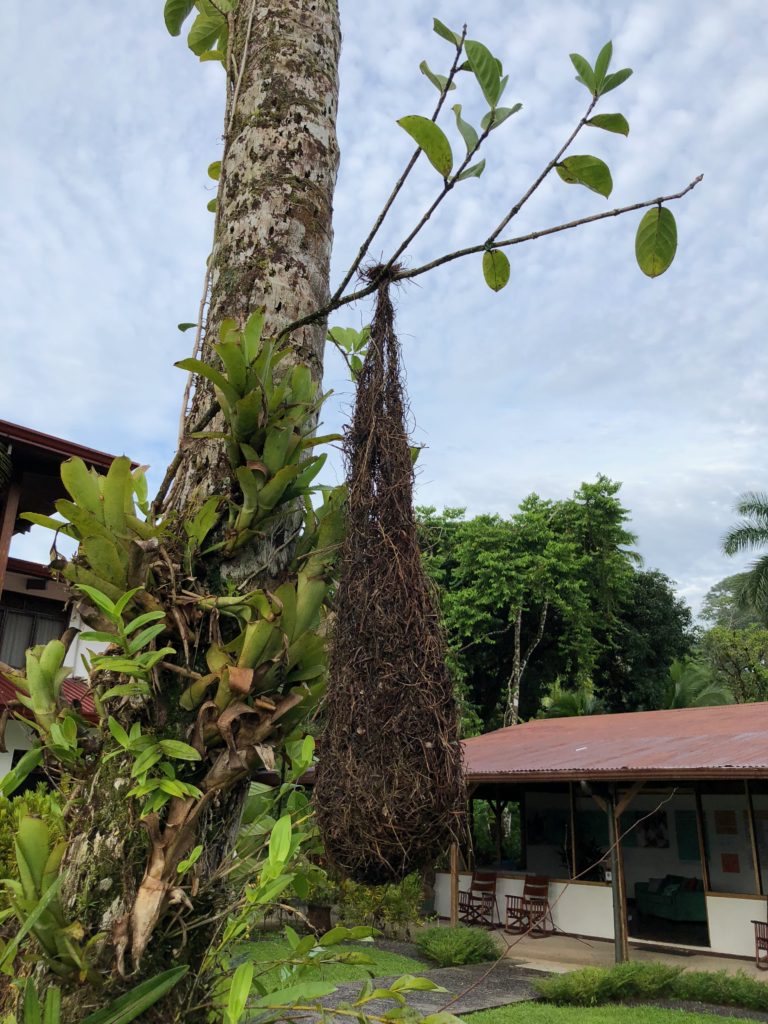
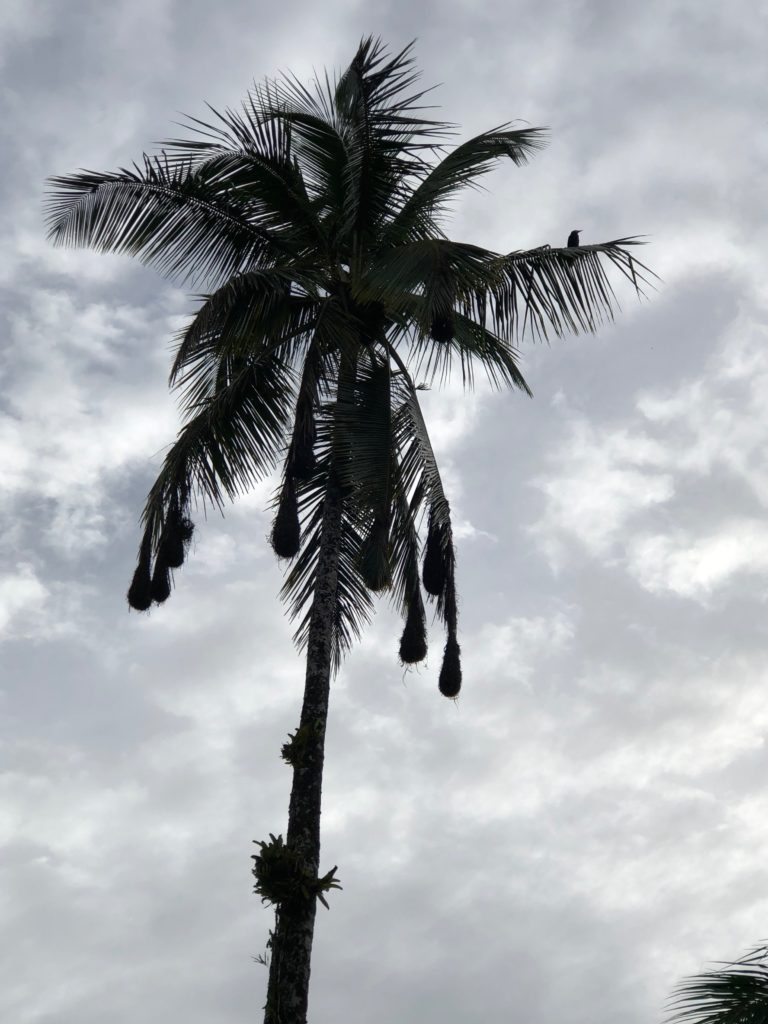
I’ve spent some time on the website BirdNote and learned that this cool bird is a colonial breeder, so the male (which is, by the way, twice the size of the female) maintains a little harem of ladies, who weave the incredible nests.

You would think that taking a plane to a city, then a car to the country, then a boat to a reclusive lodge would land you in the quietest place on earth. But, guess what? Nature is freakin’ loud! In a good way. The rooms at our lodge have open screened windows, so we felt like one with the rainforest. At bedtime, we could hear crashing waves, humming cicadas, chirping geckos, croaking frogs, occasional bird calls, and as the night wore on, it sounded like a freight train was about to crash into our room – rain. We lived in Laos and India, so I’m no stranger to monsoons. But this was a crazy amount of rain in a short amount of time. Around 4 a.m., I woke to a roaring animal in the garden behind our room. I would have thought it was a big cat dry heaving and hacking up a fur ball, but we had been warned about the howler monkeys. For much of the morning, they belted out their throaty howls, which can be heard for more than three miles. We loved it, but Tony pondered whether the locals ever dreamed of moving to the big city to escape the noise.

I chose gallo pinto for breakfast again and was not disappointed. Afterwards, we met up with Willis and a few other guests for a boat tour in the Tortuguera National Park. Before floating far from the lodge, Willis – with help from Tony, who has a superpower for spotting camouflaged critters – had already pointed out these attractions:
* a three-toed sloth,
* a two-toed sloth,
* a female anhinga (a water bird),
* a vulture,
* all three of the most common kingfishers in the area, including several Amazon and ringed kingfishers, and a tiny green kingfisher, which speared a fish and gobbled it up for our entertainment,
* many green macaws,
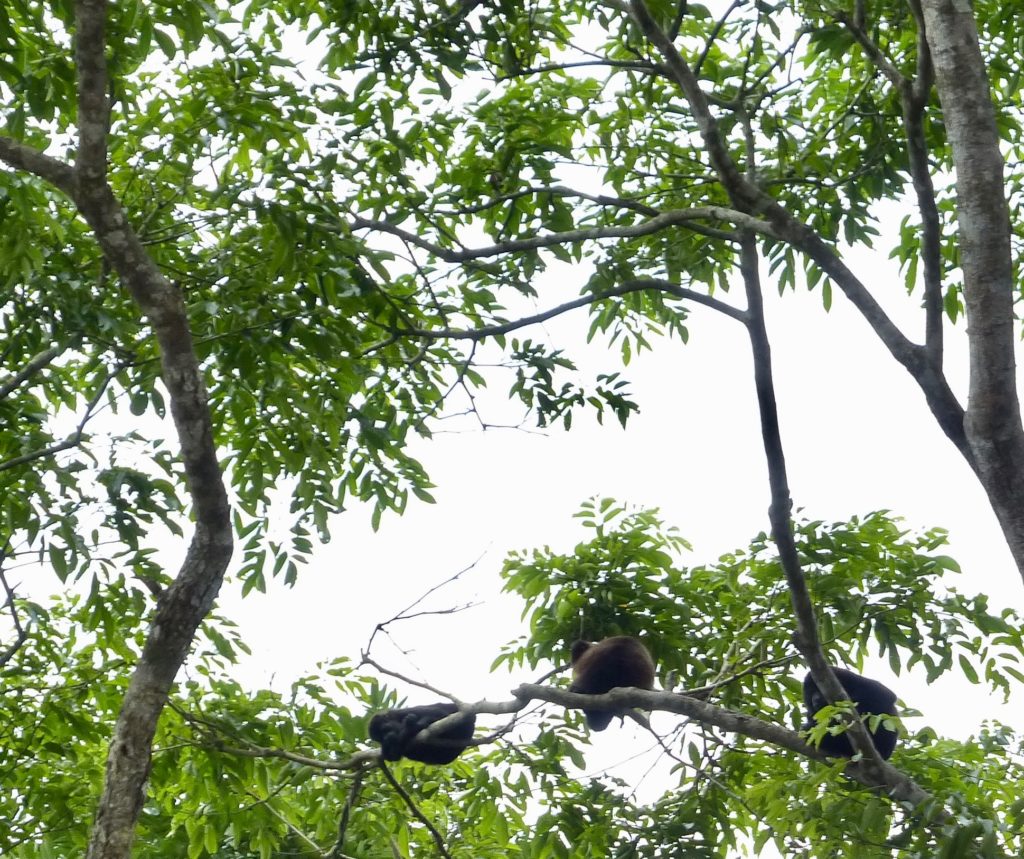
* howler monkeys, which looked exhausted from all that early morning howling and lounged lackadaisically with their prehensile tails wrapped around the branch for stability,
* collared aracari toucans, which have colorful bodies but plain beaks (unlike the Froot Loops mascot), and
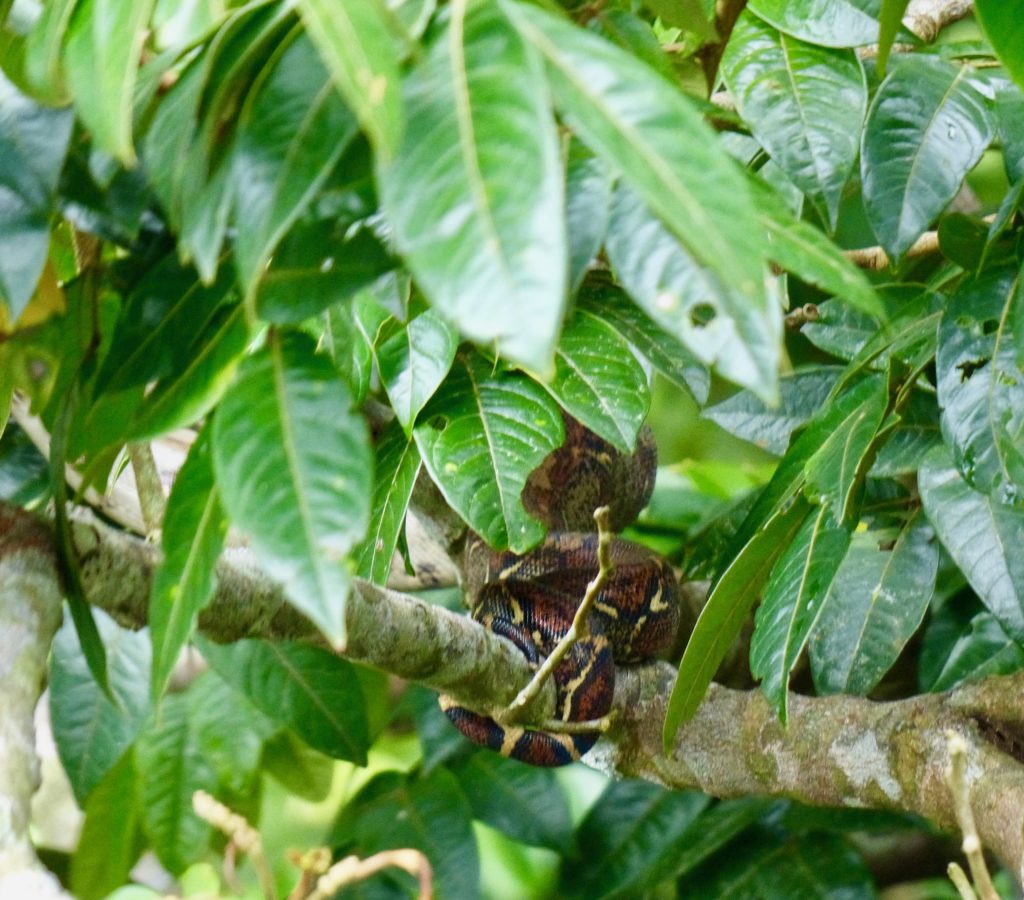
* a boa constrictor that was about 4 feet long and so tangled up in a bush that we couldn’t find its face.

Unfortunately, I didn’t get any good photos. (a) Camouflage really works, and (b) these guys were not posers.

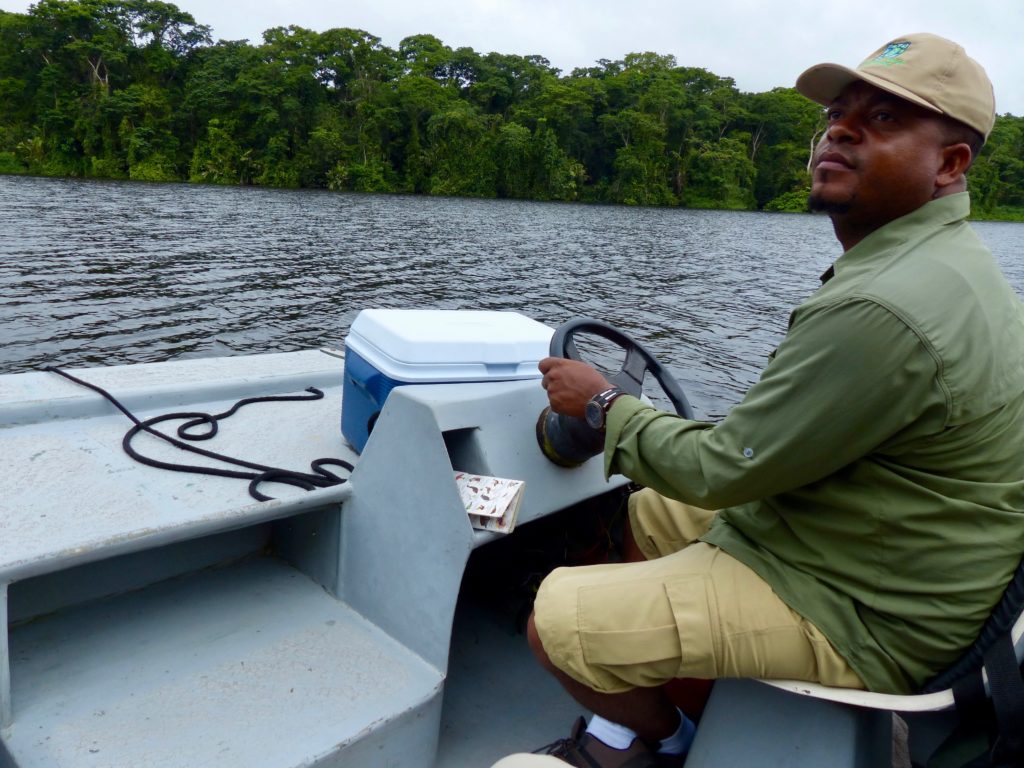
Here’s Willis, our guide. He said his great-grandfather came to Tortuguera to hunt turtles and other game. His grandfather followed suit, and his father also became a hunter until conservation became popular, and then he started working as a guide. Willis remembers riding in his dad’s boat and learning how to spot wildlife by sight, sound, and smell. He is the first generation not to carry a gun or knife, he said, and only to work in the interest of the ecosystem.
The snoozy howler monkeys.
The shy boa.
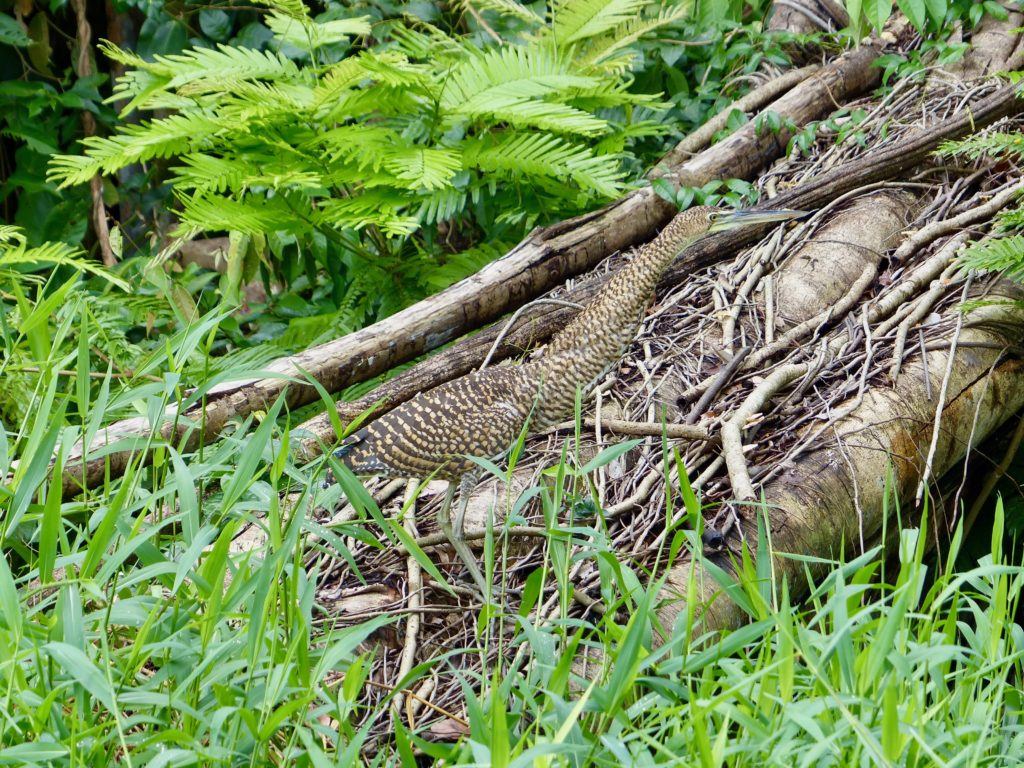
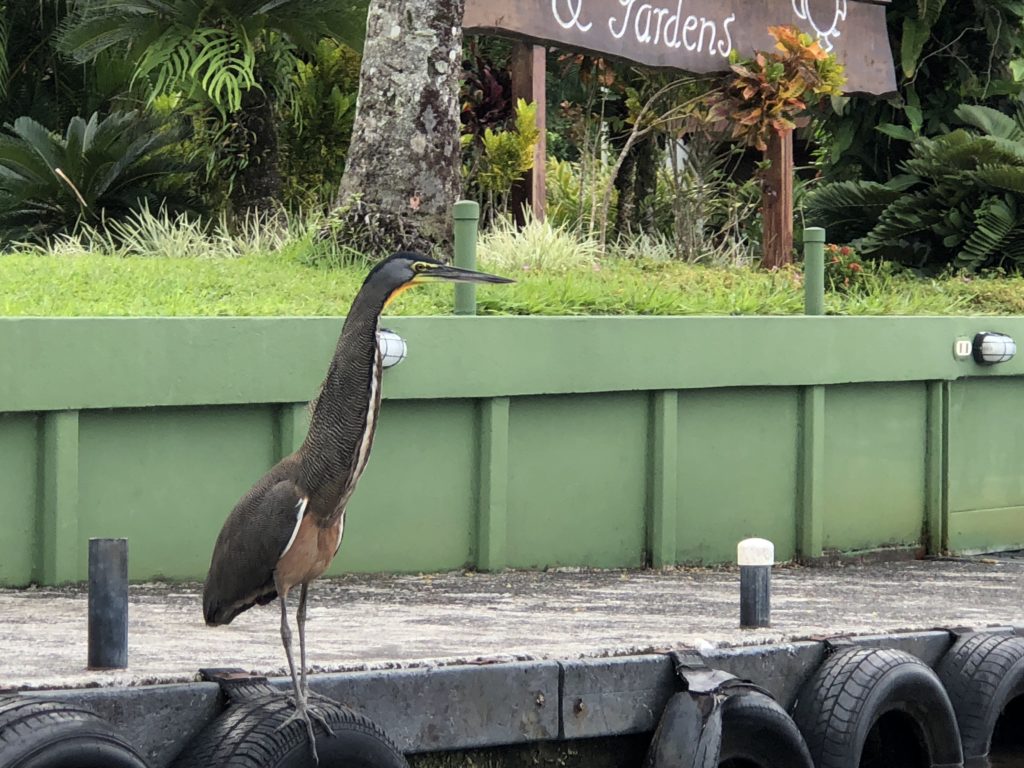
The nearly invisible tiger heron.
The wildlife extravaganza continued after our boat entered the national park. We saw:
* several bare-throated tiger herons,
* many blue morpho butterflies, which have wings that are brilliant iridescent blue when open and dull brown when closed,
* a male anhinga,
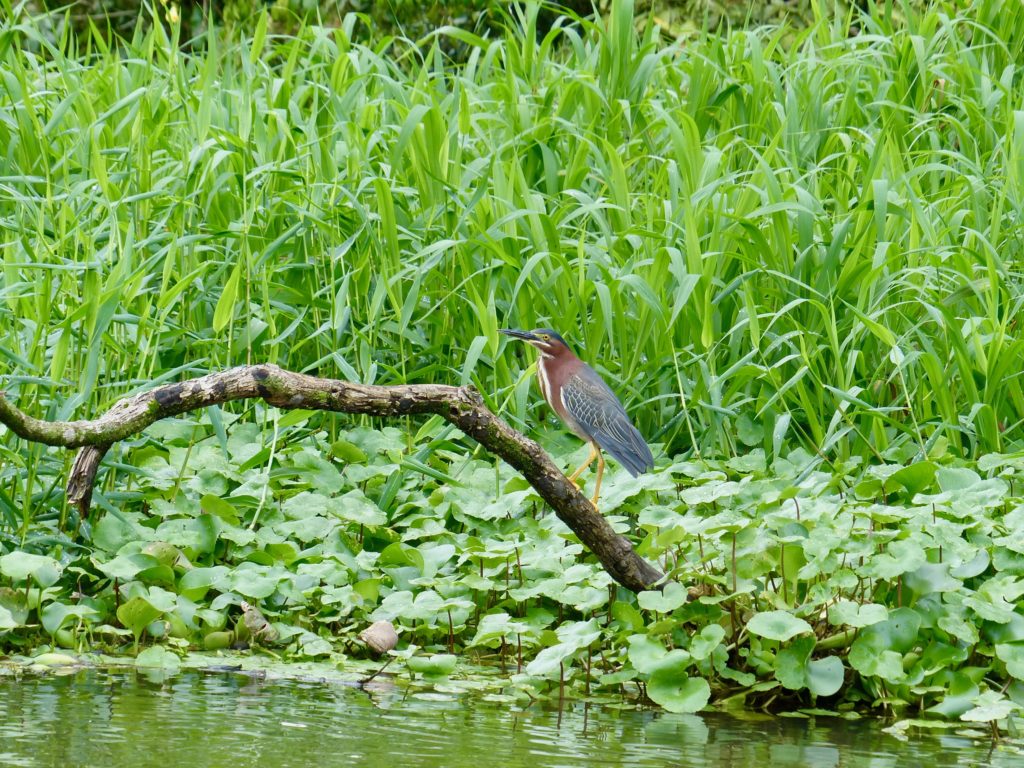
* two green herons,
* several white-faced capuchin monkeys,
* a few spider monkeys,
* a great curassow, which Willis called a turkey, hopping up a tree from branch to branch,
* two northern jacana birds foraging in the water lillies, and
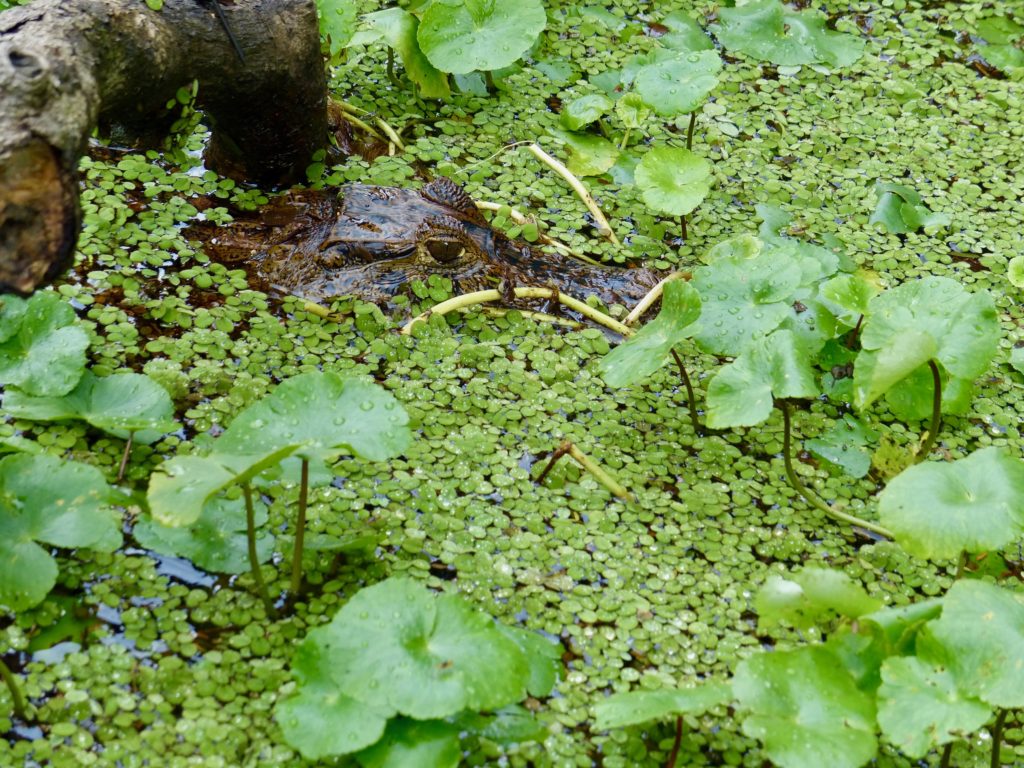
* several caimans, a smaller cousin of the crocodile.

Green heron.
Caiman #1.
Caiman #2.
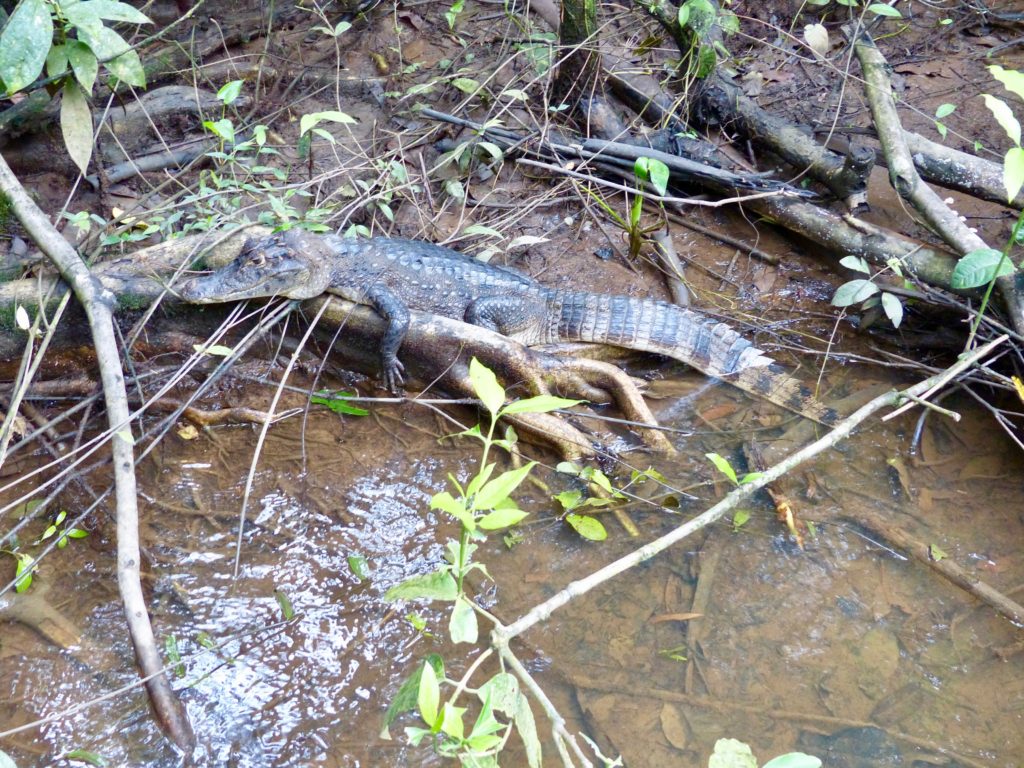
Caiman #3.
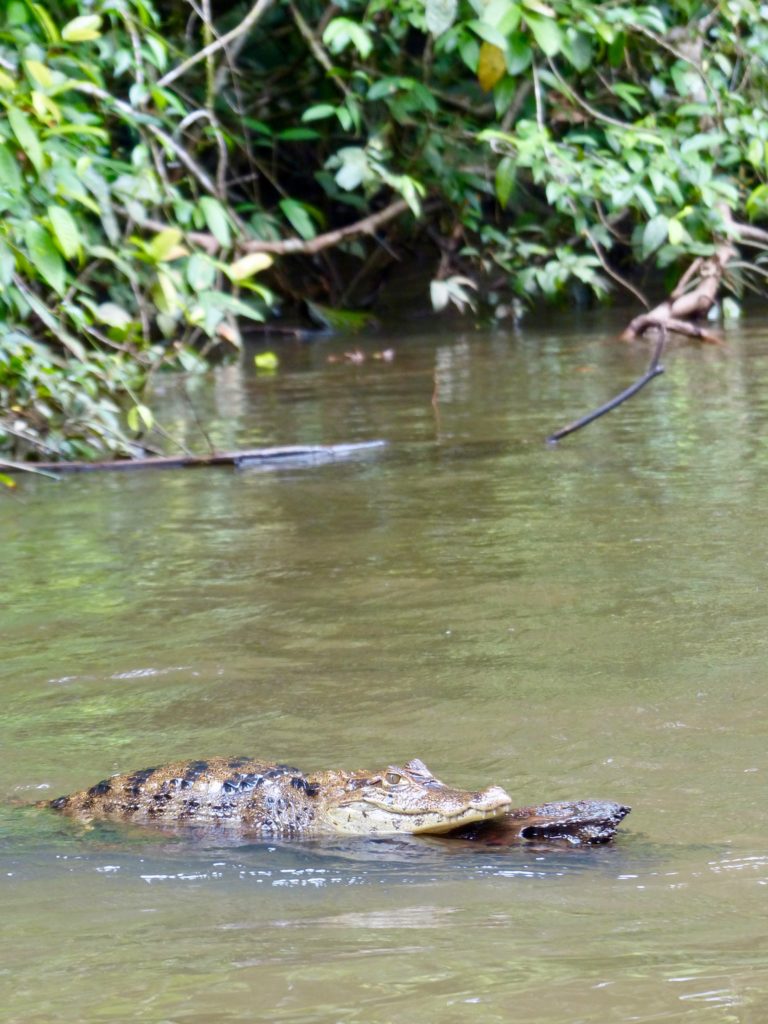
At one point, Willis spotted a Jesus Christ lizard. The bright green crested lizard got its name from its ability to run across water, something we got to see in action. Willis reached down out of the boat to splash water on the lizard, and it leapt off the stump and dashed across the water in to the jungle. At the same time, caiman #1 raised its head out of the water and settled mostly submerged and still.

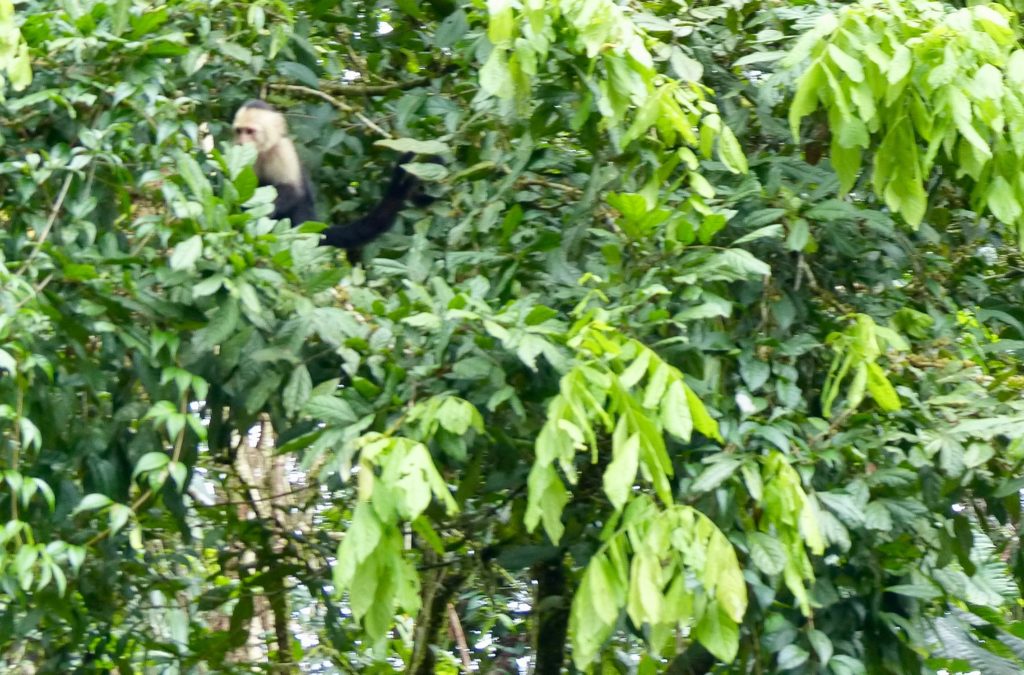
After marveling at the caiman for awhile, we motored a short distance away to watch a white-faced capuchin monkey feeding in a tree. Suddenly, caiman #3 started swimming toward us. Tony saw him first and later said it looked like a cartoon, with only his eyes poking up out of the water as he drifted toward our boat. I couldn’t decide what to focus on: the monkey or the caiman! Eventually, the monkey swung out of view and the caiman found a sunny spot to rest, so we moved on.

Caiman #3 started swimming toward us at the same time this guy was jumping around in the branches of a tree.
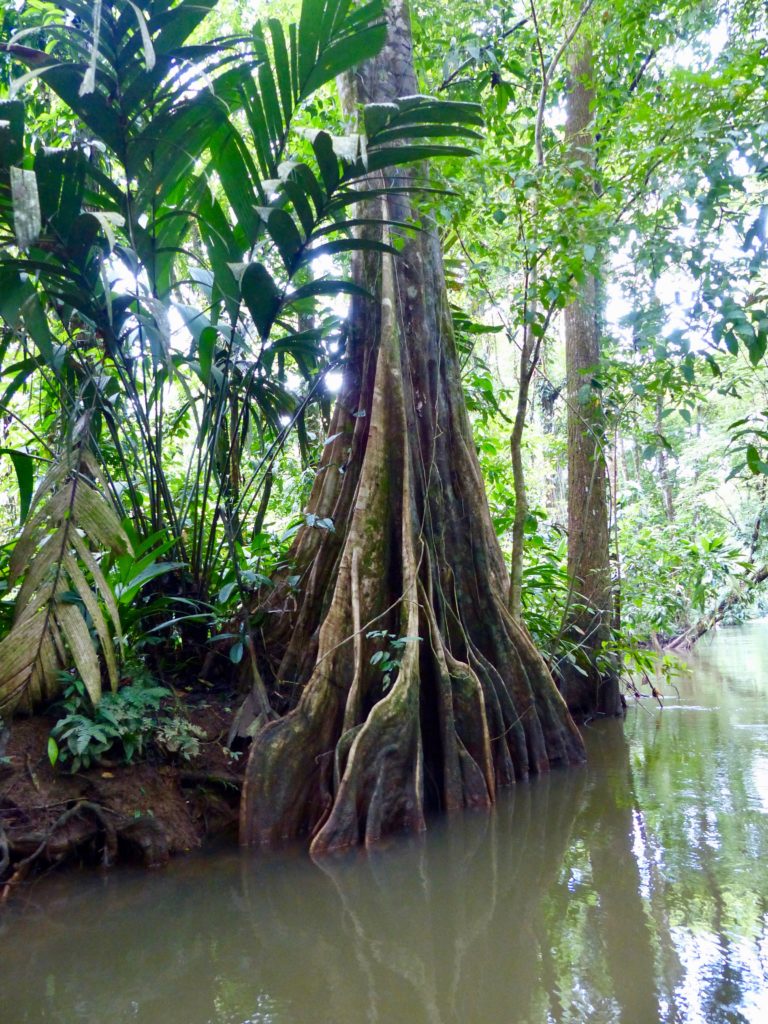
Many rainforest trees have incredible buttress roots.
Pretty scenes from our boat trip.
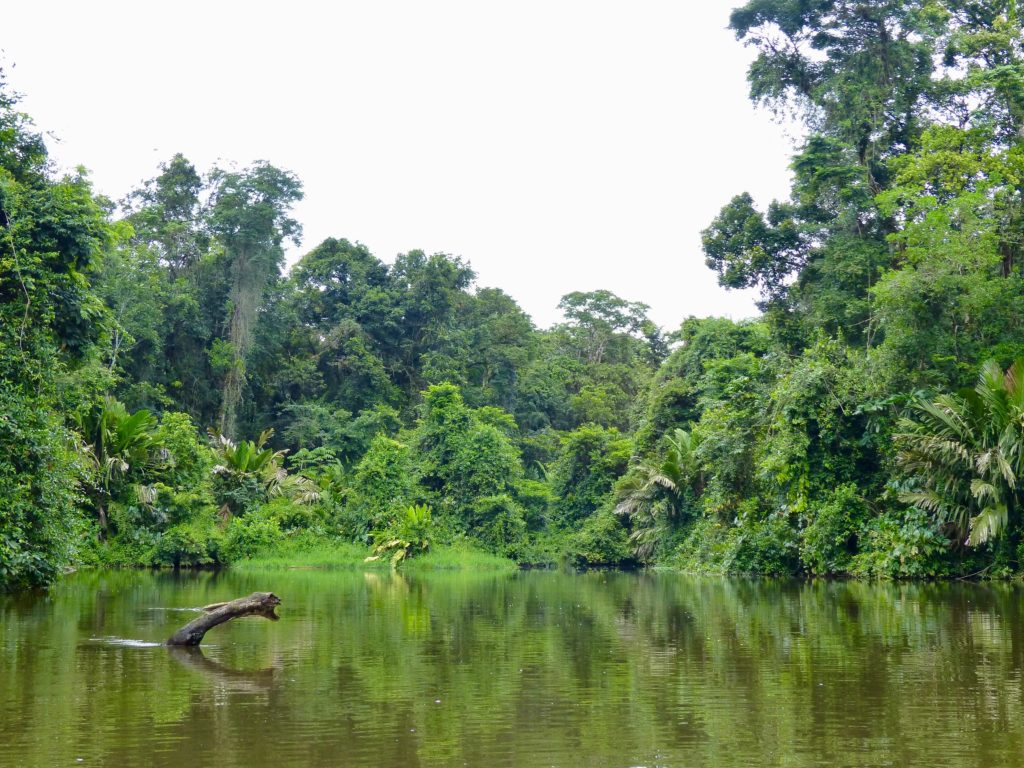
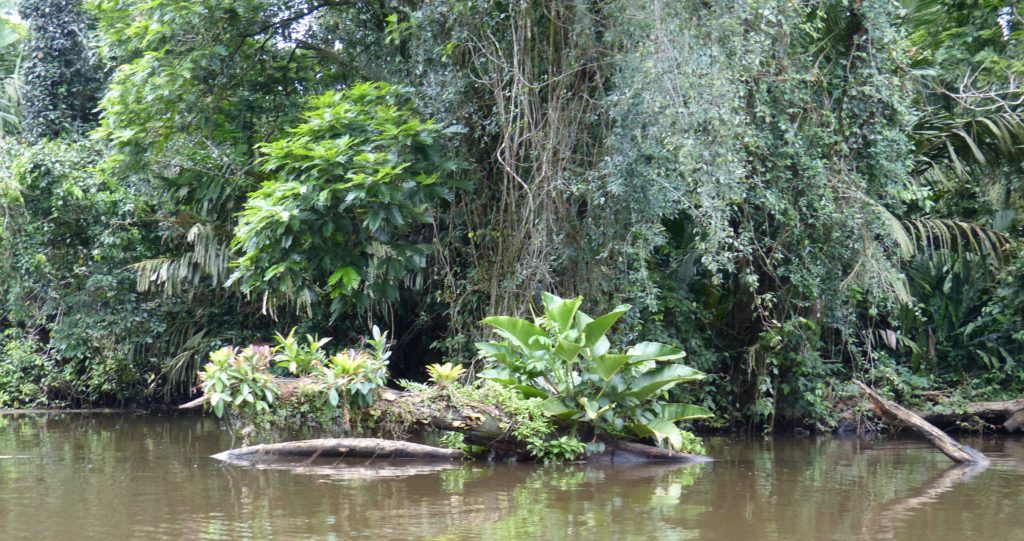
On the way back to the lodge, Willis took a detour to show us the nesting area for green sea turtles. According to Lonely Planet:

Female turtles return every two to three years to lay their eggs on the exact same beach where they were born. These behemoth animals average about 120 cm and weigh as much as 150 kg, so seeing one in person at such close range is a truly spectacular experience. Each female turtle lays eggs six times during the nesting season, and researchers discovered 18,000 nests along Tortuguero’s coast in 2015 alone.

Maybe we’ll return during nesting season some day.

Back at the lodge, we enjoyed a tasty lunch and then met up with Norton for a guided walk around the gardens. He took us to the southernmost point on the back of the property and set up a telescope, aimed at a tree across a small stream. “There was a sloth here earlier … oh good! He’s still here,” Norton said.

Sure enough, the two-toed sloth was hanging upside down and scratching his arms with his long curved claws. “Sloths have a lot of fleas,” Norton pointed out. I love the way the Costa Rica Experts website explains it:

The fur of a sloth is actually an entire ecosystem in and of itself with colonies of algae, fungi, moths, mites, and the like. The ecosystem serves as a sort of symbiotic relationship with the sloth as it gives them a green tint that allows them to hide from predators and also serves to make them rather unappetizing.

Sounds gross, but that sloth was freakin’ adorable. I could see his sweet little face plain as day as he slowly scratched his itchy armpits.

Norton walked around to a tree and pointed up. “Have you seen the bats?” he asked. I looked and looked and could not see them. “How can you not see them? There are 9, 10, 11, 12 of them,” Norton said, counting the invisible bats. Finally, Tony pointed out that they were lined up on the branch and blended in almost perfectly. Little bitty bats in a row. Norton noted they look like a snake when they sleep like that, and if they sense danger, they move along the branch one at a time to give the appearance of a slithering snake. How crazy is nature?!

Don’t worry … I won’t shame you if you can’t see the bats.
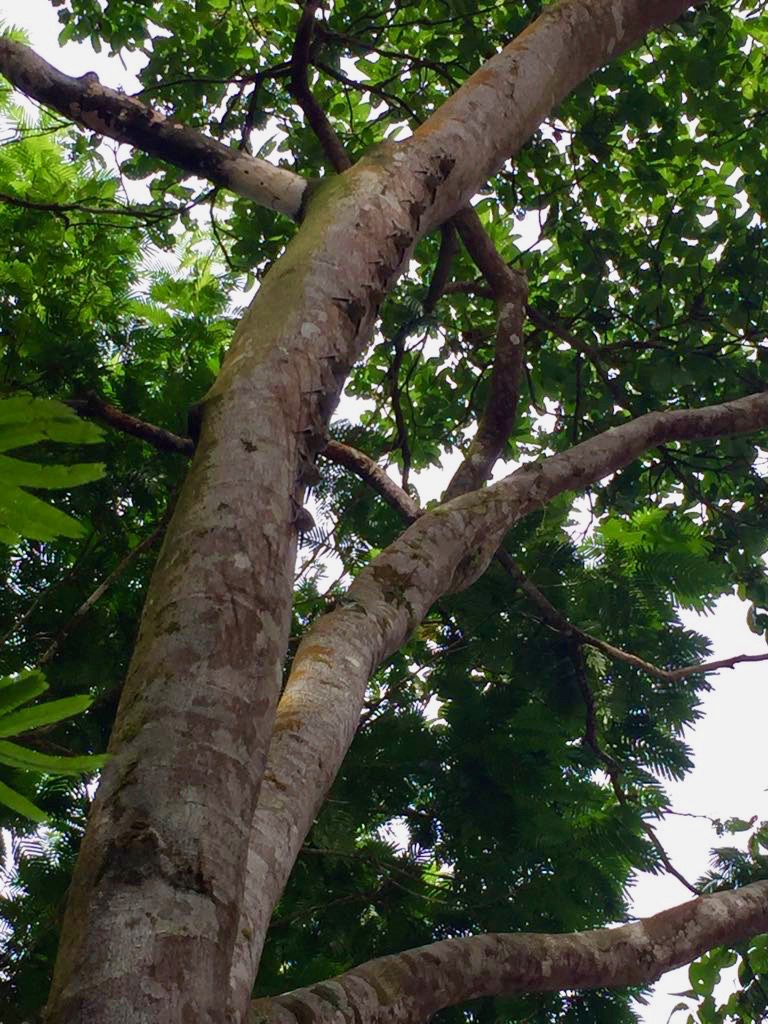
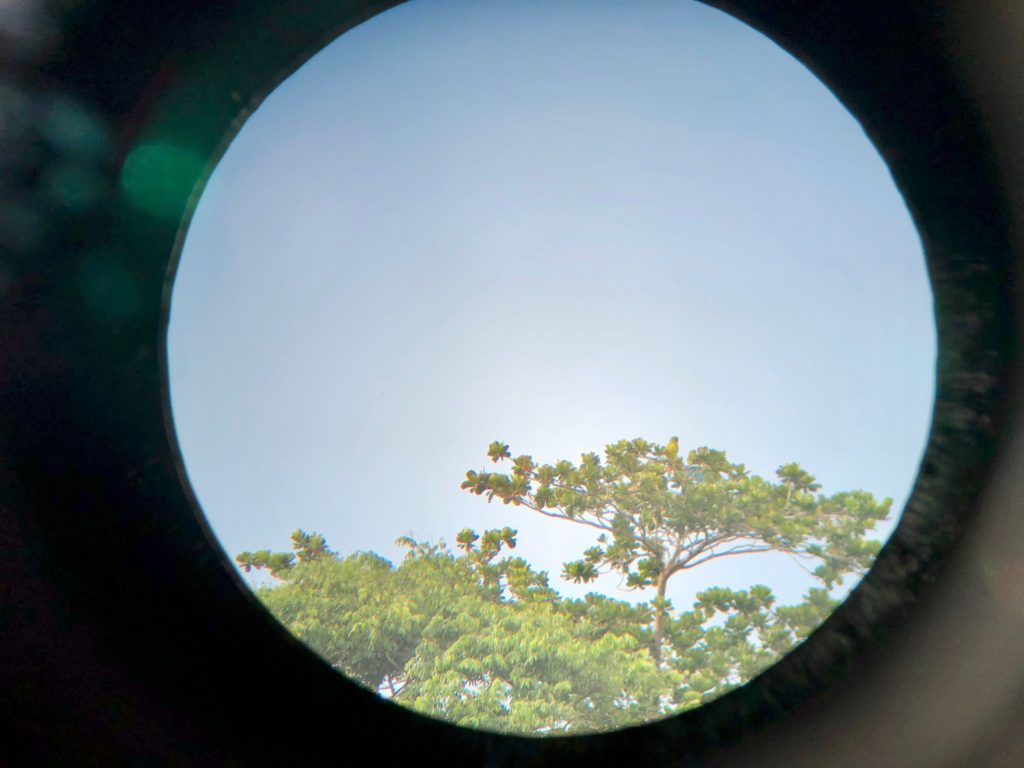
Next, we walked through the lodge’s back yard, learning about different plants and their medicinal value. Norton pointed out two bright red tiny tree frogs, a baby hummingbird in the smallest nest you ever saw, a ylang-ylang tree with blossoms that smell like heaven, and finally, he aimed his telescope across the lagoon to a tree full of green macaws. What a treat!

Hmmm… taking a photo with your phone of an image on a telescope does not work well. Plus, the dang macaws had mostly taken off by the time I got it to focus.
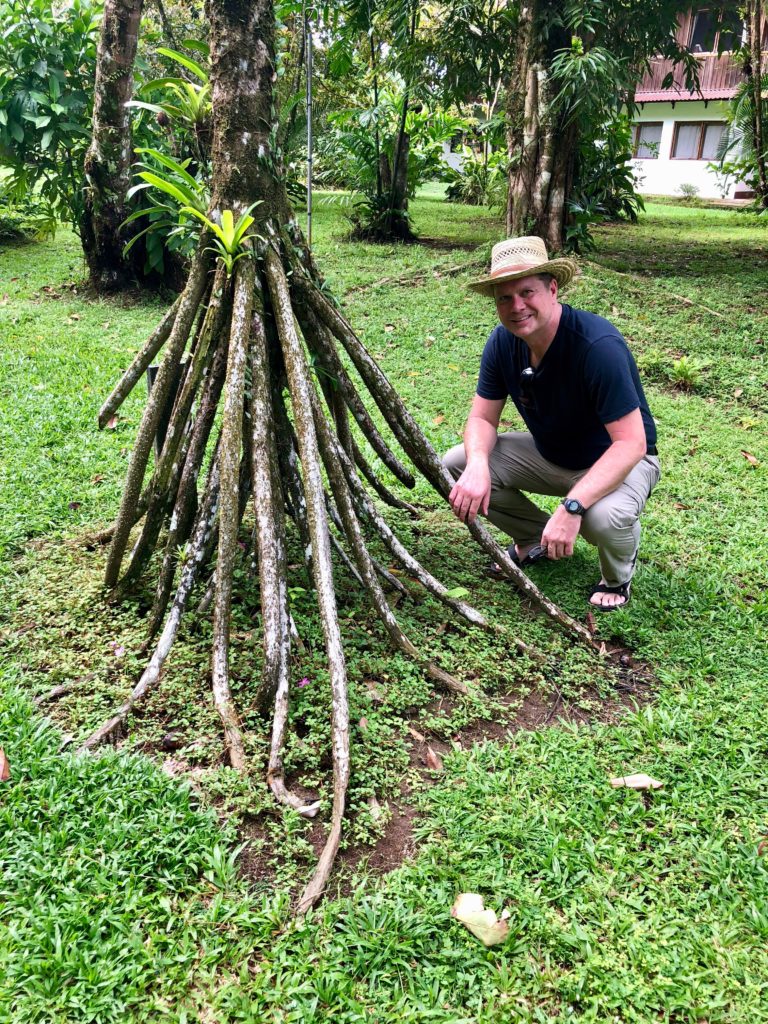
Tony poses with the “walking palm.” Can you say “Lord of the Rings”??? Norton explained that the palm follows the sun, so the “legs” dry up if they no longer support the tree, which gives the illusion that it’s walking.
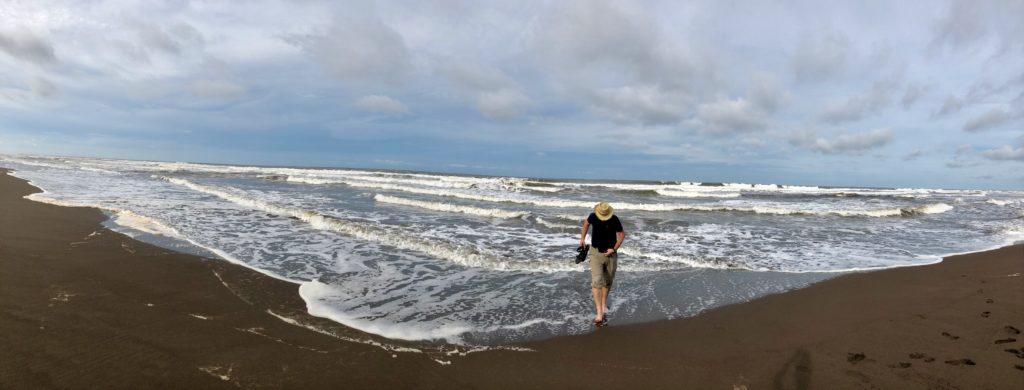
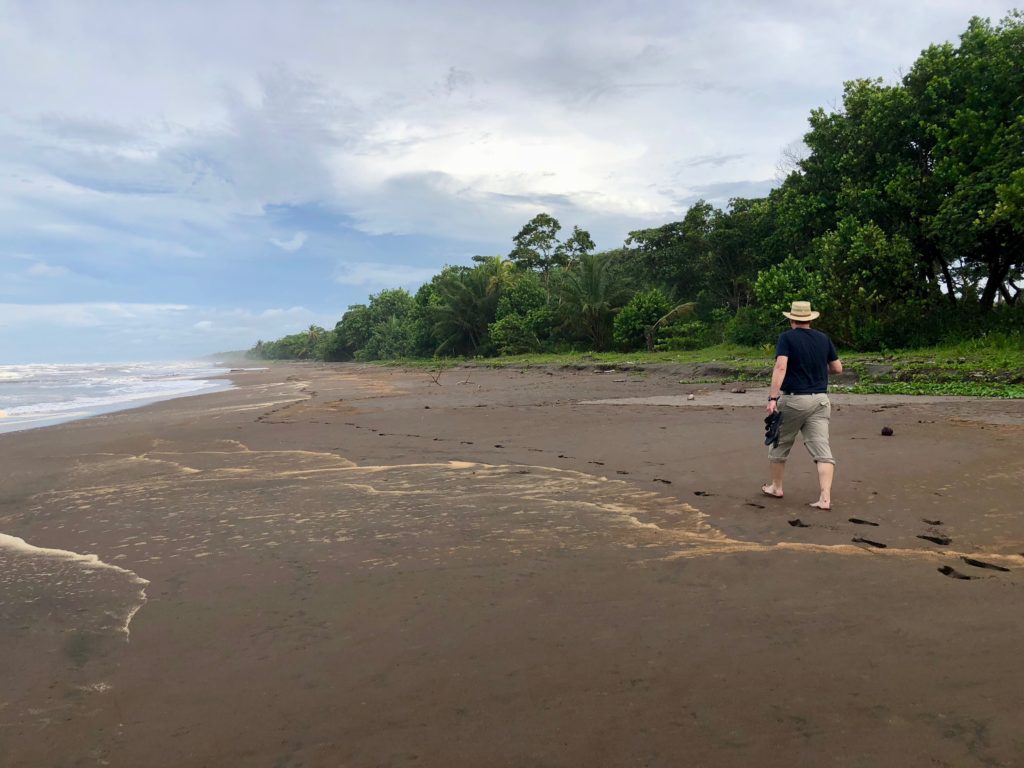
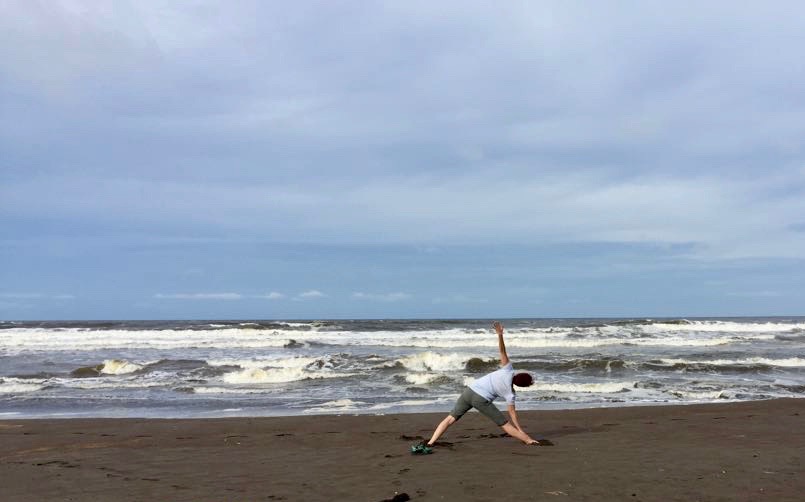
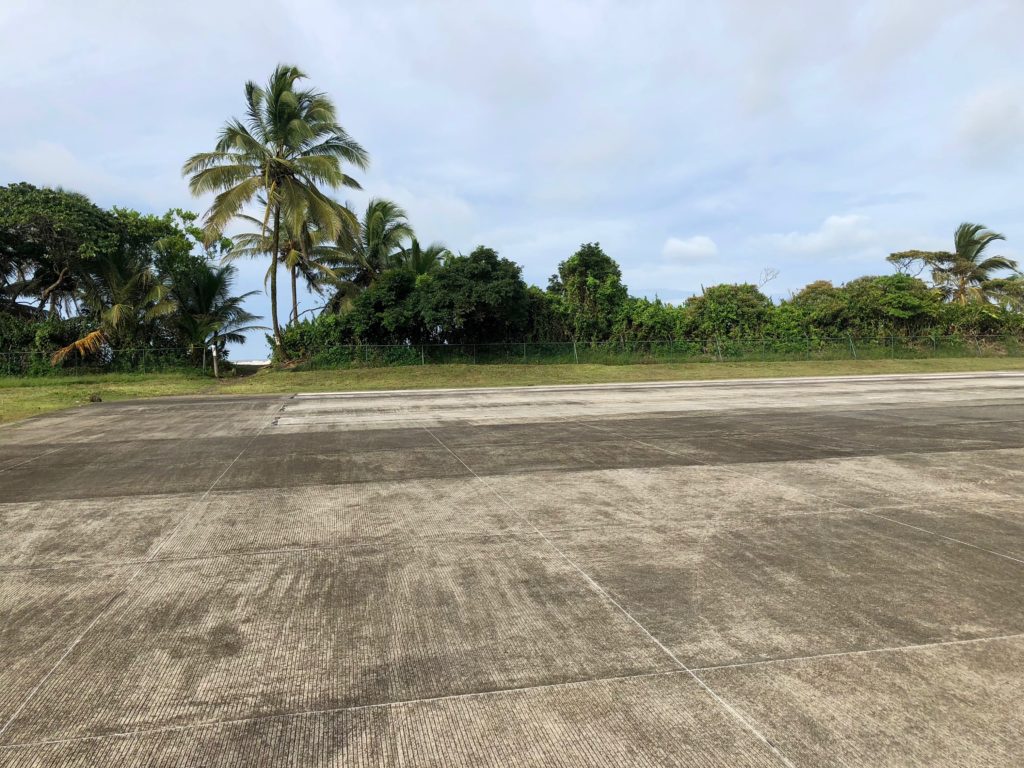
Because our visit here was cut short by Latam Airlines, every minute counted. So after our garden walk, we hitched a ride on the lodge’s water ferry to the beach across the lagoon. We climbed out of the boat, walked across the air strip (which felt a little dangerous), and through a break in the trees. The beach was completely deserted except for one other family from our hotel. I immediately kicked off my shoes and ran into the warm surf. We walked up the beach for about 30 minutes. I practiced a few yoga asanas while Tony poked around for shells. And in one magical moment, a huge flock of macaws buzzed our heads and swooped in a circle before landing on some beachfront trees.
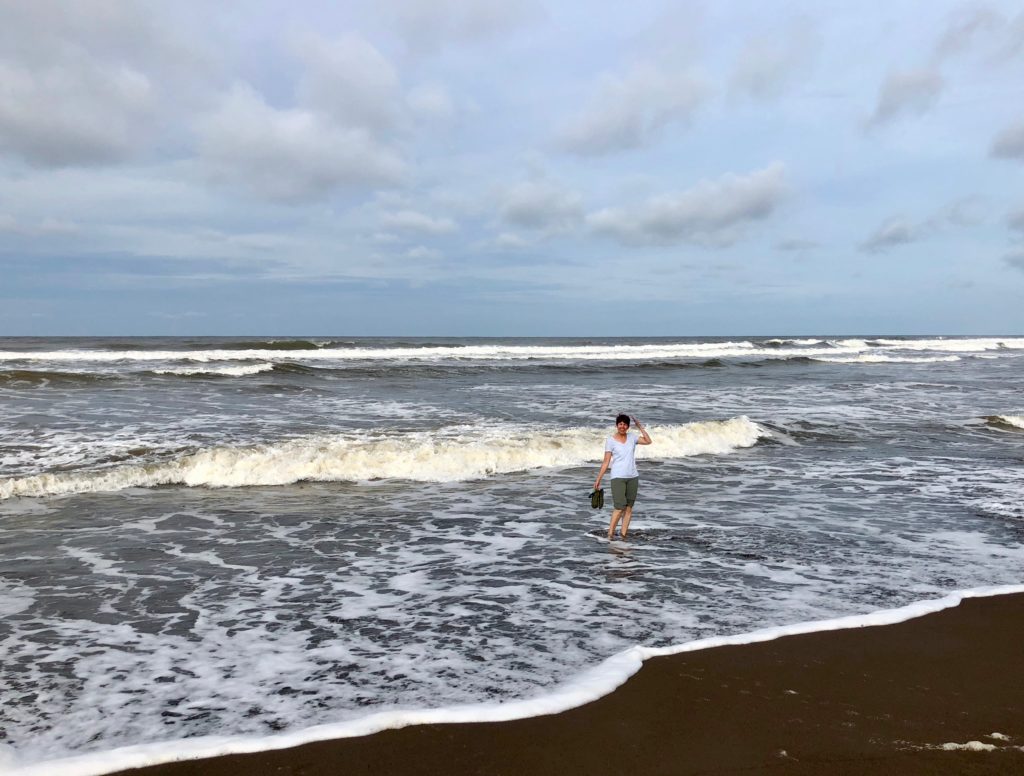
We had been warned about staying too long. That’s because the only way to get back to the lodge was to stand at the shore and wave your arms frantically until somebody saw you and sent a boat. They told us if we waited too long, it would get dark and they wouldn’t see us. Sure enough, someone spotted me gesticulating and came to get us.
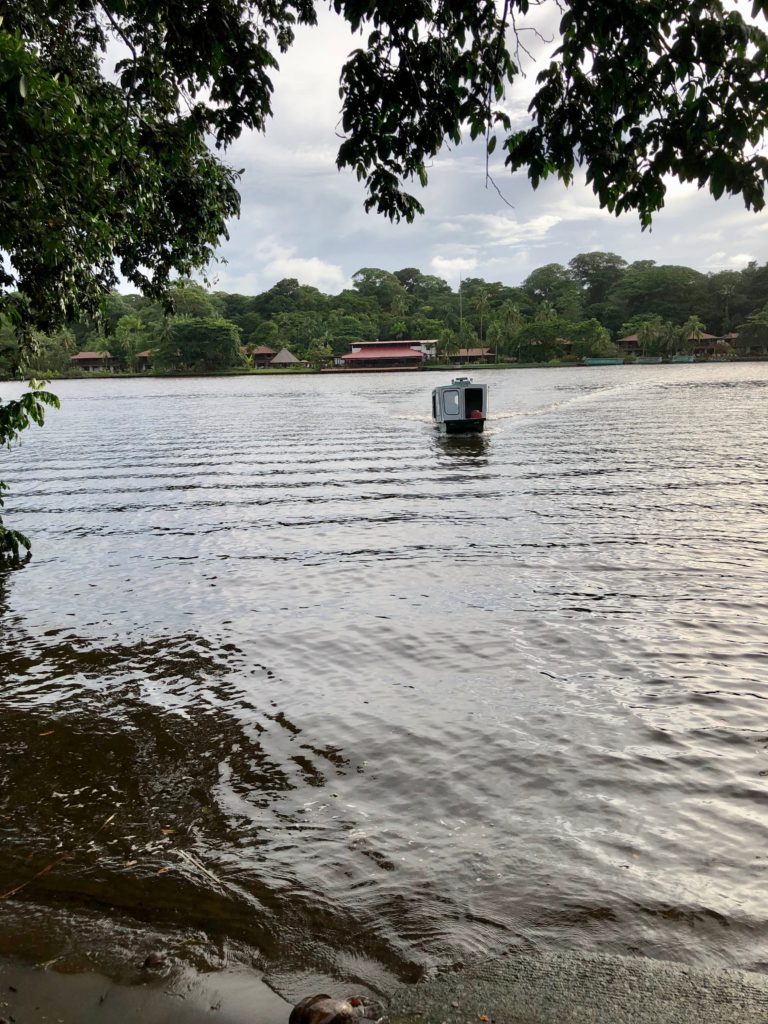
Look who was waiting for us.
After a dip in the saltwater infinity pool, we hunkered down for a little break. Right on cue, the rains started up again. Perfect timing.

I can’t believe how much we did in one day. Tomorrow, we’re off to Fortuna. Stay tuned!
Costa Rica or Bust!

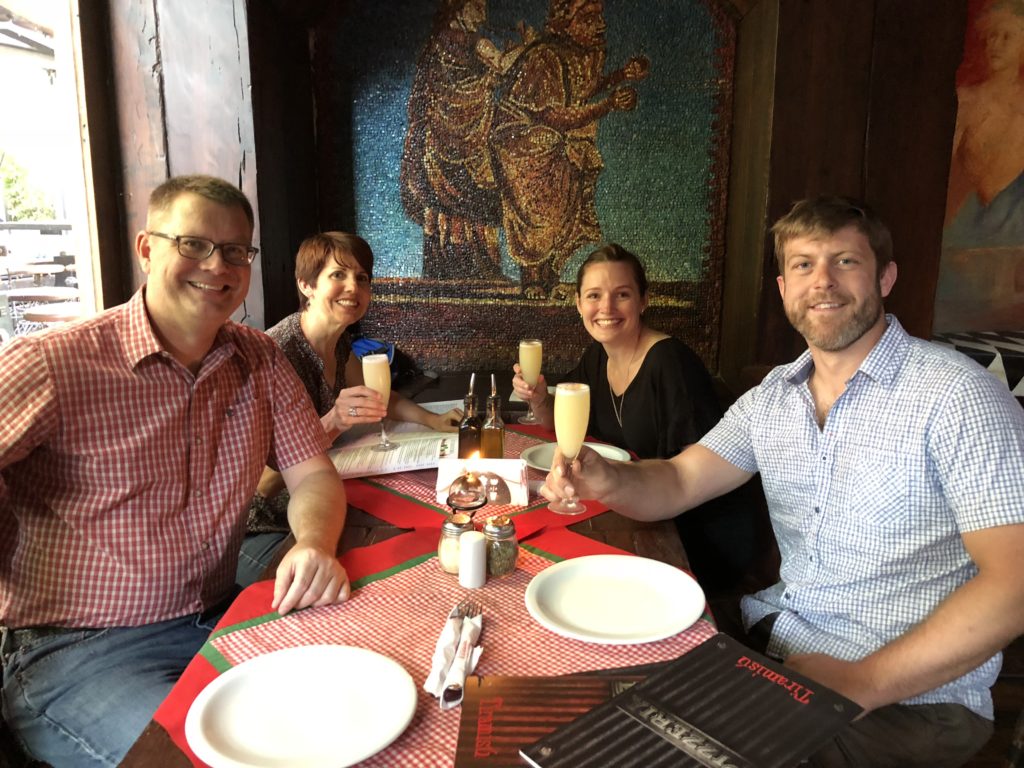
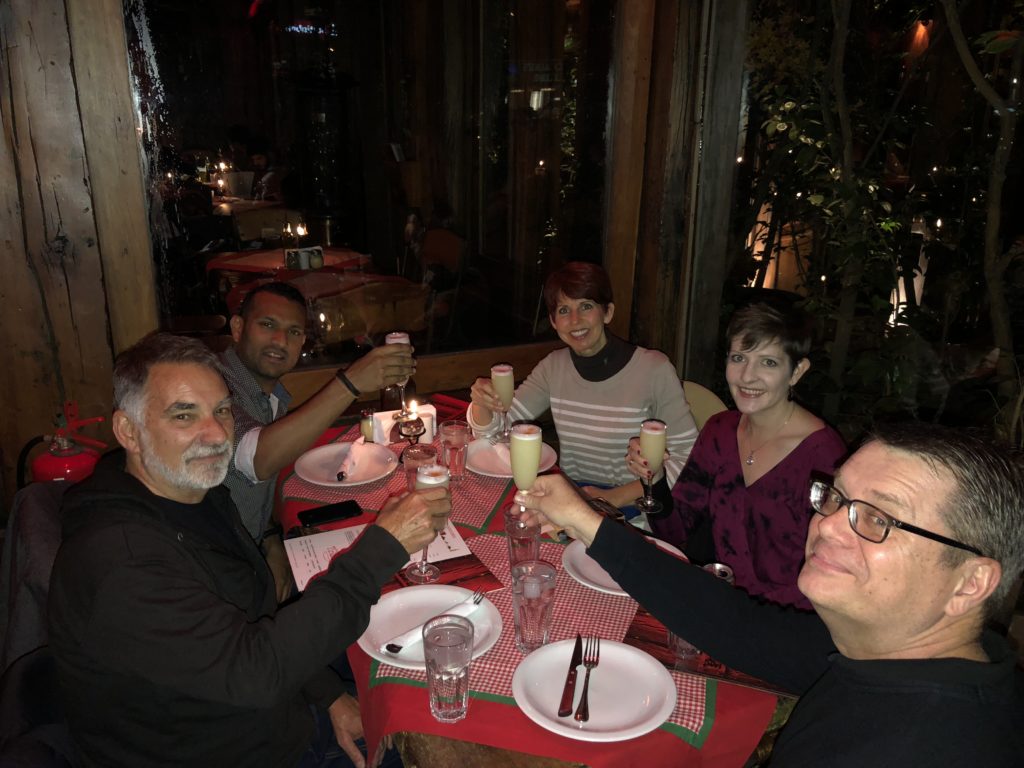
I was truly bursting with excitement about our upcoming trip to Costa Rica. This girl needed a dose of nature. George, our latest pet sitter for Ella (from trustedhousesitters.com), arrived on Friday, so we took him to Tiramisu for our now traditional pisco sour toast.

Awwww… here we are, feeling all optimistic that things would go as planned. (counterclockwise, Tony’s giant face, our friend Lisa from Nido, me, our visiting friend Brian who worked with us in Delhi and now works at our old school in Shanghai, our petsitter George)

Tony and I hit the road on Saturday morning at the crack of dawn.

And then it all went to custard.

We called an Uber at 5 a.m., but when it arrived, the driver refused to take us to the airport. Another Uber answered my call, but he also refused. I later found out an Uber driver had been shot by police at the airport the other day, so I understand their trepidation. Still, we were stressed. Our concierge called a taxi for us, and we got the airport with plenty of time to spare.

As it turned out, we had way too much time to spare. Our 8 a.m. flight was delayed. And delayed again. Until eventually it became clear that we would miss our connection in Lima, Peru. I was determined to get to Costa Rica on time so that we could kick off my amazing itinerary and head straight to Tortuga Lodge and Gardens. Check it out. Can you see why I felt eager to get there?

We had already planned to spend one night in San Jose, Costa Rica, and then drive to La Pavona on Sunday to catch a boat to the lodge. However, if we got stuck in Lima, we wouldn’t be able to get to that paradise till Monday. Maniacally, I researched flights and thought I found a solution: We would book on another airline.

So we finally boarded our Latam Airlines flight from Santiago to Lima. The plane had to have been from the Wright Brothers era. I mean, our seats felt like they were made from plywood, and our armrests had ashtrays! I started watching “Pitch Perfect 2” on the in-flight entertainment, but the system broke down about halfway through the movie and never recovered.

When we arrived in Lima, our luggage didn’t. We were among about 20 people who had missed connections and whose luggage had gone AWOL. We waited at the luggage carousel for about 30 minutes while a Latam representative calmly and kindly kept reassuring us that they would find our bags. Finally, she gave us vouchers for a hotel in Lima. It was Novotel, which I know to be a lovely and fairly upscale hotel chain. Unfortunately, it turned out to be mediocre. Tony called it the “No Votel.” But, whatever, they gave us three free meals.

I continued to research alternate flights to Costa Rica, but we couldn’t do anything until our suitcases surfaced. Dang it.

I’ve been doing a 7-day gratitude challenge on an app called Calm, and today the meditation was all about feeling gratitude in the face of adversity. F**K that. I was cranky.

I washed my underwear in the sink, and Tony ventured out to find toothbrushes and toothpaste. (Yes, yes, we’ve been traveling for umpty million years and we should know to pack a change of underwear and toothbrushes in our carry-on. Please don’t lecture.)

We were so exhausted that we crashed at 7:30 p.m. and slept all night. In the morning, I checked with the hotel’s front desk. No call from Latam. No luggage. Tony thought he was so funny with his jokes like, “What are you going to wear today?” and “We have to leave in 30 minutes and we still haven’t packed!”

We headed back to the airport at 8 a.m. The Latam lady said our bags were still lost. She asked us to check back in an hour. We wandered around the airport until the designated time, at which point she told us to come back in 30 minutes. So we did. Still no news. She gave us a voucher for lunch at the food court. After our greasy lunch, we wandered back to the Latam counter, where she told us our luggage had been found! It was put on our flight to San Jose. Hooray!

We walked buoyantly to our gate, feeling like FINALLY we were kicking off this vacation. We hunkered down to wait for our flight to Costa Rica. I had come to grips with the fact that we were going to miss one day at Tortuga Lodge. I was disappointed, but more than anything, I just wanted to get there.

Suddenly, a crabby Latam Airlines lady invaded our tranquility to ask for our yellow fever paperwork. We were like, “What?” She asked if we had stayed in Peru … because apparently you need a yellow fever shot if you travel from Peru to Costa Rica. “Well, yes, we did stay one night here because Latam lost our luggage,” I told her. She huffed and stomped away with our passports. Another passenger, a British guy who we now call Tony’s doppelganger because they looked freakily alike, overheard our conversation. He had also missed his connection to Costa Rica and stayed at our same hotel the night before. Apparently, the airline had warned him that he might encounter some problems because of his lack of yellow fever certification.

Eventually, crabby lady brought our passports back with “OK” scribbled on our boarding passes.

When we arrived in San Jose, we hustled to the immigration line, sweating about whether we would be asked about the yellow fever thing. The doppelganger was a couple people ahead of us in line. We watched him with bated breath and sighed with relief when he got his passport stamp without any drama. When it was our turn, our guy was pretty friendly and chatty. He didn’t balk at the fluorescent pink Peru stamps in our passports, but simply asked us about our professions, made a little small talk, and then found a spot to plant that coveted Costa Rica stamp. Whew!

We proceeded to the baggage claim, where – hallelujah! – our suitcases actually plopped on to the carousel with a smug sense of accomplishment. We got local SIM cards for our phones and cash in the local currency (colón), which is confusingly .0018 to the dollar. Then we caught the shuttle to the rental car agency, picked up our Suzuki Jimmy, and headed to a nearby hotel for the night. Tomorrow morning, bright and early (because we found out there will be a protest about some proposed tax), we’ll head to Tortuga Lodge.

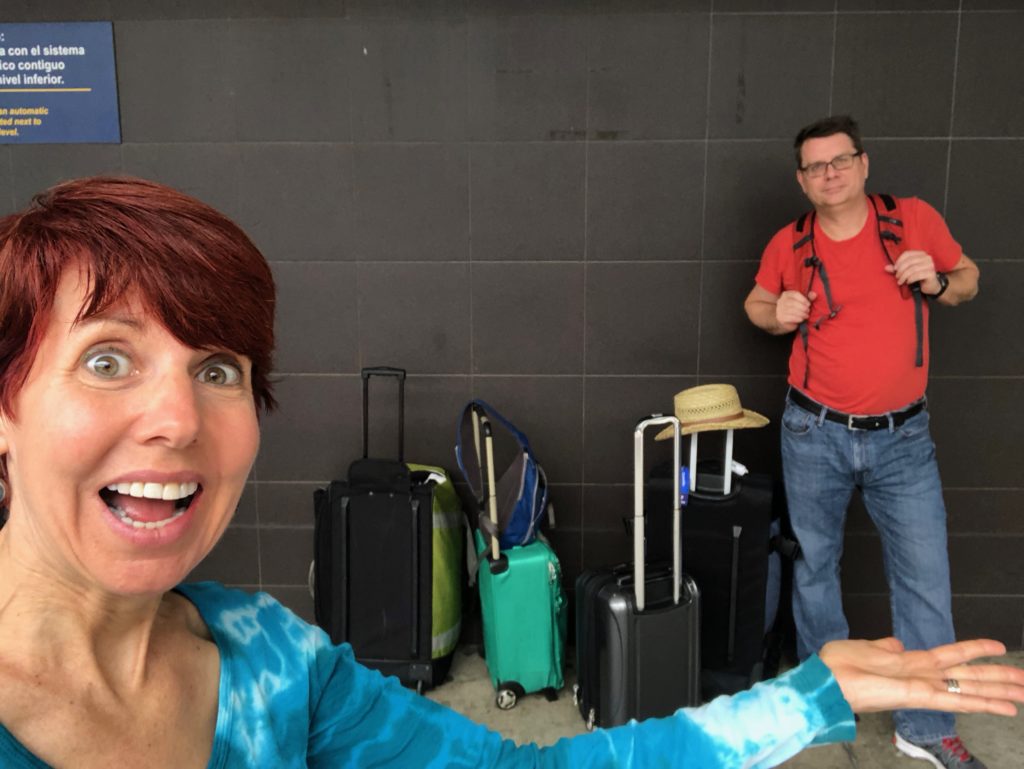
Here we are, all stinky and greasy and relieved to finally get our luggage.

Stay tuned for our Costa Rica adventures!

Easter Bunny brings mini family reunion to Florida

Tony and I have lived abroad for 17 years, and without a doubt, the hardest part for me is the lack of contact time with my parents, siblings, and seven adorable nephews and nieces. We chose this lifestyle to see the world, immerse ourselves in different cultures, and broaden our perspectives. So when a school break comes along, I grapple with a self-imposed guilt-ridden juggling act: Go home? Explore a new place?

The week before Easter, I chose to go home. I took a few personal days, combined it with our two days off school, and headed to Florida. I thought I would enjoy a little quiet time with my parents and get the scoop on my dad’s illness. That happened – a bit – but thanks to school holidays around the world, my visit turned into a mini-reunion.

My sister Kate brought her three boys from Michigan, and my brother Mike and his wife, Summer, traveled from Korea with their two kids. Our other sister Megan had just wrapped up a Florida trip, so she couldn’t justify joining us, unfortunately.

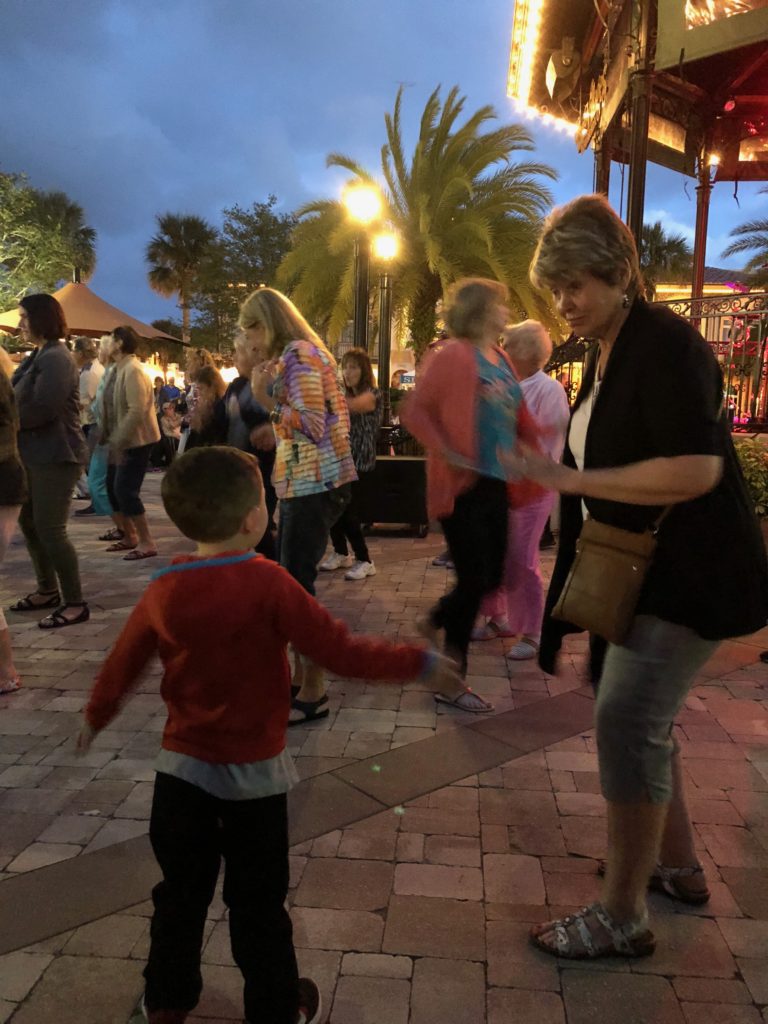
With live music in the town square every night, the younger kids danced their hearts out. The older ones are just starting to get embarrassed by their family, so they mostly sat out.

Max and my mom boogie.

This is my new go-to happy video. Jack was the life of the party.

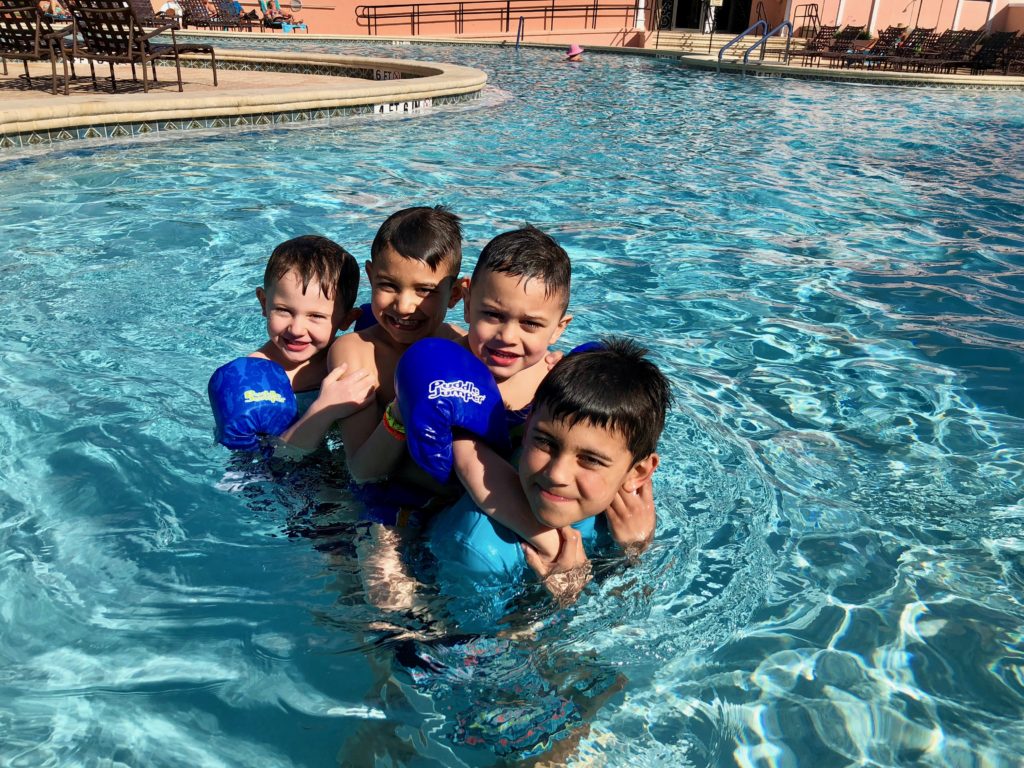
We spent a day at the club pool, where my face hurt from laughing at the shenanigans of these silly cousins.

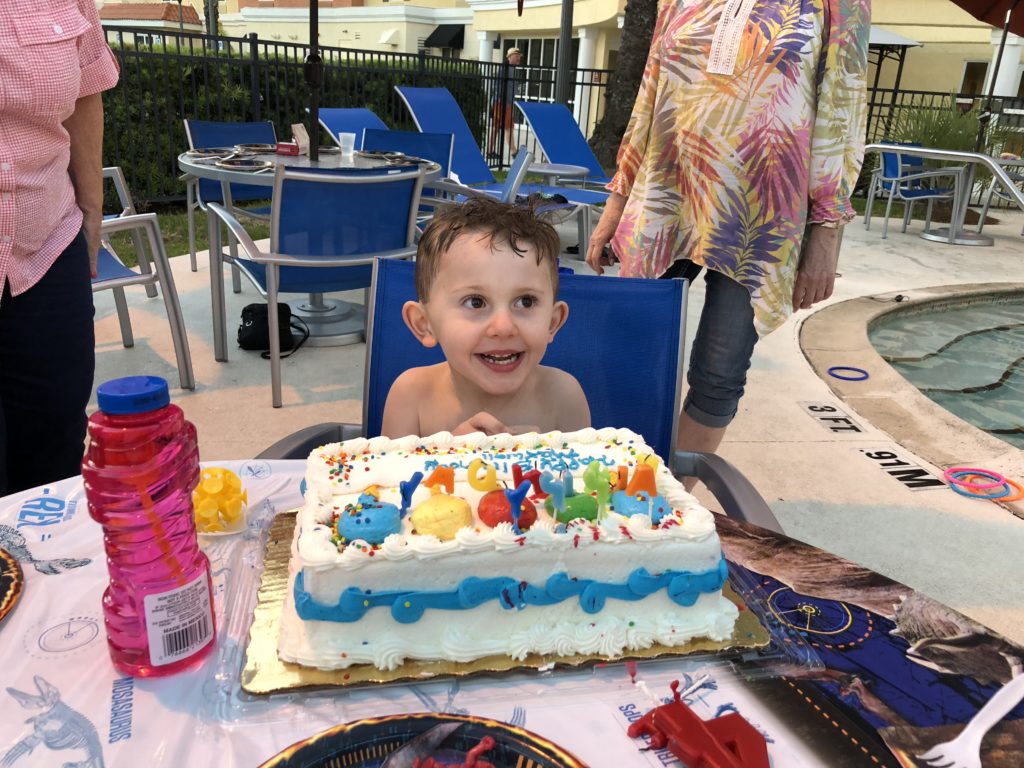
Max celebrated his fourth birthday with a pool party at the hotel. Such a cutie.

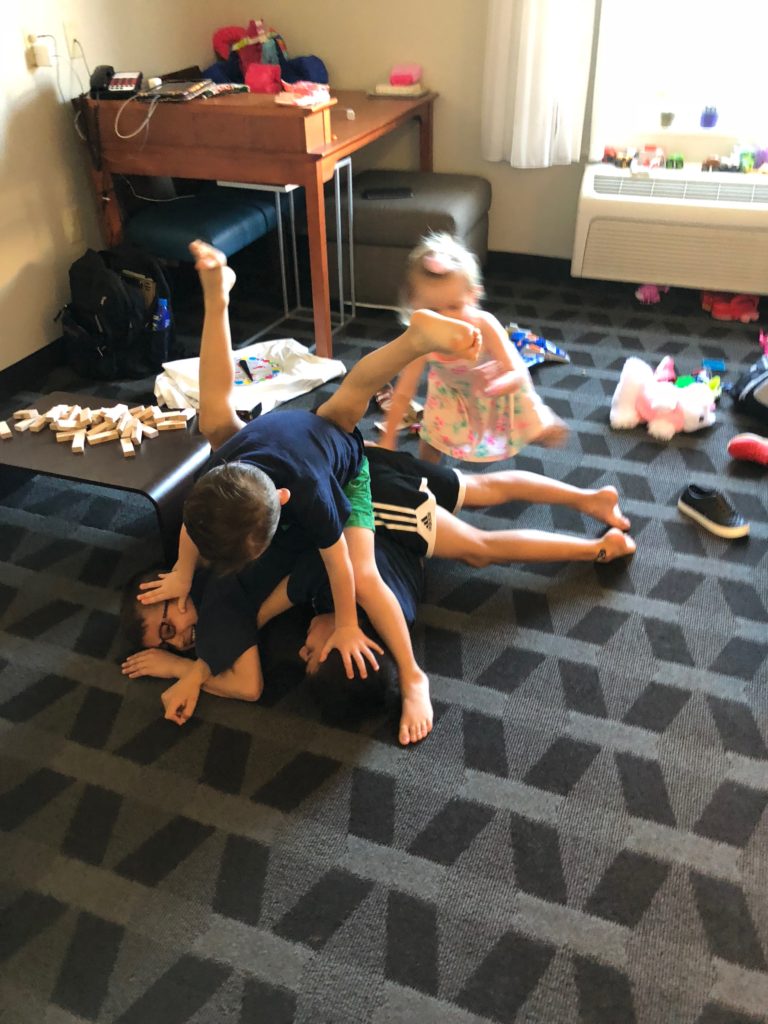
One night, I sent the other adults out to dinner while I hung out with the younger crowd at the hotel. It started to get a little out of control…

… so I turned it into a dance party! Each kid had to get up and teach us a dance move. Then we put it all together.

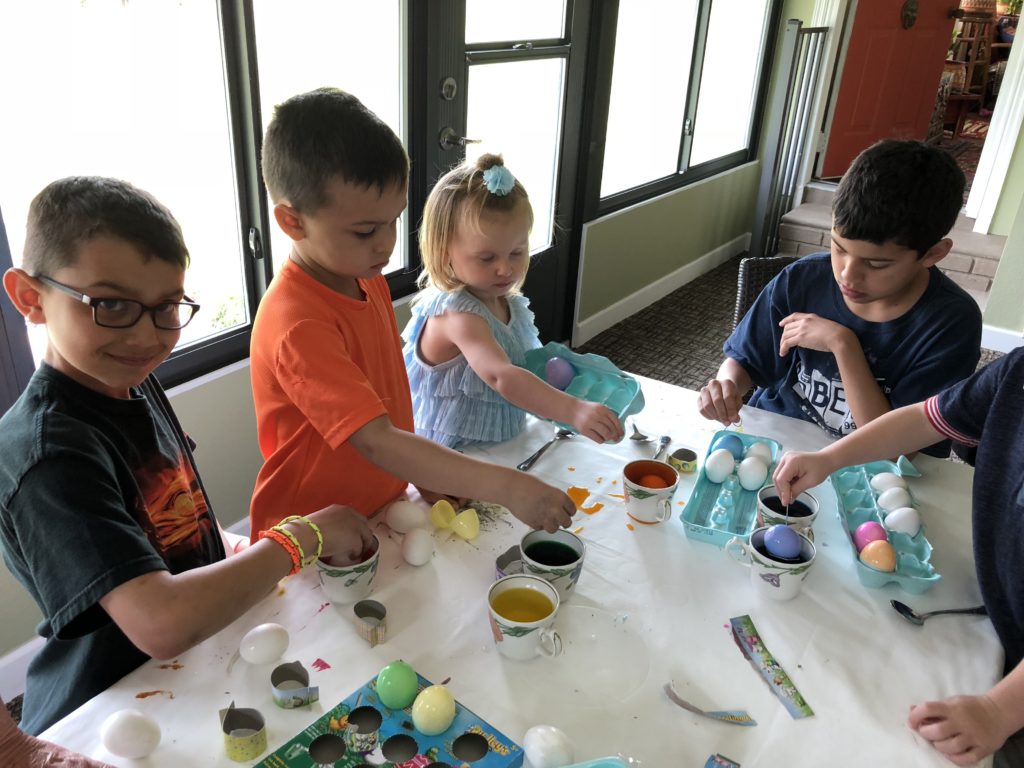
I was flying out Saturday afternoon, so Easter came a little early. The littlies colored eggs, and the next day they arrived at my parents’ house to find the Easter Bunny had hidden candy-filled eggs around the yard.

How is it I didn’t take a family photo? Sigh… As I mentioned, this kind of gathering doesn’t happen very often. This is the best I can offer. My nephew Paul kept “flossing,” a dance that literally every third grader in the freakin’ world is doing these days. So we made this video.

My dad and I spent one day together while the rest of the crew took off for a gator park. I took him to a doctor’s appointment, we ran a few errands, and we ate lunch at Sweet Tomatoes (always a treat!). With our loud, rambunctious family, he often struggles get a word in, so I appreciated this quiet time to catch up.

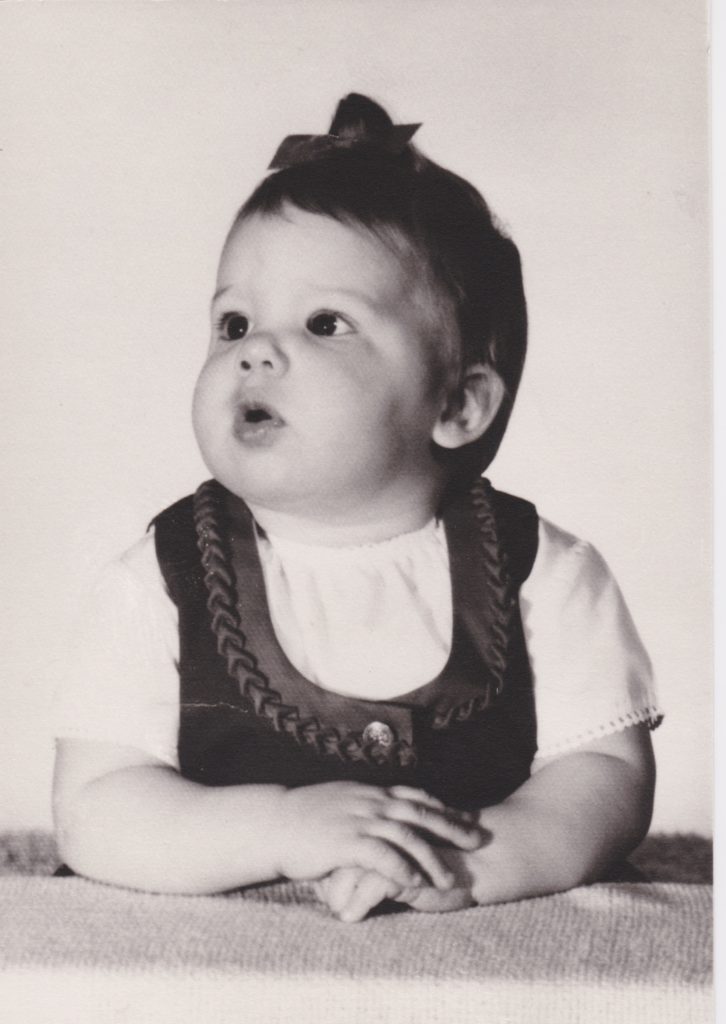
He and I launched a project to scan old photos. It’s a tedious, time-consuming process, but it was fun to reminisce about my own childhood and hear my parents’ familiar stories about their youth. I was going to post some of my favorites, but then I spent another hour or so sorting through them, getting lost in memories. I’ll just wrap up with this pic of chubby one-year old me.

Back in Chile, my heart aches already. There’s never enough time with that gang.

WineBox – bringing a new level of quirky to Valparaiso

Well, dang it. Sometimes someone just beats me to the punch.

I was just getting ready to compose a witty and fascinating post about our stay at WineBox in the Chilean port city of Valparaiso. Then google handed me this: Grant Phelps and His WineBox by Kendal Montgomery on her website Purple Mouthed.

No point reinventing the wheel. This lady nailed it. So… instead, I’ll strongly encourage you to read her post, and I’ll just add a bit of commentary about our visit.

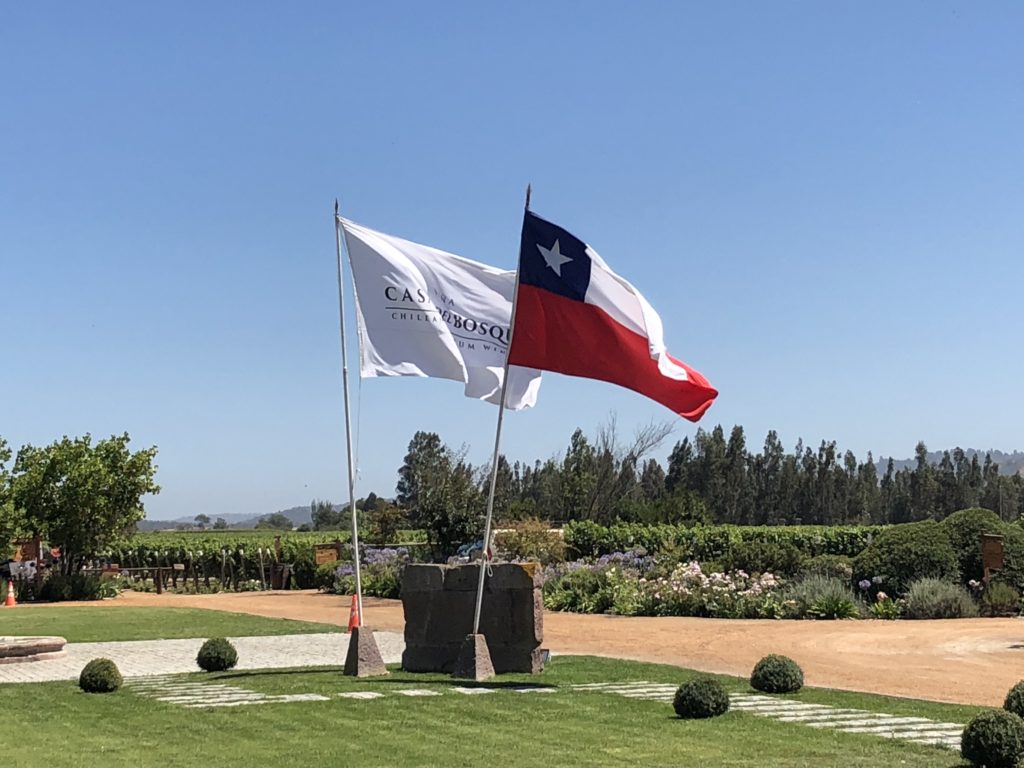
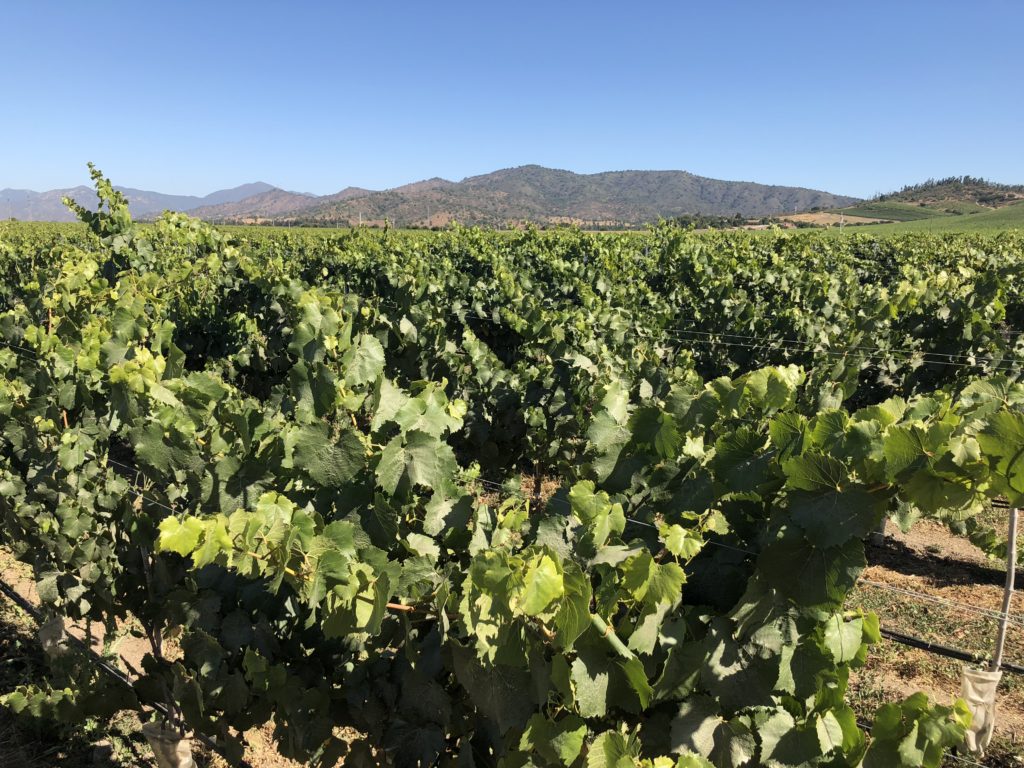
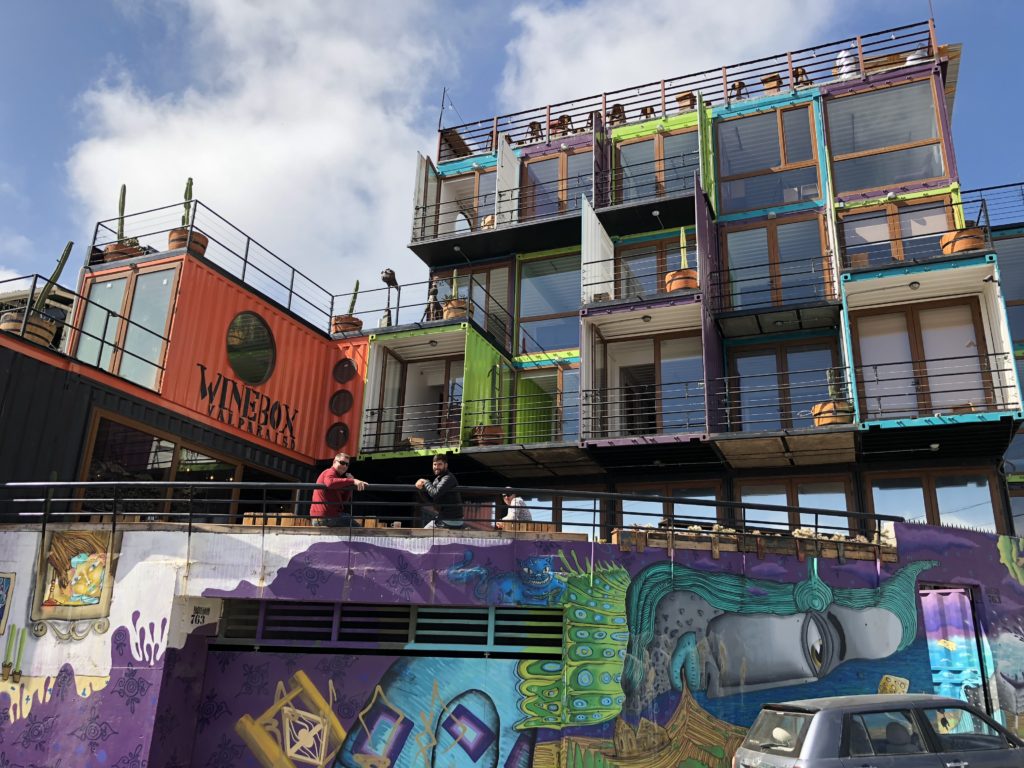
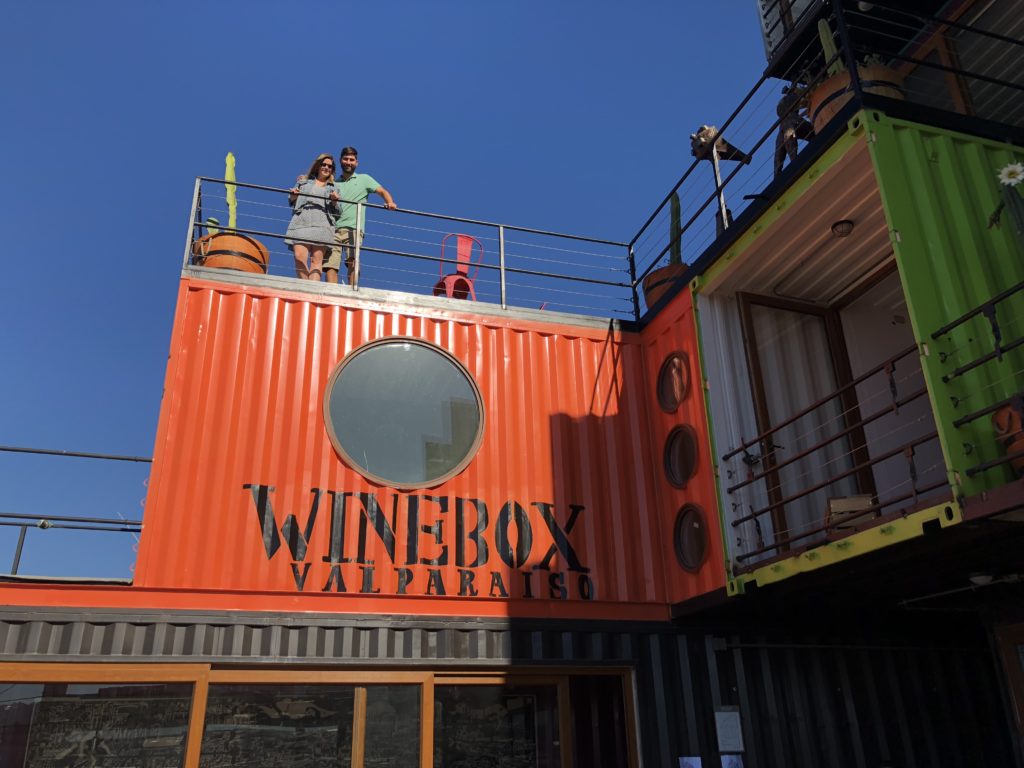
On Feb. 11, we took off for the coast to celebrate the birthday of our friend Sam. The plan included a tour and lunch at Casas del Bosque winery in the Casablanca Valley before checking in at WineBox, a new hillside hotel built out of retired shipping containers and overlooking the sea.

As we all waited in the warm sunshine, the winery started its tour without us, even though our conspicuously big gringo group had just paid. Hmmm… maybe we could have lunch first and do the tour afterwards? A waitress led us to the restaurant, where alas, there were no tables available. Hmmm… maybe we could just sit outside and drink wine? So that’s what we did. Eventually we had lunch, but the tour never materialized.

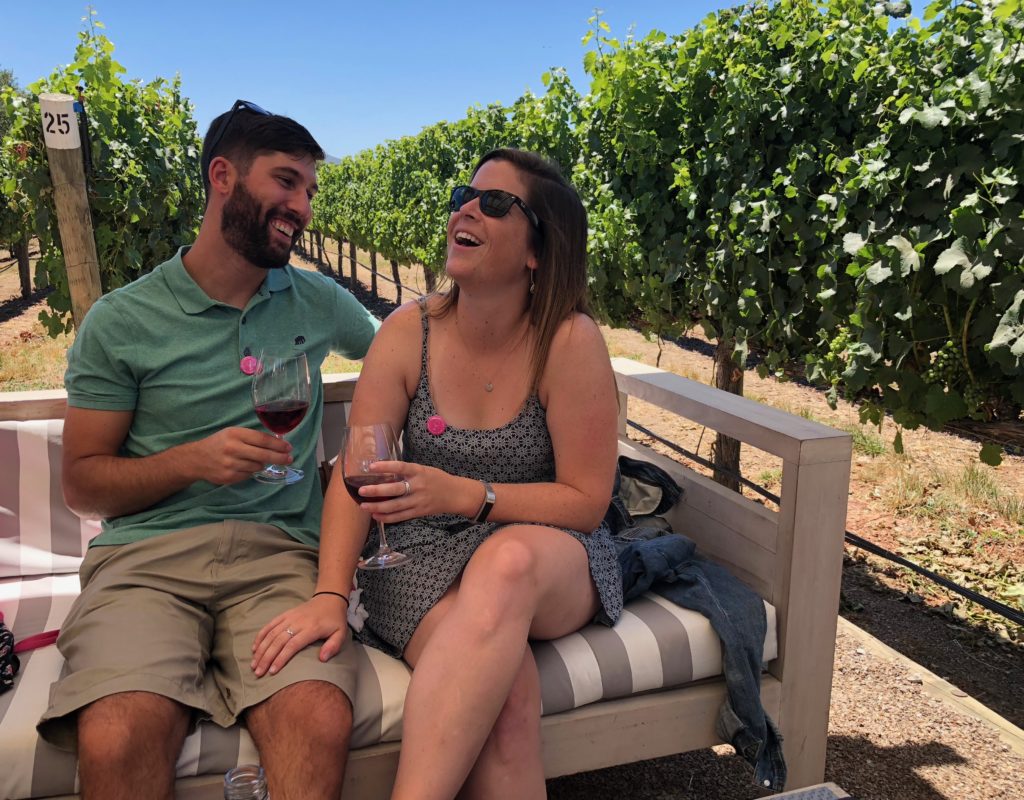
Sam and Hilary do their best “catalog models in a vineyard” schtick.

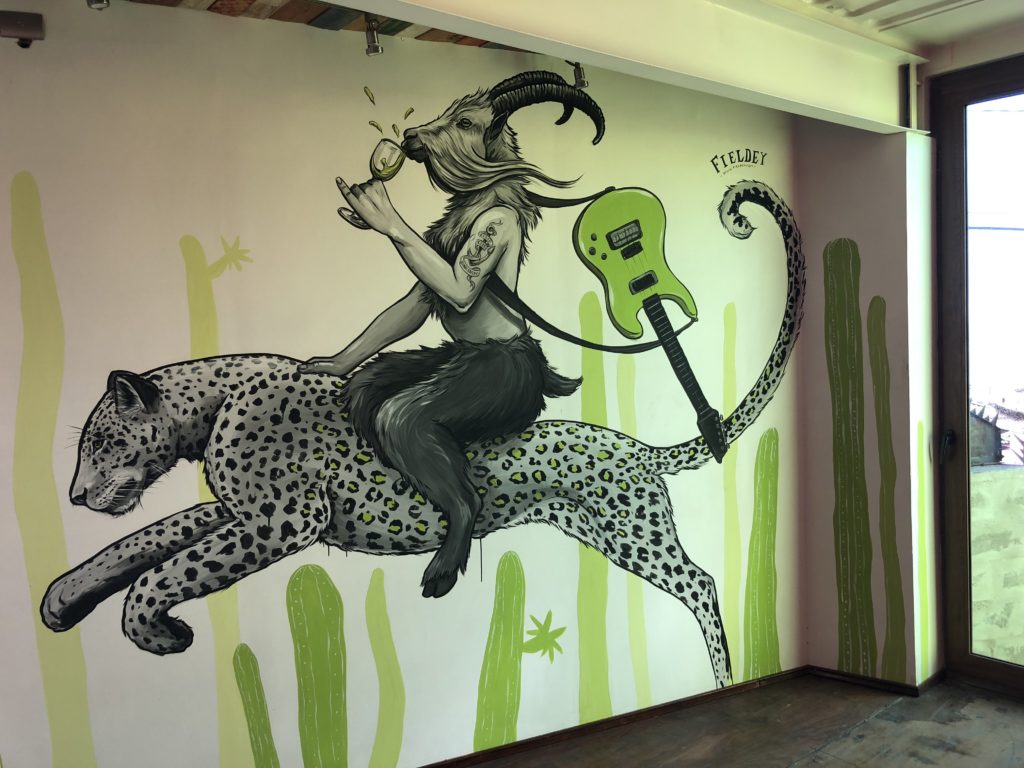
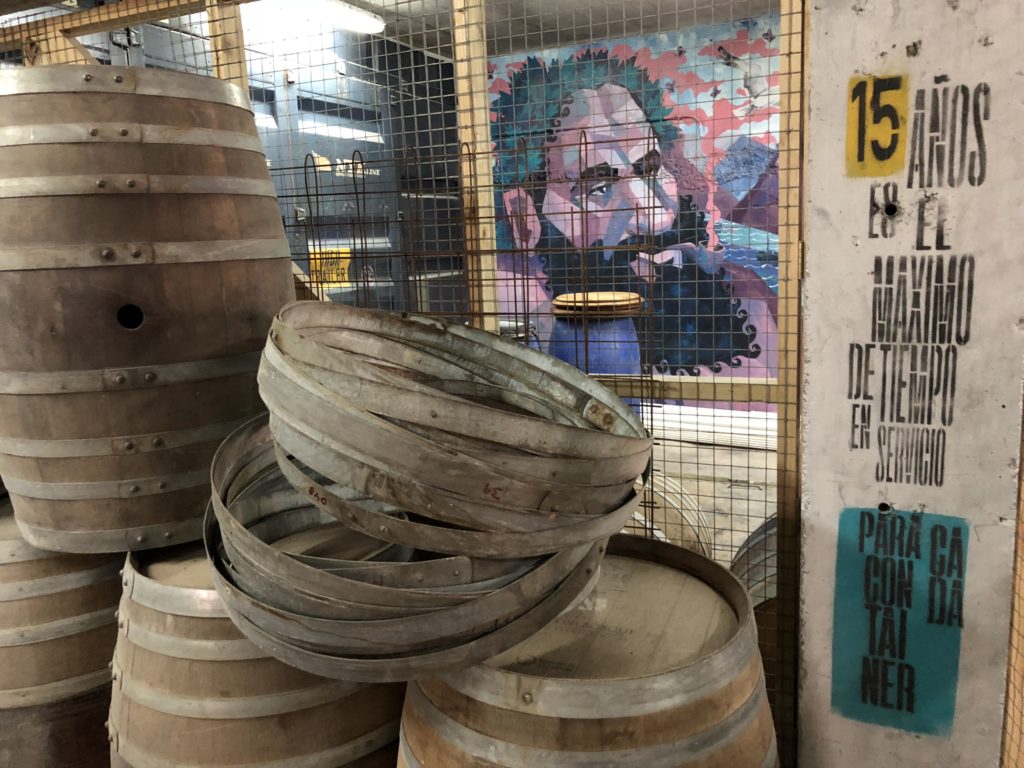
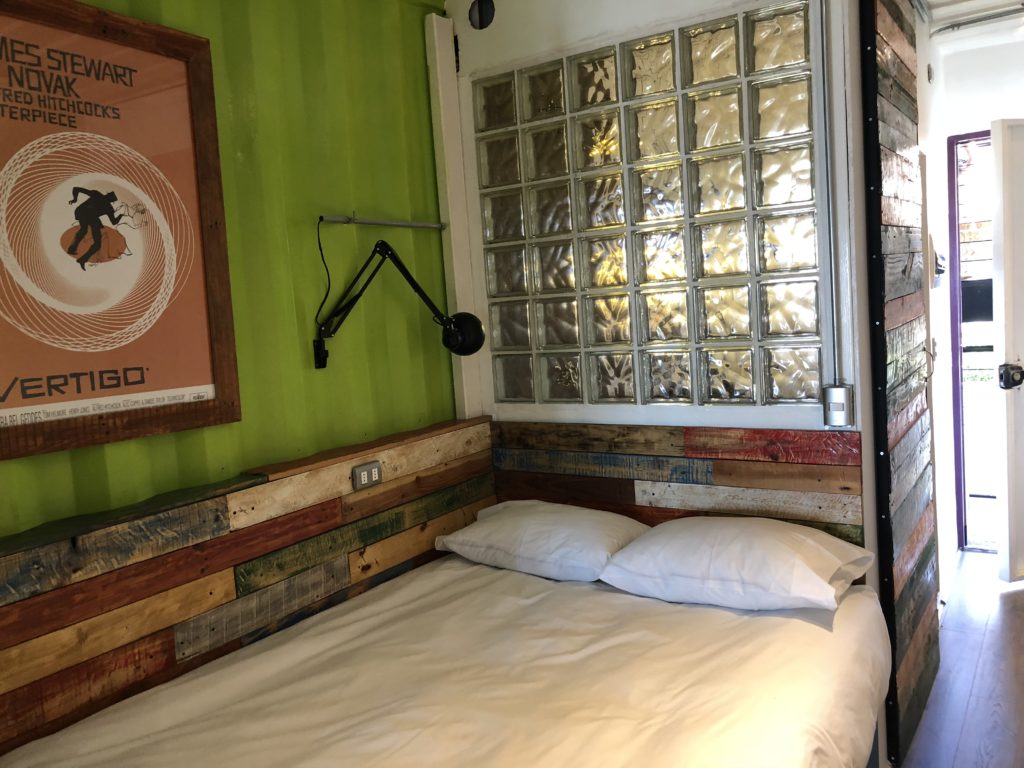
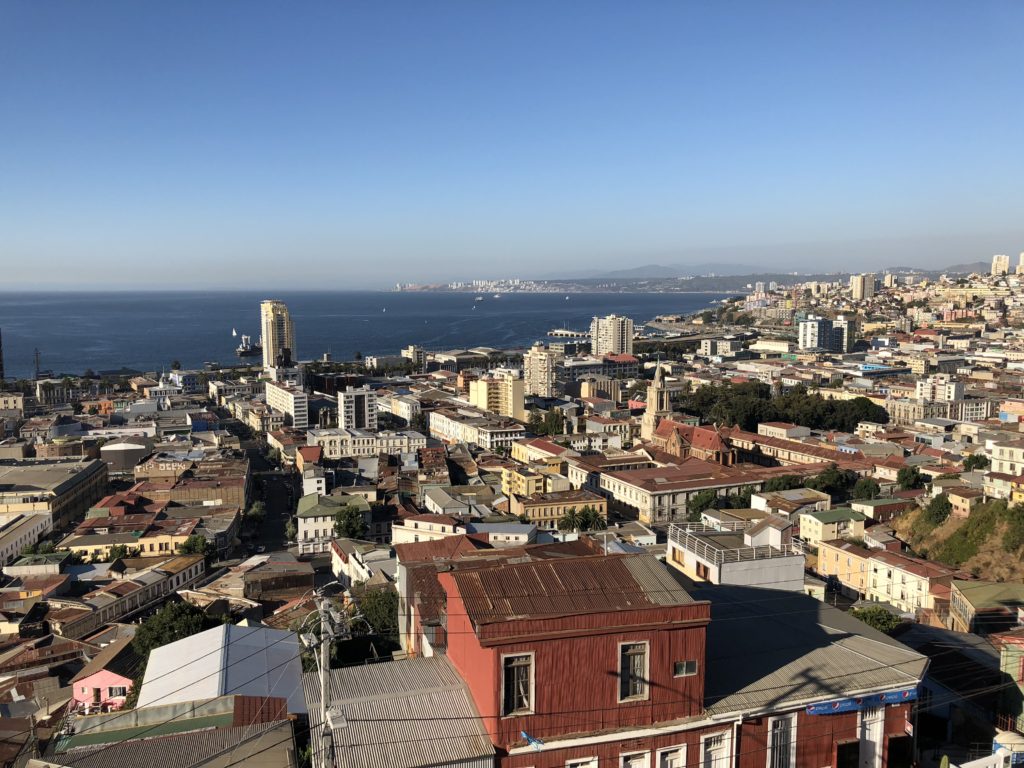
Later, we zigged and zagged up one of Valparaiso’s famous hills to reach WineBox, where we parked in the combination winery/parking garage. The place was bursting with color and art, and we all felt giddy at the novelty. Just when you think Valparaiso can’t get any quirkier…

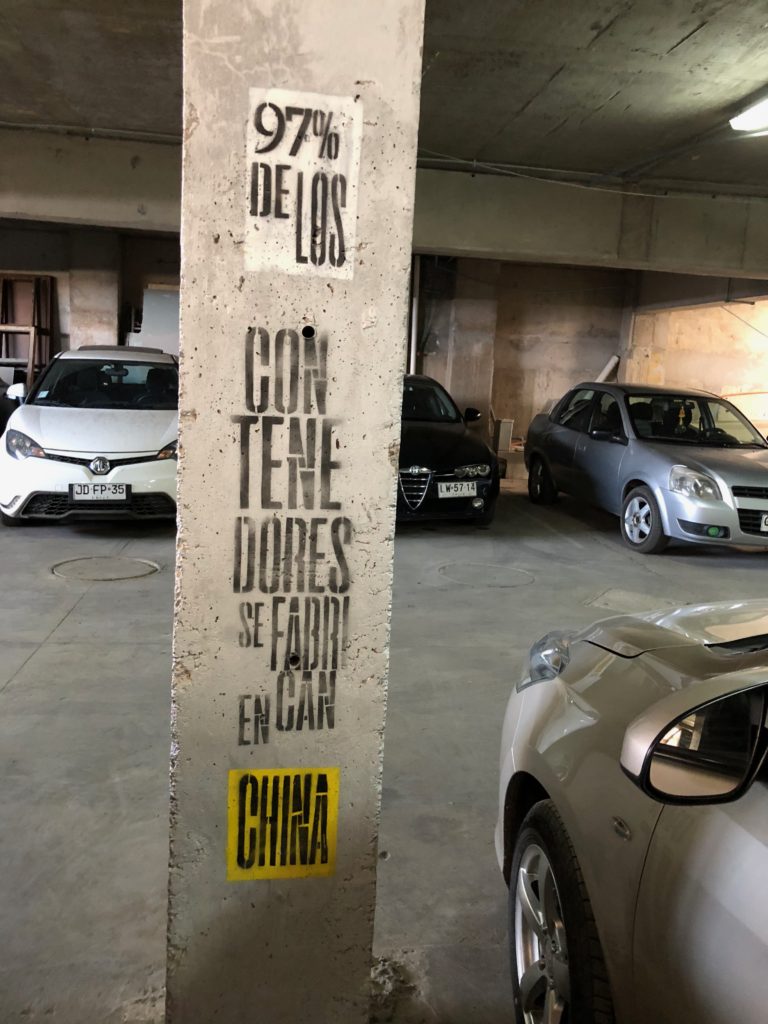
Even the beams in the garage featured stenciled art – facts about shipping containers, of course.

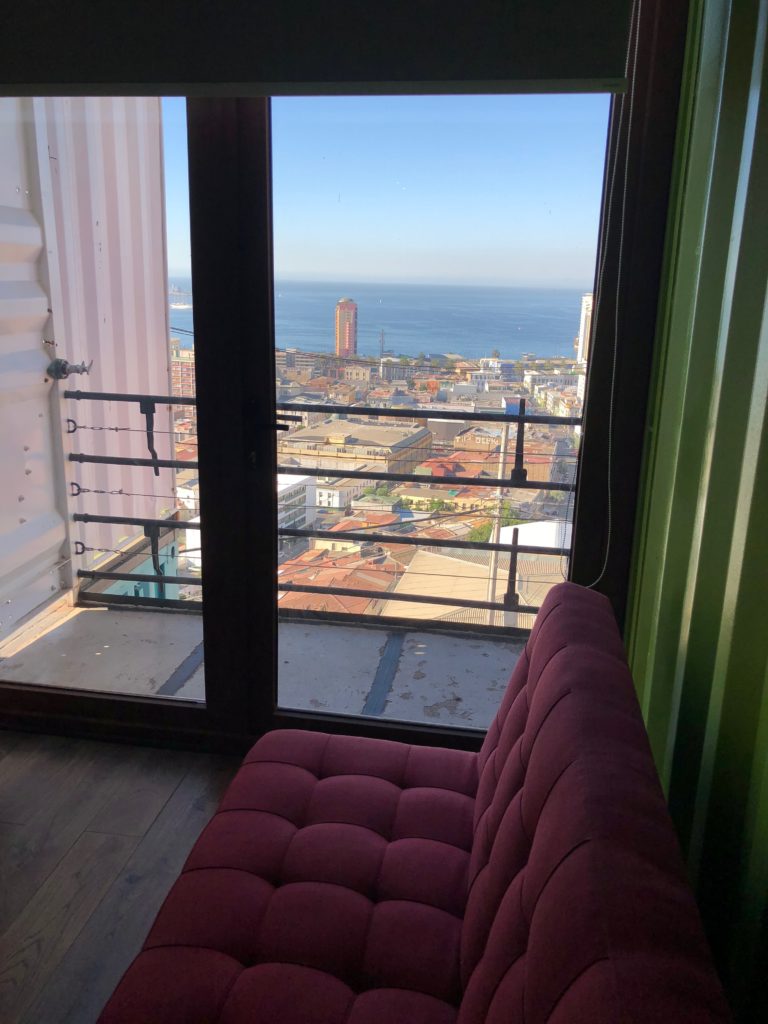
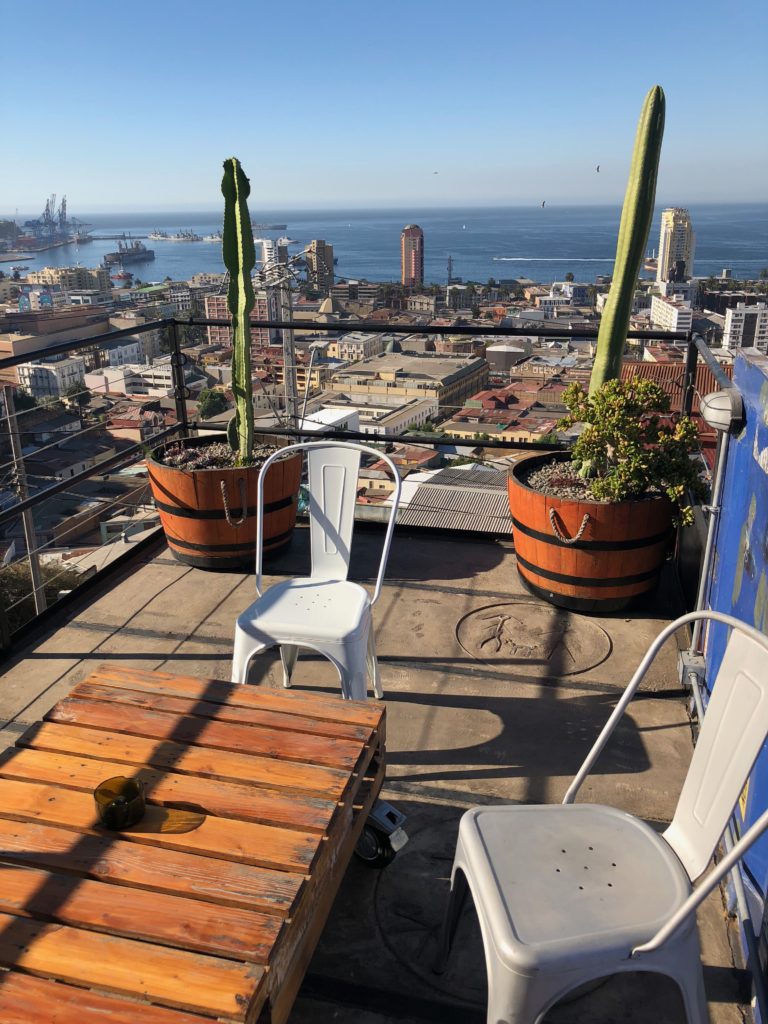
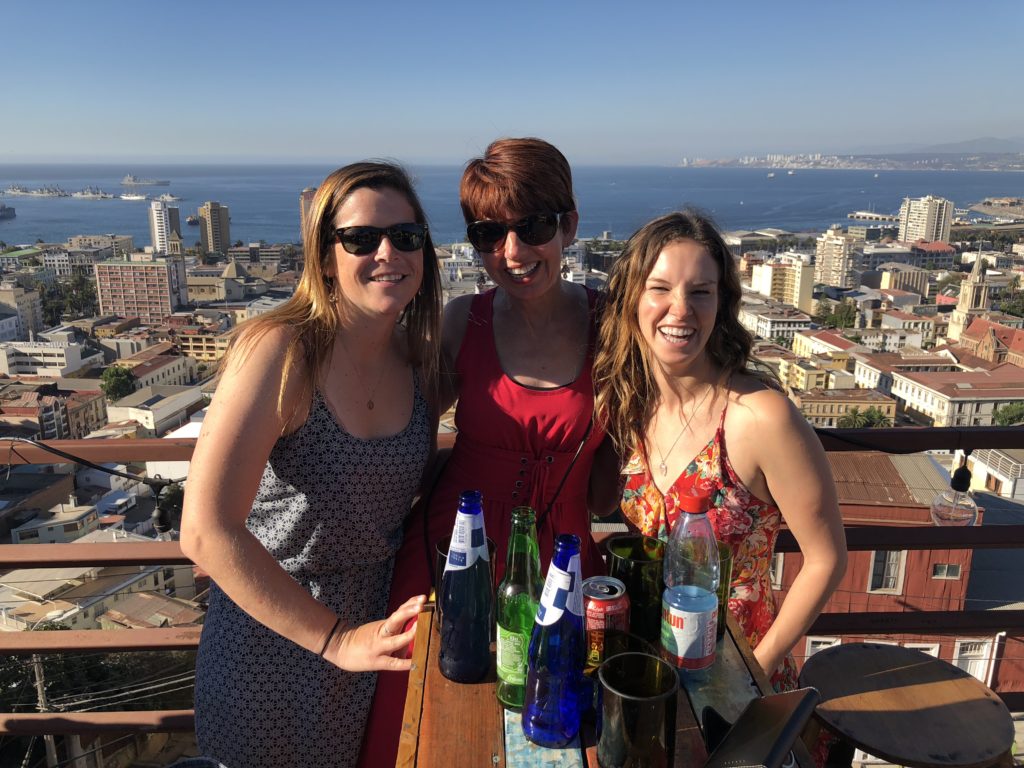
Upstairs, we explored our rooms and the rooftop bar. Such a fun vibe.

We spent the evening with pizza, wine, and games. After breakfast the next morning, winemaker and WineBox owner Grant Phelps shared his story. Check it out:

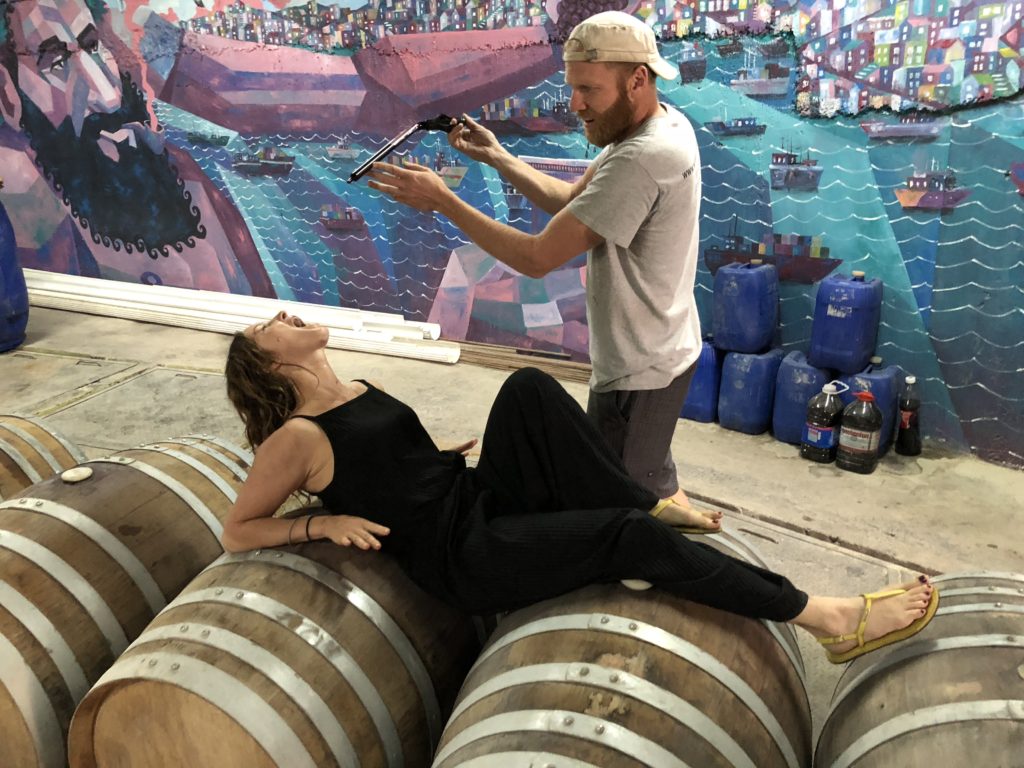
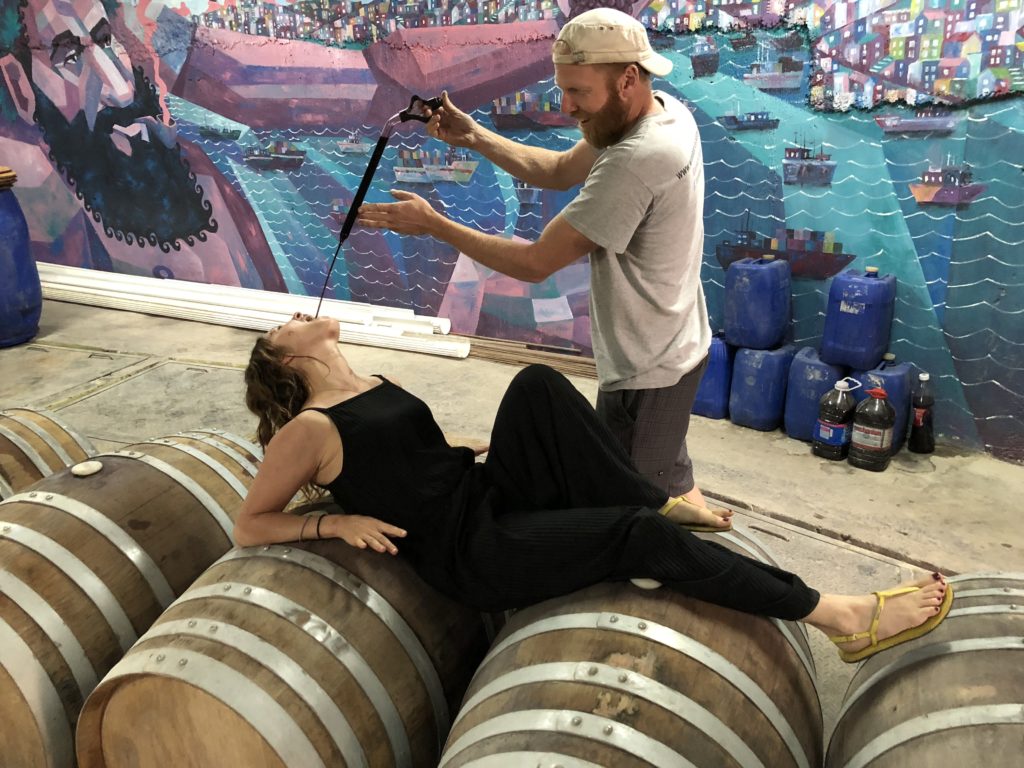
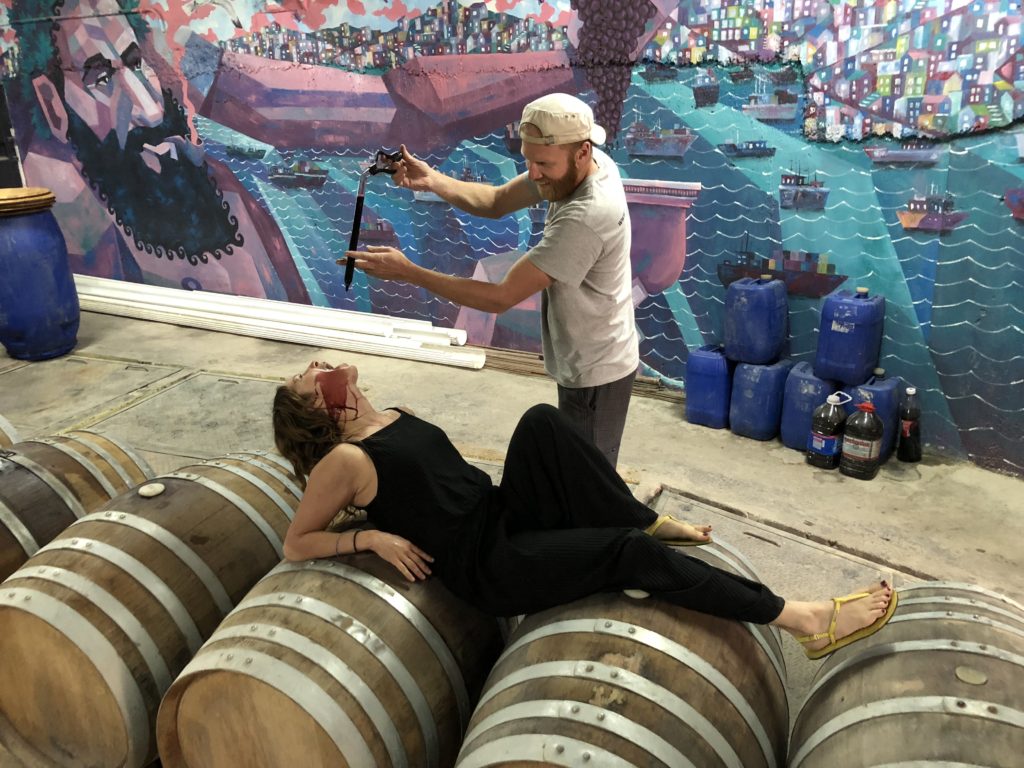
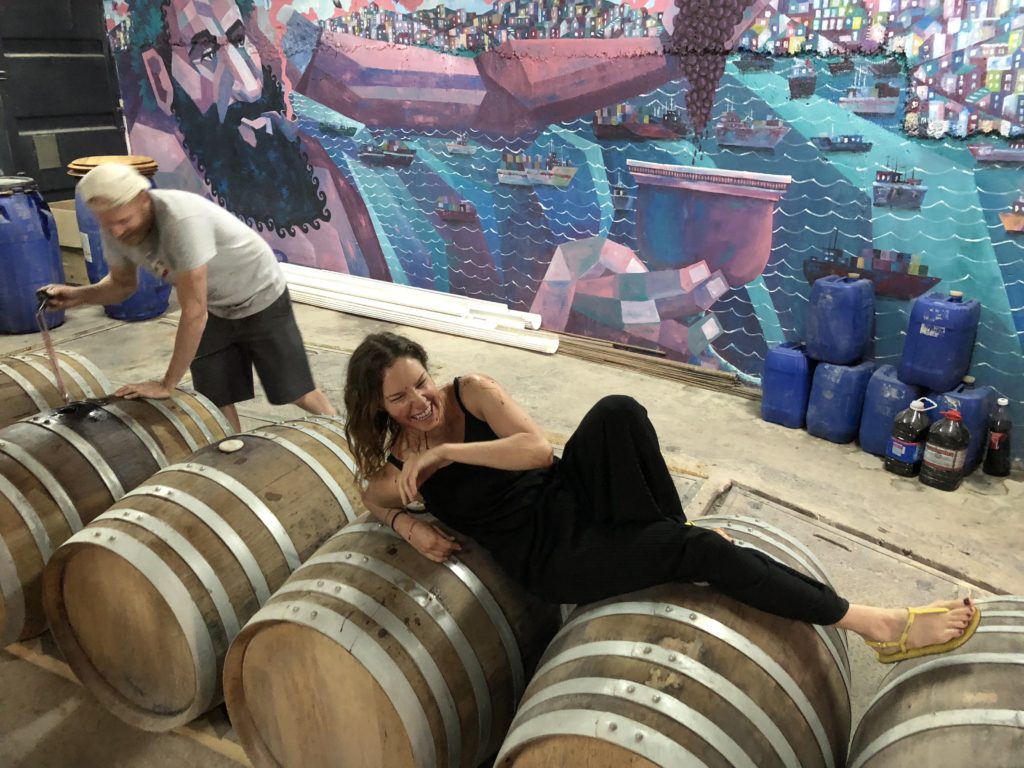
Before heading back to Santiago, Grant offered me a “syrah lay back.”
“What’s that?” I asked.
He explained, “You lay on the wine barrels and I shoot wine into your mouth.”
“Oh hell, no,” I said.
But Sarah said, “Oh hell yeah!” And that’s how Sarah became the first person in WineBox history to experience the syrah lay back. I made her wipe the wine off her back and out of her hair before getting in my car.

SUMMER? WINTER? VACATION! PART 3: Buenos Aires

This post is WAY overdue! Our trip to Buenos Aires took place Feb. 3-9. Sooooo… it’s time to catch up …

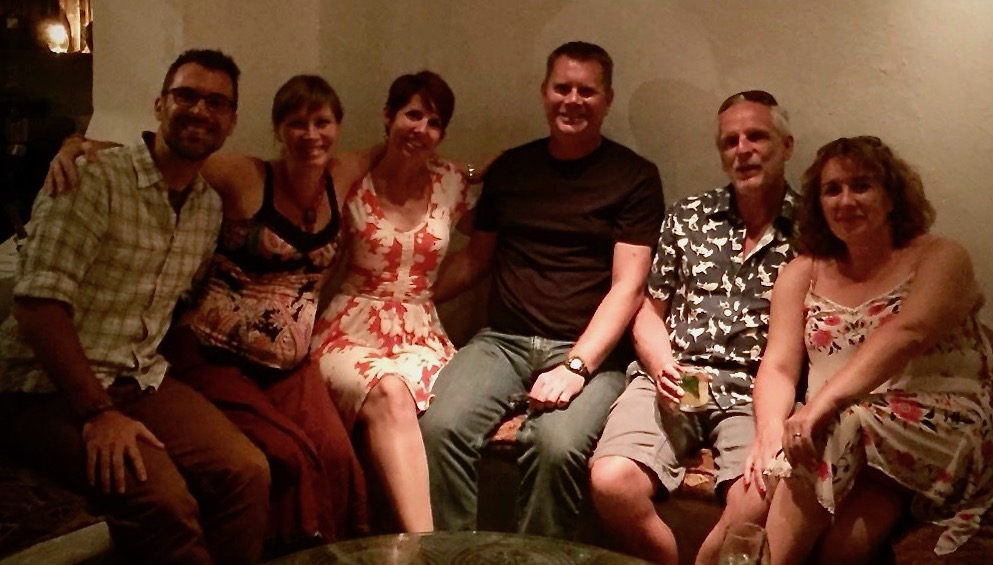
We first registered on the website Trusted Housesitters to find people to care for our cat, Ella, when we traveled. However, we’ve since discovered an unexpected perk: These are cool people! We’re making interesting friends with people from all over the world. For our weeklong trip to Buenos Aires, we were thrilled to welcome Aideen and Jonny, newlyweds from the UK, to hang out at our apartment. We may even visit them in Ireland some day! This is becoming an iconic pose on my blog: Us with our latest pet sitters, drinking pisco sours at Tiramisu.

We were traveling with our friends, Nancy and Jim, so I had booked two Airbnb apartments in the same Buenos Aires building. Unfortunately, the apartment owner canceled at the last minute because of a maintenance issue. Impulsively, Nancy and I each booked separate Airbnb’s in the same district, but they turned out to be a fair distance apart. Ours was a tiny studio, and theirs was a huge house. Bummer.

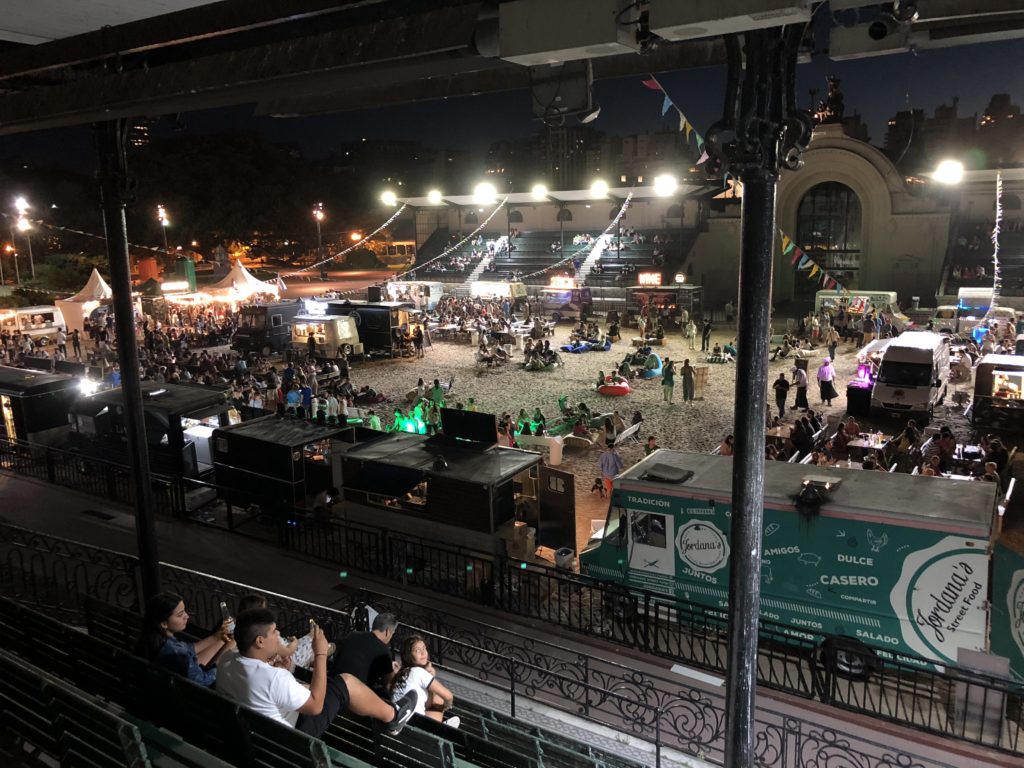
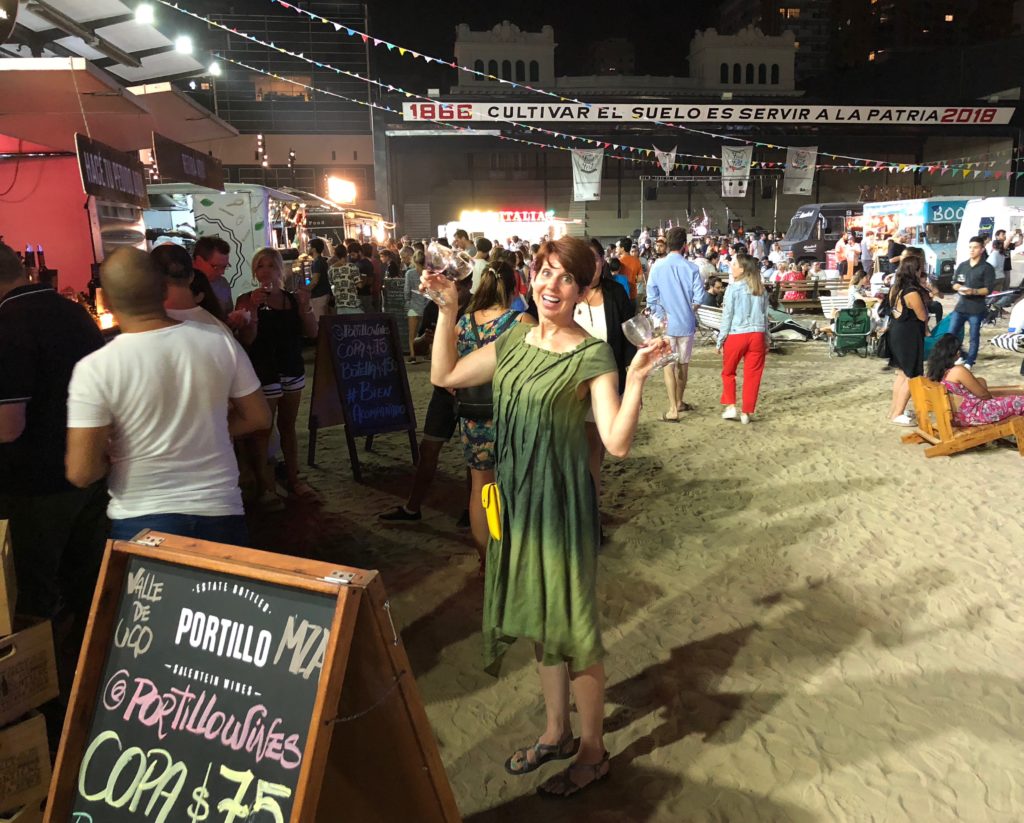
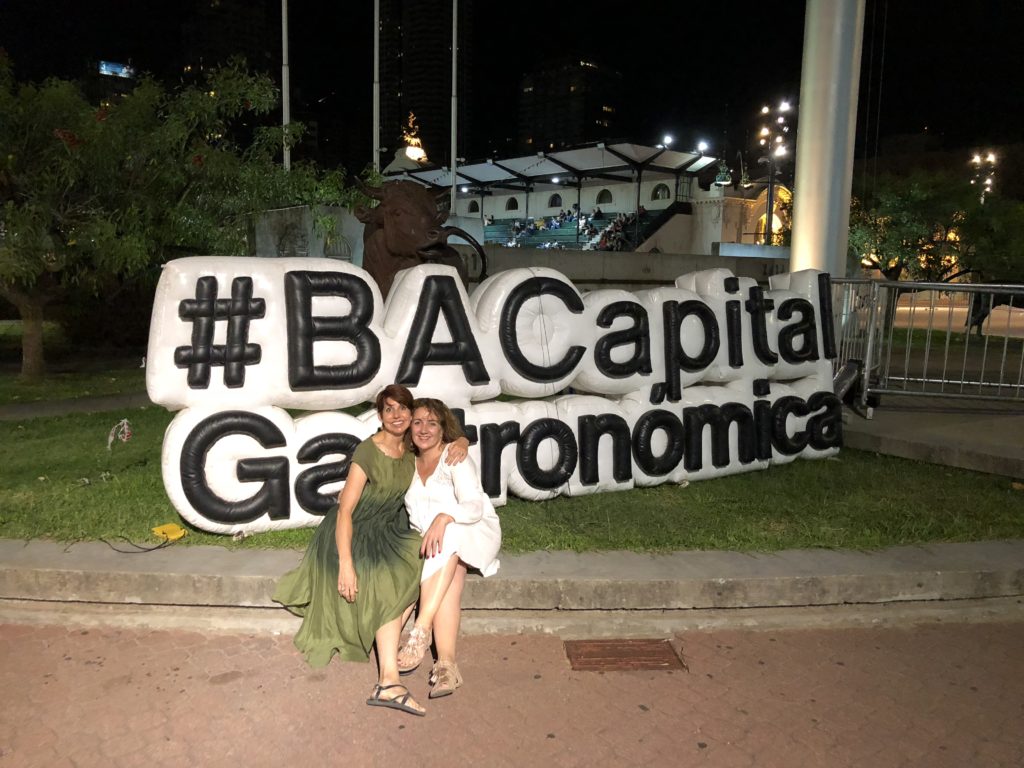
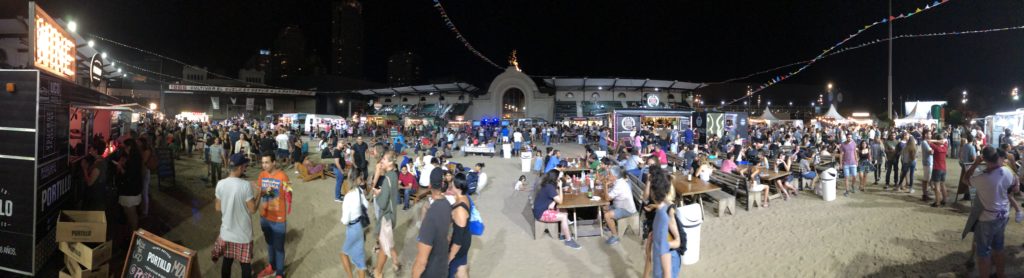
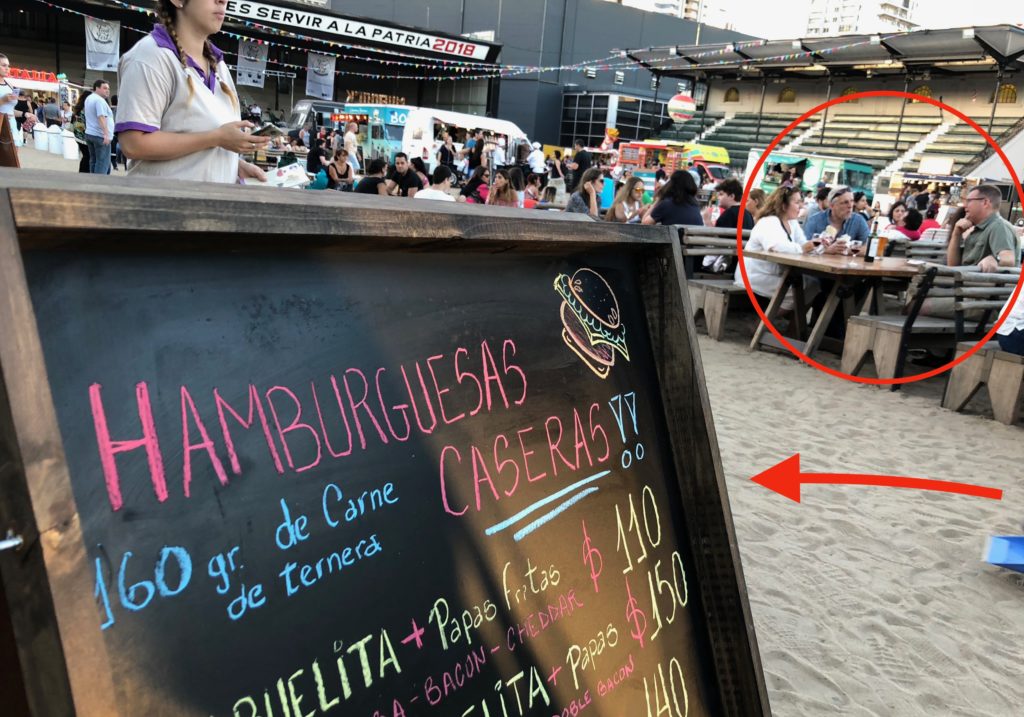
Right off the bat, we found a food truck festival and had a fun evening drinking a lot of Argentinian wine and pigging out.

I waited for 30 minutes (!) to get a hamburger from this food truck, while the rest of them gobbled up their delicious dinners from other trucks.

View from the bleachers.

Returning our “rented” wine glasses at the end of the night.

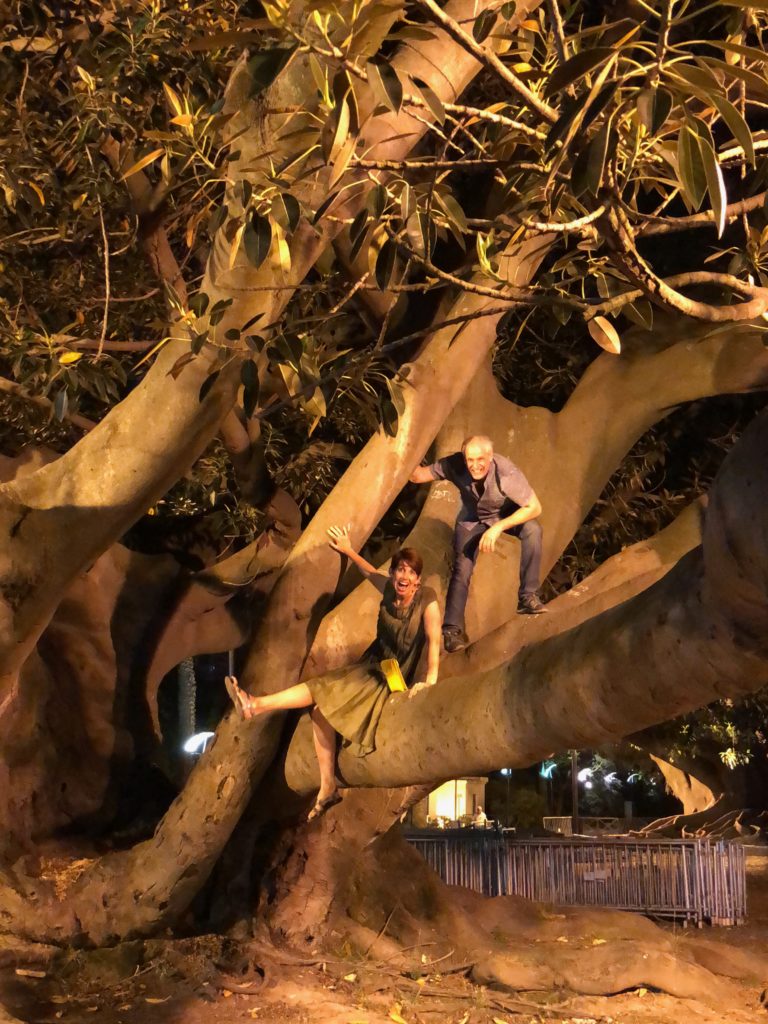
It’s possible we drank a bit too much wine … Jim and I couldn’t resist climbing this tree on the way out. A security guard blew his whistle at us, which seemed ridiculously funny at the time.

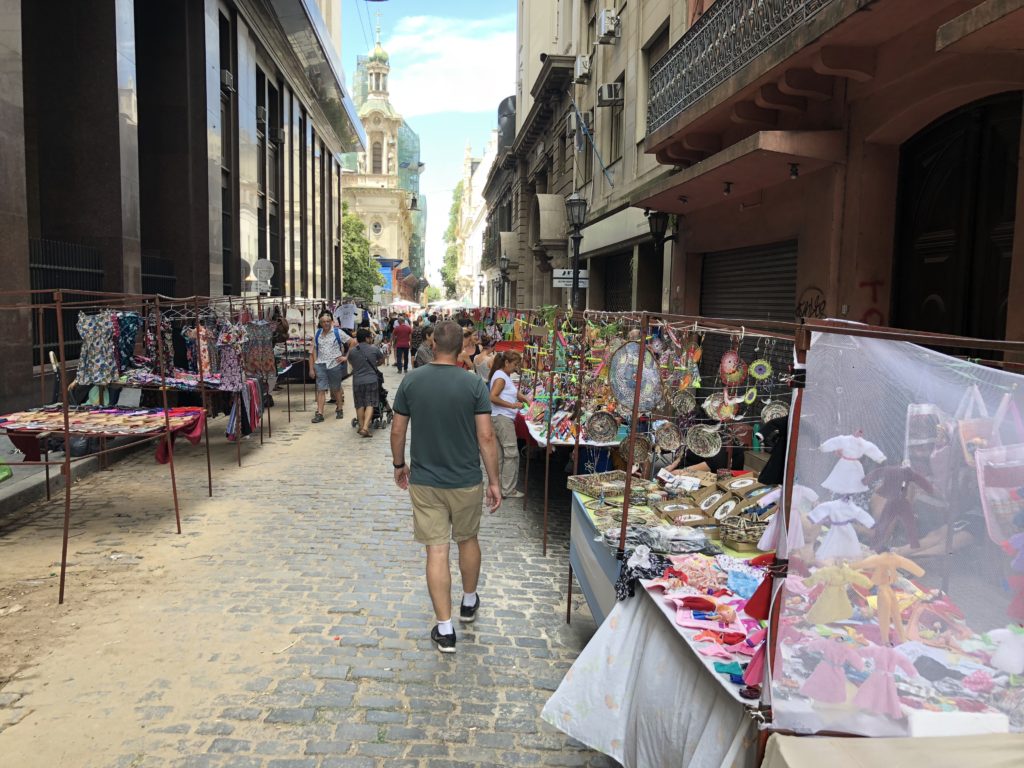
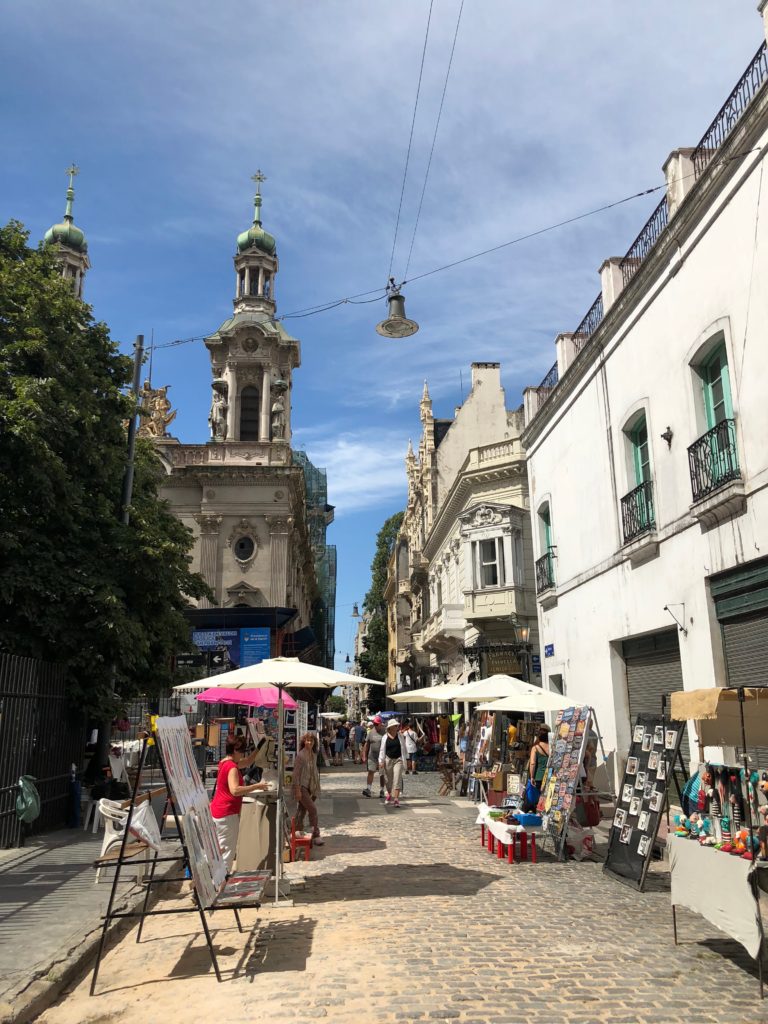
The next morning, we took the subway to the Independencia stop and strolled up the cobblestone streets to check out the Feria de San Telmo, the Sunday market. Booths lined Defensa Street with vendors selling everything from crocheted Barbie clothes and mass-produced souvenirs to stunning original artwork. We even ran into one of Ella’s previous cat sitters, Andrea, who makes and sells pompom earrings from Peruvian wool.

The stalls lined the road leading to Plaza Dorrego, which overflowed with more traditional antique market fare. Tango dancers staged a show in the square, and the surrounding restaurants offered their own tango entertainment. We paused for a beer at a café and watched the dancers for awhile. It was so intimate and sexy that I felt creepy taking photos. However, I did get a little footage of the outdoor show despite an obstructed view.

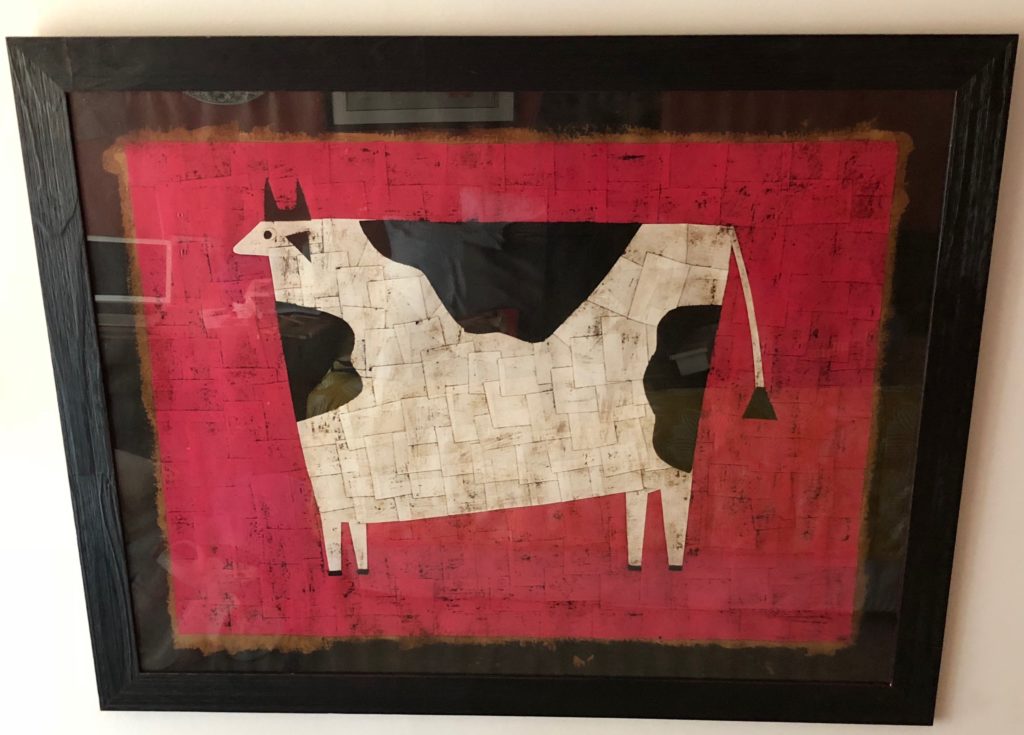
Normally, I am not an impulse shopper, but one particular booth at the market grabbed my attention. I just couldn’t take my eyes off a huge whimsical painting of a cow, so I bought it! Here it is, framed in my Santiago study. I love it! (Unfortunately, I lost the artist’s card. If you happen to visit the San Telmo market, please please please look for this artist and send me her contact info.)

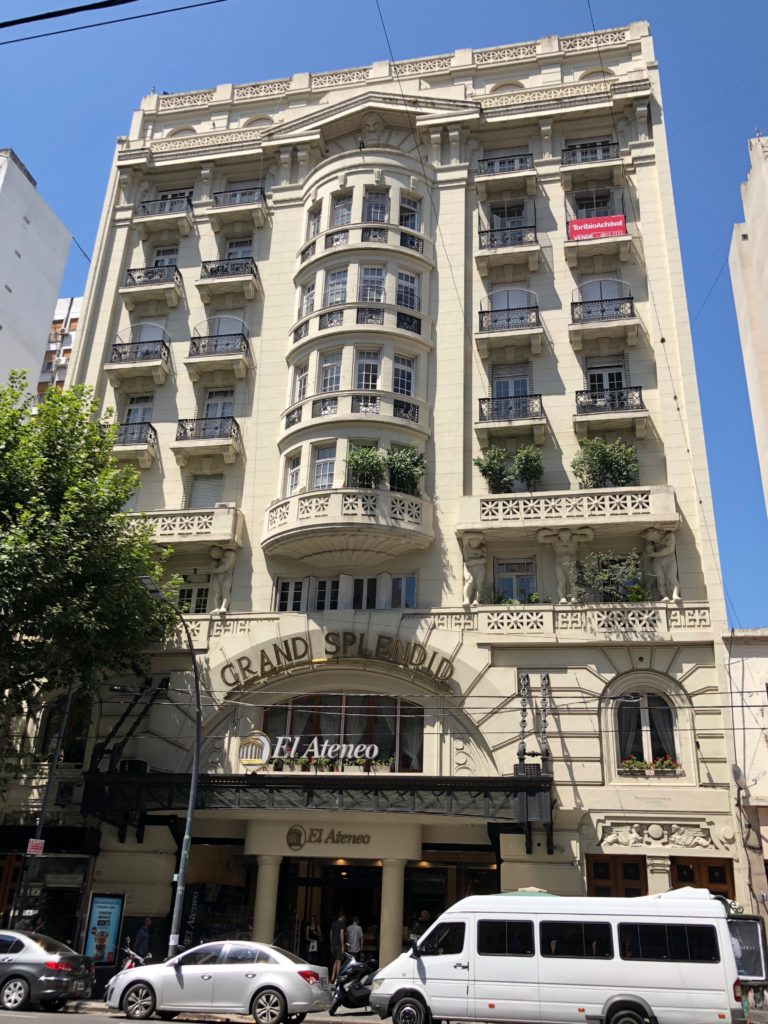
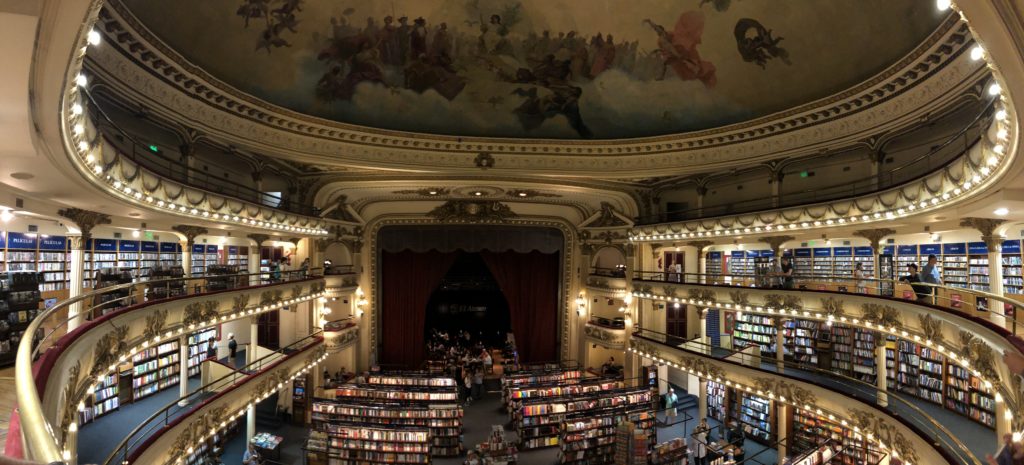
Monday morning, we paid a quick visit to Al Ateneo Grand Splendid. Built as a performing arts theater in 1919 and converted to a cinema in 1929, the building was nearly demolished at the turn of the century during a downturn in the economy. Today, a coffee bar fills the stage where famous tango dancers used to draw crowds, and the audience seating has given way to bookshelves. According to the website Atlas Obscura:

Though some lament the loss of a beloved cinema, it is now thanks to the Grupo Ilhsa – which owns 40 bookshops, including the flagship Grand Splendid location – that visitors can still revel in this wondrous monument of a bygone era. While the selection of books on offer is standard chain store fare and mostly in Spanish, bibliophiles will find the staggeringly opulent display of books to be reason enough to pay El Ateneo Grand Splendid a visit.

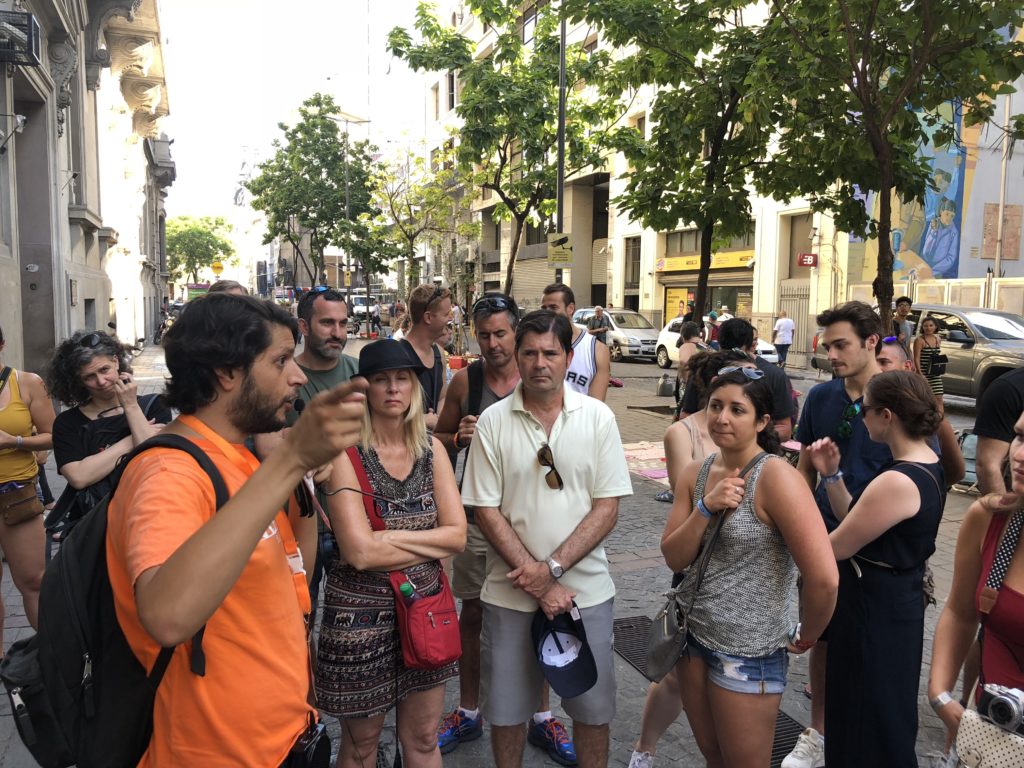
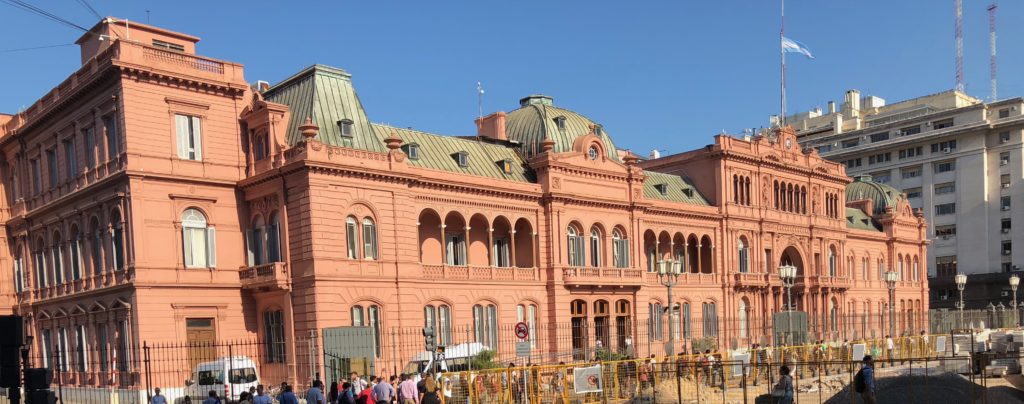
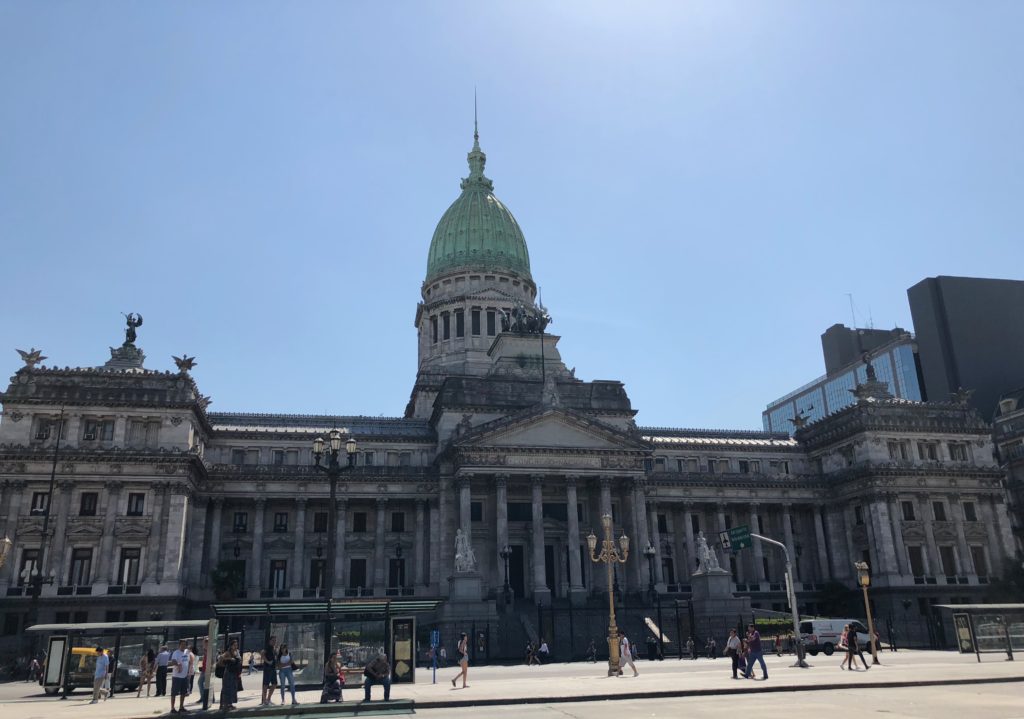
That afternoon, Tony and I met up with Buenos Aires Free Walks for a tour of the city center. We started at Palacio del Congreso, the seat of the Argentine National Congress, with our passionate young guide, Martin, and about 30 other people. The three-hour tour gave us a good overview of of Argentina’s history and economy in a nutshell.

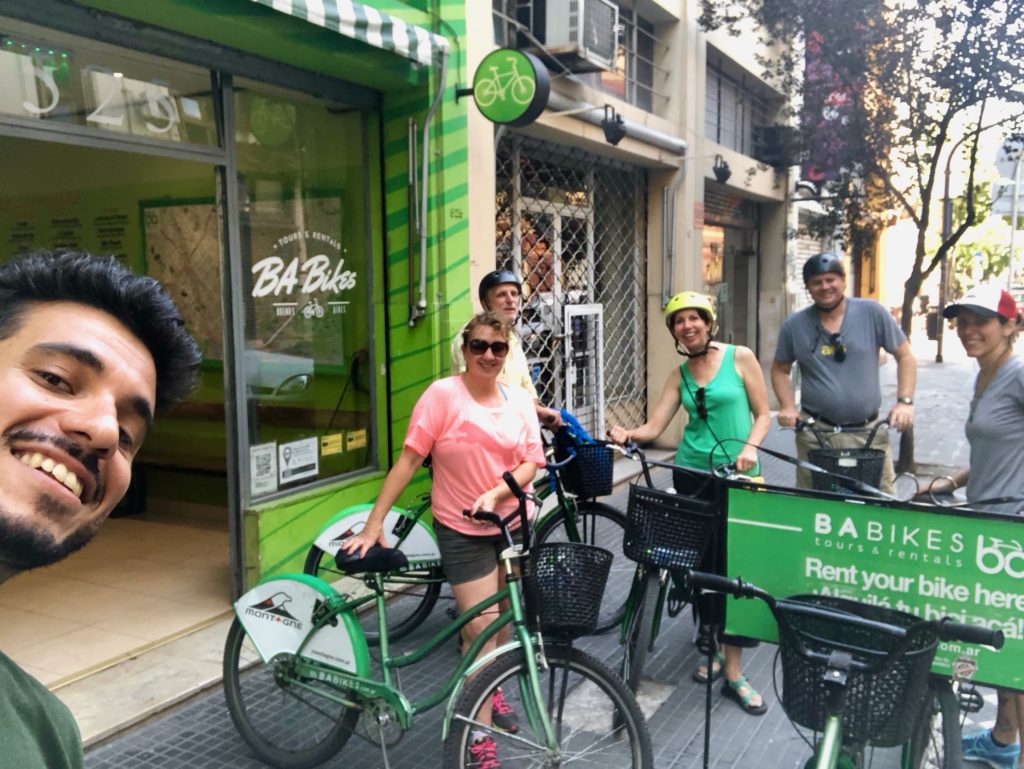
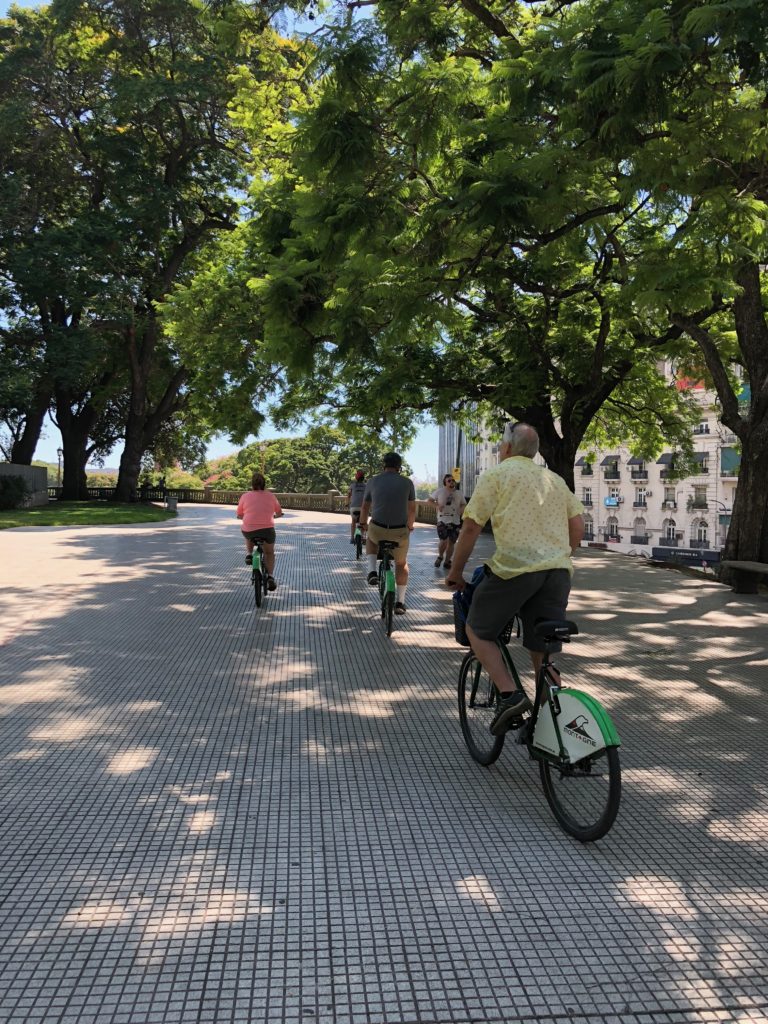
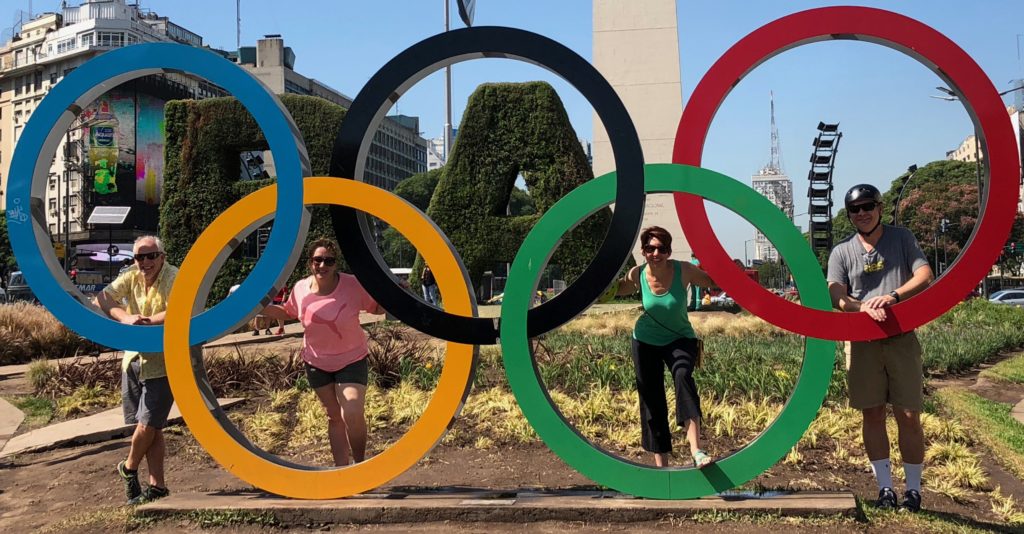
The next morning, the four of us joined Marika with BA Bikes for “North Circuit” tour. This was definitely a highlight, and I wish we’d had time to tour the “South Circuit,” as well. Next time!

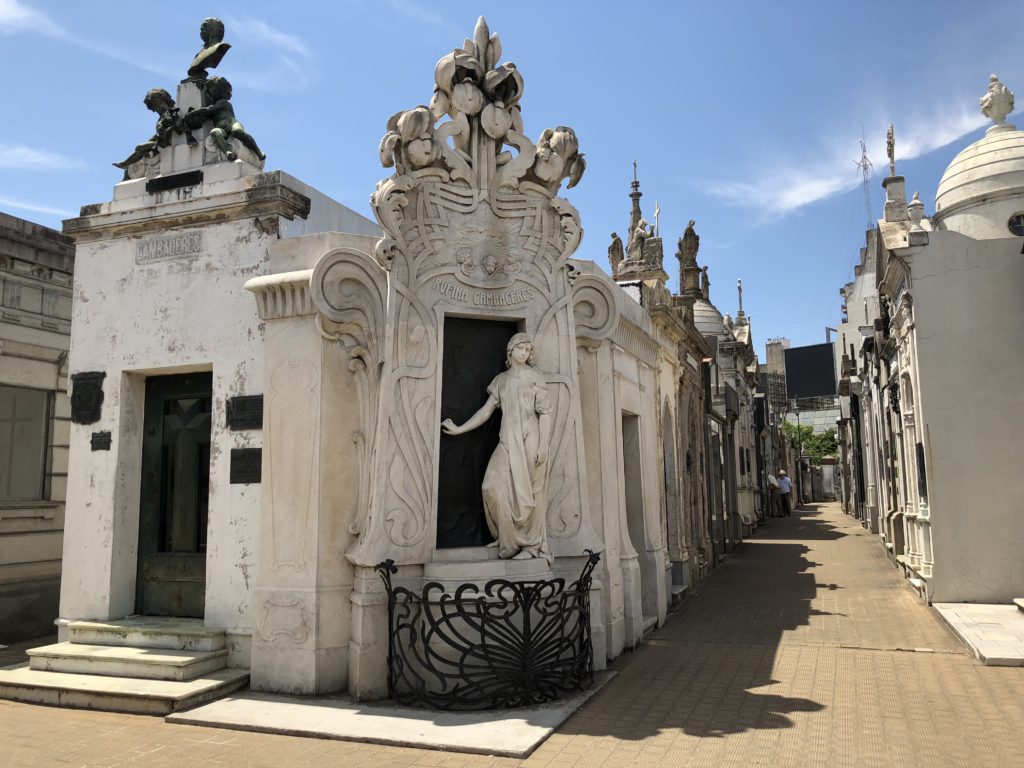
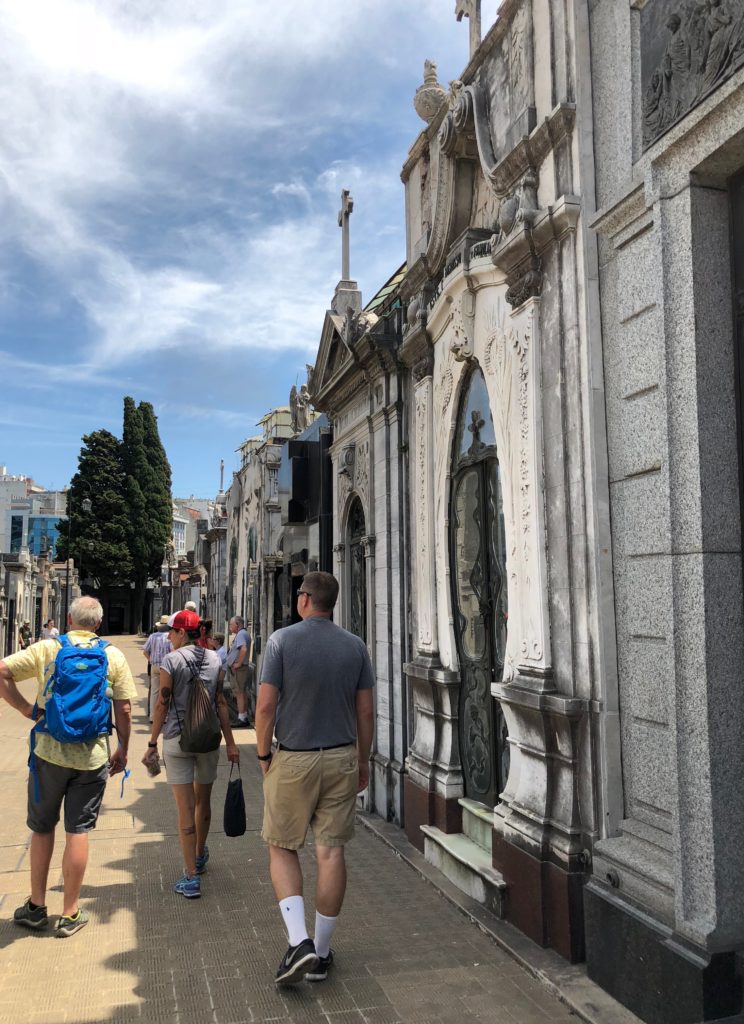
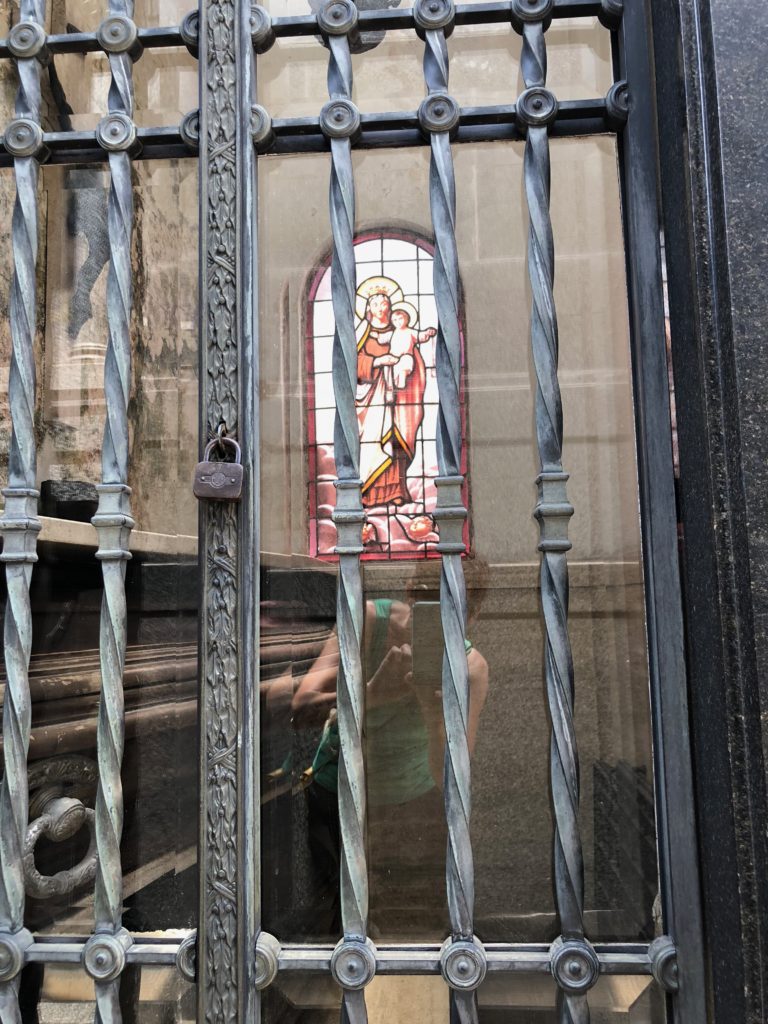
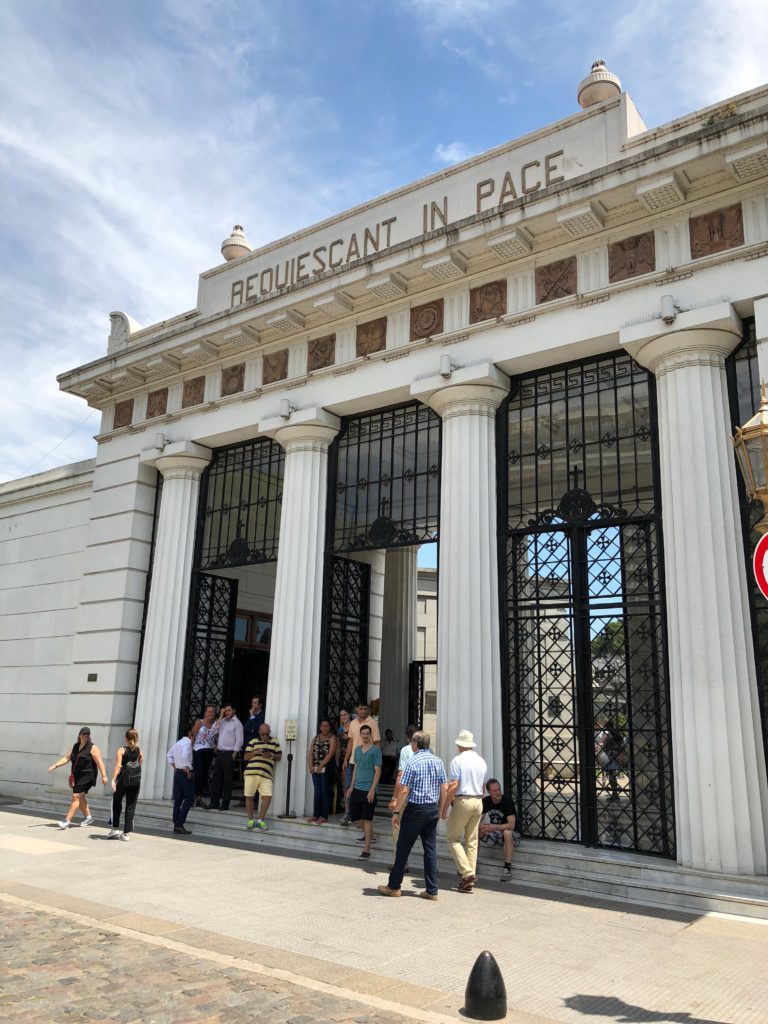
At the Recoleta Cemetery, we locked up our bikes and walked around. The mausoleums ranged from simple to insanely ostentatious, and we were surprised at how many were clearly neglected. There’s nothing like a forgotten tomb to remind you of our fleeting impact in the world. Through the broken windows, we could see caskets draped with decayed and torn fabric and bouquets of silk flowers coated in dust. Weeds sprouted from the carved and cracked marble facades. Pretty humbling.

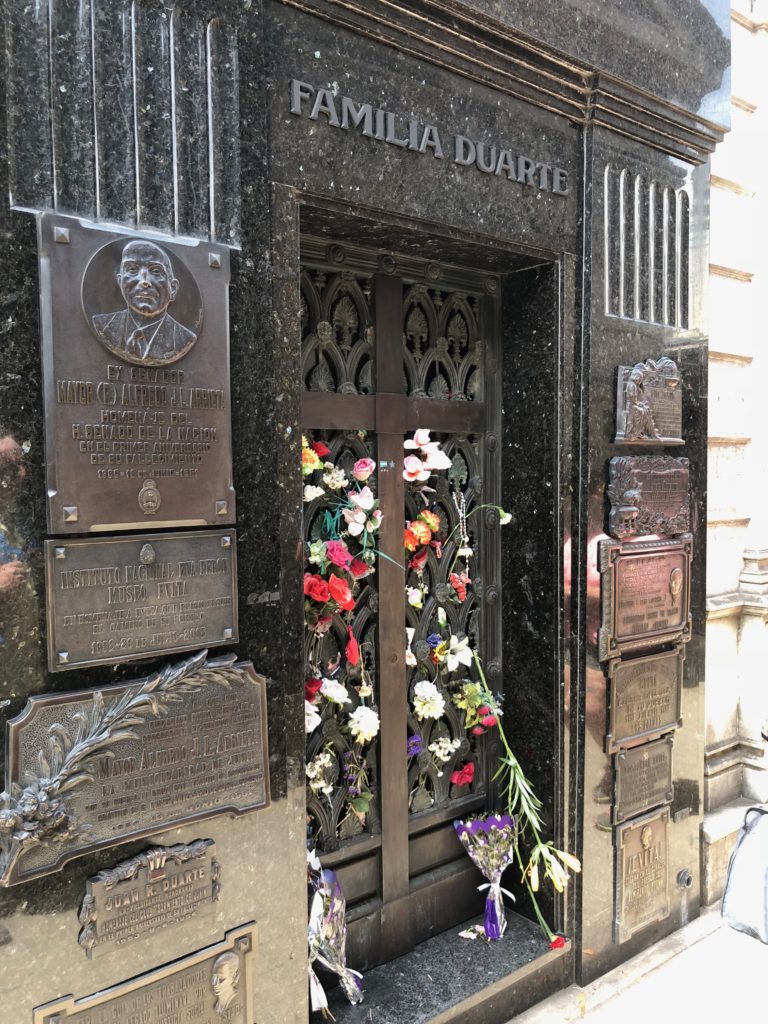
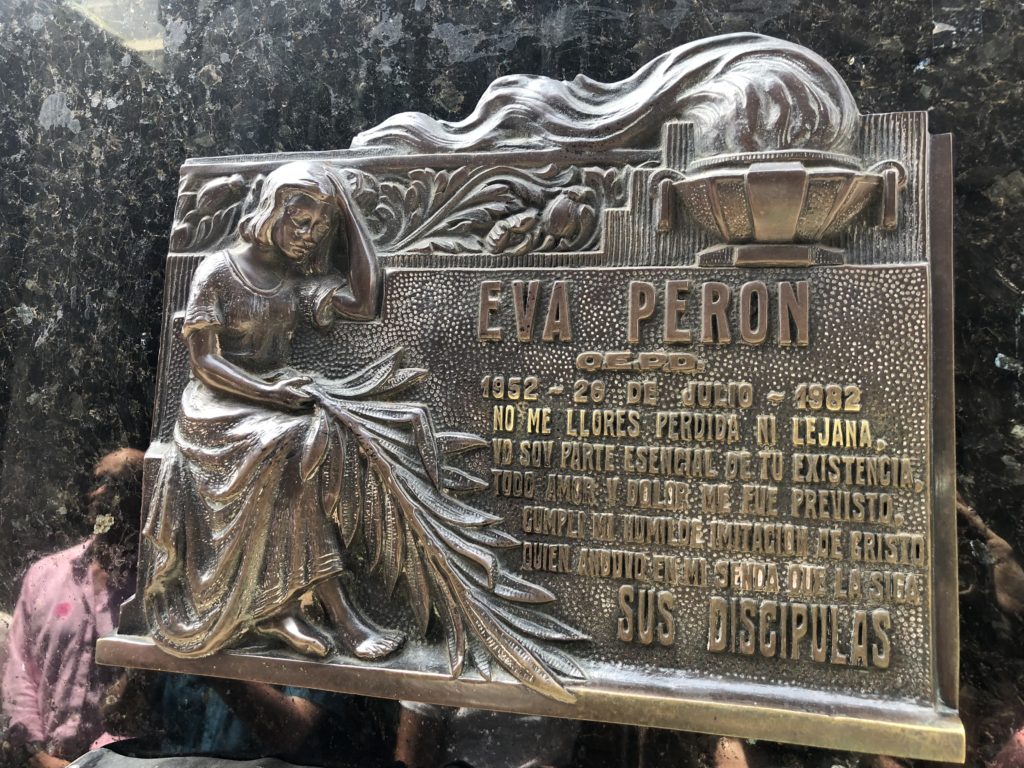
The most popular destination in the cemetery was the tomb of Eva Peron. I expected a huge monument, but she was buried in the Duarte family’s mausoleum with only a few plaques on the front to signify its importance.

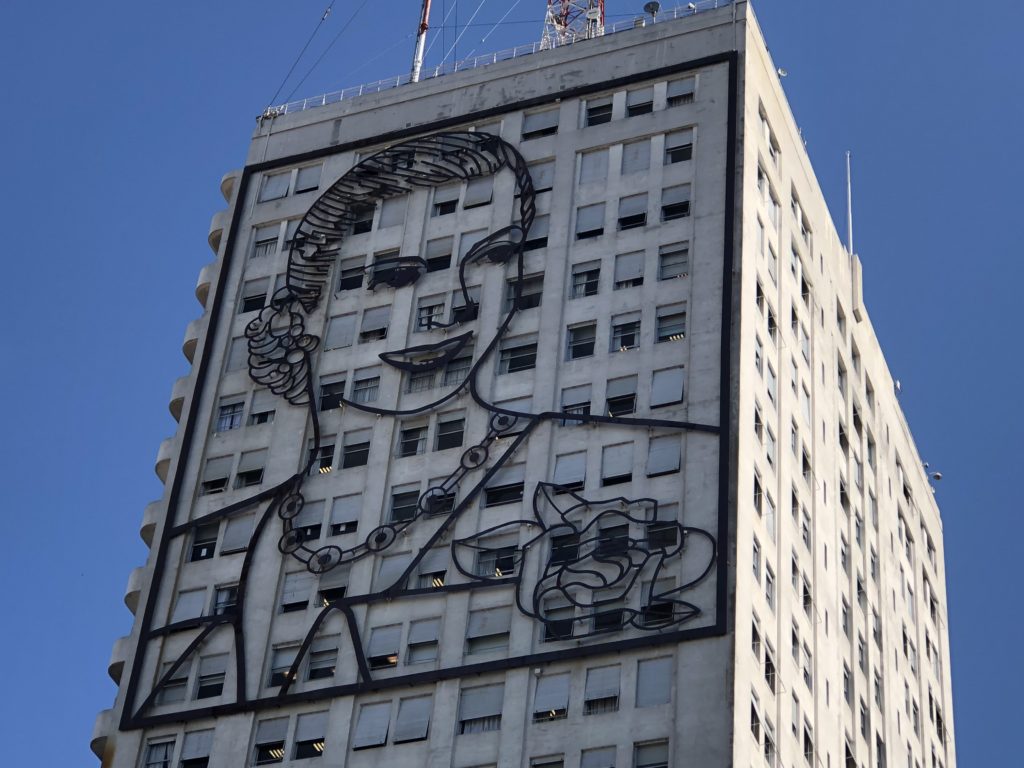
Eva Peron was Argentina’s first lady from 1946 to 1952 and became and iconic, controversial celebrity. She died at the age of 33 from cancer, but her body took more than 20 years to reach its final resting place. A New York Times article sums up the complicated story nicely:

After her death in 1952, the corpse was put on display at the headquarters of the General Confederation of Labor, where admirers came by the tens of thousands with candles and flowers and held vigils. When Mr. Peron was toppled in 1955, military leaders determined that they had to keep Eva Peron’s body from opposing political forces but they did not know how best to accomplish that.
Finally, in April 1957, the military put the body on a ship bound for Italy where it was buried under a false name. Then in 1971, Gen. Alejandro A. Lanusse overthrew Gen. Juan Carlos Ongania, the Argentine military leader. In exchange for Juan Peron’s blessing from exile, General Lanusse agreed to hold elections, restore Mr. Peron’s citizenship, provide presidential back pay of $50,000 and give him the body of Eva.
The body was exhumed from a small cemetery near Rome and transported in a silver coffin to Juan Peron’s villa in Madrid. Italian and Spanish police officers accompanied the hearse. Mr. Peron kept the body in an open casket on the dining room table of his villa, where he later built a shrine for it in the attic.
In November 1974, after the death of Mr. Peron, Eva Peron’s body was brought back to Argentina by Isabel (Peron’s third wife), who succeeded him as President. It lay in state in the presidential residence until Mrs. Peron was overthrown in 1976, when the new military rulers had the body buried in the Duarte family tomb under three plates of steel in the Recoleta Cemetery in Buenos Aires.

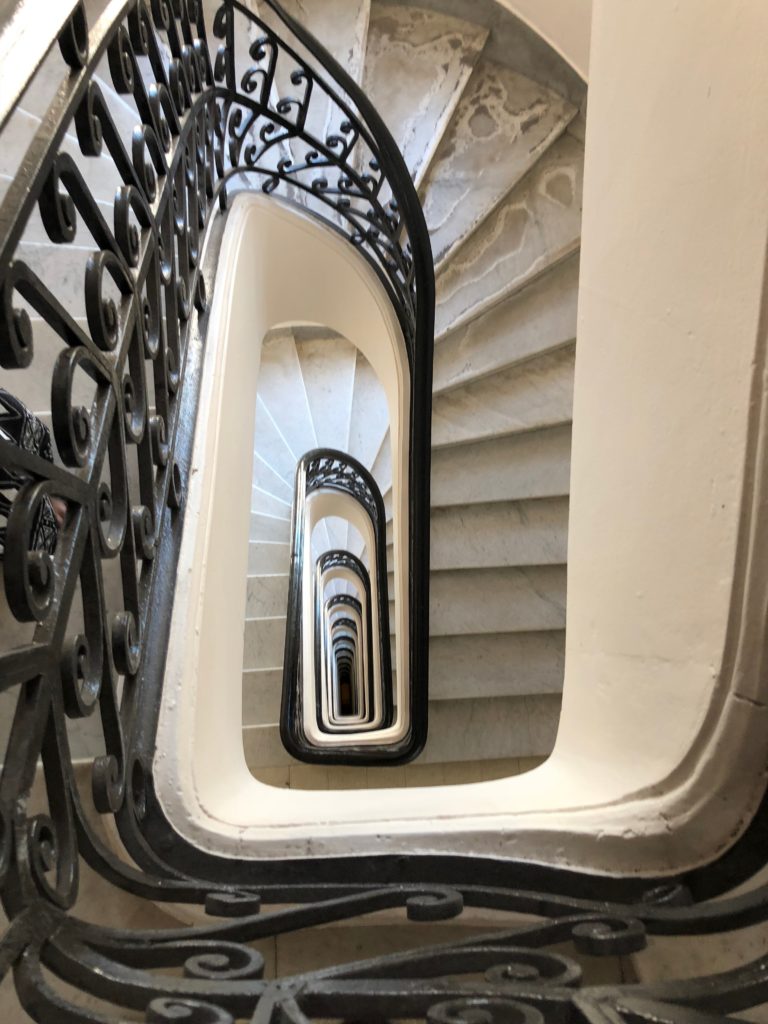
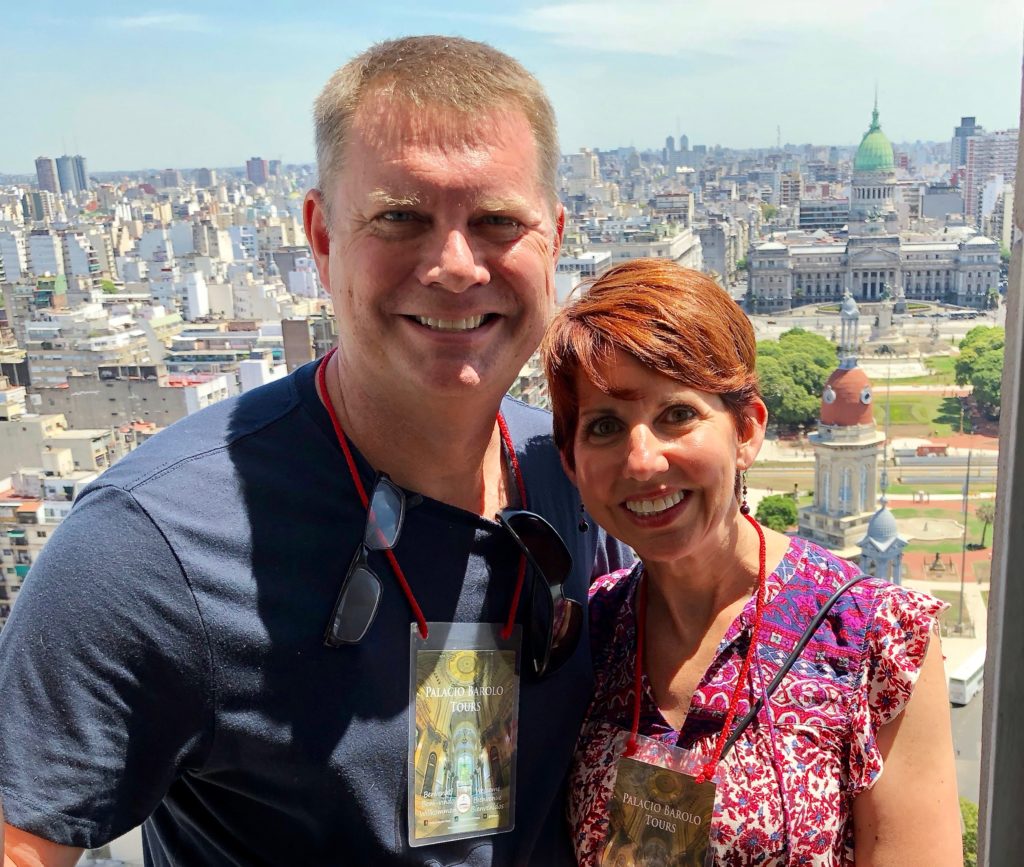
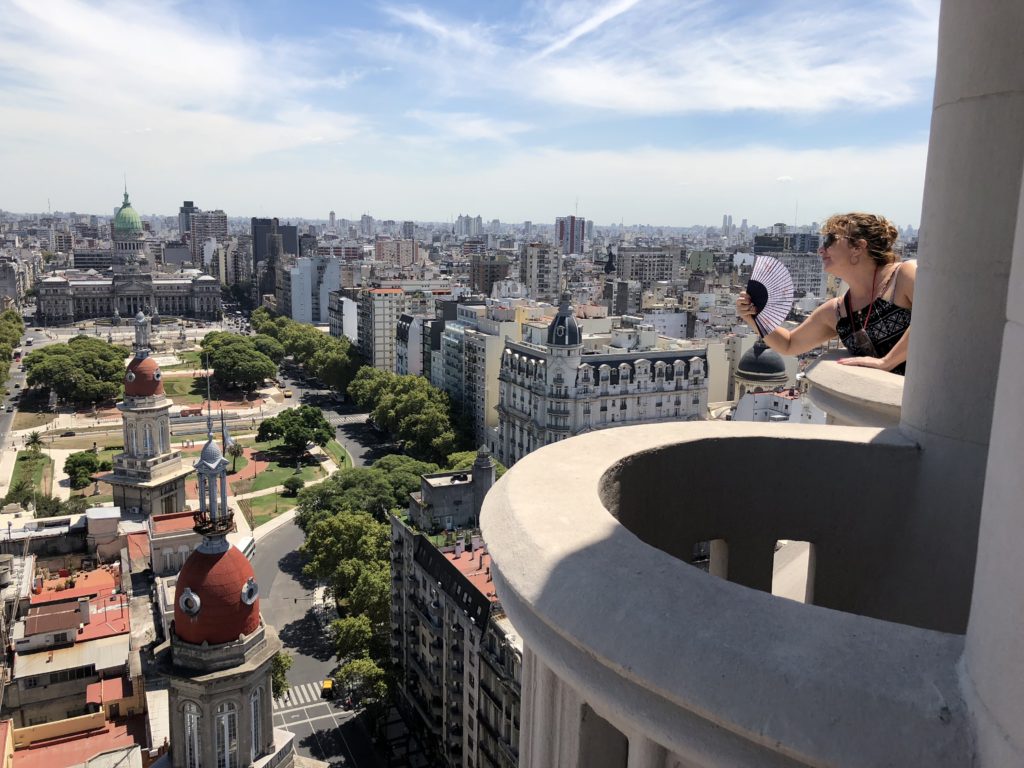
The Palacio Barolo, an office building near the National Congress, was mentioned by several tour guides, so we decided to check it out. Completed in 1923, the building was Buenos Aires’ tallest skyscraper until 1936. But what lured us to learn more was its weird connection to Dante’s Divine Comedy. The Atlas Obscura website says:

Conceived of by cotton magnate Luis Barolo and architect Mario Palanti as a secular temple, the Palacio Barolo serves as an allegory for the structure and content of Dante Allighieri’s Divine Comedy.
Believing that Europe had begun drifting toward collapse, Barolo intended the Palacio Barolo to house Dante’s ashes far away from a disintegrating European continent. His partnership with Italian architect Mario Palanti, also a Dante aficionado, resulted in the design of a structure that included the numbers most prevalent in the Divine Comedy: The building’s 22 floors (Dante divided the Divine Comedy into 22 stanzas) sit upon a foundation whose measurements conform to the golden ratio. And, like Dante’s work, the building invites visitors to progress through hell, purgatory, and heaven as they climb to the top.
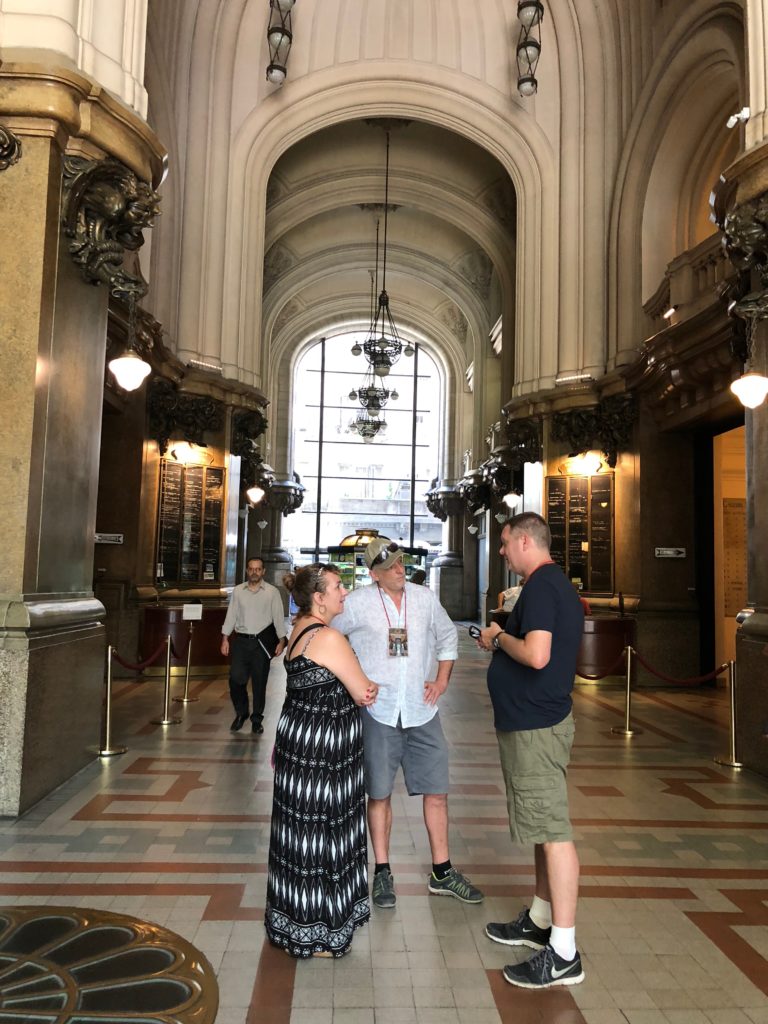
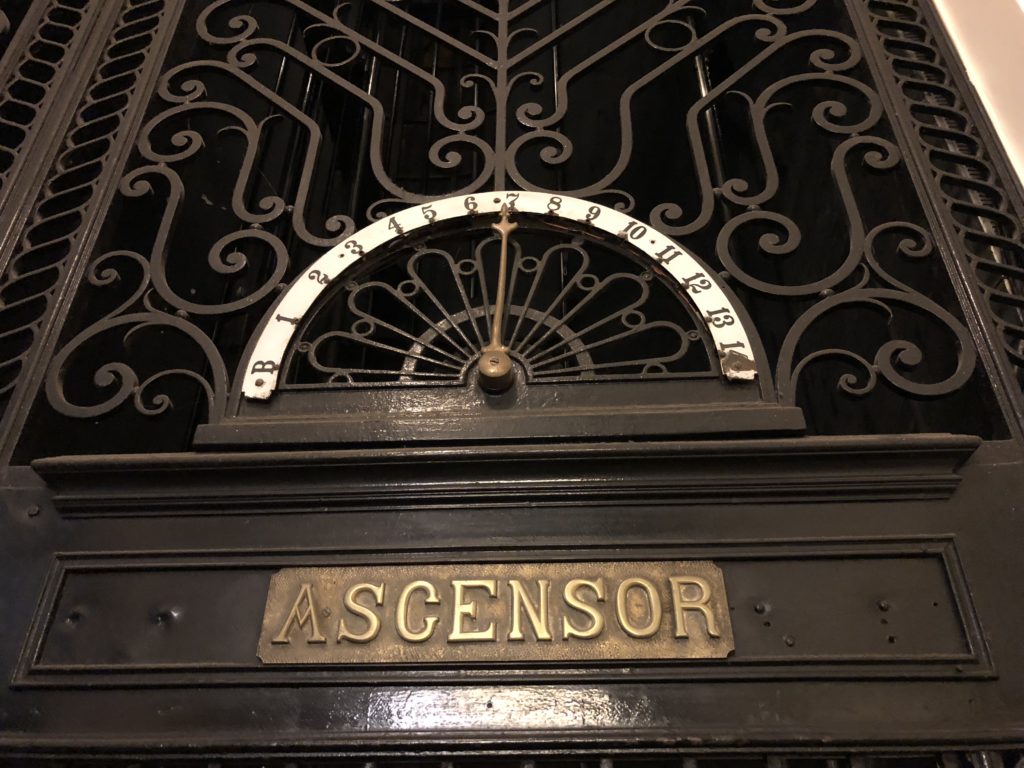
The lobby, a central hall adorned with inscriptions of Latin verse and monster statues, radiates out from a central dome into nine vaulted archways, which represent the nine circles of hell as described by Dante in the Inferno. Throughout these first three floors are geometric figures representing alchemical symbols for fire, the colors of the Italian flag, and Masonic symbols on the walls, floors, and still-operating antiquated elevators.
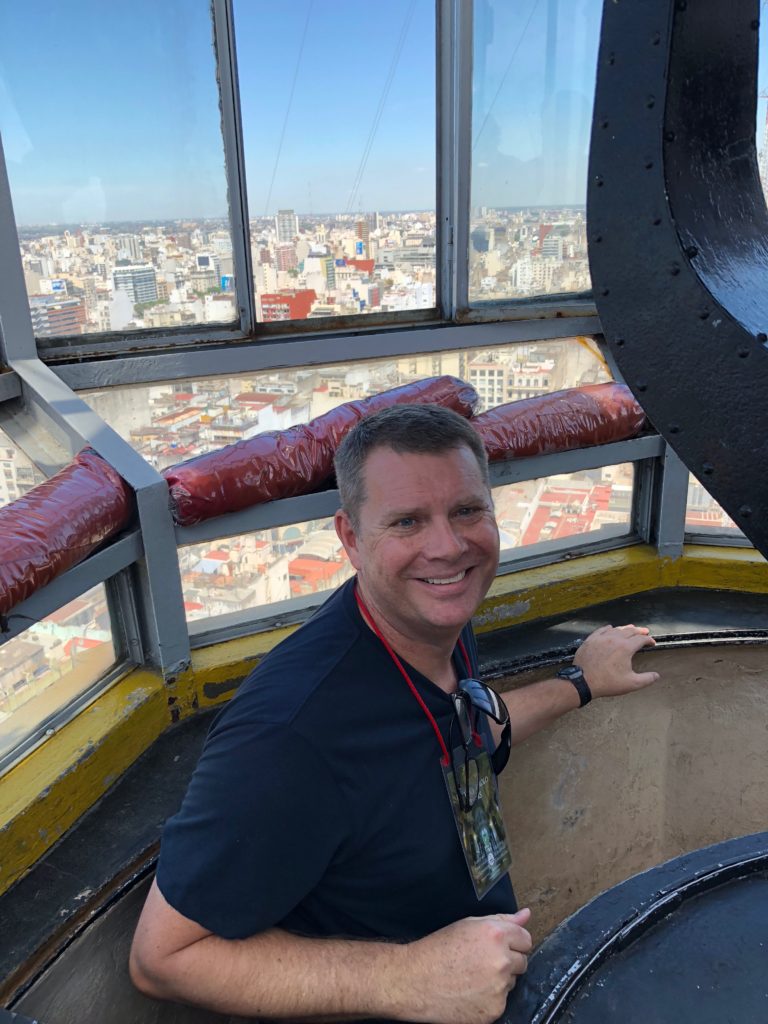
The highest levels, representing heaven, begin at an observation deck with one of the few 360 degree views of the sprawling city of Buenos Aires. Climbing a few more floors to the building’s highest point (100 meters, analogous to the 100 cantos of the Divine Comedy), one arrives at a still-working lighthouse.
Like the Pillars of Hercules at the mouth of the Mediterranean, Pilanti intended this tower light and another of his buildings, the Palacio Salvo in Montevideo, Uruguay, to serve as a welcome to visitors arriving from the Atlantic to the Rio de la Plata estuary. The ornament above the lighthouse, a figure of the Southern Cross constellation, aligns with the actual constellation on July 9th, Argentine Independence Day.

For a city with so much great art and tasty food, Buenos Aires made it particularly hard for us to spend money. Many places wouldn’t take a credit card, and most banks wouldn’t give us any cash. We watched locals form long lines each day until the ATMs ran out of money, and we often had to visit several bank branches before we found an ATM that would spit out some pesos.

One night, we met up with Nikki, a friend we knew in Laos who now works in Buenos Aires. We had planned to buy her dinner, but our efforts to find money that afternoon were unsuccessful. Embarrassing. Still, we had a great night at a fabulous Armenian restaurant called Sarkis.

Another night, we met up with Tom and Angie, friends from our days in New Delhi.

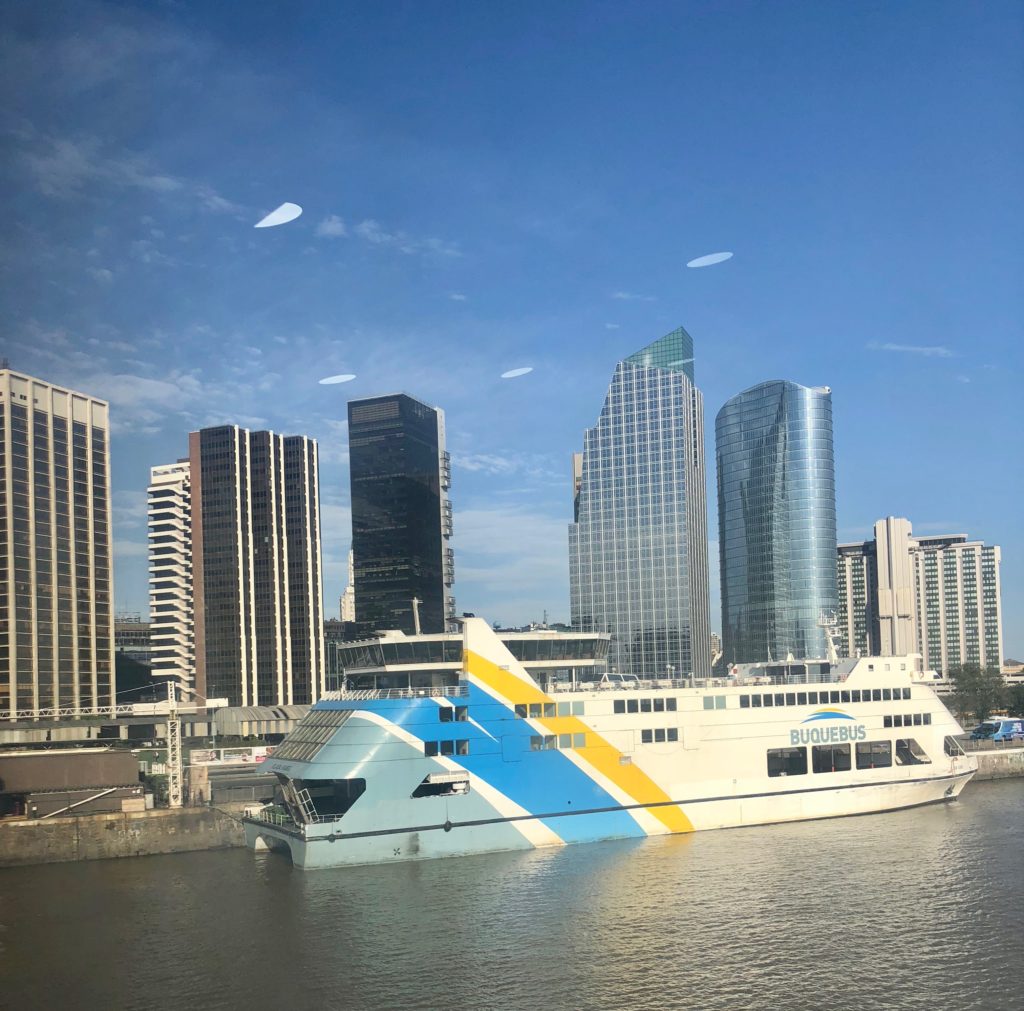
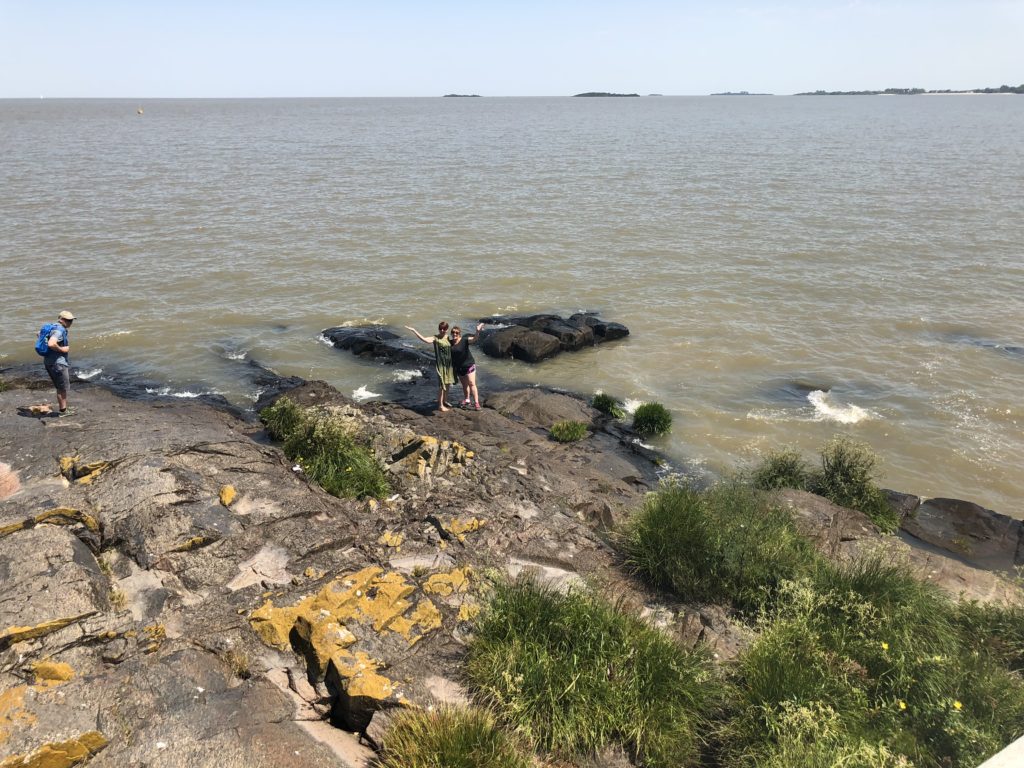
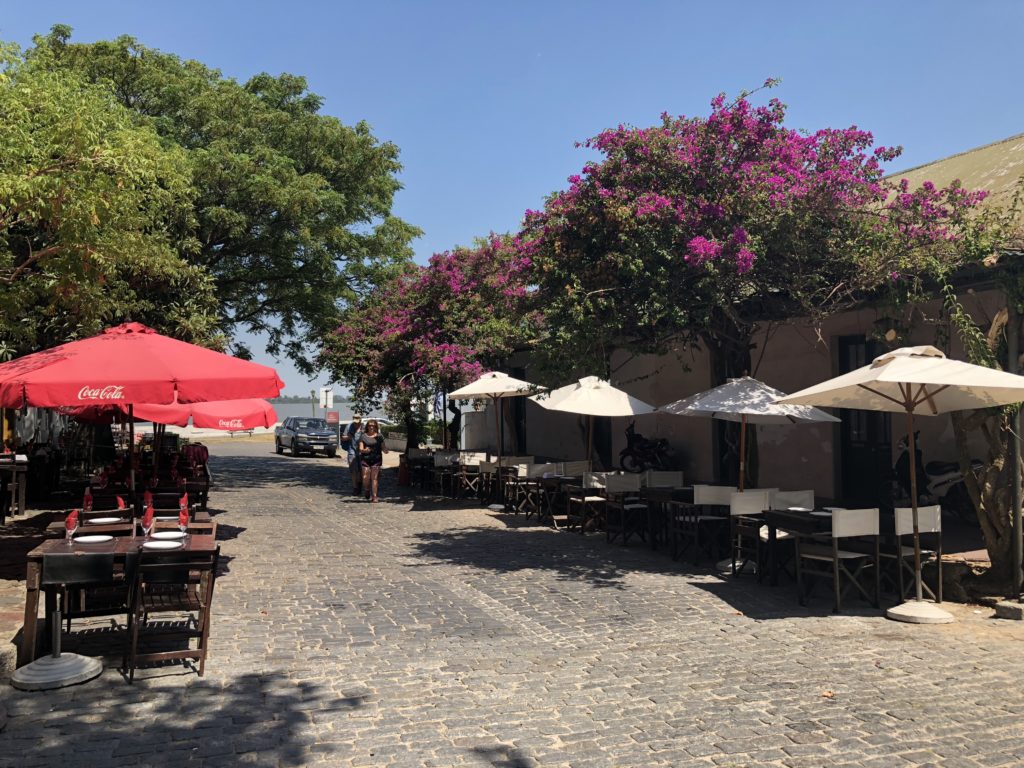
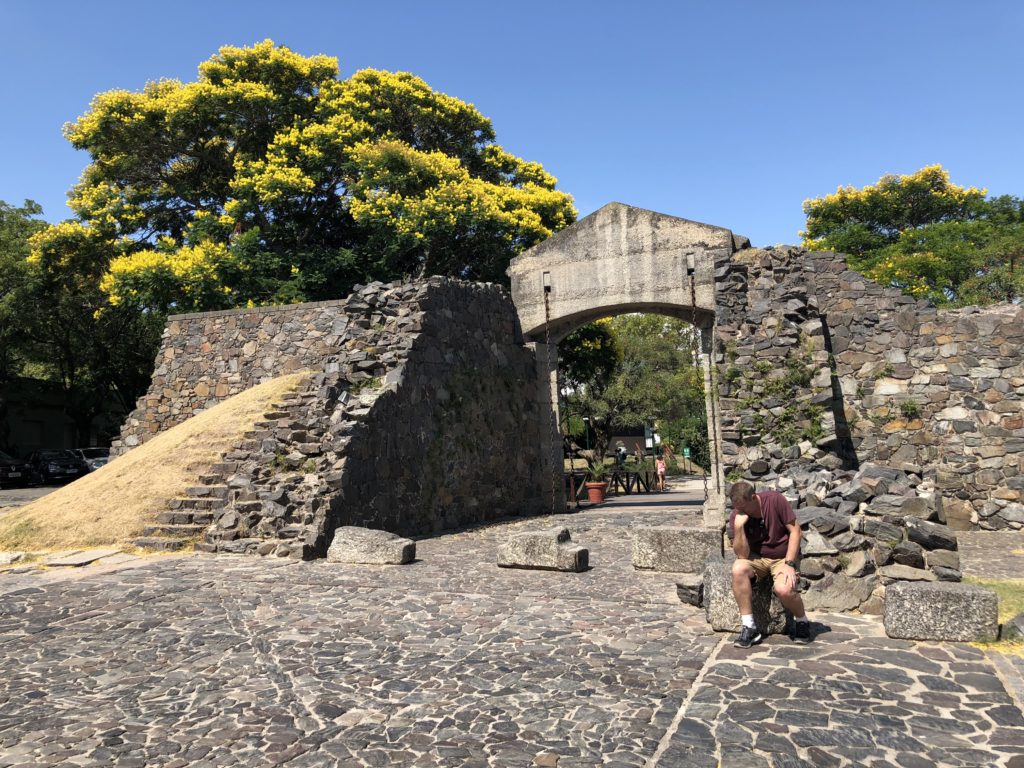
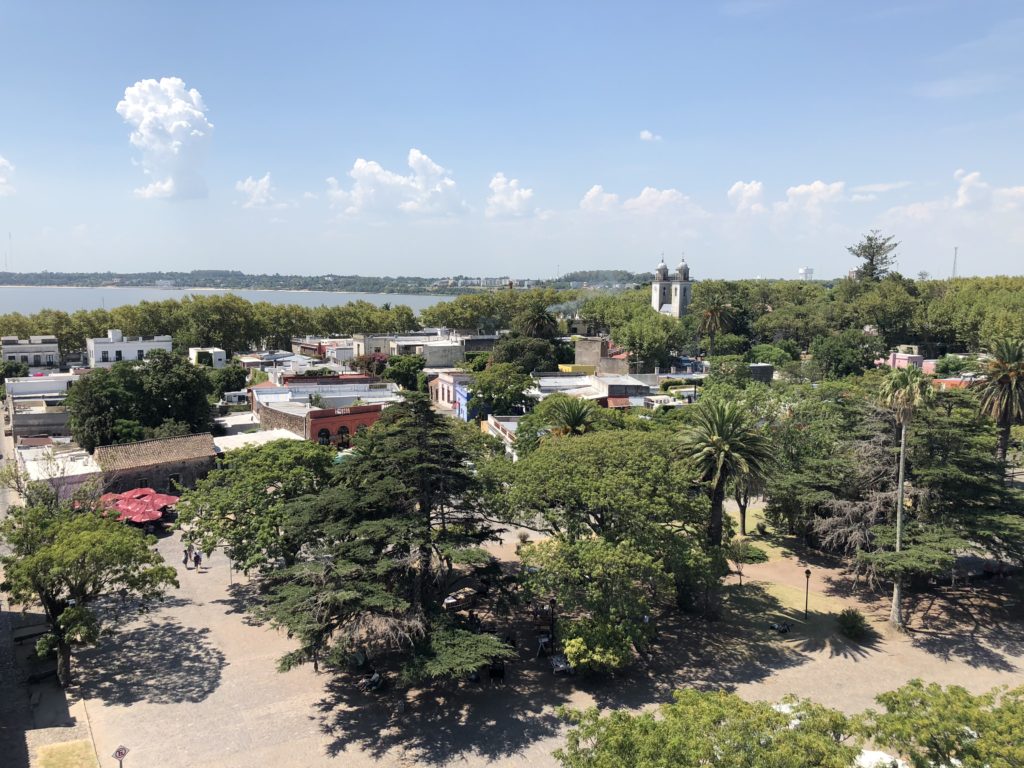
Although we were tempted to take another bike tour to a different part of BA, we decided instead to take a boat to a different country. We caught the Buquebus ferry for a one-hour journey from Argentina to Uruguay and spent the day in the port town of Colonia, a UNESCO World Heritage Site. Portuguese soldiers occupied the town in 1680, and the colony bounced back and forth between Portugal and Spain for more than 100 years. It was later incorporated into Brazil until after Uruguay was granted independence around 1828. The city is known for its quaint historical district with cobblestone streets shaded by sycamore trees and lined with charming shops and restaurants.

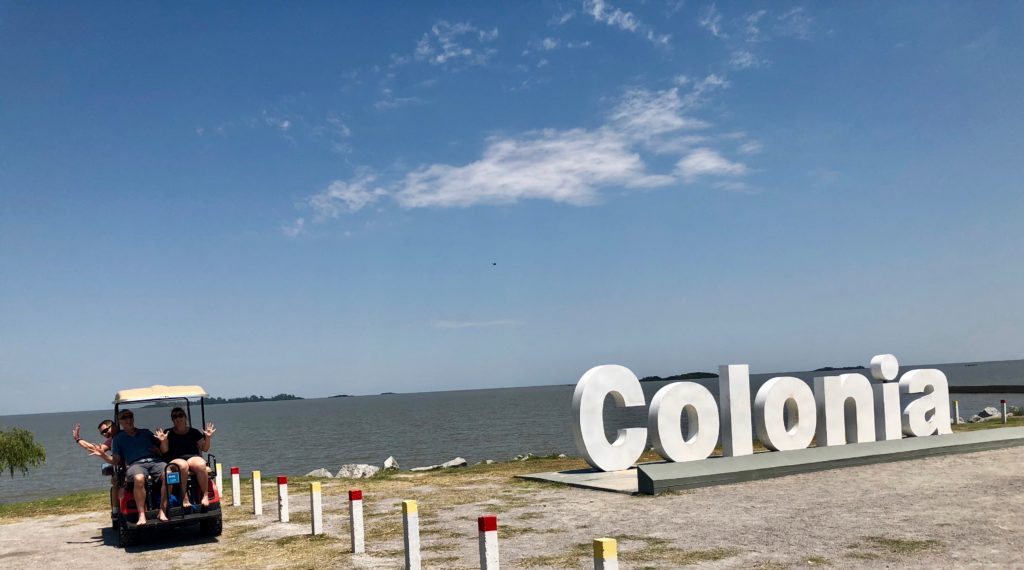
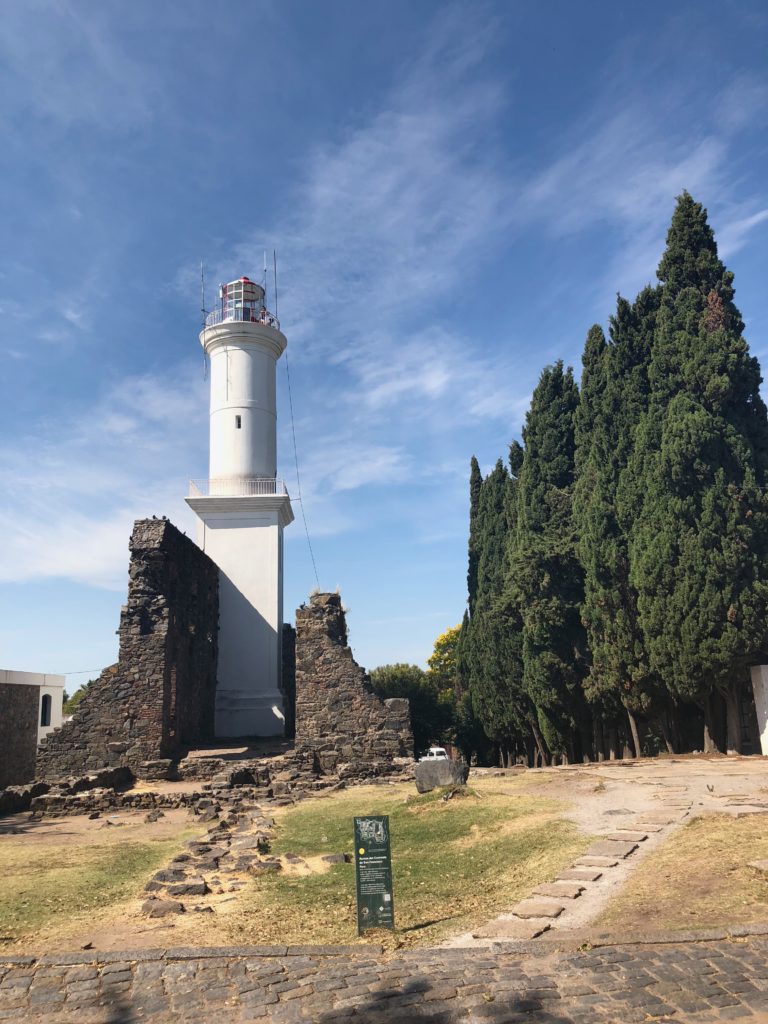
We walked around a bit and then rented a golf cart to check out the beach. After a relaxing lunch at a garden café, we climbed to the top of the lighthouse at the ruins of the Convent de Sacramento.

The next day, Jim and Nancy spent another day exploring Buenos Aires while Tony and I headed back to Santiago. Our house sitters moved on to northern Chile a few hours before we got home, but they left us with a clean apartment and a happy cat. With just a few days of freedom left before school started, we crammed in one more weekend of fun. Stay tuned!
Summer? Winter? Vacation! Part 1: Christmas in the USA

Now that winter is summer and summer is winter, our school vacation schedule is upside down. For the last 15 years in Turkey, China, Laos, and India, we followed a North American calendar with a couple weeks off at Christmas and a longer summer break. In Chile, our “summer break” occurs now – from December to February.

To kick it off, we joined my sister Kate and her family at my parent’s house in Florida. Check out my last post about The Villages to get the scoop on this unusual place.

Christmas usually explodes all over my parents’ house, but my dad was under the weather and my mom couldn’t tackle the job alone. They put up a naked tree, and Kate’s three boys made cute decorations.

The first few days in Florida were cool but sunny. Kate, Tony, and the kids even went for a swim. I just dipped my legs in the hot tub.

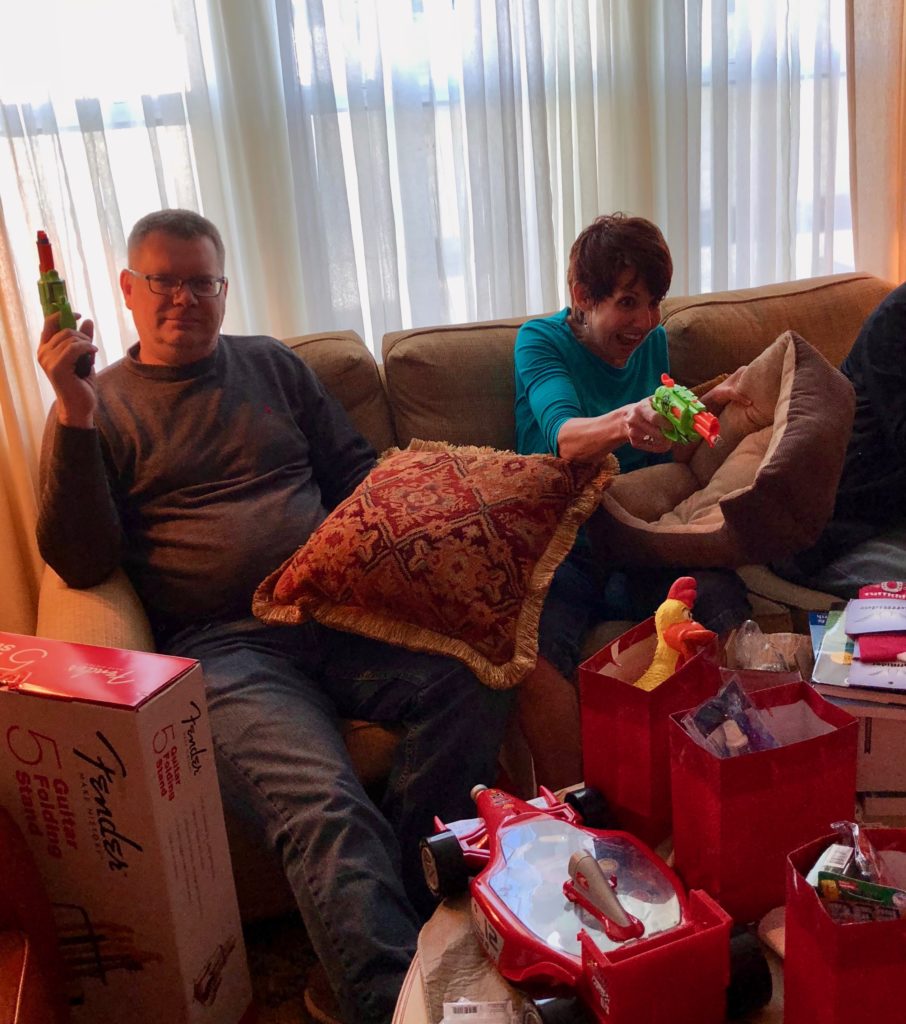
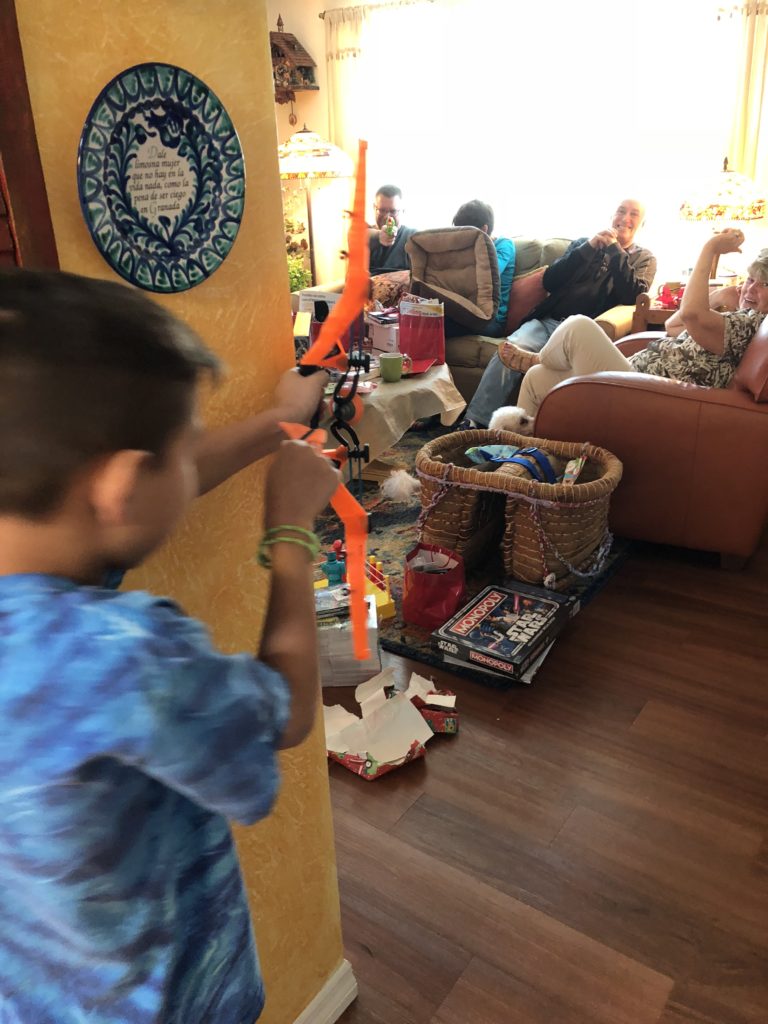
On Christmas morning, we all opened our presents. Tony had just one gift left, marked “Open last!” He ripped off the paper to find a box of Cheez-Its, his favorite snack. Everyone leaned in to have a laugh, but it was a ruse. Even Tony didn’t know that I had wrapped up two Nerf guns and extra ammo. We pulled out our weapons and started pelting everyone. The kids shrieked and dove behind the furniture. The Christmas Nerf War is a Dickinson family tradition, so we were shocked that nobody else was armed. Kate quickly ran out to her van, where the boys had coincidentally left a couple Nerf archery sets. The kids holed up in the kitchen to load their bows. Eventually, Tony and I ran out of bullets, and we were too lazy to get off the couch, so we called a truce.

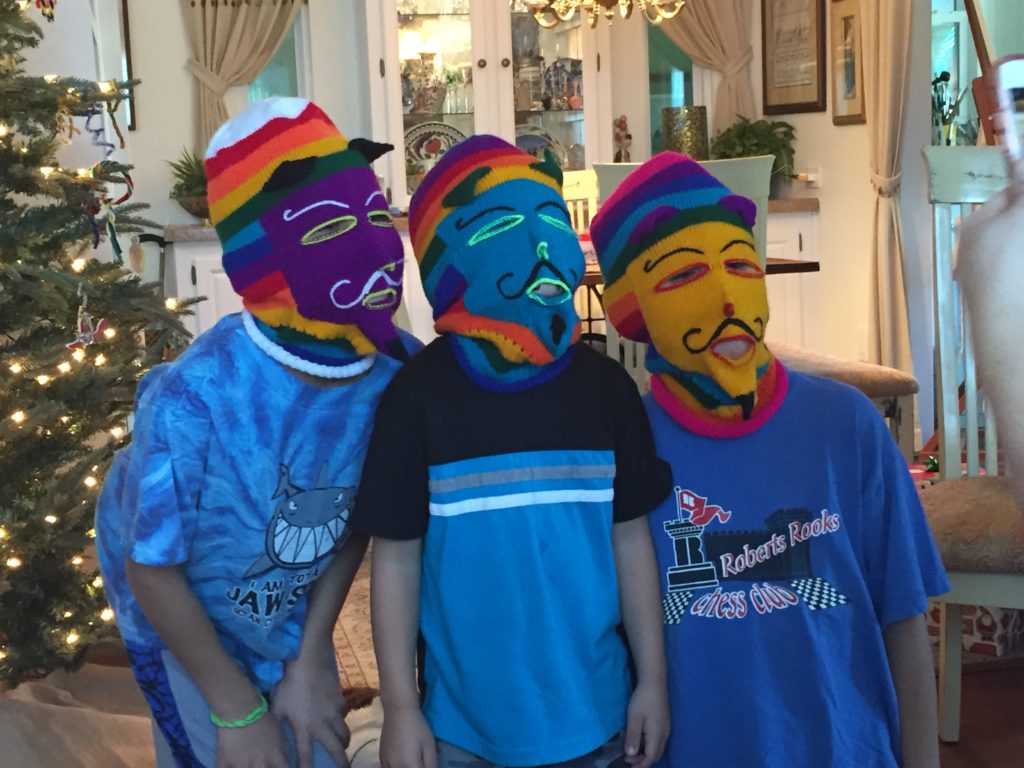
The boys wearing their silly knitted hats from Chile.

I also gave them each a little leather coin purse from Atacama, which Nico said was his favorite present. What a love bug.

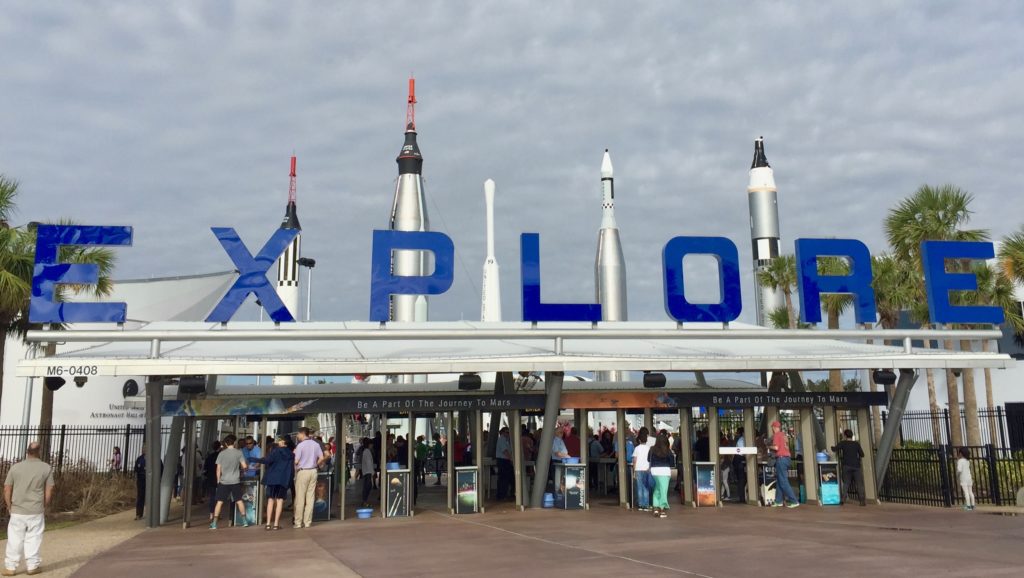
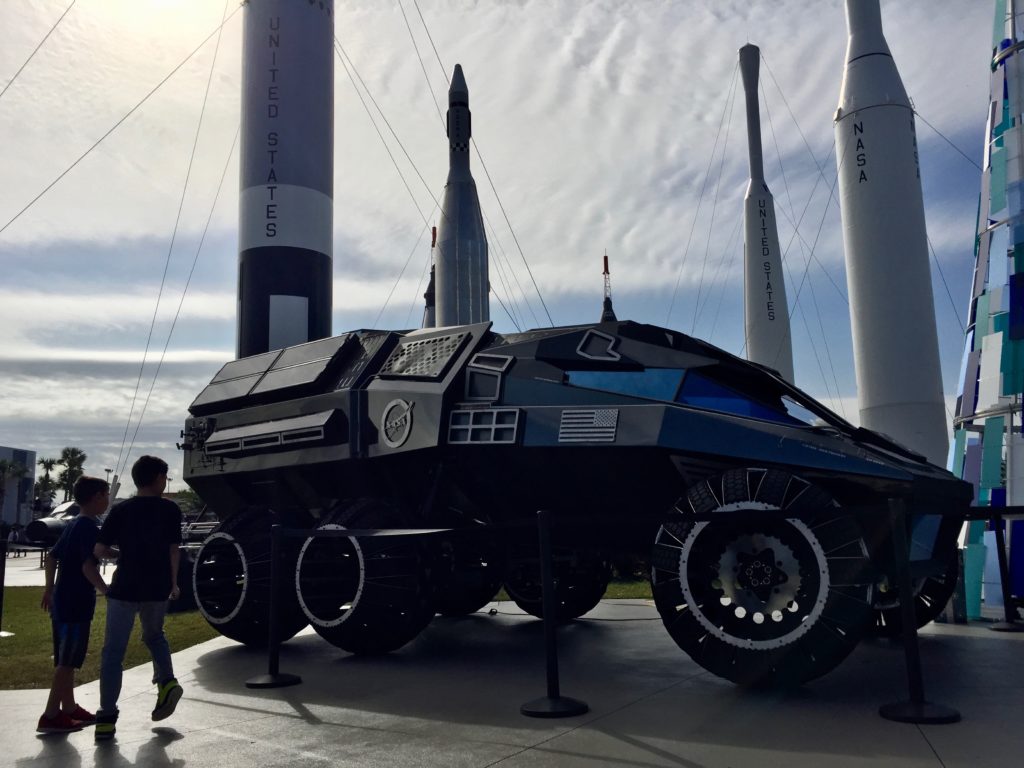
The day after Christmas we ditched my parents and took off for the Kennedy Space Center Visitor Complex. The entrance featured the word “Explore” in huge letters with a rocket garden towering in the background. “This really is a dream come true for me,” said my brother-in-law John.

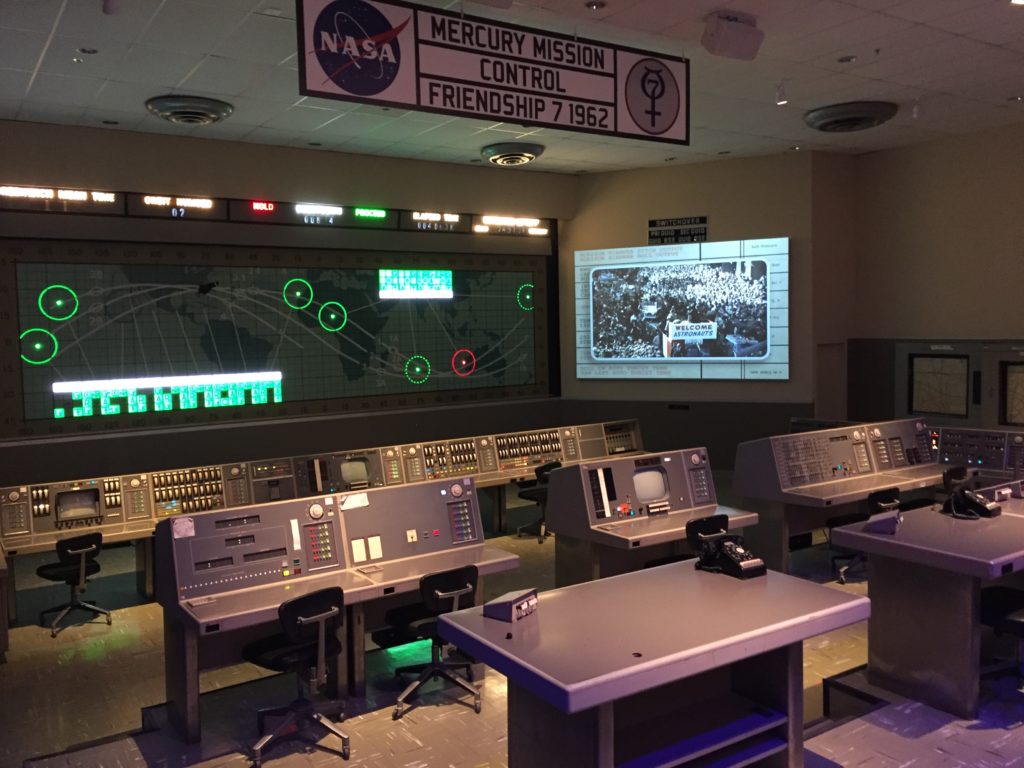
Visiting the various “mission zones” was like stepping through time, from the early days of America’s space program to the space race and moon landing to the ongoing efforts to get man to Mars. Most attractions featured videos with footage from the time period, NASA personnel commenting on their work, and astronauts reflecting on their experiences.

I had just watched the movie “Hidden Figures” on the flight to the States, so it was fun to put the true-ish story in context at the place where it all happened. One of the most fascinating take-aways for me was those first rockets launched with less computing power than we have in our cell phones today.

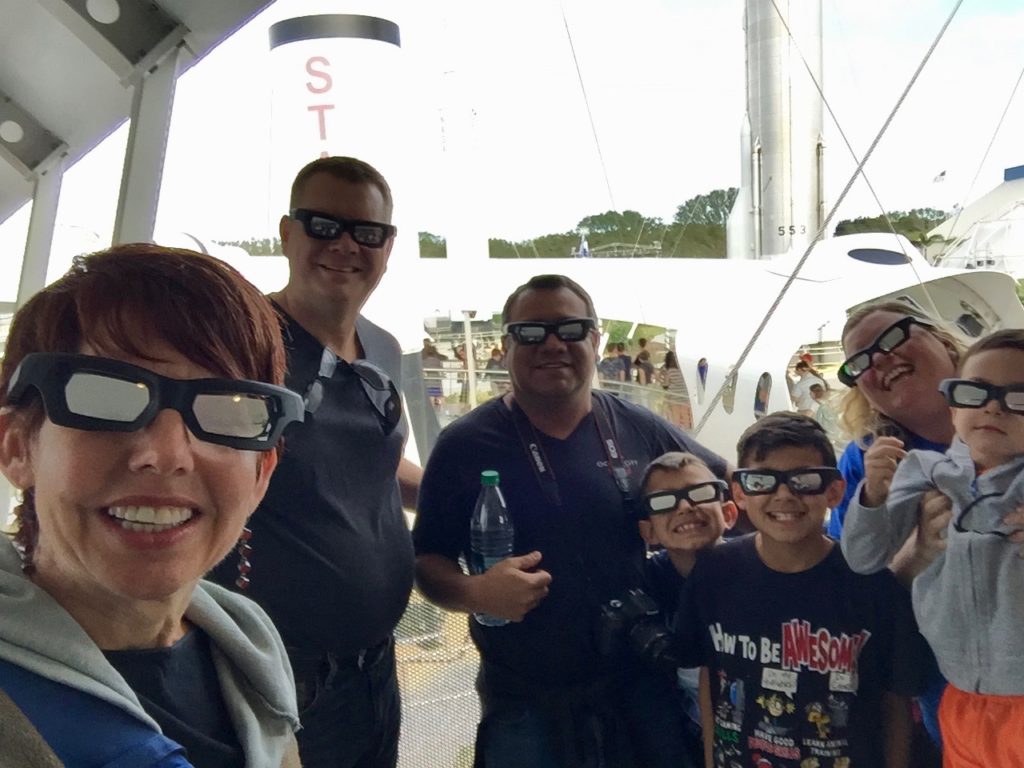
Gearing up for a 3-D movie about NASA heroes and legends.

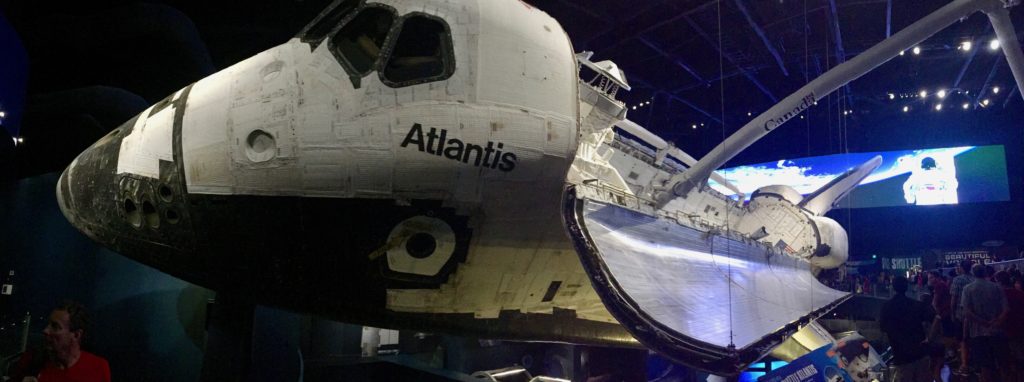
Perhaps because I have such vivid memories of the space shuttle program, my favorite mission zone was “Shuttle: A Ship Like No Other.” I remember the pride and awe I felt over the Hubble Space Telescope and International Space Station, both made possible by shuttle missions. I also remember gathering in a friend’s dorm room at the University of Kansas to watch the launch of Space Shuttle Challenger and its horrific explosion that killed everyone aboard. According to the Kennedy Space Center website, “A ship like no other, the space shuttle launched like a rocket and landed like a glider while transporting astronauts to space and back for thirty years.”

At the space shuttle mission zone, the shuttle Atlantis was suspended from the ceiling, and exhibits demonstrated life on board for the astronauts. Atlantis flew its last mission – and the last of the shuttle program – in July 2011.

Nico and Paul check out a Mars rover concept vehicle.

On the Kennedy Space Center bus tour, we saw the insanely enormous gas-guzzling crawler-transporter that moves spacecraft from NASA’s Vehicle Assembly Building to the launchpads (which takes about five hours at a speed of 1 mph!). It is the largest self-powered land vehicle in the world. We also drove by the SpaceX building, where we glimpsed the Falcon Heavy rocket, the world’s most powerful operational rocket. SpaceX founder Elon Musk has said he plans to die on Mars, “just not on impact.”

At the IMAX movie, “Journey to Space,” we got a 4-D overview of NASA’s accomplishments and future plans. Four-year-old Jack fell asleep, but the rest of us were absolutely blown away. Such an exciting reminder of how far we’ve come and space adventures that await! NASA’s research and development in preparation for a Mars mission was straight out of a sci-fi movie.

We had expected to spend a few hours at the visitor complex, but we got there shortly after it opened and we left at closing time. It was an incredible place!

A few days later, Kate and her family packed up the van and drove back to Michigan, and Tony took off for Kansas to meet up with his sisters. My other sister, Megan, joined me in Florida for a few days to hang out with Mom and Dad, and then she and I flew to her home at Laughlin Air Force Base in Del Rio, Texas.

As soon as we pulled up to the house, these two cuties – Annesley and Will – ran out to greet me. So much love!

We went to the base library and checked out a bunch of books. I must have read Where the Wild Things Are 25 times. Stories and snuggles on the sofa? I could do that all day! We also played Headbanz, which was hilarious. At five years old, Will is surprisingly savvy at asking the right questions to guess the picture on his card. Annesley just tells you your picture, which essentially ends the game. I logged quite a bit of time pushing Annesley on the swing in their backyard, which was wonderful because she chattered the whole time.

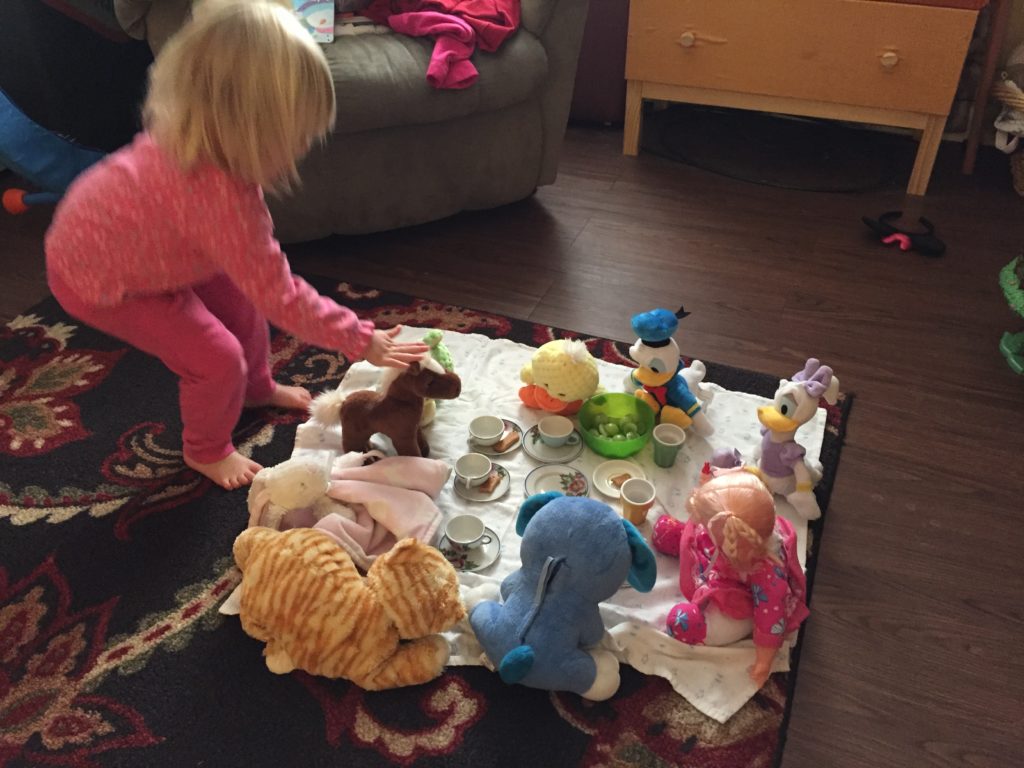
Another highlight was Annesley’s tea party with her fancy china and stuffed animals. She fed them grapes and Scooby Snacks (dog bone-shaped graham cracker treats) and entertained them with ring-around-the-rosie and duck-duck-goose (tricky when your party guests can’t run).

Britt played ball tag with the kids in the backyard after work. They looked forward to it all day!

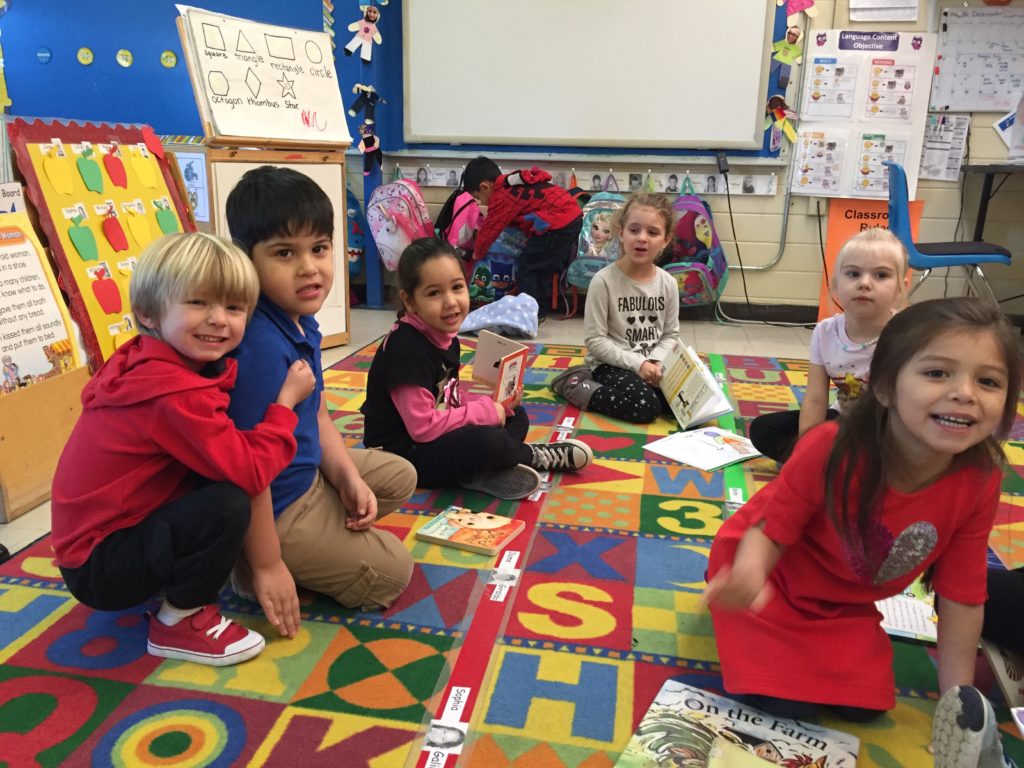
I got to visit each kid’s school. Here’s Will’s classroom.

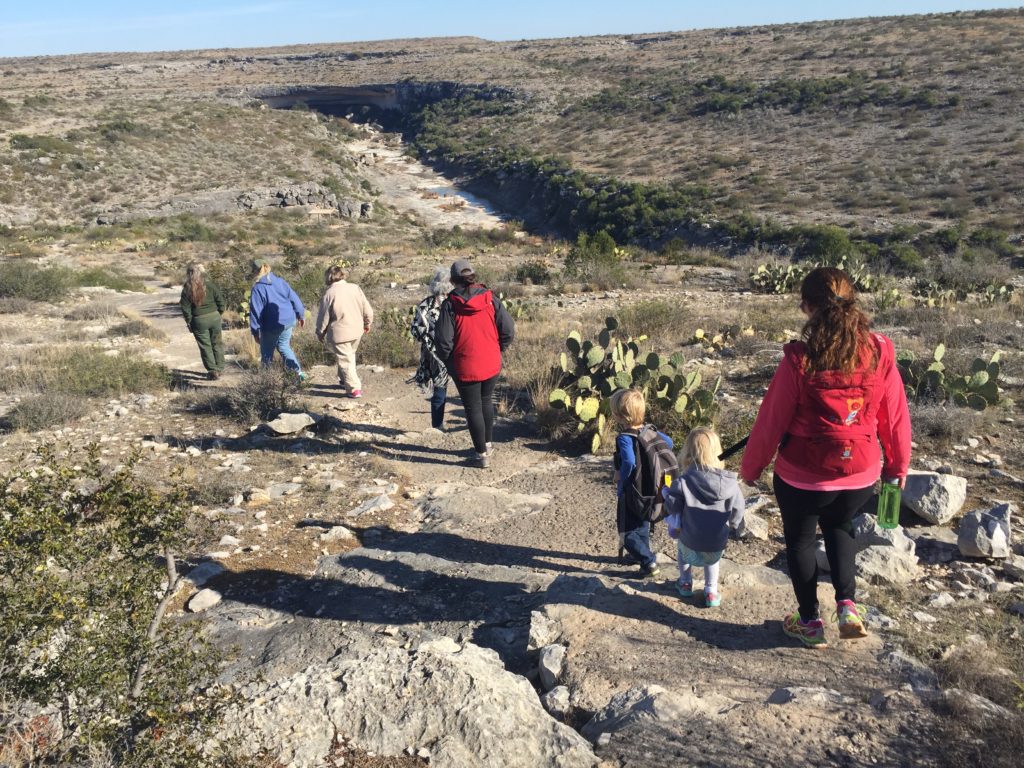
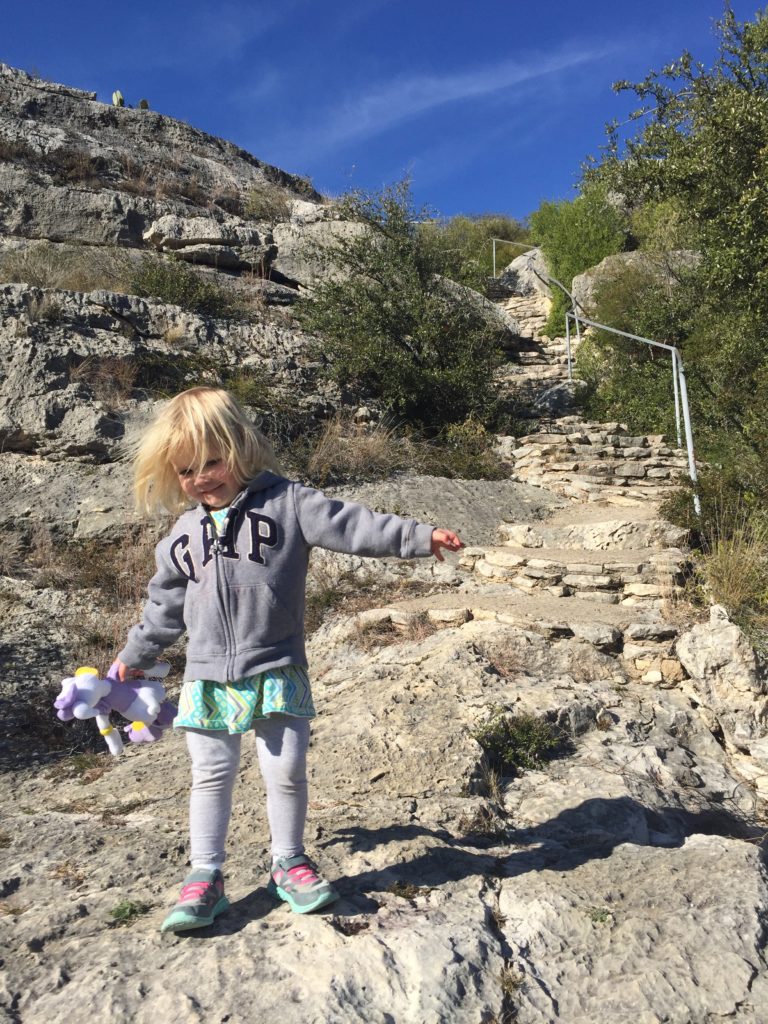
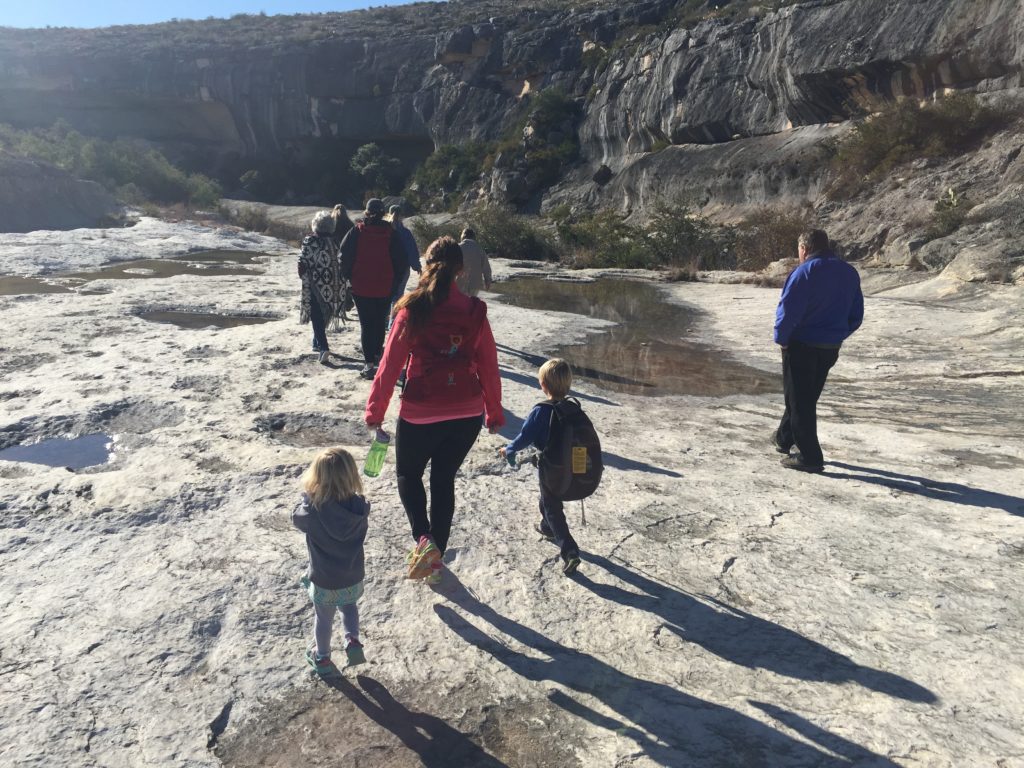
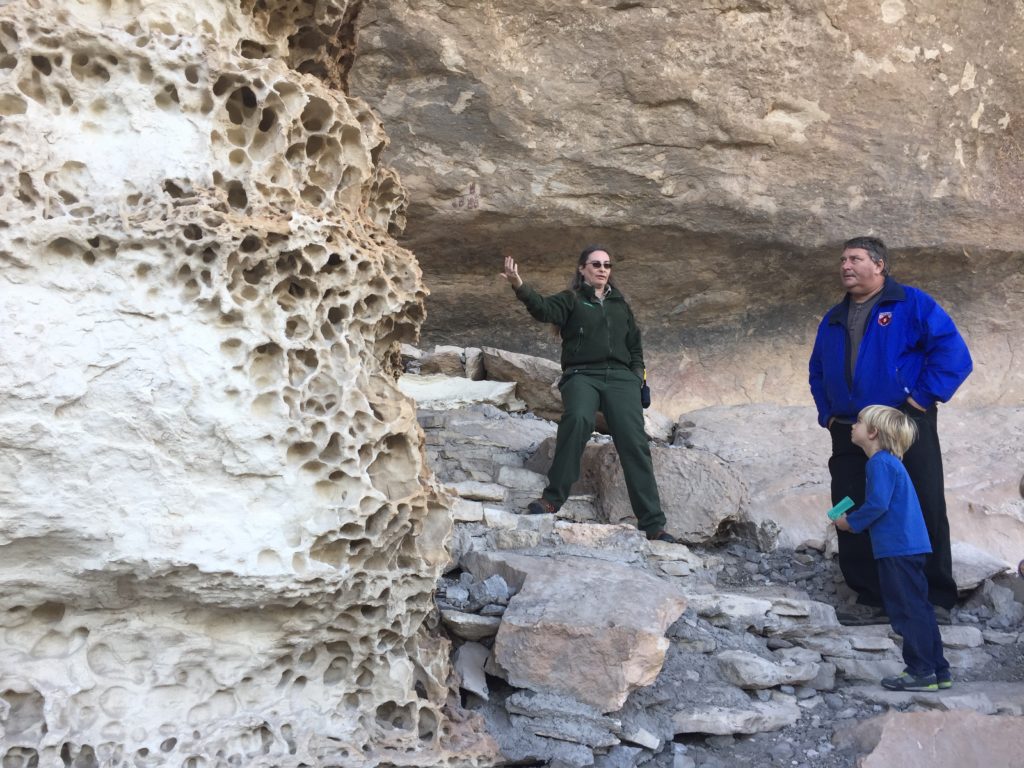
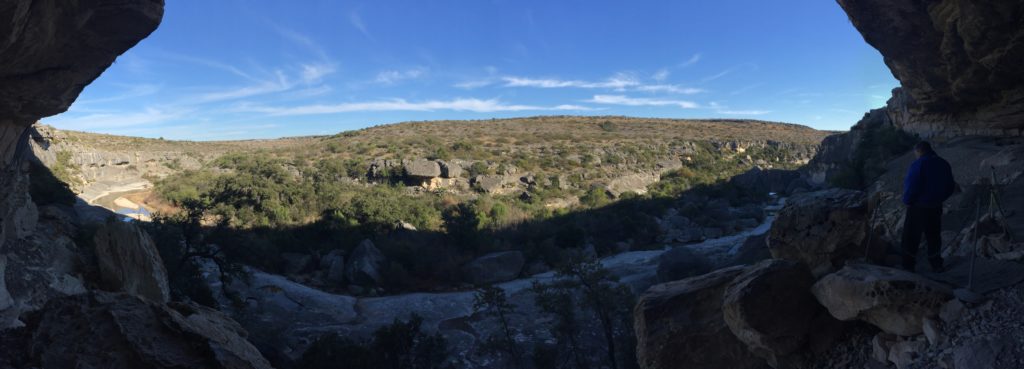
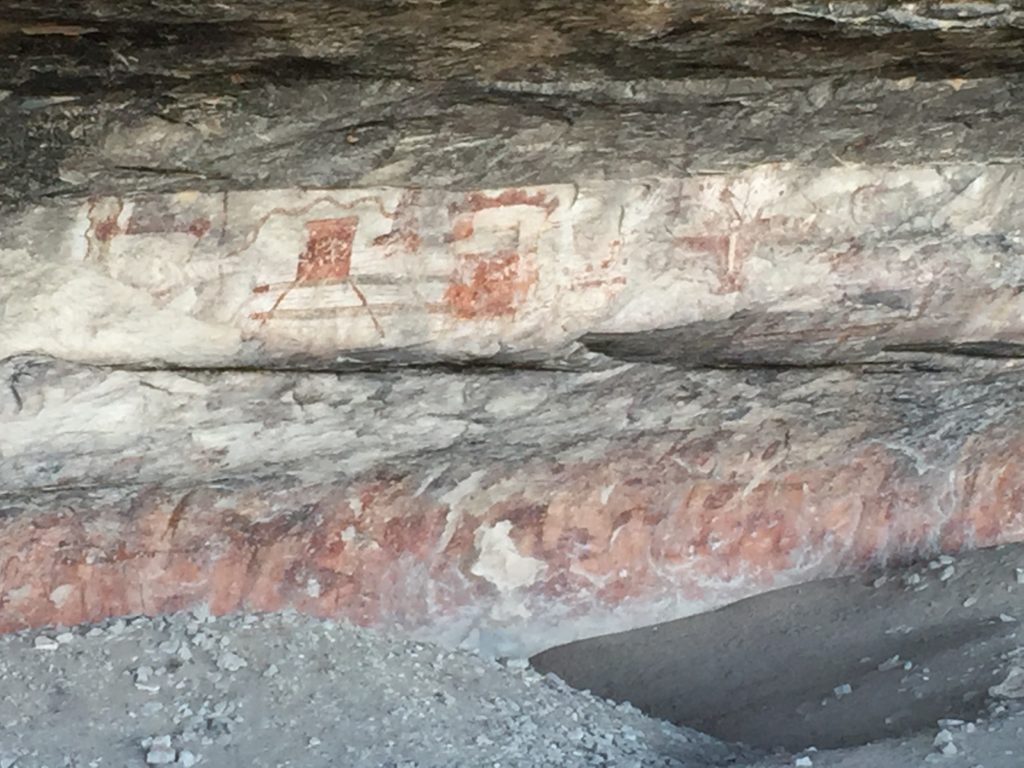
One day, Megan took us for a hike in the Seminole Canyon State Park. The kids were good little trekkers, and Will genuinely listened to the tour guide, even asking a couple questions. (Maybe he’s the next generation Guide Hog?!) We walked to the Fate Bell rock shelter, where 4,000-year-old pictographs decorate the canyon walls. Our guide, Tanya, explained the ancient artists used minerals, plants, animal fat, and other natural resources to produce their paint. What do the pictographs mean? Nobody knows for sure, she said. According to the Texas State Historical Association:

The Pecos River style is a polychrome style that is considered a manifestation of the shamanic cult. The central characters of the pictographs are faceless anthropomorphic figures, elaborately dressed and often holding a variety of accessories such as atlatls, darts, and fending sticks. The figures are often depicted with their arms outstretched, and in later pictographs the anthropomorphs’ arms are increasingly stylized and seem to be more akin to wings than arms. At one end of the shelter there are also examples of Red Linear figures-a Late Archaic Period style characterized by very small stick figures engaged in various activities.

Tanya shares some details about the site while I marvel at the weathering and erosion that has sculpted the rock.

Looking out at the canyon from the rock shelter.

Some of the pictographs.

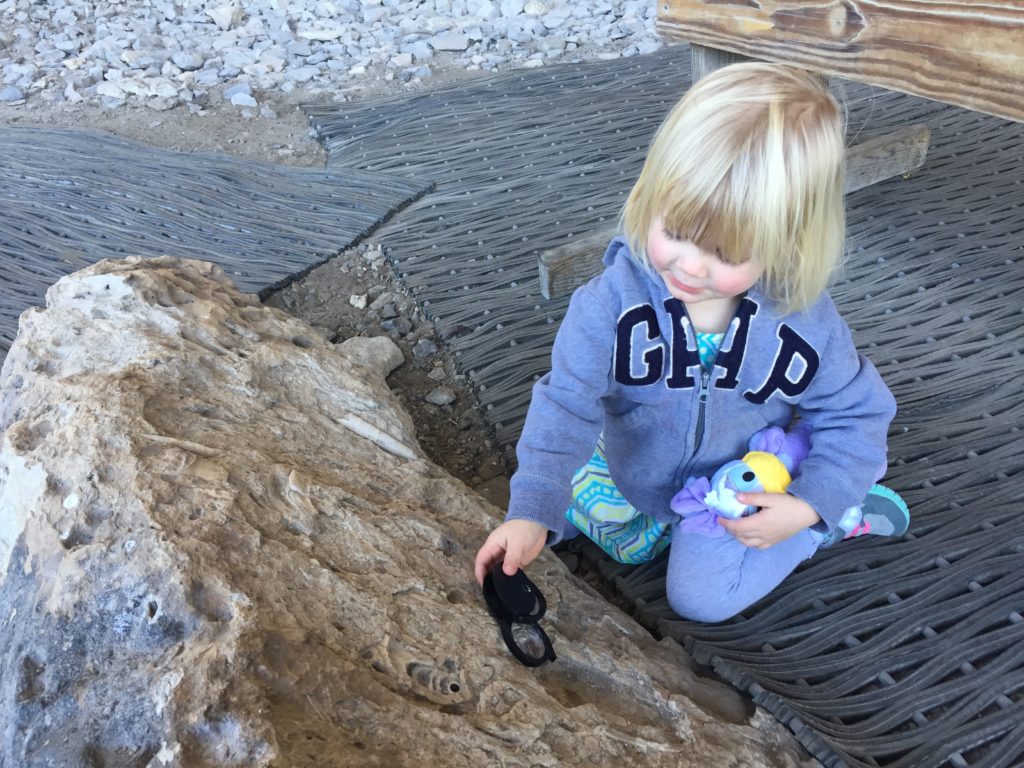
Megan checked out a Junior Park Ranger backback for the kids, which included binoculars, a sketchpad and crayons, a magnifying glass, and wildlife guides. So cool!

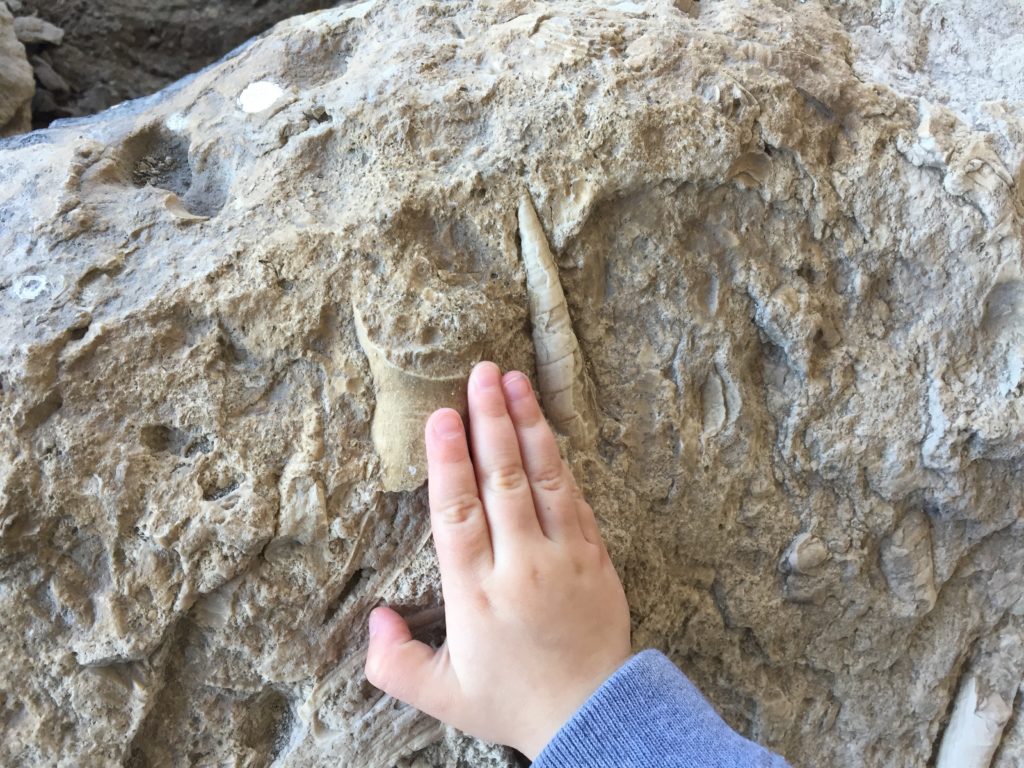
A prehistoric sea left fantastic fossils embedded in the rocks.

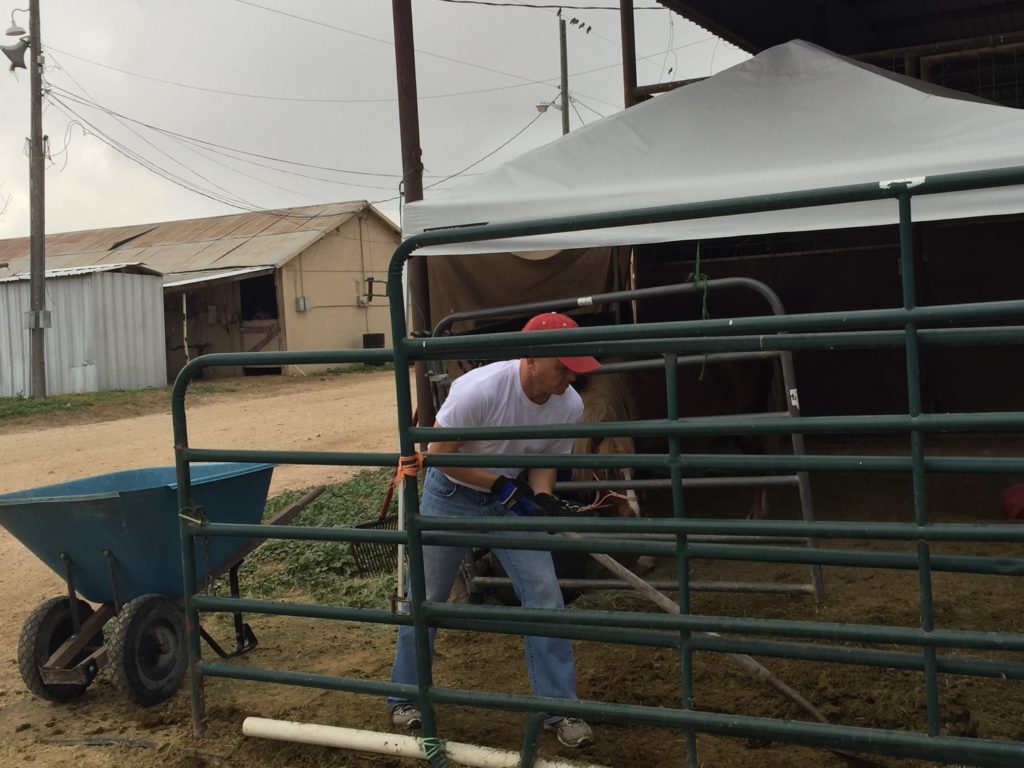
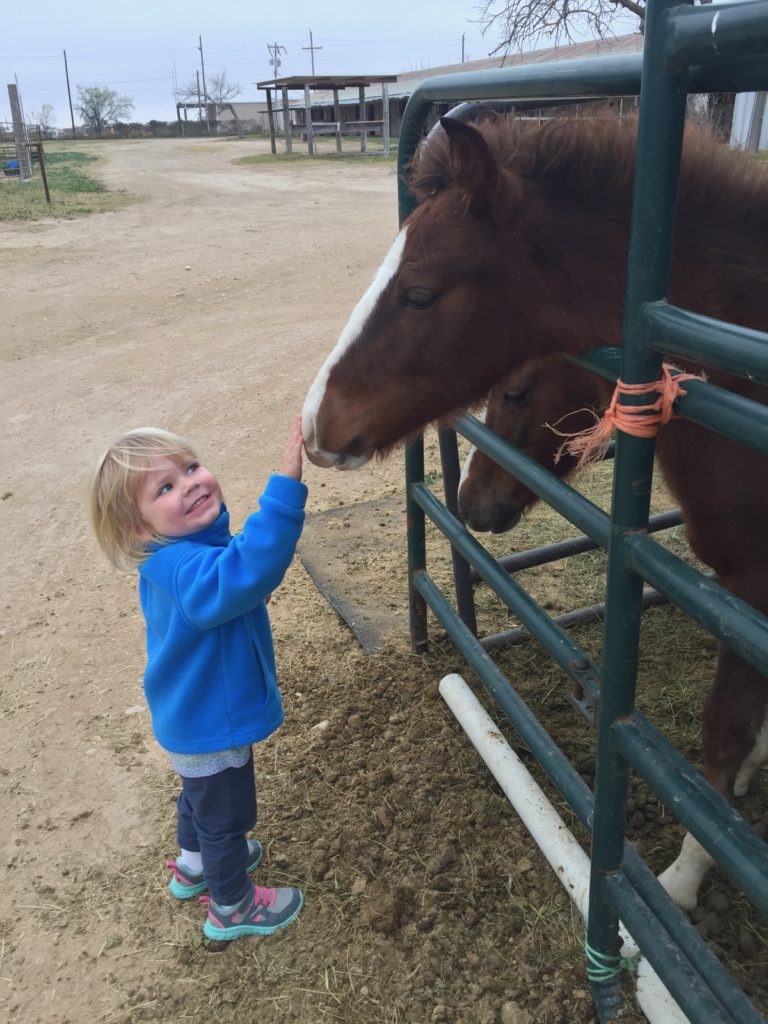
On another day, I got to combine two of my favorite things: my sister’s kids and horses! My brother-in-law, Britt, works with Ms. Jill, who recently broke her ankle and needed help keeping up with her five horses. Britt and I mucked out the stalls, which was much harder work than I expected. I actually only mucked out about half a stall before my body gave out on me.

The highlight, though, was this little guy. About four months old, he was 50% pony, 50% horse, and 100% loco.

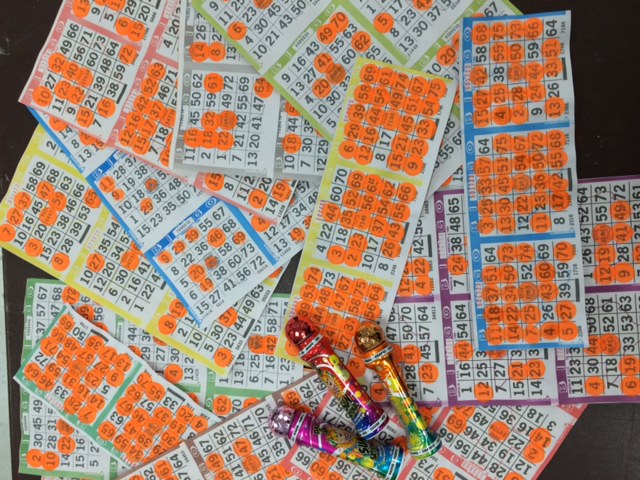
One night, Megan took me to the Del Rio Civic Center, where the Lions Club offers bingo a few nights a week. I had no idea what I was in for. Bingo was serious business to this crowd. I’m guessing there were more than 100 people in the room, and many had their dauber collection on display. I bought a bright orange dauber and a bunch of bingo cards and then prepared to hit the jackpot. I was just two numbers away from winning $750, but alas, we both walked away broke but amused. And it was a great way to practice my numbers in Spanish! The bingo ball always appeared on the video screen before the announcer called the number in English and Spanish. I tried to say the number in Spanish in my head before she said it aloud.

Although my visit was too short, I felt grateful to experience a slice of life with my sister and her family.

Now, farewell to winter and hello to summer back in Santiago. We still have another month off work!

Journey to the biggest pool in the world! Not.
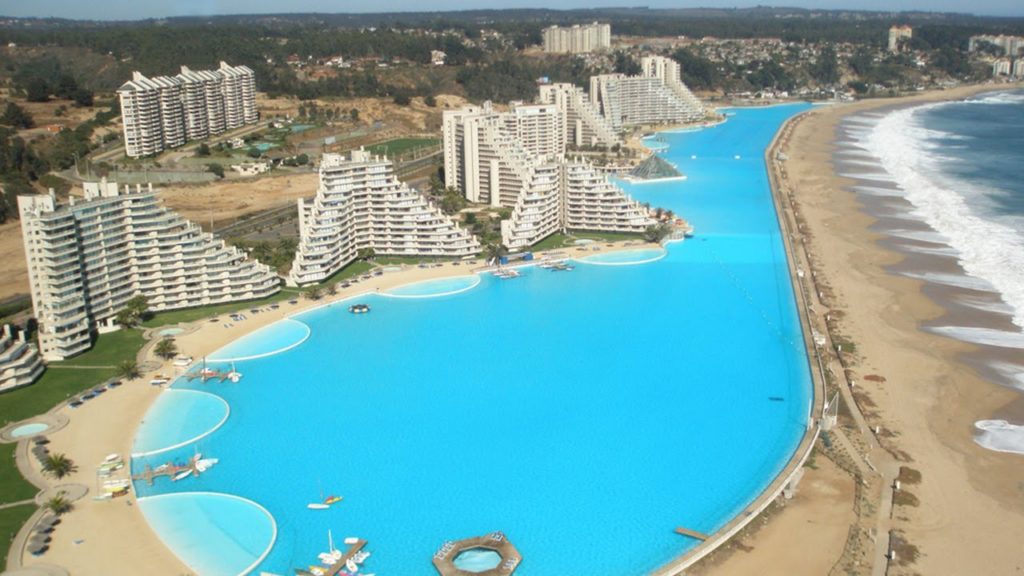
Maybe you’ve heard that the world’s biggest pool is located in Chile. Way back in August, a colleague advertised that her beachfront condo was available to rent. Nancy and I sat on my sofa, looking at the photos of the apartment, and we realized it was located AT THE BIGGEST POOL IN THE WORLD! Although I cringed at the idea of building a humongous pool literally right next to the ocean, and I didn’t even want to speculate about the environmental impact, I also couldn’t help but admit it would be pretty dang cool to say I went to the biggest pool in the world. Nancy and I got all giddy and decided to book it for Tony’s birthday, a long weekend.
As I said, that was back in August. Once we booked the apartment, we didn’t even think about it again. We didn’t do any research. We just piled in the car after school on Thursday, Dec. 7, and headed toward Crystal Lagoon. After a slight misunderstanding with Google Maps, which had us drive on the beach for a bit, we arrived at the compound. We signed in at the gate and received our resort bracelets, pulled up to the parking area, and dashed around the building to see the pool and the beach beyond.

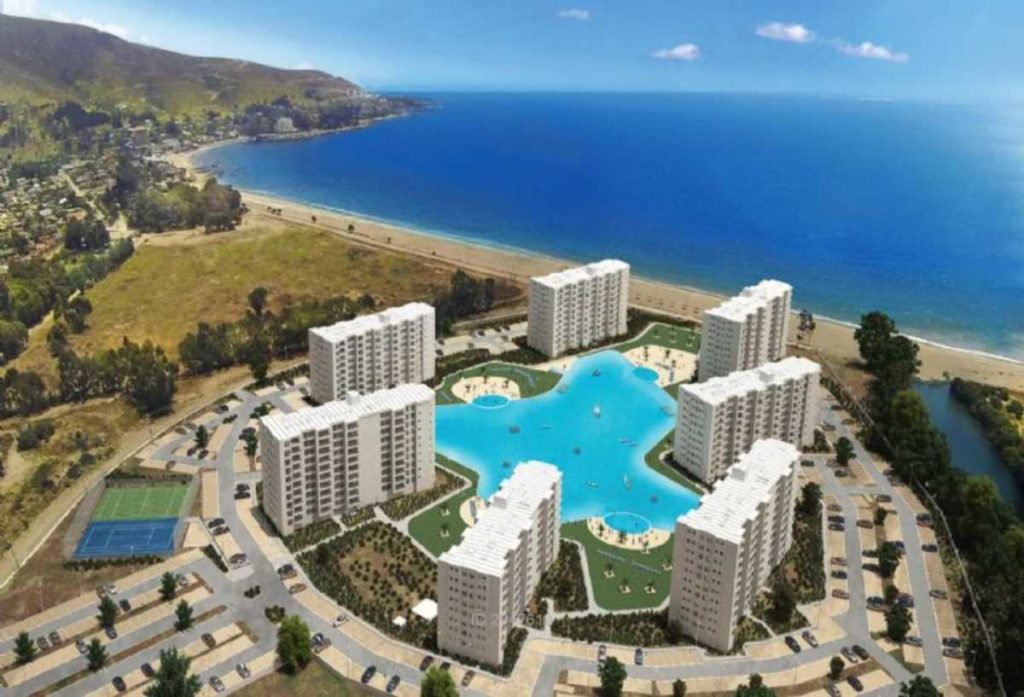
If this were a movie, the scene would freeze with a close-up on our perplexed expressions, and then pan out to a wide angle shot of the large-but-not-enormous pool, and then pan out further to show the construction site blocking the view of the ocean. The heavy overcast sky, the half-built concrete building, the swinging cranes, the churning sea – all colored gloomy gray – contributed to our sense of deflation.

For about a minute.

Then we had to face reality: We were not where we thought we were. And that sent Nancy and me into hysterics. Tony and I have lived in six countries and worked abroad for the last 17 years. Nancy has three passports and spent four years in India. We are not novice travelers. But this was a ridiculous, rookie travel-fail. And we couldn’t stop laughing. Seriously, for three days. Every time we passed the moderately-sized pool, we would crack up again. “How could we be so stupid?” we would titter.

The evening of our arrival, we drove around town looking for an open restaurant. No luck. We finally found a tiny take-away window (literally a hole in the wall), where we ordered chorillanas, a traditional Chilean dish of french fries, smothered in beef cubes and onions, with fried eggs on top. It was pretty greasy and delicious. However, we stressed a bit that we would have no other dining options during our visit.

Anyway, once we got over the realization that we had intended to go here (Alfonso del Mar) …

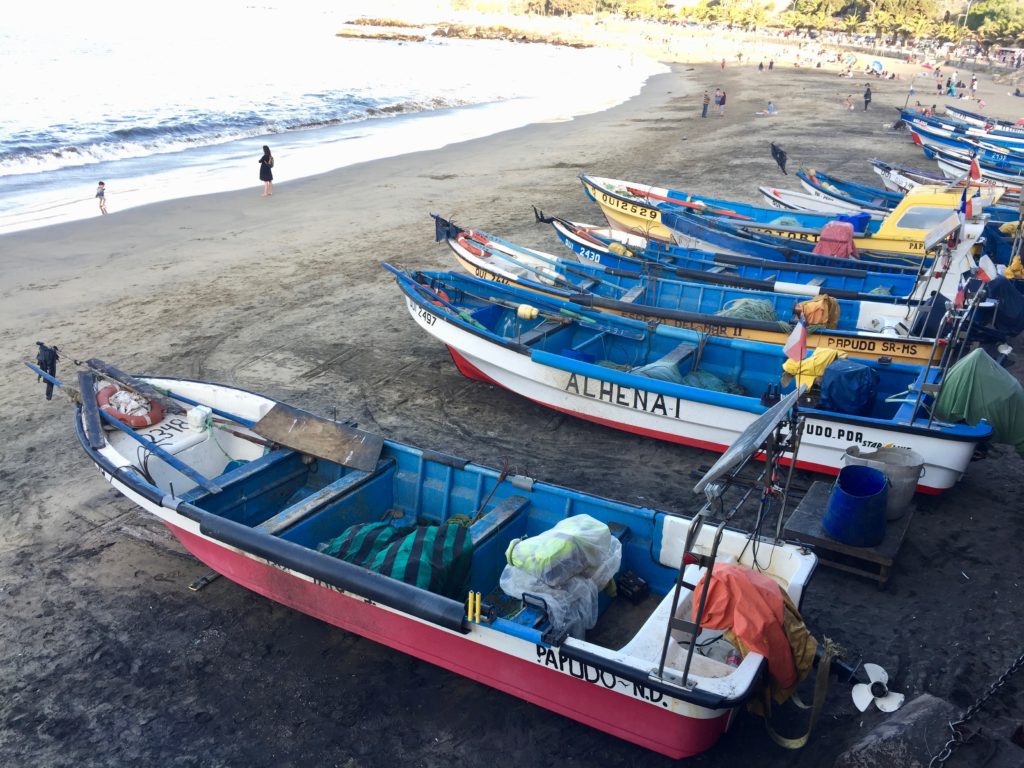
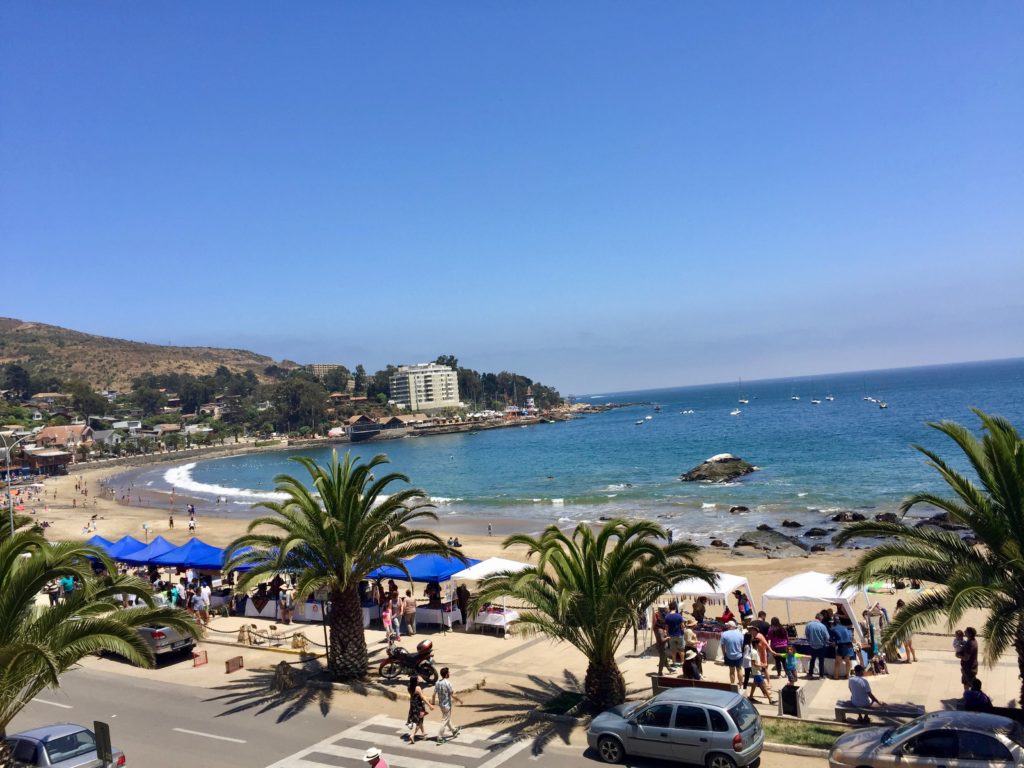
…but had actually gone here (Papudo),

we reminded ourselves that it’s about the journey, not the destination.

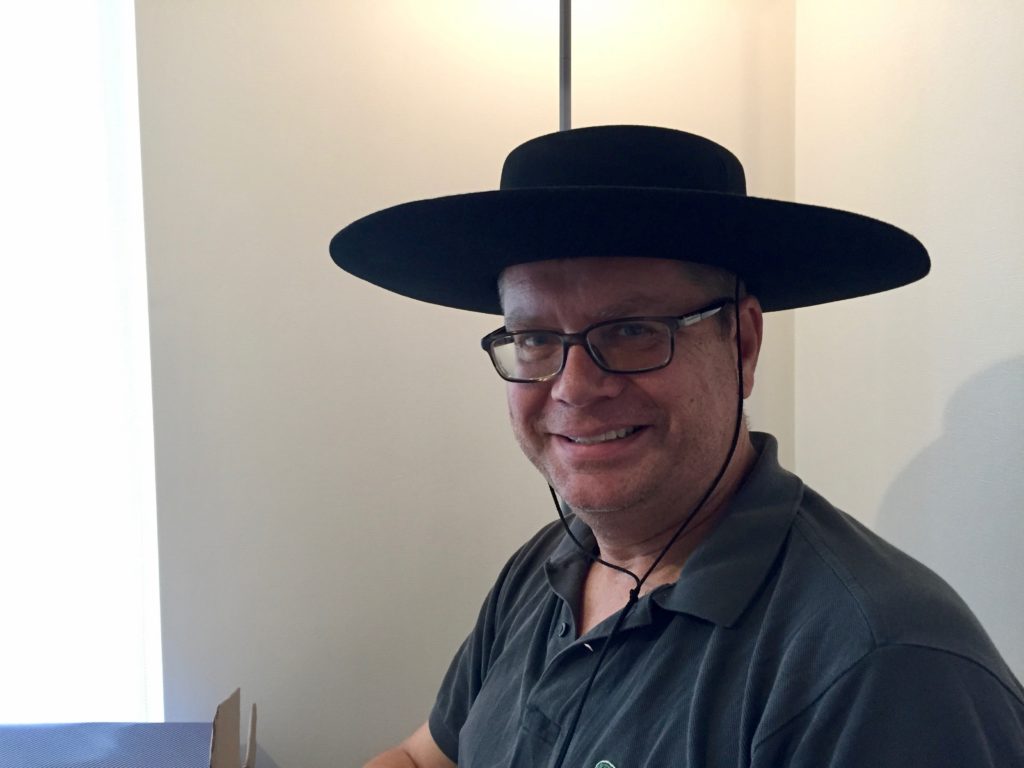
The next morning was Tony’s birthday. He opened his present from me first thing: un sobrero de huaso! This is the traditional hat worn by Chile’s huasos – cowboys – and even some city slickers. It’s not just a prop. You see it everywhere. Nancy gave him a bottle of Bailey’s and a special glass. He was pretty stoked.
After a leisurely breakfast, we looked out the window at the drizzly weather and gave up on playing at the beach. Instead, Nancy and I decided to find a supermarket. We drove about half an hour south till we reached the town of Zapallar, while Tony hunkered down to grade papers at the apartment.

Nancy and I parked at a strip mall that had a huge ferreteria. I have seen the name before but never stopped to find out what it was. Of course, I really wanted it to be a sprawling pet store devoted to ferrets. I pictured them scampering around on carpeted towers and rolling across the room in extra-large hamster balls. Alas, as my trusty SpanishDict app confirmed, “ferreteria” means “hardware store.” So that was disappointing. It was basically a Home Depot. The supermarket was right next door. We stocked up on wine and snacks, bought a few empanadas for lunch, and headed back to our home away from home.

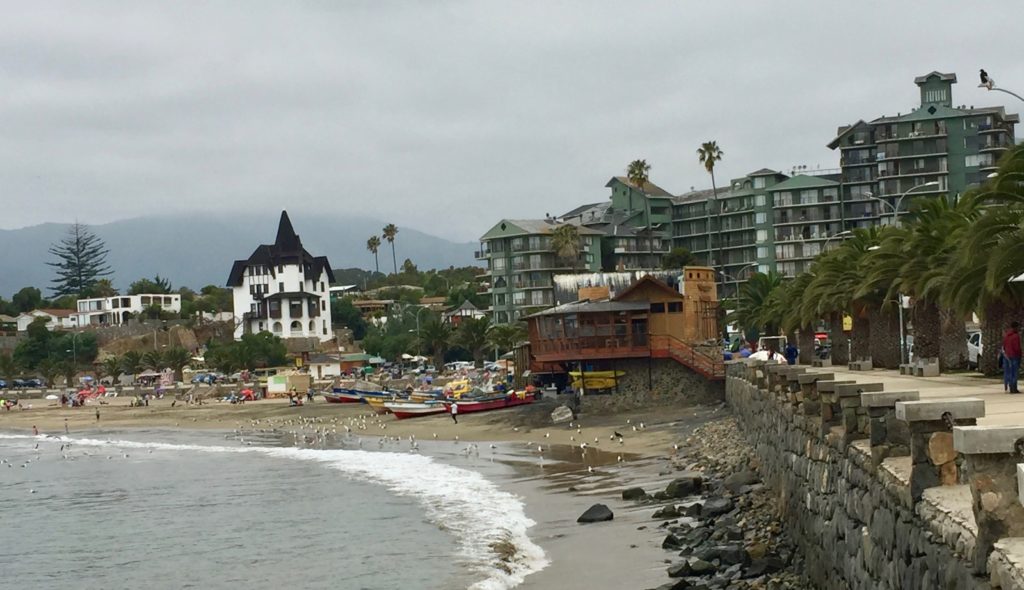
Lounging around the apartment was nice, but we could do that anywhere. We finally dragged our lazy booties out to explore. We walked through the compound to a gate that opened to the beach. Who knew? (To be fair, the apartment’s owner had actually told us a few details about the place, but the information didn’t stick.) The sky remained gray and dreary, so we all felt sluggish. We walked along a nice waterfront path, found a few promising restaurants, enjoyed the view of massive pelicans floating just a few feet above the waves, and then wandered home to get some work done. Unfortunately, Tony’s birthday always falls right when we have to write our report card comments for the end of the semester.

Later, the clouds burned off and the sky turned cerulean blue, so we wandered out again, energized by the warm sun.

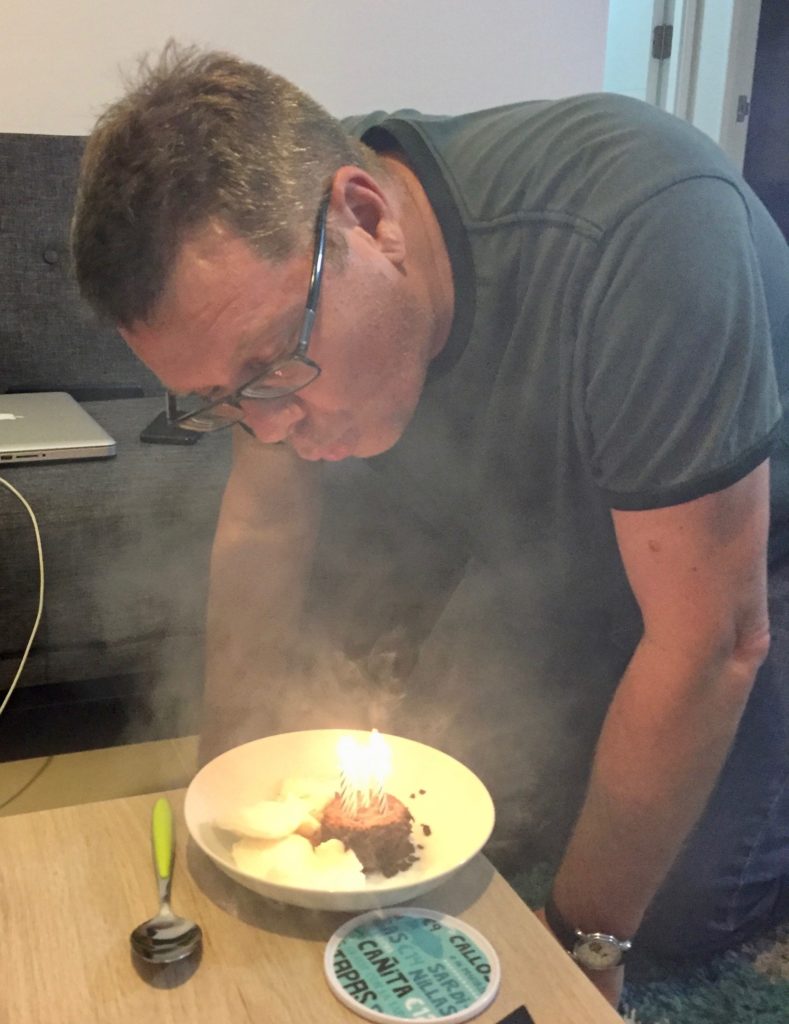
For dinner, we easily found a waterside table as the only other people eating at 7:30 p.m. were families with small children. Back at the casa, we sang “Happy Birthday” to Tony. Unbeknownst to me, the birthday candles I picked up at the supermarket were those “magic” ones that keep reigniting. That’s funny when you’re 10, but kind of annoying when you’re 52 and just want to eat your cake and ice cream.

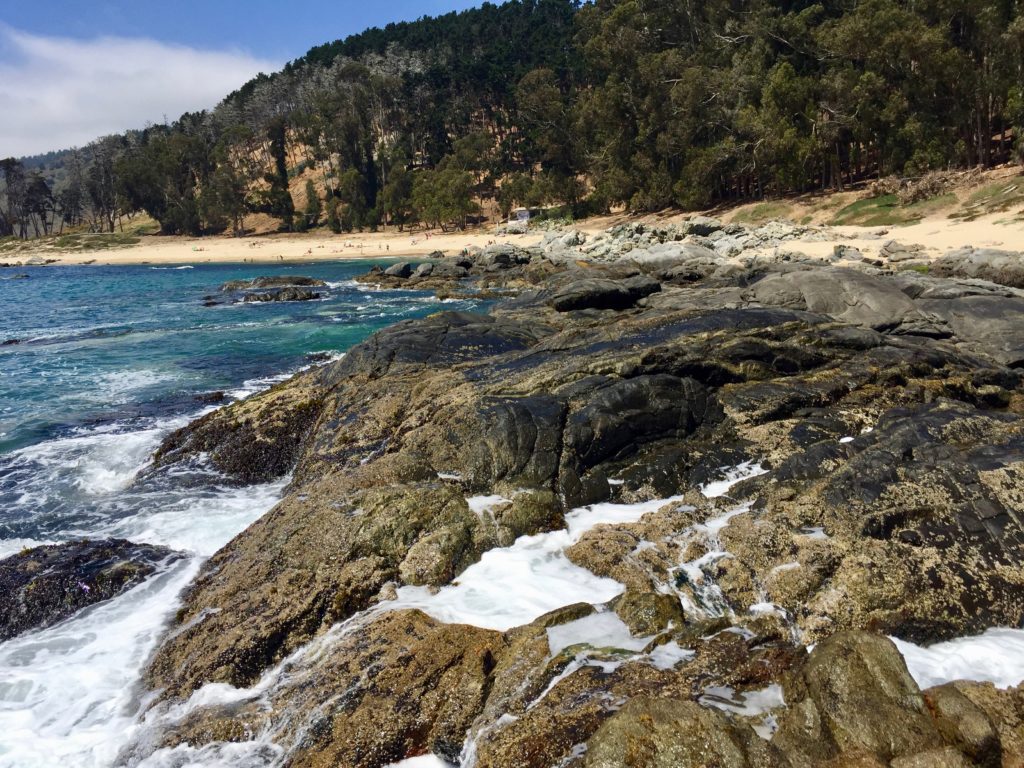
The next day, we strolled along the sandy beach, waded in the chilly Pacific water, climbed on the rocks, and soaked up the seaside sounds and smells. There was no avoiding grading and writing report card comments, but we found it’s not so bad when you can reward yourself with occasional beachside breaks.

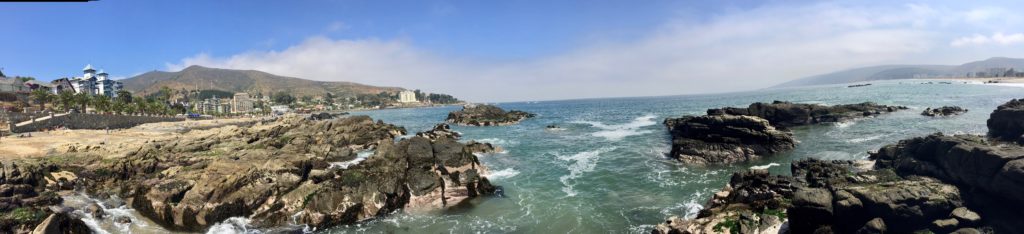
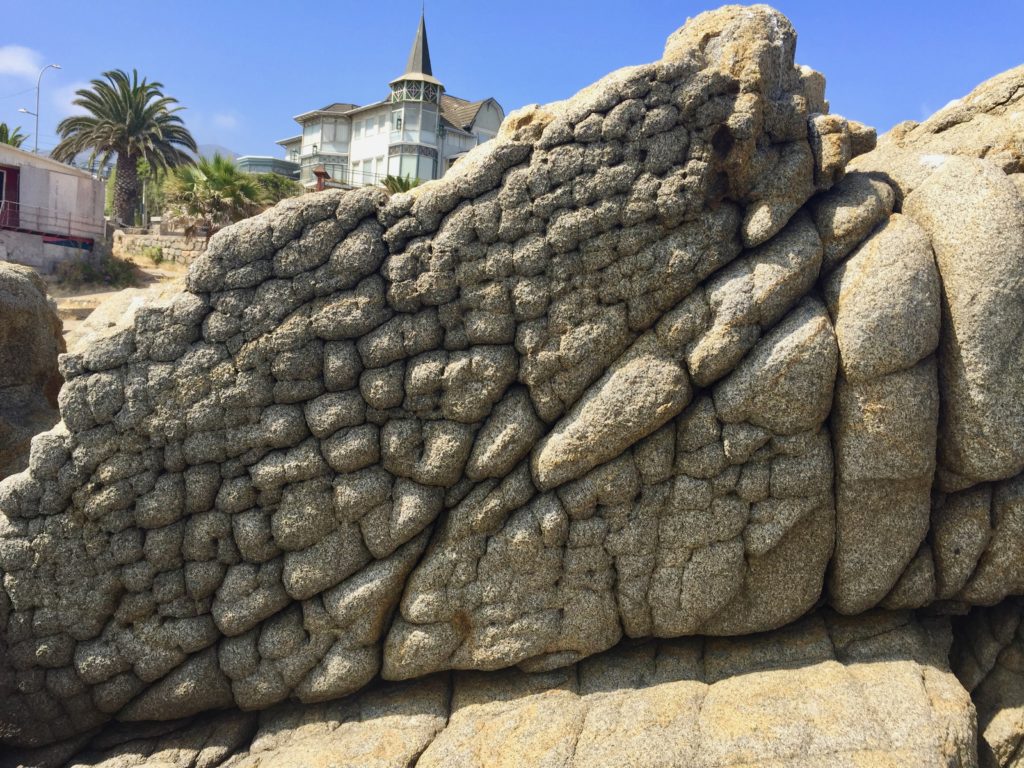
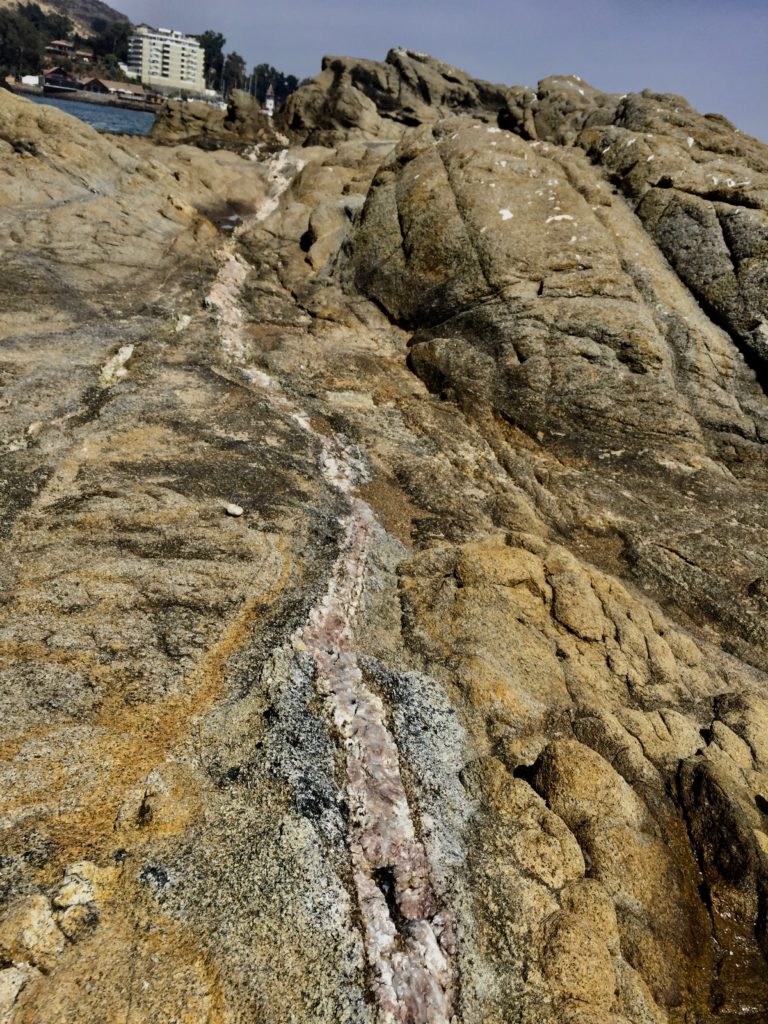
The rocks offered dramatic testimony to the forces of nature that sculpted this coastline.

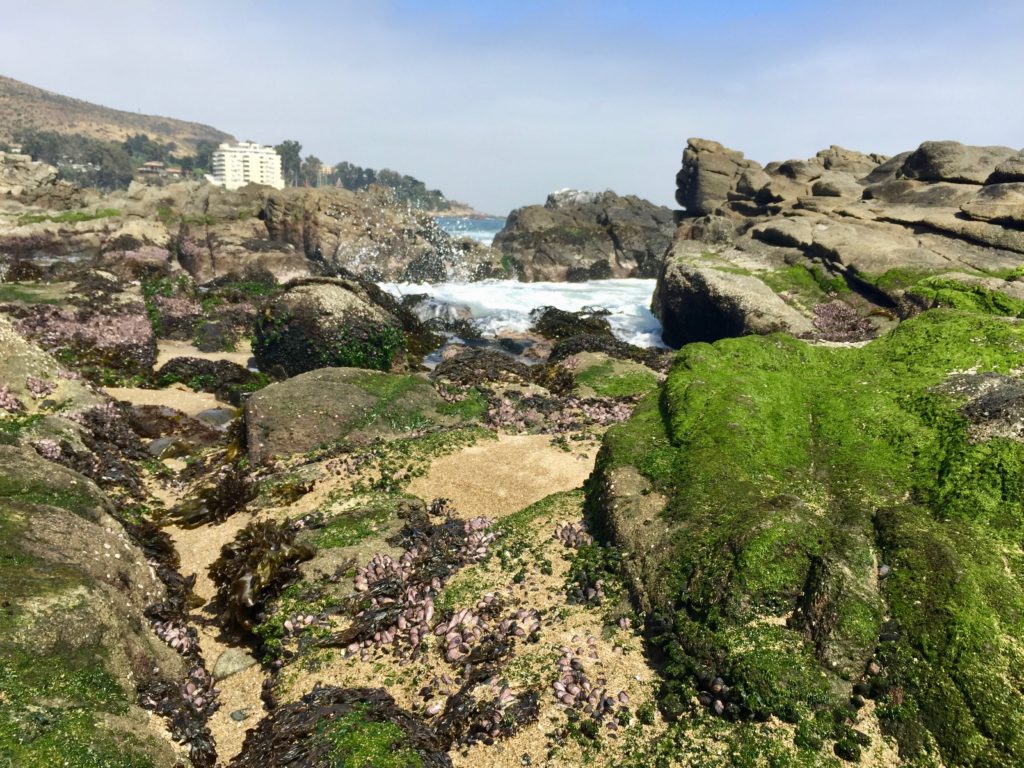
I could poke around tide pools all day.

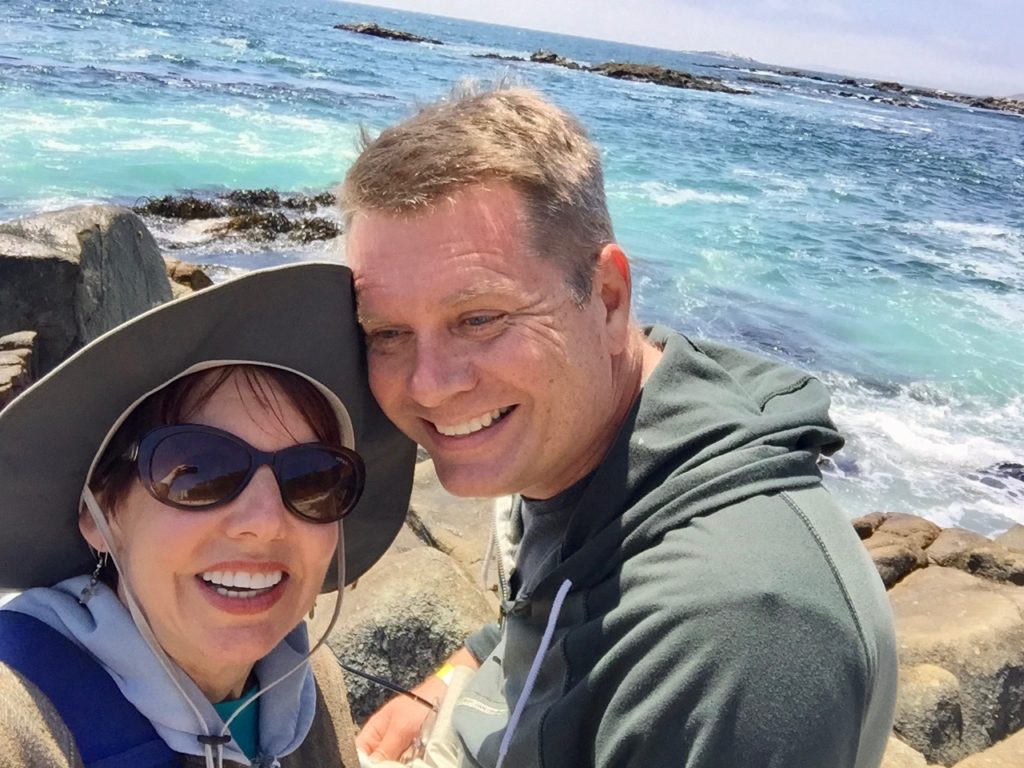
Warm sand between my toes, sitting with my sweetie on a weathered rock, watching waves blast into the boulders. I just wish I could bottle this feeling.

Huilo Huilo – a forest fairyland

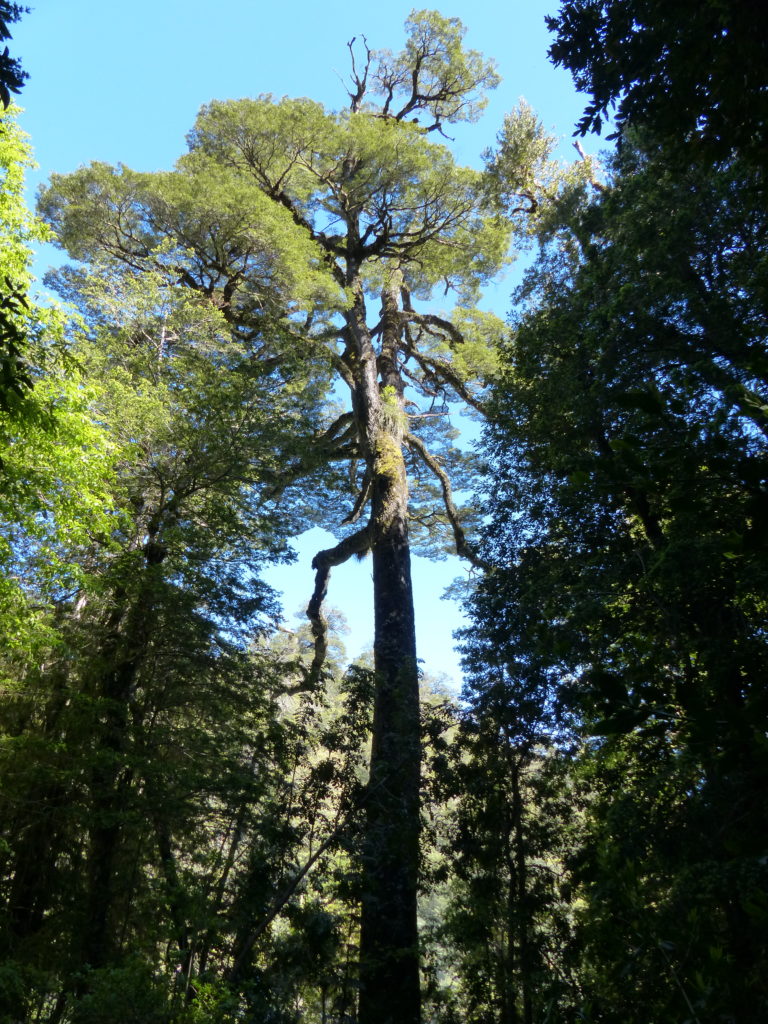
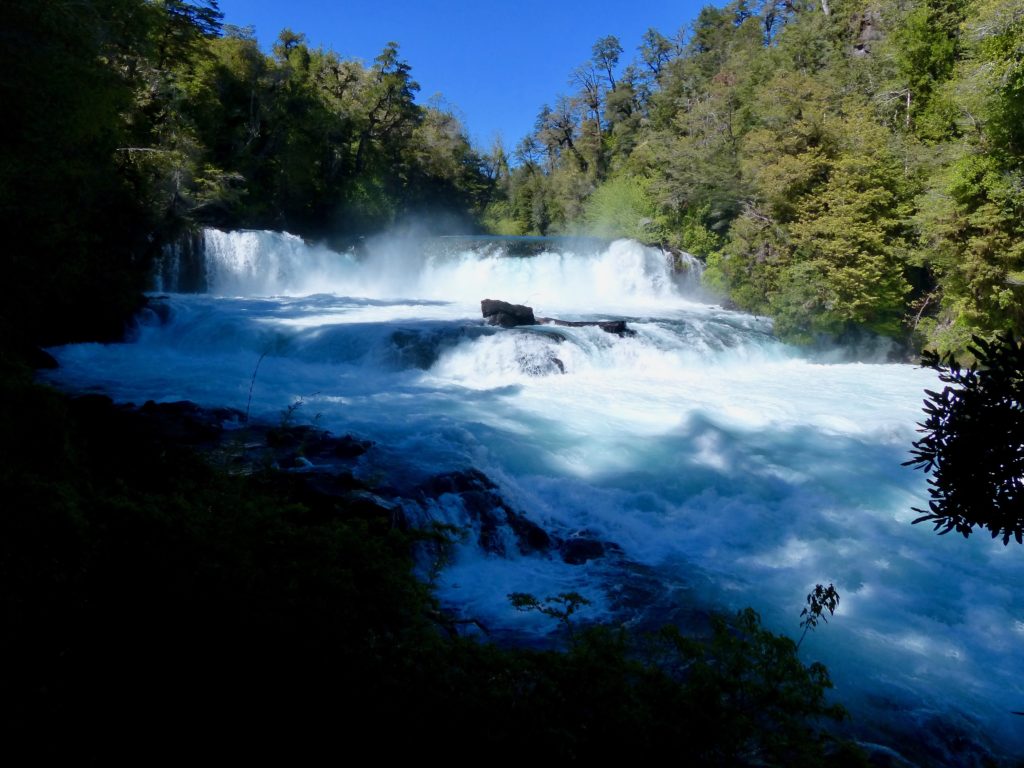
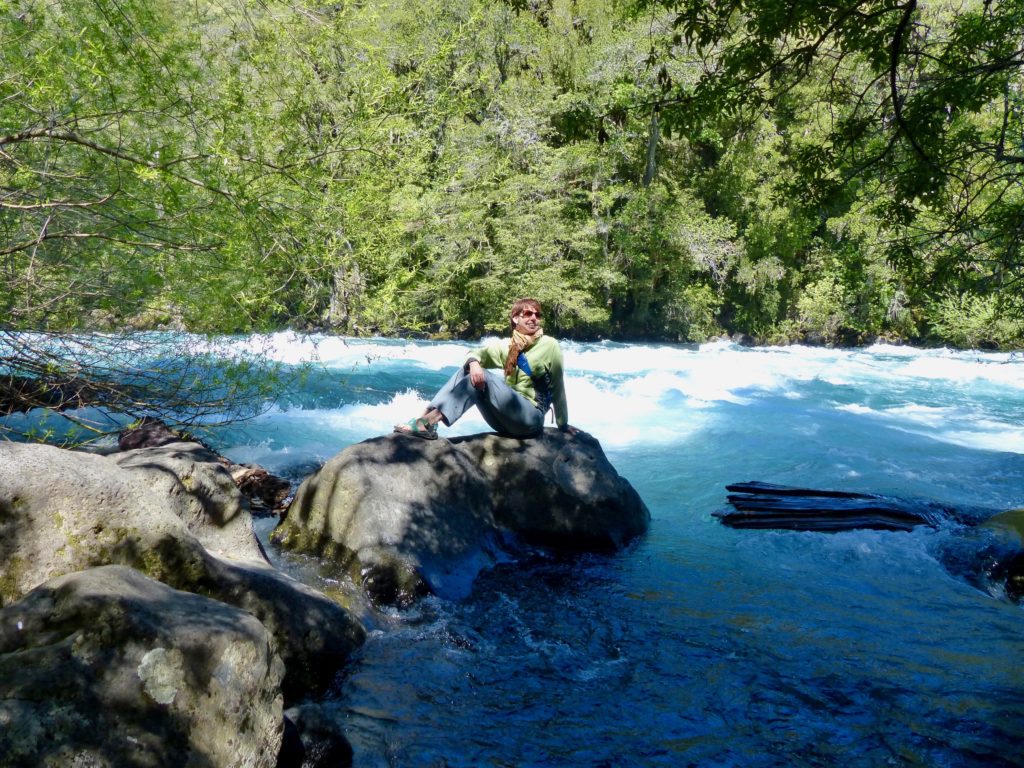
After a Thanksgiving dinner with friends at a high-rise apartment rooftop, we left the big city behind for a weekend in the Patagonian Rainforest. We spent a few days frolicking in the forest like wood sprites or hobbits. And our hotel provided the perfect backdrop for this fantasy.

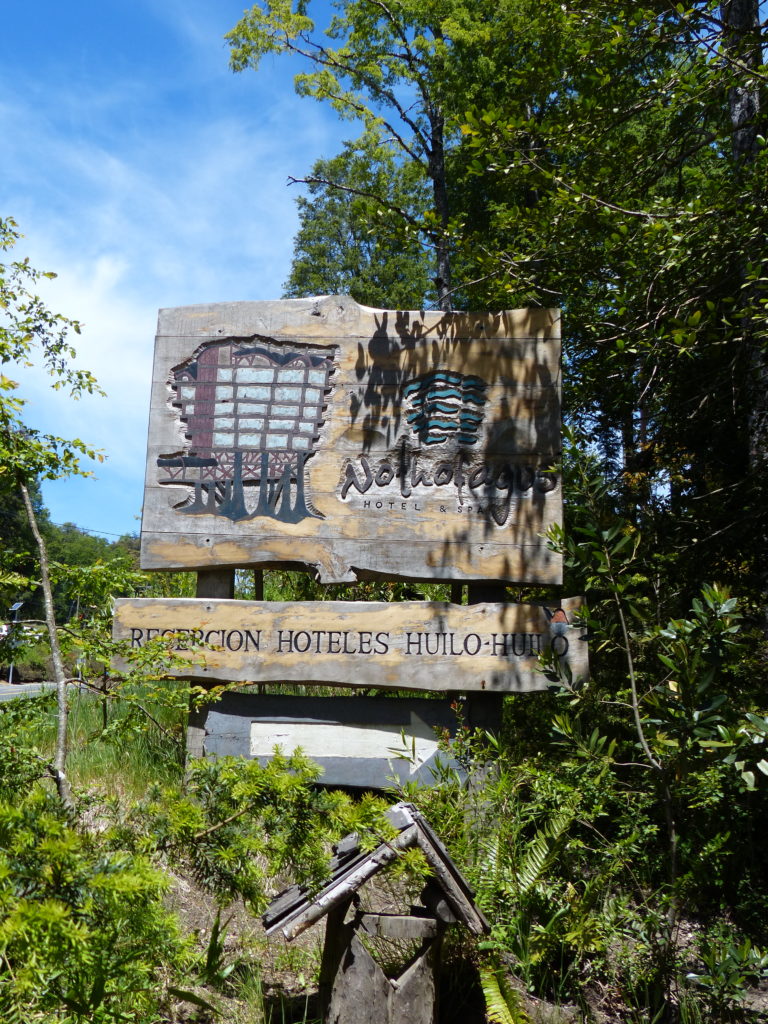
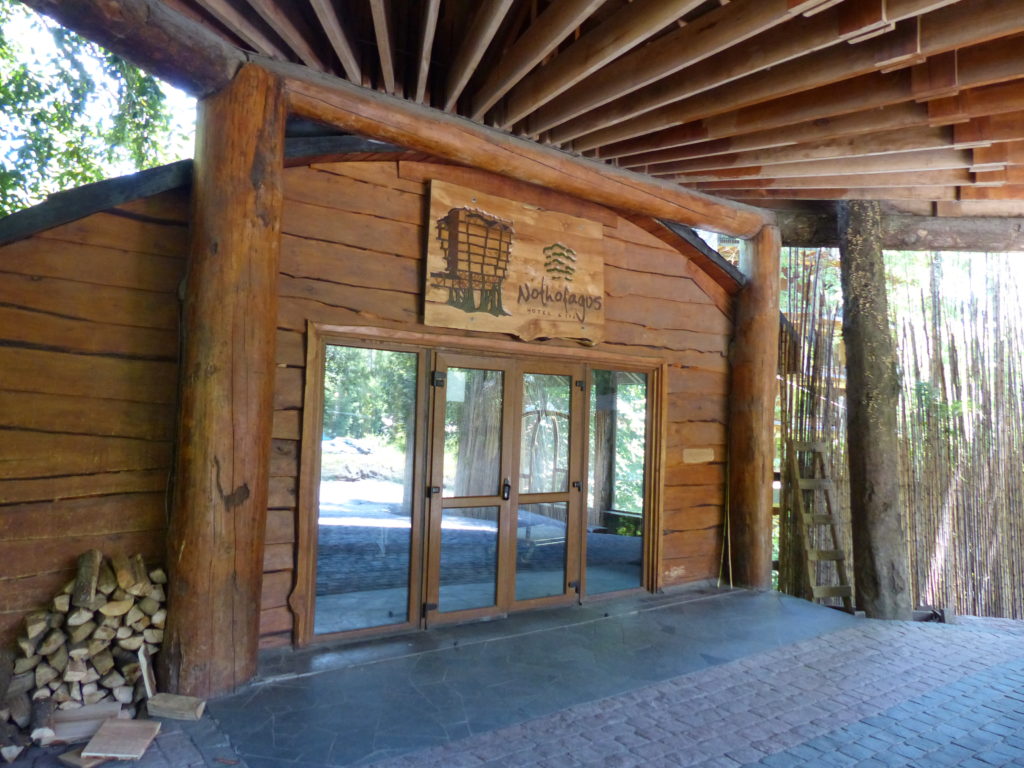
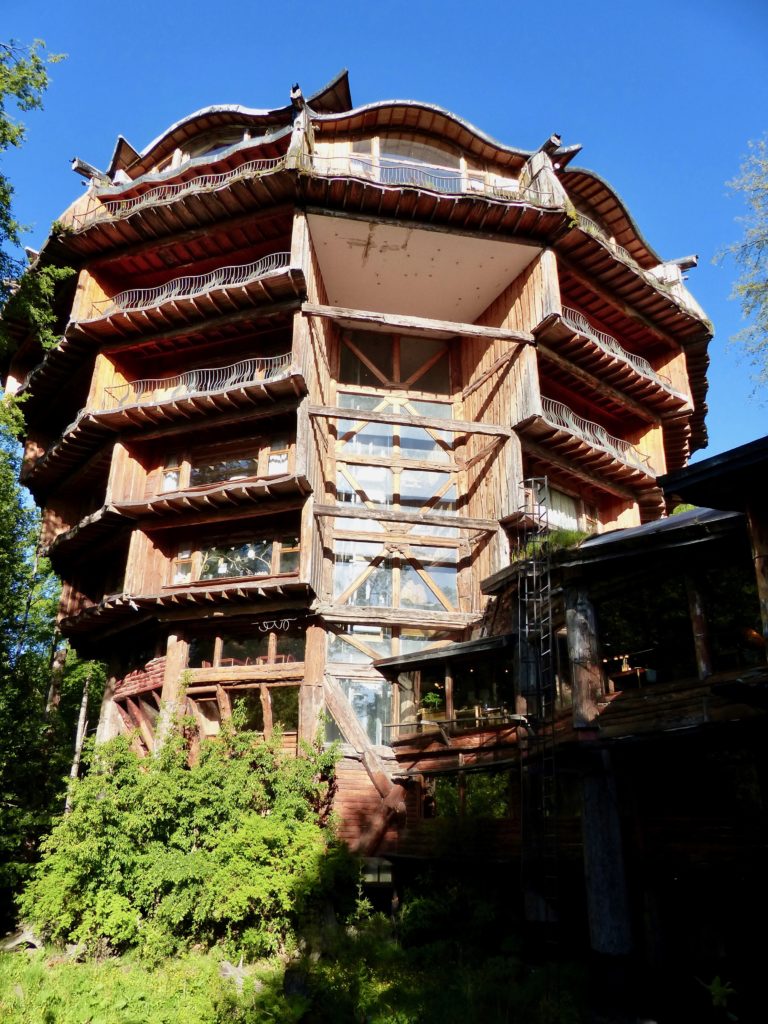
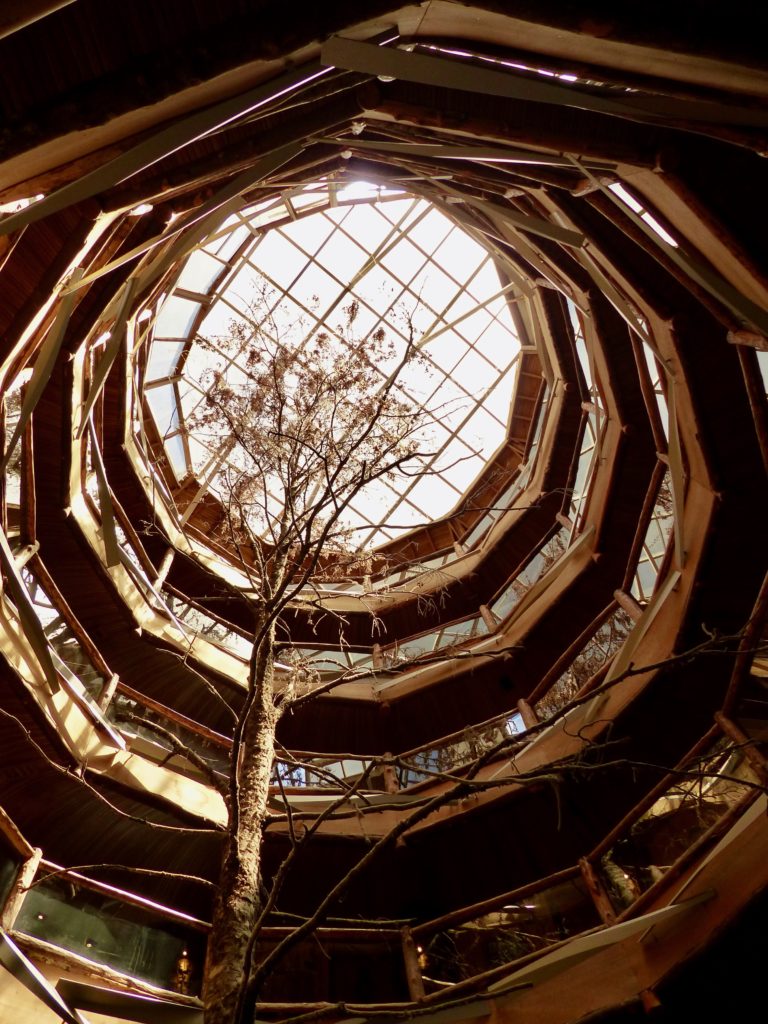
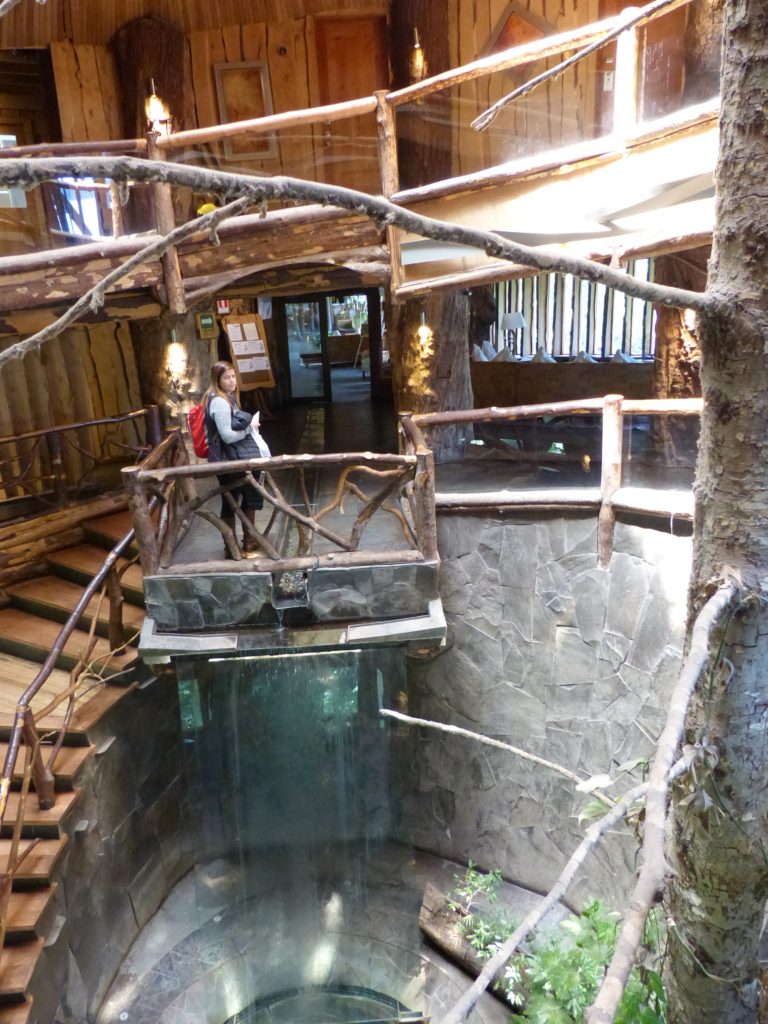
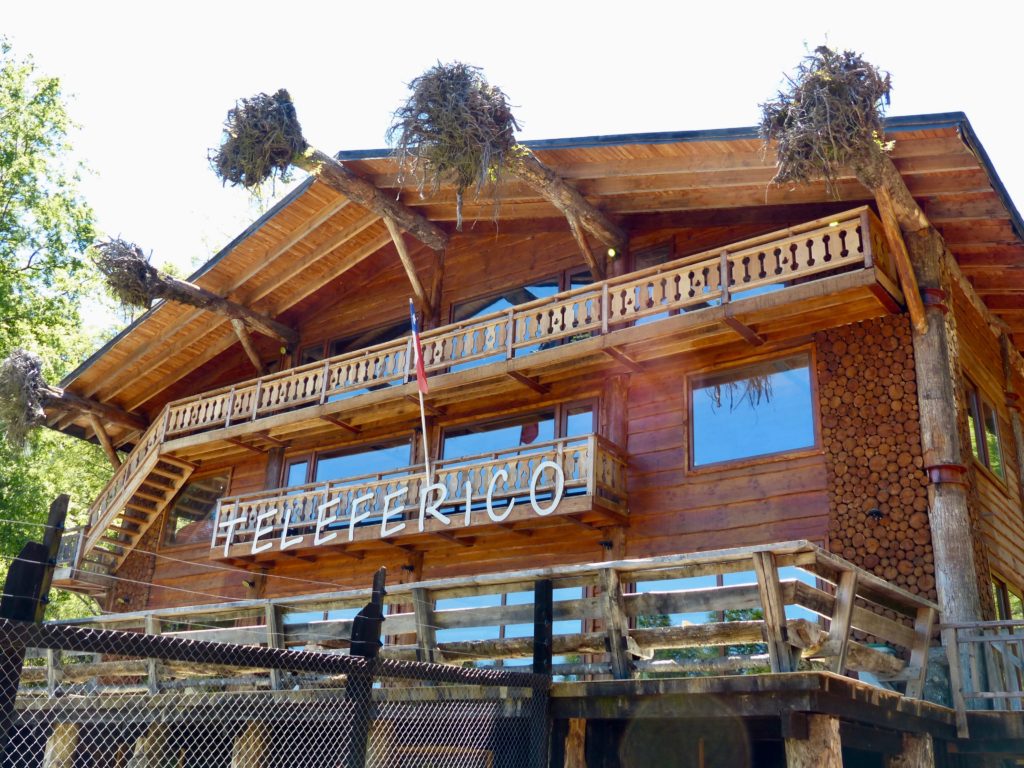
I traveled with Sam and Hillary (the Thanksgiving dinner hosts) and Nancy. We stayed in the Huilo Huilo Biological Reserve at the Nothofagus Hotel, named for the indigenous trees of the region (one of which soars up through the middle of the hotel itself). We stepped into the hotel and immediately felt transported to a fairy village, complete with confusing passageways and random staircases, a spiraling path from the ground-level restaurant to the rooftop viewing area with a waterfall at the center, rough-hewn beams and unfinished logs comprising the railings and other foundational structures, and views out every window revealing ponds, trees and other greenery, twisted man-made paths, and quirky sculptures and fountains.

It was really impossible to capture the weird wonderful whimsy of this place.

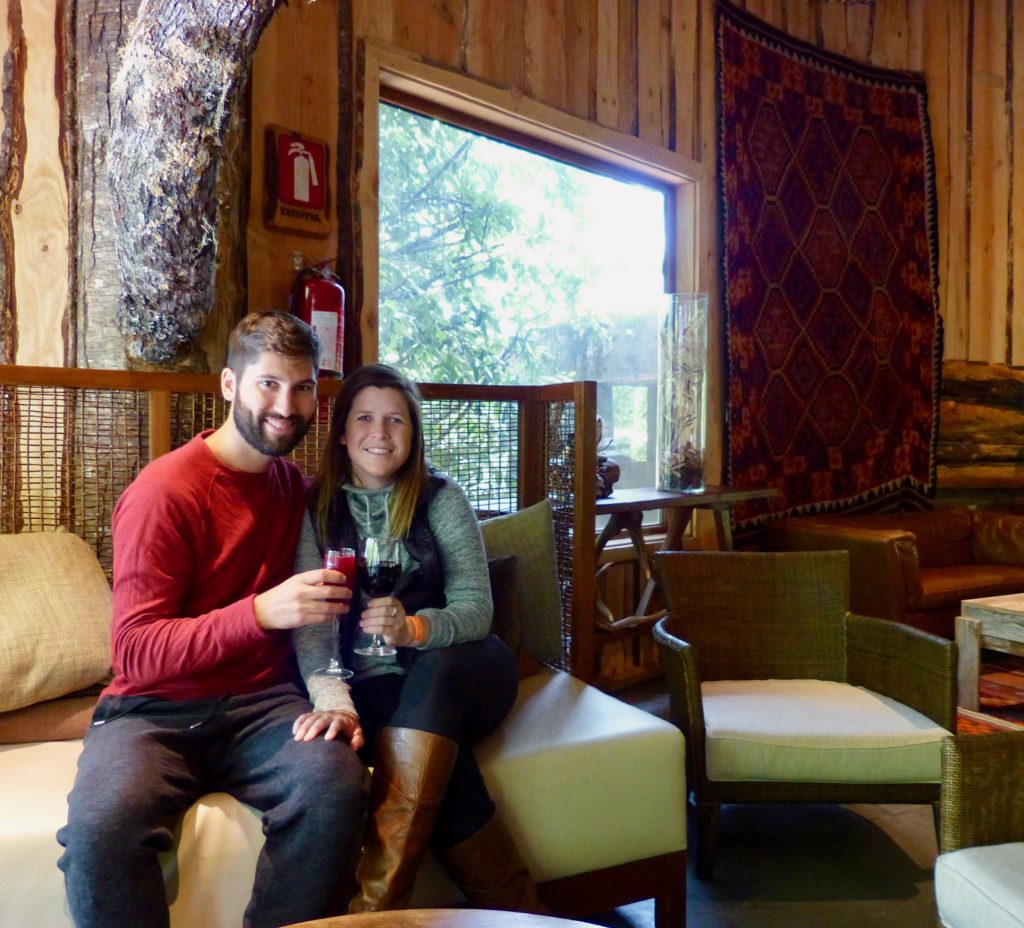
After wandering down long hallways, up and down stairs, and in and out of mysterious doorways, we stumbled upon the pool, which brought us great joy, especially because the lovely staff served us champagne while we soaked in the hot tub.

The only drawback was a lack of restaurants. The hotel’s buffet was pricey with no à la carte options, and the brewery across the road served only pizza. Still, we survived.

Walking to the brewery.

This made me giggle in the brewery bathroom.

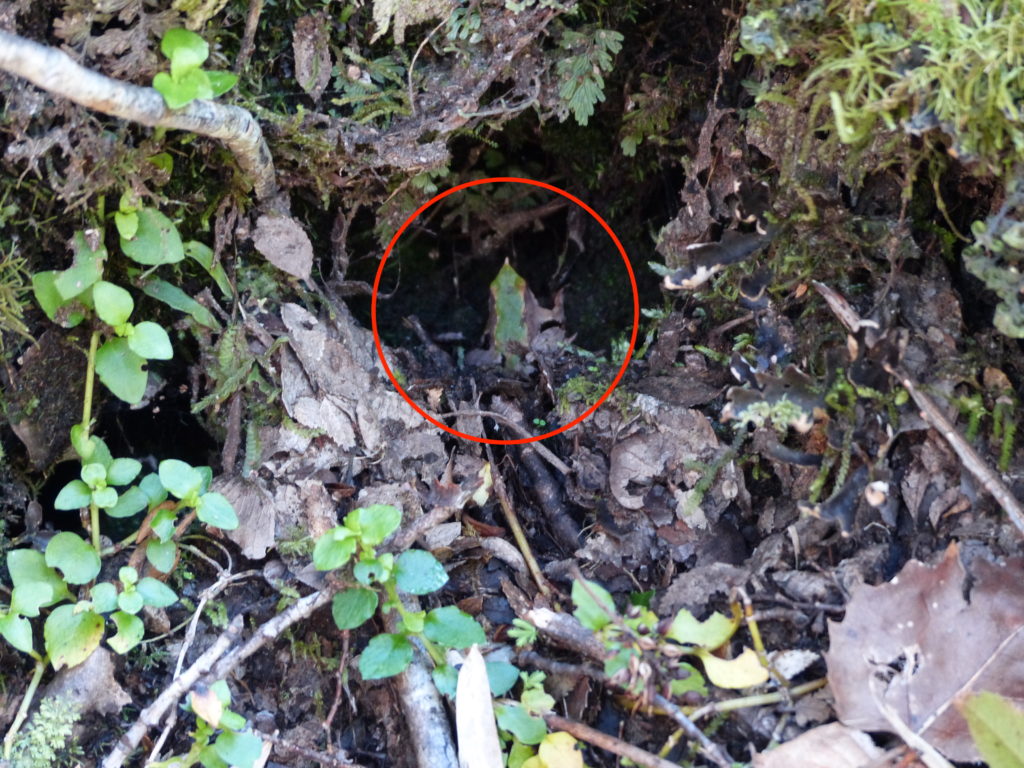
The privately owned nature reserve spans about 300,000 acres. While Chile has a dearth of exciting wildlife, thanks to its isolation on the planet (mountains … ocean … you know how that goes), Huilo Huilo is home to the endangered Darwin’s frog (we saw one!) and other special species, such as the tiny pudu deer and the marsupial monito del monte (neither of which we were fortunate enough to spot). Huilo Huilo has put a great deal of effort into the conservation of the huemal deer. Researchers are raising the deer in captivity and gradually releasing them back into the wild. We visited a viewing area to see them.

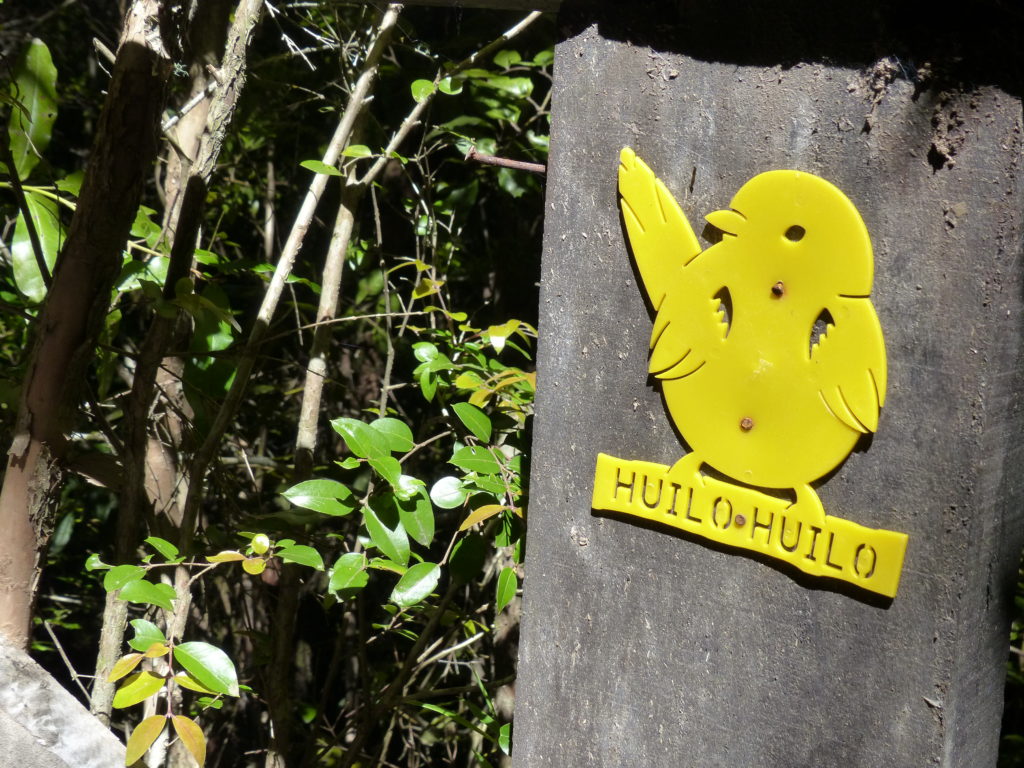
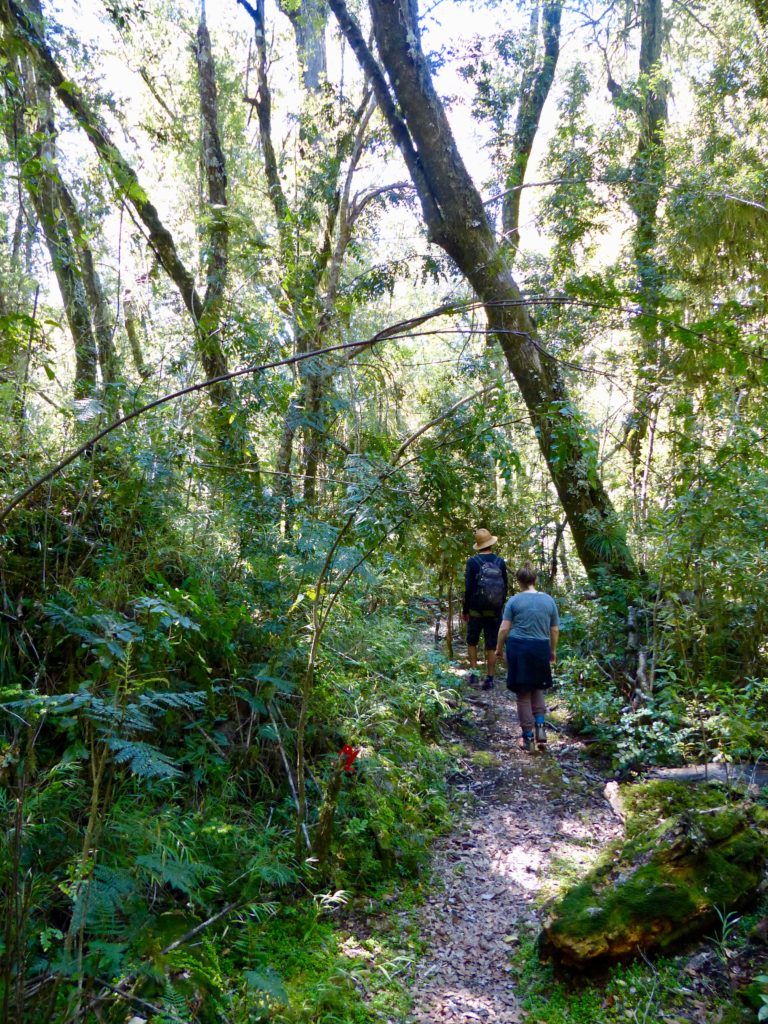
The area around our hotel featured many trails that were clearly marked by this yellow bird.

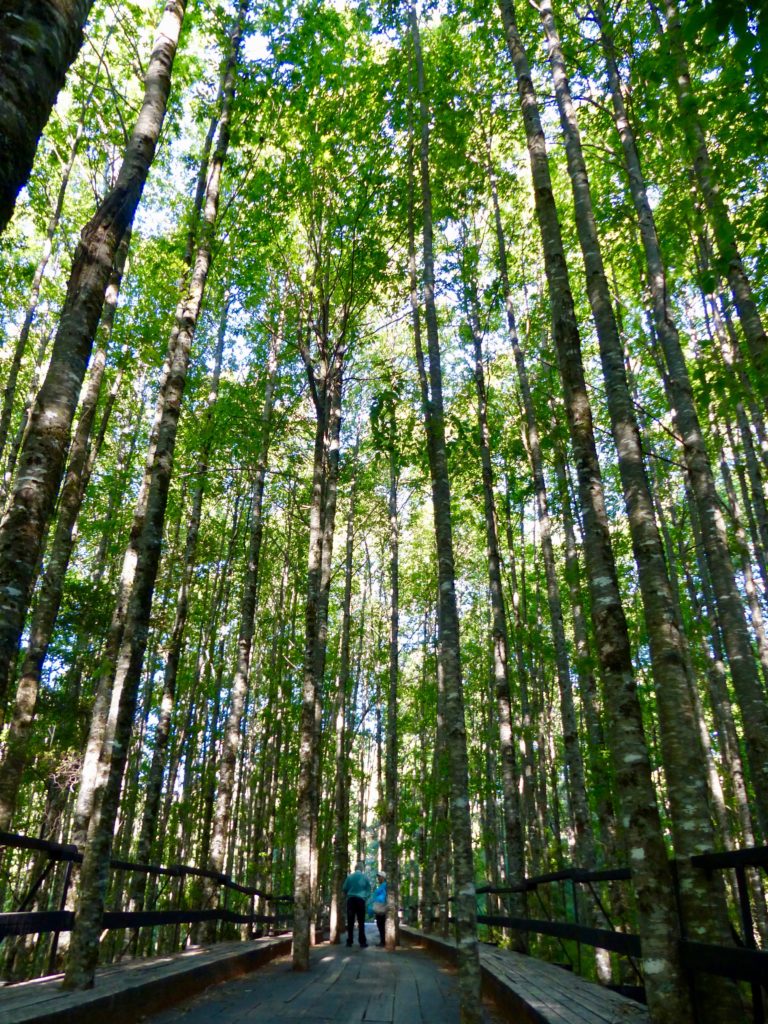
I loved how this boardwalk was built around the trees.

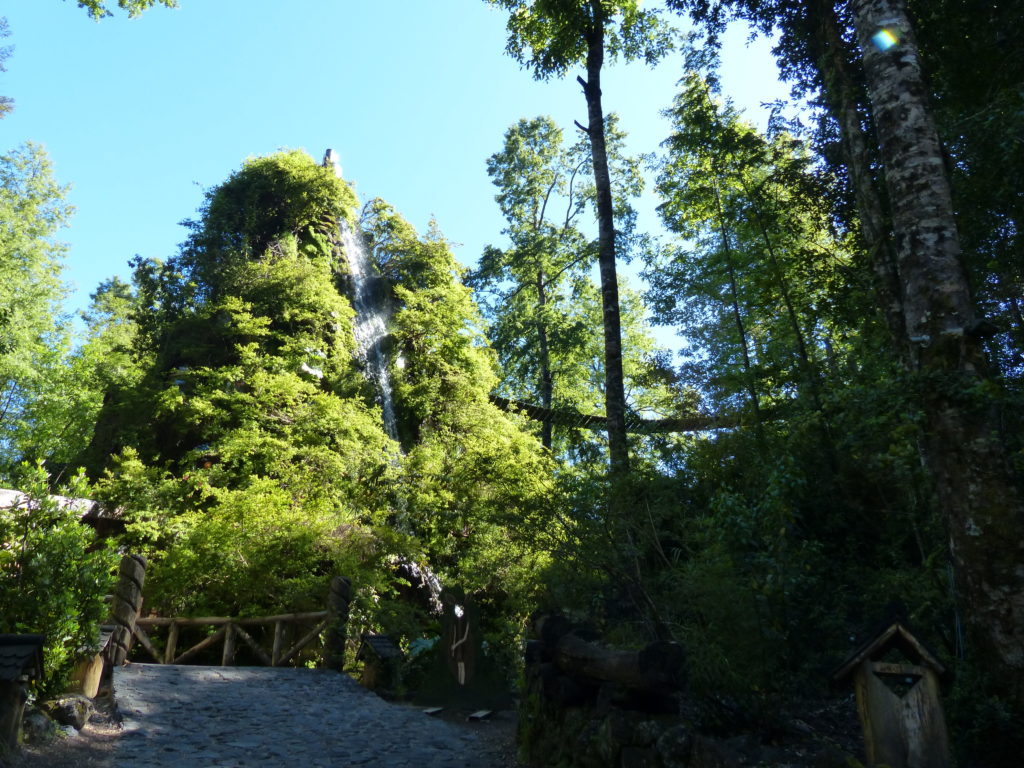
Another hotel on the property is called Montaña Magica (Magic Mountain), a cone-shaped structure seemingly overgrown by the forest itself with a waterfall tumbling down between the windows.

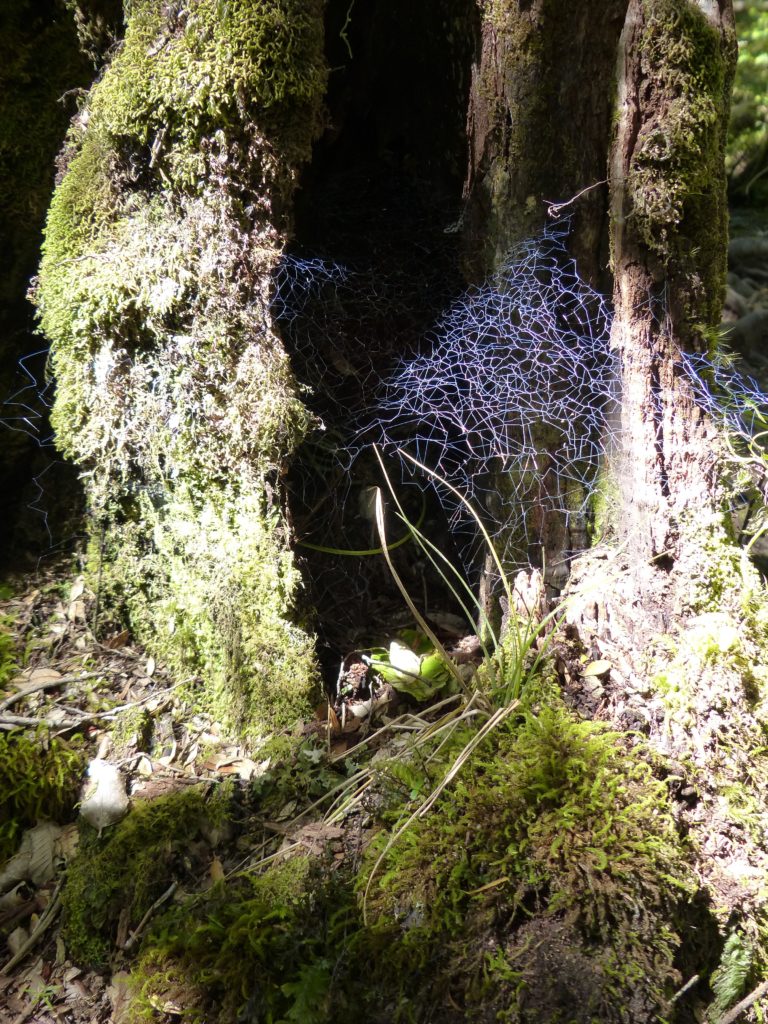
These wacko webs looked like the spiders had been partying too hard the night before.

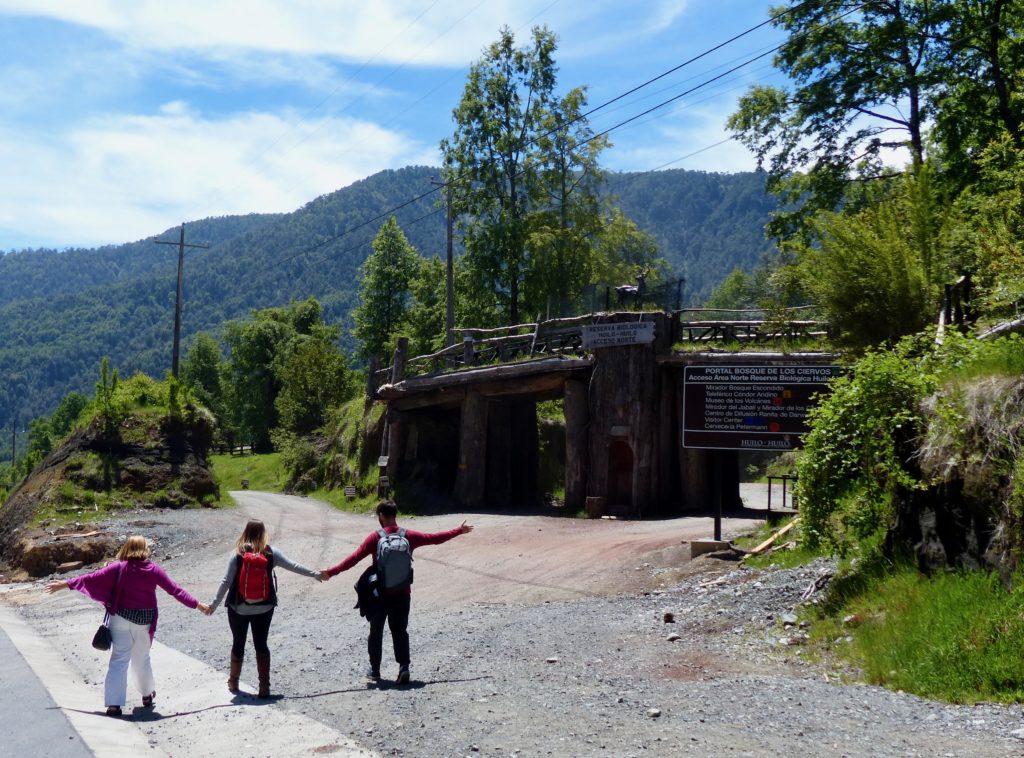
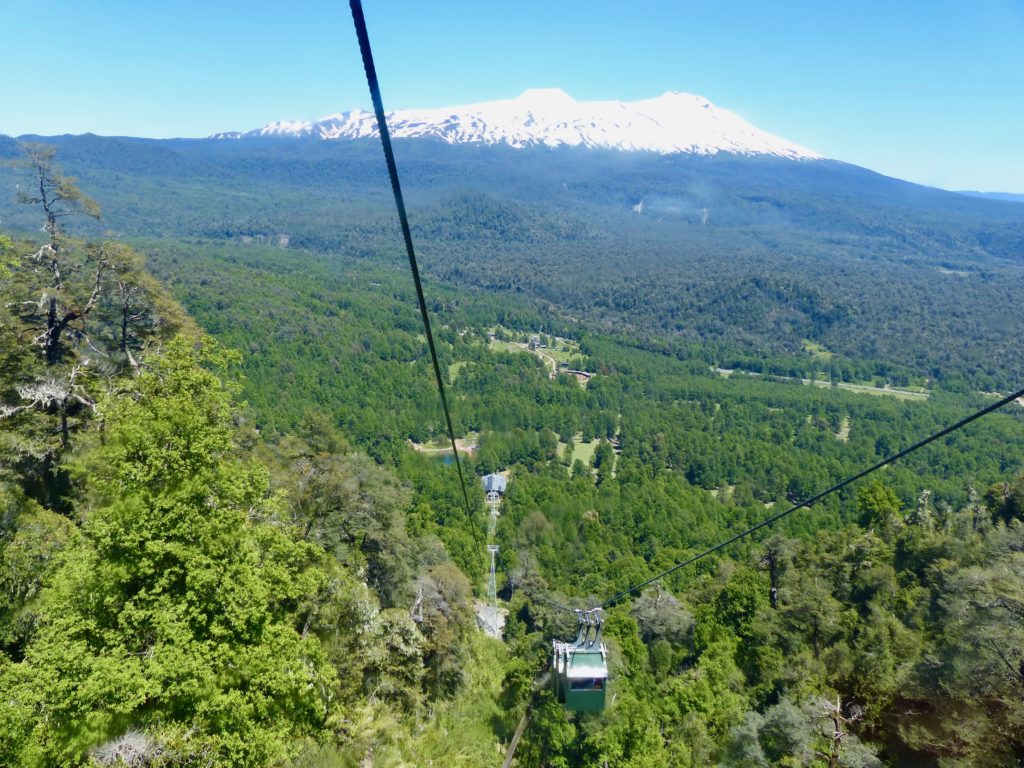
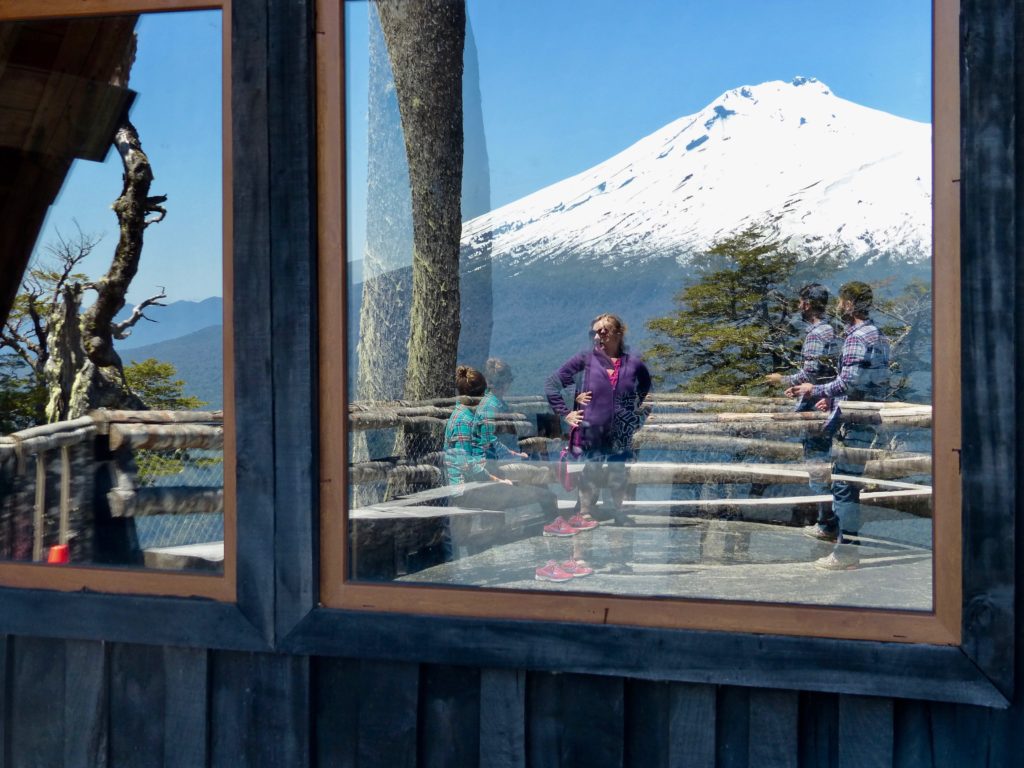
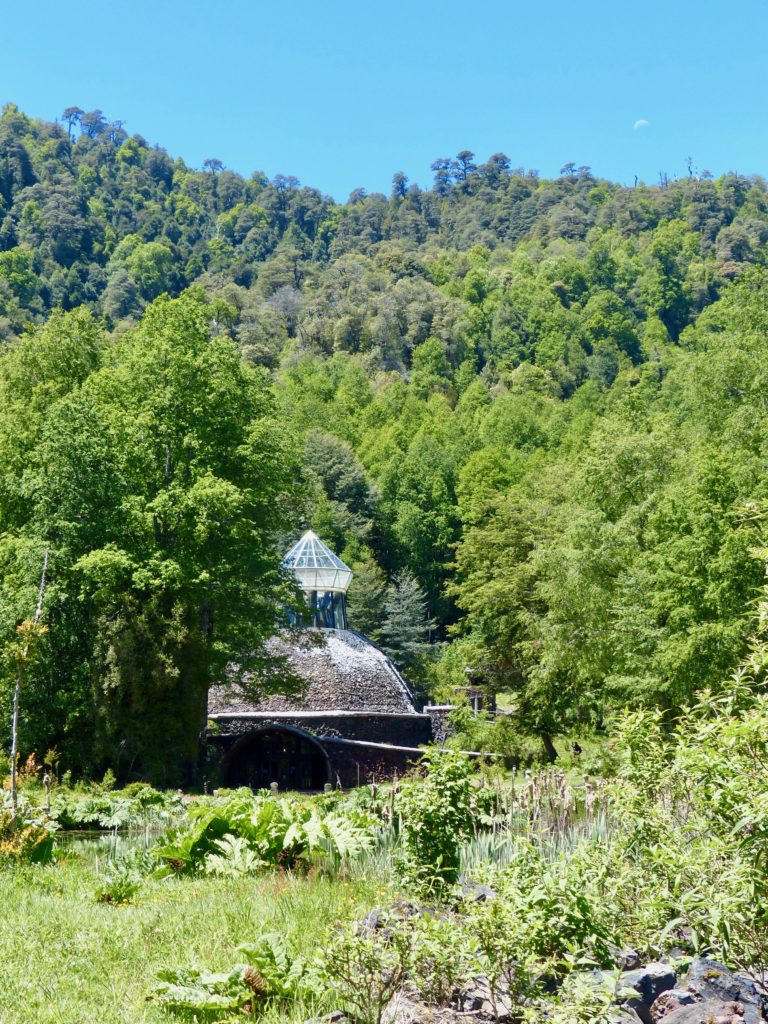
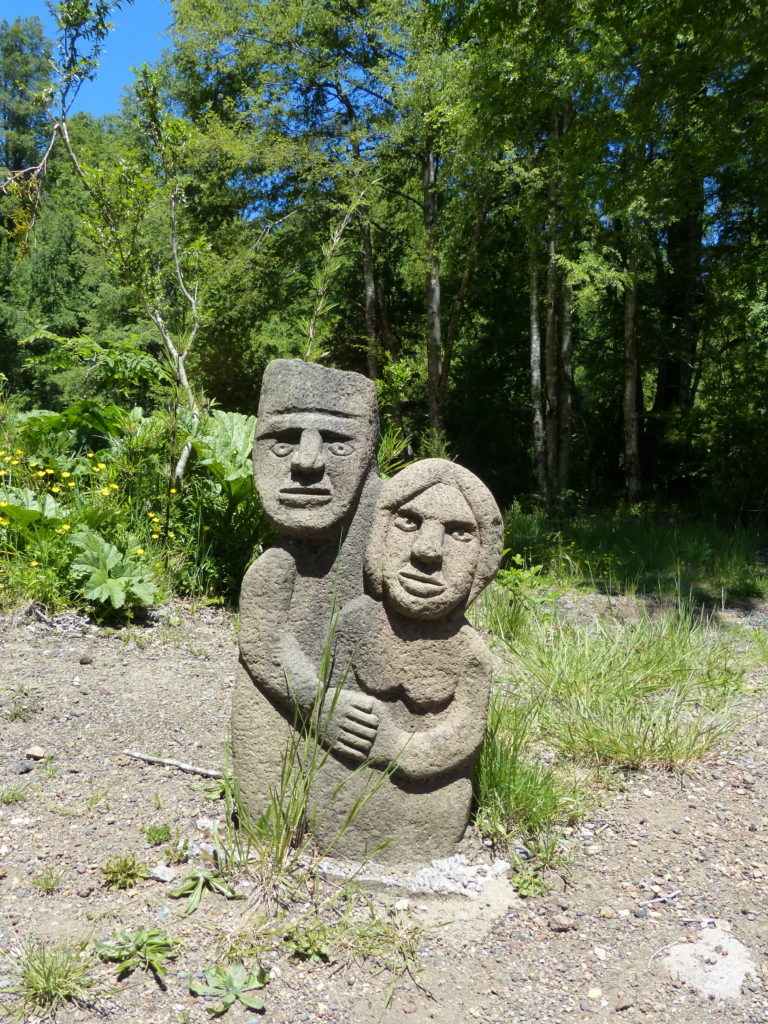
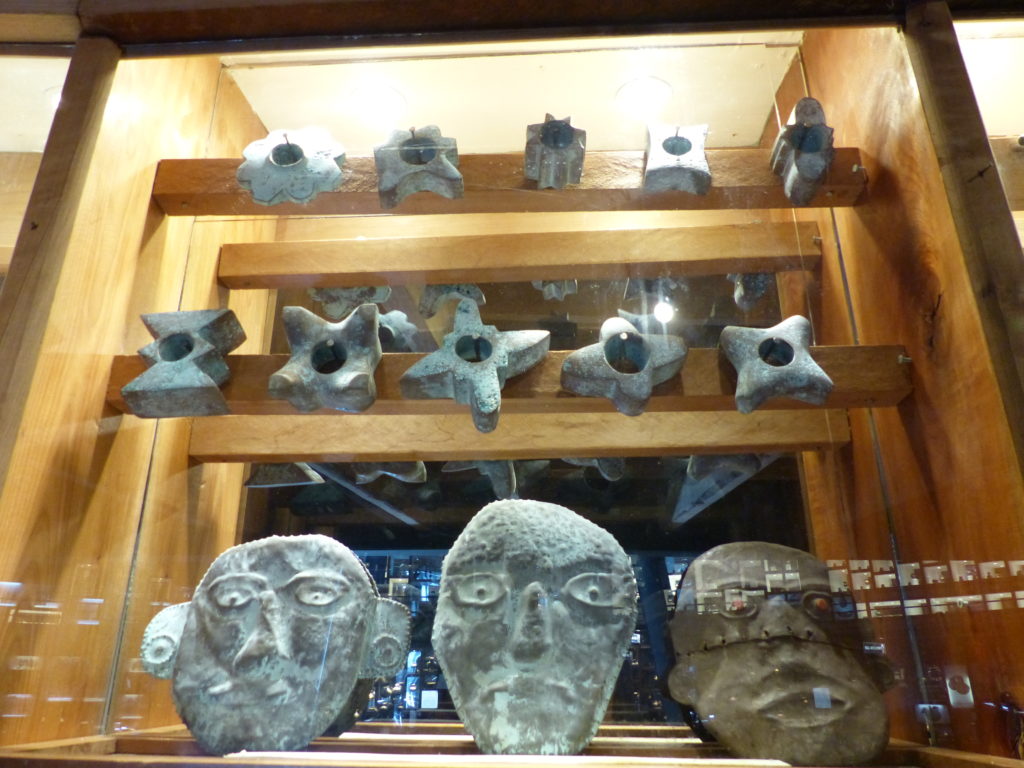
Later, the Cóndor Andino Cableway took us up the mountain to 3,829 feet above sea level for a spectacular view of the glacier-covered Mocho Choshuenco volcano. Back at the bottom, we visited the Museo de los Volcanes, an architecturally stunning museum housing a collection of indigenous items from the area.

The cableway station.

The museum had wonderful displays with English signage. I could have spent way more time there.

We also took a guided tour to a dormant volcano called Piedras Magneticas, named for the rocks that supposedly contain so much iron they confused the compasses of early explorers. Our guide, Rogelio, had a great eye and spotted the Darwin’s frog among the foliage. The most fascinating thing about this little frog is that the father scoops up the eggs and protects them in his vocal sac – that bubble you see under a frog’s chin – until the tadpoles develop. When the froglets are ready to survive on their own, daddy just spits them out. Crazy!

Darwin’s frog … so well camouflaged.

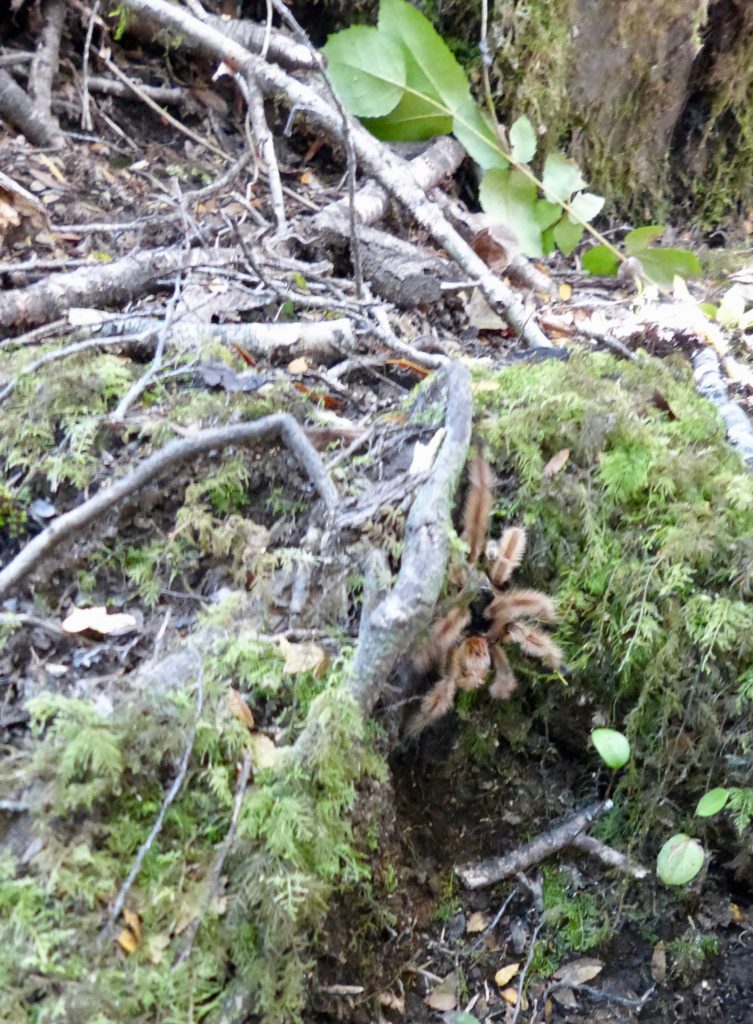
Rogelio also told us the names of many fascinating plants and birds, but of course I can’t remember anything, dang it! One highlight (nerd alert) was the Chilean hazelnut tree. I have been eating these yummy avellanas on my salads, but I had no idea what they were. It was cool to see the tree and to understand better where those nuts come from. We also saw a huge, beautiful tarantula, which Rogelio said was harmless. I wanted to pick it up, but he said we were scaring it.

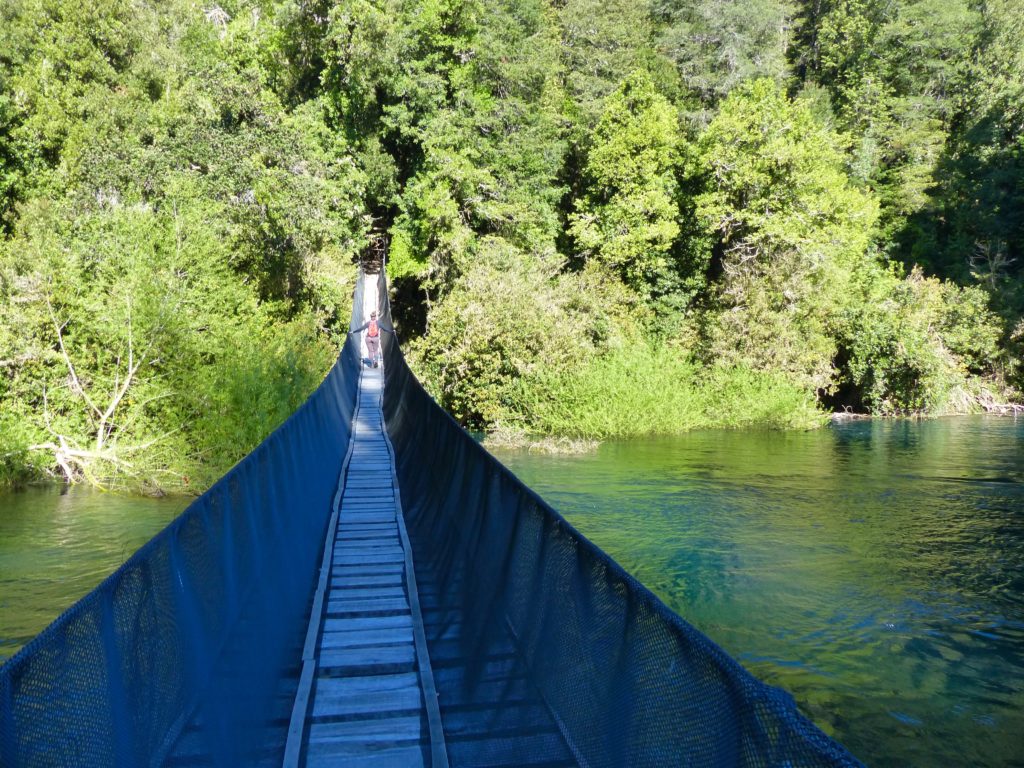
We crossed this bridge to get to the island for our hike.

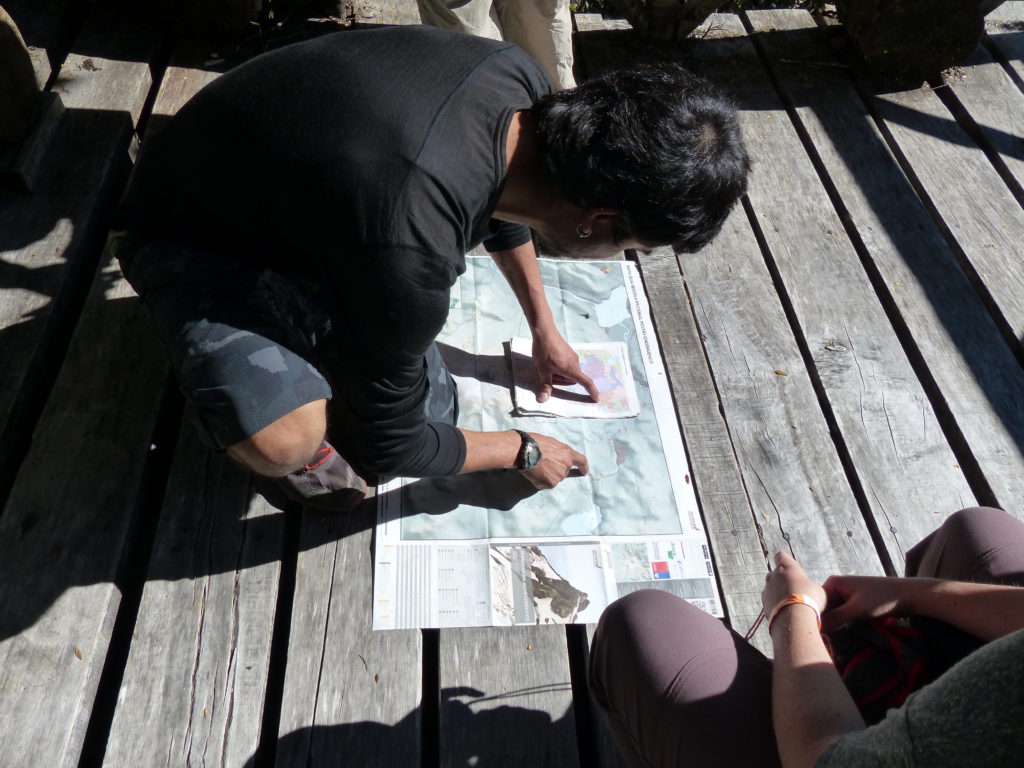
We climbed to the top of the volcanic island, and Rogelio showed us the route on a map.

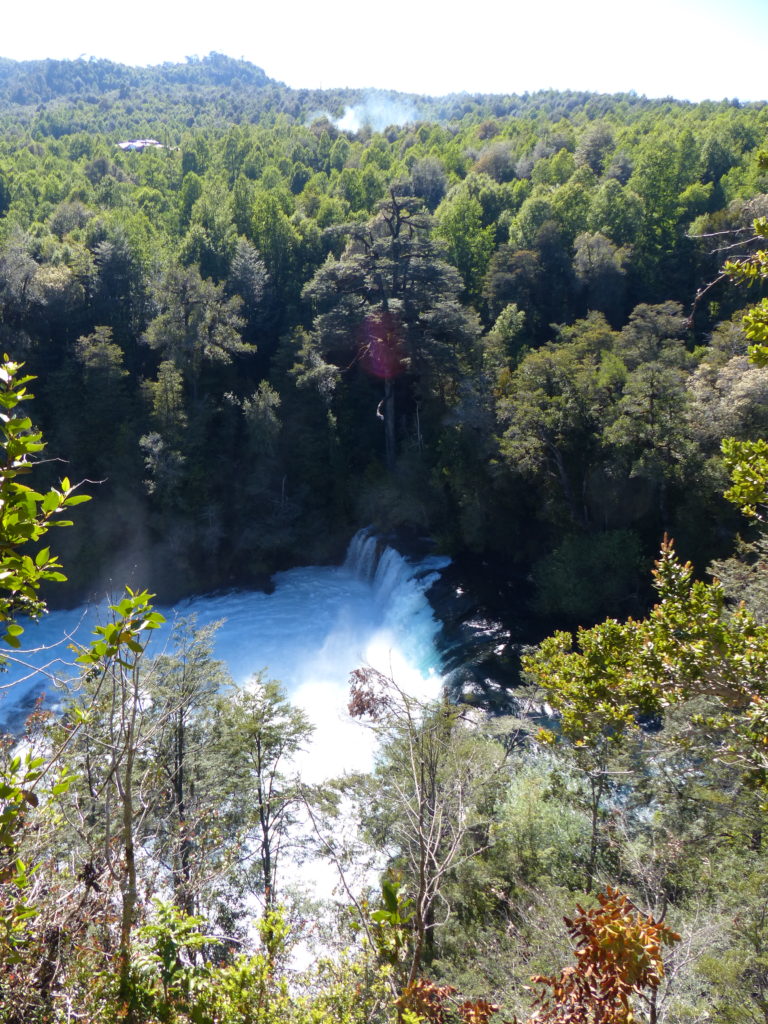
The view from the top.

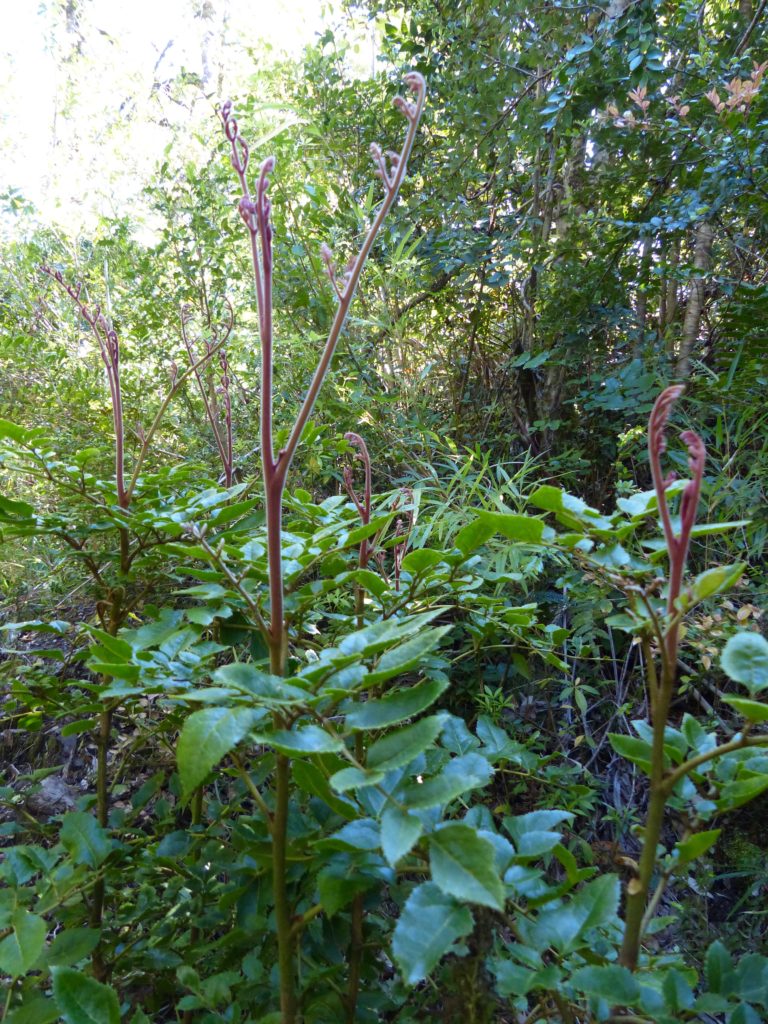
A baby hazlenut tree.

The friendly tarantula.

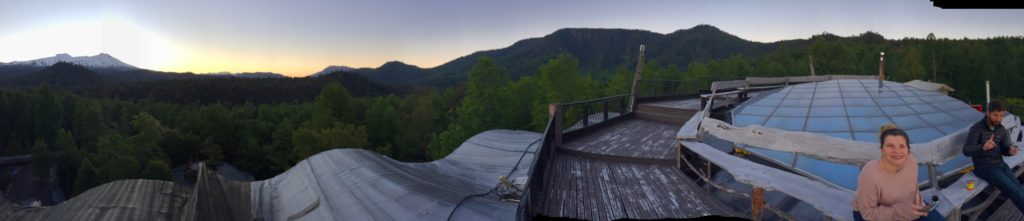
One night, we had a little dance party on the hotel roof at sunset.
Friends + nature + wine = happy intoxication.

Sam made this fun video:

Day trip: La Recova Winery

One of my favorite events of the year in Santiago is MOVInight. Not MOVIE night. MOVI without an E. It stands for Movimiento de Viñateros Independientes, or the Movement of Independent Vintners, in English. Small Chilean wineries showcase their wares in a festive setting with music, food trucks, and a hip lively crowd. I wrote about last year’s event here. This year’s MOVInight took place on Nov. 10 in a different but equally fabulous venue. Unfortunately, I didn’t snap any photos worthy of posting. I did, however, sample a delicious rosé from a boutique winery called La Recova, and I knew I would have to pay that place a visit.

A month later, on Dec. 2, I hired a driver and piled into a van with four girlfriends – Nancy, Clare, Hillary, and Lisa – for the 2-hour drive to Casablanca Valley, one of Chile’s premier wine regions. Several mass-producing wineries line the highway – called Ruta del Vino, but La Recova hides off the main path, outside the village of Las Dichas (which translates to “good fortunes”). The small-scale winery produces its wines from a single variety, Sauvignon Blanc.

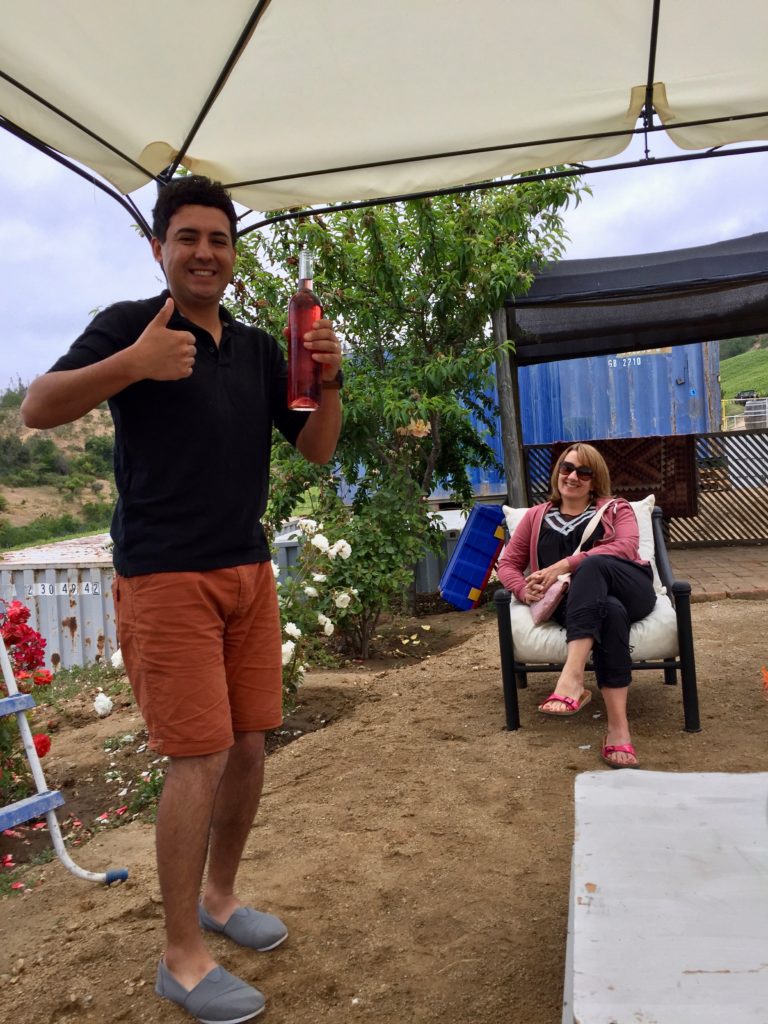
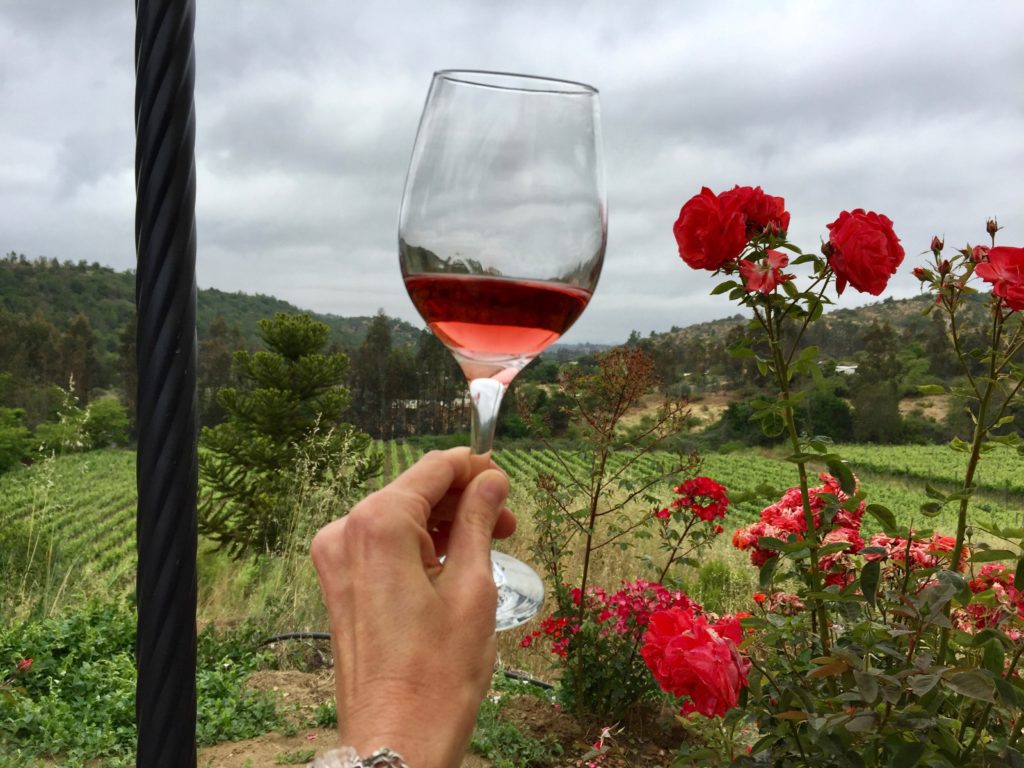
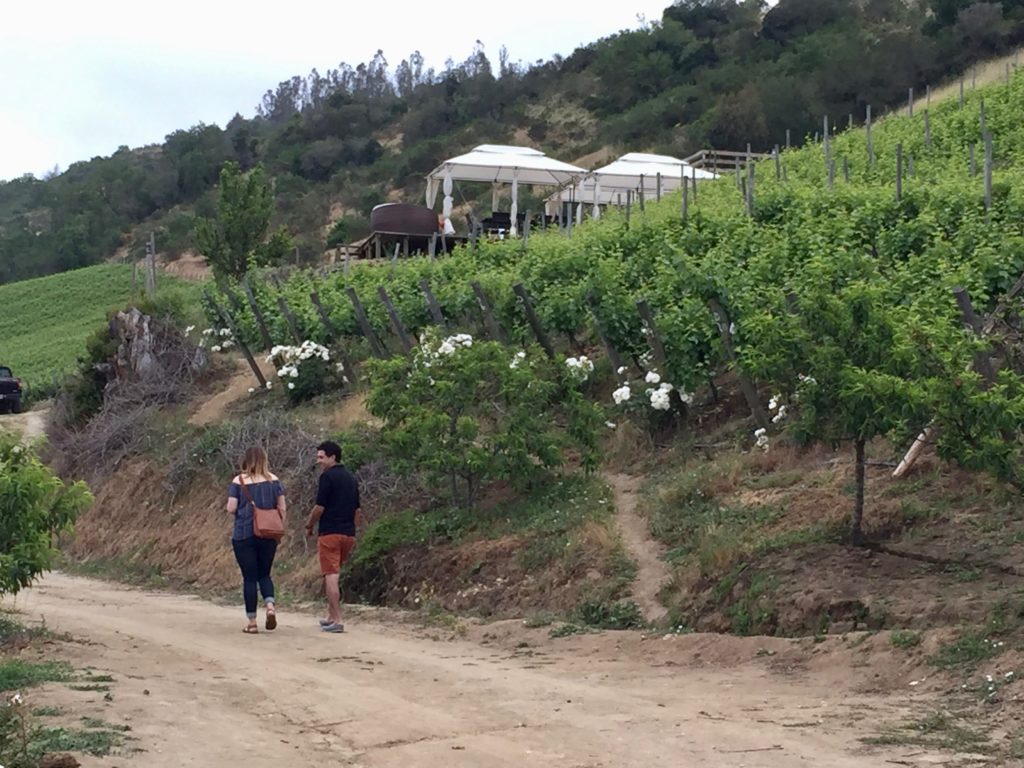
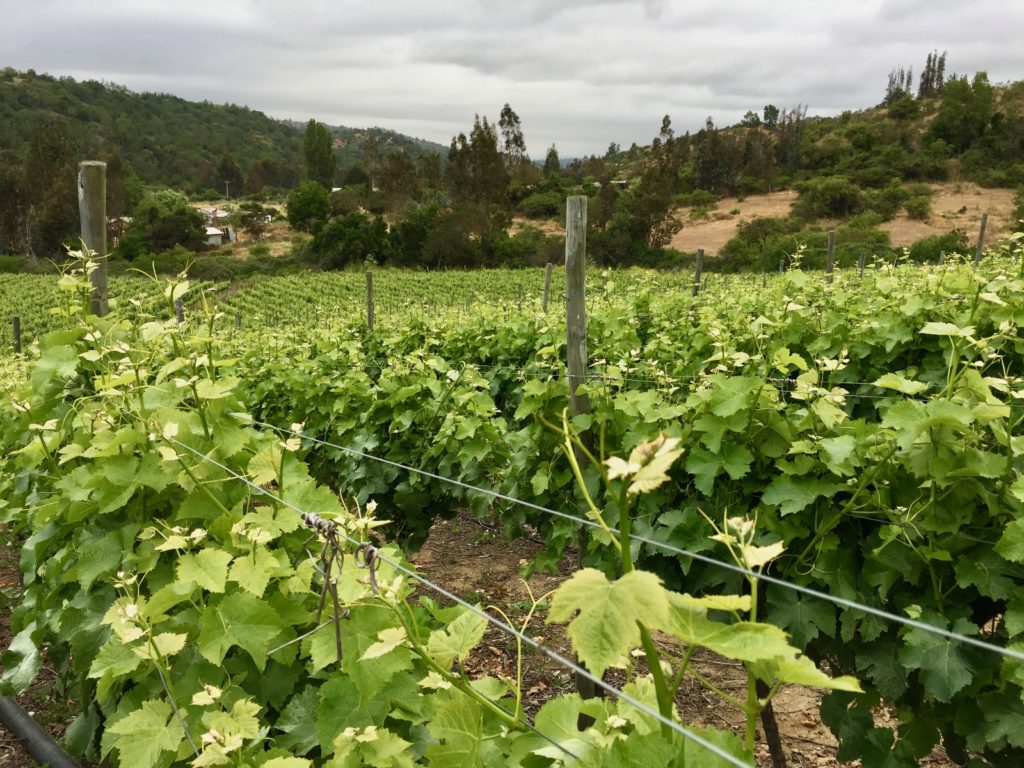
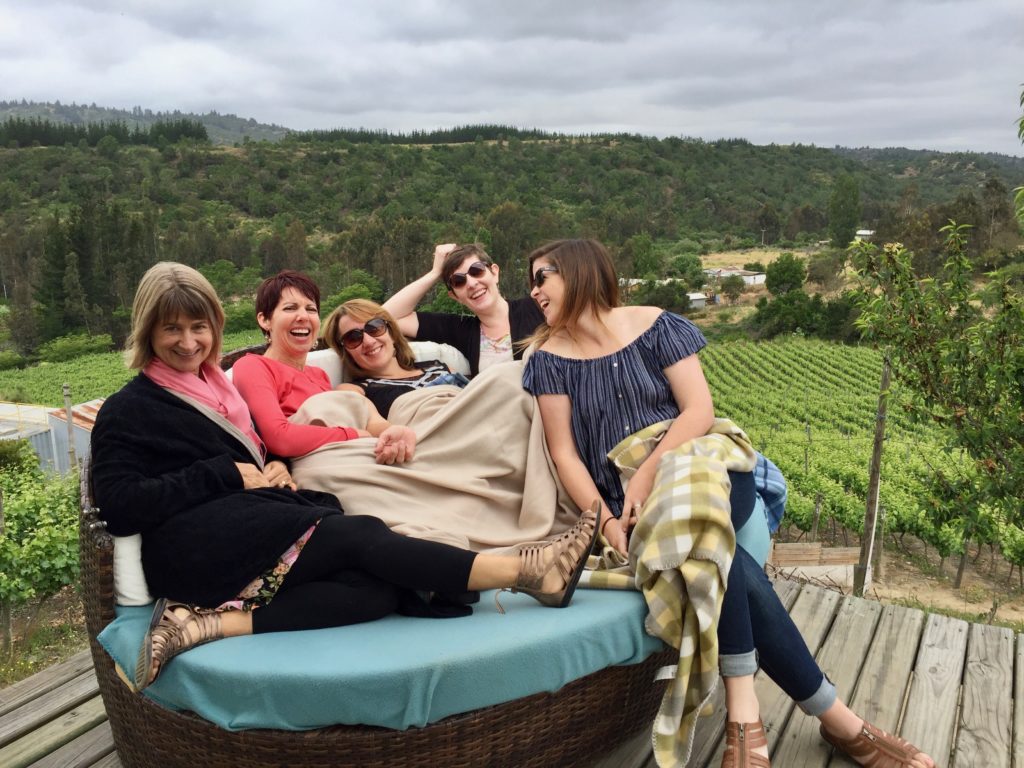
We were woefully underdressed for the chilly temperatures (except for Clare, who kept pulling layers of clothing out of her bag like Mary Poppins). Nevertheless, we kicked off our tour outside with a glass of rosé, made from La Recova’s Sauvignon Blanc grapes mixed with Syrah skins. Overlooking hectares of vines that crawled down the hillside and back up surrounding slopes, we learned about the vineyard and its unique wine from a friendly and patient guide named George.

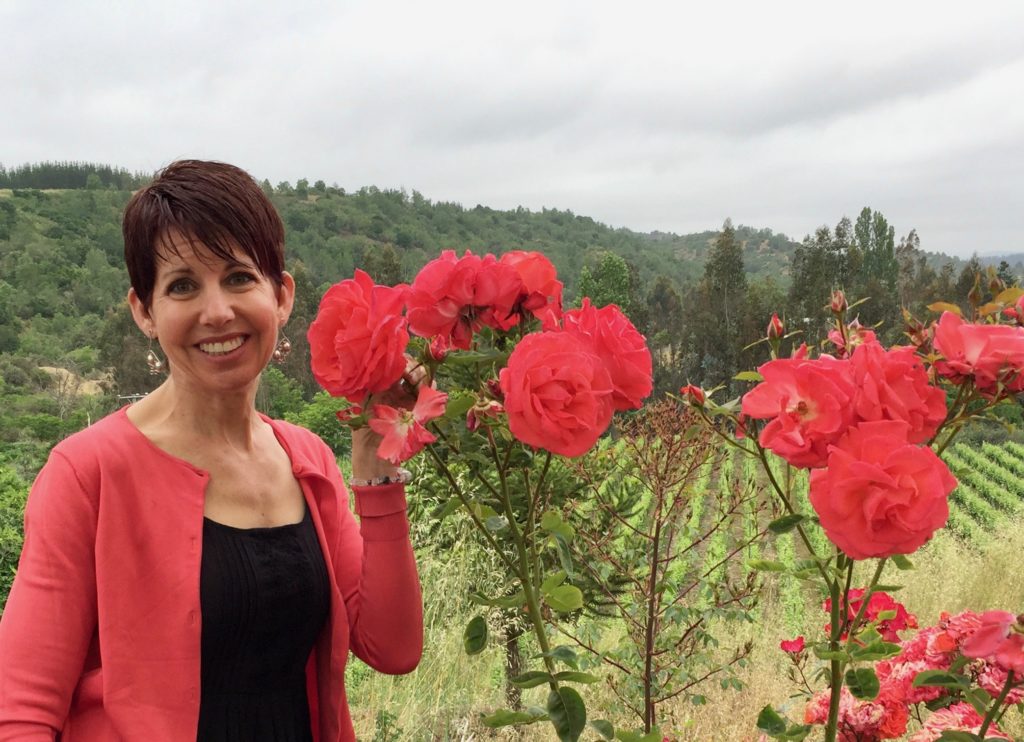
Fat fragrant roses framed the scene, perfectly matched to the wine (and my cardigan).

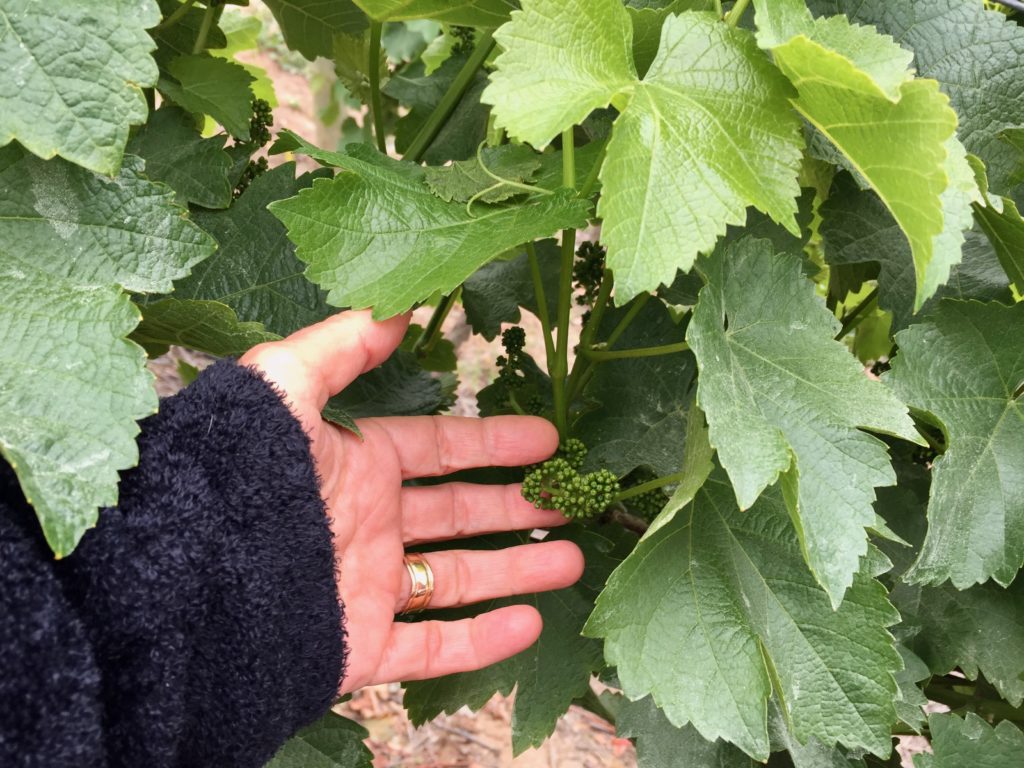
George led us into the rows of grape vines, where he showed us some Sauvignon Blanc baby grapes.

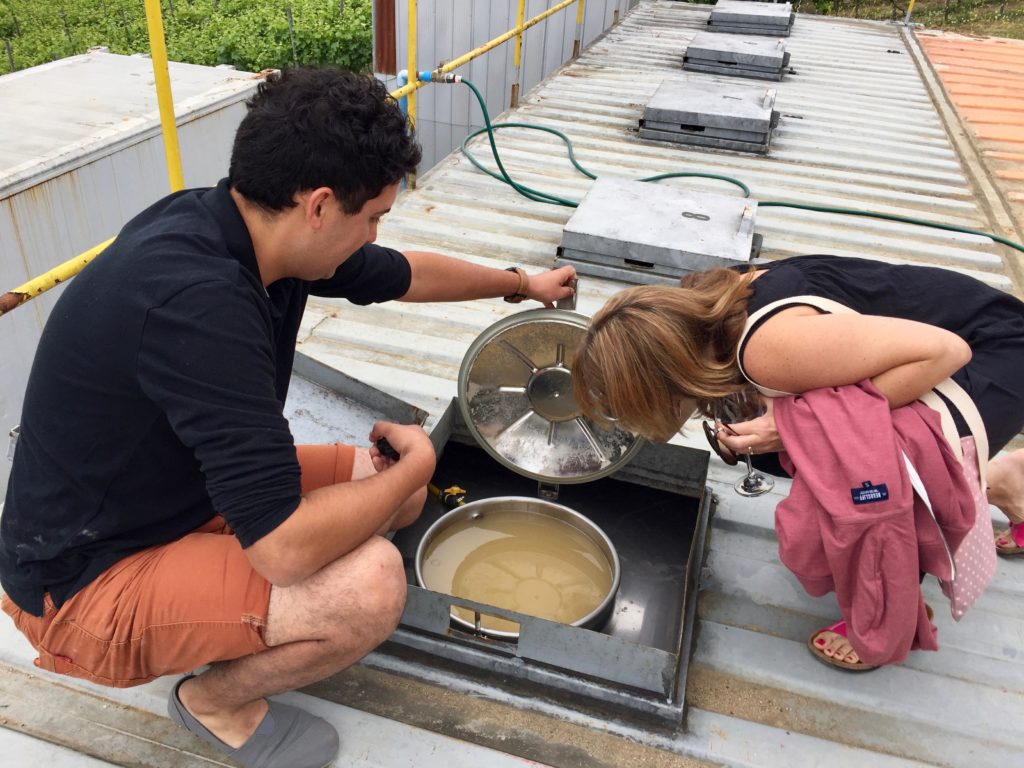
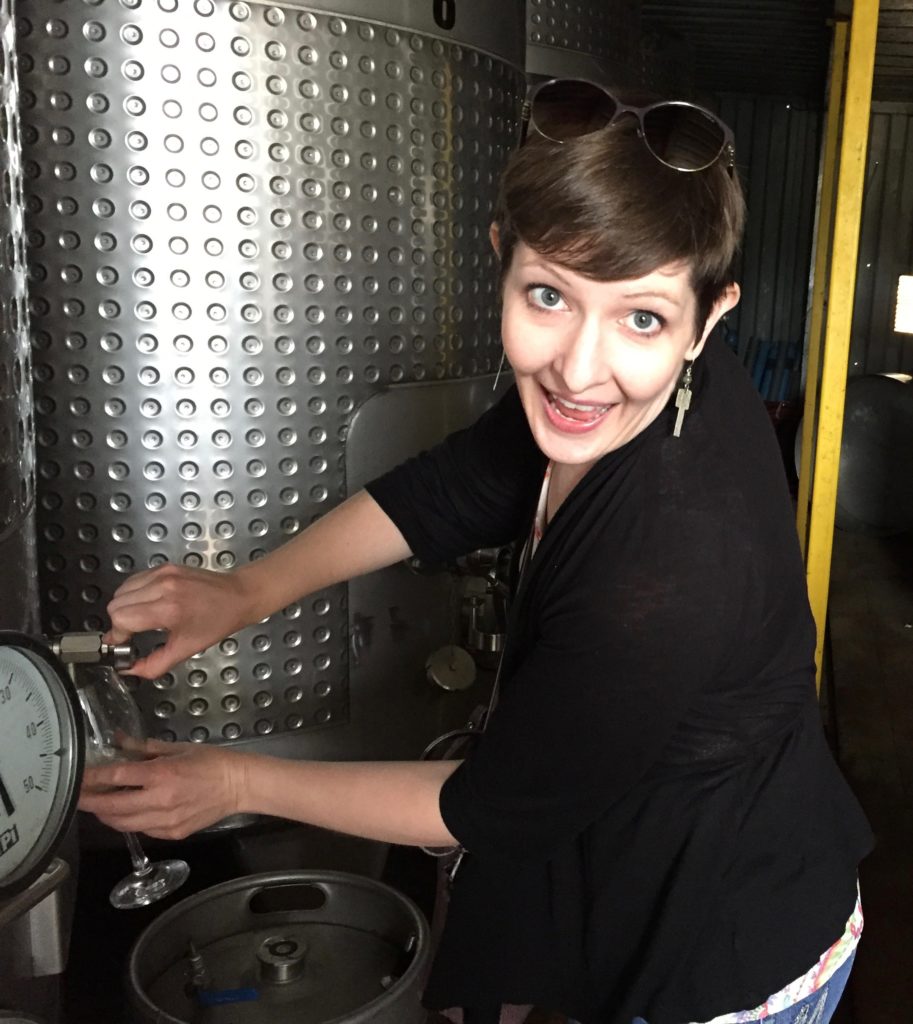
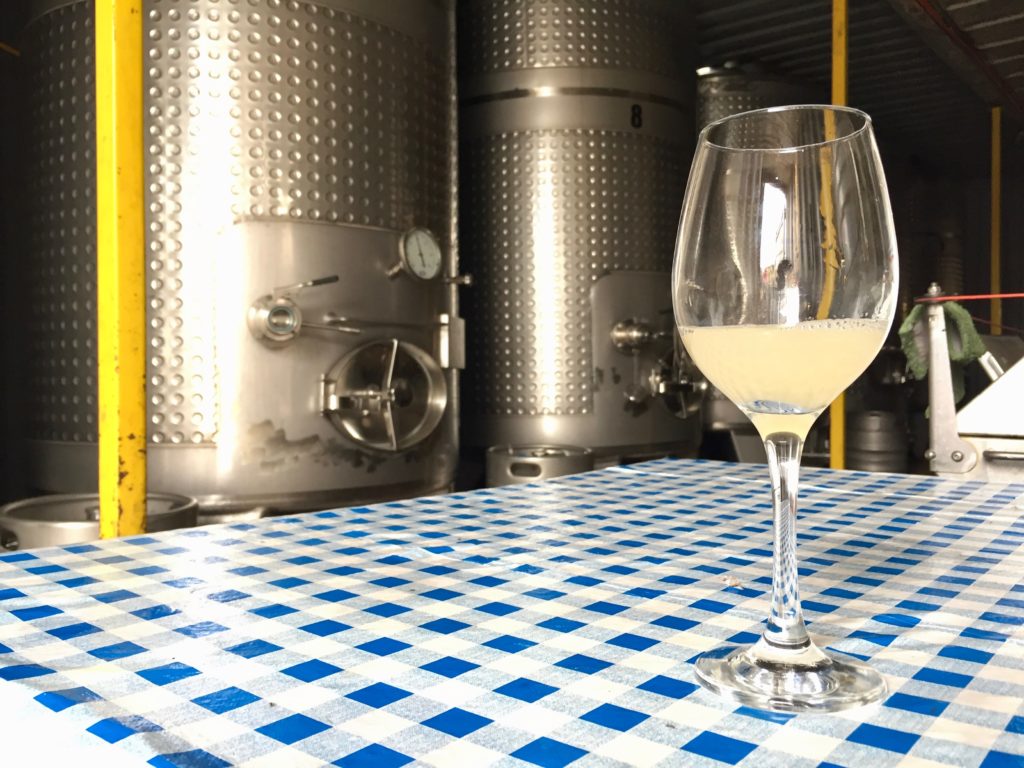
From there, we walked to the roof of a small building, where grapes are fed into tanks below. George lifted a cover so we could see the cloudy soup that would eventually become wine. On ground level, he let us each tap the tank to try a sample.

By then, we were all a bit tipsy and getting peckish. Fortunately, it was time for lunch! We climbed the steps to a hilltop terrace, where we were greeted by Chef Ivan Parra and his assistant, Fernanda. We sat at a table with more cutlery than I knew how to use, and George rustled up some blankets for us. I wish I had done a better job of recording what we ate and drank.

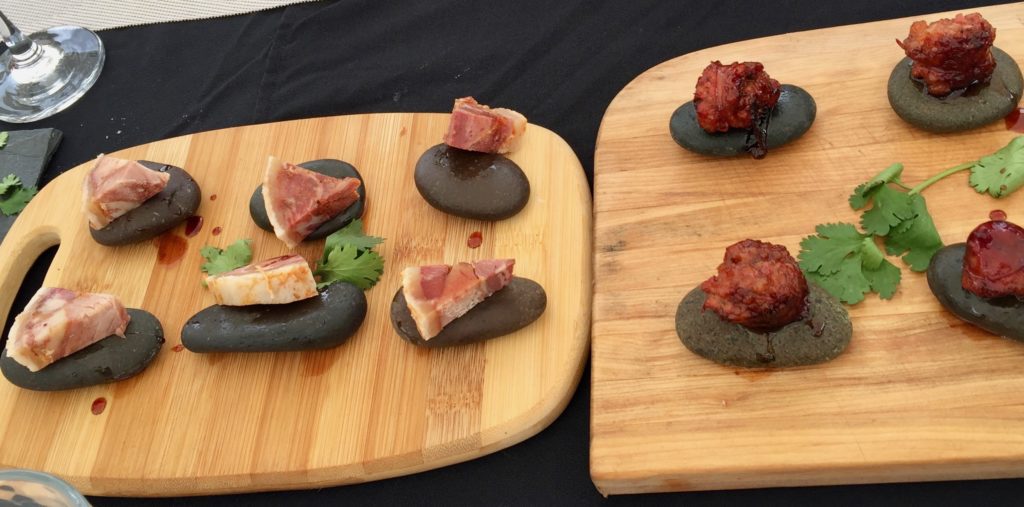
We started with bread and pebre, a typical Chilean salsa. Chef Ivan also brought out a pebre made with a popular kind of seaweed. I think we drank Sauvignon Blanc with that course. Next, we had this … I have no idea what they were, other than tasty chunks of meat. It’s possible we drank one of the two varieties of rosé at that time.

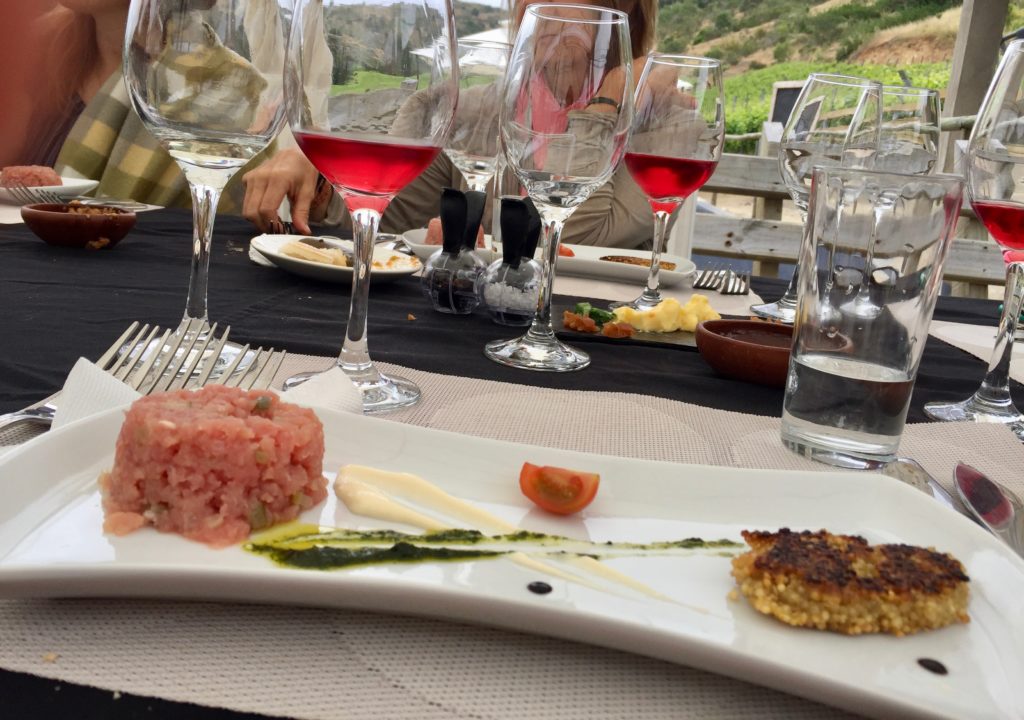
The next course was … hmmm, I think it was a twist on ceviche with a quinoa cake, plus a different rosé, if memory serves.

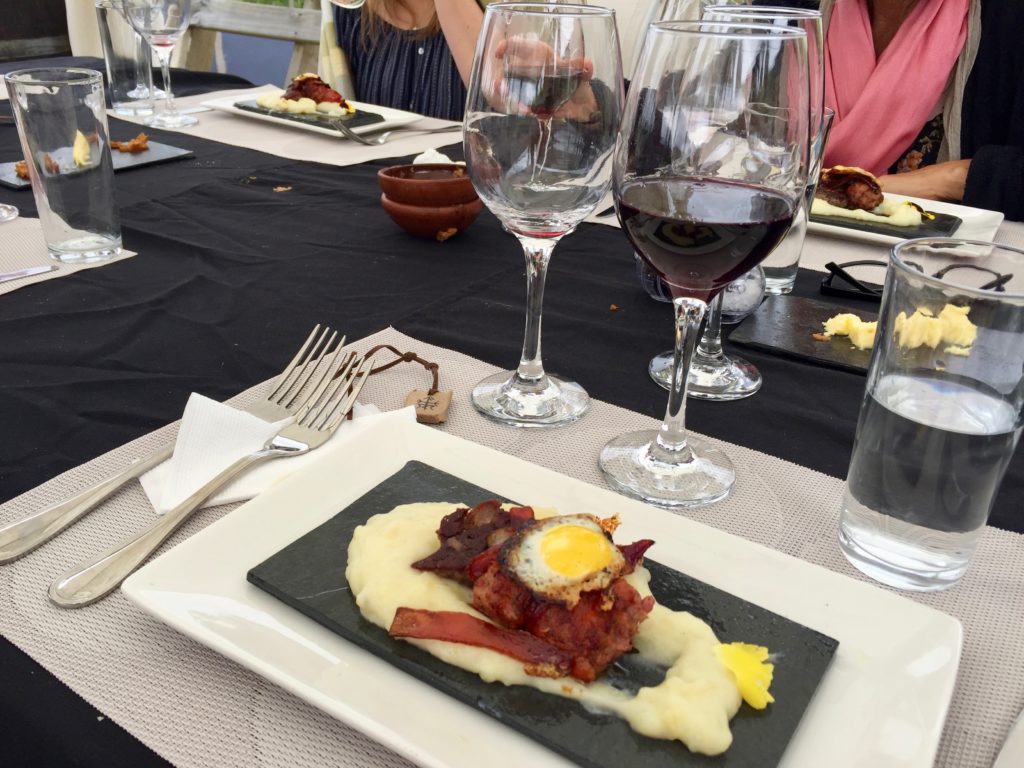
A gourmet version of the Chilean chorillana came next, paired with the winery’s Merlot-Cabernet Sauvignon blend.

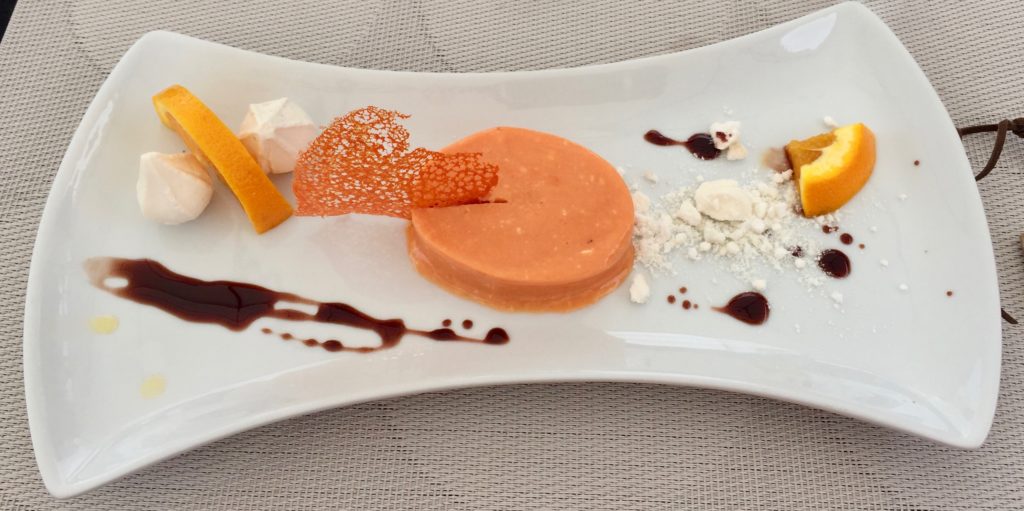
Finally, a lovely maracuya sherbet satisfied our sweet tooth … with more wine, of course.

La Recova was the perfect place to recharge our batteries. I look forward to another visit, and I’ll dress appropriately next time!

Dieciocho 2017 – Day 5 – Termas de Puritama

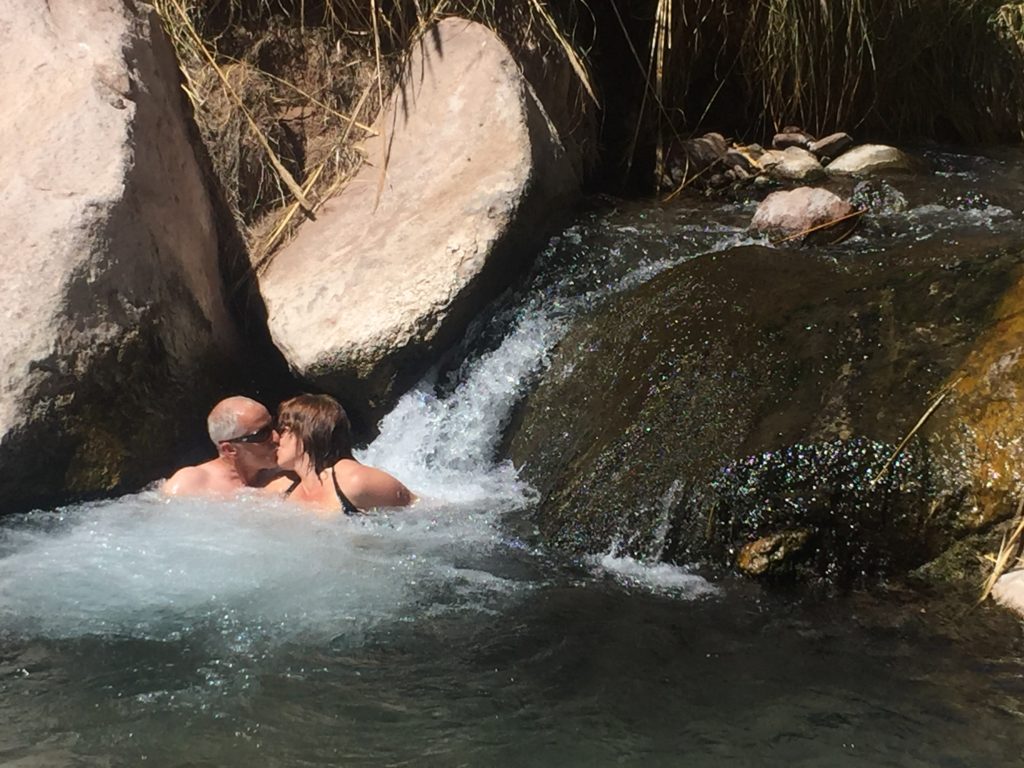
For our last full day in San Pedro, I think we chose the absolutely most fantastic thing to do: soak in some natural hot springs.

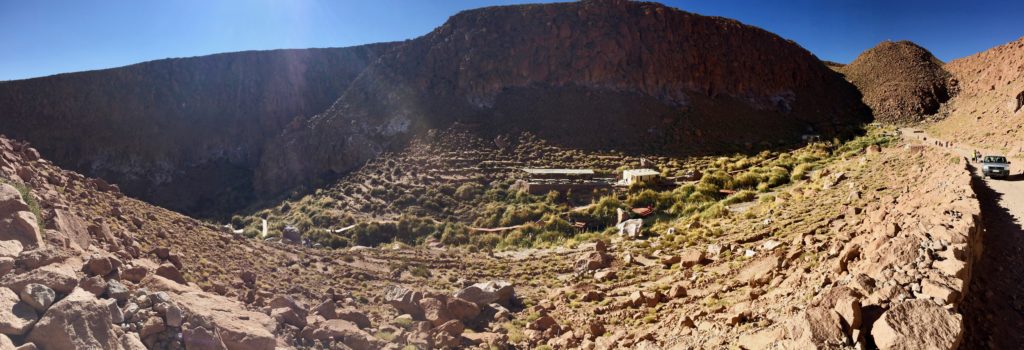
Our driver, Oscar, picked us up at 2 p.m. for the 34-kilometer bone-rattling drive to Termas de Puritama. Once we arrived and paid the entrance fee, he tried to explain some of the bathing protocols, but most of it was lost in translation. Oscar waited with the van at the top of the ravine, and we walked down the steep path to the springs.

The name Puritama means “hot water” in the indigenous Kunza language. The water’s temperature ranges from 25°-33°C or 77-91°F, cooling off as it flows downhill.

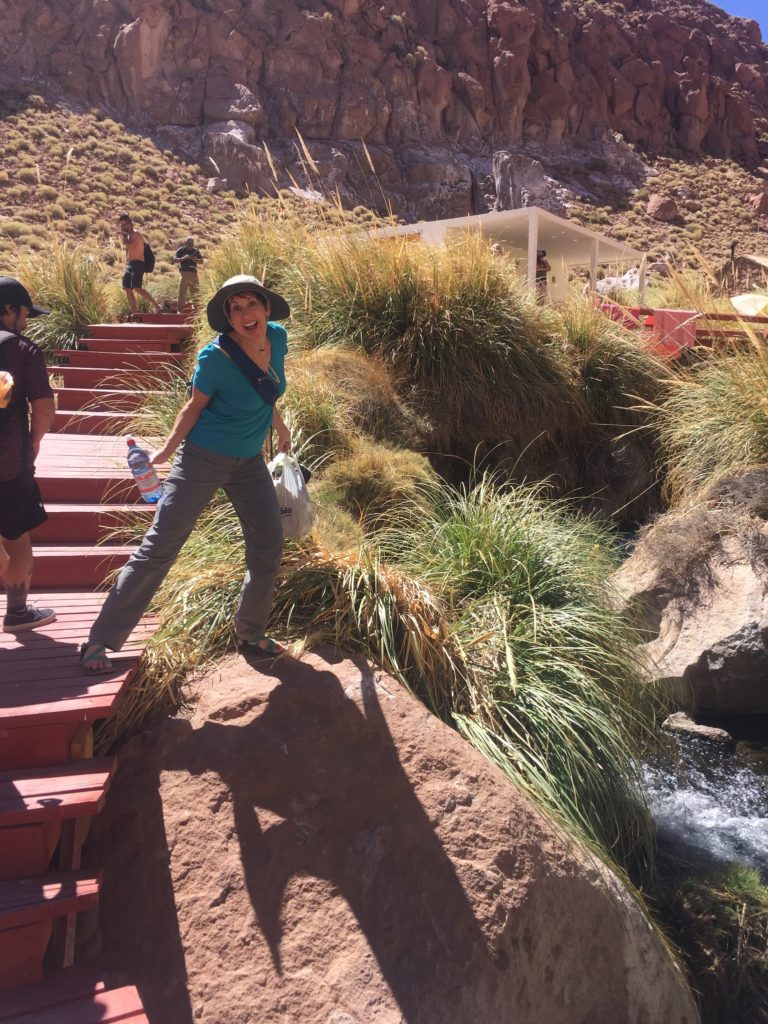
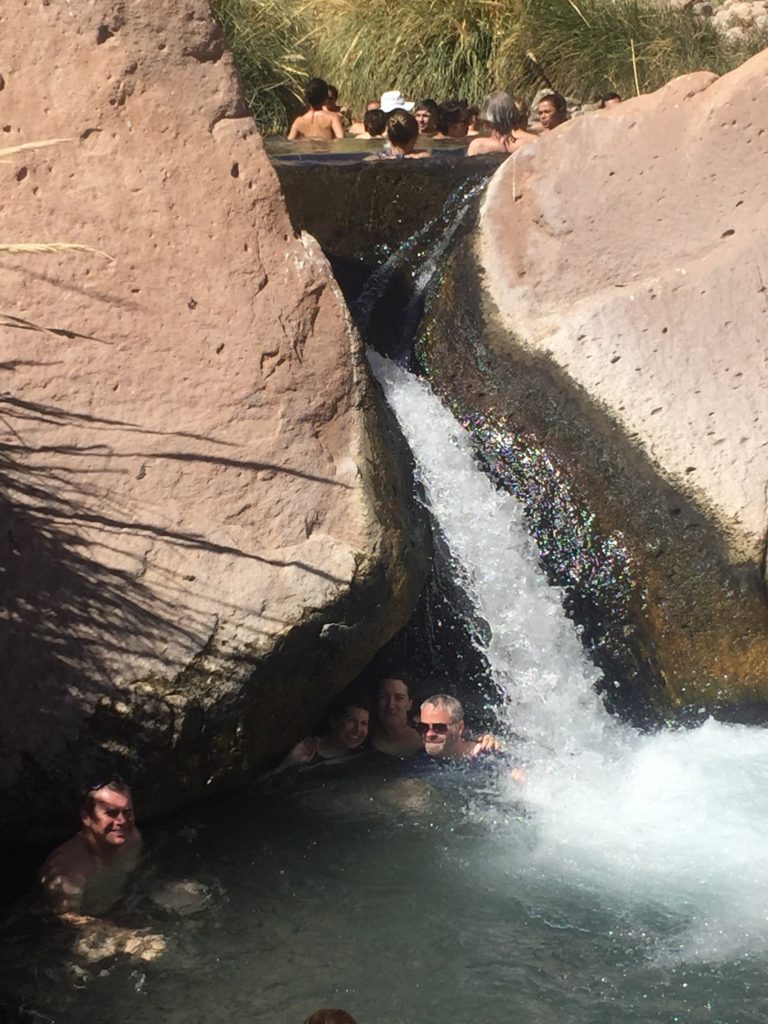
The water spilled from pool to pool, creating entertaining waterfalls and occasionally strong currents. Raised boardwalks connected the eight pools and branched off to restrooms, changing rooms, and a covered picnic space. I later learned the site is maintained by the Explora company.

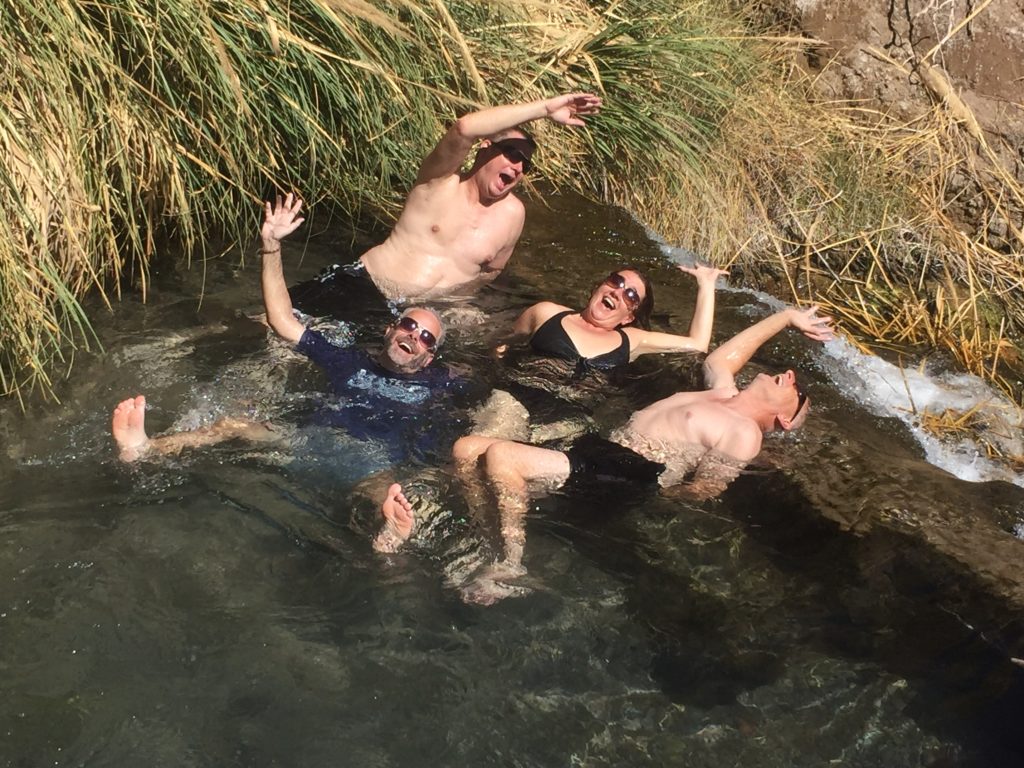
This place was a gajillion times better than I could have anticipated. Although quite busy, the pools never felt uncomfortably crowded, and everyone seemed thrilled to be there. Big smiles all around. The positive energy was infectious.

View from the top.

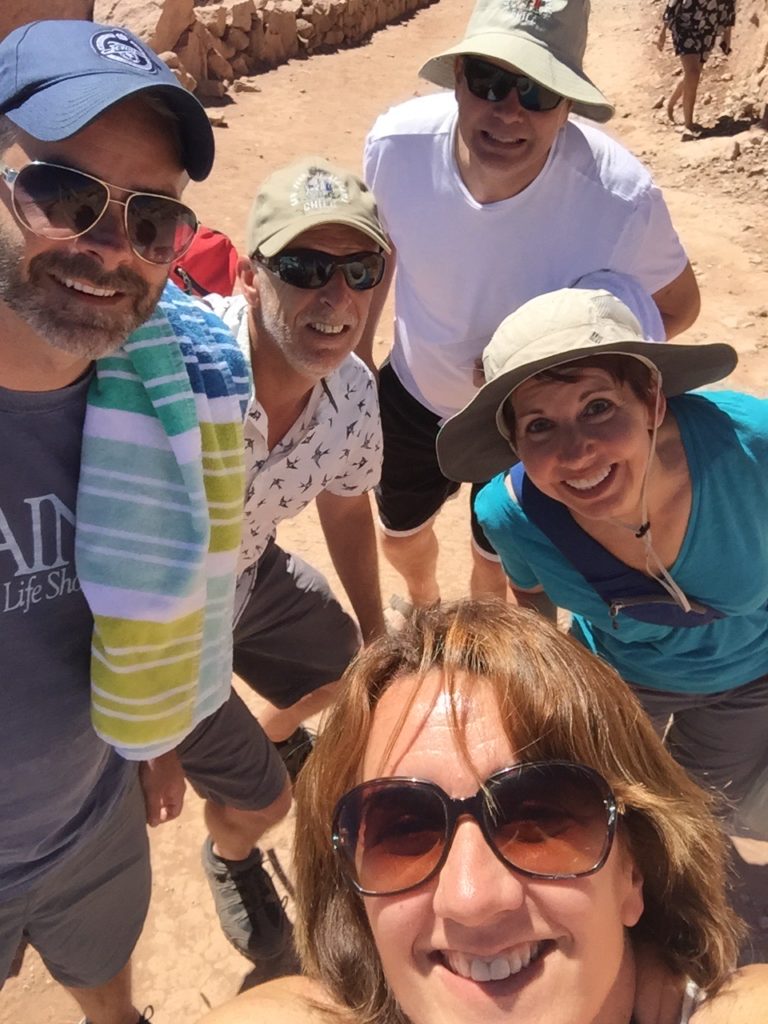
Tony and I reached the parking lot first at the end of our visit. I tried to chat in Spanish with Oscar, the driver. Turns out he was a big fan of Ray Charles, the Beatles, Elvis, the Four Seasons, and other stars of the oldies stations. He played some of his favorites during the ride, and we sang the whole way home.

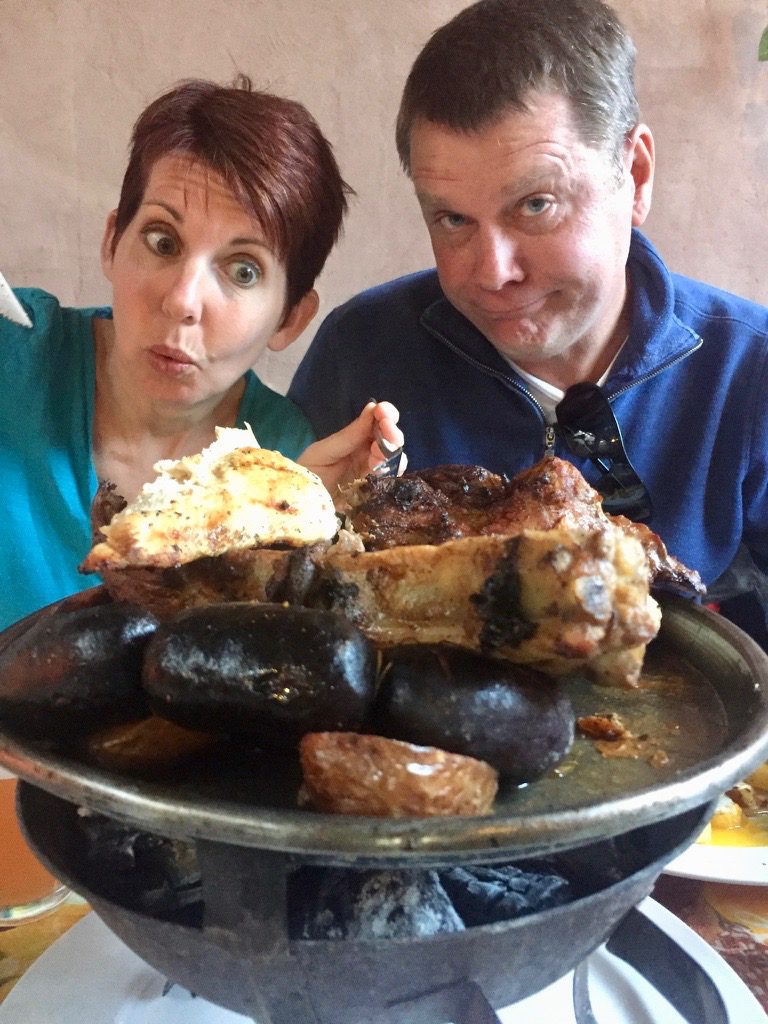
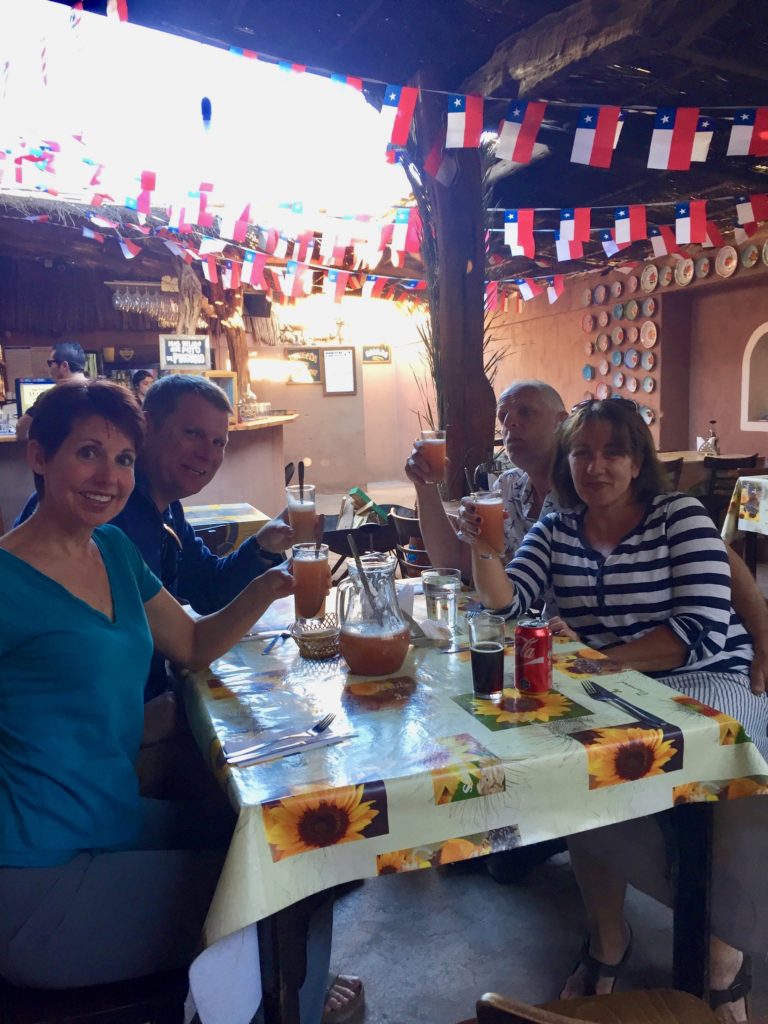
Back in San Pedro, we went out for our last dinner in Atacama. Nancy and Jim ordered this giant pile of meat, and we shared a pitcher of terremotos, a traditional Dieciocho drink made from pipeño wine and pineapple ice cream.